1.05q Trigonometric functions to solve problems in context, including…

Section
1.05 Trigonometry
Level
A level only
Statement
Be able to use trigonometric functions to solve problems in context, including problems involving vectors, kinematics and forces.
Guidance
Problems may include realistic contexts, e.g. movement of tides, sound waves, etc. as well as problems in vector form which involve resolving directions and quantities in mechanics.
Since 2018
11 parts, 22 marks · topic pages: Trigonometric modelling, Trigonometric ratios, graphs, radians and the sine and cosine rules, Solving trigonometric equations, Exponential growth, decay and modelling, Functions, composite and inverse functions, modulus, Addition and double-angle formulae, harmonic form, Kinematics: language and graphs

Back to the checklist

June 2024 · Paper 1 · Q9(a)(i) 1 mark Medium
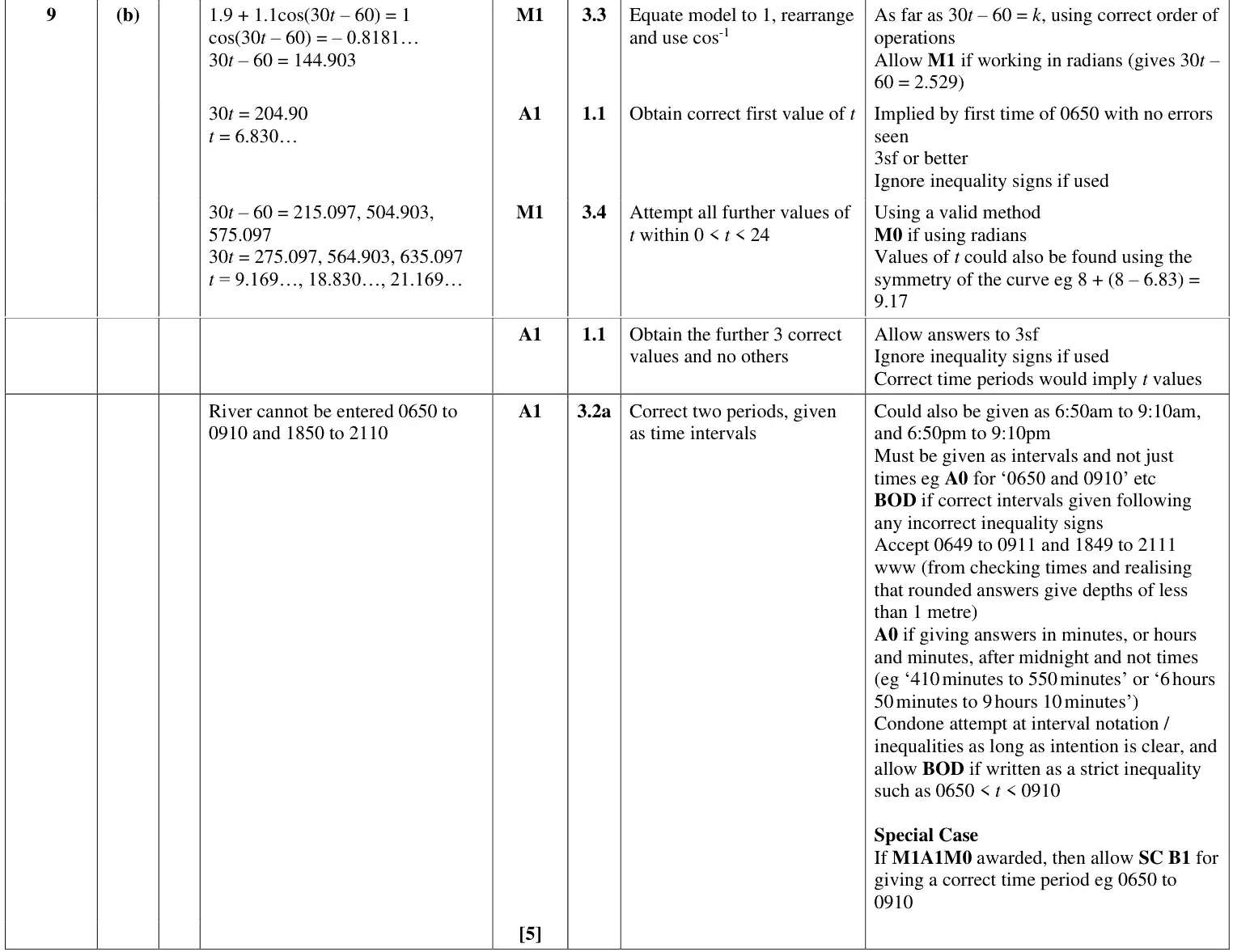
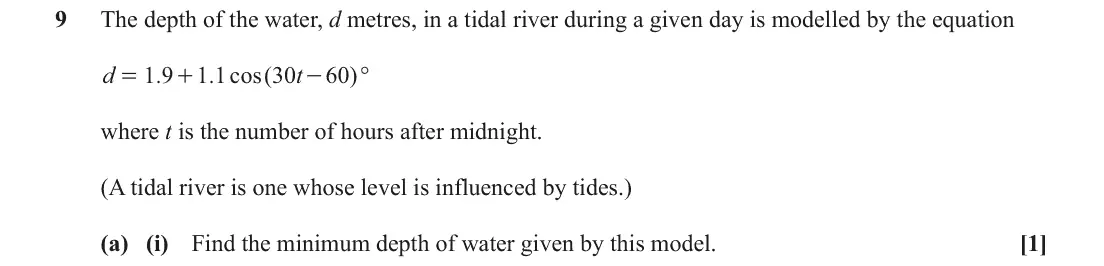
9 The depth of the water, d metres, in a tidal river during a given day is modelled by the equation d 1 9 . 1 1 . cos ( t )° = + - where t is the number of hours after midnight. (A tidal river is one whose level is influenced by tides.) (a) (i) Find the minimum depth of water given by this model. [1]
June 2024 · Paper 1 · Q9(a)(ii) 2 marks Easy
Show the start of this questionEarlier part of this question
(ii) Find the value of t when the minimum depth first occurs. [2]
June 2024 · Paper 1 · Q9(b) 5 marks Hard
Show the start of this questionEarlier part of this question
(b) A boat can only enter the river when the depth of water is at least 1 metre. Determine the two periods of time during the day between which this boat will not be able to enter the river. Give your answers correct to the nearest minute. [5]
June 2024 · Paper 1 · Q9(c) 1 mark Hard
Show the start of this questionEarlier part of this question
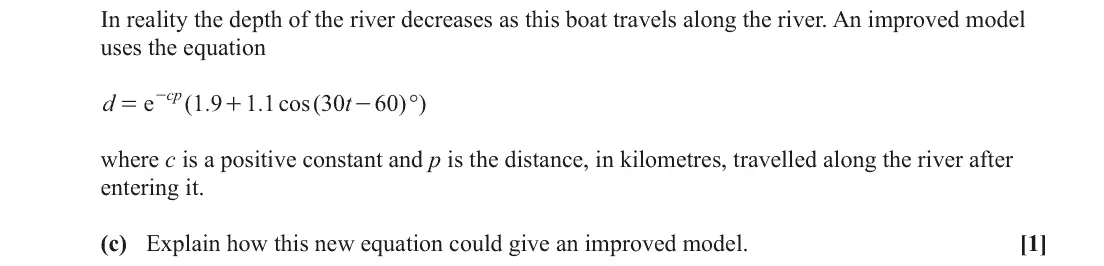
In reality the depth of the river decreases as this boat travels along the river. An improved model uses the equation e cp d - ( . 1 9 1 1 . cos ( t )°) = + - where c is a positive constant and p is the distance, in kilometres, travelled along the river after entering it. (c) Explain how this new equation could give an improved model. [1]
Autumn 2021 · Paper 2 · Q4(a) 1 mark Medium
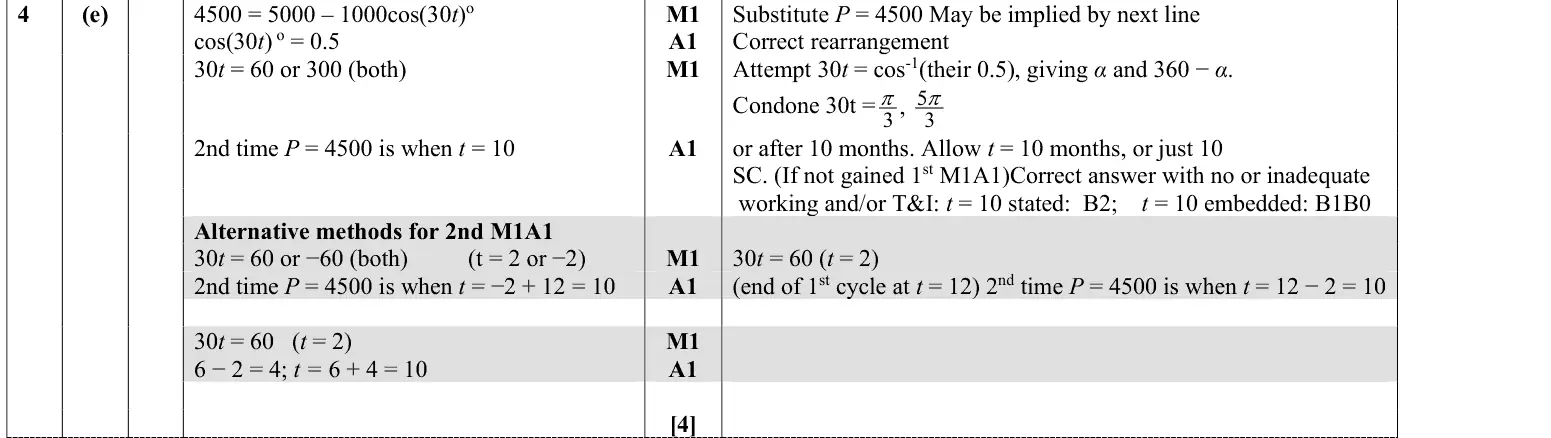
4 The size, P, of a population of a certain species of insect at time t months is modelled by the following formula. P = 5000 - 1000cos (30t)° (a) Write down the maximum size of the population. [1]
Autumn 2021 · Paper 2 · Q4(b) 1 mark Medium
Show the start of this questionEarlier part of this question
(b) Write down the difference between the largest and smallest values of P. [1]
Autumn 2021 · Paper 2 · Q4(c) 1 mark Medium
Show the start of this questionEarlier part of this question
(c) Without giving any numerical values, describe briefly the behaviour of the population over time. [1]
Autumn 2021 · Paper 2 · Q4(d) 2 marks Medium
Show the start of this questionEarlier part of this question
(d) Find the time taken for the population to return to its initial size for the first time. [2]
Autumn 2021 · Paper 2 · Q4(e) 4 marks Medium
Show the start of this questionEarlier part of this question
(e) Determine the time on the second occasion when P = 4500. [4]
Autumn 2021 · Paper 2 · Q4(f) 1 mark Medium
Show the start of this questionEarlier part of this question
A scientist observes the population over a period of time. He notices that, although the population varies in a way similar to the way predicted by the model, the variations become smaller and smaller over time, and P converges to 5000. (f) Suggest a change to the model that will take account of this observation. [1]
Autumn 2021 · Paper 3 · Q5(b) 3 marks Medium
Show the start of this questionEarlier part of this question
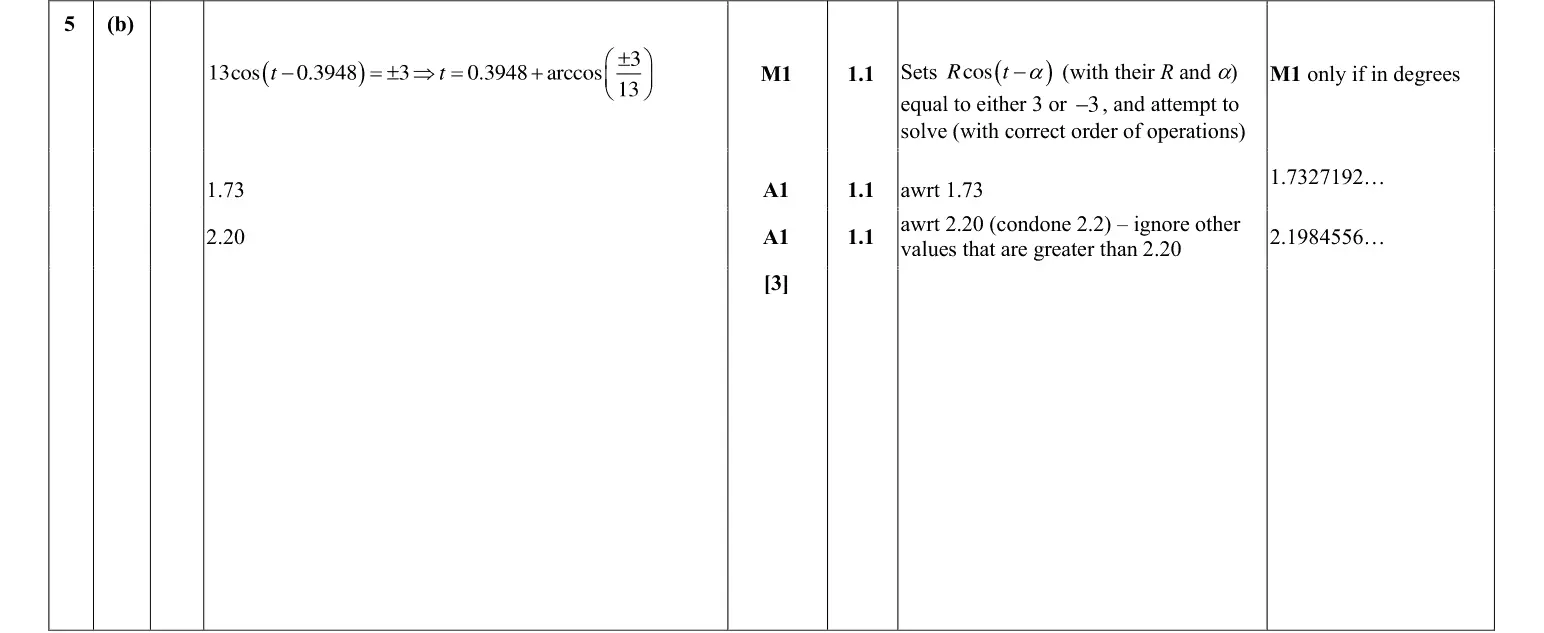
(b) Hence find the two smallest positive values of t for which P is moving, in either direction, - . with a speed of 3 m s 1 [3]

Find an A-level maths tutor

Stuck on this? Book a trial session with an A-level maths tutor.

Prefer email? Send an enquiry

If you are under 18, please include a parent's contact details. Enquiries go to enquiries@mathsaleveltutor.com and are deleted once handled.