Examiner's comment
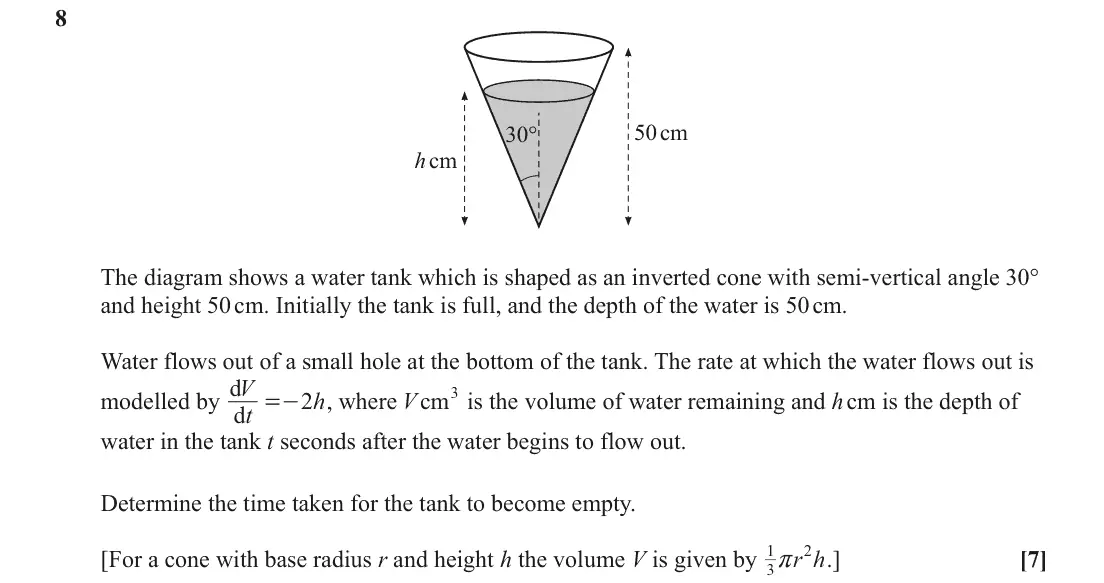
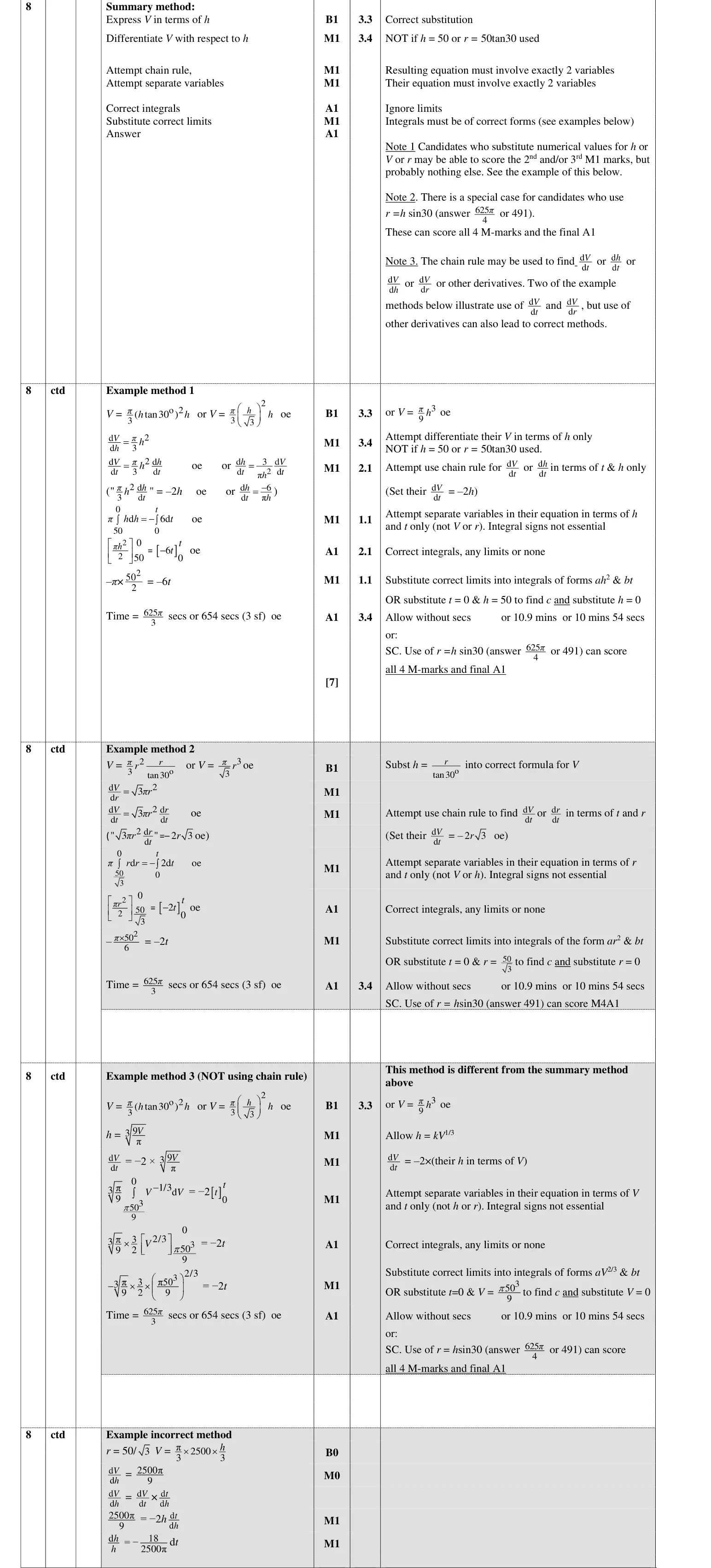
This differential equation question is of a fairly standard type, found in many text books. So one might reasonably expect candidates to be familiar with questions of this type. Despite this, responses were, on the whole, disappointing. In fact, about half the candidates scored 0 marks on this question. However, there were also a good number of excellent solutions. A few candidates thought that r = hsin 30°, but gave an otherwise completely correct solution. These candidates scored 5 marks out of 7. The main difficulty faced by candidates was that there were more than two variables involved (V, h, t and r). Most candidates obtained an equation in three variables, but then attempted to differentiate or integrate, treating one of the variables as a constant. For example: d V d V 1 2 1 3 πr2h ⇒ V = d r = 3 πrh (or d h = 3 πr2). d V h = −2t ⇒ dV = −2tdh ⇒ V = −2th. d Some candidates avoided this trap by using a numerical value for one of the variables, e.g. h = 50 or 50 3 3 r = , thus rendering their equation incorrect. Some candidates appreciated the need to use the chain rule but, while doing so, made one of the above d V d V d t d V d t 1 1 3 πr2 ⇒ h ⇒ d h = d t × d h , but d h = 3 πr2 = (−2t) × d errors. Thus a typical solution was as follows. 2 2 50 3 50 3 π d t 1 ∫ d h 2500 3 3 3 3 π = −2t d h ⇒ = −2tdt ⇒ 9 h = −2t + c. Then use h = 50 when t = 0 to find c and finally substitute h = 0 to find t. Finally, some candidates used a different, correct method that did not require the use of the chain rule. It did, however, involve some rather awkward substitution of a limit. This method can be found on the published mark scheme, Question 8, Example method 3.