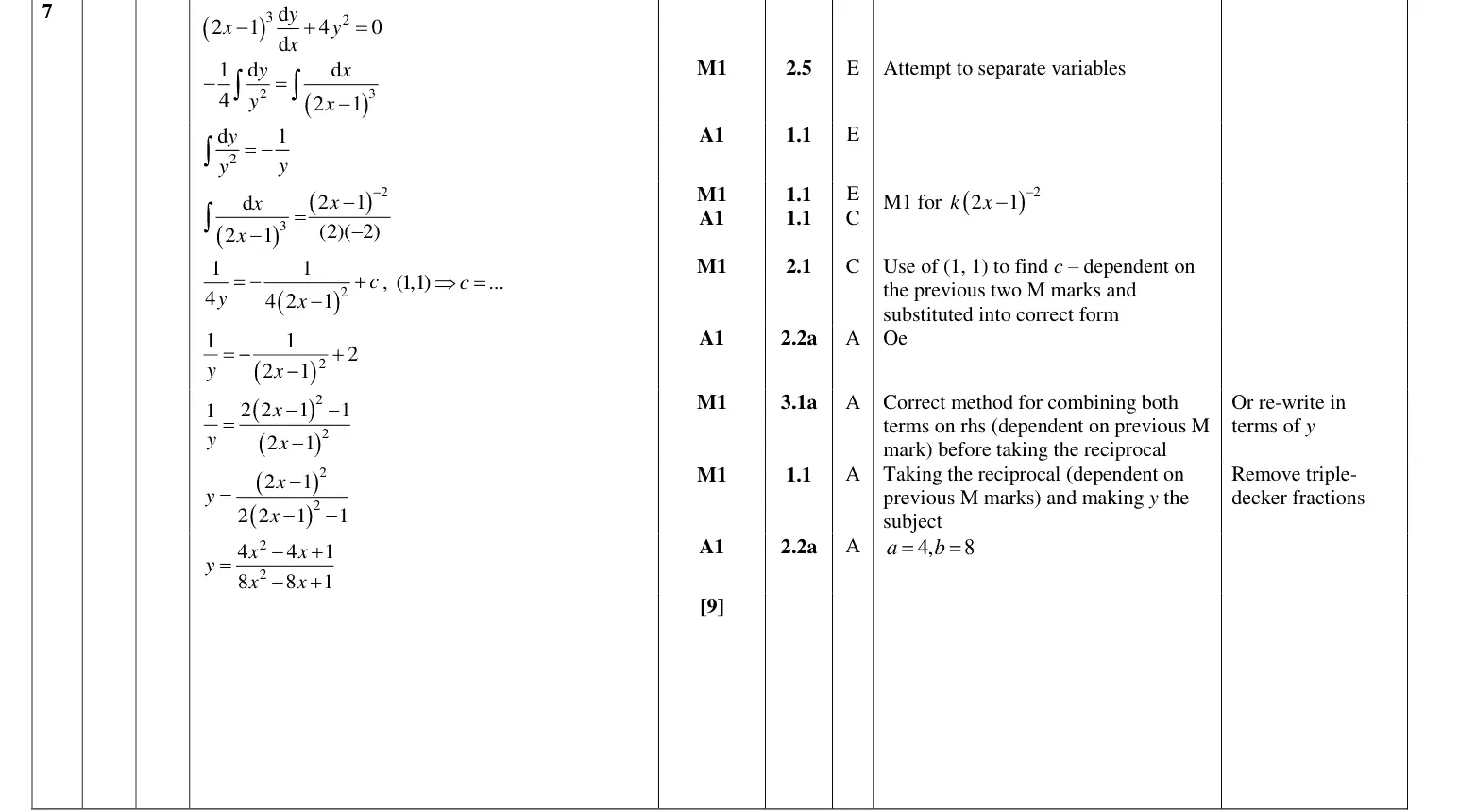
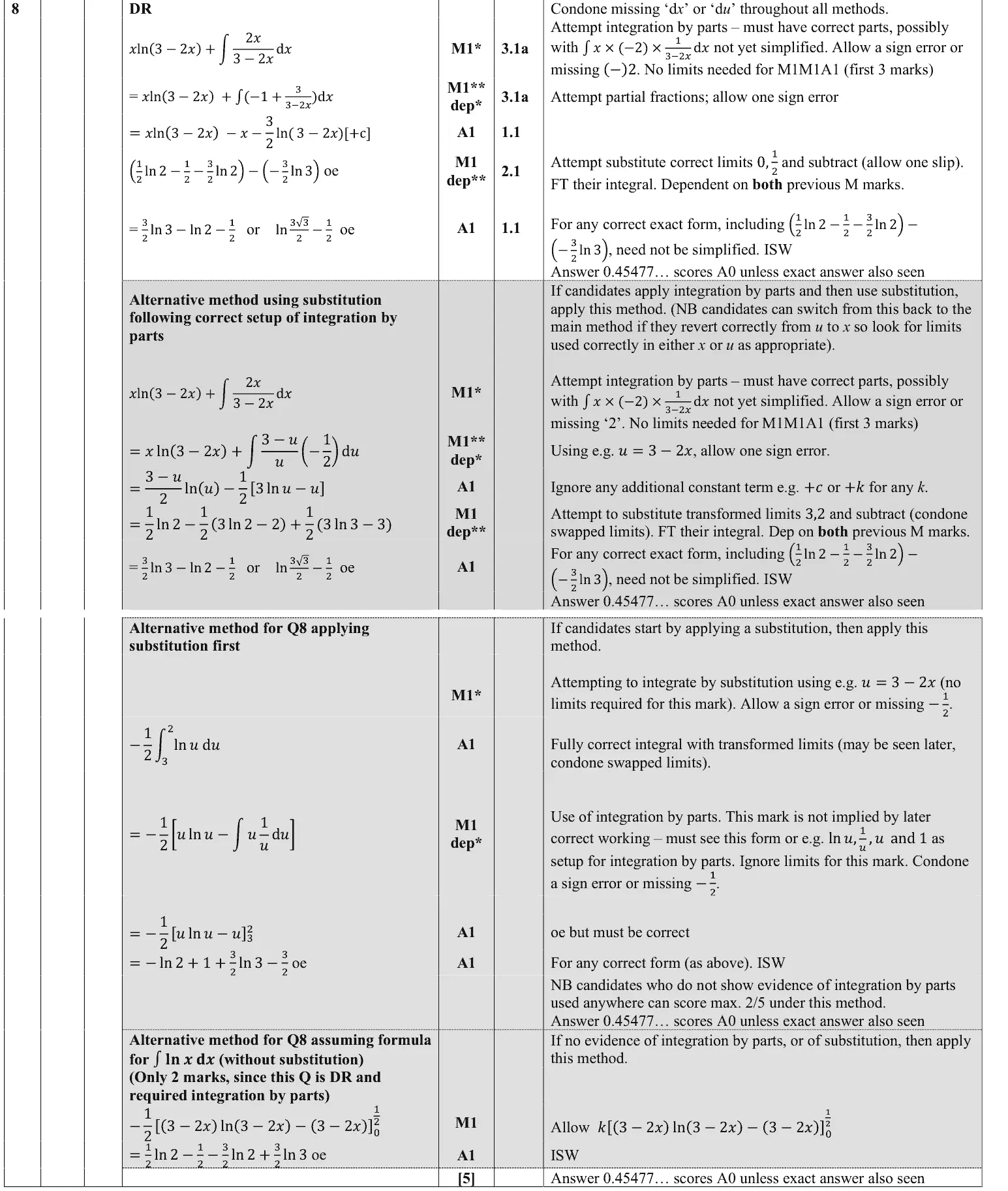
Mark scheme for this part
Examiner's comment
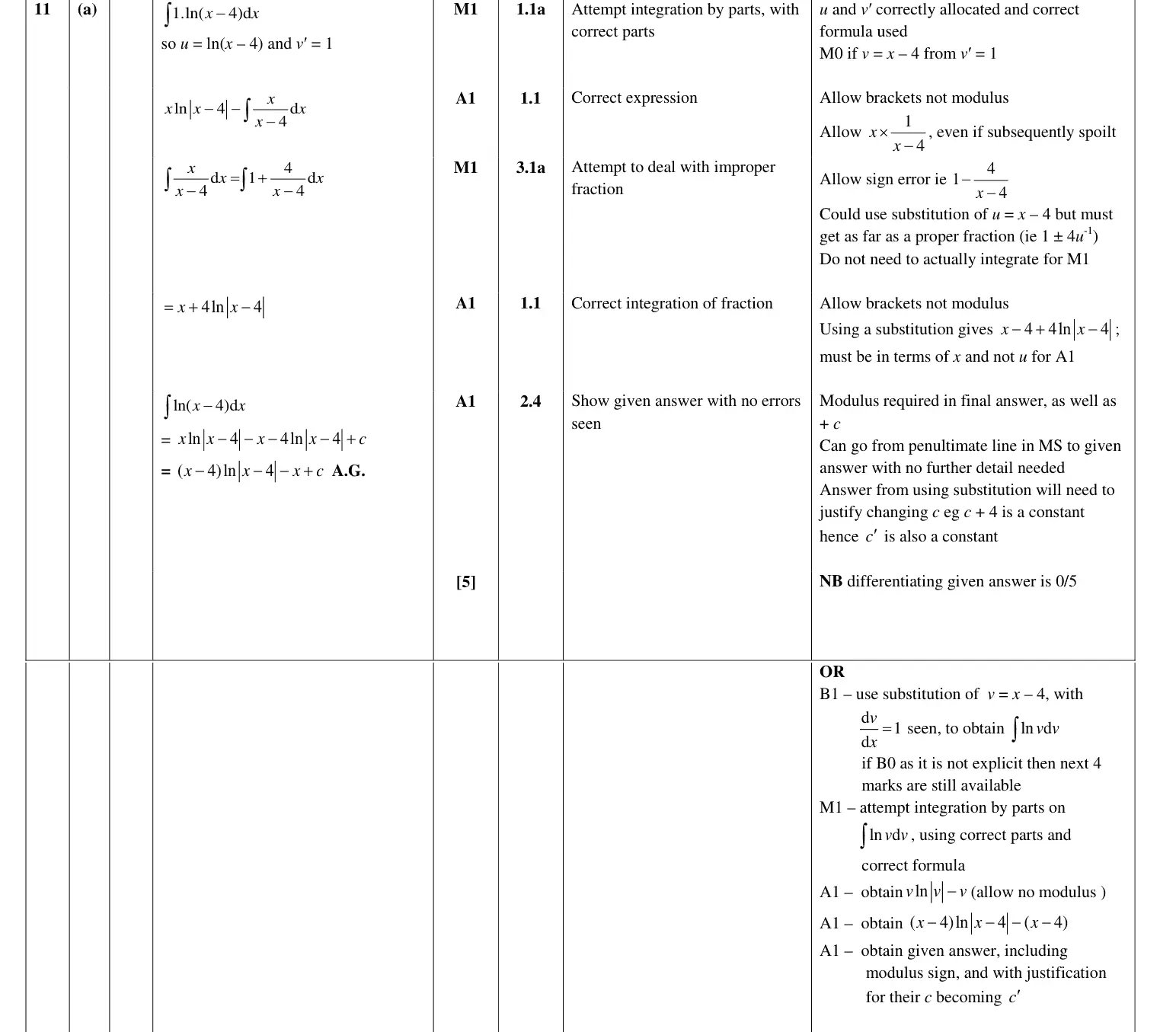
Many candidates scored at least 3 marks in this question, and some very good answers were seen, although a significant number of candidates made no progress beyond the initial setup (typically scoring M1 only). The question specified the use of integration by parts, so answers which did not use this technique anywhere could not score full marks (see the third alternative method in the scheme). Most candidates applied ‘by parts’ directly to the given integral and then proceeded via either partial fractions or substitution on the resulting second integral as shown in the first two methods on the scheme. A few candidates made an error in setting up their ‘by parts’ (resulting in an inconsistent statement). Some candidates, perhaps in trying to solve the resulting integral, went backwards by attempting ‘by parts’ again and undoing their initial setup – which normally resulted in no further progress being made. The second alternative method was quite often seen, with candidates starting by applying a substitution (which is a logical way to approach the given integral). Candidates still needed to demonstrate the use of ‘by parts’ in their working in order to be eligible for full marks– as shown in the scheme. In all methods, sign errors were very common – often meaning that the method marks were scored but one or both of the accuracy marks were not. For candidates who used a substitution, some did not ‘translate’ the limits at the point of applying the substitution. This was often recovered (especially for candidates who reversed the substitution later) and some candidates even chose to work in a mixture of variables (i.e. keeping the first term of the ‘by parts’ in x and substituting within the second integral to, e.g. u). The scheme was deliberately flexible to accommodate this, but candidates should be reminded that, when using a substitution on a definite integral, it is important that the limits are adjusted at the point the substitution is made so that the integral remains correct throughout. This is particularly important when working under a DR instruction – which means there is greater emphasis on fully correct working leading to the answer. In a few cases (whether from substitution or sign errors) candidates inadvertently recovered to the correct final answer, but the final mark could not be awarded for answers that arose from incorrect working. This is an excellent example of a fully correct solution to this question. This candidate correctly sets up the integration by parts and proceeds to use a substitution to evaluate the ‘new’ integral (as shown in the first alternative method on the scheme). They do this correctly and revert to the original form in x before applying the appropriate limits correctly, leading to the correct final answer, 5/5.
Key points and common errors
- by parts with u = ln(3 − 2x), v = x
- second integral by division or substitution
- exact answer (3/2)ln3 − ln2 − 1/2
- sign errors common
- change limits when substituting
- by parts must be used