1.02h Express solutions through correct use of 'and' and 'or', or through…
Section
1.02 Algebra and Functions
Level
AS & A level
Statement
Be able to express solutions through correct use of 'and' and 'or', or through set notation.
Guidance
Familiarity is expected with the correct use of set notation for intervals, e.g. {x : x > 3}, {x : −2 ≤ x ≤ 4}, {x : x > 3} ∪ {x : −2 ≤ x ≤ 4}, {x : x > 3} ∩ {x : −2 ≤ x ≤ 4}, ∅. Familiarity is expected with interval notation, e.g. (2, 3), [2, 3) and [2, ∞).
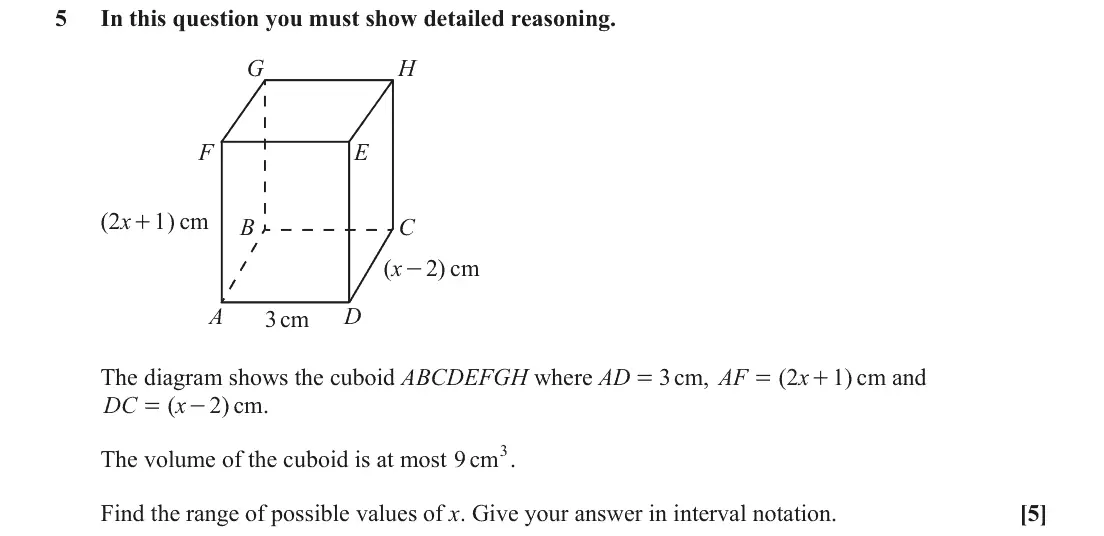
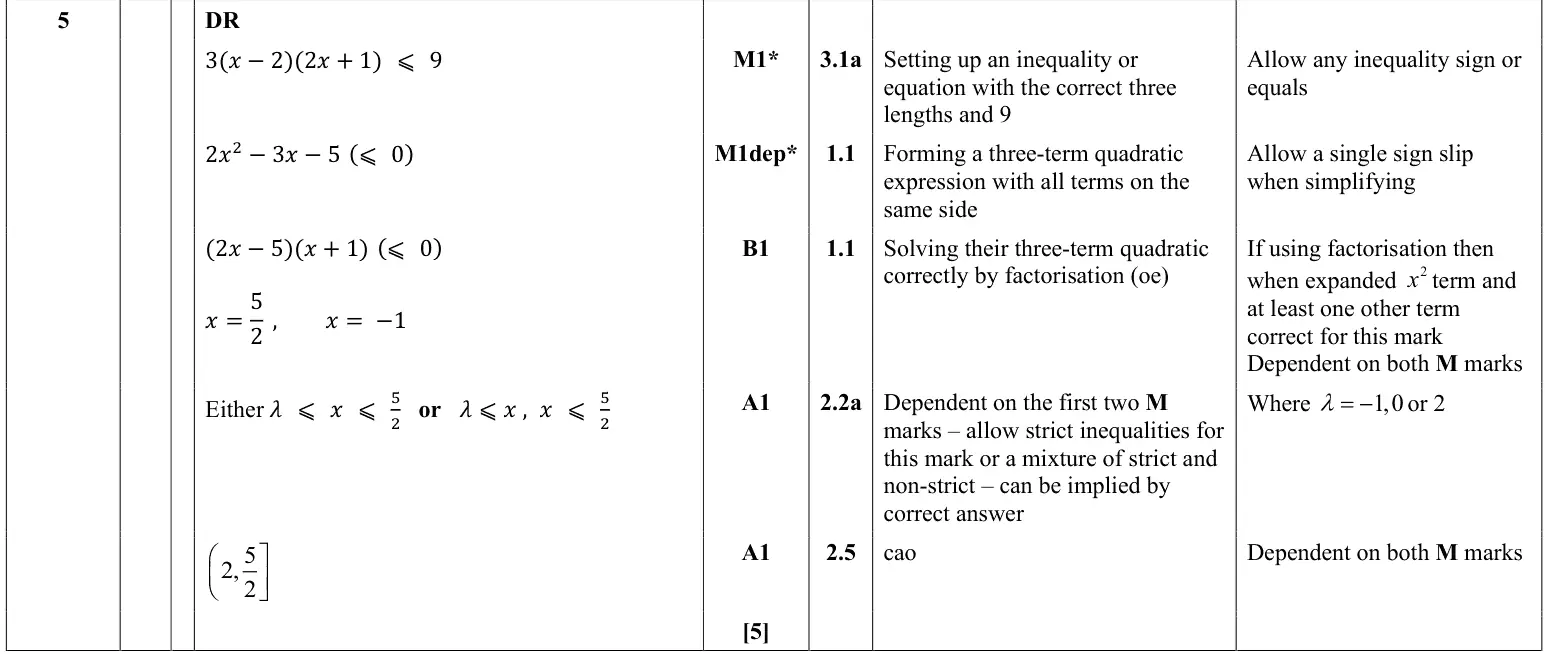
Very few candidates scored full marks in this question since ‘interval notation’ did not seem to be well understood, with many candidates giving set notation in the final answer instead. Also many missed the significance of ‘2’. Many good attempts scored just the first 4 marks, usually with -1 ≤ x ≤ 2.5 getting the fourth mark. This was the second DR question on the paper. In this question candidates were expected provide the method used for solving the quadratic equation – as this is a skill required on the Specification, just doing it with the calculator scored B0. The DR instruction helps to indicate to candidates when this is required, and it is good practice to include working for all steps in a DR question. The other 4 marks were still available. Some candidates did not use the 9cm3 at all, just giving the volume as a quadratic, simplifying this and then re-factorising and solving to produce - ½ and 2.
Key points and common errors
volume 3(x − 2)(2x + 1) ≤ 9
2x² − 3x − 5 ≤ 0 so −1 ≤ x ≤ 5/2
lengths positive needs x > 2
interval notation (2, 5/2], not set notation
June 2025 · Paper 3 · Q4(b)3 marksMedium
Show the start of this question
Mark scheme for this part
Examiner's comment
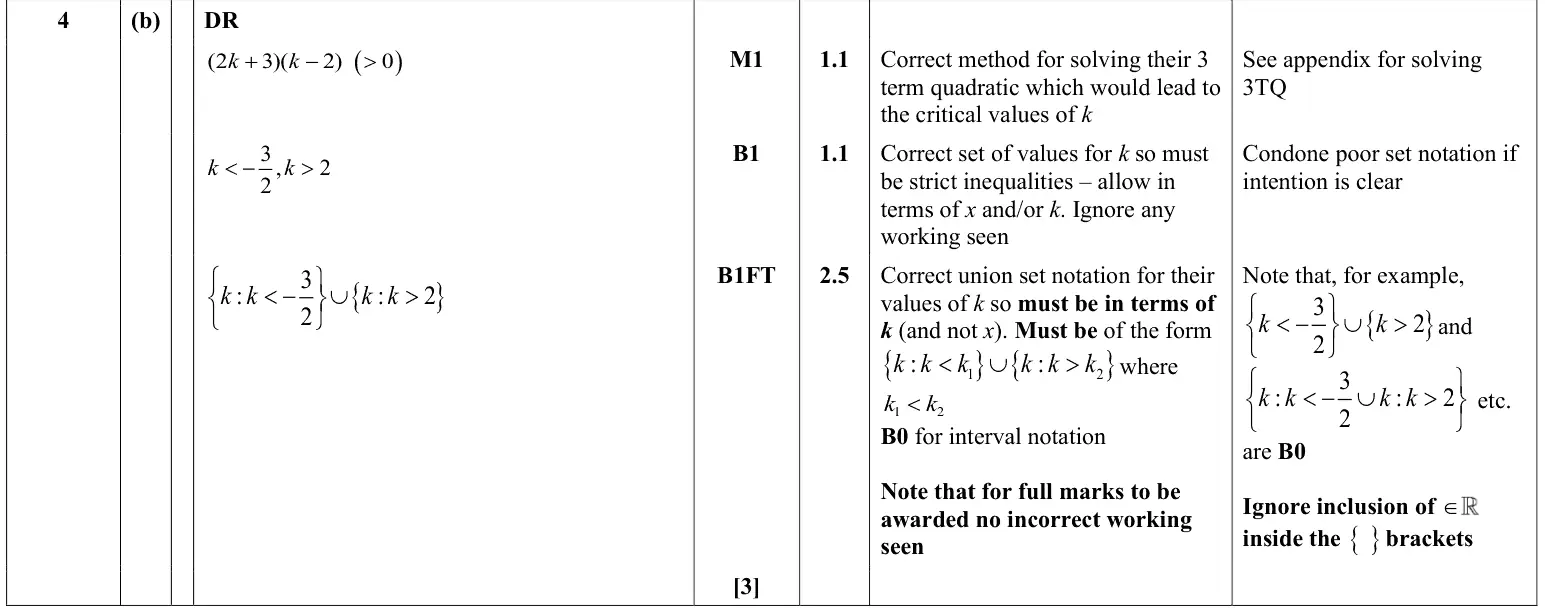
While many candidates scored full marks in this part, some did not show a correct method for solving this quadratic inequality even though the question clearly said that ‘detailed reasoning’ must be shown. It was also the case that many candidates struggled with the requirement to give their answer in set notation with many either leaving their answer as 𝑘< − 2 , 𝑘> 2, giving an answer using interval notation, or using the symbol for ‘intersection’ rather than the correct answer of {𝑘: 𝑘< − 2} ∪{𝑘: 𝑘> 2}. It was also noted by examiners that many candidates defaulted to giving their solution in terms of 𝑥 rather than 𝑘.
Key points and common errors
(2k + 3)(k − 2) > 0
{k : k < −3/2} ∪ {k : k > 2}
method for the quadratic must be shown
set notation must be in k with ∪
June 2024 · AS Paper 2 · Q3(b)2 marksMedium
Show the start of this question
Mark scheme for this part
Examiner's comment
For credit in this part we expected candidates to use the given inequality to obtain critical values and these were commonly found correctly. The question asked for set notation in the final answer and, as in previous years, we were quite strict in what we allowed. We needed to see ‘curly’ brackets, as is seen in the mark scheme. We accepted k ∈ {x : x > 0.5} U {x < −4.5}. Below are some examples of responses that were given B0FT. {k > 0.5} U {k < −4.5} {k : k > 0.5 or k < −4.5} {k : k > 0.5 U k < −4.5} {k : k > 0.5 , k < −4.5} (−ꝏ, −4.5) U (0.5, ꝏ). We also saw Ո used and incorrect inequality signs.
Key points and common errors
critical values 0.5 and −4.5
{k : k > 0.5} ∪ {k : k < −4.5} with curly brackets, strictly marked
June 2024 · Paper 1 · Q8(a)1 markEasy
Mark scheme for this part
Examiner's comment
This question was generally well answered.
Key points and common errors
x < 0 (not x ≤ 0)
interval notation (−∞, 0) allowed
June 2024 · Paper 3 · Q25 marksHard
Mark scheme for this part
Examiner's comment
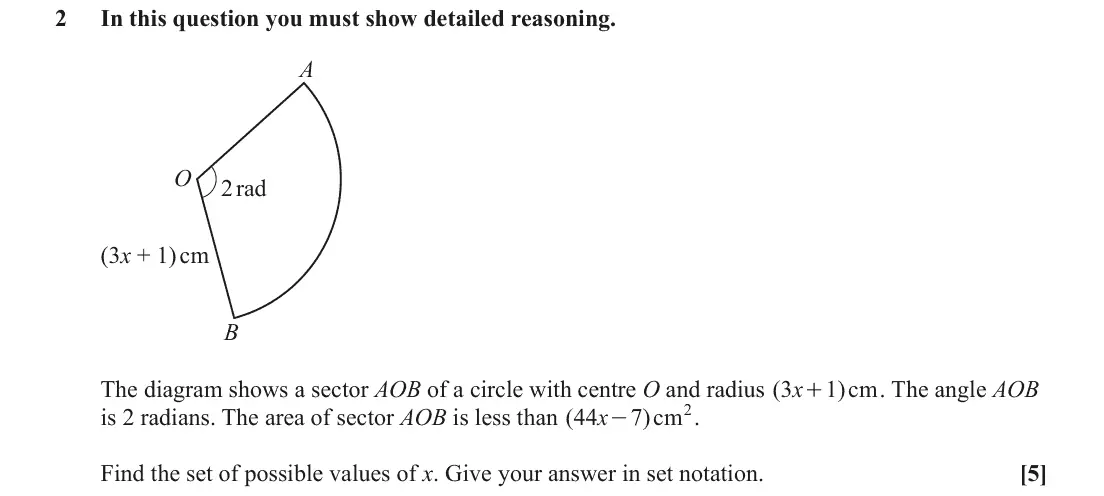
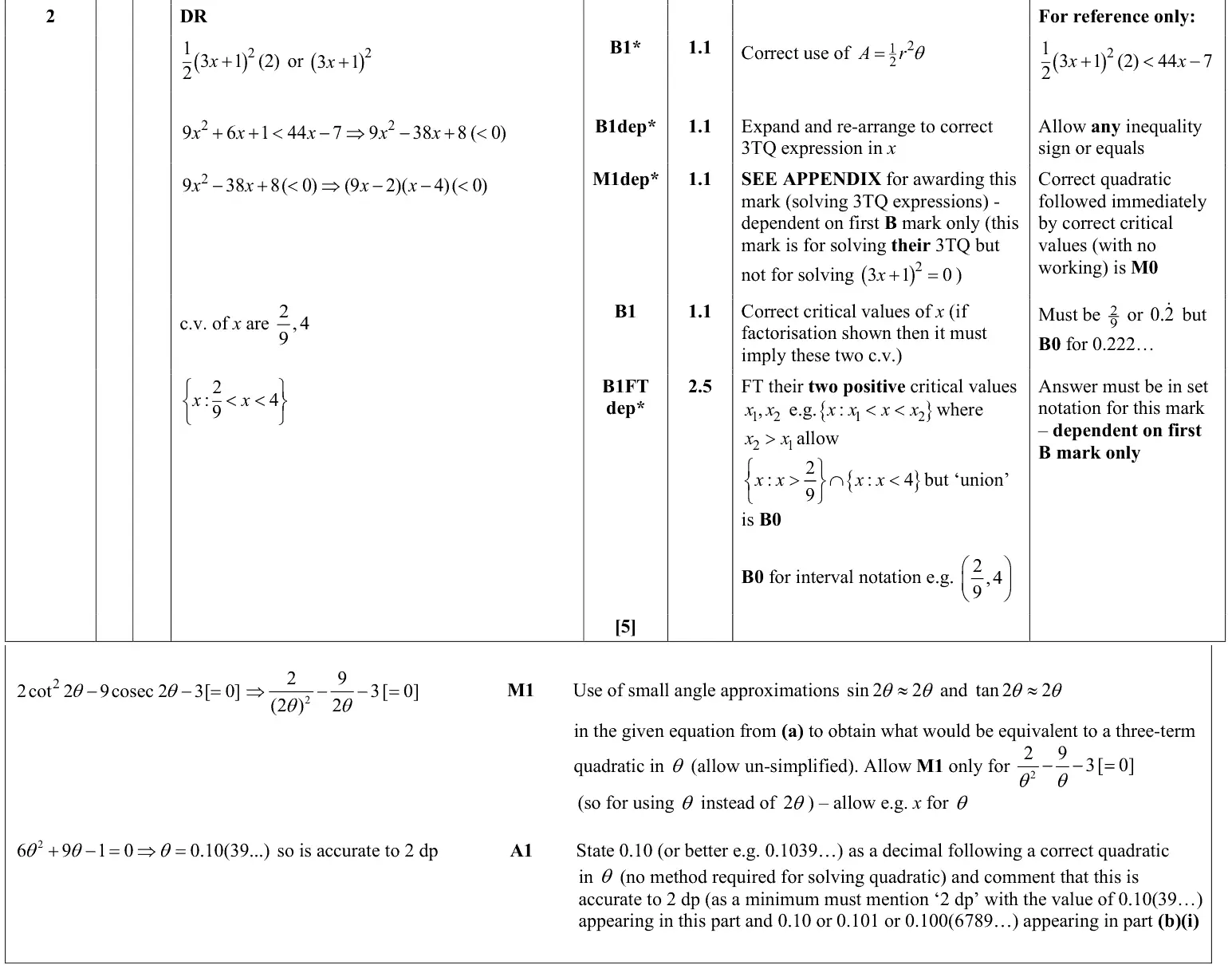
Many candidates seemed unfamiliar with the formula 𝐴= 2 𝑟2𝜃 for the area of a sector of a circle with 𝜃 measured in radians, with many either quoting incorrect formulae (so scoring no marks in this part) or having to convert from a corresponding formula with the angle given in degrees. Of those candidates who did know the correct formula most then simplified correctly to the inequality 9𝑥2 −38𝑥+ 8 < 0. However, very few candidates showed a correct method for solving this quadratic inequality even though the question clearly said that ‘detailed reasoning’ must be shown. It was also the case that many candidates are still unfamiliar with set notation with many either leaving their answer as 9 < 𝑥< 4, giving an answer using interval notation or using the symbol for ‘union’, rather than either correct answer of 9 < 𝑥< 4} or {𝑥: 𝑥> 9} ∩{𝑥: 𝑥< 4}. {𝑥:
Key points and common errors
A = ½r²θ = (3x + 1)² < 44x − 7
9x² − 38x + 8 < 0
(9x − 2)(x − 4) < 0
{x : 2/9 < x < 4}
interval notation B0
many did not know the radian sector formula
June 2024 · Paper 3 · Q3(b)1 markMedium
Show the start of this question
Mark scheme for this part
Examiner's comment
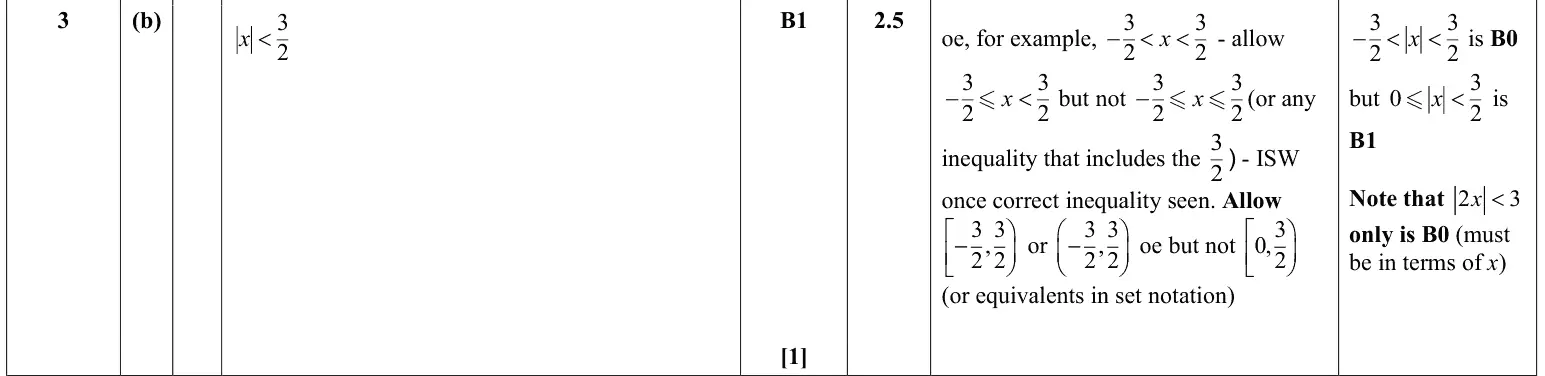
The most common incorrect answers seen in this part were either |𝑥| < 1 or |𝑥| < 3.
Key points and common errors
modulus of x < 3/2 (−3/2 < x < 3/2)
common wrong answers: modulus of x < 1 or < 3
June 2023 · AS Paper 2 · Q13 marksMedium
Mark scheme for this part
Examiner's comment
Most candidates realised that the discriminant of the quadratic equation needed to be considered. Many knew that Δ < 0 was needed, although the first 2 marks were potentially available from Δ = 0 or Δ > 0. 2 3 Critical values of ± 3 and ± 4 were seen and it was not uncommon to only see a positive critical value. The 3 2, or -3 3 2 and we did not give A1 if ‘and’ was used in final response was sometimes given as k > ± 2 < k < the final statement, regarding this as equivalent to the set notation Ո.
Key points and common errors
Δ = 9 − 4k² < 0
critical values ±3/2
k < −3/2 or k > 3/2
often only the positive critical value
'k > ±3/2' is wrong
June 2023 · Paper 2 · Q5(c)(ii)2 marksHard
Show the start of this question
Mark scheme for this part
Examiner's comment
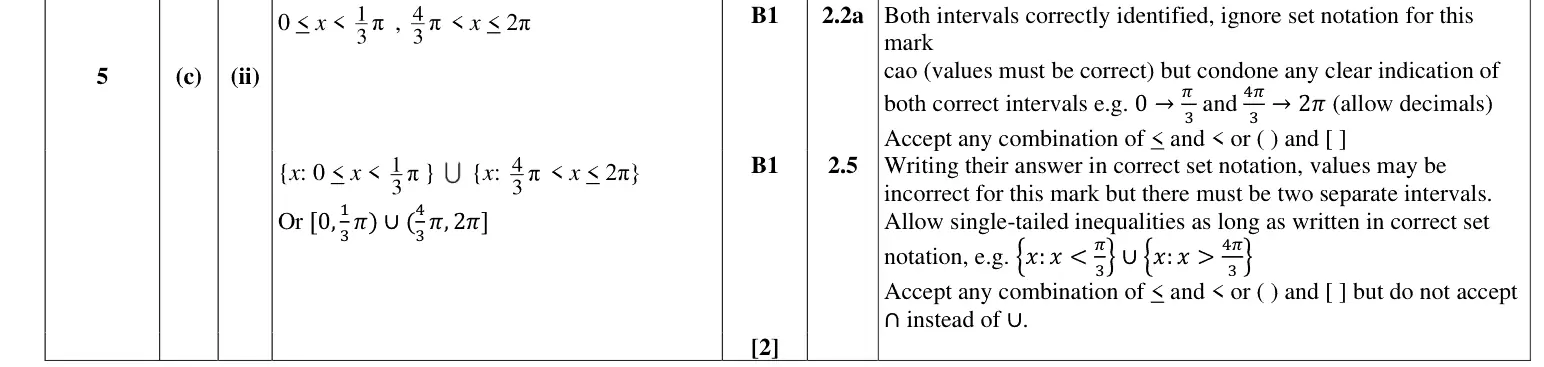
There were 2 marks available here. The first was for identifying the correct range of x-values (regardless of set notation used). Very few candidates managed to do this correctly, even having obtained the correct values in part (a) and ‘matched’ them in part (b) – with many omitting the outer limits of both ranges. The second mark (which was available independently of the first) was for giving their range in correct set notation, represented as the Union of two sets. More candidates obtained this mark than the first, but many made errors such as ∩ instead of ∪, or omitting ‘x:’ from one or both sets, or otherwise incorrect set notation.
Key points and common errors
{x : 0 ≤ x < π/3} ∪ {x : 4π/3 < x ≤ 2π}
outer limits often omitted
∩ instead of ∪
June 2023 · Paper 2 · Q9(b)(ii)1 markHard
Show the start of this question
Mark scheme for this part
Examiner's comment
Very few candidates obtained this mark. Some identified the correct range of values, in correct set notation, but hardly any candidates stated that only integer values in the range were appropriate.
Key points and common errors
{x : x ∈ ℤ, 0 ≤ x ≤ 20}
x must be stated to be an integer
June 2022 · AS Paper 2 · Q12 marksMedium
Mark scheme for this part
Examiner's comment
Question 8 (b). • Understood mathematical terminology less well, e.g., Questions 3 and 5 (a). The majority of candidates correctly identified the critical values of 2 and -3, earning the first mark, but many did not write the solution using set notation. Those that did try to provide set notation used sloppy notation, e.g. {x : x < -3 U x > 2} or confused U and Ո. For this second mark, we only accepted an answer in the form written in the mark scheme.
Key points and common errors
critical values 2 and −3
{x : x < −3} ∪ {x : x > 2}
many did not use set notation or wrote it sloppily (e.g. {x : x < −3 ∪ x > 2})
June 2022 · Paper 2 · Q6(b)2 marksMedium
Mark scheme for this part
Examiner's comment
Many candidates identified the range correctly, although not all could express it correctly in set notation. Some common answers that gained only 1 mark were these y > 1 2 , {x: x > 1 2 }, {f(x): f(x) > 1 2 }, {x: f(x) > 1 2 }, ( 1 2 , ∞). Some unnecessary “ ∞”s were seen (though not penalised), e.g. {y: 1 2 < y < ∞}. Some common wrong answers involved f(x) < 1 2 or f(x) > 2.
Key points and common errors
f(x) ≥ 1/2
{y : y ≥ 1/2}
{x : x ≥ 1/2} or f(x) > 2 lose marks
Autumn 2021 · AS Paper 1 · Q3(a)3 marksMedium
Mark scheme for this part
Key points and common errors
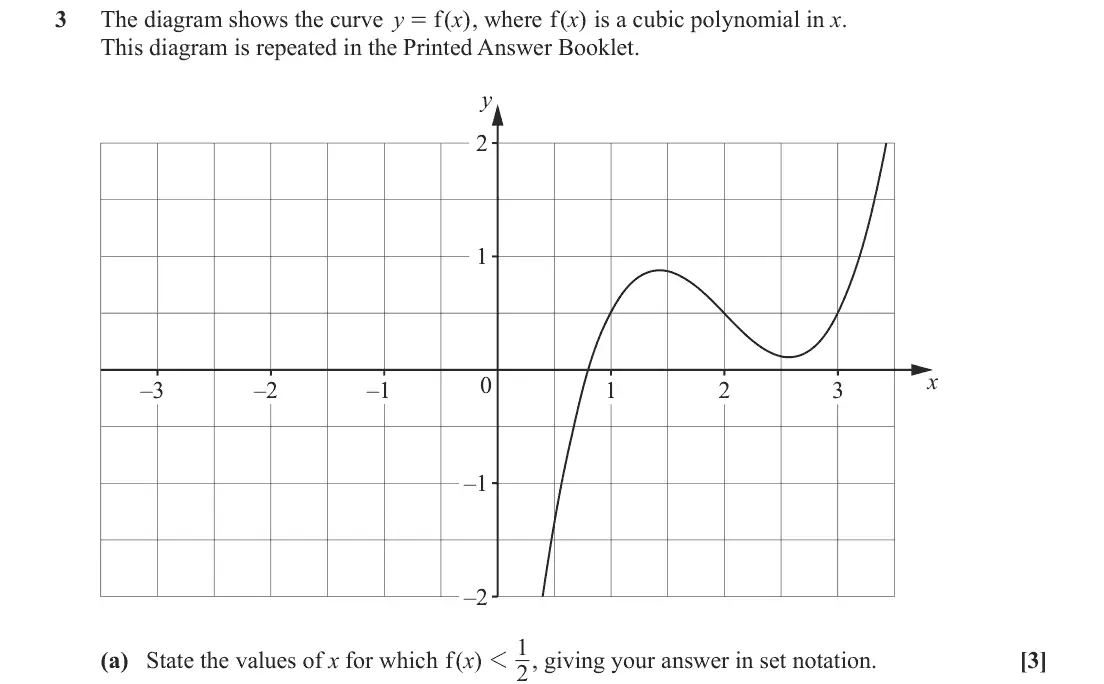
read where the curve is below y = ½: x < 1 and 2 < x < 3
set notation {x : x < 1} ∪ {x : 2 < x < 3}
strict inequalities
Autumn 2020 · AS Paper 1 · Q6(a)4 marksMedium
Mark scheme for this part
Key points and common errors
(x − 2)(x + 3) > 0
x < −3 or x > 2
{x : x < −3} ∪ {x : x > 2}
Autumn 2020 · Paper 3 · Q3(d)3 marksMedium
Show the start of this question
Mark scheme for this part
Examiner's comment
(Comment on Question 03 as a whole) There were some excellent responses to this question, although some candidates dropped marks for errors in the notation used. Those candidates that used completing the square in part (a) were generally more successful than those that used calculus. A significant number did not gain the final accuracy mark due to incorrectly stating 9 9 rather than correctly stating the range of the function ( ) x ≥− f x ≥− . 2 2 Some candidates appeared to misunderstand the concept of range, finding the roots by factorising to ( ) 2 x x + 3 to then incorrectly conclude that 3 x ≥ In part (b) there were unfortunately a number of vague answers provided starting ‘It is …’. Examiners cannot be expected to know what the ‘it’ is that the candidate is talking about; answers need to be explicit, either in words or as part of an annotated diagram. ( ) Most candidates started part (c) successfully and found the expression for g a . Some candidates introduced errors, or just wasted some exam time, producing an initial algebraic form for the composite f g x rather than substituting their numerical answer to ( ( ) ) into ( ) function g − 2 f x . Part (d) included the request to give their final answer in set notation. The ‘Determine’ request meant that the method mark was for clear and accurate algebraic manipulation into the standard three term quadratic. There is an assumption that candidates would solve quadratic equations by inspection or by using the solve function on their calculator, the command word just signals that the mathematical argument must be evident. The majority of candidates scored these initial 2 marks, but a significant number struggled with giving their result in correct set notation format.
Key points and common errors
2x² + 3x − 2 > 0, critical values ½ and −2
{x : x < −2} ∪ {x : x > ½}
many struggled with set notation
June 2019 · Paper 1 · Q14 marksEasy
Mark scheme for this part
Examiner's comment
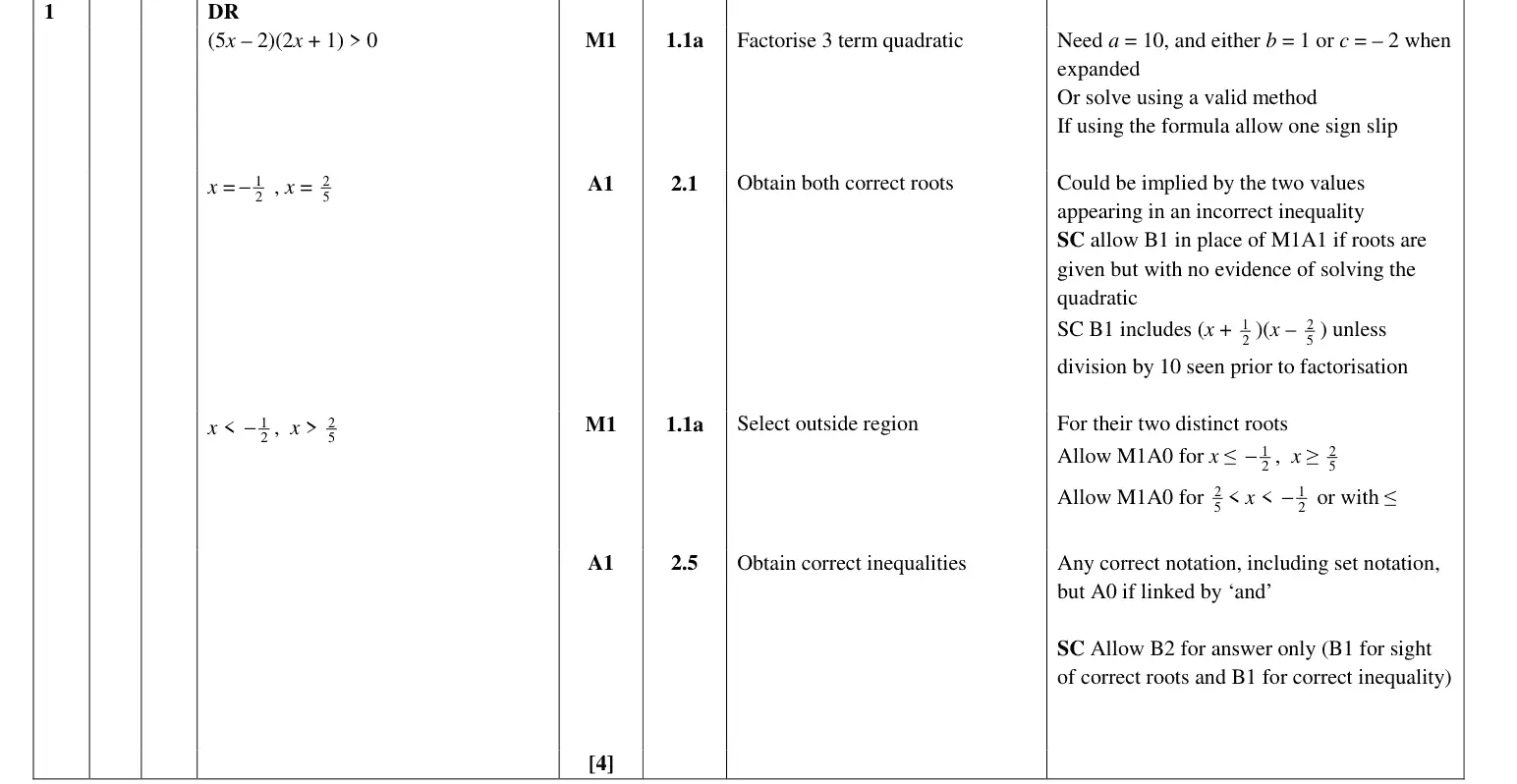
This question was generally answered well, with many fully correct solutions seen. Candidates generally paid heed to the ‘detailed reasoning’ instruction, showing how they had solved their quadratic. Some candidates used their calculator to produce the roots and then either quoted them or attempted to work backwards and deduce what the factors might have been. Most candidates were then able to identify the correct region for the inequality, with the majority giving their answer as inequalities whereas some showed good mastery of set notation. A few spoiled an otherwise correct solution by using ‘and’ to link their inequalities and others attempted to write it as a single inequality.
Key points and common errors
(5x − 2)(2x + 1) > 0 with working shown
x < −1/2 or x > 2/5
joining the two inequalities with 'and' loses the last mark
set notation accepted
June 2019 · Paper 3 · Q3(a)4 marksEasy
Mark scheme for this part
Examiner's comment
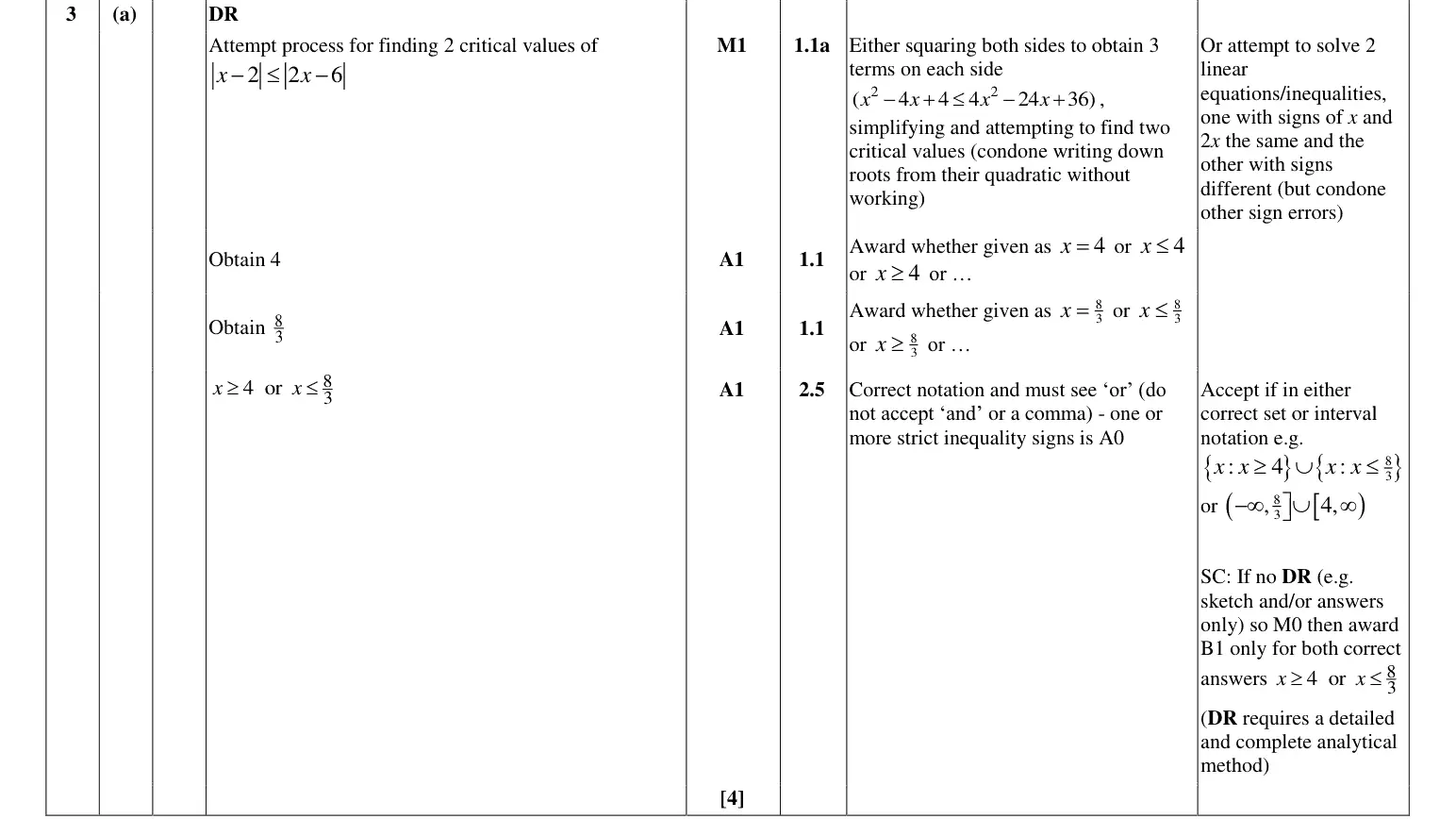
This question was answered extremely well with nearly all candidates correctly solving this inequality involving the modulus function. Of the two main methods for solving this type of inequality the first, which involved re-writing as ( ) ( ) x − 2 ≤ 2 x − 6 was far more successful than those candidates who decided to re-write as two linear equations/inequalities (one of which should have had signs of x and 2x the same and the other with signs different) as many made sign errors even though most started from the correct two equations/inequalities. Although most candidates obtain the correct two critical values, and so therefore obtained the first three values, the only answers accepted by examiners for consistency were: x ≥ 4 or x ≤ { } { } x : x ≥ 4 ∪ x : x ≤ ( [ ) −∞ , ∪ 4 , ∞
Key points and common errors
square both sides: critical values 8/3 and 4
x ≤ 8/3 or x ≥ 4 with 'or', not 'and'
sign errors with the two linear cases
June 2018 · Paper 1 · Q6(iii)2 marksMedium
Show the start of this question
Mark scheme for this part
Examiner's comment
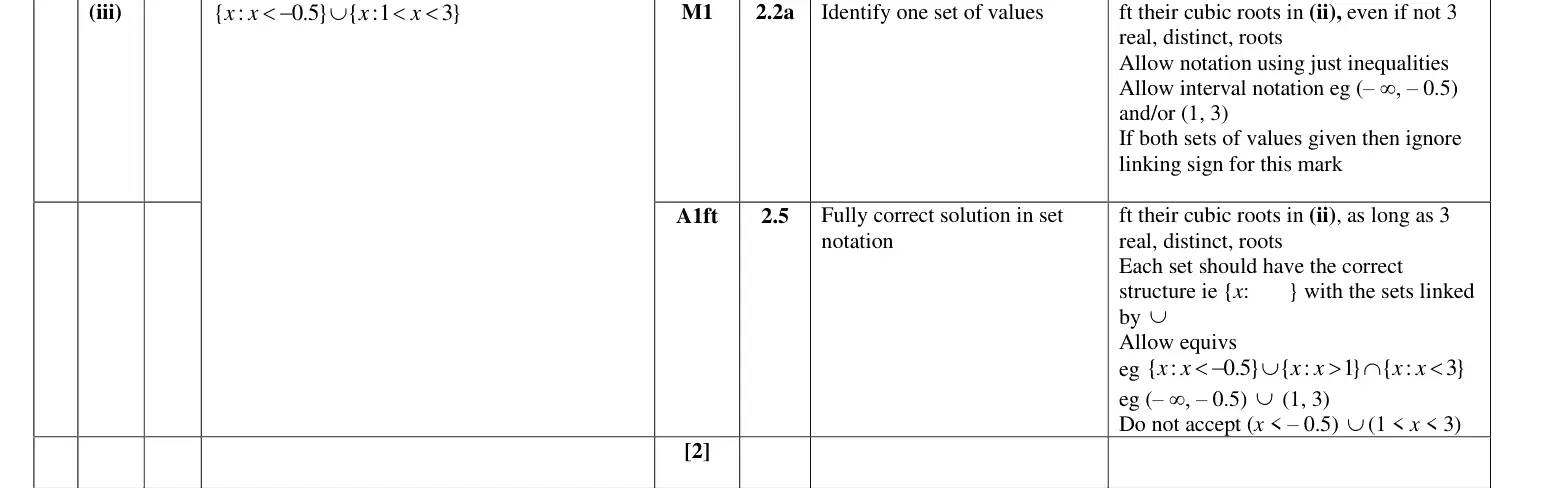
Set notation is new to this specification and some candidates were clearly familiar with the topic whereas others were not able to use the notation correctly, achieving only partial credit. This response gives a fully correct solution, using correct set notation, so gains full credit. This response demonstrates an alternative, but equally, valid use of set notation and also gains full credit. use of ∪ shows some familiarity with set notation, but the structure is not fully correct so they do not get This response gains one mark for identifying at least one correct set of values using inequalities. The the second mark.
Key points and common errors
{x : x < −0.5} ∪ {x : 1 < x < 3}
correct set notation structure required
June 2018 · Paper 3 · Q36 marksMedium
Mark scheme for this part
Examiner's comment
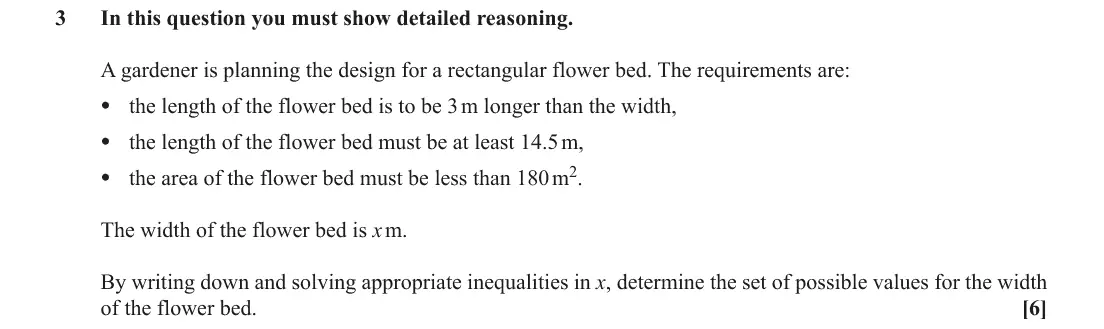
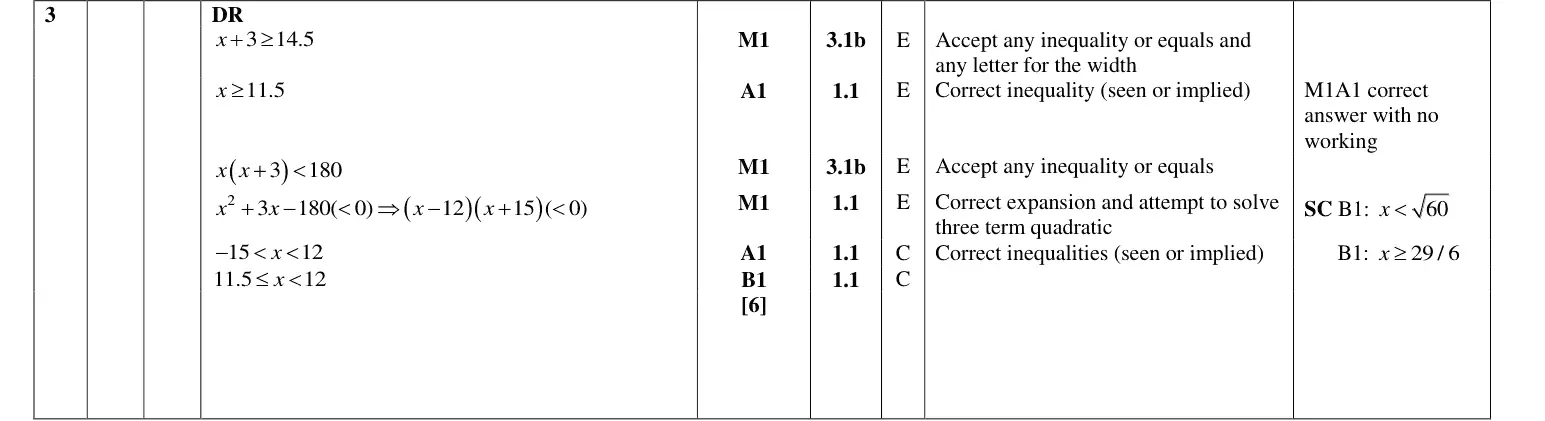
As this was a detailed reasoning question it was expected that candidates would do just that and show sufficient reasoning so that examiners could see that a complete analytical method had been employed. So it was therefore not possible to award full marks to those candidates who wrote statements such as ( ) x x + 3 < 180 ⇒− 15 < x < 12 .While many candidates correctly found that 11 5 . ≤ x < 12 a small 29 proportion of candidates stated that ≤ x < 60 . This incorrect answer came from misreading the 6 question and considering the length of the flower bed to be three times longer than its width (and not just 3 m longer than the width).
Key points and common errors
x + 3 ≥ 14.5 gives x ≥ 11.5
x(x + 3) < 180 gives (x − 12)(x + 15) < 0 so −15 < x < 12
combine: 11.5 ≤ x < 12
full method needed for DR
Find an A-level maths tutor
Stuck on this? Book a trial session with an A-level maths tutor.