Understand and use the coordinate geometry of the circle including using the equation of a circle in the form (x − a)² + (y − b)² = r²; completing the square to find the centre and radius of a circle; use of the following properties: the angle in a semicircle is a right angle; the perpendicular from the centre to a chord bisects the chord; the radius of a circle at a given point on its circumference is perpendicular to the tangent to the circle at that point.
Guidance
Students should be able to find the radius and the coordinates of the centre of the circle given the equation of the circle, and vice versa. Students should also be familiar with the equation x² + y² + 2fx + 2gy + c = 0. Students should be able to find the equation of a circumcircle of a triangle with given vertices using these properties. Students should be able to find the equation of a tangent at a specified point, using the perpendicular property of tangent and radius.
Mark scheme (whole question; this part is marked with the orange bar)
Examiner's comment
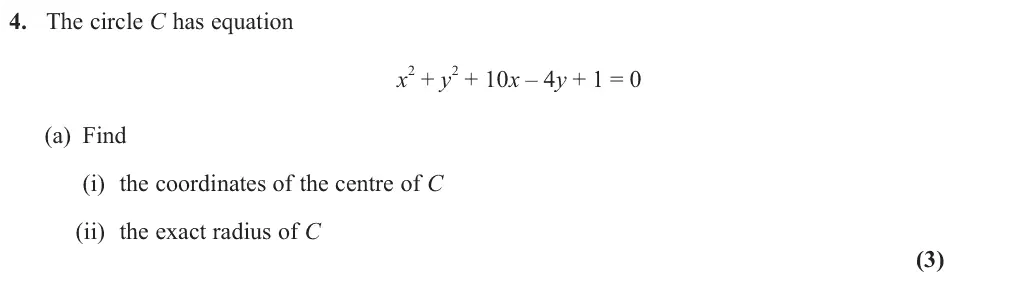
In part (a), most candidates showed good understanding of how to write the equation of a circle in a suitable form to extract the coordinates of the centre and the radius. There were occasional slips with the centre coordinates given as any combination of (±5, ±2). It was more common to see errors in manipulating the constants to get the correct radius. Candidates should be reminded to leave answers in the exact form, unless prompted by the question to round to a certain degree of accuracy.
Common mistakes
complete the square (x + 5)² + (y − 2)²: centre (−5, 2), radius √28 = 2√7 exact
sign errors in the centre
errors with the constant for r
June 2025 · AS Paper 1 · Q4(b)3 marks
Mark scheme (whole question; this part is marked with the orange bar)
Examiner's comment
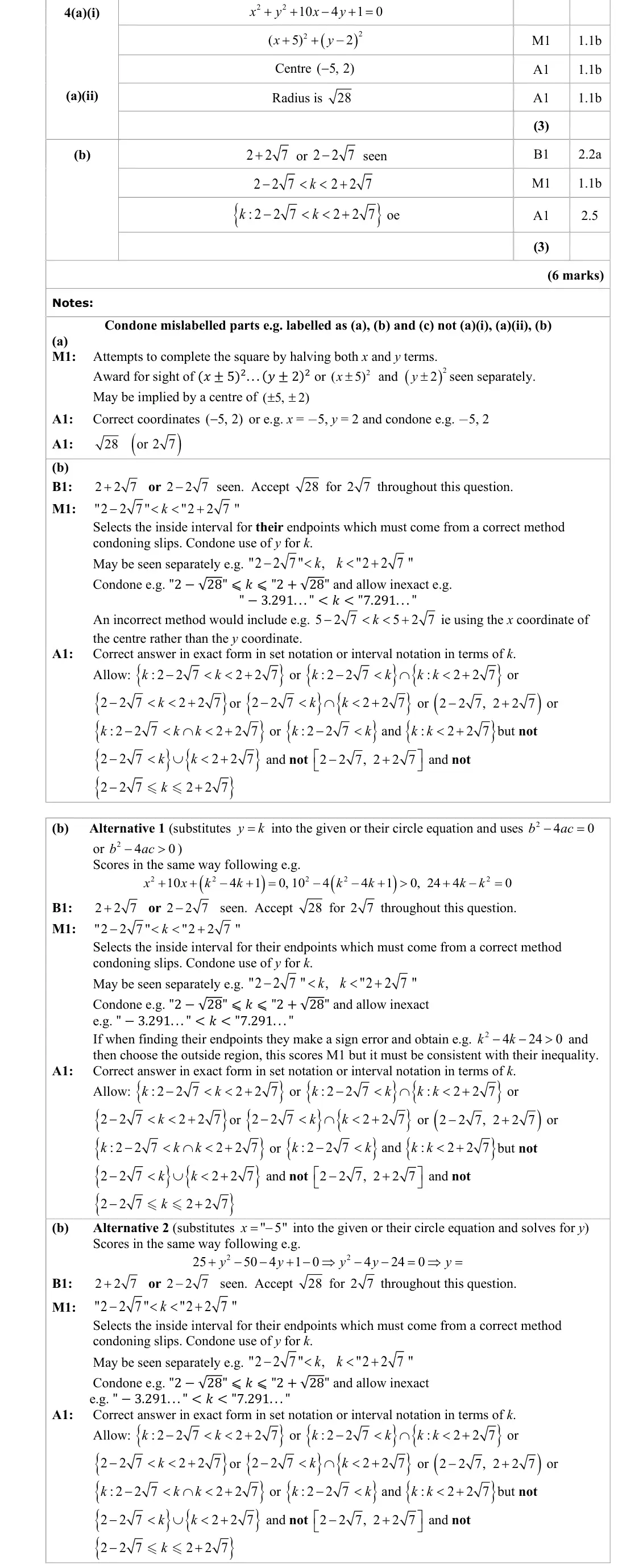
In part (b), a variety of approaches were seen, many attempting an algebraic method using the equation of the circle and discriminant rather than a geometrical approach. The geometrical approach was generally much more successful and succinct. Many candidates would have benefitted from drawing a diagram illustrating a circle and a horizontal line with equation y = k to enable them to visualise the situation. Some diagrams with y = k drawn as a diagonal line were seen. Algebraic methods were generally less successful, with errors in the algebra and errors in identifying the coefficients to apply to the discriminant. Without the context, candidates often chose the wrong range of values since the quadratic inequality obtained contained a negative 2x term. Many candidates did not provide a final answer in set notation despite identifying the correct range of values. Use of “union” instead of “intersection” was seen quite frequently.
Common mistakes
geometric: y-coordinate of centre ± radius gives 2 − 2√7 < k < 2 + 2√7
using the x-coordinate (5 ± 2√7) is wrong
discriminant method error-prone (negative k² term leads to the wrong region)
answer must be in set notation, not ∪ and not ⩽
June 2025 · Paper 1 · Q2(a)3 marks
Mark scheme (whole question; this part is marked with the orange bar)
Examiner's comment
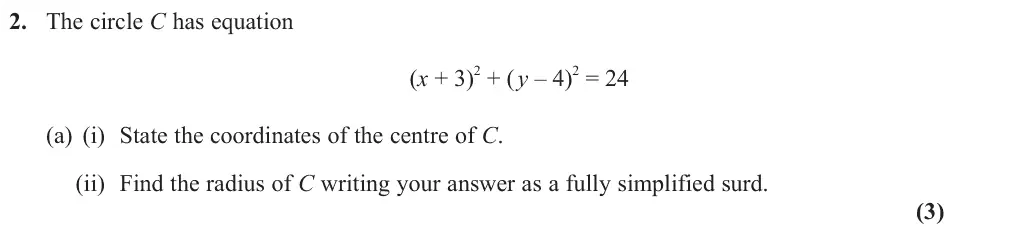
This question on circles was usually well answered with most learners able to score full marks. Part (a) was answered well, with most responses able to identify the coordinates of the centre for the first mark and deduce the exact value of the radius. Only a few responses did not score the first mark, mainly due to an incorrect sign or by swapping the x coordinate and y coordinate around. The most common mistakes seen in this part of the question were related to not writing the value of the radius as a fully simplified surd.
Common mistakes
centre (−3, 4) (sign errors or swapped coordinates)
radius √24 must be fully simplified to 2√6
June 2025 · Paper 1 · Q2(b)2 marks
Mark scheme (whole question; this part is marked with the orange bar)
Examiner's comment
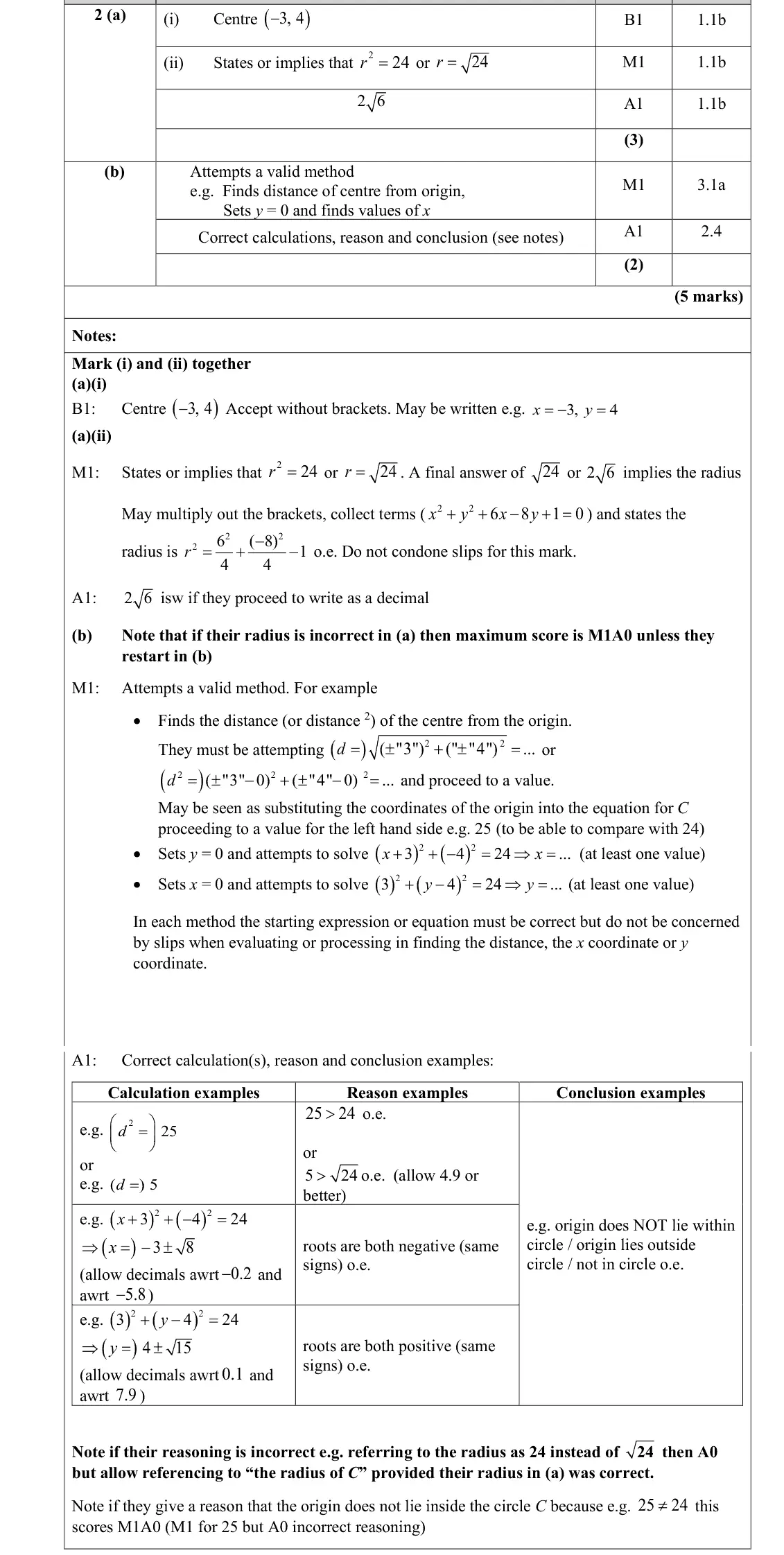
This question on circles was usually well answered with most learners able to score full marks. In part (b), many different strategies were seen within the responses, all duly listed in the main rubric. The most recurrent approach, usually successfully implemented, saw attempts to find the distance or the distance squared of the origin from the centre of the circle before comparing it with the radius or the radius squared and concluded. A smaller proportion of learners opted for reaching a quadratic equation, either in x or y, by setting y = 0 or x = 0 respectively, in the equation of the circle with the aim to find the intersections of the circle with the relevant axis and then check whether the x (or y) coordinates of the origin fell within these values. This approach was successfully implemented only by the most competent learners, who were also able to gain the final mark by reaching a correct conclusion. Other approaches were usually poorly implemented or outrightly incorrect as they consisted of adding the radius to either the x or y coordinate of the centre and then comparing this with the distance from the coordinate axes. A good proportion of the responses who were awarded the method mark, did not gain the final mark due to incorrect comparisons, such as 5 4 or 25 24 ≠ ≠ or incorrect final statements. The conclusion of “the origin does not lie in the circle” was often left out with some learners just writing “no”. It is important to remind learners that reasons and conclusions should always be clear and complete and that it is often useful to use the wording of the question to ensure that the question is answered. 6
Common mistakes
distance of the centre from the origin is 5 (or d² = 25) and 5 > √24 (25 > 24) so the origin is outside
"25 ≠ 24" is not a reason
comparing with 24 as the radius is wrong
must give a clear conclusion, not just "no"
setting y = 0 and finding both roots negative also works
June 2024 · AS Paper 1 · Q10(a)4 marks
Mark scheme (whole question; this part is marked with the orange bar)
Examiner's comment
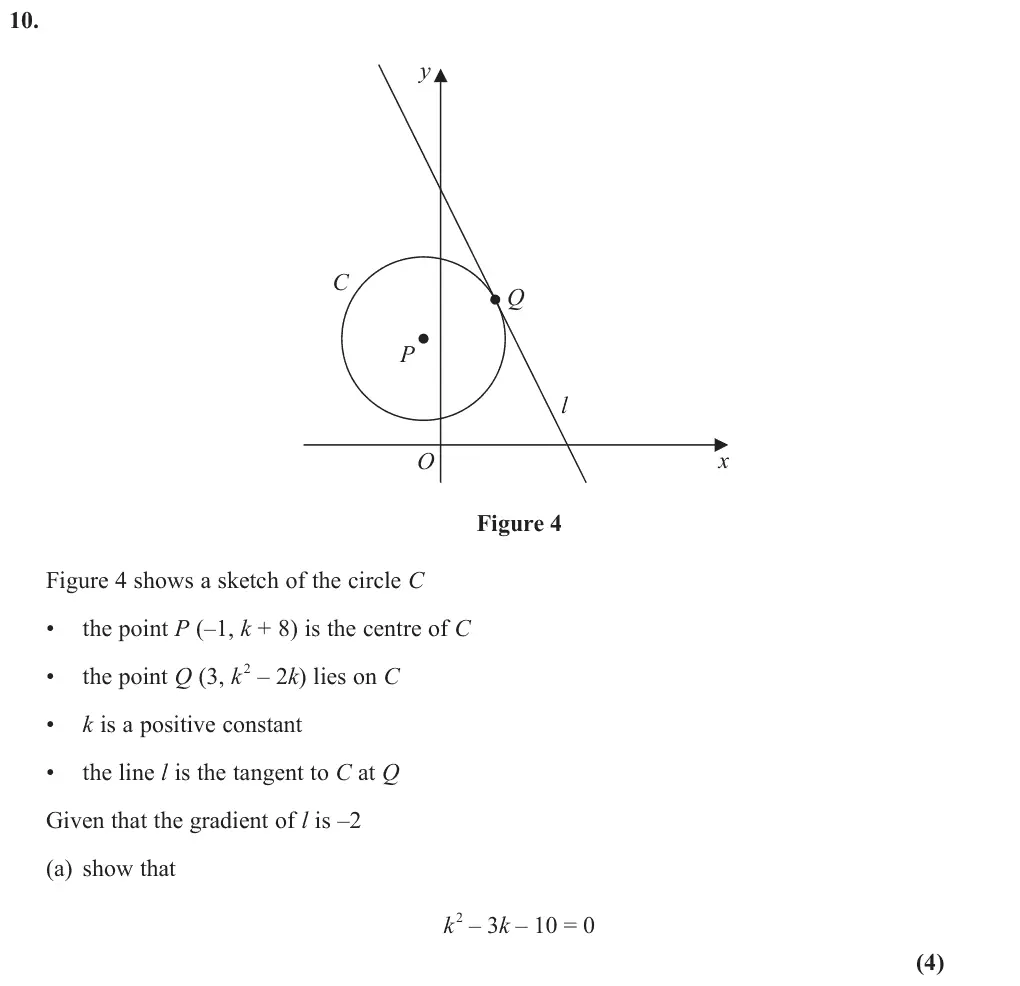
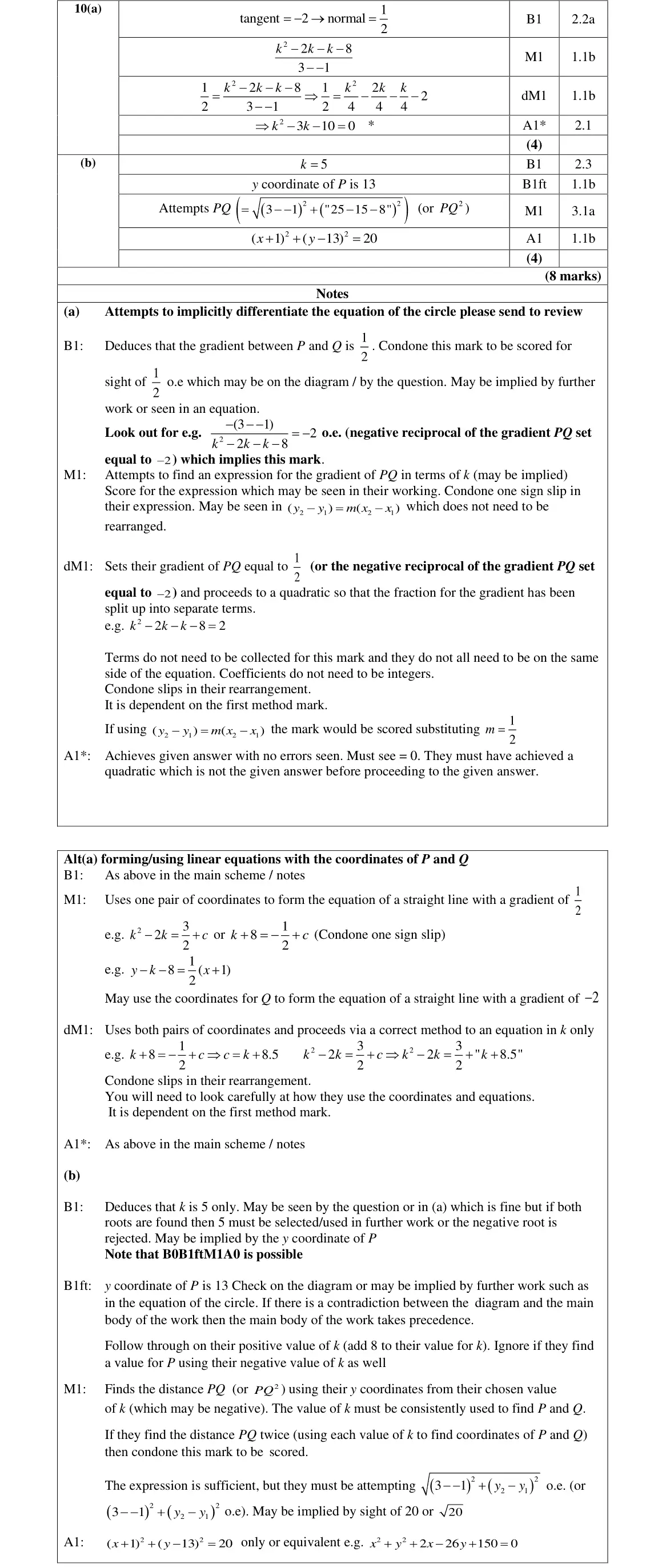
This question required problem solving skills and focused on coordinate geometry and circles. Part (a) required candidates to obtain a given equation. The most common route for this was to work out the gradient between P and Q and to set this equal to the negative reciprocal of the gradient of the tangent. Candidates attempting this route scored well. The other common route was to find two equations for radius using the coordinates of P and Q and the gradient of 1 2 . In general, candidates who had a strategy for the question did well on this part with just bracketing and sign errors being the major problem. Unfortunately, many did not appreciate the relevance of the gradient of the tangent of l would enable them to find the gradient of the normal to the curve at Q (hence the equation of the line between P and Q) and only typically scored one mark for being able to form an equation using the coordinates for Q with the given gradient of 2 - and not knowing where to go from there.
Common mistakes
tangent gradient −2 so radius PQ has gradient ½
(k² − 2k − k − 8)/(3 + 1) = ½
"= 0" needed
many did not link the tangent to the gradient of PQ
June 2024 · AS Paper 1 · Q10(b)4 marks
Mark scheme (whole question; this part is marked with the orange bar)
Examiner's comment
This question required problem solving skills and focused on coordinate geometry and circles. Part (b) required candidates to find the equation of the circle. Most candidates found both values of k but ignored the information in the question that k was a positive constant. Those who did appreciate this and used 5 k = went on with good success to find the coordinates of P, giving them the centre of the circle and Q which allowed them to calculate the radius and complete the question. This part was more often successfully answered than the “show” part (a), which showed good accessibility, as well as good exam technique by many candidates to still attempt a later part, even if they were unable to successfully answer the earlier part.
Common mistakes
k = 5 only (k positive, reject −2)
centre (−1, 13)
r² = PQ² = 4² + 2² = 20
(x + 1)² + (y − 13)² = 20
June 2024 · Paper 2 · Q14(a)3 marks
Mark scheme (whole question; this part is marked with the orange bar)
Examiner's comment
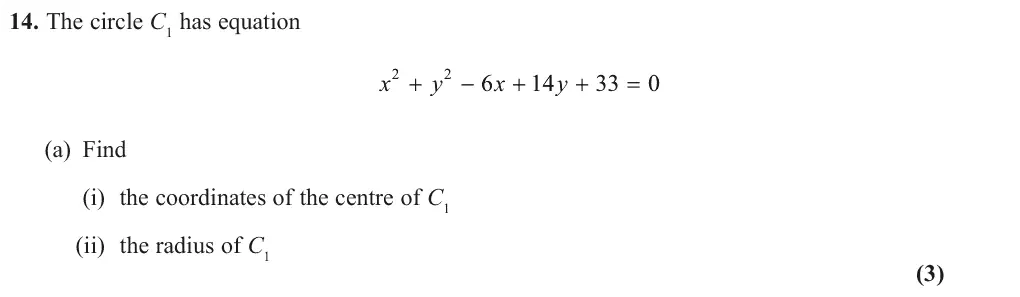
A common marking profile in this question was to score all three marks in (a) followed by zero marks in (b). In part (a) the most common approach was to complete the square and very often it was successful although there were a variety of incorrect answers for the centre – usually variations of ( ) 3, 7 . Quite a few knew the strategy for finding the radius although not all of them knew how to use it correctly and 91 r = was a frequently seen incorrect answer from attempting ( ) ( ) 2 2 3 9 7 49 33 0. x y - + + + + + = A surprising number of candidates evaluated 72 as something other than 49.
Common mistakes
complete the square: centre (3, −7)
r² = 9 + 49 − 33 = 25 so r = 5 (not √91, not ±5)
June 2024 · Paper 2 · Q14(b)5 marks
Mark scheme (whole question; this part is marked with the orange bar)
Examiner's comment
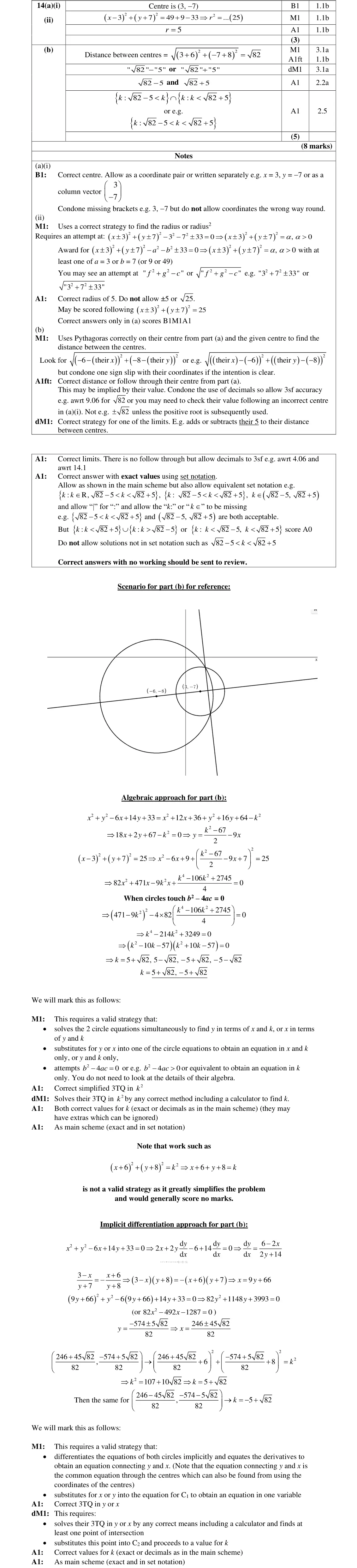
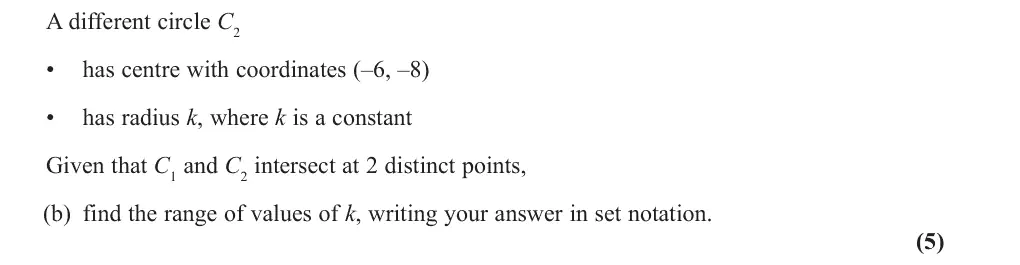
A common marking profile in this question was to score all three marks in (a) followed by zero marks in (b). In part (b), it was common for no marks to be scored and there were a large number of non- attempts. The most successful candidates were those who drew diagrams and looked at the problem geometrically. However, the most common approach was an algebraic one. This typically involved solving the 2 circle equations simultaneously, but the majority of such attempts were aborted before any marks were gained. There was also some poor use of algebra with things such as ( ) ( ) 2 2 3 7 25 3 7 5 x y x y - + + = -+ + = seen a surprising number of times and such attempts gained no credit. Many candidates did recognise that there would be a discriminant involved so they often arrived at a point when they thought that it would be appropriate to calculate one. However, this was usually prematurely. Despite this, it was noted that some examiners did report the occasional successful algebraic attempt. Some candidates calculated the equation of the line passing through the centres but then did not realise what they had to do with it. Most who were able to find the correct distance between the centres recognised they had to add and subtract the radius found earlier to give the limits of the solution set. Candidates who made it this far sometimes lost the final accuracy mark due to the use of incorrect notation. For candidates who got as far as the correct interval for k, the most successful were those who gave the final answer as a single set. Candidates who broke the answer into two sets, often used the incorrect symbol between them.
Common mistakes
distance between centres √82 by Pythagoras
two intersections when √82 − 5 < k < √82 + 5
answer in set notation (one set, or ∩ between two sets, not ∪)
a diagram makes it straightforward
solving simultaneously is long and usually aborted
June 2023 · AS Paper 1 · Q6(a)2 marks
Mark scheme (whole question; this part is marked with the orange bar)
Examiner's comment
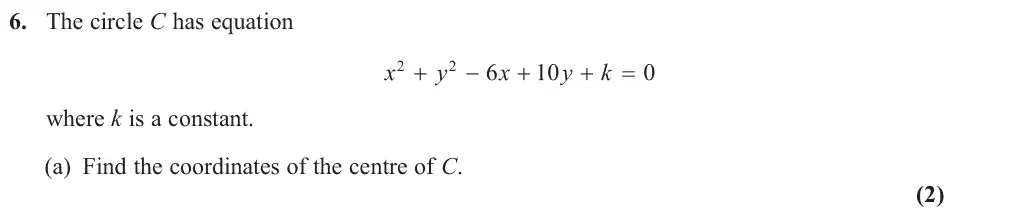
Part (a) of this question was well answered as candidates appeared to be able to complete the square to determine the coordinates of the centre as being ( ) 3, 5 - .
Common mistakes
complete the square: (x − 3)² + (y + 5)² = 34 − k
centre (3, −5), sign errors common
June 2023 · AS Paper 1 · Q6(b)3 marks
Mark scheme (whole question; this part is marked with the orange bar)
Examiner's comment
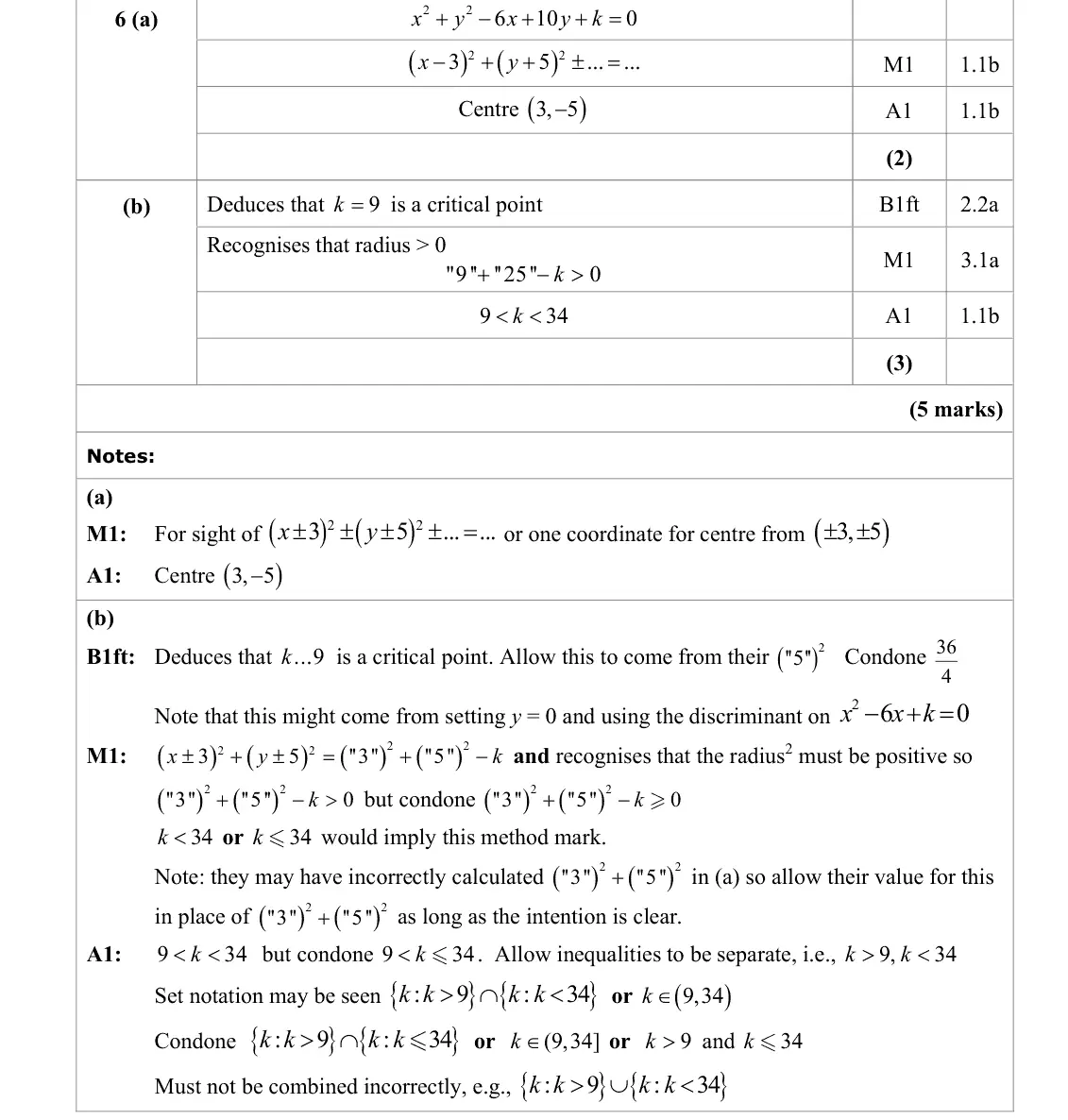
However, part (b) appeared to be inaccessible to the majority of candidates as they failed to interpret and/or k which arose from the requirement that the circle did not touch the x-axis. Here, the most common mistake was in assuming the circle must not touch the x-axis, resulting in 25 k . Some candidates approached this part of the question by substituting the coordinates of their centre and then using the discriminant involving k, while those who drew a decent sketch used the far simpler geometric approach and arrived at the result in a far more concise fashion. In contrast, a good number were able to determine the upper limit of k, 34 k . However, a good number of candidates did not attempt this part of the question, illustrating the candidates’ struggle with circle geometry and that, for many centres, it would be worth investing more time into developing deeper understanding of the various types of problems that can arise in circle geometry.
Common mistakes
not touching the x-axis needs radius < 5 (the modulus of the y coordinate of the centre), so 34 − k < 25 gives k > 9
radius² > 0 gives k < 34
answer 9 < k < 34
a sketch makes it much easier
many missed k > 9
June 2023 · Paper 1 · Q10(a)3 marks
Mark scheme (whole question; this part is marked with the orange bar)
Examiner's comment
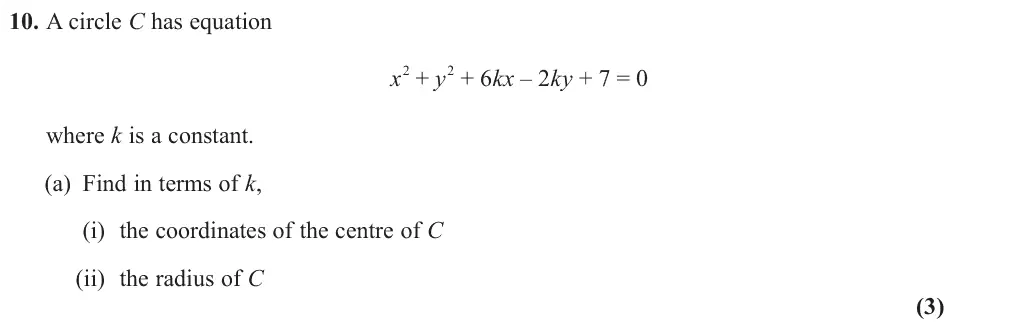
Candidates were typically able to make good progress in part (a) with the method of completing the square being familiar to many when dealing with the equation of the circle. Part (b) was focused on using the discriminant and solving a quadratic inequality, however, the manipulation proved to be a lot for some, resulting in a wide range of marks. Again, the access was good on this question such that candidates who could not do part (a) were not restricted from attempting part (b), although those with errors from part (a) often found that this caused issues in part (b) and resulted in losing many of the marks. In general candidates obtained ( 3 , ) k k - as the centre of the circle in part (a). Common errors included (3 , ) k k - and ( 3 , ) kx ky - . If candidates were successful at completing the square, they could find the correct radius of the circle. When attempting to complete the square a common error was to subtract 2 3k instead of( ) 2 3k . Occasionally, candidates would find 2 2 10 7 r k = - but did not proceed to take the square root. Those who collected terms on the right-hand side of the equation in order to form the square of the radius made fewer sign errors than those who did not. Others tried to manipulate the equation mentally, so writing down a wrong radius with no evidence of its development (and thus no method mark). One error was to write 2 10 7 10 7 k k - = - . Sometimes there were sign slips such as writing the 7 - as +7 when rearranging the equation.
Common mistakes
complete the square to get centre (−3k, k) and radius √(10k² − 7)
not ±√ and not halved
June 2023 · Paper 1 · Q10(b)6 marks
Mark scheme (whole question; this part is marked with the orange bar)
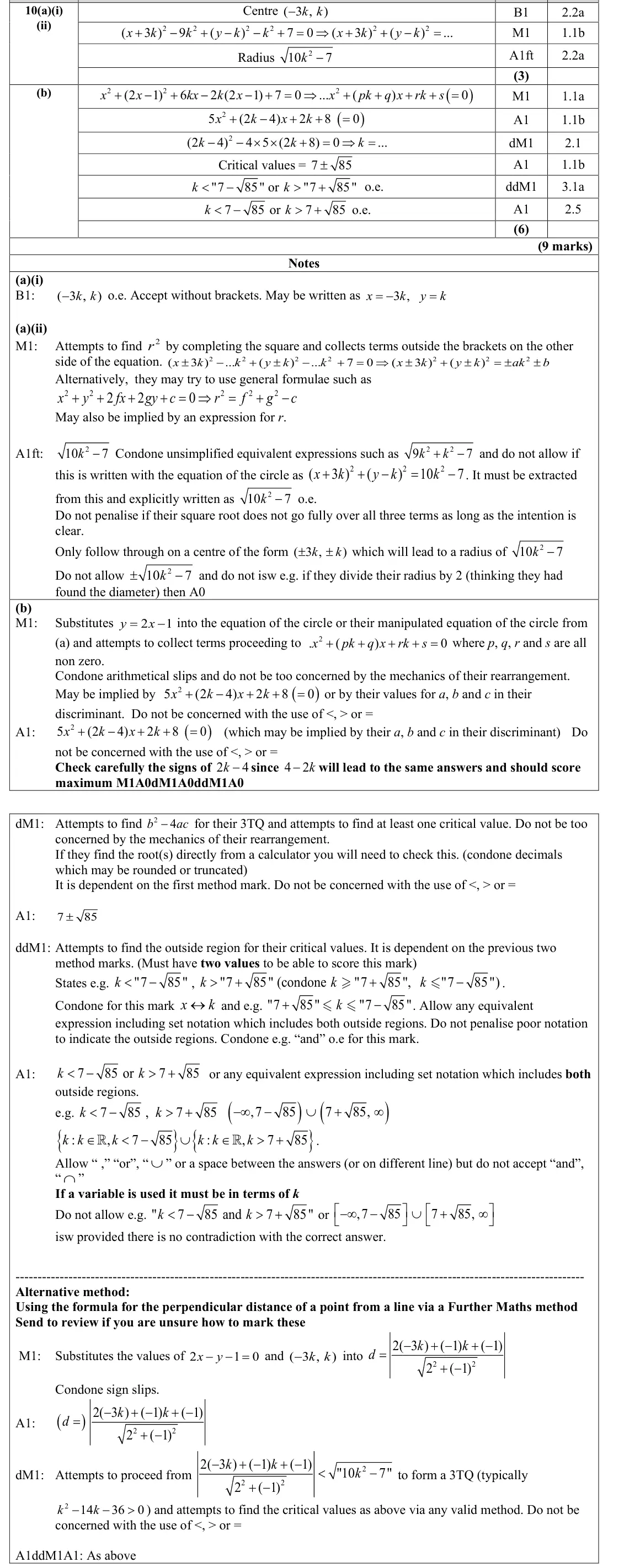
Examiner's comment
Candidates were typically able to make good progress in part (a) with the method of completing the square being familiar to many when dealing with the equation of the circle. Part (b) was focused on using the discriminant and solving a quadratic inequality, however, the manipulation proved to be a lot for some, resulting in a wide range of marks. Again, the access was good on this question such that candidates who could not do part (a) were not restricted from attempting part (b), although those with errors from part (a) often found that this caused issues in part (b) and resulted in losing many of the marks. In part (b), whilst a number of candidates had little idea how to proceed, the vast majority did realise what was required and attempted to produce an equation in x by substitution. Many lost their way in the algebraic complexity, or did not know what to do with the equation (sometimes trying to solve it to find a value for k). A significant number of candidates did produce a three-term quadratic for x, with coefficients in terms of k. Centres should note that the scheme required the quadratic in x to be of the form specified, and that it be set out in a way which identified the coefficients (possibly implied by later use in the discriminant). So, for example, “ (2 4) k - x” was required rather than “ 2 4 kx x - ” as this provided evidence of recognising that the coefficients were the key to solving this problem. Quite a few candidates had a constant term which was not of the required form which meant that no marks could be scored. In general candidates who found critical values for their discriminant by solving 2 4 0 b ac - = were more successful than those who expressed it as an inequality. Often the inequality was simply carried forward to a statement about k; those who identified the two critical values by solving an equation perhaps thought more carefully about where the region was. The “need” to write a single inequality was seemingly pressing for many, so 7 85 7 85 k + - was seen. A few candidates did not use exact values of k and lost the final accuracy mark. Some candidates used 'and' with their two regions, however, most recognised that this needed to be 'or', either stating this explicitly or just using a comma between their two answers. A number of capable candidates brought some interesting approaches to bear on the problem, adopting a variety of techniques from Further Maths specifications.
Common mistakes
substitute y = 2x − 1 into the circle
b² − 4ac > 0
critical values 7 ± √85
outside region with "or" or ∪, not "and"
June 2022 · AS Paper 1 · Q11(a)3 marks
Mark scheme (whole question; this part is marked with the orange bar)
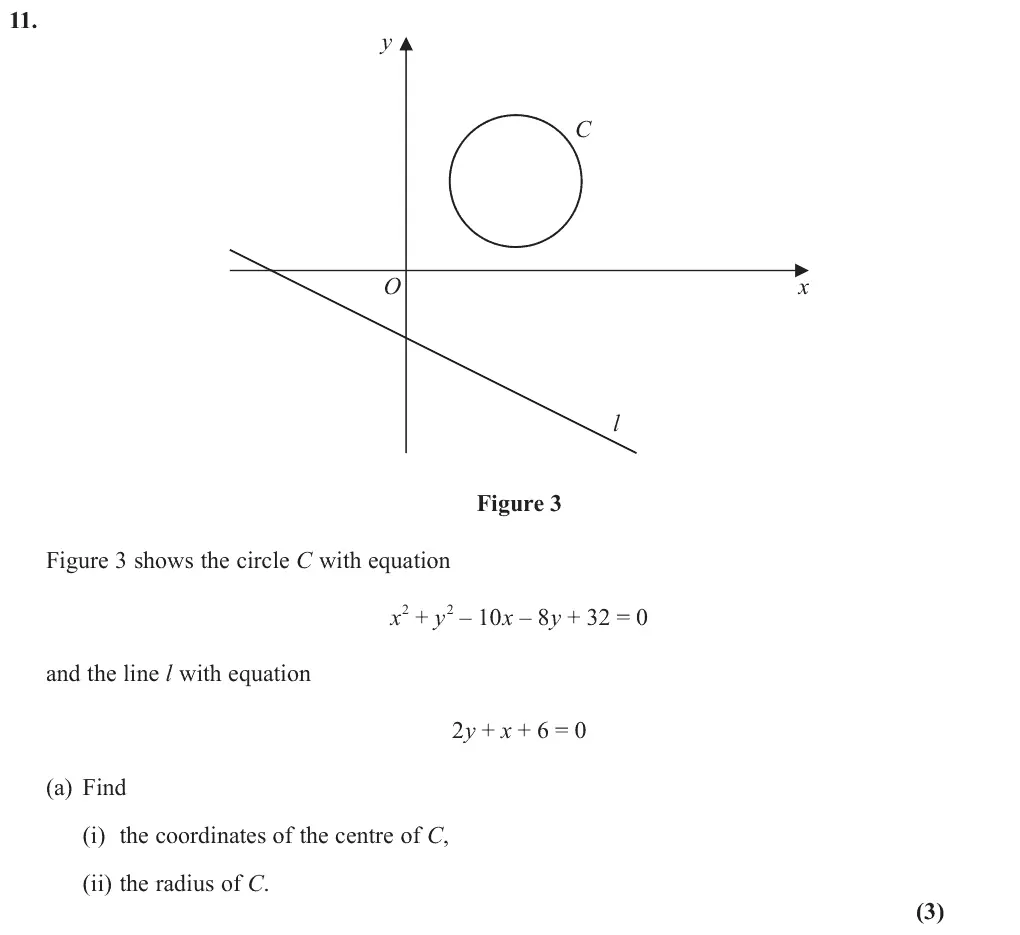
Examiner's comment
This question often enabled candidates to score marks in the first part, however, part (b) proved to be very good at discriminating between the most able candidates. In part (a), there were very few non attempts. Unfortunately, some did not know how to complete the square correctly and used 10 and 8, thus losing the marks. The majority of candidates achieved full marks, however or two marks because of a slip, usually in finding the radius.
Common mistakes
complete the square: (x − 5)² + (y − 4)² = 9
centre (5, 4), radius 3 (not using 10 and 8)
June 2022 · AS Paper 1 · Q11(b)5 marks
Mark scheme (whole question; this part is marked with the orange bar)
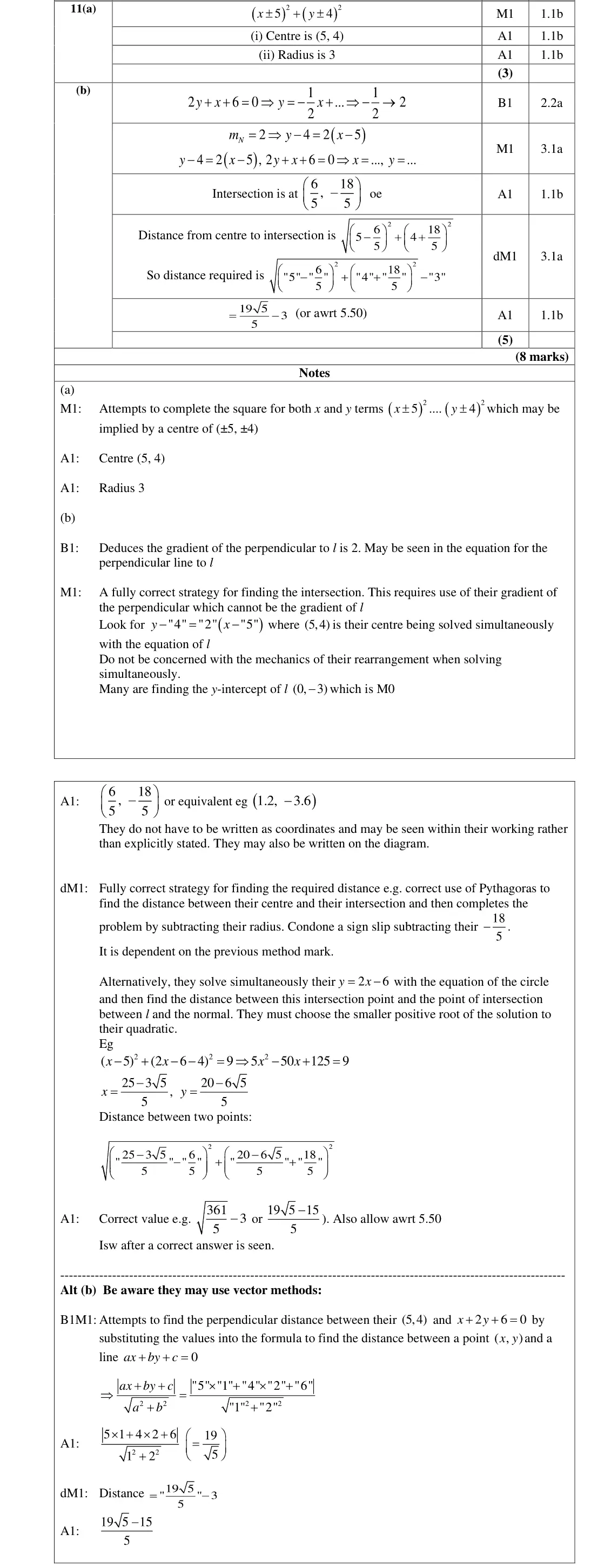
Examiner's comment
This question often enabled candidates to score marks in the first part, however, part (b) proved to be very good at discriminating between the most able candidates. Part (b) was challenging for many; non attempts or attempts which achieved no marks were common. Quite a few candidates scored the B mark for the gradient of the perpendicular and some went on to find the equation of the normal, but they did not find the point of intersection of the straight lines and so could not progress to the remaining marks. It was common to see one of the straight-line equations substituted into the equation of the circle. Those who substituted the normal equation and had also found the point of intersection of the straight lines, often correctly found the distance between the points correctly and gained full marks. Those who found the distance between the centre and the point of intersection of the straight lines, often forgot to subtract 3 for the radius, thus losing the last two marks. A large number of candidates found the y intercept of the line l, and then the distance between (0,3) and the centre. A very small number of candidates used a vector method.
Common mistakes
the normal to l through the centre has gradient 2
intersect with l at (6/5, −18/5)
distance from the centre minus the radius 3 (often forgotten)
using the y-intercept (0, −3) is wrong
(19√5 − 15)/5 ≈ 5.50
June 2022 · Paper 1 · Q3(a)3 marksEasy
Mark scheme (whole question; this part is marked with the orange bar)
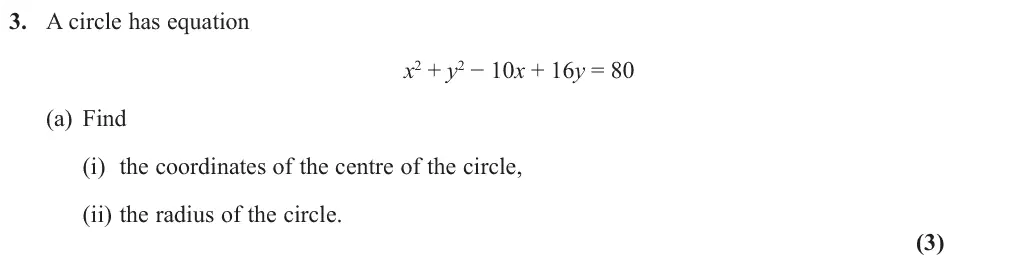
Examiner's comment
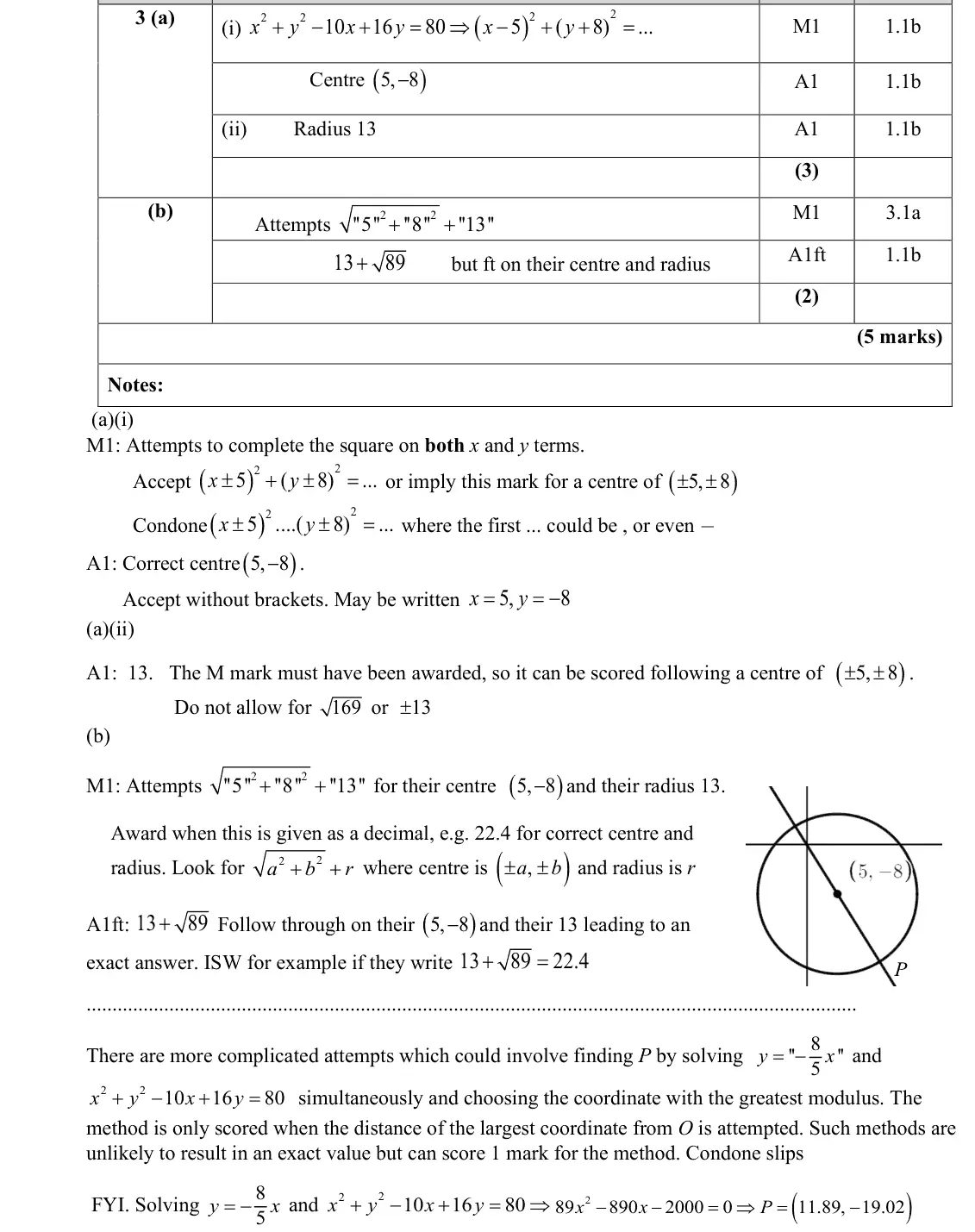
This question on the geometry of a circle had standard bookwork in part (a) followed by problem solving in part (b). Success in part (b) was usually achieved by candidates who drew a diagram. In part (a) most candidates scored all three marks. Some candidates made sign errors when completing the square but still obtained some version of (± 5, ± 8). Many candidates were still able to get the correct radius following this slip. A significant minority of candidates obtained a centre of (5, - 4) seemingly from square rooting the 16 rather than halving.
Common mistakes
complete the square on x and y: (x − 5)² + (y + 8)² = 169
centre (5, −8), radius 13 (not ±13)
centre (5, −4) from rooting 16 instead of halving
June 2022 · Paper 1 · Q3(b)2 marksEasy
Mark scheme (whole question; this part is marked with the orange bar)
Examiner's comment
This question on the geometry of a circle had standard bookwork in part (a) followed by problem solving in part (b). Success in part (b) was usually achieved by candidates who drew a diagram. In part (b), there was full follow through on the centre and radius, which allowed many candidates to score full marks despite errors in part (a). Candidates who drew a diagram worked out that they need to find the distance of the centre from the origin and add on the radius. One lengthy method involved finding the intersection of the circle with the line through O and C, but this was unlikely to give the requested exact answer, and some candidates gave up at the point where the quadratic had to be solved as it had unpleasant coefficients. A common error was based on simply doubling the radius, either as 26 or finding the length of the vector (10, -16) as 2 Ö89.
Common mistakes
OP = distance from O to the centre + radius = √89 + 13 (exact)
draw a diagram
doubling the radius (26) or 2√89 are common errors
intersecting the line OC with the circle is long and rarely exact
Oct 2021 · AS Paper 1 · Q15(a)2 marks
Mark scheme (whole question; this part is marked with the orange bar)
Examiner's comment
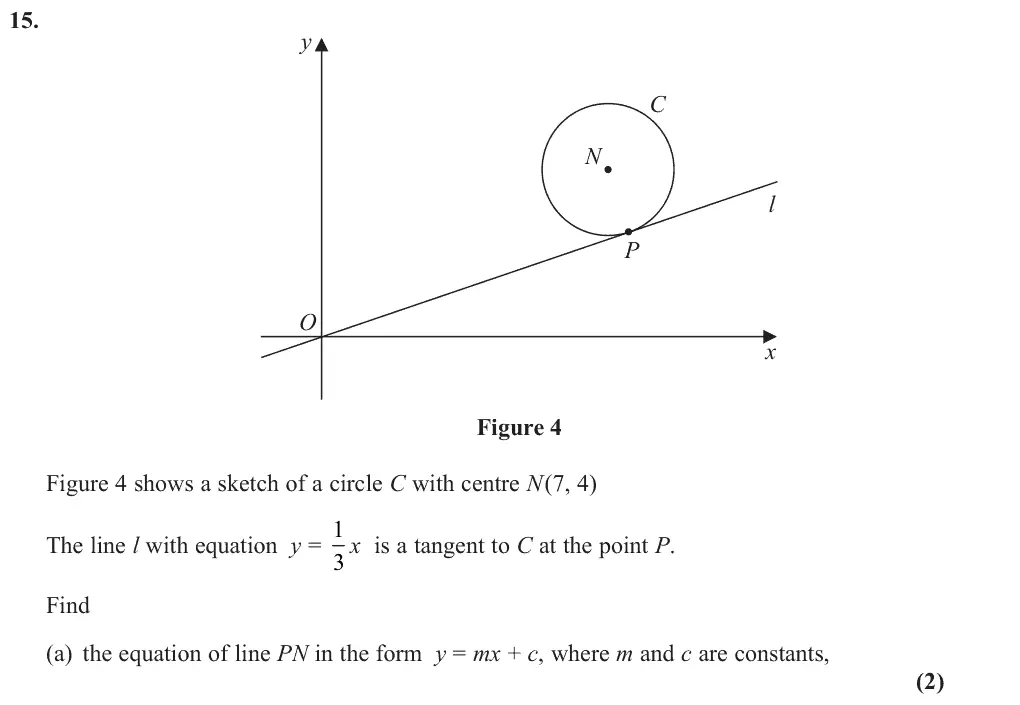
9 This question provided a good range of marks between the candidates, although nearly all candidates struggled to proceed to the final answer in part (c). There were also several blank responses on this question which may have been down to candidates either running out of time or just getting overwhelmed towards the end of a paper. In part (a), candidates were usually able to find the equation of the line. The odd error in rearranging their equation of the line or incorrectly sub substituting in the coordinates for x and y were the few situations where full marks were not scored.
Common mistakes
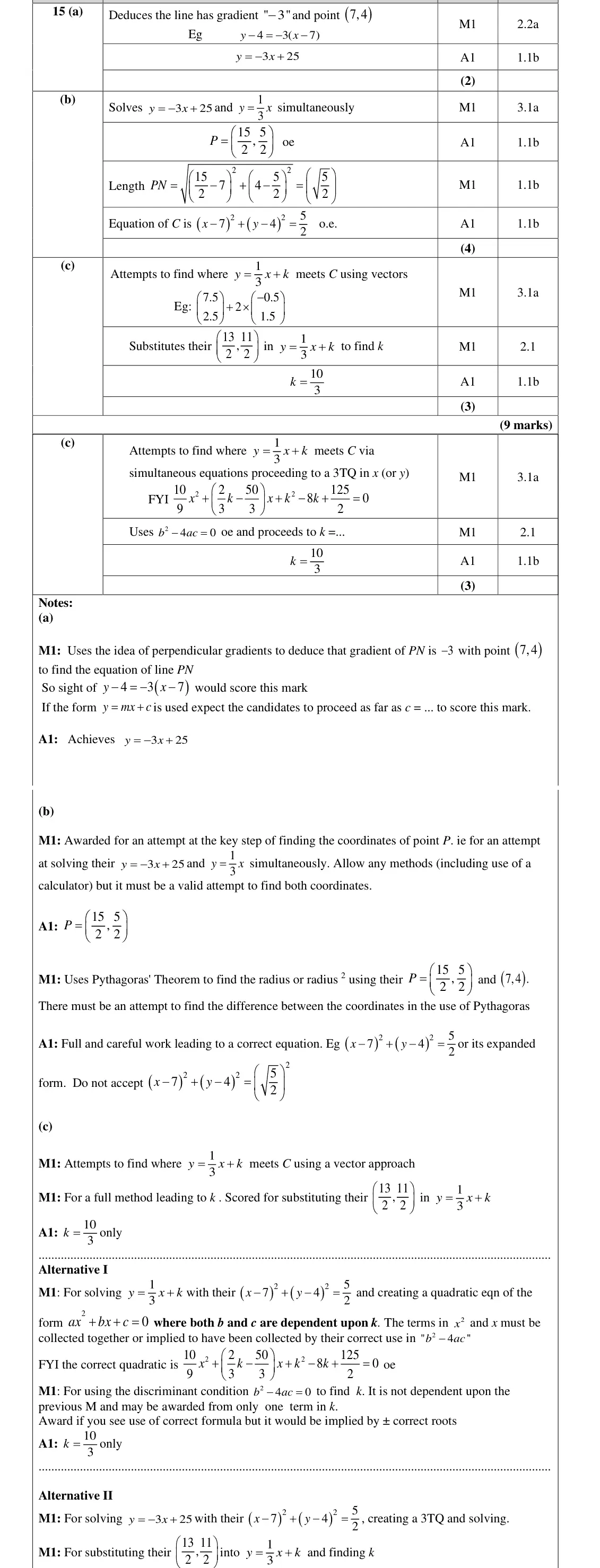
radius NP is perpendicular to the tangent so gradient −3 through (7, 4): y = −3x + 25
Oct 2021 · AS Paper 1 · Q15(b)4 marks
Mark scheme (whole question; this part is marked with the orange bar)
Examiner's comment
9 This question provided a good range of marks between the candidates, although nearly all candidates struggled to proceed to the final answer in part (c). There were also several blank responses on this question which may have been down to candidates either running out of time or just getting overwhelmed towards the end of a paper. Part (b) was generally attempted well. Most knew and attempted to find the point where the two lines intersected each other and found the point P correctly. They were then able to find the radius and usually proceeded to find the equation of the circle. Sometimes the equation of the circle had the squared missing from the brackets or it was equated to the radius rather than 2r .
Mark scheme (whole question; this part is marked with the orange bar)
Examiner's comment
9 This question provided a good range of marks between the candidates, although nearly all candidates struggled to proceed to the final answer in part (c). There were also several blank responses on this question which may have been down to candidates either running out of time or just getting overwhelmed towards the end of a paper. Part (c) was either not attempted at all or candidates made an attempted but abandoned due to the expressions formed appearing so complicated that it seemed as though they were convinced they had gone wrong. Usually, candidates opted to substitute their part (a) answer into their part (b) equation of the circle. To score the first mark candidates had to multiply out the brackets and collect terms together to form a 3TQ where k was in both the b and c coefficients of the quadratic. Some candidates stopped before getting this far, although it was pleasing that some continued to persevere and pick up the first mark. Those who continued, realised the discriminant needed to be used, but disappointingly once they had their expression also decided to stop even if they had a quadratic in k which they could solve. Therefore only 1 or no marks was scored in nearly all responses. The easiest way was the vector approach, which was seen, but far too frequently, and even then, it was only a few candidates who were able to score full marks on this question.
Common mistakes
the other tangent touches at the opposite end of the diameter through P: (13/2, 11/2), then k = 10/3
via simultaneous equations the quadratic in x has b and c depending on k and b² − 4ac = 0 (k = 0 is rejected)
candidates often abandoned the messy algebra
Oct 2021 · Paper 1 · Q7(a)4 marks
Mark scheme (whole question; this part is marked with the orange bar)
Examiner's comment
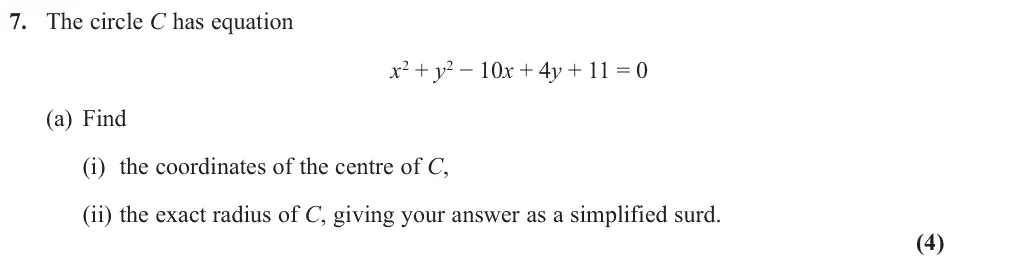
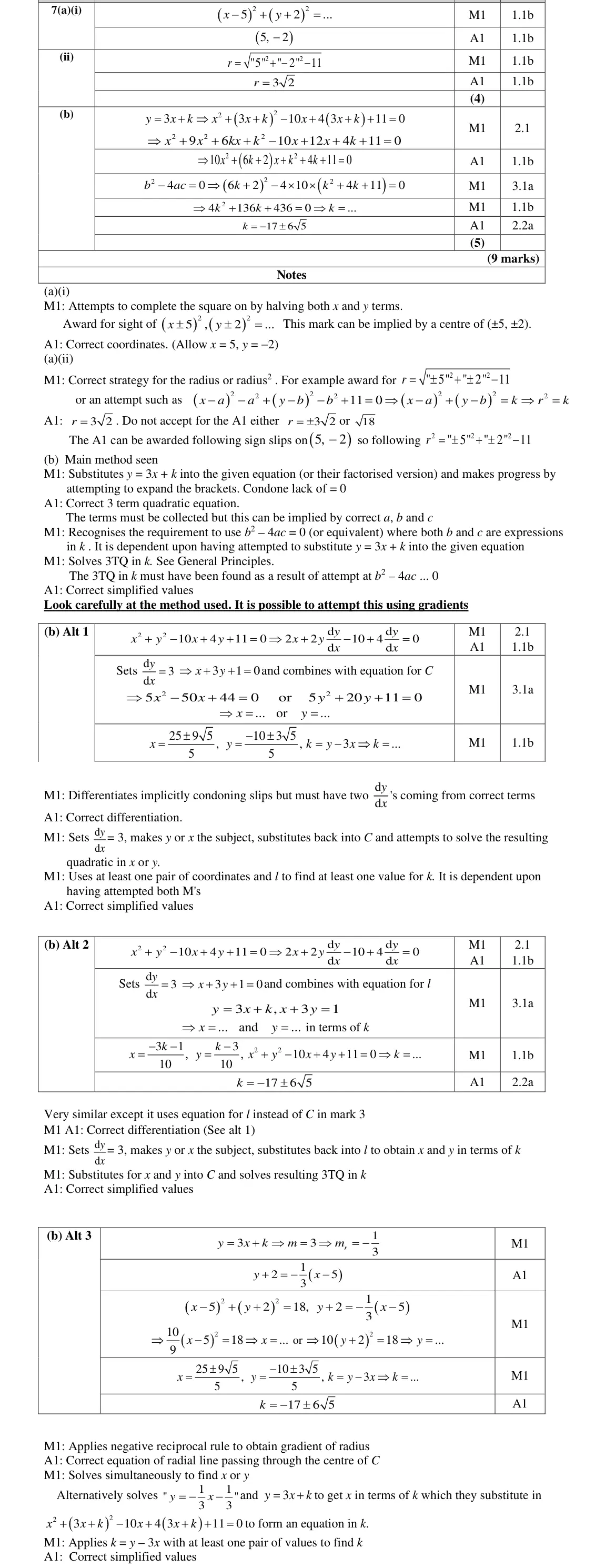
The first few marks in this question were very accessible but the final part of the question proved to be a useful discriminator especially around grade C and below. Part(a) The majority of candidates achieved full marks in this part. Sign errors were responsible for most errors, although failure to halve was also seen with either or both of (x ±10)2 and (y ± 4)2 being seen. Having achieved (x-5)2+(y+2)2 = 18, it rare to see the centre or radius not found correctly.
Common mistakes
complete the square: (x − 5)² + (y + 2)² = 18
centre (5, −2)
r = 3√2, not ±3√2 or √18
halving errors
Oct 2021 · Paper 1 · Q7(b)5 marks
Mark scheme (whole question; this part is marked with the orange bar)
Examiner's comment
The first few marks in this question were very accessible but the final part of the question proved to be a useful discriminator especially around grade C and below. Part (b) This part was found to be discriminating with complete solutions seen from only the most competent of candidates. The most common approach was to substitute y = 3x + k into the circle equation to find a quadratic in x (with coefficients in terms of k) for the points of intersection. Errors mostly arose when (3x + k +2)2 was expanded incorrectly or the 2x + 6kx terms not being gathered together. Many solutions then stopped after the substitution and expansion step, as candidates did not seem to appreciate what to do with an equation of this complexity in two variables. Application of b 2 = 4ac to find equal roots was used on many occasions but errors frequently occurred. Only a very few solutions involved attempts via b2 - 4ac > 0. It was not always obvious to see how a student had solved their quadratic (formula not quoted and values for a, b and c not seen) but a limited number of correct solutions were seen. Using a calculator quadratic solver was frequent and acceptable. Several attempts started by using implicit differentiation on the circle equation. Although this is a possible method, it did not often go beyond using dy/dx = 3 to get x+3y+1= 0. Another method seen several times was to find the equation of the normal ( i.e. the radius ) to try to make progress towards finding values of k, but this method also seldom went further than the equation of the line.
Common mistakes
substitute y = 3x + k into the circle to get 10x² + (6k + 2)x + k² + 4k + 11 = 0
tangent means b² − 4ac = 0
k = −17 ± 6√5
alternatives via the radius gradient −1/3 or implicit differentiation rarely completed
Oct 2020 · AS Paper 1 · Q11(i)5 marks
Mark scheme (whole question; this part is marked with the orange bar)
Examiner's comment
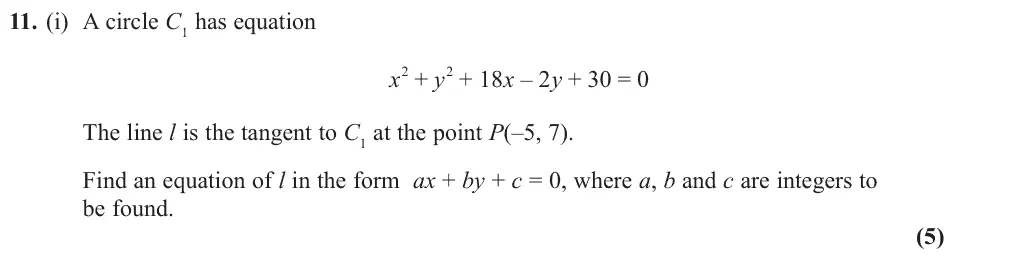
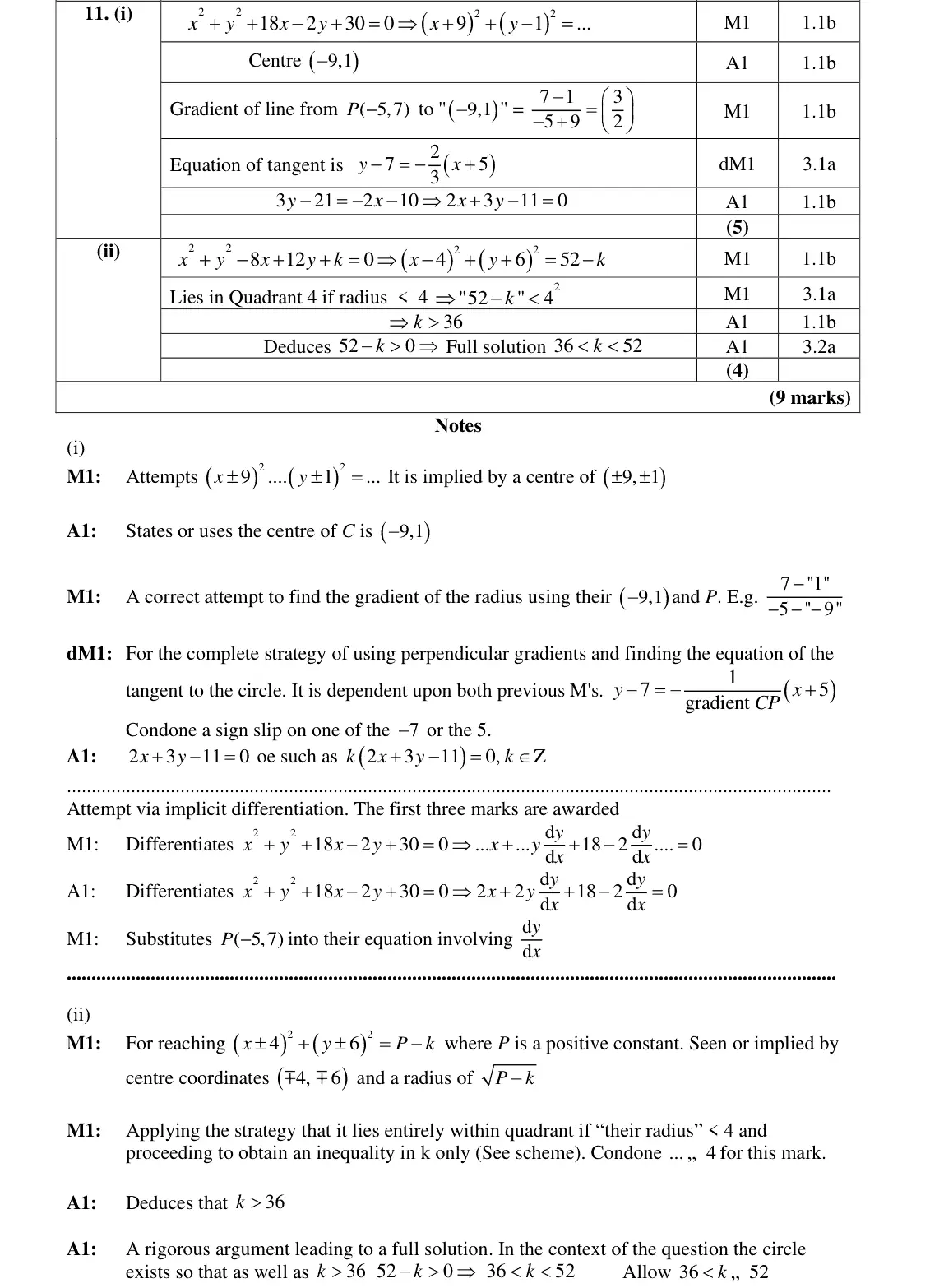
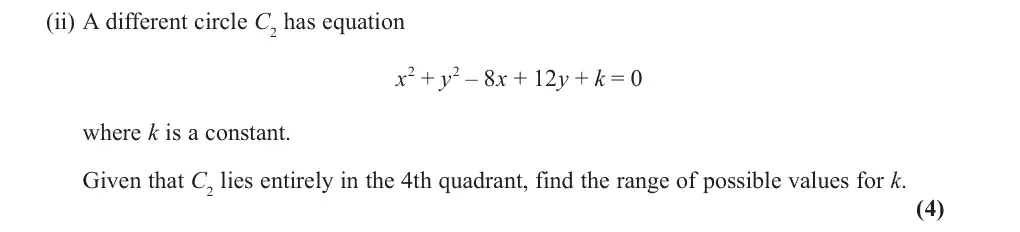
Candidates were generally successful in answering the first part of this question, but found the second part more challenging, with only a few gaining full marks. In part (i), most candidates were confident in completing the square to find the coordinates of the centre of the circle, and many could then successfully find the gradient of the line from the centre to the given point. There were still a number of candidates who made sign errors when finding the gradient, however. Some candidates forgot to then find the negative reciprocal of this gradient in order to find the tangent, and a few did not give their final answer in the requested form, but this was generally answered well. Candidates should be reminded to check the form that the answer should be given in to ensure that they score marks that they are more than capable of achieving. In part (ii), again most candidates were confident in completing the square and finding the radius of this circle in terms of k, but a number then stated this radius needed to be less than 6, rather than saying it needed to be less than 4. There were a large number who made errors + 52 k just rearranging the equation resulting in the radius as . Only a very small number of k candidates picked up the final mark for realising that, in addition to , we also required 36 k in order for the circle to actually exist. 52
Common mistakes
centre (4, −6), radius √(52 − k)
in the 4th quadrant needs radius < 4 (distance from the centre to the y-axis, not 6) so k > 36
circle exists needs 52 − k > 0
36 < k < 52
Oct 2020 · Paper 1 · Q11(a)4 marks
Mark scheme (whole question; this part is marked with the orange bar)
Examiner's comment
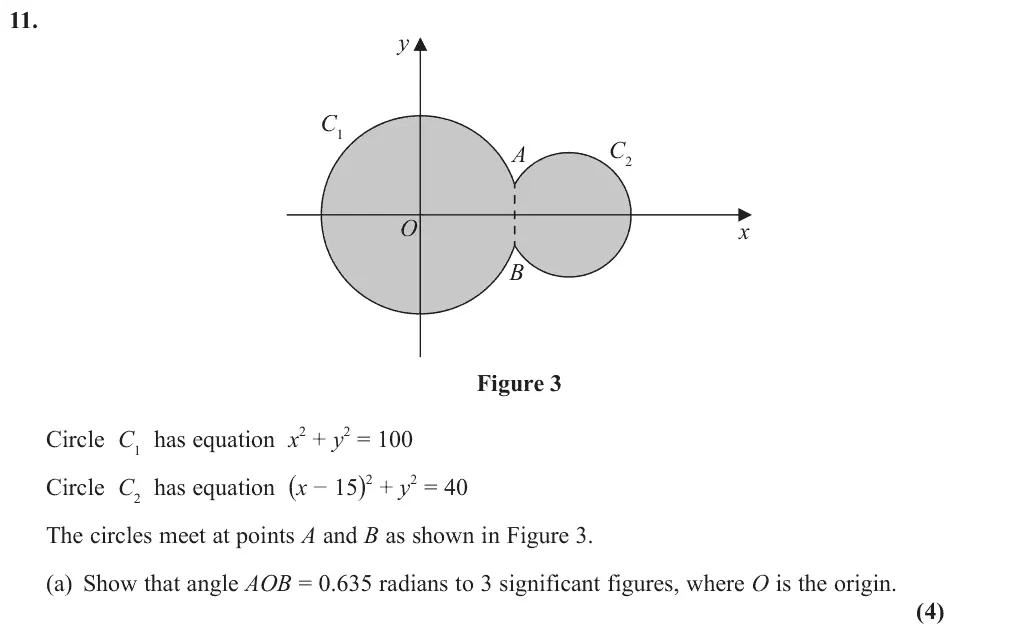
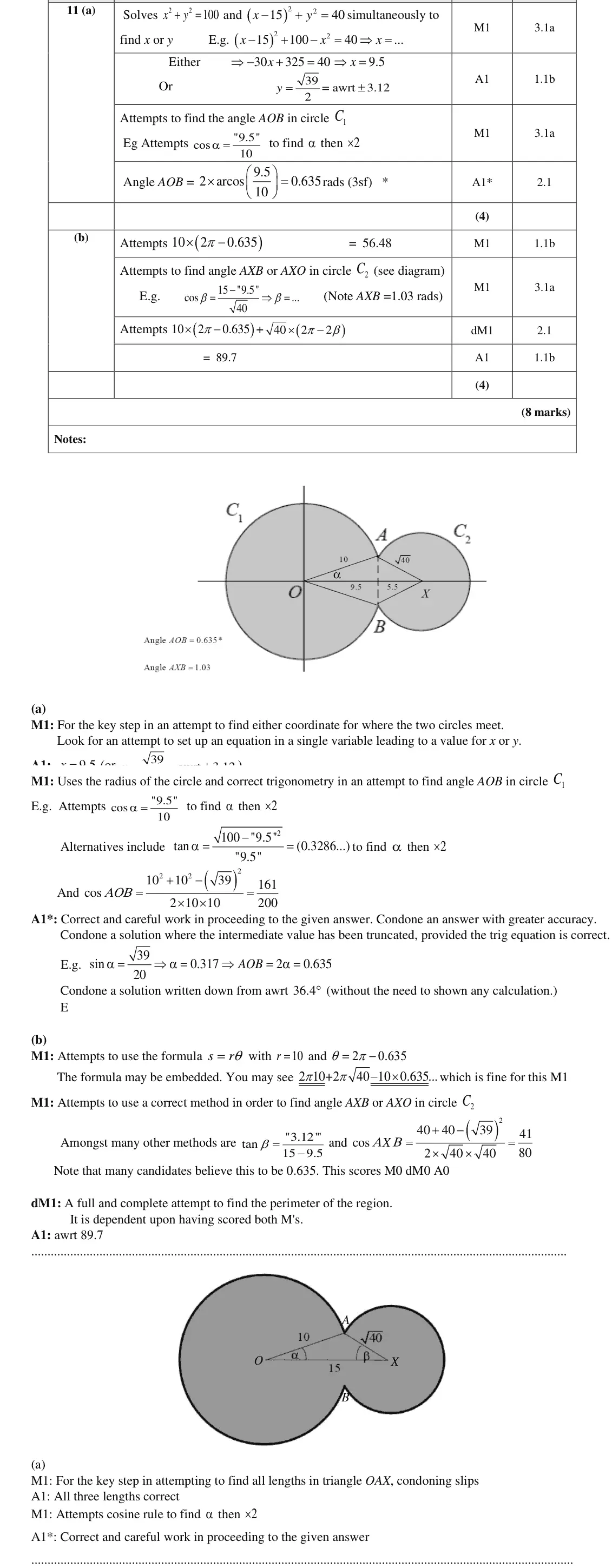
This proved to be a challenging question with very few candidates achieving full marks (a) Candidates used a variety of approaches. The most common started by using algebra to find the coordinates of the points where the circles meet. This was achieved correctly by a majority of those who did the question this way. Then the required angle was found either by trigonometry in a right angled triangle and doubling an angle, or by the cosine rule in triangle AOB. Errors in this approach included processing x2+y2=100 into x+y=10. Although a minority of candidates’ answers stopped after finding coordinates for A or B, there were a significant number who went on to score the remaining 2 marks. However, some did not seem to realise that length OA=10 as it is a radius of C1, and had to use the distance formula to find this length. Another approach that was seen, but not so frequently was to use knowledge of circle equations in finding the radii and centres, to establish the lengths of the sides of triangle OAX, with X being the centre of circle C2. Using the cosine rule then led to half of the required angle. When used, this method often gained all four marks. (See relevant diagram below)
Common mistakes
solve the circle equations simultaneously, x = 9.5 (x² + y² = 100 is not x + y = 10)
OA = 10 is the radius
cos α = 9.5/10, AOB = 2α = 0.635
Oct 2020 · Paper 1 · Q11(b)4 marks
Mark scheme (whole question; this part is marked with the orange bar)
Examiner's comment
This proved to be a challenging question with very few candidates achieving full marks overall, and with many more difficulties encountered in (b) rather than (a). (b) It was very common to see just the first mark scored in this part. This was due to many candidates wrongly assuming that the given angle AOB=0.635 was the same size as the angle AXB at the centre of circle C2. For the minority of candidates who tried a correct method to find the size of angle AXB, or half of it, most of these achieved the correct values of either 1.03 or 0.516. Even for the minority of candidates who found one of these angles correctly, getting the final answer correct proved a challenge and only a very small minority managed this. Note that it was possible to do part (b) even if (a) was not attempted. However, it seemed that failure to find a way to do (a), led in nearly every case to no valid attempt at (b).
Common mistakes
major arc of C₁ is 10(2π − 0.635)
angle AXB at the centre of C₂ is 1.03, not 0.635 (very common error)
add √40(2π − 1.03)
perimeter 89.7
Oct 2020 · Paper 2 · Q14(a)3 marks
Mark scheme (whole question; this part is marked with the orange bar)
Examiner's comment
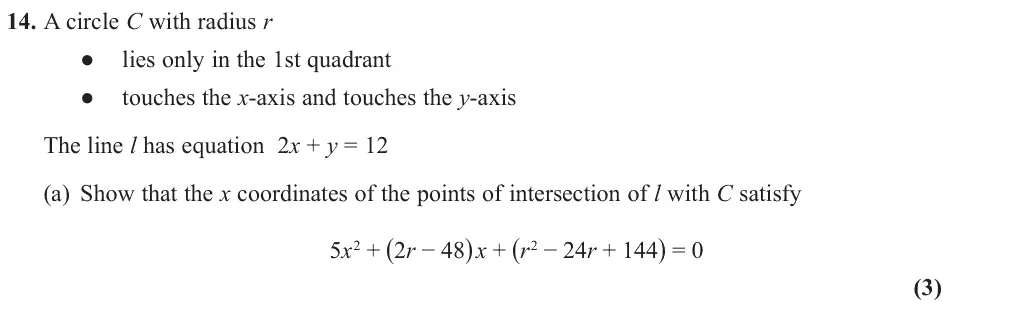
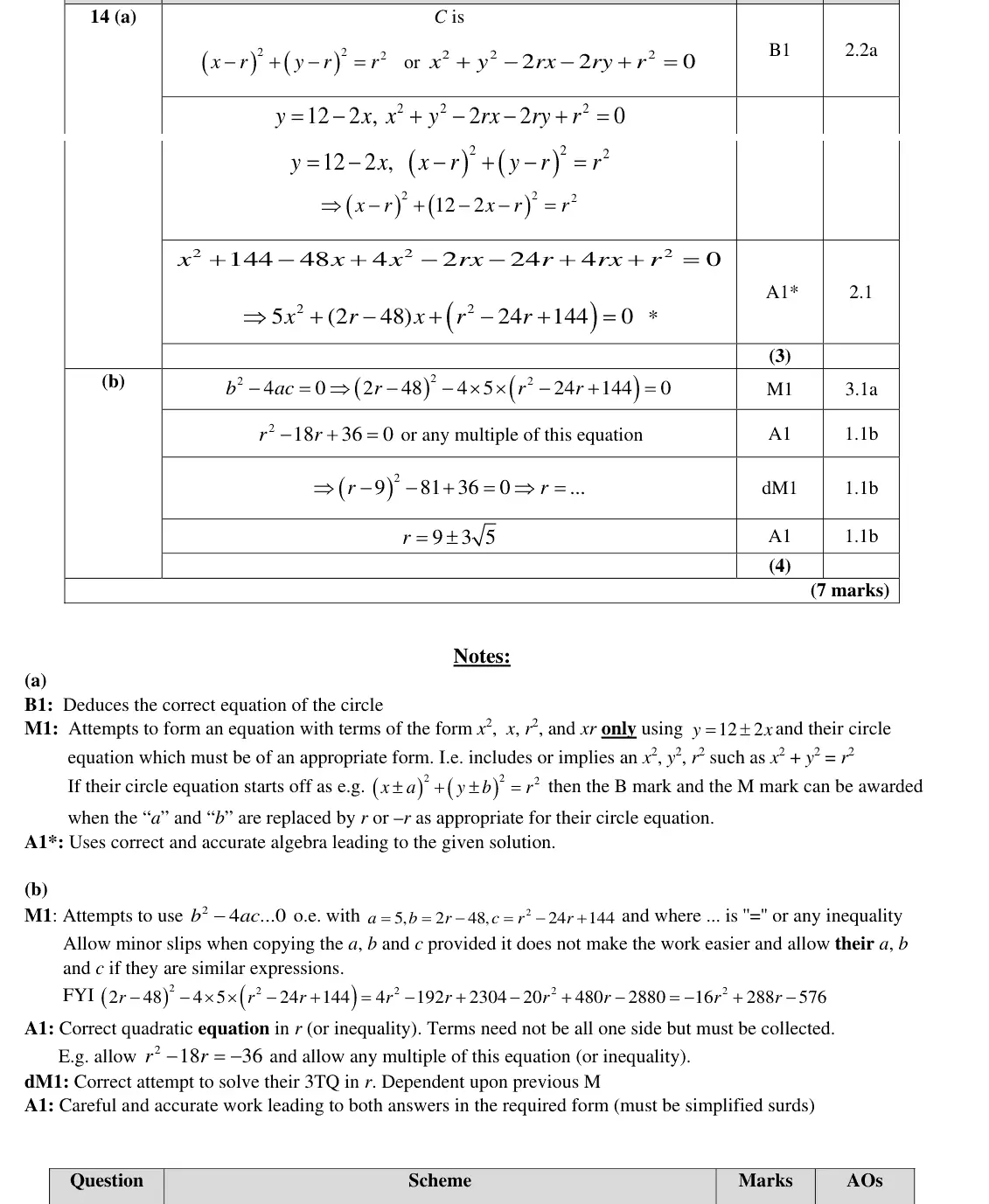
Part (a) presented some thinking challenges for many candidates, in particular spotting that a = b = r in their equation for the circle. About half of the candidates were not able to deduce the correct equation of the circle. The most commonly seen incorrect equations were 𝑥𝑥2 + 𝑦𝑦2 = 𝑟𝑟2 , (𝑥𝑥+ 𝑟𝑟)2 + (𝑦𝑦+ 𝑟𝑟)2 = 𝑟𝑟2 and (𝑥𝑥 ± 𝑎𝑎)2 + (𝑦𝑦 ± 𝑏𝑏)2 = 𝑟𝑟2. Some of these candidates managed to gain the method mark for using 𝑦𝑦= 12 – 2𝑥𝑥, but a disappointingly high number didn’t progress. Relatively few candidates who initially used 𝑎𝑎 and 𝑏𝑏, correctly replaced them with 𝑟𝑟 to attain at least one mark. Some candidates tried to use a sketch to help them. This did allow some to identify the centre as (𝑟𝑟, 𝑟𝑟), but many put the circle in the wrong quadrant and proceeded to use (𝑟𝑟, -𝑟𝑟) or (-𝑟𝑟, 𝑟𝑟). The majority of candidates who gained the B1 and M1 expanded their expressions correctly to give the correct equation and attain the A1, although the algebra involved in squaring the 3-term expression (𝑟𝑟2 -24𝑟𝑟+ 144)was not always carried out correctly. Candidates were generally more successful when they expanded (𝑦𝑦-𝑟𝑟)2 first before substituting 𝑦𝑦= 12 - 2𝑥𝑥.
Common mistakes
touching both axes in the 1st quadrant gives centre (r, r)
not x² + y² = r² or centre (−r, r)
substitute y = 12 − 2x and expand carefully
Oct 2020 · Paper 2 · Q14(b)4 marks
Mark scheme (whole question; this part is marked with the orange bar)
Examiner's comment
Part (b) proved to be more accessible to most candidates. Many recognised the need to use the discriminant and equate to zero, though poor algebraic manipulation often cost them the accuracy marks. Almost all candidates used a calculator to solve the quadratic, though there were examples of the quadratic formula being used, mainly correctly. A small number resorted to calculus to find a gradient, but very few successfully attempted to differentiate their equation and set the gradient to -2. A few tried to use the idea of gradient or even equate the equation with 12 – 2𝑥𝑥.
Common mistakes
tangent so b² − 4ac = 0
simplifies to r² − 18r + 36 = 0
r = 9 ± 3√5 as simplified surds
June 2019 · AS Paper 1 · Q10(a)3 marksEasy
Mark scheme (whole question; this part is marked with the orange bar)
Examiner's comment
(a) This was generally answered successfully with candidates able to complete the square and set the equation in the correct format. Usual numerical errors when manipulating equation led to sign errors and a wrong value for r 2.
Common mistakes
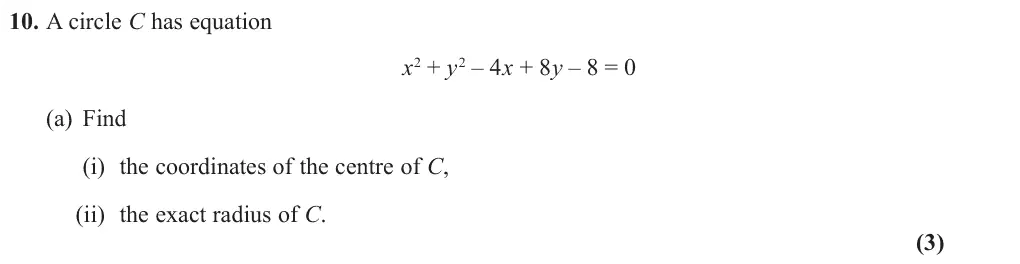
complete the square: (x − 2)² + (y + 4)² = 28
centre (2, −4)
radius √28 = 2√7 (sign slips with r²)
June 2019 · AS Paper 1 · Q10(b)2 marksEasy
Mark scheme (whole question; this part is marked with the orange bar)
Examiner's comment
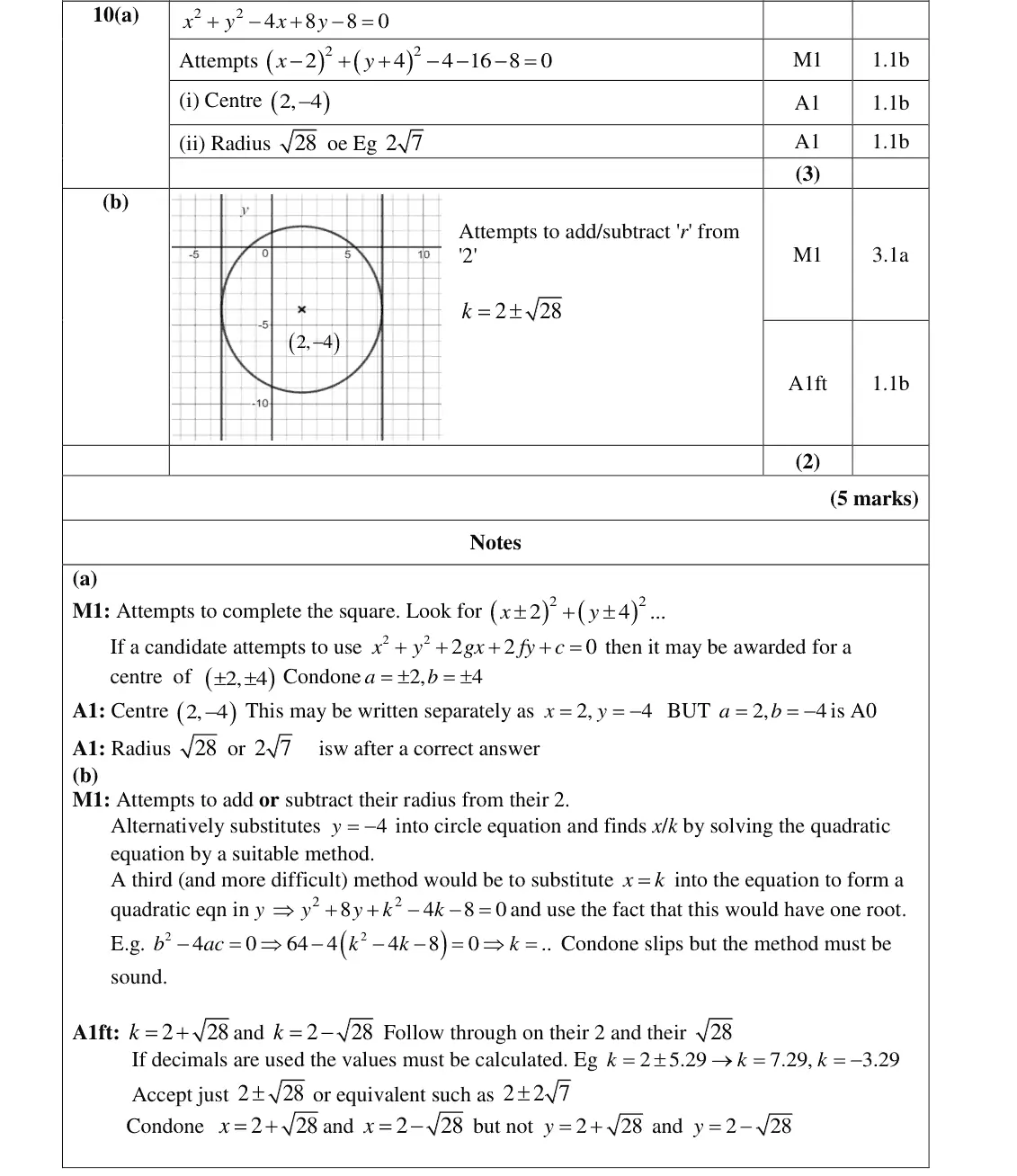
(b) Candidates need to use the marks available as a guide to how much work they need to be doing. The most common error was to fail to recognise that x = k is a vertical straight line. Those who sketched a diagram were able to deduce the values of k by adding and subtracting their radius from the centre’s x-coordinate. However many, many candidates opted to equate the line x = k with the circle equation using substitution which led to a complicated manipulation and use of the discriminant to achieve their final answer. Of those who attempted this method, few were successful with most abandoning their method before reaching a conclusion.
Common mistakes
x = k is a vertical line: k = 2 ± √28 (centre x ± radius)
a sketch helps
substituting x = k and using the discriminant is long and usually abandoned
June 2019 · Paper 2 · Q46 marks
Mark scheme (whole question; this part is marked with the orange bar)
Examiner's comment
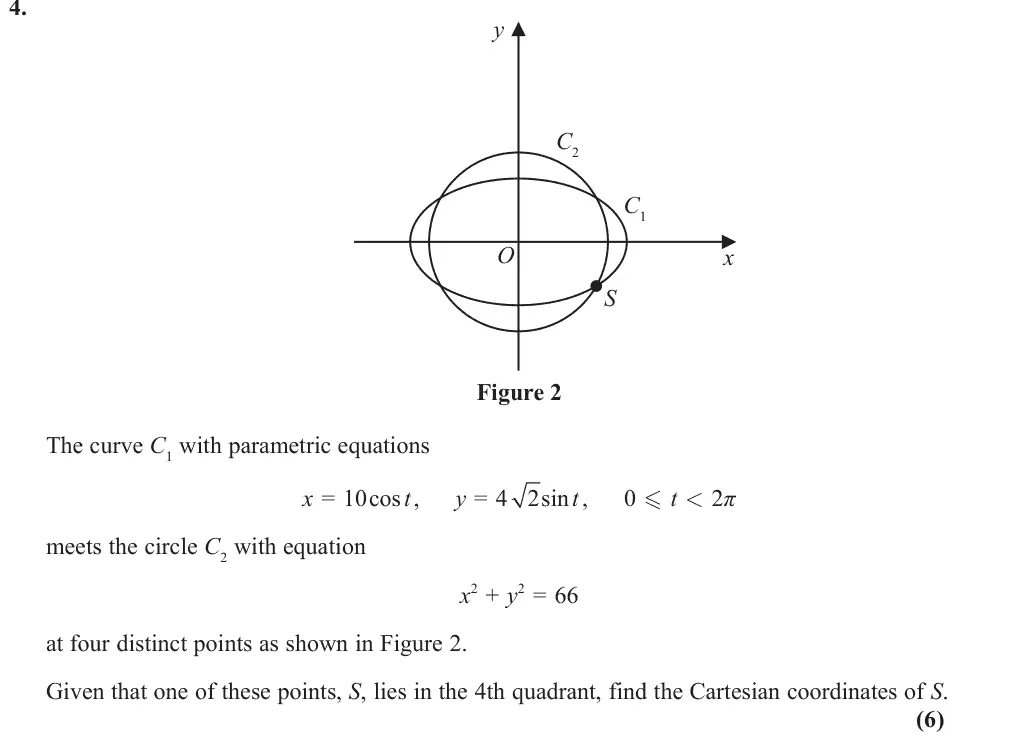
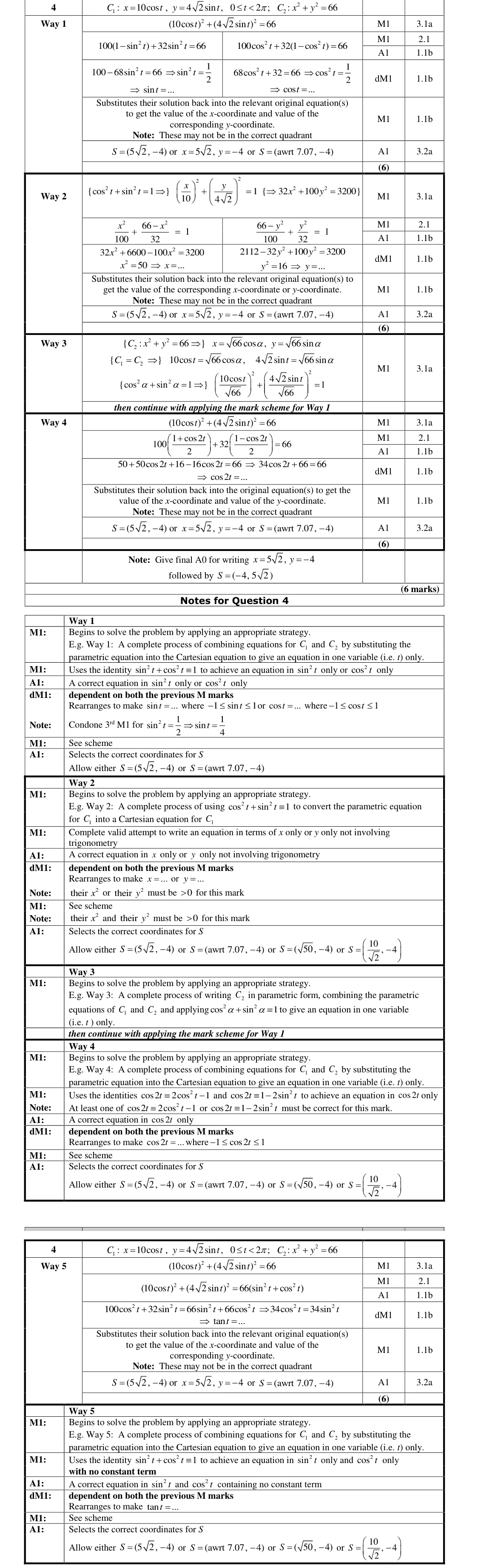
Q04 was well attempted by both medium ability and higher ability candidates. Lower ability candidates struggled to make progress, with most of them scoring no more than one mark. There were two common methods that were used by candidates. The first method, covered by Way 1 in the mark scheme, was the substitution of the parametric equations of 1 C into the Cartesian equation of 2 C to give an equation in t only; the trigonometric identity 2 2 sin cos 1 t t being used to obtain an equation in 2 sin t (or 2 cos t ) only, and a value for sint (or cos )t found. The second method, covered by Way 2 in the mark scheme, was the application of the trigonometric identity 2 2 sin cos 1 t t to the parametric equations of 1 C to give 2 2 1, 10 4 2 x y the Cartesian equation of 2 C being used to obtain an equation in 2x (or 2) y only, and a value for x (or y) found. A few candidates used a correct method of progressing from 2 2 (10cos ) (4 2 sin ) 66 t t to either 2 tan 1 t or cos2 0. t In all these methods, substituting back yielded their coordinates for S, with most candidates realising that 0 Sx and 0. Sy Some candidates incorrectly stated S as (5 2 , 4). In the first method, successful candidates used either 7 4 t or , 4 t and then applied symmetry to find the correct coordinates for S as either (5 2 , 4) or (7.07, 4). An area of concern centred around arithmetical slips or errors in elementary algebra. Examples of the former included 2 (4 2) becoming 8 or 64; 2 1 sin 2 t becoming 1 sin ; 4 t and 2 2 1 100 32 x y becoming 2 2 32 100 1 or 100 or 32. x y Examples of the latter included the invalid methods of 2 2 66 y x becoming 66 y x and 2 2 sin 1 100 x t becoming sin 1 . 10 x t Candidates who made no creditable progress included those who differentiated the parametric equations for 1 , C and those who obtained, e.g. 4 2 sin arccos 10 x y leading to 2 2 32sin arccos 66. 10 x x
Common mistakes
substitute the parametric equations into x² + y² = 66 and use sin²t + cos²t = 1 (or convert C₁ to x²/100 + y²/32 = 1)
(4√2)² = 32 not 8
S in the 4th quadrant is (5√2, −4), not (−4, 5√2)
June 2018 · AS Paper 1 · Q14(a)3 marks
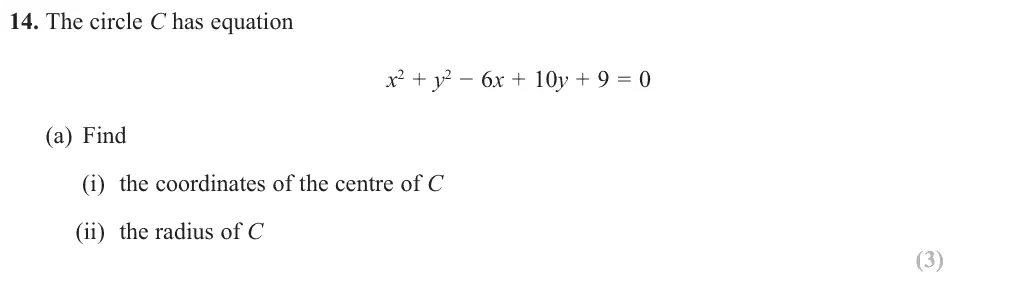
Mark scheme (whole question; this part is marked with the orange bar)
Examiner's comment
Part (a) was very accessible, part (b) less so. Hence in part (a) there were a large number of students who scored full marks. There were however occasional sign errors witnessed when the students completed the square.
Common mistakes
complete the square: (x − 3)² + (y + 5)² = 25
centre (3, −5), radius 5
sign errors when completing the square
June 2018 · AS Paper 1 · Q14(b)6 marks
Mark scheme (whole question; this part is marked with the orange bar)
Examiner's comment
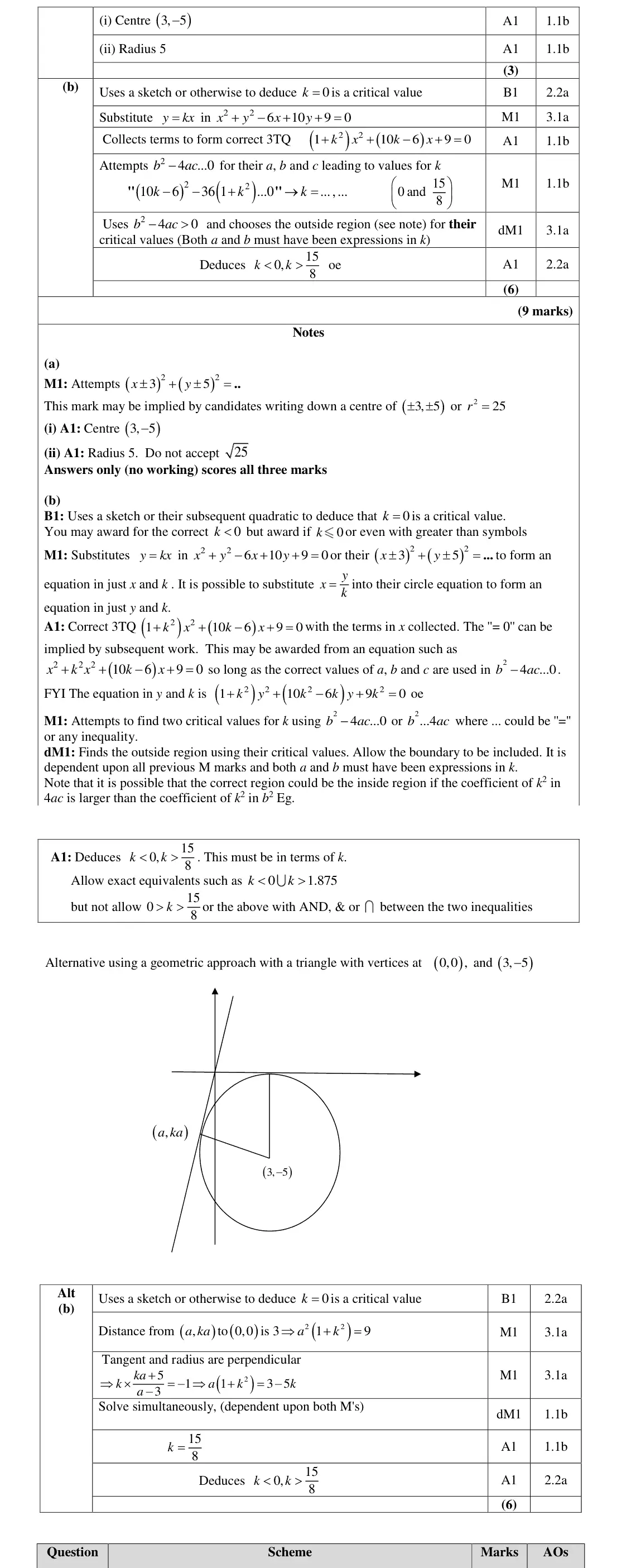
Part (a) was very accessible, part (b) less so. In (b), the first method mark was scored by the majority of students who showed their substitution of y = k x . Those who substituted into the equation given in the question rather than their (a) answer often coped better with the less challenging algebra. Collecting terms to reach a correct three term quadratic was a significant hurdle for many, although the most common error was to write kx2 for (kx)2. Most students correctly quoted b2 – 4ac before using it. Having done this they were usually able to factorise their expression to obtain k = 0 and another critical value. Having done the bulk of the work, many spoiled an otherwise perfect solution by stating the inside region.
Common mistakes
substitute y = kx: (1 + k²)x² + (10k − 6)x + 9 = 0 (write (kx)², not kx²)
b² − 4ac > 0 gives critical values 0 and 15/8
outside region k < 0 or k > 15/8 (not the inside region and not joined with "and")
June 2018 · Paper 1 · Q6(a)3 marks
Mark scheme (whole question; this part is marked with the orange bar)
Examiner's comment
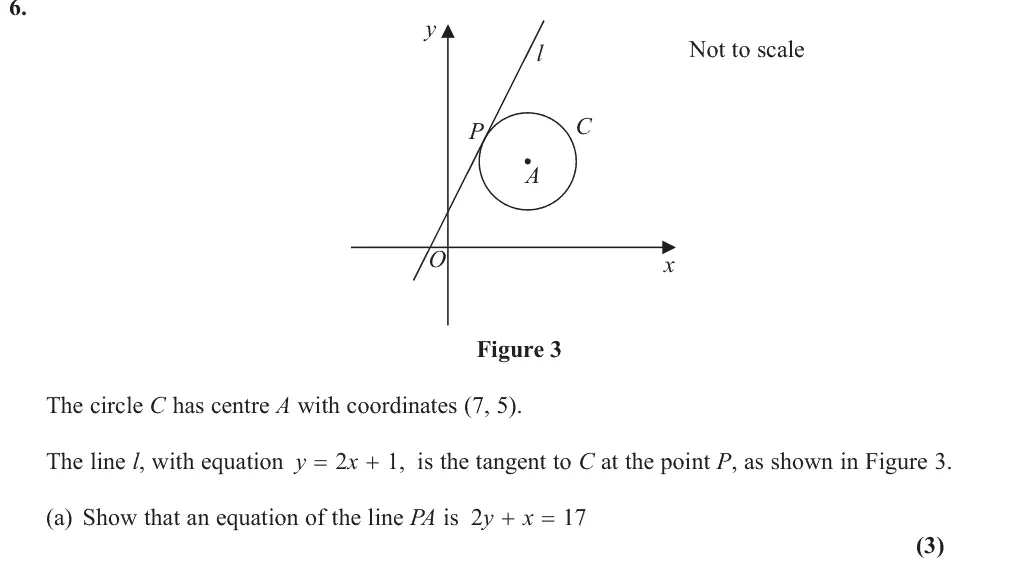
Part (a) was a ''show that'' question in which students used the idea of perpendicular gradients to find the equation of line PA. It was very straightforward and well done with almost all students scoring the 3 marks. Part (b) required the students to find the equation of the circle C
Common mistakes
radius perpendicular to tangent so gradient of PA is −½
line through A(7, 5)
complete to 2y + x = 17
June 2018 · Paper 1 · Q6(b)4 marks
Mark scheme (whole question; this part is marked with the orange bar)
Examiner's comment
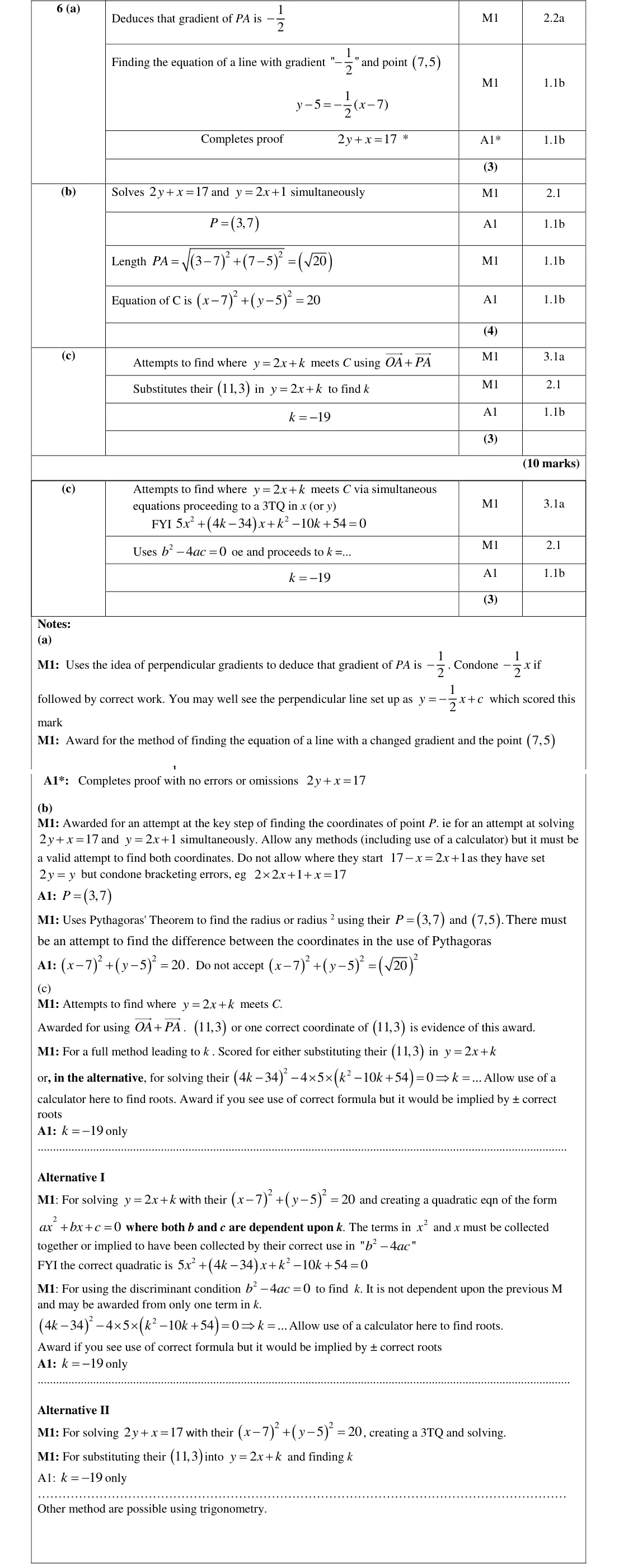
students scoring the 3 marks. Part (b) required the students to find the equation of the circle C using the information given. Again most students attempted this with ease, finding firstly the coordinates of point P, and then the radius PA, before writing down the equation of the circle. Errors witnessed tended to be arithmetic, although some students complicated the question by attempting to solve 2 2 simultaneously in an attempt to 2 and 7 5 x y r 2 1 y x find r. There were numerous ways to find the value of k in part (c). One of the best involved
Common mistakes
solve y = 2x + 1 with 2y + x = 17 to get P(3, 7)
r² = PA² = 20
equation (x − 7)² + (y − 5)² = 20, not (√20)²
June 2018 · Paper 1 · Q6(c)3 marks
Mark scheme (whole question; this part is marked with the orange bar)
Examiner's comment
find r. There were numerous ways to find the value of k in part (c). One of the best involved using vector geometry to find the coordinates of the point N on C, where meets C. 2 y x k Using the fact that PA enabled students to find N = (11,3) and then k by substituting AN this point into Again simultaneous equation methods were common, some more 2 . y x k successful than other. The most common correct attempt involved solving with 2 y x k 2 2 and then finding where the resulting equation had one root. Care was 7 5 20 x y required with the algebra, especially the squaring of terms, as well as the application of the 2 discriminant This proved to be too great a challenge for many. 4 0. b ac
Common mistakes
best route: other tangent point N = A + PA vector = (11, 3), then k = −19