Understand and use composite functions; inverse functions and their graphs.
Guidance
The concept of a function as a one-one or many-one mapping from ℝ (or a subset of ℝ) to ℝ. The notation f : x ↦ and f(x) will be used. Domain and range of functions. Students should know that fg will mean “do g first, then f”, and that if f⁻¹ exists then f⁻¹f(x) = ff⁻¹(x) = x. They should also know that the graph of y = f⁻¹(x) is the image of the graph of y = f(x) after reflection in the line y = x.
Mark scheme (whole question; this part is marked with the orange bar)
Examiner's comment
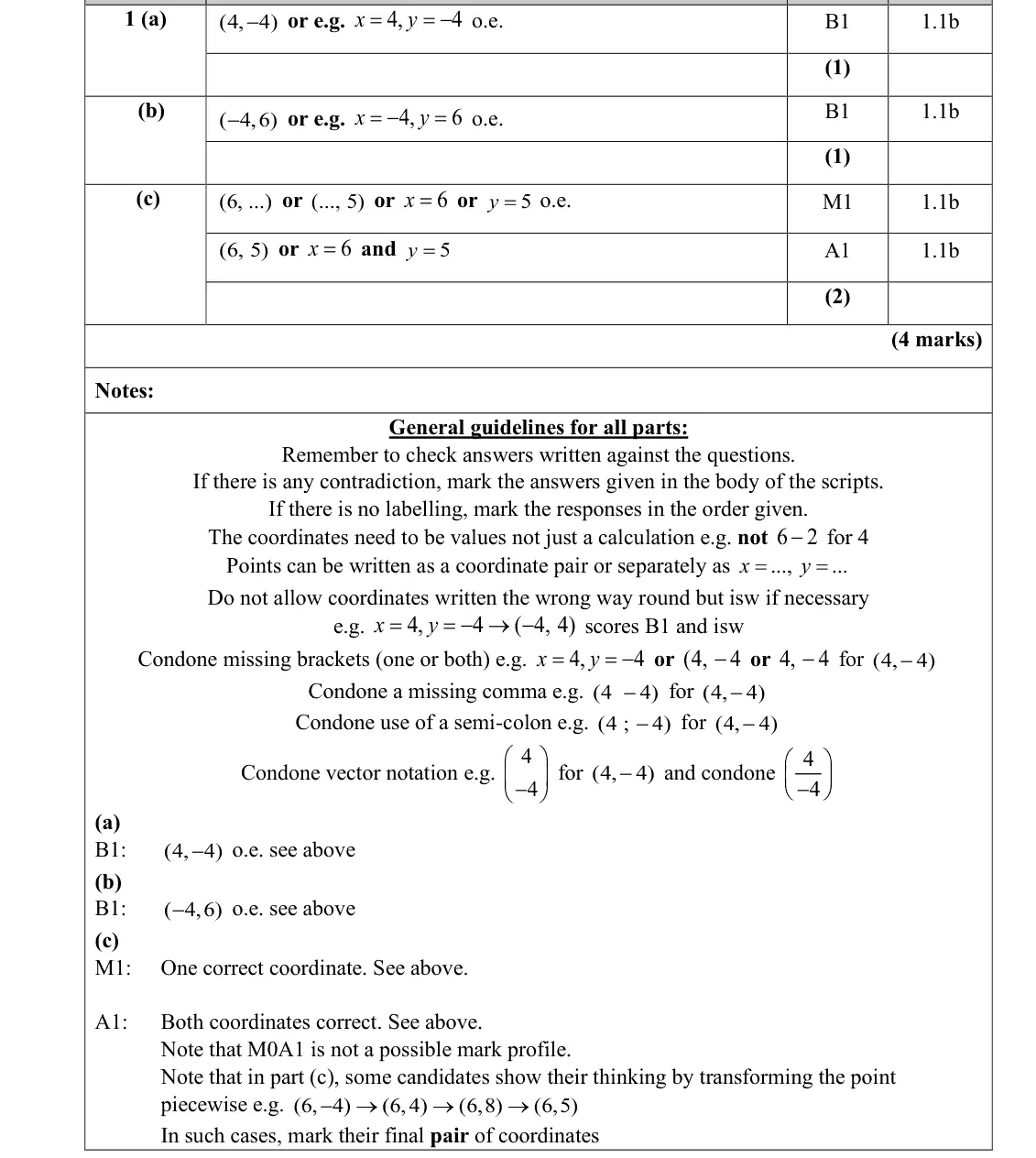
This question required learners to apply a transformation to a point in an unknown function and identify the new coordinates. However, many found it more challenging than was likely intended. Part (b) proved to be the most challenging element of the question. A significant number of responses did not recognise that finding the inverse function required reflecting a point in the line y x = , where they just needed to swap the coordinates. Instead, many attempted incorrect transformations, such as reflecting in the x- or y-axis, swapping signs, or confusing the inverse with the reciprocal function. Common incorrect responses included ( ) 6, 4 - , ( ) 4, 6 - , 1 6, 4 - , and 1 1 , 6 4 - , indicating misunderstanding of the effect of an inverse function on a coordinate. The notation also appeared to cause confusion for some. Overall, very few correct responses were seen, and this part of the question successfully discriminated between stronger and weaker learners.
Common mistakes
the graph of the inverse is the reflection in y = x, so swap the coordinates: (−4, 6)
common errors (6, 4), (−4, −6), reciprocals such as (1/6, −1/4) (confusing inverse with reciprocal)
very few correct
June 2025 · Paper 2 · Q12(b)2 marks
Mark scheme (whole question; this part is marked with the orange bar)
Examiner's comment
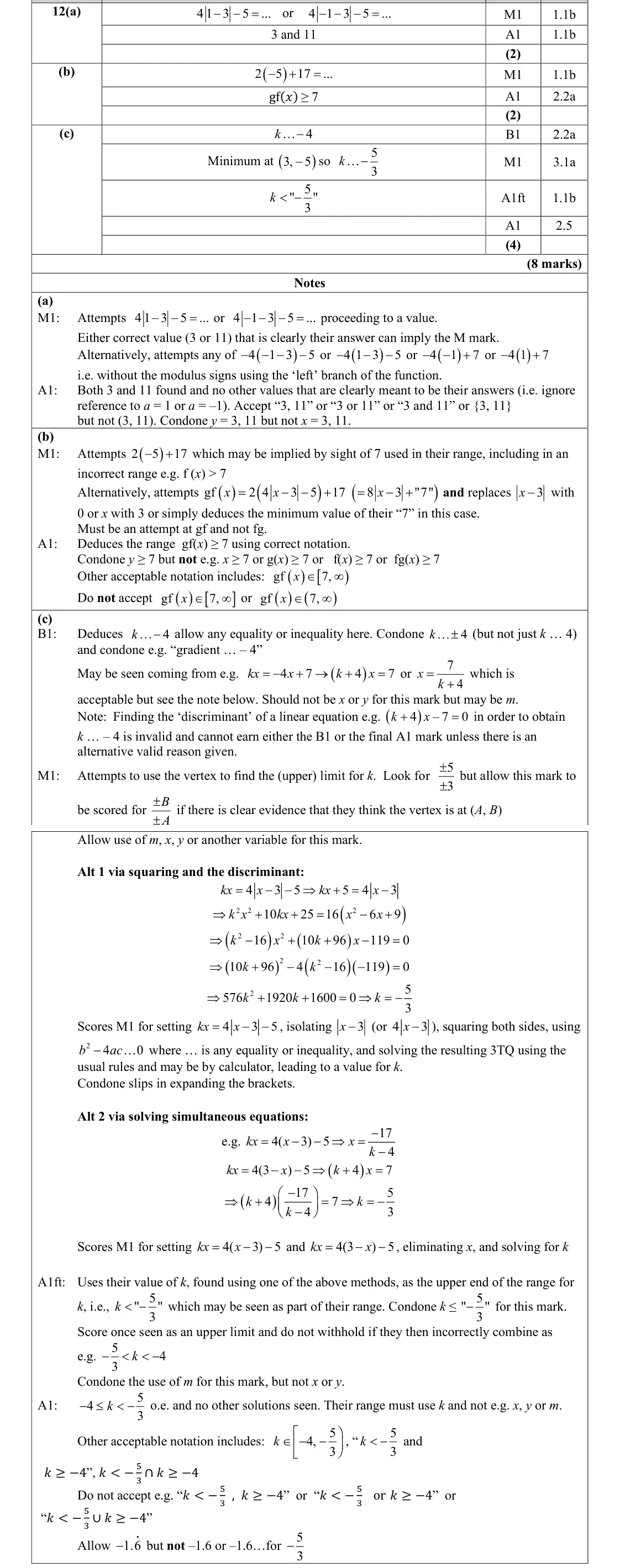
This question, assessing understanding of modulus functions, composite functions and the range, was accessible to almost all learners. Generally, responses scored well on the first two parts but did not find a simple strategy for the last part. In part (b), some responses found the minimum value of the function directly from ( ) 2 5 17 - + but a significant number found an expression for gf(x) first ( ) 2 4 3 5 17 x - - + . Of these, some knew to either replace ( ) 3 x - with 0, or x with 3 leading to a minimum value of 7, but a significant number did not know how to proceed from the function gf(x). Having found the correct minimum value, many learners gave the correct answer gf(x) >= 7, but a number incorrectly gave the answer as x >= 7 or f(x) >= 7. A few learners gave their answer in ‘set’ notation and these learners generally scored both marks for this part. Some learners used graphical transformations to arrive at their range, the majority of which got to the final answer, scoring full marks.
Common mistakes
minimum of f is −5 so gf(x) ≥ 2(−5) + 17 = 7
range in terms of gf(x), not x ≥ 7 or f(x) ≥ 7
June 2024 · Paper 1 · Q8(a)2 marks
Mark scheme (whole question; this part is marked with the orange bar)
Examiner's comment
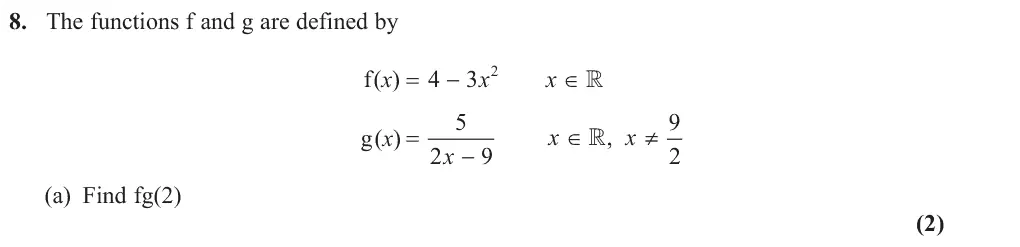
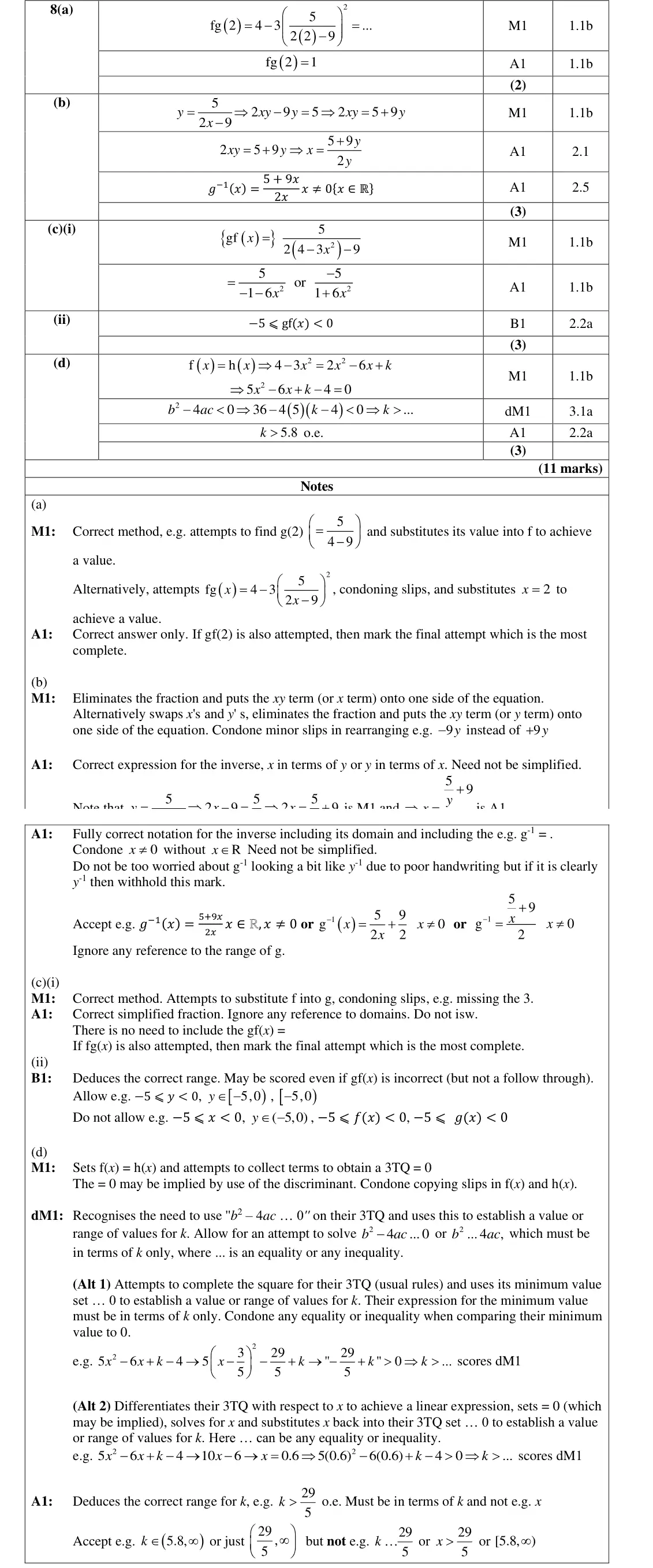
This question was answered very well by the majority of candidates with many scoring upwards of 8 marks out of the available 11. It highlighted that candidates continue to struggle with identifying the domain and range of functions, and that in most cases candidates are not aware that they should state the domain when defining a function. In part (a), the vast majority of candidates scored full marks. Most candidates determined g(2) and then substituted the result, –1, into f(x). A few candidates attempted to substitute the expression for g(x) into f(x) to determine a general form for fg(x) before substituting x = 2 to determine the solution. Those who tried to expand the squared term before substituting often could not find the correct answer as they had errors in the expansion and/or in dealing with the negative coefficient of the squared expression. Some candidates evaluated gf(2) instead of fg(2), although this was fairly infrequent. part (a) incorrectly through working out fg(x) made the same error here.
Common mistakes
g first, then f: g(2) = −1, fg(2) = 1
not gf(2)
June 2024 · Paper 1 · Q8(b)3 marks
Mark scheme (whole question; this part is marked with the orange bar)
Examiner's comment
This question was answered very well by the majority of candidates with many scoring upwards of 8 marks out of the available 11. It highlighted that candidates continue to struggle with identifying the domain and range of functions, and that in most cases candidates are not aware that they should state the domain when defining a function. In part (b), the majority of candidates scored 2 marks. Common errors included attempting to differentiate g(x) or attempting to find its reciprocal, both of which scored no marks, while sign errors with the 9y or 9x term meant that other candidates missed out on the first accuracy mark. The final accuracy mark was more demanding and was commonly not secured as candidates rarely attempted to write down the domain of ( ) 1 g x - , a point that has been referenced in many previous examiner reports. It was also common that candidates did not use a suitable notation for their final answer for ( ) 1 g x - .
Common mistakes
g⁻¹(x) = (5 + 9x)/(2x) with domain x ≠ 0 and g⁻¹(x) = notation (domain rarely given)
not the derivative or reciprocal
June 2024 · Paper 1 · Q8(c)3 marks
Mark scheme (whole question; this part is marked with the orange bar)
Examiner's comment
This question was answered very well by the majority of candidates with many scoring upwards of 8 marks out of the available 11. It highlighted that candidates continue to struggle with identifying the domain and range of functions, and that in most cases candidates are not aware that they should state the domain when defining a function. There were a minority of candidates who attempted both fg(2) and gf(2) in part (a) and fg(x) and gf(x) in part (c), seemingly confused by the notation or attempting to cover both options. Candidates should be discouraged from doing this – examiners mark the final response, and, in effect, candidates are wasting valuable time by attempting both cases. In part (c)(i), the majority of candidates scored full marks. Where errors arose, this was often a result of attempting to simplify the final solution to another expression and with the errors being algebraic rather than arithmetical, ISW was not applied. It was surprising that some candidates who were successful in part (a) treated gf(x) as ( ) ( ) g f x x here and thus failed to score. Those who had constructed an expression in Very few candidates scored the mark in part (c)(ii). There was some evidence of confusion between the domain and range and amongst those who did look for the range only one critical value was found by many candidates: often giving either gf(𝑥) ⩾ -5 or ( ) gf 0 x rather than the full interval. A small number of candidates who managed to identify both boundary conditions used x rather than y or gf(x) and thus did not score the mark.
Common mistakes
gf(x) = −5/(1 + 6x²) (g of f, not g × f)
range −5 ≤ gf(x) < 0 rarely scored, must be in terms of gf(x) or y, not x
June 2024 · Paper 1 · Q8(d)3 marks
Mark scheme (whole question; this part is marked with the orange bar)
Examiner's comment
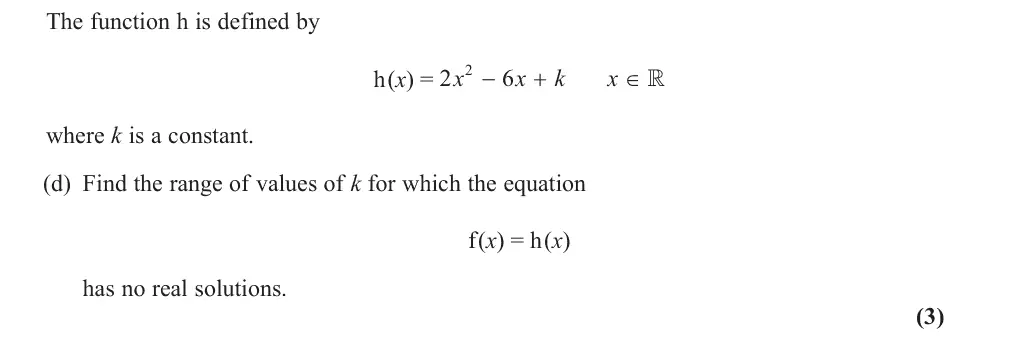
This question was answered very well by the majority of candidates with many scoring upwards of 8 marks out of the available 11. It highlighted that candidates continue to struggle with identifying the domain and range of functions, and that in most cases candidates are not aware that they should state the domain when defining a function. In part (d), some candidates were able to secure marks having found the previous parts challenging. Algebraic errors were not uncommon when equating the expressions and often the = 0 was “dropped” in favour of a stand-alone expression. Candidates generally progressed to determining the discriminant, but setting the discriminant greater than or equal to zero was often seen. Some candidates attempted to find the discriminant of a quadratic set = k which scored no marks. Some of those who attempted the correct inequalities lost the final mark due to slips when simplifying such as ( ) 36 20 4 36 20 80 k k - - == - - or failure to reverse the inequality when dividing through by –20.
Common mistakes
5x² − 6x + k − 4 = 0
no real roots so b² − 4ac < 0 (not ≥ 0)
reverse the inequality when dividing by −20
k > 5.8
June 2023 · Paper 1 · Q7(a)1 mark
Mark scheme (whole question; this part is marked with the orange bar)
Examiner's comment
Overall, this was an accessible question on functions which allowed candidates to attempt all sections of it even when they found parts (a) or (b) particularly challenging. In part (a), a large majority of candidates were able to score the B mark available, with nearly all attempting to give the range. Although the mark scheme was generously accepting notations such as f 3 or range 3 , some candidates lost the mark for unacceptable labels such as 3 x or f( ) 3. x
Common mistakes
range is f(x) > 3, not x > 3 or f(x) ≥ 3
June 2023 · Paper 1 · Q7(b)3 marks
Mark scheme (whole question; this part is marked with the orange bar)
Examiner's comment
Overall, this was an accessible question on functions which allowed candidates to attempt all sections of it even when they found parts (a) or (b) particularly challenging. In general, candidates correctly rearranged the formula and interchanged x and y successfully in part (b). A small number of candidates made some errors in applying the correct order of operations and this resulted in an incorrect expression for the inverse function. A common error was seen with candidates who incorrectly manipulated 3 2 y x = + - to obtain 2 9 2 y x = + - . The candidates who lost the A mark were often due to labelling the inverse as y = instead of e.g. 1 f ( ) ... x - = . A small minority of candidates misread 1 f ( ) x - as f ( )x and so they differentiated the function instead of finding the inverse of it. Candidates should be advised to read the question and the labels carefully to check which skill is required. A common error costing candidates the B mark was failing to record the domain of the inverse function. This mark was rarely scored across the entire cohort, despite 3 marks possibly indicating that more was required by candidates than just rearranging to find 1 f ( ) x - . Candidates who paid careful attention to how f and g were defined in the question would be able to attempt similarly for the inverse function.
Common mistakes
label the answer f⁻¹(x) =, not y =
domain x > 3 comes from the range in (a)
June 2023 · Paper 1 · Q7(c)2 marks
Mark scheme (whole question; this part is marked with the orange bar)
Examiner's comment
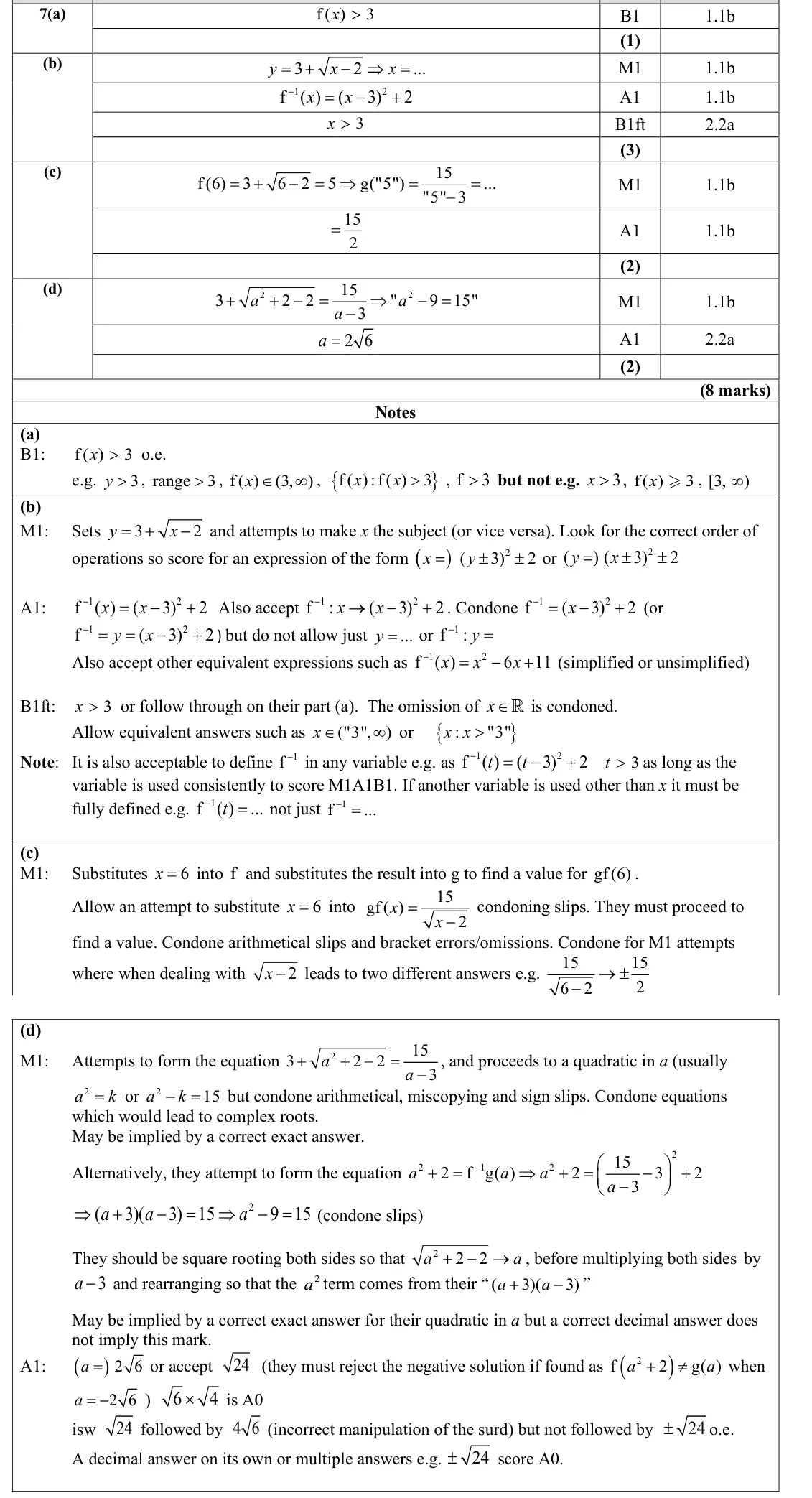
Overall, this was an accessible question on functions which allowed candidates to attempt all sections of it even when they found parts (a) or (b) particularly challenging. Part (c) had the lowest number of errors out of the entire question and was one of the most successfully answered parts over the entire paper. Part (c) was well attempted by many candidates even when they could not attempt parts (a) or (b). Most candidates scored both marks available in this part. Finding f(6) first and then substituting this result into g was more common than substituting 6 x = into the composite function gf(x). This second approach caused some errors due to incorrect algebraic manipulation leading to various incorrect answers for the composite function.
Common mistakes
find f(6) = 5 first, then g(5)
June 2023 · Paper 1 · Q7(d)2 marks
Mark scheme (whole question; this part is marked with the orange bar)
Examiner's comment
Overall, this was an accessible question on functions which allowed candidates to attempt all sections of it even when they found parts (a) or (b) particularly challenging. A large number of candidates scored the first mark in part (d) as they correctly formed the equation ( 3)(3 ) 15 a a - + = and proceeded to a quadratic in a. Several candidates failed to spot that 2 a a = , or that 2 2 2 2 a a + - = . Some candidates that found 2 6 a = did not reject the negative solution losing the last A mark. Some candidates possibly rejected the negative solution by seeing that the domain of f had to be greater than 2 and fortuitously scored the final mark. However, others may have considered that the ( ) 2 2 6 2 - + also satisfied this domain resulting in ( ) ( ) 2 f 2 6 2 0 - + , but that ( ) g 2 6 0 - so this negative solution had to be rejected. Other errors included writing decimal answers only. On several occasions 2 9 15 a - = incorrectly became 2 6 a = . A number of candidates were not able to obtain the quadratic equation needed (hence, did not score any marks) because they got confused by 2 3 a + and not realising that this was actually3 a + . Others tried to manipulate the equation leading to a quartic equation and usually solved via a calculator (and successfully in a few cases), however those who had proceeded along this route typically were expected to apply algebraic division or the factor theorem to find the quadratic factor, having introduced other solutions from squaring and the complexity of their expressions meant it was rare for the method mark to be scored.
Common mistakes
√((a² + 2) − 2) = a gives a² − 9 = 15
exact answer 2√6 only (reject −2√6)
June 2022 · Paper 2 · Q10(a)2 marks
Mark scheme (whole question; this part is marked with the orange bar)
Examiner's comment
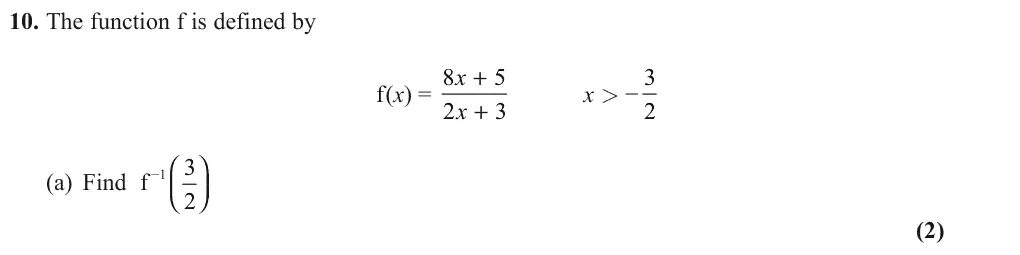
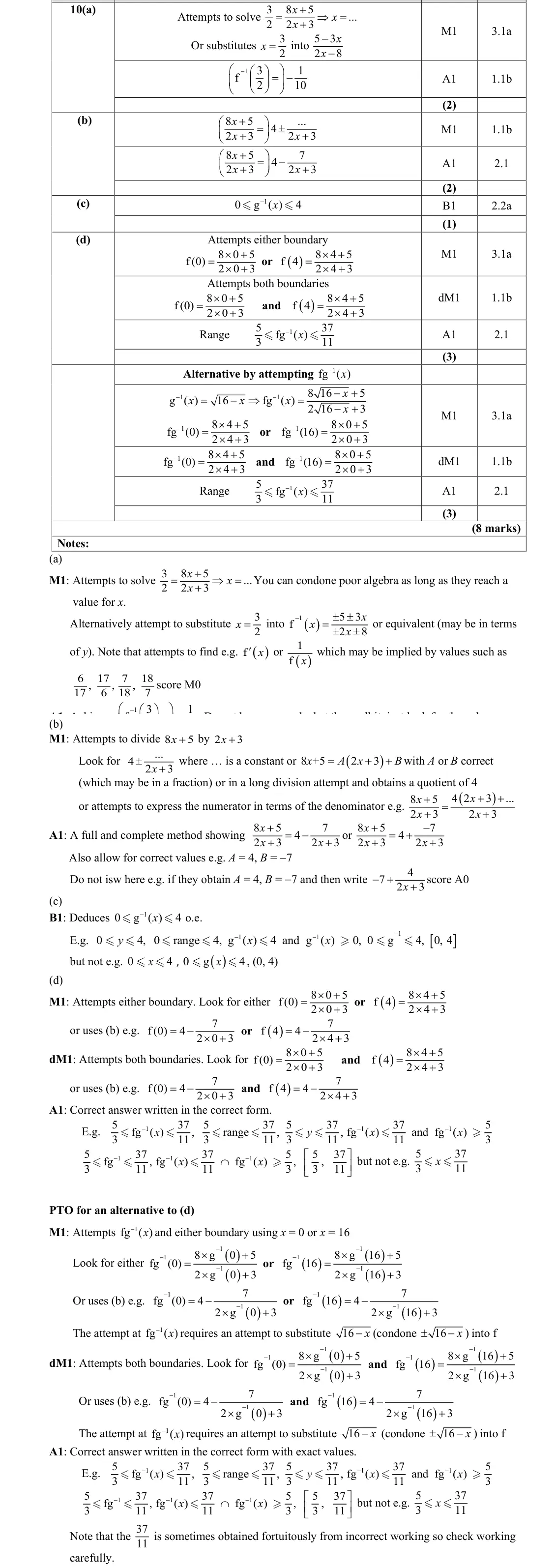
Parts (a) and (b) were generally answered well by most candidates, however parts (c) and (d) proved to be good discriminators with many failing to score any marks. Part (a) required candidates to find f -1( 3 2). The most common approach seen was finding the inverse function then substituting in x = 3 2. This was usually carried out successfully with a few candidates losing a mark for arithmetic slips when rearranging. Very few attempted the more straightforward method of solving f (x) = 3 2. Of those gaining no marks, the common misconception was substituting x = 3 2 into the reciprocal of the function or evaluating f ( 3 2). Several substituted x = 3 2 into f′(x). In part (b) most students seemed confident about how to start and the majority of those who attempted it achieved both marks. Candidates either equated the numerator to achieve 8x + 5 = A(2x + 3) + B or used the long division method. There were some errors in calculating A after finding the correct value for B. Those who used the long division method made fewer mistakes than those who compared coefficients. A few candidates attempted to manipulate the numerator and expressed it in terms of the denominator with a good rate of success. A few candidates lost the final accuracy mark due to substituting the correct A and B into the wrong place to give -7 + 4/(2x + 3)
Common mistakes
solve (8x + 5)/(2x + 3) = 3/2 to get −1/10 (simpler than finding f⁻¹)
not f(3/2), 1/f(x) or f′(x)
June 2022 · Paper 2 · Q10(c)1 mark
Mark scheme (whole question; this part is marked with the orange bar)
Examiner's comment
In part (c) it was common to see the correct boundary values given but many lost the mark by using incorrect notation. Common errors seen were 0 <= x <= 4, 0 <= g(x) <= 4, or even 0 <= f(x) <= 4; using < instead of <= ; or missing out the lower boundary value altogether. Many did not realise that the values of the range of g-1(x) are the same as the domain of g(x) and found g-1(x) first but then failed to give the correct range, gaining no marks. Giving the range as 0 to 16, instead of 0 to 4 was a common incorrect answer. A significant number obtained only one of the correct values.
Common mistakes
range of g⁻¹ is the domain of g: 0 ≤ g⁻¹(x) ≤ 4
written in terms of x or g(x), strict inequalities or 0 to 16 score 0
June 2022 · Paper 2 · Q10(d)3 marks
Mark scheme (whole question; this part is marked with the orange bar)
Examiner's comment
Part (d) proved to be demanding for most candidates. Some candidates realised they could simply evaluate f(0) and f(4) to find the boundary values but most started by trying to find an expression for fg-1(x). Many were able to find g-1(x) = sqrt (16 - x) and used this to obtain fg-1(x) = (8 sqrt (16 - x) + 5)/(2 sqrt (16 - x) + 3) or fg-1(x) = 4 - 7/(2 sqrt (16 - x) + 3) (using their answer to (b)). Some made no further progress from here and thus scored no marks. Of those that did carry on, common errors from this point included using 4 as the upper value rather than 16 or changing sqrt (16 - x) to an incorrect expression such as 4 - sqrt x. Since one of the boundary values was 0 some candidates found 37/11 from incorrect work and did not score the method mark. Some candidates, who did find the correct values, lost the final mark by using < instead of <= in their inequality. It was not uncommon to see part (d) left blank.
Common mistakes
range of g⁻¹ is [0, 4] so evaluate f(0) = 5/3 and f(4) = 37/11
5/3 ≤ fg⁻¹(x) ≤ 37/11 with ≤ not <
using 4 instead of 16 in fg⁻¹(x)
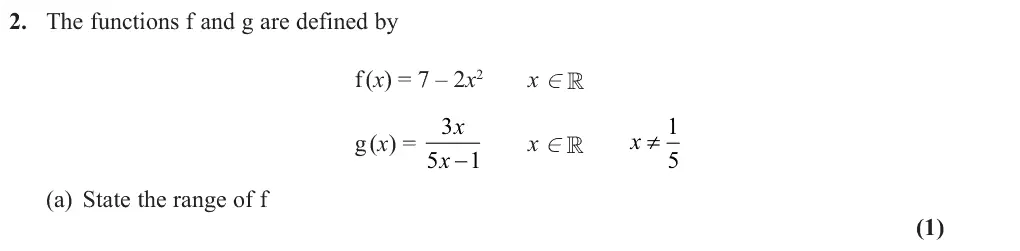
Oct 2021 · Paper 2 · Q2(a)1 mark
Mark scheme (whole question; this part is marked with the orange bar)
Examiner's comment
This question was well answered with the modal mark being full marks. Part (a) was the least well answered part where and it is clear that students have difficulty with the concept of range. Incorrect answers included y < 7and y 7. Some candidates attempted to use the graph’s x-intercepts in their work, so incorrect answers such as 14 14 appeared occasionally. x - < < 4 4 In contrast, part (b) was well answered, with most candidates gaining all of the marks.
Common mistakes
range f(x) ≤ 7 (not y < 7, not x-values from the intercepts)
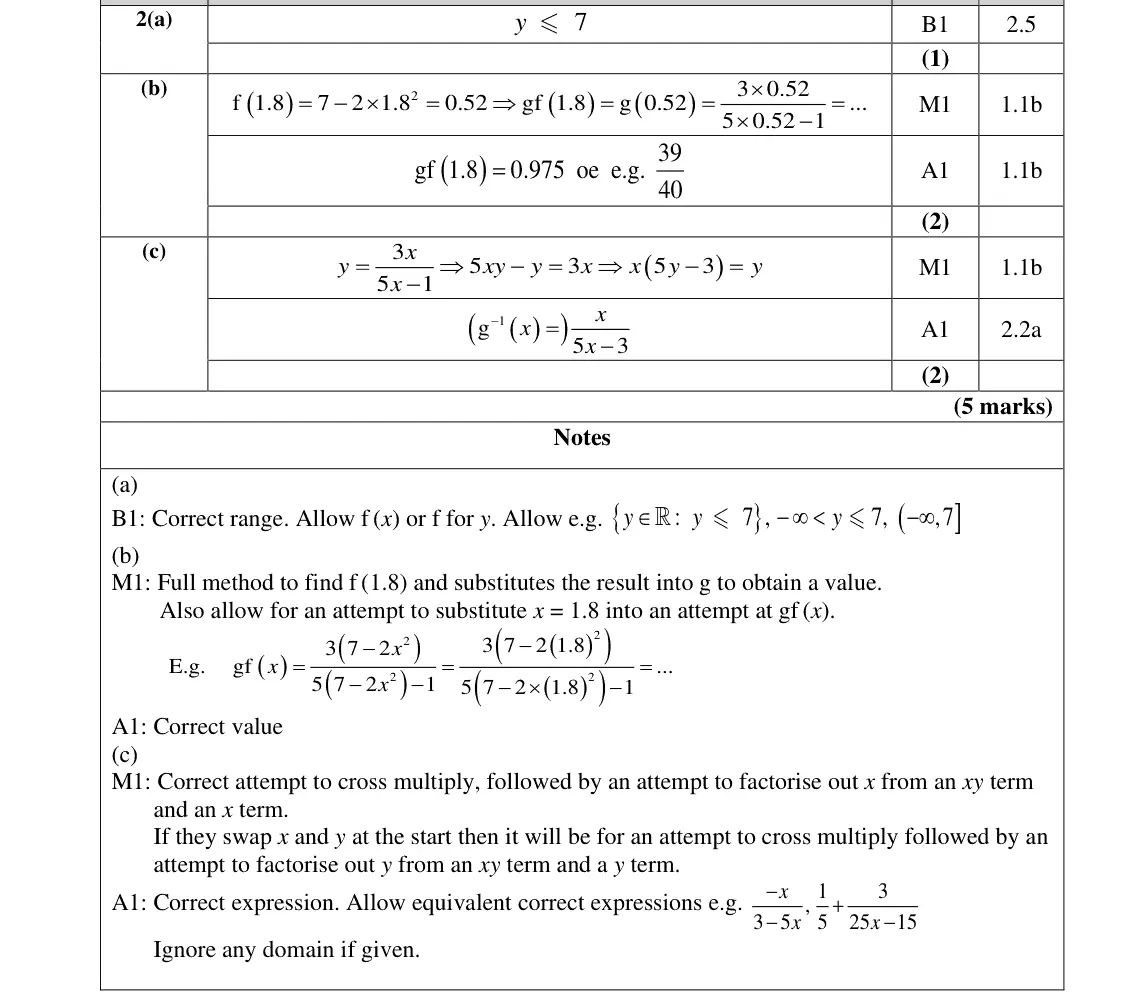
Oct 2021 · Paper 2 · Q2(b)2 marks
Mark scheme (whole question; this part is marked with the orange bar)
Examiner's comment
In contrast, part (b) was well answered, with most candidates gaining all of the marks. The most common approach was to find f (1.8) = 0.52 and then g (x) = 0.975. Some candidates correctly established the composite function gf (x) and then calculated gf (1.8). There were occasional instances of finding fg (1.8) by mistake. Similarly (c) was well answered. Most candidates knew the process of finding the inverse function by rearranging to make x the subject and switching the x’s and y’s (or by switching first and then rearranging) and many successfully reached the x ( ) correct answer of . 1 g - x = 5 3 x -
Common mistakes
find f(1.8) = 0.52 first, then g(0.52) = 0.975
not fg(1.8)
Oct 2021 · Paper 2 · Q2(c)2 marks
Mark scheme (whole question; this part is marked with the orange bar)
Examiner's comment
This question was well answered with the modal mark being full marks. Part (a) was the least well answered part where and it is clear that students have difficulty with the concept of range. Incorrect answers included y < 7and y 7. Some candidates attempted to use the graph’s x-intercepts in their work, so incorrect answers such as 14 14 appeared occasionally. x - < < 4 4 In contrast, part (b) was well answered, with most candidates gaining all of the marks. The most common approach was to find f (1.8) = 0.52 and then g (x) = 0.975. Some candidates correctly established the composite function gf (x) and then calculated gf (1.8). There were occasional instances of finding fg (1.8) by mistake. Similarly (c) was well answered. Most candidates knew the process of finding the inverse function by rearranging to make x the subject and switching the x’s and y’s (or by switching first and then rearranging) and many successfully reached the x ( ) correct answer of . 1 g - x = 5 3 x -
Common mistakes
cross-multiply and factorise out x (or y): g⁻¹(x) = x/(5x − 3)
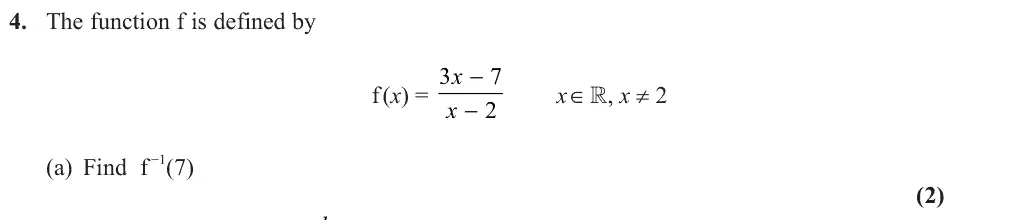
Oct 2020 · Paper 1 · Q4(a)2 marks
Mark scheme (whole question; this part is marked with the orange bar)
Examiner's comment
This was a relatively straightforward test on function notation. 1 - In part (a) most candidates opted to find the inverse function before substituting f ( ) x 7. x = Very few attempted the more straightforward method of solving f ( ) Most in 7. x = candidates achieved some success, with some slips being made by those attempting to 1 - f ( ) find . Of those gaining no marks, the majority came from a misunderstanding of x and others into [ ] 1 - 7 x = ′ the notation with some substituting into f ( ) f ( ) x x
Common mistakes
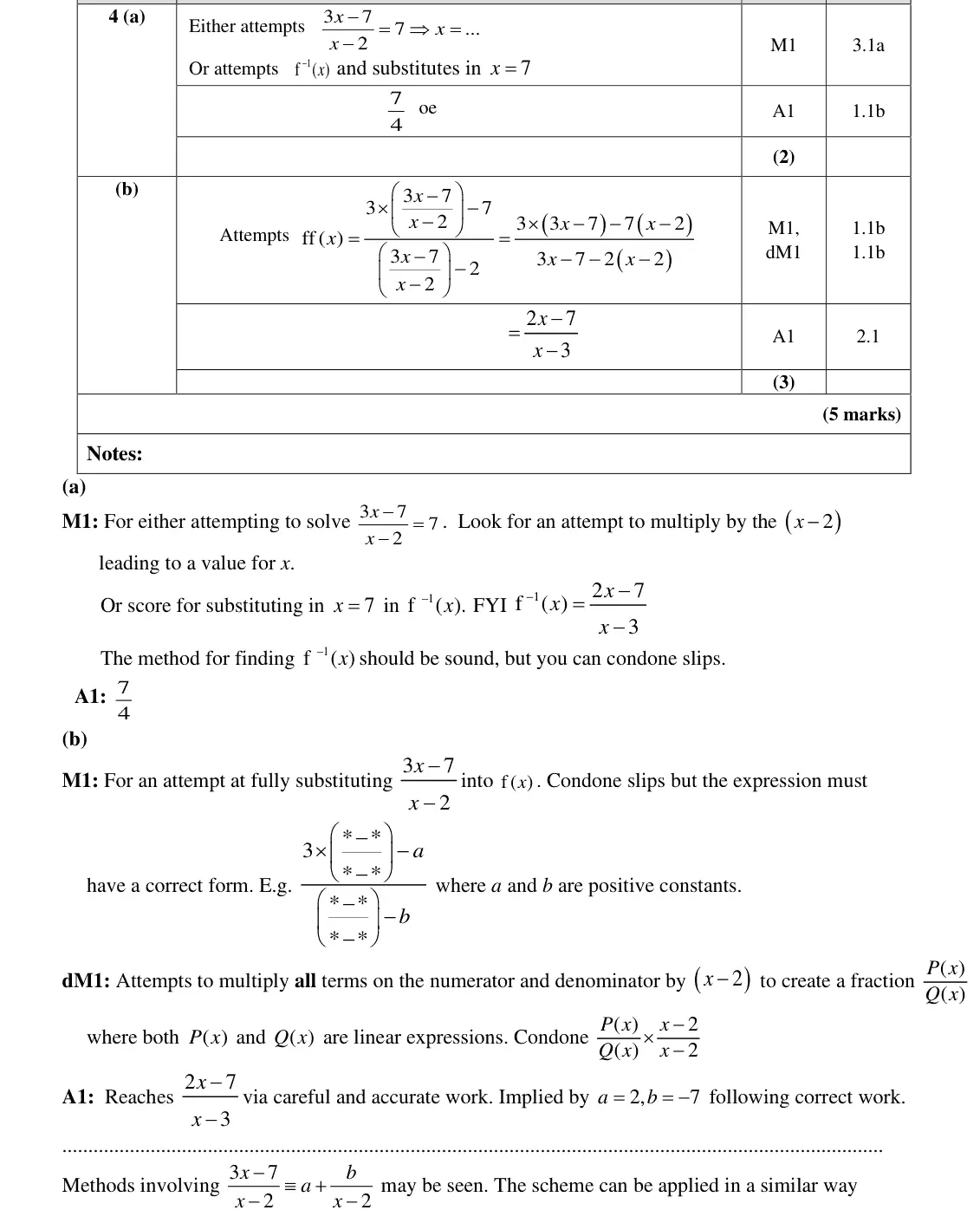
solve f(x) = 7 directly (quicker) or find f⁻¹(x) = (2x − 7)/(x − 3) and substitute
answer 7/4
misreading f⁻¹ as 1/f or f′
Oct 2020 · Paper 1 · Q4(b)3 marks
Mark scheme (whole question; this part is marked with the orange bar)
Examiner's comment
This was a relatively straightforward test on function notation. In part (b) most candidates understood the notation and gained the first mark by forming an expression of the correct form. Many were then able to multiply both numerator and denominator by ( ) 2 to form a single fraction of the required form. This part is x - where most errors crept in; some having problems with the bracketing but most with the process of multiplying all terms on both numerator and denominator by the (x – 2) term.
Common mistakes
ff means f(f(x)): substitute (3x − 7)/(x − 2) for x, then multiply every term of numerator and denominator by (x − 2)
bracketing errors
(2x − 7)/(x − 3), a = 2, b = −7
Oct 2020 · Paper 1 · Q9(c)3 marks
Mark scheme (whole question; this part is marked with the orange bar)
Examiner's comment
Unsurprisingly candidates found part (c) more challenging, especially (c) (ii) where the significance of x=0 was rarely understood. It was however a good discriminator for stronger candidates.
Common mistakes
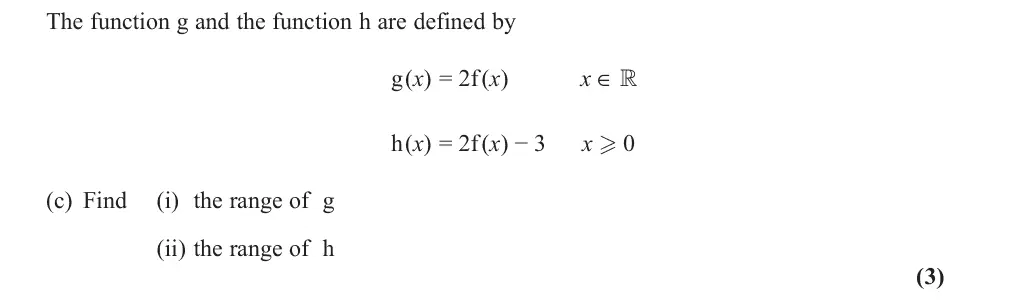
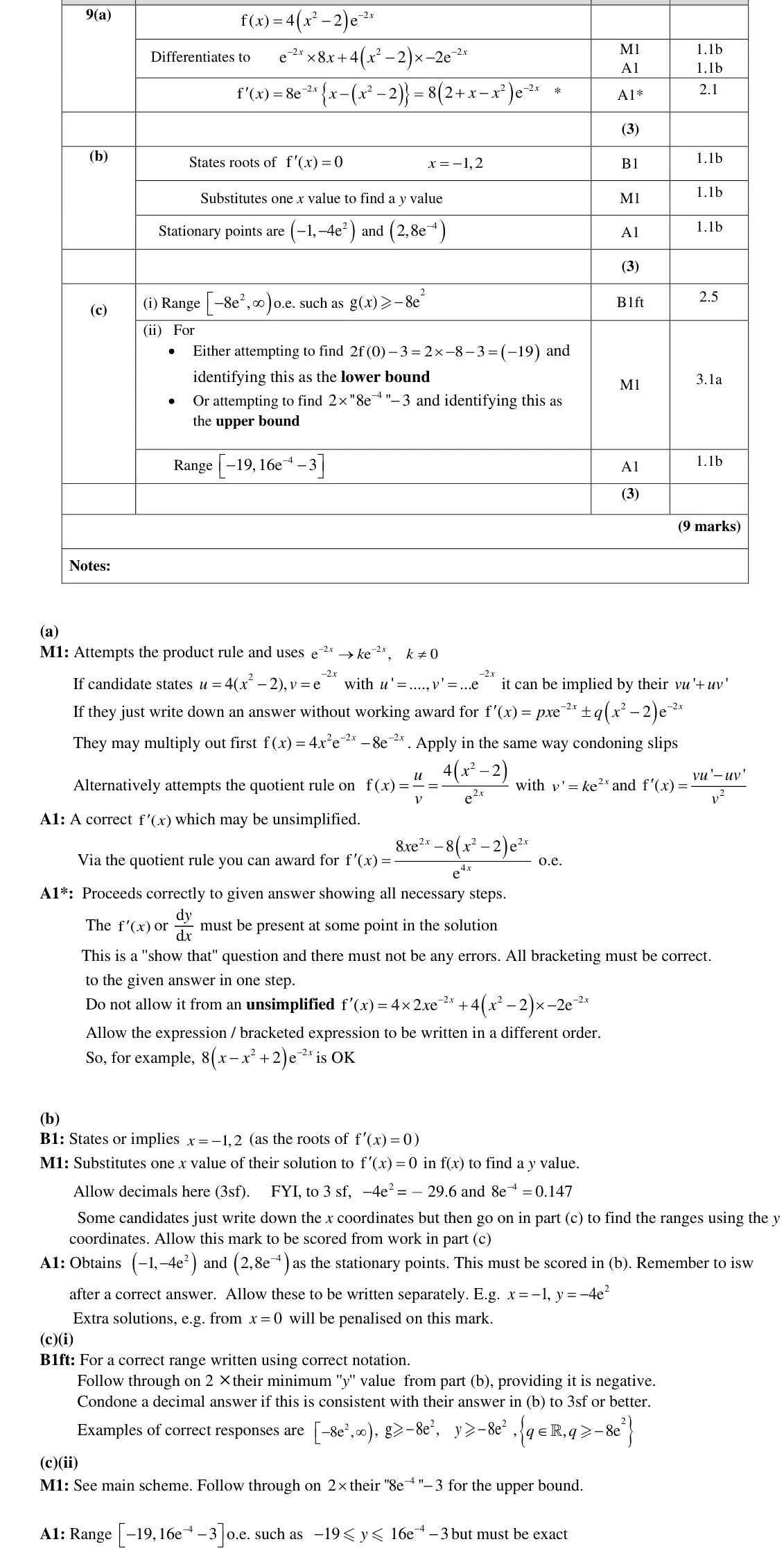
(i) g(x) ≥ −8e² (double the minimum)
(ii) h has domain x ≥ 0: lower bound h(0) = 2f(0) − 3 = −19, upper bound 16e⁻⁴ − 3 from the maximum
significance of x = 0 rarely seen
exact values and correct range notation
Oct 2020 · Paper 2 · Q13(a)1 mark
Mark scheme (whole question; this part is marked with the orange bar)
Examiner's comment
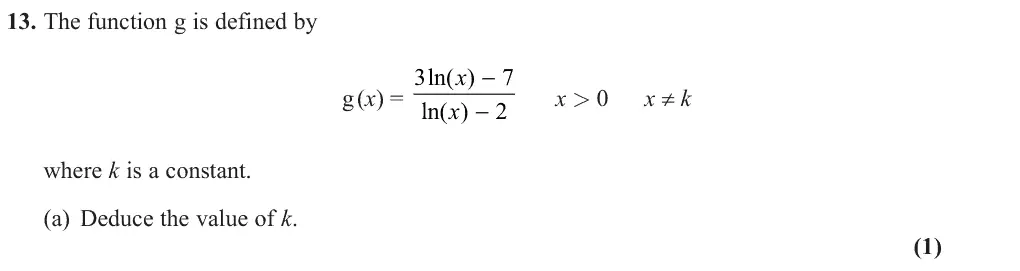
Part (a) was often answered correctly and candidates knew to set the denominator equal to zero and solve to obtain a value for 𝑘𝑘. Unfortunately, candidates sometimes left their answer as 𝑥𝑥= e2 which was, of course, incorrect. Some candidates gave the inexact answer of 𝑘𝑘 = 7.39 which was condoned. Commonly seen incorrect answers included 𝑘𝑘 = 0, or 𝑘𝑘 = 1. A number of candidates gave the value 𝑘𝑘= 3 suggesting that the expression in the denominator had been incorrectly interpreted as ln(𝑥𝑥-2) rather than ln(𝑥𝑥) -2 as was stated. A small number of candidates wrote “there is no 𝑘𝑘 in the question” perhaps failing to spot its presence in the domain.
Common mistakes
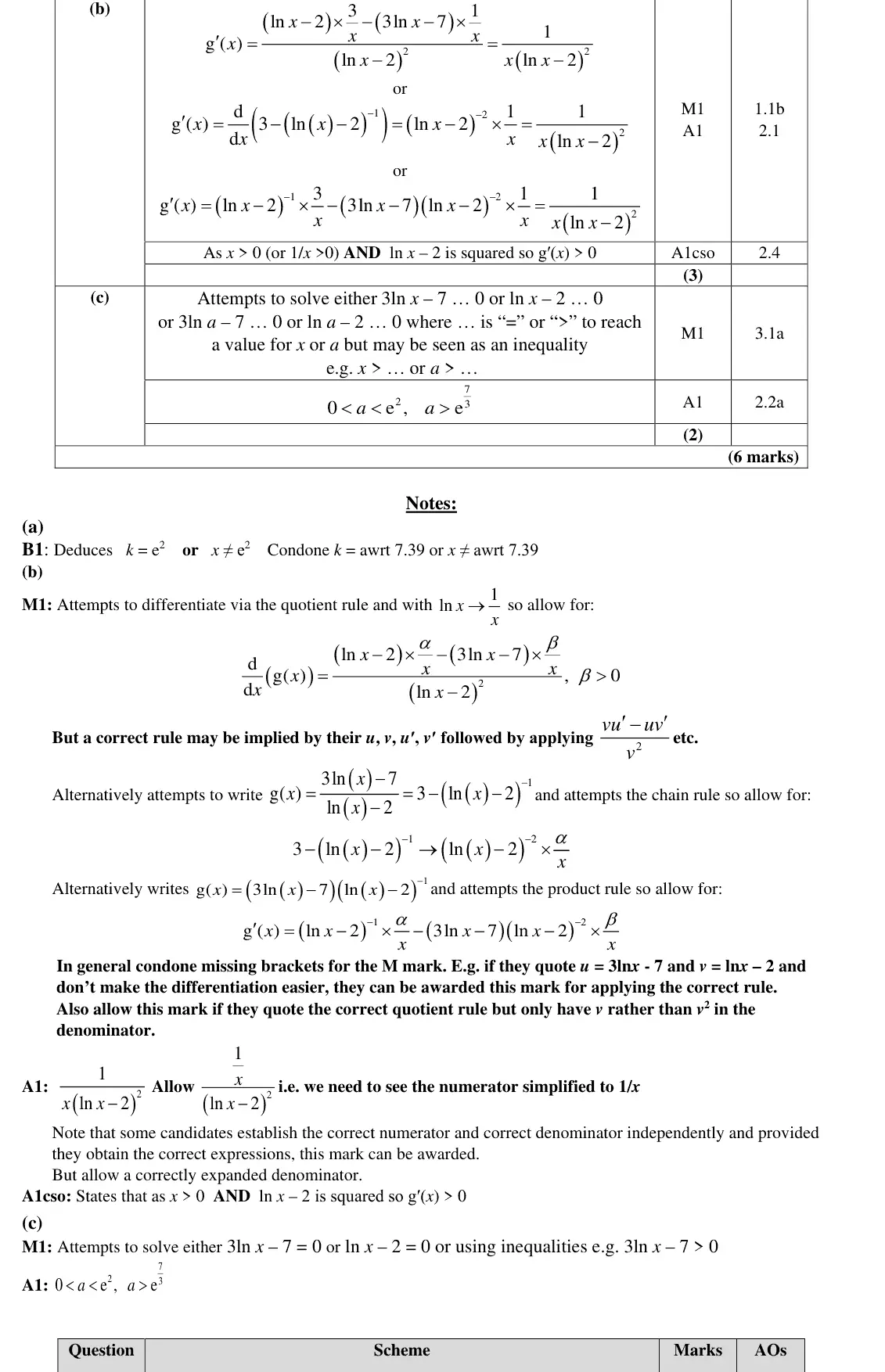
the denominator ln x − 2 = 0 gives k = e²
answer k =, not x = e²
not ln(x − 2)
June 2019 · Paper 1 · Q5(c)4 marksEasy
Mark scheme (whole question; this part is marked with the orange bar)
Examiner's comment
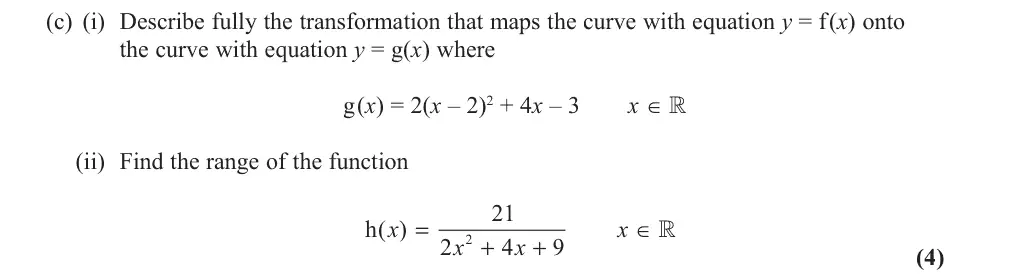
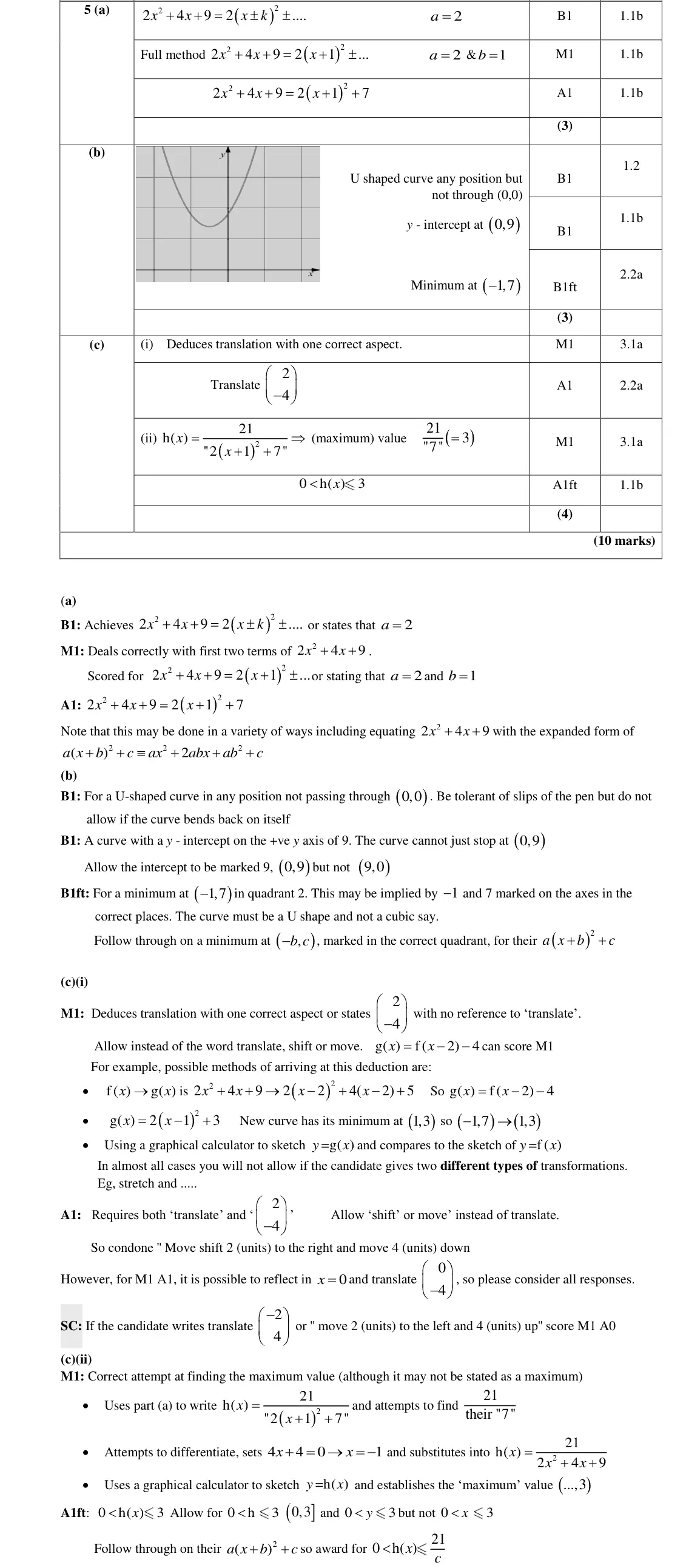
This question on completing the square and the quadratic function was accessible to all, especially the first 6 marks. Part (c) was more demanding but there were some excellent responses here. As stated earlier, part (c) was a lot more demanding. Rather strangely part (i) was found more accessible than part (ii). Many candidates sketched the new curve and compared the positions of the turning points noting that had ''moved'' to 1,3 . Disappointingly a rather sizeable majority could only describe this ''movement'' 1,7 21 h( ) x as a ''transformation'' rather than ''translation'' . Fewer students could use the form to 2 2( 1) 7 x 21 x y 0 find the range of the function. Many resorted to substituting producing a range with as one of 9 the limits. Common incorrect answers for the range of h scoring one mark were h( ) 3 x or 0 f ( ) 3 x .
Common mistakes
(i) needs the word translate and the vector (2, −4), not just "transformation"
(ii) h(x) = 21/(2(x + 1)² + 7) so 0 < h(x) ≤ 3
common errors h(x) ≤ 3 or using 9 as a limit
June 2019 · Paper 2 · Q6(a)2 marks
Mark scheme (whole question; this part is marked with the orange bar)
Examiner's comment
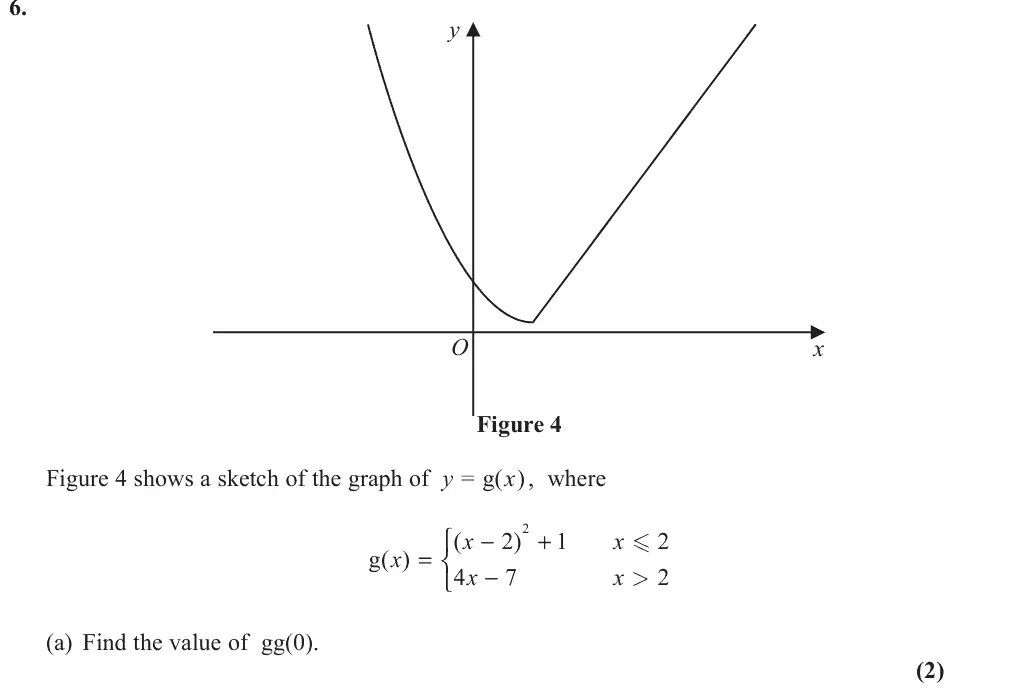
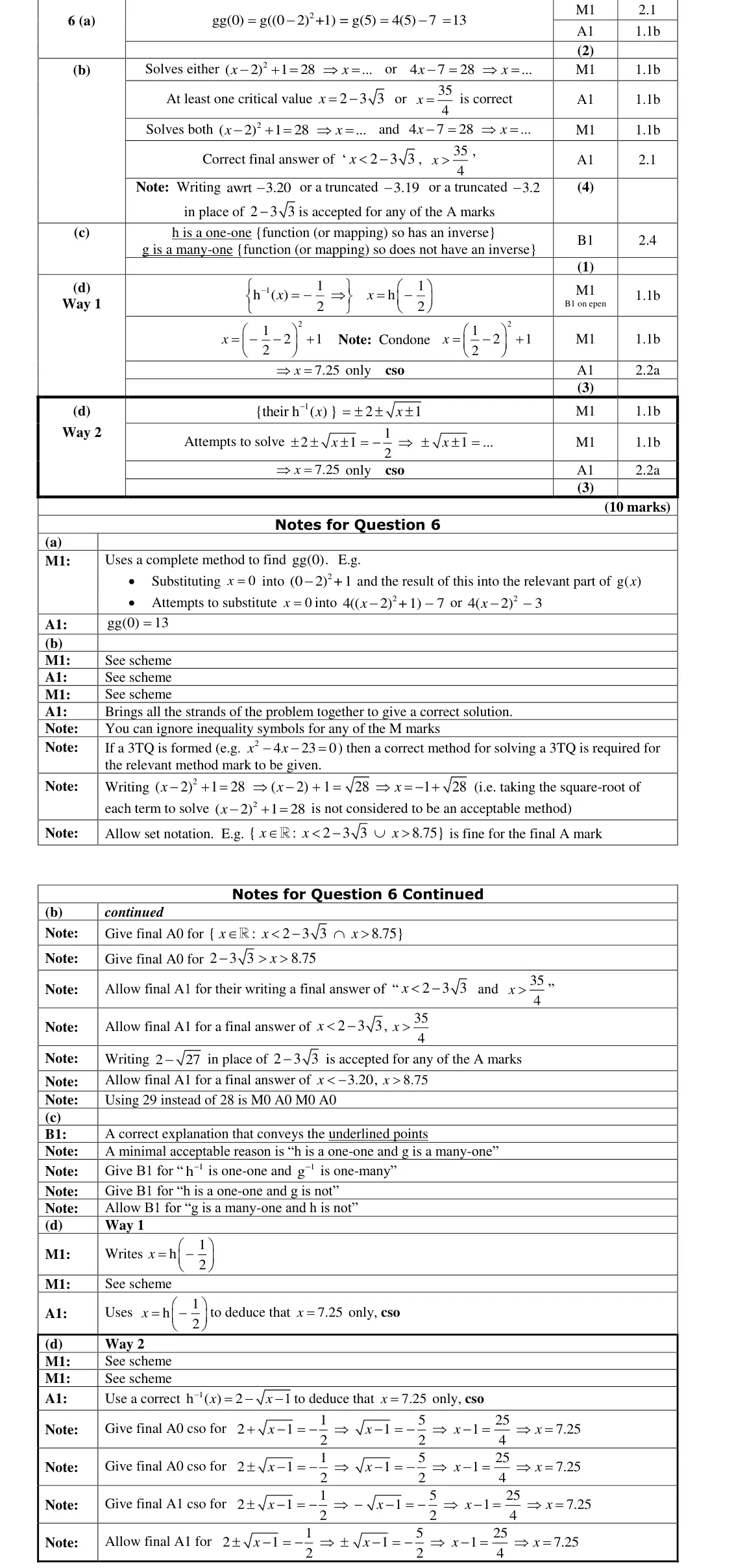
Q06 discriminated well between candidates of all abilities, with only a few candidates gaining full marks. There were some marks in Q06(b) and Q06(d) which were accessible to the majority of candidates. x In Q06(a), many candidates struggled with the split domain for g( )x (i.e. for 2, and for 2 g( ) ( 2) 1 x x 2, g( ) 4 7) x x x and only a minority gained both marks. Many candidates found a correct g(0) 5, but a significant number used the incorrect 2 gg(0) (5 2) 1 10. method of substituting ‘5’ to give Only a minority used a correct method and found gg(0) 4(5) 3 13. Occasionally candidates found an algebraic expression for gg( ), x although this was often incorrect. Very few obtained a x x x 2 2 correct answer of 13 by substituting into or 0 4(( 2) + 1) 7 4( 2) 3. x In Q06(b), many candidates attempted to solve the inequality g( ) 28 by finding the critical values for x. Most solved the linear equation to find a correct critical value 35 , x x 2 3 3. and many solved the quadratic equation to find A minority 4 x x 2 3 3 2 3 3 rejected and deduced that was the second critical value. Only a few candidates used the critical values and the diagram in Q6 to write down the correct 35 35 , x 2 3 3 . x x solution Some candidates, however, incorrectly gave 4 4 35 x 2 3 3 2 3 3 x x or gave as their final answer. A few candidates 4 made no creditable progress in Q06(b) by using a method of equating both parts of 2 ( 2) 1 4 7. x x g( )x and attempting to solve the equation Although Q6(c) required a comment for both functions, f and g, some candidates only wrote a comment about one of the two functions. A significant number of candidates believed that g did not have an inverse due to its being defined in ‘two parts’. Candidates who were successful in Q6(c) usually gave a reason such as, ‘g is a many- one function and h is a one-one function’. A few correctly stated that the inverse of g is one-many, which is not a function, whereas the inverse of h is one-one, which is a function. A few candidates incorrectly described g as a ‘one-many function’. 1 h . In Q06(d), only a few candidates applied the method of finding x by applying 2 As this method was less prone to error, most candidates who used it scored full marks. 1 h ( ), x Most candidates applied a complete method of finding their inverse followed 1 1 h ( ) . x by using their inverse to form and solve the equation Many candidates 2 x who found a correct answer lost the final mark in Q06(d). This was because 7.25 1 h ( ) 2 1 x x they used the incorrect inverse (instead of the correct 1 ) which led to their ‘solving’ the incorrect x 1 h ( ) 2 1 x x 1 (which has 2 x 7.25. no solutions) to give A few candidates in Q06(d) incorrectly believed that 1 h ( )x referred to the reciprocal of h, or even to the first derivative of h with respect to x.
Common mistakes
g(0) = 5, then use the 4x − 7 branch because 5 > 2: gg(0) = 13
common error (5 − 2)² + 1 = 10
June 2019 · Paper 2 · Q6(b)4 marks
Mark scheme (whole question; this part is marked with the orange bar)
Examiner's comment
Q06 discriminated well between candidates of all abilities, with only a few candidates gaining full marks. There were some marks in Q06(b) and Q06(d) which were accessible to the majority of candidates. x In Q06(a), many candidates struggled with the split domain for g( )x (i.e. for 2, and for 2 g( ) ( 2) 1 x x 2, g( ) 4 7) x x x and only a minority gained both marks. Many candidates found a correct g(0) 5, but a significant number used the incorrect 2 gg(0) (5 2) 1 10. method of substituting ‘5’ to give Only a minority used a correct method and found gg(0) 4(5) 3 13. Occasionally candidates found an algebraic expression for gg( ), x although this was often incorrect. Very few obtained a x x x 2 2 correct answer of 13 by substituting into or 0 4(( 2) + 1) 7 4( 2) 3. x In Q06(b), many candidates attempted to solve the inequality g( ) 28 by finding the critical values for x. Most solved the linear equation to find a correct critical value 35 , x x 2 3 3. and many solved the quadratic equation to find A minority 4 x x 2 3 3 2 3 3 rejected and deduced that was the second critical value. Only a few candidates used the critical values and the diagram in Q6 to write down the correct 35 35 , x 2 3 3 . x x solution Some candidates, however, incorrectly gave 4 4 35 x 2 3 3 2 3 3 x x or gave as their final answer. A few candidates 4 made no creditable progress in Q06(b) by using a method of equating both parts of 2 ( 2) 1 4 7. x x g( )x and attempting to solve the equation Although Q6(c) required a comment for both functions, f and g, some candidates only wrote a comment about one of the two functions. A significant number of candidates believed that g did not have an inverse due to its being defined in ‘two parts’. Candidates who were successful in Q6(c) usually gave a reason such as, ‘g is a many- one function and h is a one-one function’. A few correctly stated that the inverse of g is one-many, which is not a function, whereas the inverse of h is one-one, which is a function. A few candidates incorrectly described g as a ‘one-many function’. 1 h . In Q06(d), only a few candidates applied the method of finding x by applying 2 As this method was less prone to error, most candidates who used it scored full marks. 1 h ( ), x Most candidates applied a complete method of finding their inverse followed 1 1 h ( ) . x by using their inverse to form and solve the equation Many candidates 2 x who found a correct answer lost the final mark in Q06(d). This was because 7.25 1 h ( ) 2 1 x x they used the incorrect inverse (instead of the correct 1 ) which led to their ‘solving’ the incorrect x 1 h ( ) 2 1 x x 1 (which has 2 x 7.25. no solutions) to give A few candidates in Q06(d) incorrectly believed that 1 h ( )x referred to the reciprocal of h, or even to the first derivative of h with respect to x.
Common mistakes
solve each branch = 28
reject 2 + 3√3 (not in x ≤ 2)
answer x < 2 − 3√3 or x > 35/4 (not "and" or ∩)
do not equate the two branches
June 2019 · Paper 2 · Q6(c)1 mark
Mark scheme (whole question; this part is marked with the orange bar)
Examiner's comment
Q06 discriminated well between candidates of all abilities, with only a few candidates gaining full marks. There were some marks in Q06(b) and Q06(d) which were accessible to the majority of candidates. x In Q06(a), many candidates struggled with the split domain for g( )x (i.e. for 2, and for 2 g( ) ( 2) 1 x x 2, g( ) 4 7) x x x and only a minority gained both marks. Many candidates found a correct g(0) 5, but a significant number used the incorrect 2 gg(0) (5 2) 1 10. method of substituting ‘5’ to give Only a minority used a correct method and found gg(0) 4(5) 3 13. Occasionally candidates found an algebraic expression for gg( ), x although this was often incorrect. Very few obtained a x x x 2 2 correct answer of 13 by substituting into or 0 4(( 2) + 1) 7 4( 2) 3. x In Q06(b), many candidates attempted to solve the inequality g( ) 28 by finding the critical values for x. Most solved the linear equation to find a correct critical value 35 , x x 2 3 3. and many solved the quadratic equation to find A minority 4 x x 2 3 3 2 3 3 rejected and deduced that was the second critical value. Only a few candidates used the critical values and the diagram in Q6 to write down the correct 35 35 , x 2 3 3 . x x solution Some candidates, however, incorrectly gave 4 4 35 x 2 3 3 2 3 3 x x or gave as their final answer. A few candidates 4 made no creditable progress in Q06(b) by using a method of equating both parts of 2 ( 2) 1 4 7. x x g( )x and attempting to solve the equation Although Q6(c) required a comment for both functions, f and g, some candidates only wrote a comment about one of the two functions. A significant number of candidates believed that g did not have an inverse due to its being defined in ‘two parts’. Candidates who were successful in Q6(c) usually gave a reason such as, ‘g is a many- one function and h is a one-one function’. A few correctly stated that the inverse of g is one-many, which is not a function, whereas the inverse of h is one-one, which is a function. A few candidates incorrectly described g as a ‘one-many function’. 1 h . In Q06(d), only a few candidates applied the method of finding x by applying 2 As this method was less prone to error, most candidates who used it scored full marks. 1 h ( ), x Most candidates applied a complete method of finding their inverse followed 1 1 h ( ) . x by using their inverse to form and solve the equation Many candidates 2 x who found a correct answer lost the final mark in Q06(d). This was because 7.25 1 h ( ) 2 1 x x they used the incorrect inverse (instead of the correct 1 ) which led to their ‘solving’ the incorrect x 1 h ( ) 2 1 x x 1 (which has 2 x 7.25. no solutions) to give A few candidates in Q06(d) incorrectly believed that 1 h ( )x referred to the reciprocal of h, or even to the first derivative of h with respect to x.
Common mistakes
h is one-one, g is many-one – comment needed on both
"g is in two parts" or "g is one-many" is wrong
June 2019 · Paper 2 · Q6(d)3 marks
Mark scheme (whole question; this part is marked with the orange bar)
Examiner's comment
Q06 discriminated well between candidates of all abilities, with only a few candidates gaining full marks. There were some marks in Q06(b) and Q06(d) which were accessible to the majority of candidates. x In Q06(a), many candidates struggled with the split domain for g( )x (i.e. for 2, and for 2 g( ) ( 2) 1 x x 2, g( ) 4 7) x x x and only a minority gained both marks. Many candidates found a correct g(0) 5, but a significant number used the incorrect 2 gg(0) (5 2) 1 10. method of substituting ‘5’ to give Only a minority used a correct method and found gg(0) 4(5) 3 13. Occasionally candidates found an algebraic expression for gg( ), x although this was often incorrect. Very few obtained a x x x 2 2 correct answer of 13 by substituting into or 0 4(( 2) + 1) 7 4( 2) 3. x In Q06(b), many candidates attempted to solve the inequality g( ) 28 by finding the critical values for x. Most solved the linear equation to find a correct critical value 35 , x x 2 3 3. and many solved the quadratic equation to find A minority 4 x x 2 3 3 2 3 3 rejected and deduced that was the second critical value. Only a few candidates used the critical values and the diagram in Q6 to write down the correct 35 35 , x 2 3 3 . x x solution Some candidates, however, incorrectly gave 4 4 35 x 2 3 3 2 3 3 x x or gave as their final answer. A few candidates 4 made no creditable progress in Q06(b) by using a method of equating both parts of 2 ( 2) 1 4 7. x x g( )x and attempting to solve the equation Although Q6(c) required a comment for both functions, f and g, some candidates only wrote a comment about one of the two functions. A significant number of candidates believed that g did not have an inverse due to its being defined in ‘two parts’. Candidates who were successful in Q6(c) usually gave a reason such as, ‘g is a many- one function and h is a one-one function’. A few correctly stated that the inverse of g is one-many, which is not a function, whereas the inverse of h is one-one, which is a function. A few candidates incorrectly described g as a ‘one-many function’. 1 h . In Q06(d), only a few candidates applied the method of finding x by applying 2 As this method was less prone to error, most candidates who used it scored full marks. 1 h ( ), x Most candidates applied a complete method of finding their inverse followed 1 1 h ( ) . x by using their inverse to form and solve the equation Many candidates 2 x who found a correct answer lost the final mark in Q06(d). This was because 7.25 1 h ( ) 2 1 x x they used the incorrect inverse (instead of the correct 1 ) which led to their ‘solving’ the incorrect x 1 h ( ) 2 1 x x 1 (which has 2 x 7.25. no solutions) to give A few candidates in Q06(d) incorrectly believed that 1 h ( )x referred to the reciprocal of h, or even to the first derivative of h with respect to x.
Common mistakes
quickest: x = h(−½) = 7.25
if finding h⁻¹ it must be 2 − √(x − 1) (domain of h is x ≤ 2), using 2 + √(x − 1) loses the final mark
h⁻¹ is not the reciprocal or derivative
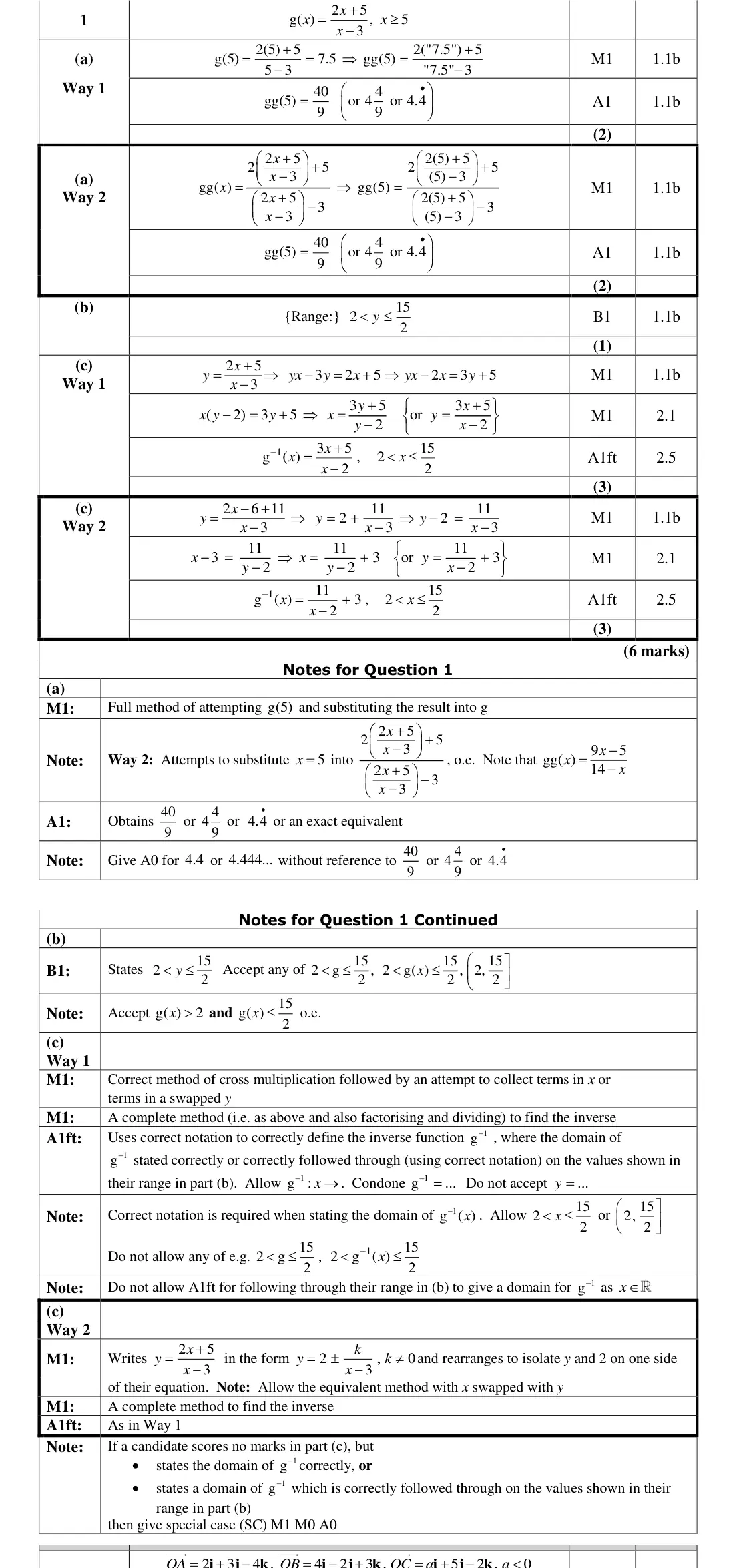
June 2018 · Paper 2 · Q1(a)2 marks
Mark scheme (whole question; this part is marked with the orange bar)
Examiner's comment
This question proved accessible to all, but only the most able students scored full marks. In part (a), most students found the value of g(5) and substituted this value back into g( ), x with 40 gg(5) . nearly all of them being successful in finding the correct A minority found 9 x into the result. gg( )x algebraically and substituted 5
Common mistakes
find g(5) = 7.5 first, then g(7.5) = 40/9
a few find gg(x) algebraically (gg(x) = (9x − 5)/(14 − x)) before substituting
June 2018 · Paper 2 · Q1(b)1 mark
Mark scheme (whole question; this part is marked with the orange bar)
Examiner's comment
This question proved accessible to all, but only the most able students scored full marks. In 15 2 g( ) . x In part (b), only a few students stated the correct range The most common 2 15 15 15 15 g( ) , g( ) , g( ) x x x 2 . x incorrect answers included and 2 2 2 2
Common mistakes
range 2 < g(x) ≤ 15/2 (or 2 < y ≤ 15/2)
common errors g(x) ≥ 2, wrong inequality at either end, writing x instead of g(x)
June 2018 · Paper 2 · Q1(c)3 marks
Mark scheme (whole question; this part is marked with the orange bar)
Examiner's comment
This question proved accessible to all, but only the most able students scored full marks. In 3 5 x y In part (c), most students used a correct process to find with some finding 2 x 11 tried to either 1 3. y A few students, who misunderstood the notation g , 2 x differentiate g( )x or write down the reciprocal of g( ). x Some students lost the final mark by 3 5 x 1 g ( ) x stating neither nor its domain in correct notation. Some students made no 2 x 1 g . attempt to write down the domain of