Add vectors diagrammatically and perform the algebraic operations of vector addition and multiplication by scalars, and understand their geometrical interpretations.
Guidance
The triangle and parallelogram laws of addition. Parallel vectors.
Mark scheme (whole question; this part is marked with the orange bar)
Examiner's comment
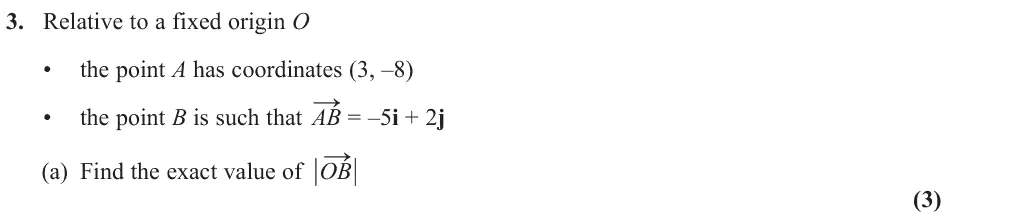
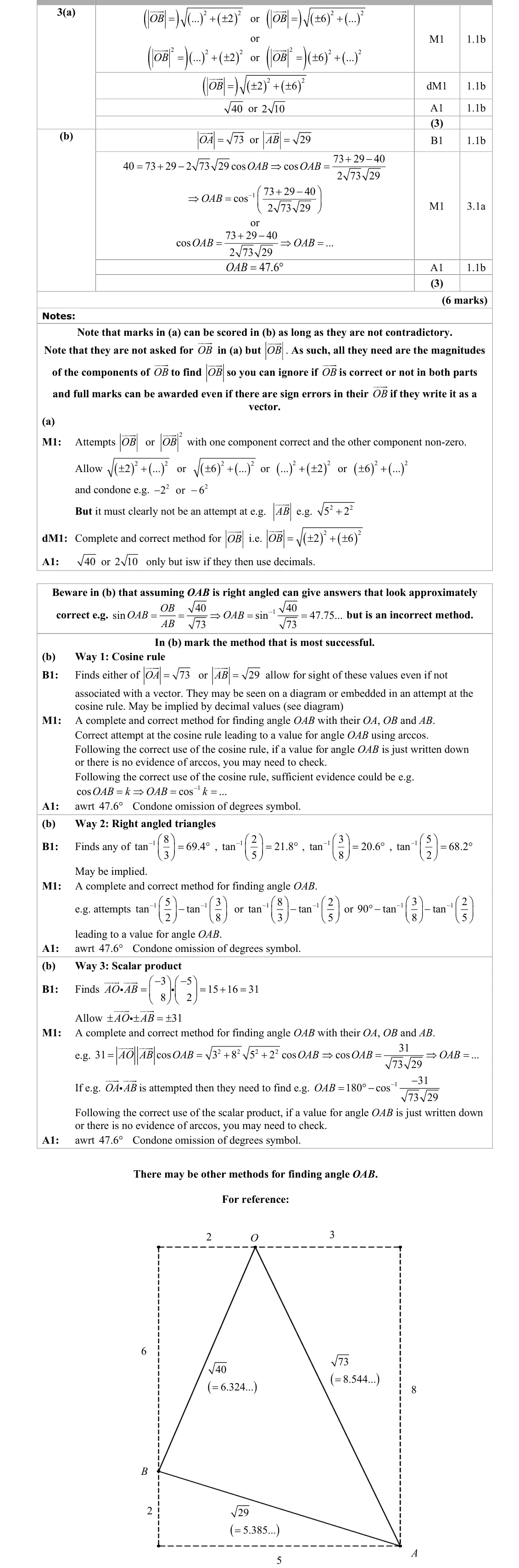
In part (a), a good proportion of candidates arrived at the correct value for OB as 40 or 2 10 , either in part (a) or (b). Some candidates mistakenly found OB as OA AB - rather than OA AB + whilst others found OB but not its magnitude, although they were allowed recovery if they subsequently found the magnitude in part (b). A few just found AB in this part and others slipped up on one of the components of OB .
Common mistakes
OB = OA + AB = −2i − 6j (not OA − AB)
exact magnitude √40 = 2√10
stopping at the vector OB or finding the magnitude of AB
June 2025 · AS Paper 2 (Mechanics) · Q2(a)1 mark
Mark scheme (whole question; this part is marked with the orange bar)
Examiner's comment
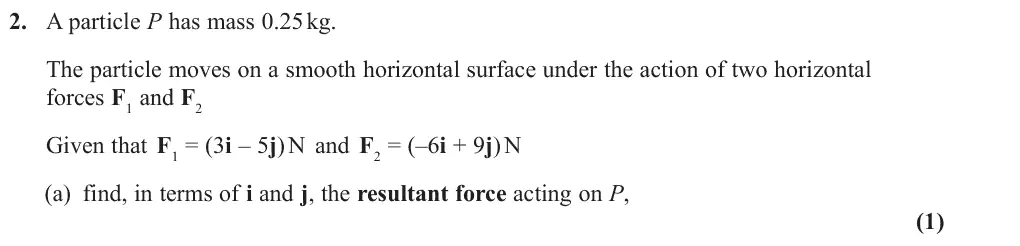
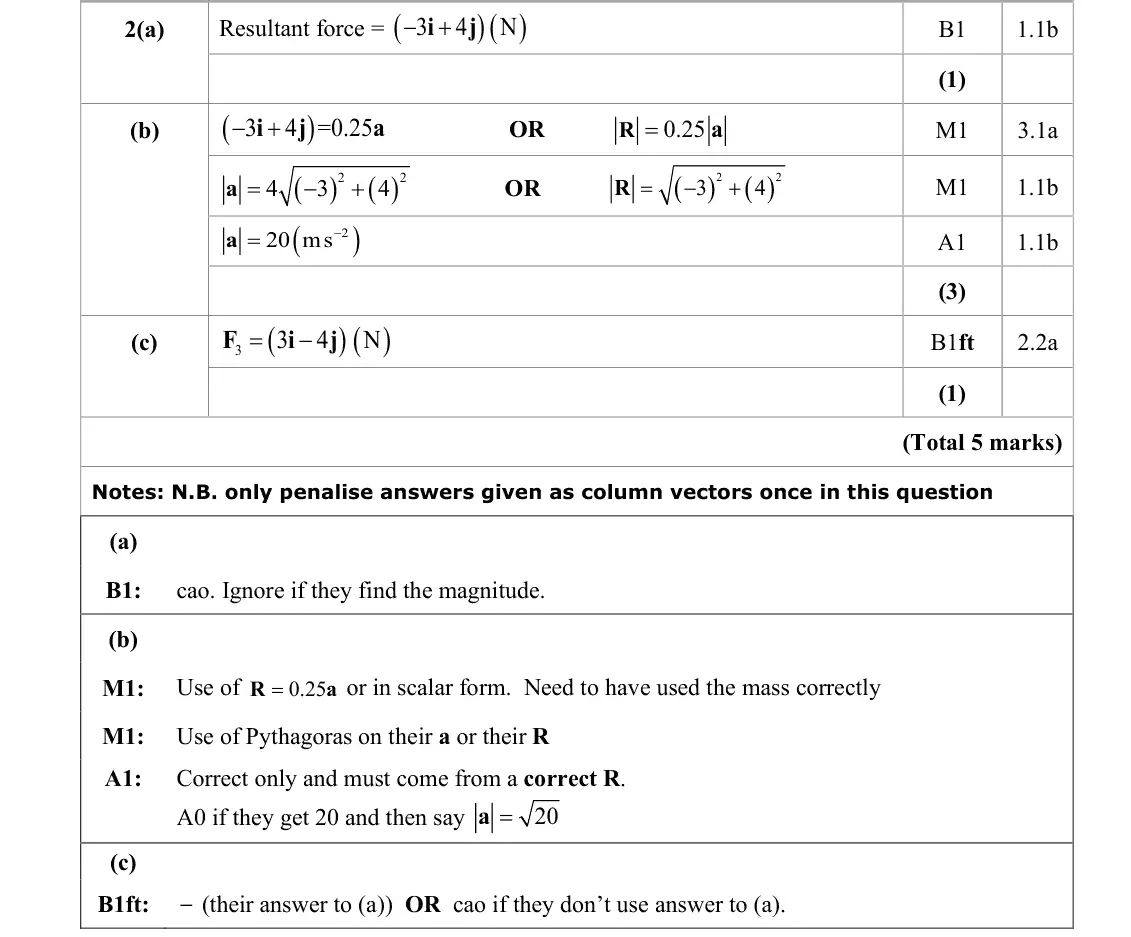
Part (a) was mostly correctly answered, but some candidates were confused as to whether to add or subtract the forces, with 9i + 14j being the most common incorrect answer. This was usually carried through to part (b) but then often replaced in part (c) with the correct answer of 3i – 4j. Many candidiates worked with column vectors but most gave the answer in the required format. Very occasionally the answer was seen in (xi, yj) format or the column vector form of this.
Common mistakes
add the force vectors: (−3i + 4j) N
9i + 14j (subtracting) was the most common error
answer must be in i, j form
June 2025 · AS Paper 2 (Mechanics) · Q2(c)1 mark
Mark scheme (whole question; this part is marked with the orange bar)
Examiner's comment
Part (c) not always correct even if the rest of the question was and often left blank. There was the occasional correct follow through from part (a).
Common mistakes
constant velocity means the resultant force is zero (Newton's first law), so F3 = −(their (a)) = (3i − 4j) N
often left blank
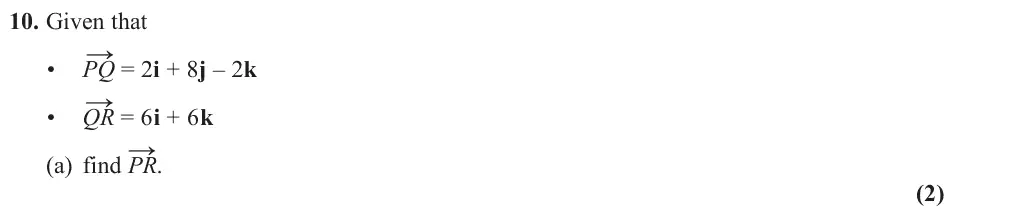
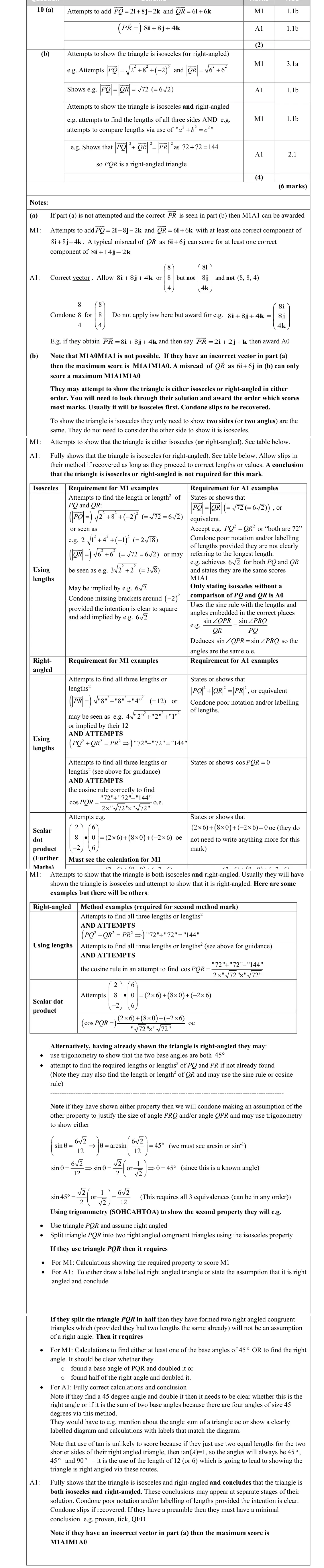
June 2025 · Paper 1 · Q10(a)2 marks
Mark scheme (whole question; this part is marked with the orange bar)
Examiner's comment
This question tested learners’ knowledge of vectors and proof of the properties of a triangle. In part (a), many gained both marks by successfully adding the vectors, correctly identifying and combining the i, j, and k components. Common errors included misreading the vector QR as 6 6 + i j, or subtracting the two given vectors. It should be noted that subtracting vectors was seen in a significant minority of responses. This was likely due to confusion arising from a misinterpretation of the vectors as position vectors, where PR OR OP = - . Learners should be encouraged to sketch a diagram as a guide.
Common mistakes
PR = PQ + QR = 8i + 8j + 4k (add, do not subtract: they are not position vectors)
misreading QR as 6i + 6j
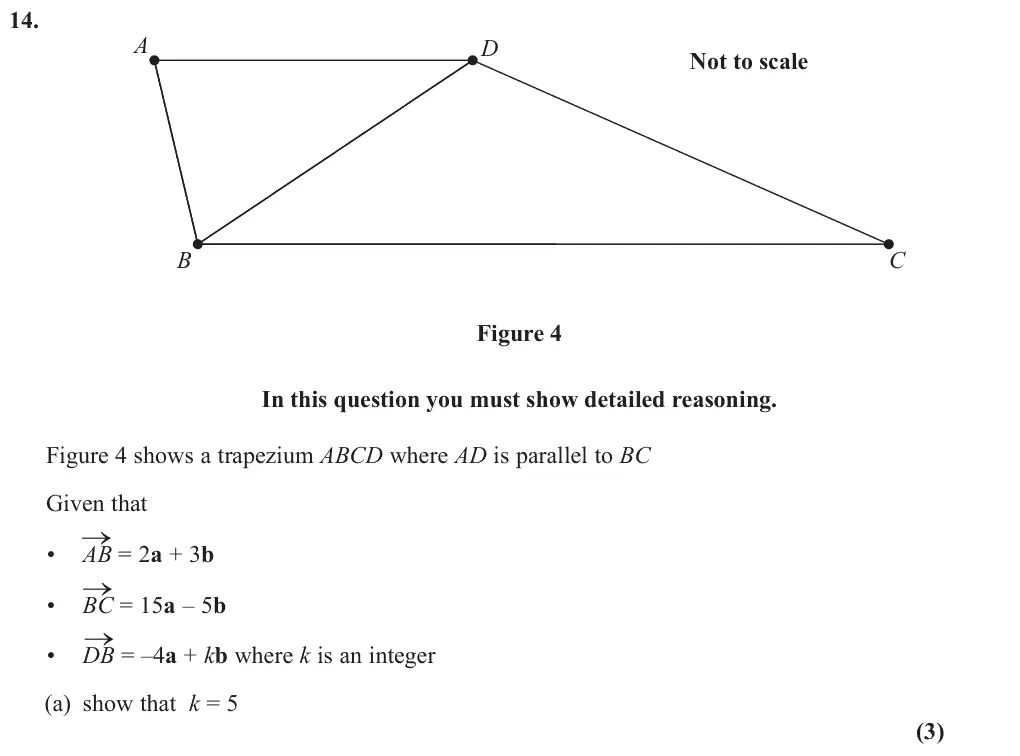
June 2025 · Paper 2 · Q14(a)3 marks
Mark scheme (whole question; this part is marked with the orange bar)
Examiner's comment
This question about vectors proved to be a good differentiator between learners. Many were only able to make progress in part (a), whilst learners who had a good knowledge of the techniques required progressed through part (b) as well. Most learners made some progress, but also found this question to be challenging. Throughout, responses saw varied methods, and many made effective use of the given diagram to help answer the question. In general, those that wrote the route down using good vector notation fared better than those who did not in both parts of the question. In part (a), most successful responses attempted to use AD or DA , often finding an equation such as ( ) 4 15 5 2 3 k λ - + = - + + a b a b a b or ( ) 6 3 AD k = + - a b gaining the first mark. Some responses worked with the components of a and b from the start, rather than writing down expressions with vectors, but often produced correct work. A common mistake, however, was to incorrectly use AD AB DB = + and responses doing this made no progress in part (a). Those who had made a successful start were then often able to equate the a and b components of their expression to produce two simultaneous equations and used the a component to establish a value of their parameter λ, and the b component to find k. Others simply compared ( ) 6 3 k + - a b and 15a – 5b by inspection and were able to find the correct scale factor between them using it to find k with sufficient working. Regardless of the method used, some learners with incorrect work often wrote down the given answer, k = 5, without realising that their work did not lead to this value.
Common mistakes
AD = AB − DB = 6a + (3 − k)b (not AB + DB)
AD parallel to BC: compare 6a + (3 − k)b with 15a − 5b (scale factor 2.5)
writing k = 5 from wrong work
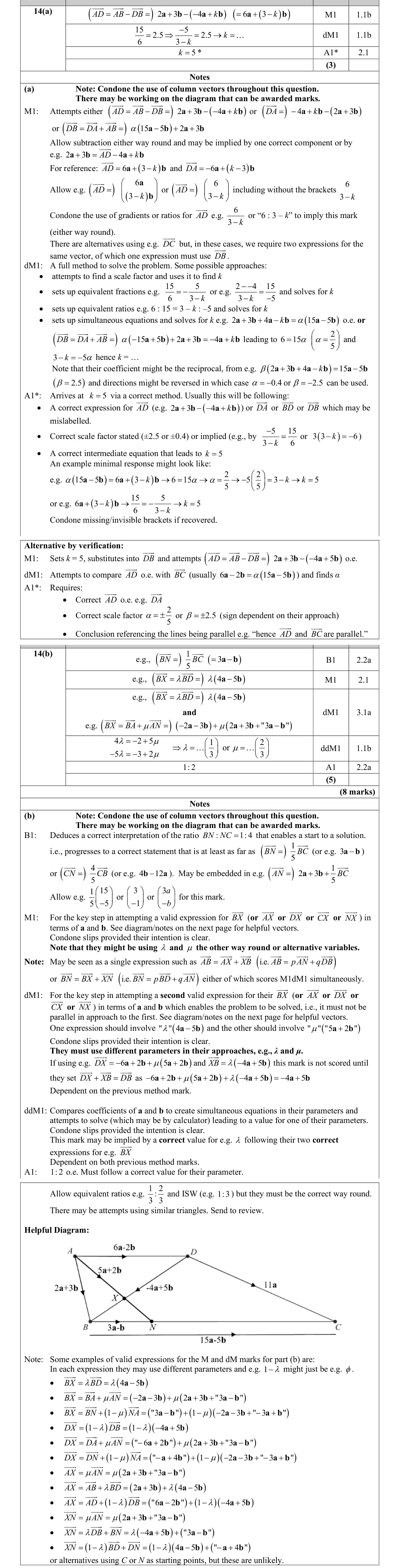
June 2025 · Paper 2 · Q14(b)5 marks
Mark scheme (whole question; this part is marked with the orange bar)
Examiner's comment
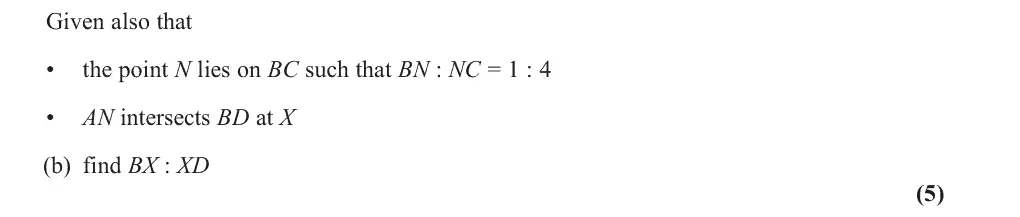
This question about vectors proved to be a good differentiator between learners. Many were only able to make progress in part (a), whilst learners who had a good knowledge of the techniques required progressed through part (b) as well. Most learners made some progress, but also found this question to be challenging. Throughout, responses saw varied methods, and many made effective use of the given diagram to help answer the question. In general, those that wrote the route down using good vector notation fared better than those who did not in both parts of the question. Learners found part (b) of the question significantly harder. Many responses earned the first mark for identifying that 1 , 5 BN BC = and this was often the only mark scored in this question. A common error, however, was to misinterpret the ratio BN : NC, and to incorrectly use 1 4 BN BC = . Most learners who made progress found two expressions for one of the vectors BX ± , AX ± , NX ± or DX ± , one using a multiple of AN and one using a multiple of DB . Where responses found a second vector with a different parameter, they were typically successful in solving simultaneous equations and identifying the correct ratio. Common errors included: only finding one expression or using the same vector ( AN or DB ) in both of their expressions or using the same parameter in both expressions. There were other strategies employed, but invariably they had the same issues as the strategy covered in the main scheme. A neat approach was to establish that triangles AXD and NXB were similar and since AD = 2BN it followed immediately that BX : XD = 1 : 2. There were some responses that attempted to use a similar strategy, but often the work was not detailed enough, simply stating that AD and BN were parallel without further justification that they understood the triangles were similar.
Common mistakes
BN = ⅕BC = 3a − b (not ¼BC)
two expressions for BX with different parameters (λ along BD, μ along AN) then compare coefficients
BX : XD = 1 : 2
similar triangles AXD and NXB (AD = 2BN) need justifying
June 2025 · Paper 3 (Mechanics) · Q3(a)1 mark
Mark scheme (whole question; this part is marked with the orange bar)
Examiner's comment
In part (a) most responses scored the first mark by using F = ma with the given mass and acceleration vector. A few responses omitted the mass. The question stipulated that the answer should be given in terms of i’s and j’s and most learners did so correctly.
Common mistakes
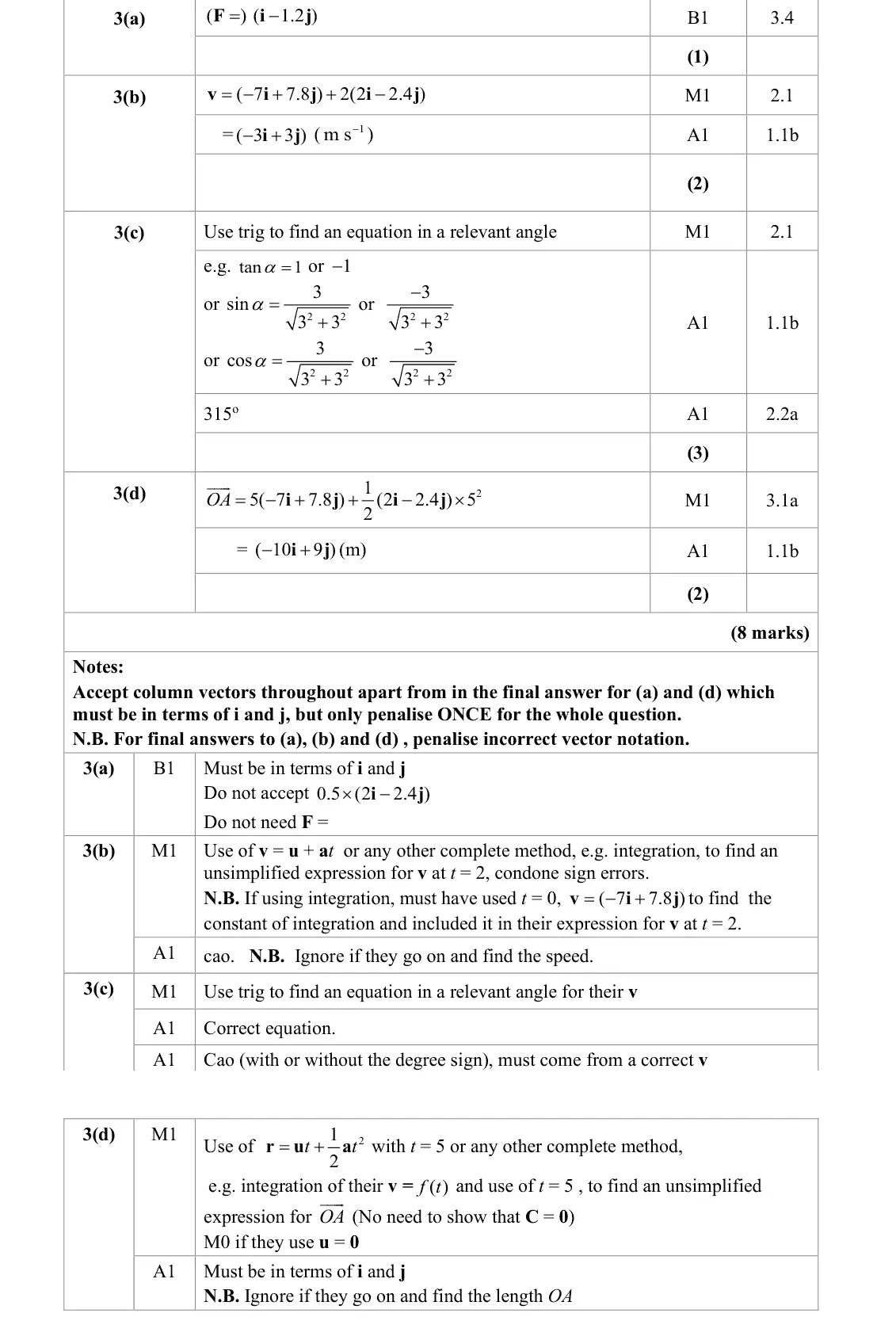
F = ma = 0.5(2i − 2.4j) = i − 1.2j
omitting the mass
final answer must be simplified in i and j
June 2025 · Paper 3 (Mechanics) · Q3(b)2 marks
Mark scheme (whole question; this part is marked with the orange bar)
Examiner's comment
In part (b) most responses scored both marks by quoting and correctly using t = + v u a with their vector quantities. A few used their F for a. Arithmetical slips were occasionally seen. It was relatively rare to see the method of integration deployed. This was more mixed in terms of levels of success with some not considering the constant of integration. Others made arithmetical slips, the longer method providing more opportunity to make an error. Many responses demonstrated a preference for column vectors and used them in this part.
Common mistakes
v = u + at with vectors
use a, not F
if integrating, include the constant from v at t = 0
June 2025 · Paper 3 (Mechanics) · Q3(d)2 marks
Mark scheme (whole question; this part is marked with the orange bar)
Examiner's comment
Part (d) was well answered with a suvat equation being the preferred and most successful method for the majority. A few attempted to use integration, and with the constant of integration being the zero vector, this was generally successful albeit a longer method. Almost all responses gave the answer in terms of i’s and j’s, as required by the question.
Common mistakes
r = ut + ½at² with t = 5 and u = −7i + 7.8j (not u = 0)
answer −10i + 9j in i and j
June 2024 · AS Paper 1 · Q3(a)2 marks
Mark scheme (whole question; this part is marked with the orange bar)
Examiner's comment
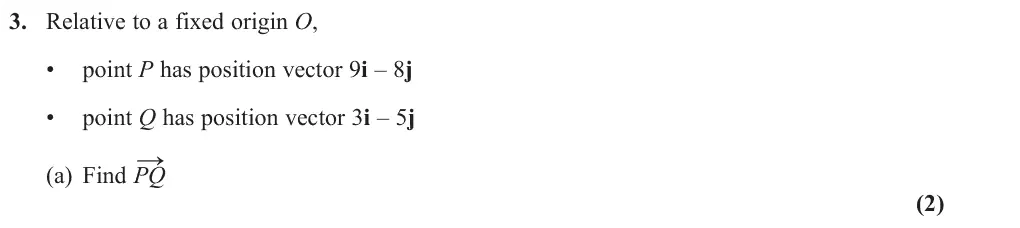
Overall, this question proved fairly tricky with lots of candidates losing marks throughout. In part (a), most candidates knew they needed to subtract the vectors, there were a few signs slips when doing this and quite a few candidates subtracted the wrong way round so found QP instead. There were a small but significant number who added the vectors.
Common mistakes
PQ = q − p = −6i + 3j
subtracting the wrong way round (QP) or adding the vectors
June 2024 · AS Paper 1 · Q3(c)4 marks
Mark scheme (whole question; this part is marked with the orange bar)
Examiner's comment
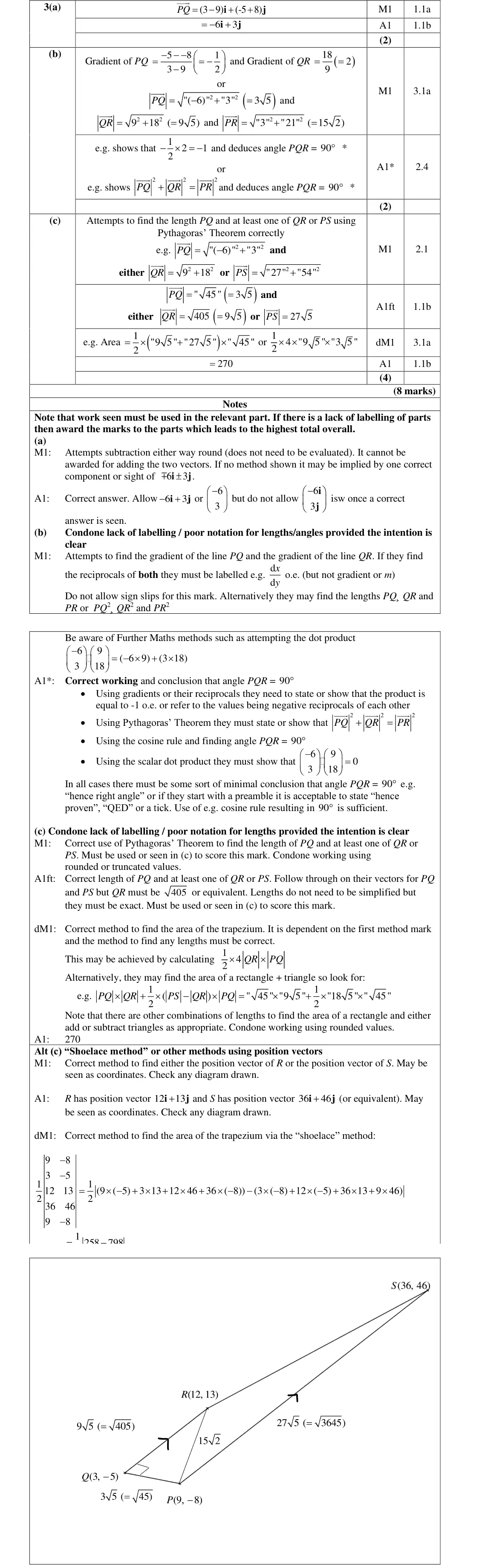
Overall, this question proved fairly tricky with lots of candidates losing marks throughout. Part (c) proved quite tricky for a lot of candidates many of whom did not seem to have fully understood the shape with which they were working. Those who were successful usually had a good diagram identifying it as a trapezium and were able to find the area. There were a number of attempts at splitting the shape up into a rectangle and triangle or 2 triangles, but often there was a misunderstanding about which lengths were which and how they should be combined to find the area. The most common error in the rectangle and triangle approach was that the candidates failed to spot that the triangle was a right-angled triangle so could use QP as the ‘height.’ The two triangles approach would also often have the same issue. There were quite a few attempts that treated the shape either as just a rectangle or just a triangle. It was pleasing however to see that whilst a large number of candidates were unsure of how to proceed to find the area many did at least acknowledge the need to attempt the lengths of various vectors, which generally resulted in two marks being awarded.
Common mistakes
PQRS is a trapezium (PS parallel to QR) with height PQ = 3√5
QR = 9√5, PS = 27√5
area = ½(9√5 + 27√5)(3√5) = 270
a diagram helps
treating the shape as a rectangle or parallelogram
not spotting the right angle
June 2024 · AS Paper 2 (Mechanics) · Q35 marks
Mark scheme (whole question; this part is marked with the orange bar)
Examiner's comment
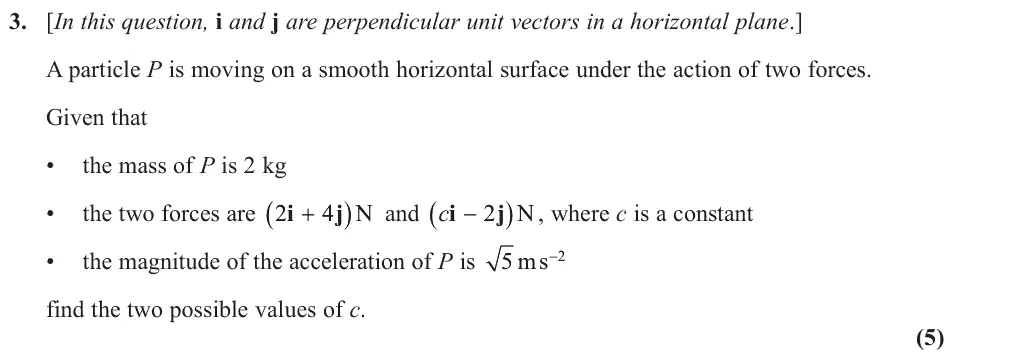
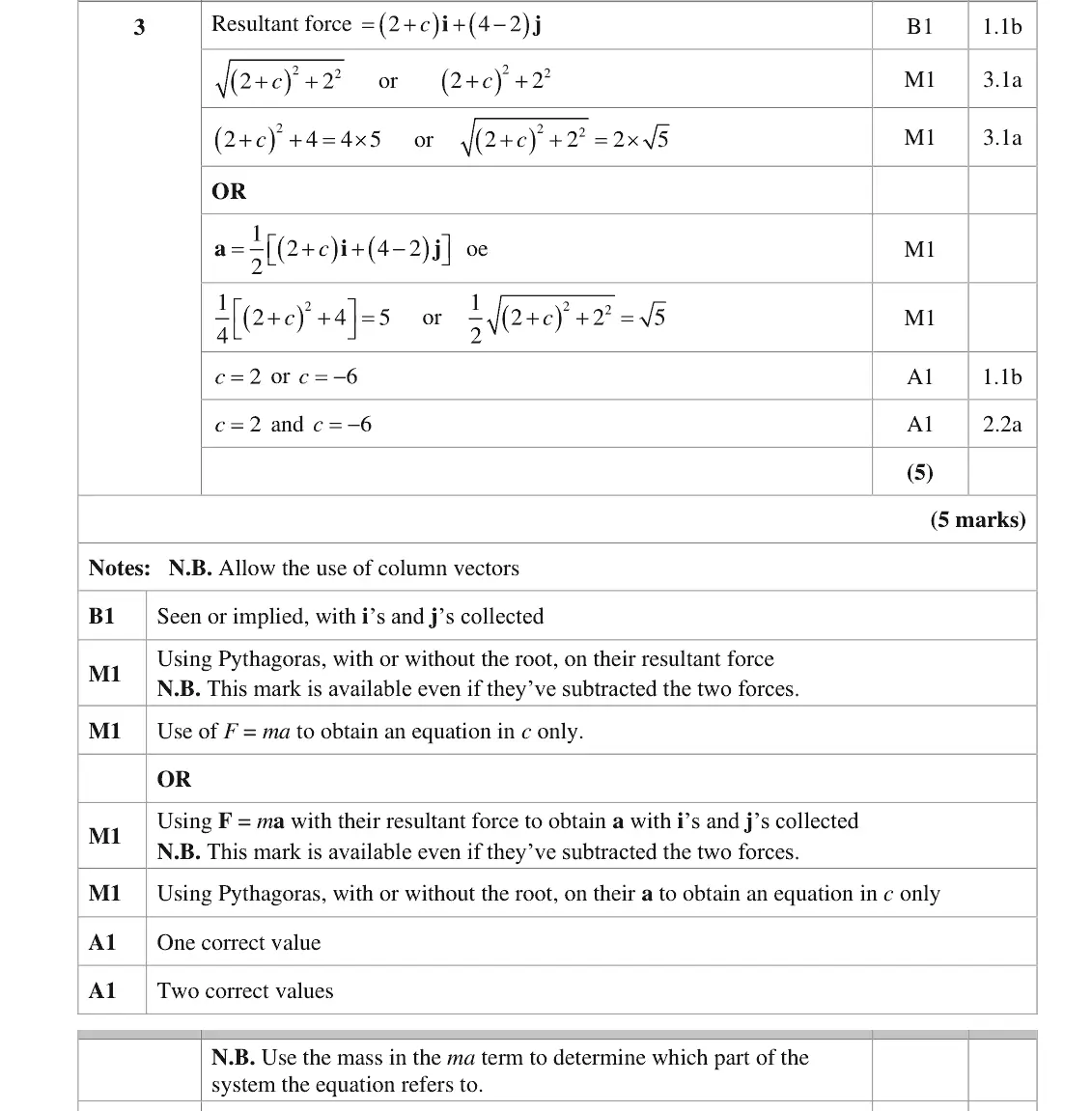
This was a challenging question for many candidates since forces were given as vectors, but the acceleration was given as a scalar. Although most realised that the two forces needed to be combined to produce a resultant, some subtracted the components rather than adding, thererby failing to achieve the first mark. This also required the i and j terms to be collected to enable an expression for the magnitude to be found. A common starting point was to equate the vector sum of the forces to a scalar ‘ma’ term often leading to no further valid progress. Those who attempted to work in scalars sometimes equated the magnitude of their resultant to sqrt 5 (acceleration) rather than 2 sqrt 5 (ma term) and managed to secure one of the two available method marks. Where a correct unsimplified equation in c was reached, processing errors such as not squaring each side or in expanding brackets sometimes led to incorrect answers. The few who found the acceleration vector and equated the magnitude to sqrt 5 or the square of the magnitude to 5 tended to do so successfully despite the slightly harder algebra.
Common mistakes
resultant force (2 + c)i + 2j (add, not subtract, the components)
F = ma with magnitudes: (2 + c)² + 2² = (2√5)² = 20, or acceleration vector with magnitude √5
c = 2 or c = −6
equating a vector to the scalar ma
using √5 instead of 2√5 for ma
June 2024 · Paper 2 · Q7(b)4 marks
Mark scheme (whole question; this part is marked with the orange bar)
Examiner's comment
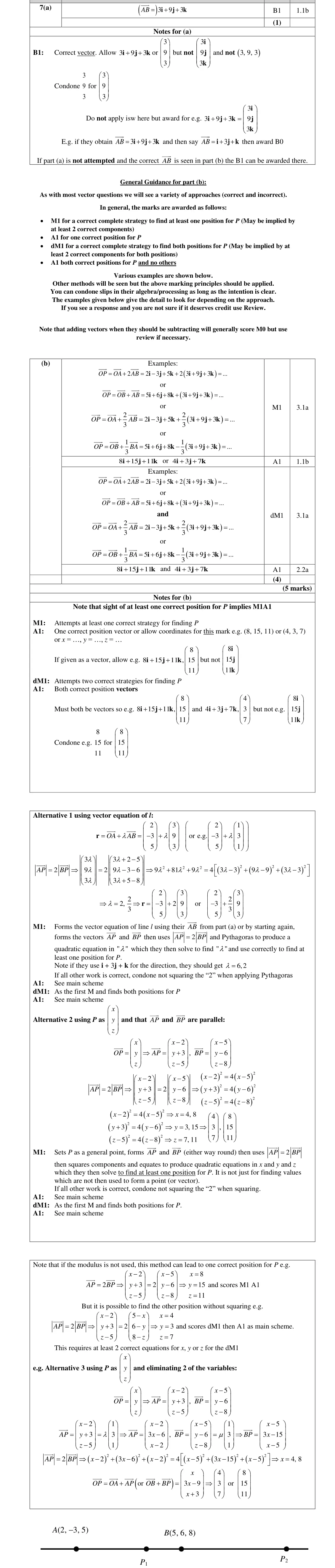
This question proved to be a differentiator between candidates. Some were unable to make any meaningful progress while others demonstrated a very intuitive grasp of the topic and were able to produce answers with very little working. In part (b), many candidates did not appreciate the scaffolding in the question and did not use their answer to part (a) to help them with a strategy for part (b). Relatively few candidates used the most straightforward method to find both two possible positions of P, e.g., 2 OP OA AB = + and 2 3 OP OA AB = + . Some candidates were able to find one of the positions (usually 8i+15j+11k) but not the other, with a common misconception being that the second point was on the opposite side of A, attempting 2 OP OA AB = - . There was also some confusion with the ratio with some candidates using 1 3 OP OA AB = + . Many candidates failed to appreciate that there were two points satisfying 2 AP BP = . Relatively few candidates drew a diagram or used the given diagram on the question paper to give them some idea of where P could be. It was much more common for candidates to take an unnecessarily complicated algebraic approach. Many responses calculated |𝐴𝐵⃗⃗⃗⃗⃗ |(= 3 sqrt 11) and progressed no further. Many responses attempted to express 2 AP BP = in terms of variables representing components of an unknown vector, showing a good understanding of how to calculate the magnitude, but struggled to formulate suitable equations. Some candidates used a fully correct method of considering the point P as the general point on the line OP OA AB = + and then setting up the equation 2 AP BP = . These candidates tended to arrive at two final answers for P, having found two log( ) log( ) log( ) ab a b = values for λ, but many had made processing errors and could only gain the method marks as a result. Other candidates set up a general point P in the form xi + yj + zk, then used 2 AP BP = , extracted and solved ( ) ( ) 2 2 2 4 5 , x x - = - ( ) ( ) 2 2 3 4 6 y y + = - and ( ) ( ) 2 2 5 4 8 z z - = - to generate 3 pairs of possible values for the x, y and z components. These candidates then tended to struggle to determine the possible positions of P from their 6 values. Vector notation was very variable with a wide variety of non-standard notations being encountered. It would be helpful for candidates to bear in mind that a four-mark question should not involve pages of work and that there are more efficient strategies. Whatever method was adopted, work was sometimes difficult to follow as there was little explanation and unclear notation used. In part (b), because of the volume of work they were producing, candidates often needed more space to complete their solution. Candidates are strongly advised that if they run out of space, they should use supplementary paper rather than complete their answer within the space of another question.
Common mistakes
two positions: OA + 2AB = 8i + 15j + 11k and OA + (2/3)AB = 4i + 3j + 7k
the second point is between A and B, not OA − 2AB
a diagram helps
finding the modulus of AB (3√11) alone gets nowhere
long algebraic methods error-prone
June 2024 · Paper 3 (Mechanics) · Q4(c)4 marks
Mark scheme (whole question; this part is marked with the orange bar)
Examiner's comment
(c) Many of those who differentiated in (b), successfully differentiated their velocity vector to obtain the acceleration vector. However, a significant number of candidates did not know how to proceed from there and the second stage of the process proved to be a discriminator. It was only the stronger candidates who realised that their acceleration vector had to be a multiple of the given vector. Those who did make this link generally were able to complete the question successfully. A number of unsuccessful candidates just set the i-component of the acceleration equal to -1 (or more rarely to -27). Most of k -- those who compared a to ( 27 ) i j were able to reach an equation in t only which they then tried to solve. Fewer candidates used a ratio approach but a significant minority of these used the reciprocal of the correct ratio but were still able to score the method mark. Having reached a correct equation in t or T only, some then struggled to obtain the correct answer. There were a few candidates who tried to use a suvat approach for this part not realising that this was not a constant acceleration situation and scored nothing.
Common mistakes
a = −(3/4)t^(−3/2)i − (3/4)j must be a multiple of (−i − 27j): use the ratio of components (not the reciprocal)
setting the i component equal to −1 is wrong
T = 9
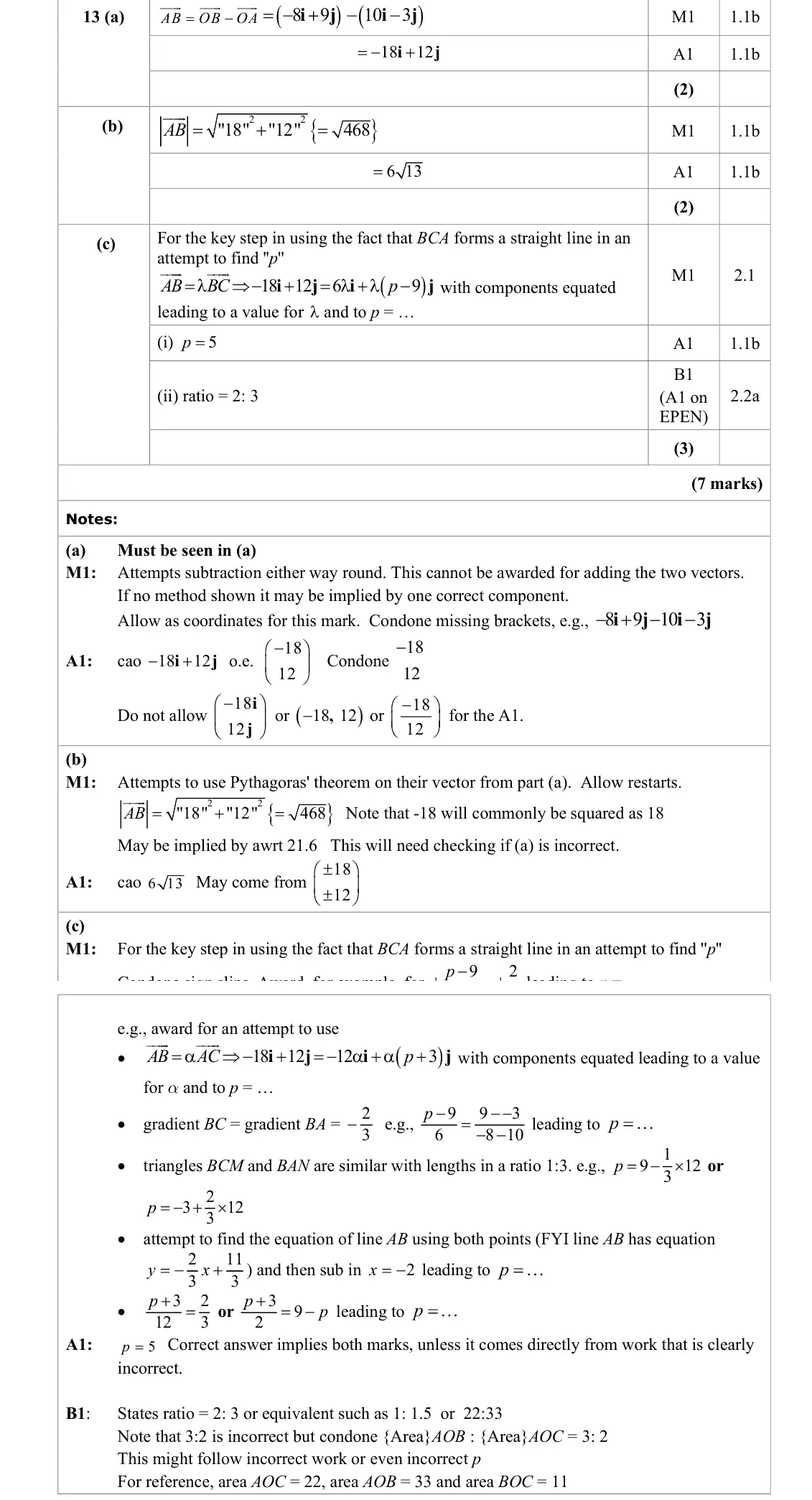
June 2023 · AS Paper 1 · Q13(a)2 marks
Mark scheme (whole question; this part is marked with the orange bar)
Examiner's comment
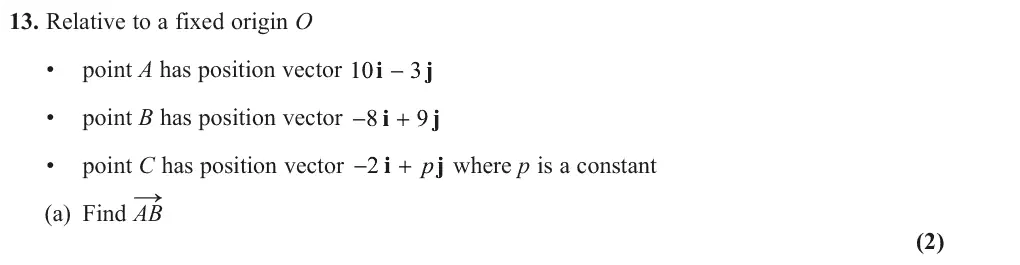
Given that candidates often find vector problems quite challenging, this question proved to be quite accessible, and most candidates made good progress through parts (a) and (b) of this question, with part (c) more mixed. In part (a), most candidates successfully reached 18 12 - + i j although a few subtracted the vectors the wrong way round or added the position vectors of A and B instead.
Common mistakes
AB = OB − OA = −18i + 12j
subtracting the wrong way round or adding
June 2023 · AS Paper 1 · Q13(c)3 marks
Mark scheme (whole question; this part is marked with the orange bar)
Examiner's comment
Given that candidates often find vector problems quite challenging, this question proved to be quite accessible, and most candidates made good progress through parts (a) and (b) of this question, with part (c) more mixed. Many candidates did not successfully reach p = 5. Typical errors in (c)(i) were assuming AB = BC , setting the sum of the position vectors of A, B and C equal to zero or assuming that ( ) 18 12 2 k p - + = - + i j i j . A significant number of candidates omitted (c)(ii) after an unsuccessful attempt at (c)(i), and when responses were seen they were often lengthy and involved unnecessary attempts at calculating the areas of the triangles AOC and AOB. A common incorrect answer was 4:9, reached after assuming incorrectly that the two triangles were similar. Some candidates did, however, successfully reach a ratio of 2:3 either after area calculations, or by, for example, examining the relative lengths of AB and AC. Part (ii) did not rely on an answer to part (i) and so a reasonable number of candidates scored the final mark having been unable to find p, with some doing so very concisely. It was notable that many of the concise solutions to both parts came from a simple, well-constructed and clear diagram.
Common mistakes
(i) AB parallel to BC (or gradient/line AB) gives p = 5
wrong assumptions: AB = BC, position vectors summing to zero
(ii) triangles share height from O so ratio = AC : AB = 2 : 3 (4 : 9 from assuming similarity is wrong)
a clear diagram helps
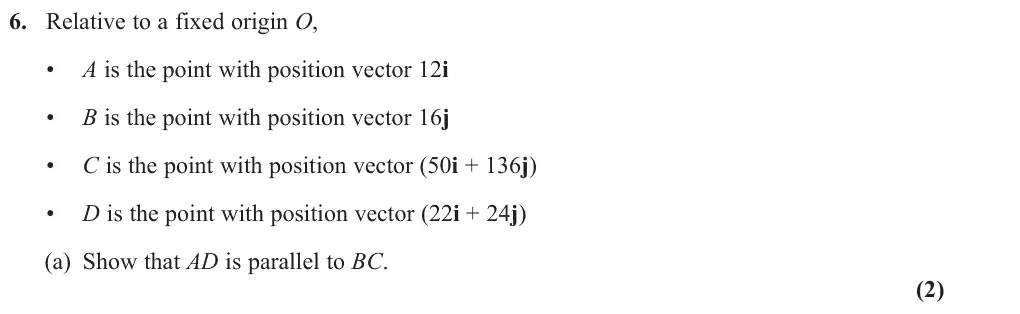
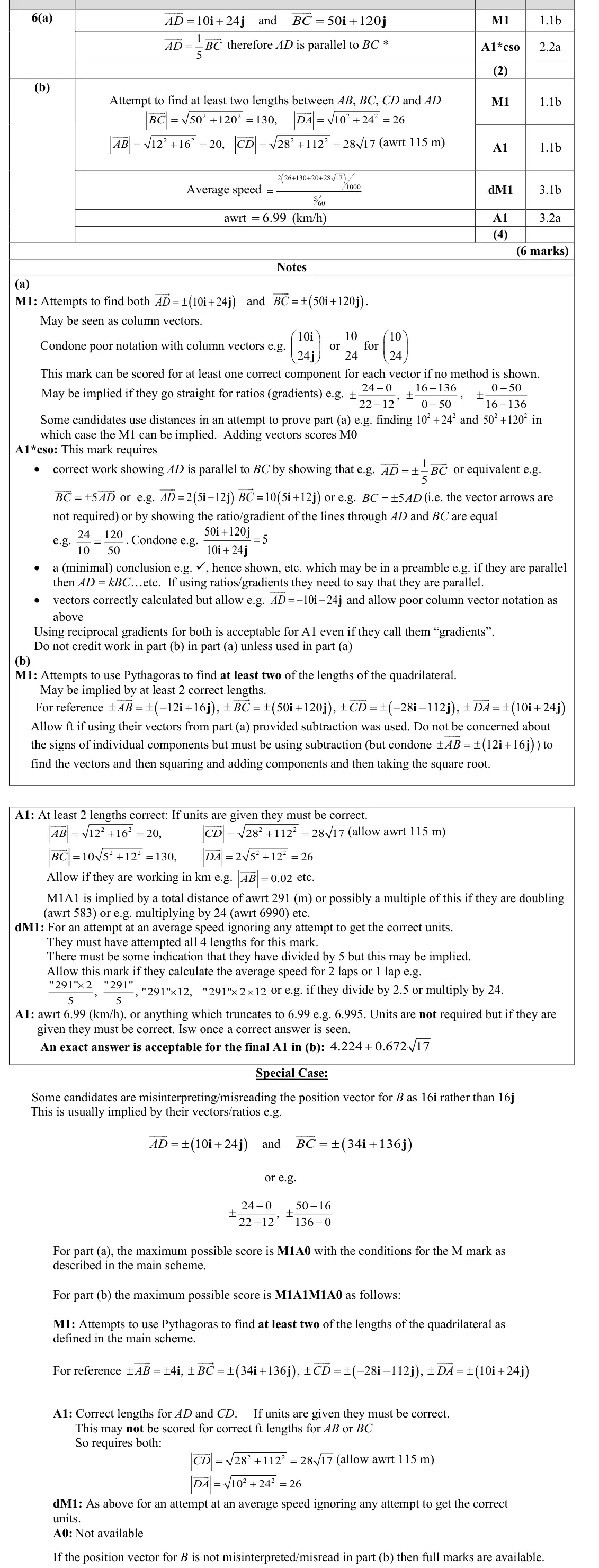
June 2023 · Paper 2 · Q6(a)2 marks
Mark scheme (whole question; this part is marked with the orange bar)
Examiner's comment
This question was relatively well attempted. Most candidates attempted both parts and scored highly overall. In part (a) the majority of candidates correctly identified 10i + 24j, and 50i + 120j. Those who didn’t, often mistakenly added the position vectors instead of subtracting them. Most then went on to show that one was a multiple of the other (or that they were both different multiples of the same vector). However, some wrote the vectors the wrong way round for their multiple, which lost the second mark. Some candidates used other successful methods involving ratios or “gradients”. A common error here was candidates attempting to conclude the vectors were parallel by calculating and using their magnitudes. The most common reason for the loss of a mark in part (a) was with candidates correctly showing that the two vectors were multiples of each other but then not drawing a conclusion afterwards. It is important that candidates state what is shown by their working and provide a conclusion.
Common mistakes
AD = d − a = 10i + 24j, BC = 50i + 120j (subtract, not add, position vectors)
BC = 5AD so parallel, with a conclusion
equal magnitudes do not show parallel
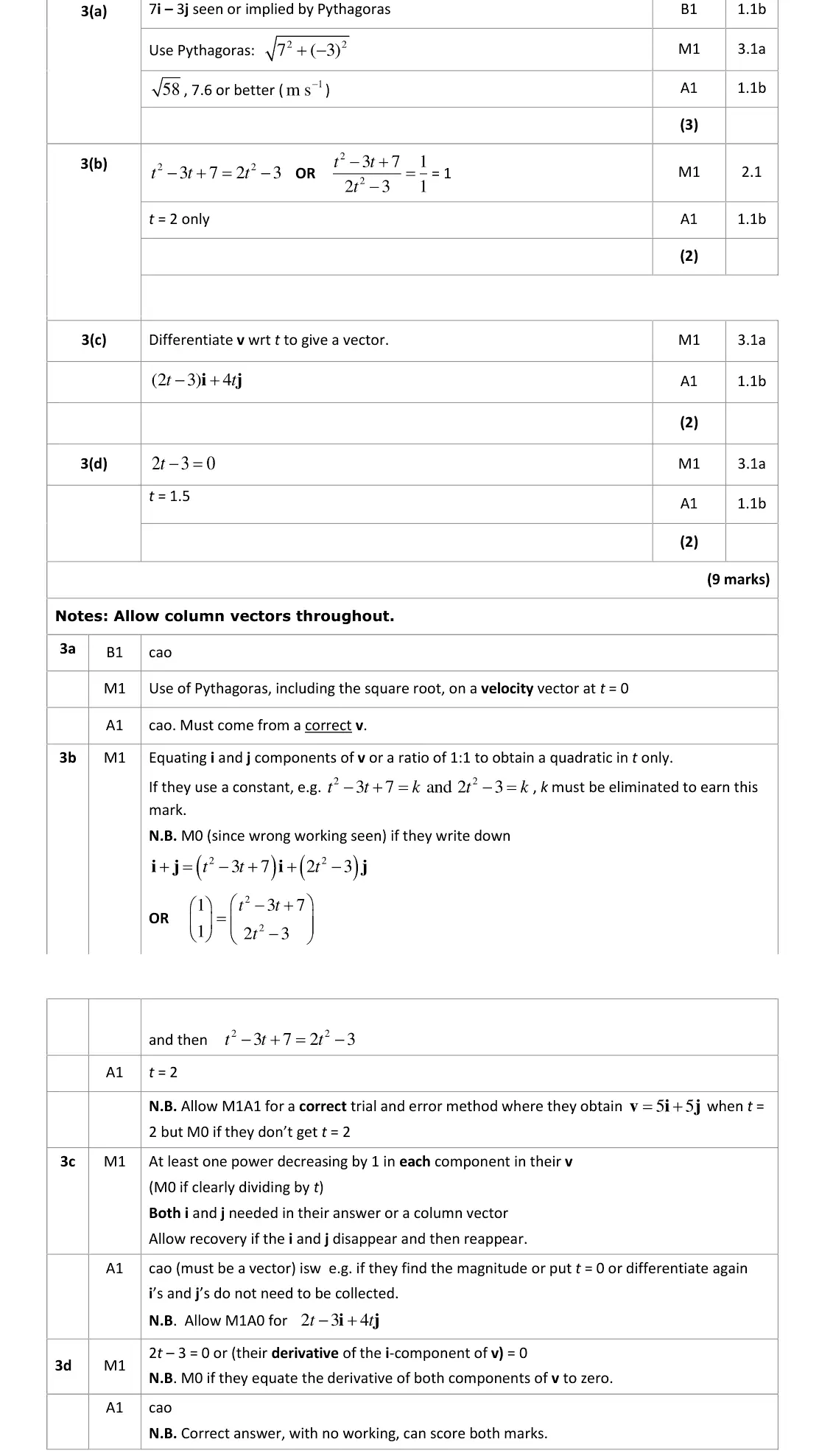
June 2023 · Paper 3 (Mechanics) · Q3(b)2 marks
Mark scheme (whole question; this part is marked with the orange bar)
Examiner's comment
The majority of candidates who attempted the second part used a correct method, setting the i and j components of the velocity equal to each other or both equal to a constant which was then eliminated. A few also successfully used trial and error. However, a significant number set both i and j coefficients equal to 1, solved one or two separate equations and scored nothing.
Common mistakes
equate the i and j components (t² − 3t + 7 = 2t² − 3), t = 2 only
setting each component equal to 1 scores nothing
June 2023 · Paper 3 (Mechanics) · Q3(d)2 marks
Mark scheme (whole question; this part is marked with the orange bar)
Examiner's comment
Part (a) was generally a well answered question. Some found the velocity vector at t = 0 and went no further, either forgetting, or not being aware that they needed to use Pythagoras’ Theorem to find the speed. A small number of candidates scored the M mark only, if they had an incorrect velocity vector but used Pythagoras’ Theorem correctly. The majority of candidates who attempted the second part used a correct method, setting the i and j components of the velocity equal to each other or both equal to a constant which was then eliminated. A few also successfully used trial and error. However, a significant number set both i and j coefficients equal to 1, solved one or two separate equations and scored nothing.
Common mistakes
perpendicular to i means the i-component of acceleration is zero: 2t − 3 = 0, t = 1.5
setting both components to zero scores M0
June 2022 · AS Paper 1 · Q3(a)2 marks
Mark scheme (whole question; this part is marked with the orange bar)
Examiner's comment
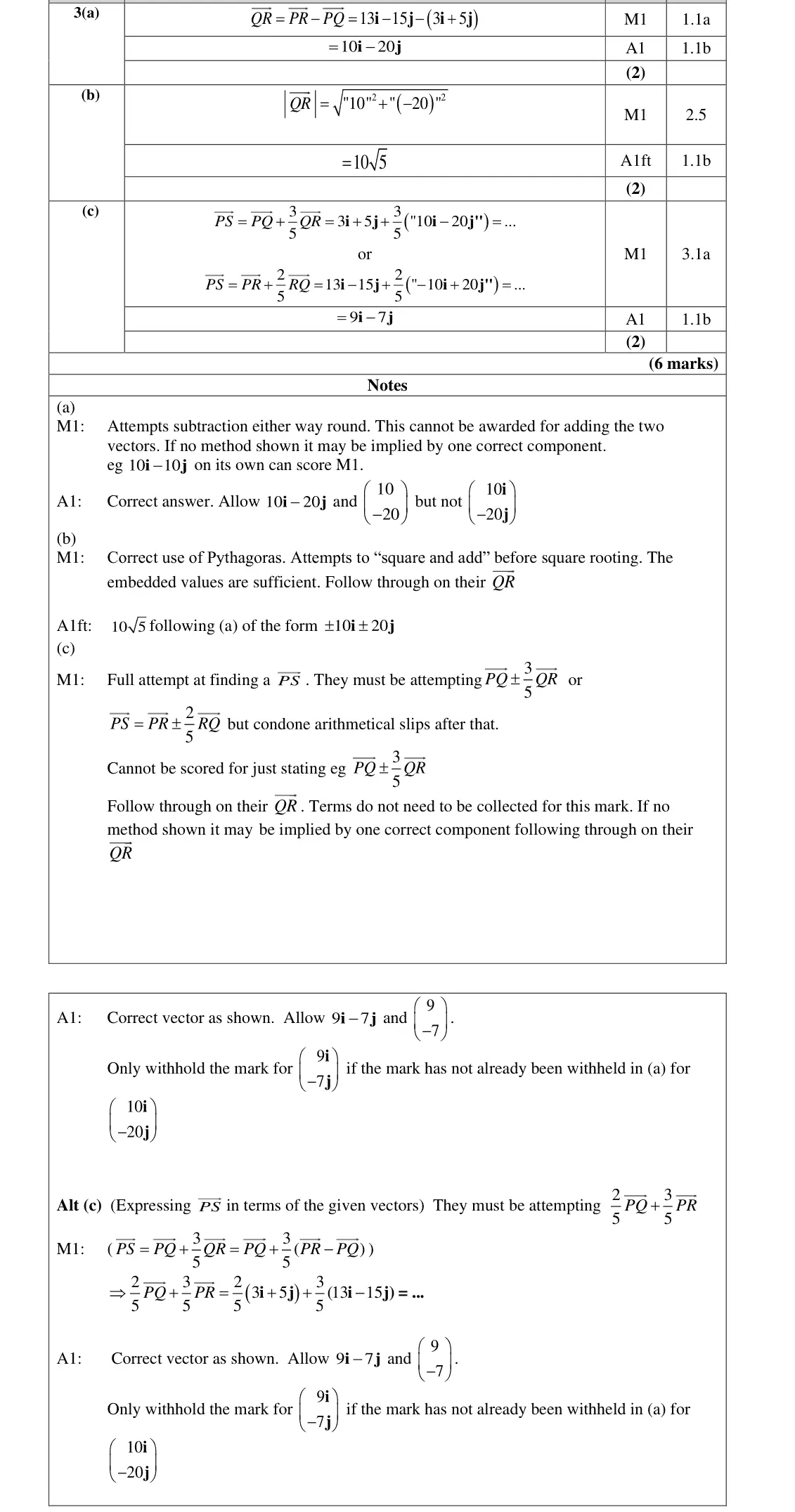
Many candidates tackled this question well, scoring full marks. Only a few made either no attempt or scored 0 for their efforts. The use of diagrams was widespread and seemed to aid those candidates in parts (a) and (c) to clarify their work. In part (a), errors were either adding the given vectors, subtracting the incorrect way round, or arithmetic errors involving negative numbers. Many candidates chose to use PQ PR - + rather than PR PQ - and seemed to have more success with the j component.
Common mistakes
QR = PR − PQ (not PQ + PR)
sign slips with the j component
10i − 20j
June 2022 · AS Paper 1 · Q3(c)2 marks
Mark scheme (whole question; this part is marked with the orange bar)
Examiner's comment
Many candidates tackled this question well, scoring full marks. Only a few made either no attempt or scored 0 for their efforts. The use of diagrams was widespread and seemed to aid those candidates in parts (a) and (c) to clarify their work. Part (c) did provide problems for a number of candidates, although a pleasing number provided full solutions which were often concise. Some continued down the line of attempting to calculate magnitudes using the answer to (b) and magnitudes of the given vectors, whilst others failed to find the appropriate proportion of QR (usually using 2 3 or 1 3 ). The other main error seen was candidates failing to take proper account of the direction of RS . Others just found the appropriate proportion of QR but did not provide a full method and scored no marks as a result.
Common mistakes
PS = PQ + (3/5)QR (not 2/3 or 1/3 of QR)
take care with the direction of RQ if going via R
working with magnitudes is wrong
9i − 7j
June 2022 · Paper 1 · Q9(b)4 marksHard
Mark scheme (whole question; this part is marked with the orange bar)
Examiner's comment
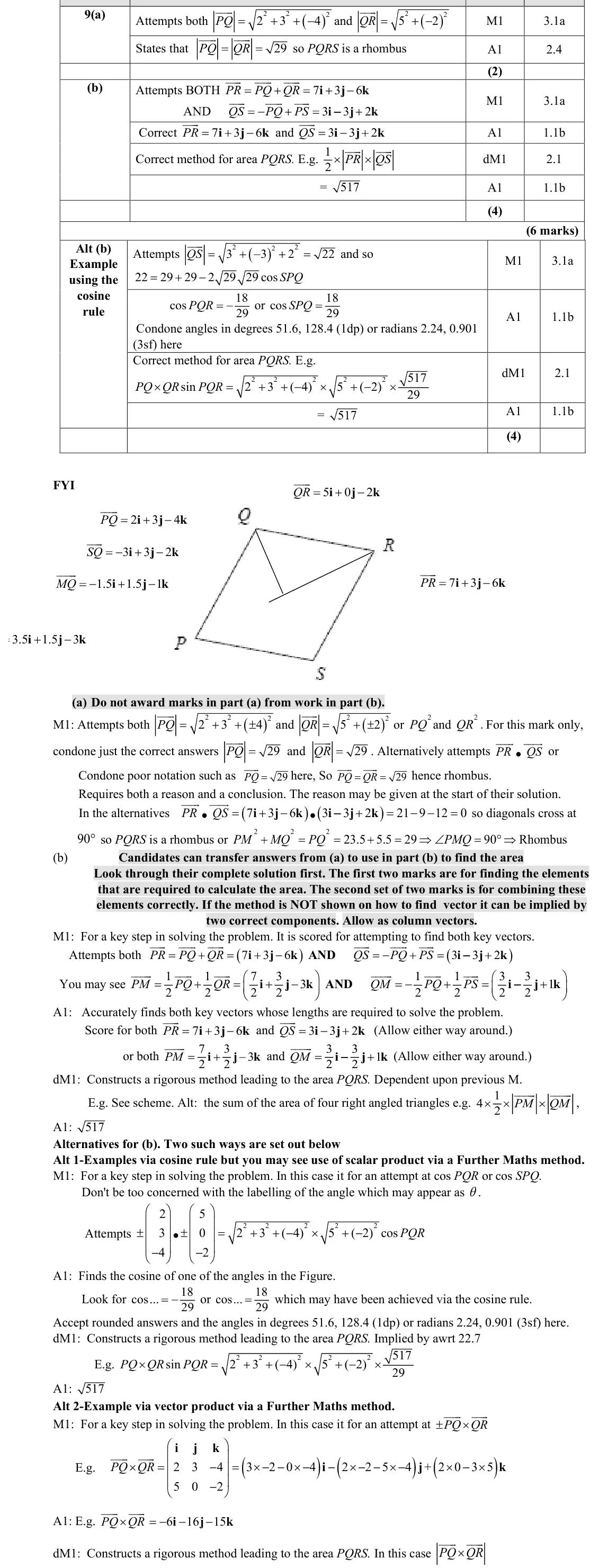
This vector question was set within the context of a rhombus. Surprisingly, many candidates were unable to use (or remember) the basic geometric of a rhombus and over 30% did not manage to make any progress. A vast array of approaches were in evidence in part (b) to find the area of the rhombus. The easiest and most direct approach was to find 1 2 PR QS x . A more common method used involved finding the length of one diagonal, followed by the cosine rule to find an internal angle and then use of the formula 'ab sin C '. Unfortunately most attempts using this method only scored 3 marks as it was usual for answers to be given as 22.7 rather than the one required, Ö517. Other methods seen involved use of Heron’s formula, the “shoelace” determinant method, scalar product and vector product….. with many successfully used. Students who added a “narrative” – so explaining what they attempted to do – were in a better position to gain credit if they suffered a processing error early in their solution. This has to be considered good practice. The most common incorrect solution, seen many times over was in stating area = 29 29 29 PQ PS x = x =
the cosine-rule/½ab sin C route often gave 22.7 not √517
over 30% made no progress
June 2022 · Paper 2 · Q13(a)3 marks
Mark scheme (whole question; this part is marked with the orange bar)
Examiner's comment
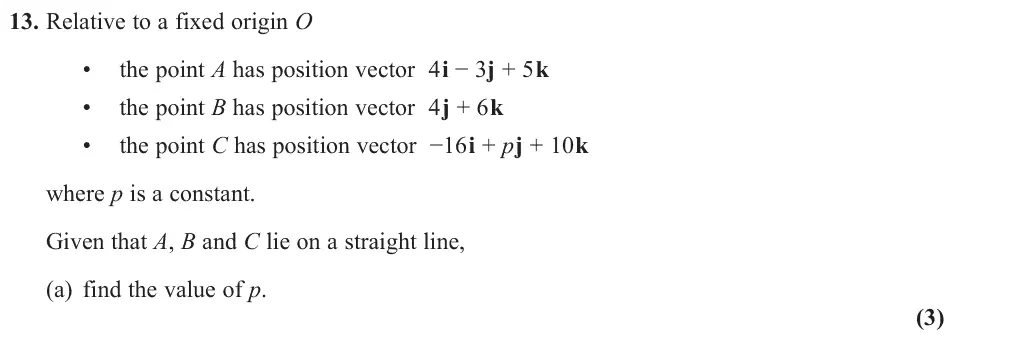
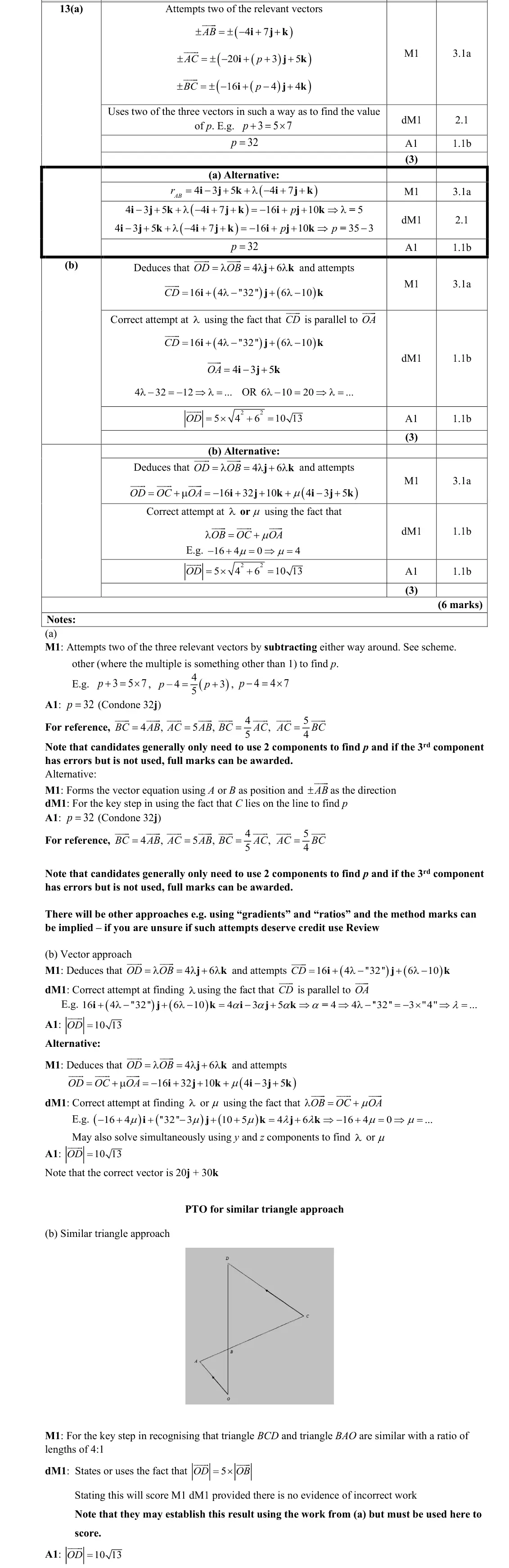
This question was a good differentiator, with the majority of candidates gaining some credit, but only the strongest achieving full marks. Overall, candidates often demonstrated good reasoning skills and were rewarded with good marks on this question but a significant number of candidates struggled with this topic. Throughout, methods of solution were many and varied, and often involved non vector approaches that were sometimes difficult to follow. In part (a) candidates using a vector method often attempted to subtract the given position vectors to form at least two of the vectors ±𝐴𝐴𝐴𝐴 ሬሬሬሬሬ⃗, ±𝐴𝐴𝐴𝐴 ሬሬሬሬሬ⃗ or ± 𝐵𝐵𝐵𝐵 ሬሬሬሬሬ⃗ although errors in their components were common. Candidates unfortunately often misread 𝑂𝑂𝑂𝑂 ሬሬሬሬሬ⃗ as ൭ 4 0 6 ൱ or ൭ 4 6 0 ൱. This was as far as many candidates reached, but some were able to successfully complete this approach by establishing 𝐵𝐵𝐵𝐵 ሬሬሬሬሬ⃗= 4𝐴𝐴𝐴𝐴 ሬሬሬሬሬ⃗, 𝐴𝐴𝐴𝐴 ሬሬሬሬሬ⃗= 5𝐴𝐴𝐴𝐴 ሬሬሬሬሬ⃗ or 5𝐵𝐵𝐶𝐶 ሬሬሬሬሬሬሬሬ⃗= 4𝐴𝐴𝐴𝐴 ሬሬሬሬሬ⃗ and reached p = 32. Some candidates incorrectly used methods like 𝐴𝐴𝐴𝐴 ሬሬሬሬሬ⃗= 𝐴𝐴𝐴𝐴 ሬሬሬሬሬ⃗ or assumed that the original position vectors were parallel. Candidates attempting to work out the magnitudes of vectors usually gained no marks. Others who made progress with vector methods, established the vector equation of the straight line through A, B and C and used this to find p. Candidates often used non vector methods as well. A common approach was to ignore one component and compare ‘gradients’ using the other two e.g. 4-(-3) 0-4 = 𝑝𝑝-4 -16-0 . This was judged to be an acceptable approach, although errors with the substitution of values were common. Some even established an ‘equation’ such as 𝑦𝑦= - 7 4 𝑥𝑥+ 4 and then substituted in 𝑥𝑥= -16 to find p, which, again, was acceptable, but it was a shame that so many candidates resorted to such methods and seemed to lack confidence in their ability to construct a solution using vectors. In some cases where the first method mark was awarded, candidates went on to an incorrect equation such as 𝑝𝑝= 4 x 7 and were much less likely to be awarded the second method mark, as it was often unclear which vector they were working with for this step. Many fully correct answers for (a) were seen, sometimes with minimal working. It should be noted here that candidates should try to make their intention clear, as there were many occasions where examiners struggled to follow the structure of candidates’ work and were unable to award marks as a result.
Common mistakes
form two of AB, AC, BC by subtraction (OB = 4j + 6k, no i component)
parallel vectors are multiples: AC = 5AB gives p + 3 = 35, p = 32
magnitudes are no help
June 2022 · Paper 2 · Q13(b)3 marks
Mark scheme (whole question; this part is marked with the orange bar)
Examiner's comment
This question was a good differentiator, with the majority of candidates gaining some credit, but only the strongest achieving full marks. Overall, candidates often demonstrated good reasoning skills and were rewarded with good marks on this question but a significant number of candidates struggled with this topic. Throughout, methods of solution were many and varied, and often involved non vector approaches that were sometimes difficult to follow. Part (b) was found to be challenging by most candidates, with few gaining any marks and with many not attempting it. Many candidates again worked with magnitudes of vectors and made no progress. Those candidates who did gain credit usually used the fact that 𝑘𝑘𝑂𝑂𝑂𝑂 ሬሬሬሬሬ⃗-𝑂𝑂𝑂𝑂 ሬሬሬሬሬ⃗= ൭ 16 4𝑘𝑘-𝑝𝑝 6𝑘𝑘-10 ൱ was parallel to 𝑂𝑂𝑂𝑂 ሬሬሬሬሬ⃗ to find 𝑘𝑘= 5 giving 𝑂𝑂𝑂𝑂 ሬሬሬሬሬሬ⃗= ൭ 0 20 30 ൱. Many candidates failed to realise that 𝑂𝑂𝑂𝑂 ሬሬሬሬሬሬ⃗= 𝑘𝑘൭ 0 4 6 ൱, and made no progress, whilst others incorrectly assumed that ൭ 16 4𝑘𝑘-𝑝𝑝 6𝑘𝑘-10 ൱= 𝑂𝑂𝑂𝑂 ሬሬሬሬሬ⃗. Candidates often drew diagrams to visualise the problem but full marks in this part were rarely awarded. A significant number of candidates who had found the correct vector, failed to find its magnitude.
Common mistakes
OD = λOB and CD = OD − OC parallel to OA gives λ = 5, OD = 20j + 30k
modulus 10√13 (fully simplified)
CD is not equal to OA
many stopped at the vector
June 2022 · Paper 3 (Mechanics) · Q3(a)4 marks
Mark scheme (whole question; this part is marked with the orange bar)
Examiner's comment
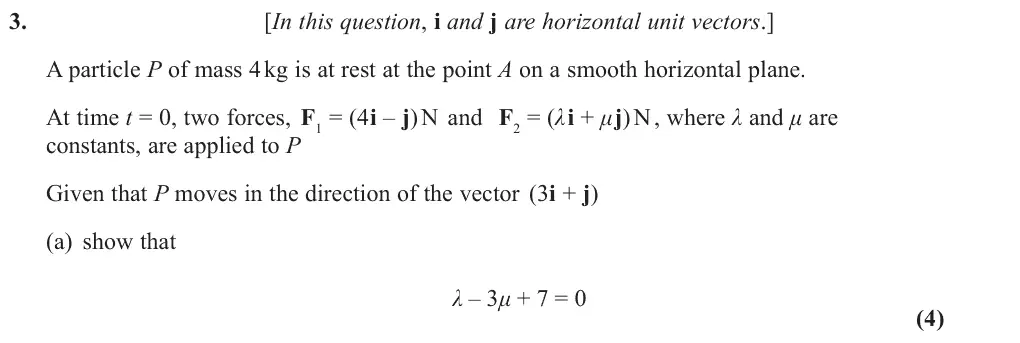
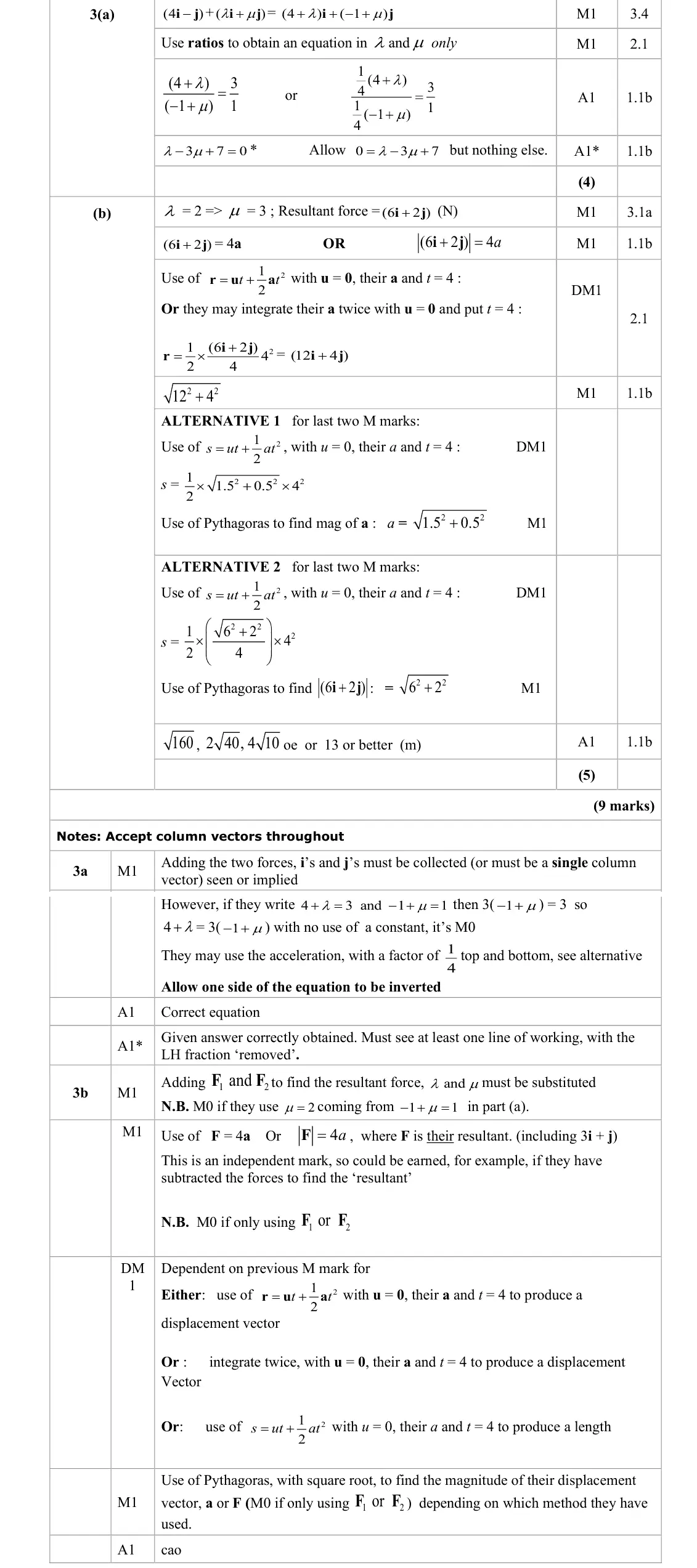
In part (a), the majority of candidates were able to achieve the first mark for adding the two forces and collecting the i and j components. Many just equated this resultant force to the vector (3i + j) rather than using (3i + j) to define the direction. Some set up equations λ + 4 = 3 and mu - 1 = 1 and proceeded to solve them simultaneously gaining no further credit. Those who did use ratio usually went on to derive the required equation correctly; however, it should be remembered that, if required to derive a given answer, this must be written as a final conclusion in the form exactly as stated in the question. Another successful approach was to equate the i and j coefficients to 3k and k and solve as simultaneous equations. A small minority of candidates applied F = 4a or used integration to find v at this stage and then used ratio appropriately to obtain the required answer. In the second part, many candidates were able to find the resultant force and
Common mistakes
resultant (4 + λ)i + (−1 + μ)j is parallel to 3i + j so use ratios
equating the resultant to 3i + j (λ + 4 = 3, μ − 1 = 1) scores no more
final line must be λ − 3μ + 7 = 0 exactly
Oct 2021 · AS Paper 1 · Q4(a)2 marks
Mark scheme (whole question; this part is marked with the orange bar)
Examiner's comment
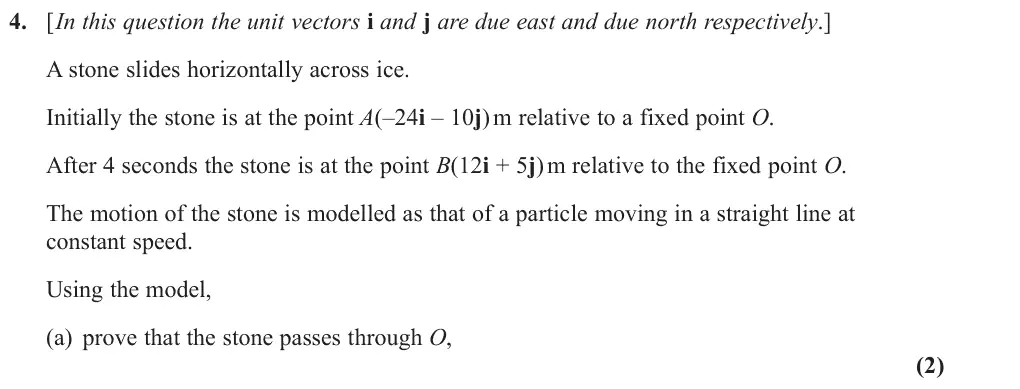
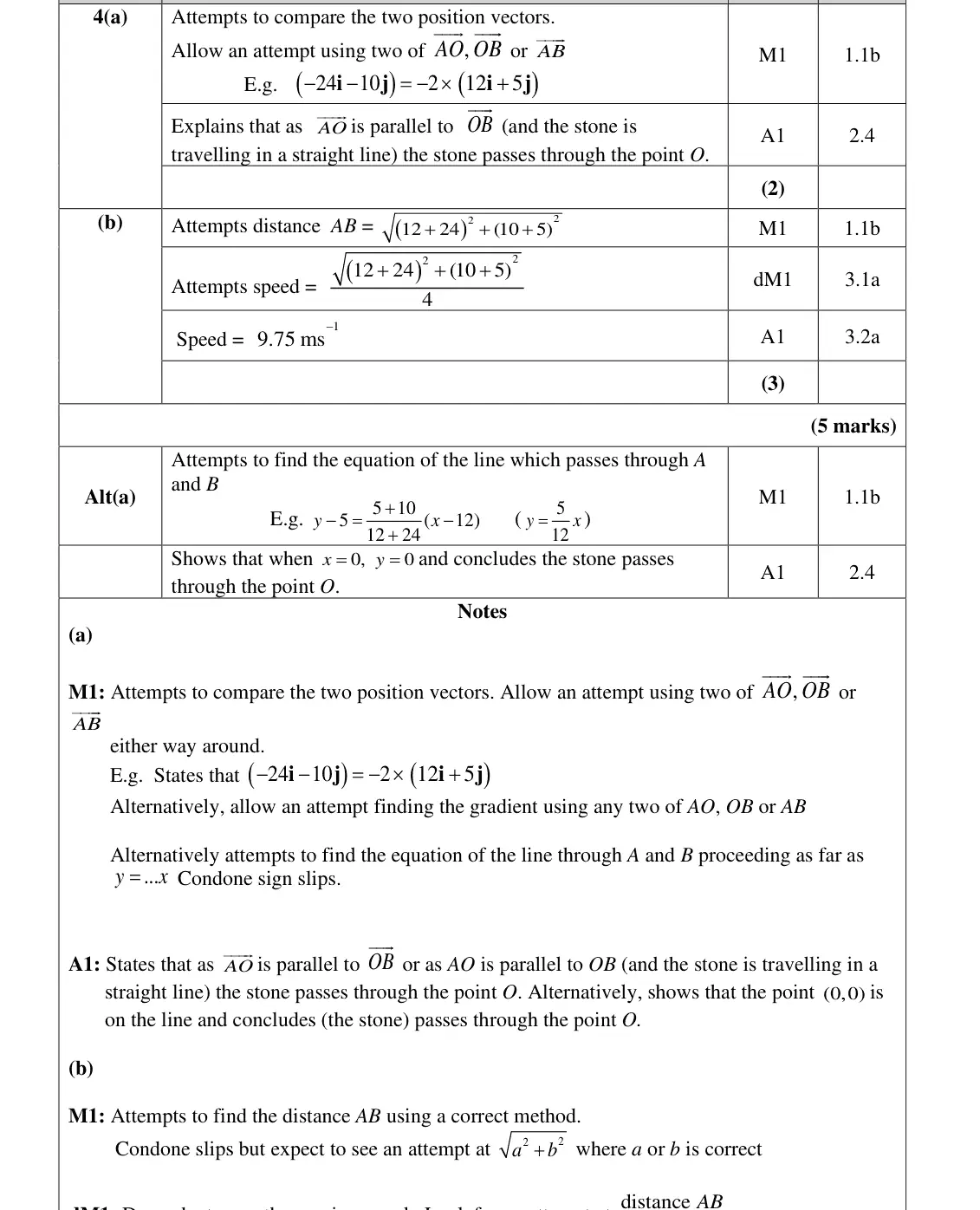
This question using vectors was generally well answered with most candidates scoring more than half of the marks available. In part (a) candidates seemed unsure how to go about proving that the stone passed through the origin. The most successful attempts typically involved finding the equation of the line for the stone which was 5 12 y x = and showed that the origin was on this line or stated that this linear equation would pass through the origin. Other attempts which candidates proceeded with involved either comparing the position vectors and showing that one was a multiple of the other or showing that the gradients of the position vectors were the same. Plotting the points on a graph was not an acceptable method to prove.
Common mistakes
show AO and OB are parallel, e.g. −24i − 10j = −2(12i + 5j), and conclude that as the stone moves in a straight line it passes through O
or show the line y = (5/12)x passes through the origin
plotting points is not a proof
Oct 2021 · AS Paper 1 · Q15(c)3 marks
Mark scheme (whole question; this part is marked with the orange bar)
Examiner's comment
9 This question provided a good range of marks between the candidates, although nearly all candidates struggled to proceed to the final answer in part (c). There were also several blank responses on this question which may have been down to candidates either running out of time or just getting overwhelmed towards the end of a paper. Part (c) was either not attempted at all or candidates made an attempted but abandoned due to the expressions formed appearing so complicated that it seemed as though they were convinced they had gone wrong. Usually, candidates opted to substitute their part (a) answer into their part (b) equation of the circle. To score the first mark candidates had to multiply out the brackets and collect terms together to form a 3TQ where k was in both the b and c coefficients of the quadratic. Some candidates stopped before getting this far, although it was pleasing that some continued to persevere and pick up the first mark. Those who continued, realised the discriminant needed to be used, but disappointingly once they had their expression also decided to stop even if they had a quadratic in k which they could solve. Therefore only 1 or no marks was scored in nearly all responses. The easiest way was the vector approach, which was seen, but far too frequently, and even then, it was only a few candidates who were able to score full marks on this question.
Common mistakes
the other tangent touches at the opposite end of the diameter through P: (13/2, 11/2), then k = 10/3
via simultaneous equations the quadratic in x has b and c depending on k and b² − 4ac = 0 (k = 0 is rejected)
candidates often abandoned the messy algebra
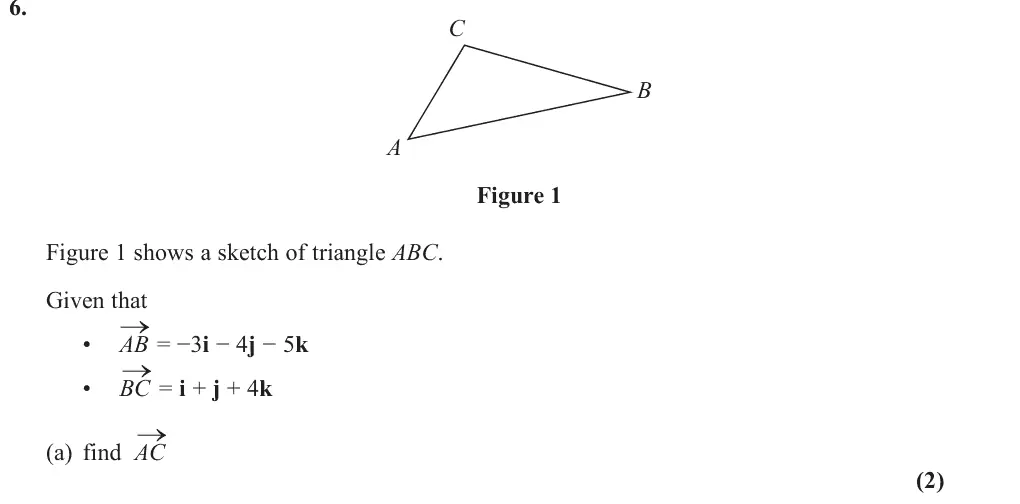
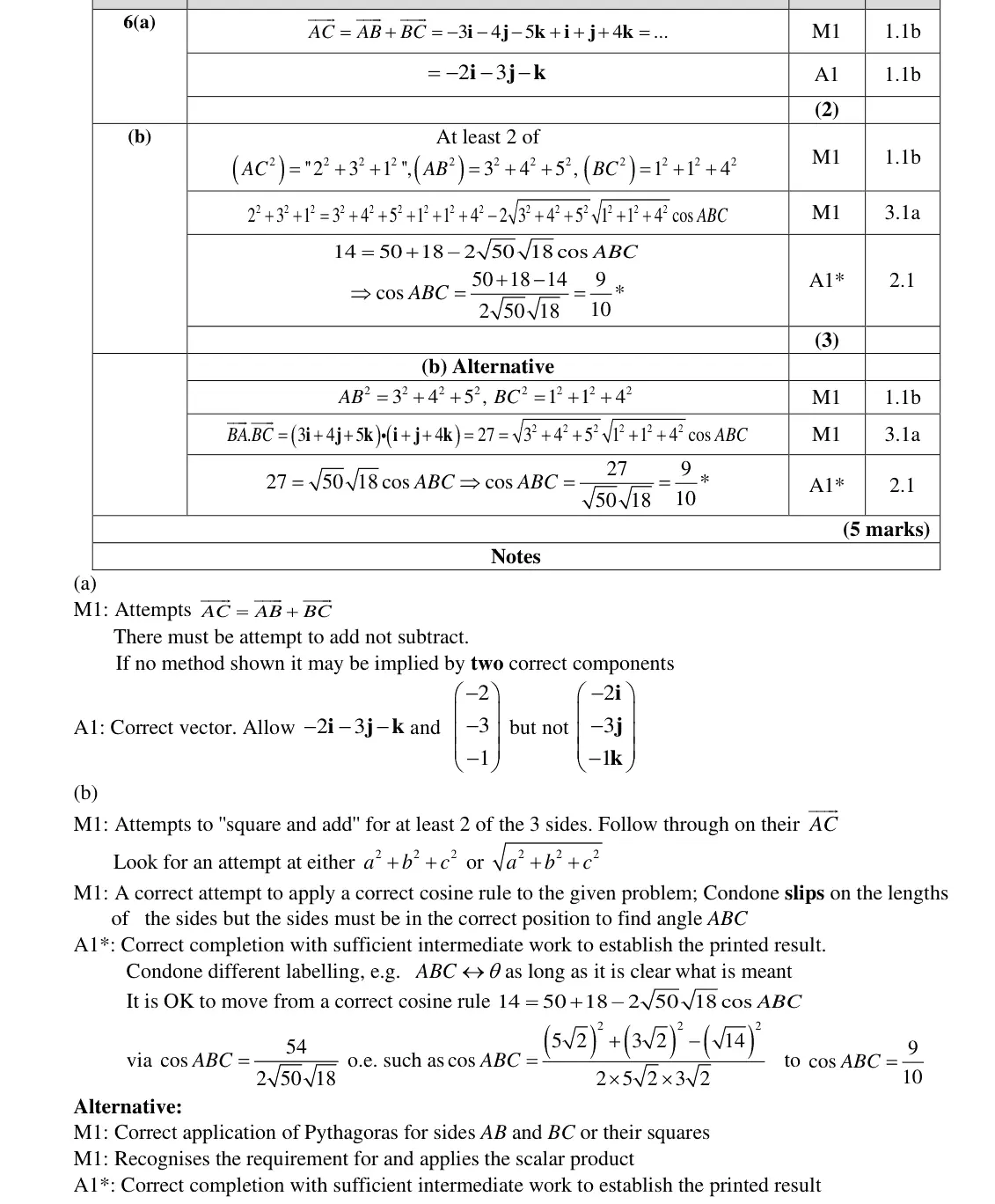
Oct 2021 · Paper 1 · Q6(a)2 marks
Mark scheme (whole question; this part is marked with the orange bar)
Examiner's comment
This was another question where the modal mark was full marks, this time achieved by over 40% of the candidates Part(a) A very significant majority of candidates obtained vector AC correctly. Only a few subtracted rather than adding the given vectors AB and BC.
Common mistakes
AC = AB + BC = −2i − 3j − k
add, not subtract
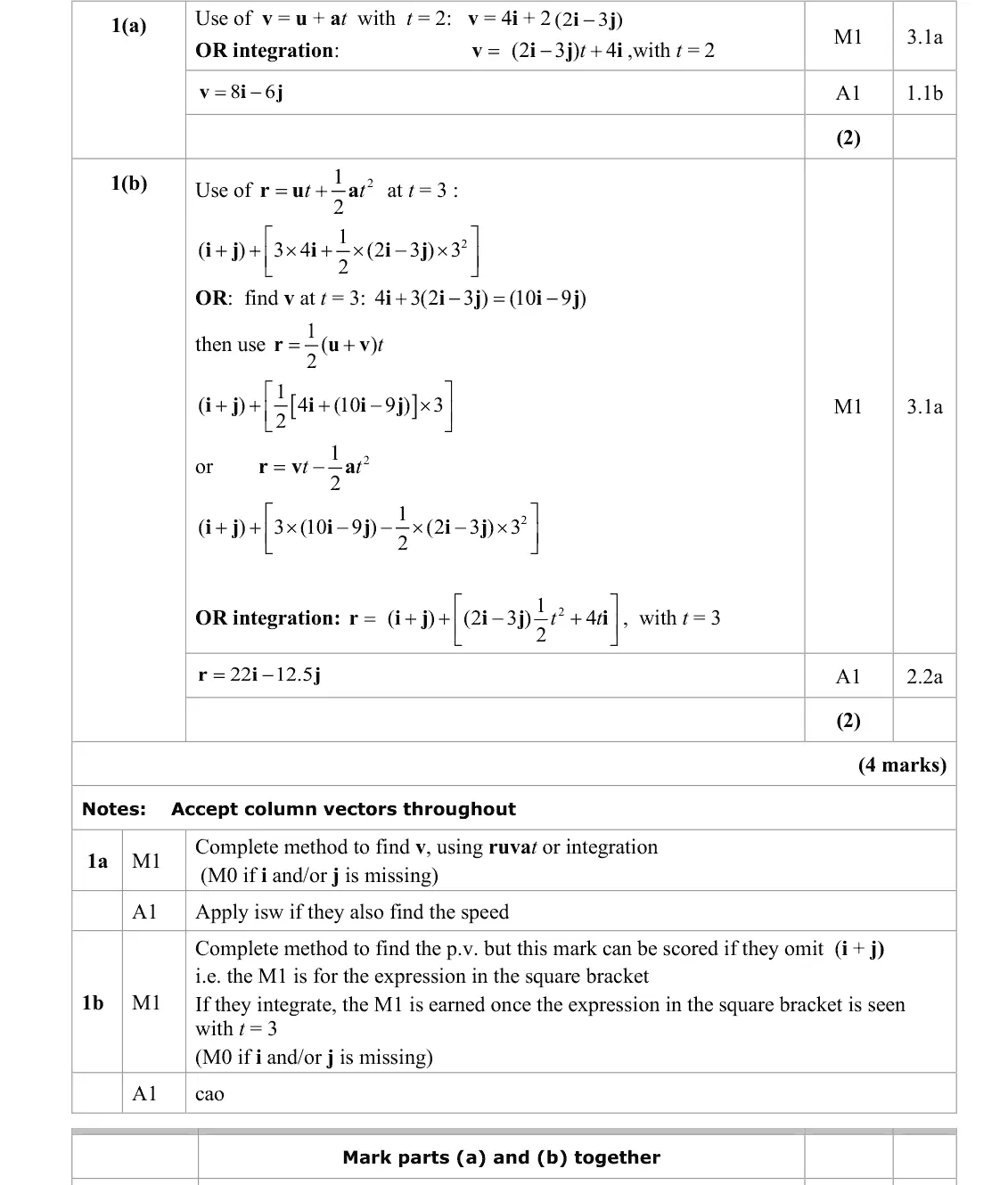
Oct 2021 · Paper 3 (Mechanics) · Q1(b)2 marks
Mark scheme (whole question; this part is marked with the orange bar)
Examiner's comment
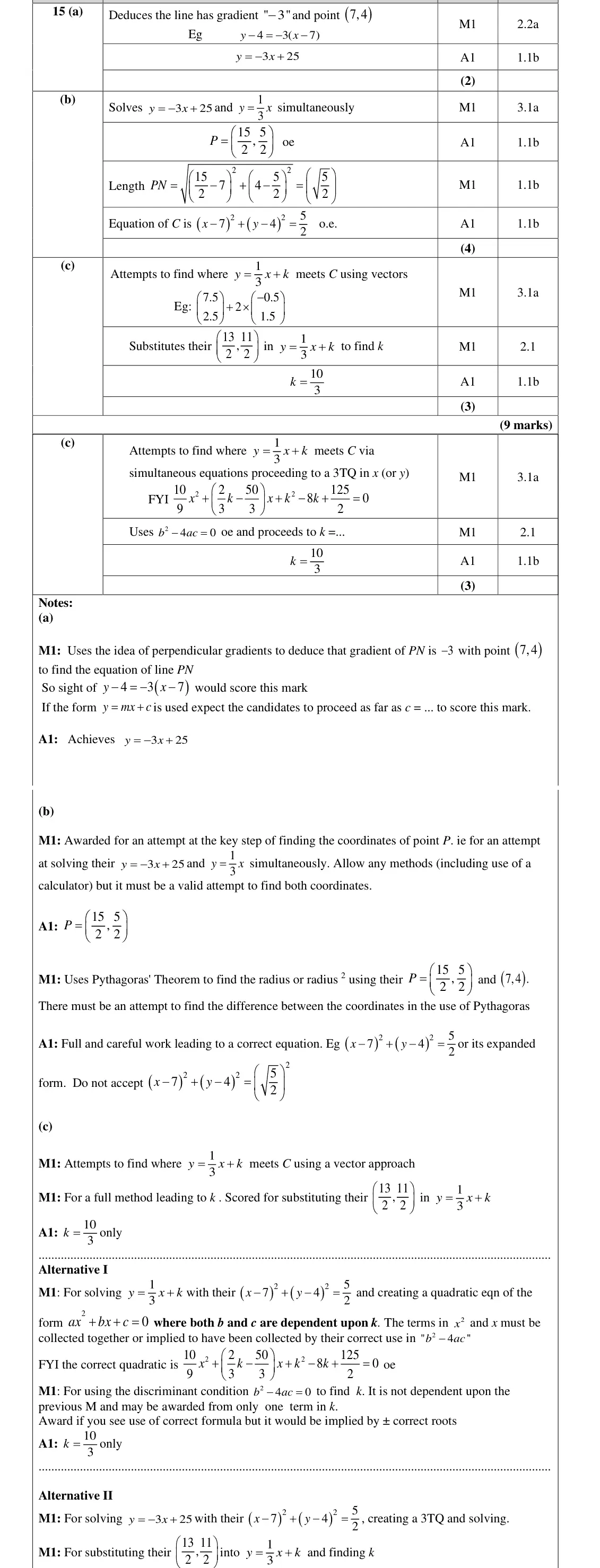
Part (b) proved to be more challenging. Although there were many good solutions employing 2 1 2 t t = + r u a to find the change in displacement from t = 0 to t = 3, earning the method mark, a sizeable number of candidates forgot to add on i + j. The equivalent to the first stage using integration was 2 1 (2 3 ) 4 2 t t = - + r i j i . It was essential to include use of the 4i to earn the method mark, but the use of i + j was only required for the A mark. Some students chose to answer the question in stages, working out position vectors at t = 1, 2 and then t = 3. Other errors involved not keeping the question in i and j or column vector form, which lost the M mark, or incorrectly trying to turn the problem into a scalar problem.
Common mistakes
s = ut + ½at² gives the displacement only: add the initial position i + j (commonly forgotten)
stay in vector form, not a scalar problem
answer 22i − 12.5j
Oct 2021 · Paper 3 (Mechanics) · Q5(b)3 marks
Mark scheme (whole question; this part is marked with the orange bar)
Examiner's comment
achieved zero marks. Part (b) proved to be the least popular part of this question. 1 = 2t and then 3t Successful candidates employed a ratio method to obtain the equation 2 solved it. However, a significant minority of candidates incorrectly equated the i and j parts and then solved the two equations to obtain the correct answer. Candidates should note that this approach scored no marks. Other errors included using the acceleration vector or the displacement vector rather than the velocity vector when dealing with direction of travel. Part (c) tended to be well answered with a good number of candidates
Common mistakes
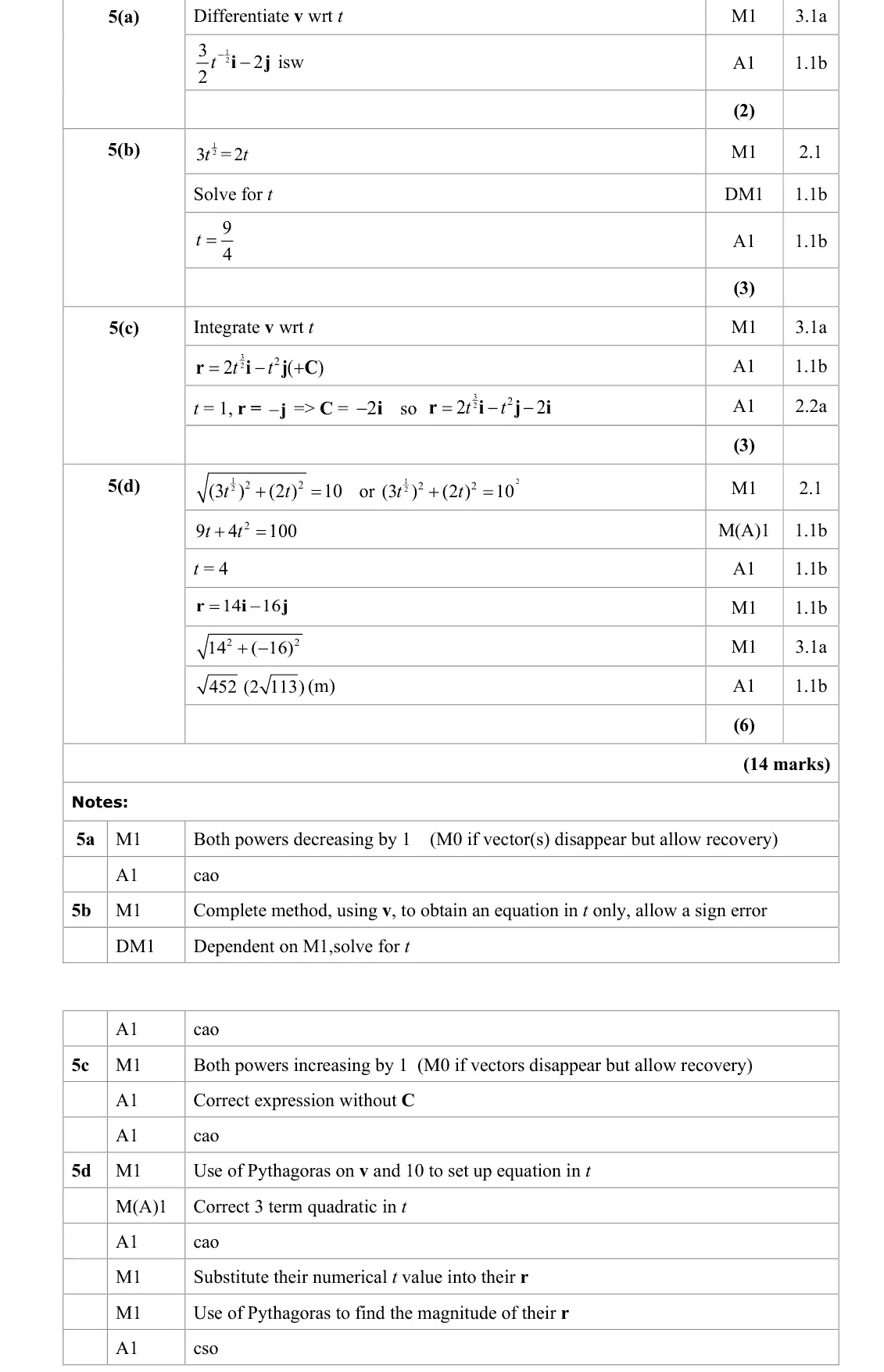
moving in direction i − j means the i and j components of v are equal and opposite: 3t^½ = 2t
equating v to i − j scores nothing
use v, not a or r
t = 9/4
Oct 2020 · Paper 1 · Q3(b)2 marks
Mark scheme (whole question; this part is marked with the orange bar)
Examiner's comment
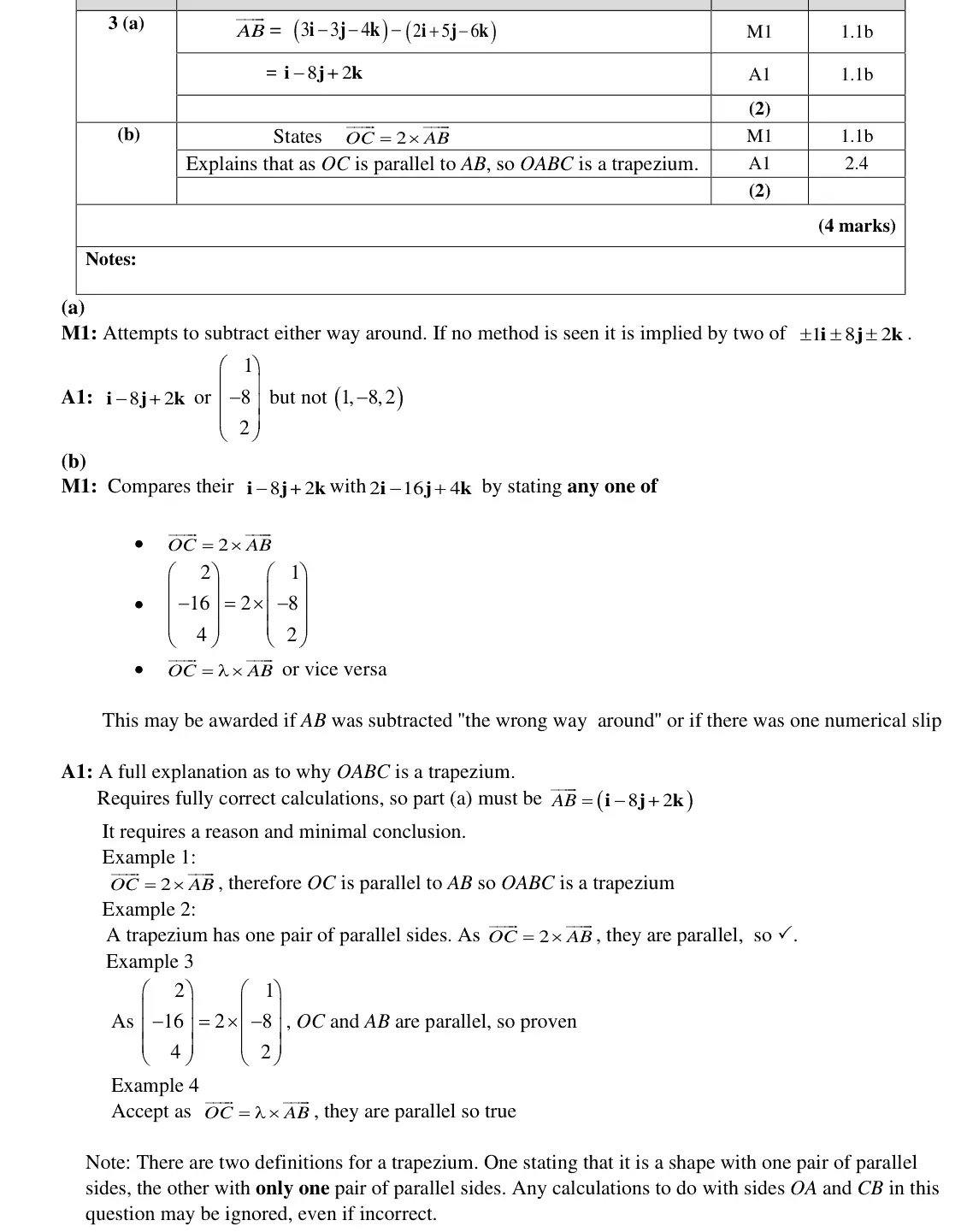
In (b) those who gained both marks were able to compare the two vectors AB and OC to show that they were parallel and conclude that OABC is a trapezium. Usually candidates made a sketch of a trapezium so they could visualize which vectors or sides they would compare. This is a very good idea and should be encouraged by centres. Marks were lost when • candidates did not give a minimal conclusion after finding OC and AB were parallel. • candidates incorrectly stating that 2 AB OC = x • candidates finding the length of each side OABC rather than their directions
Common mistakes
OC = 2AB so OC is parallel to AB, hence a trapezium
a reason and minimal conclusion needed
finding side lengths instead of directions scores nothing
Oct 2020 · Paper 2 · Q23 marks
Mark scheme (whole question; this part is marked with the orange bar)
Examiner's comment
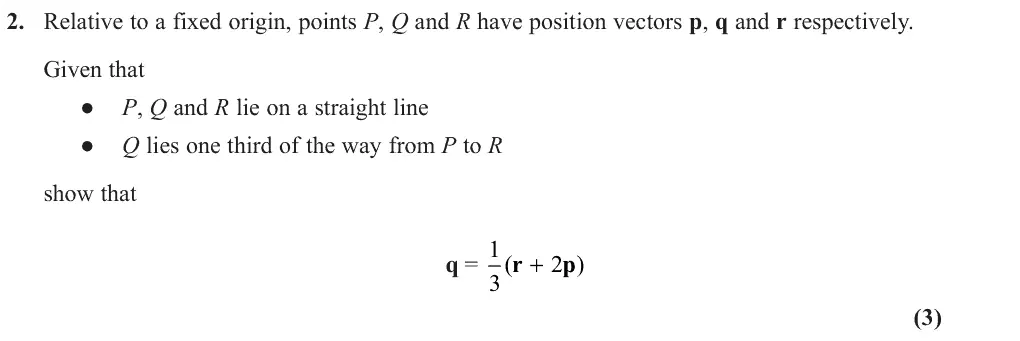
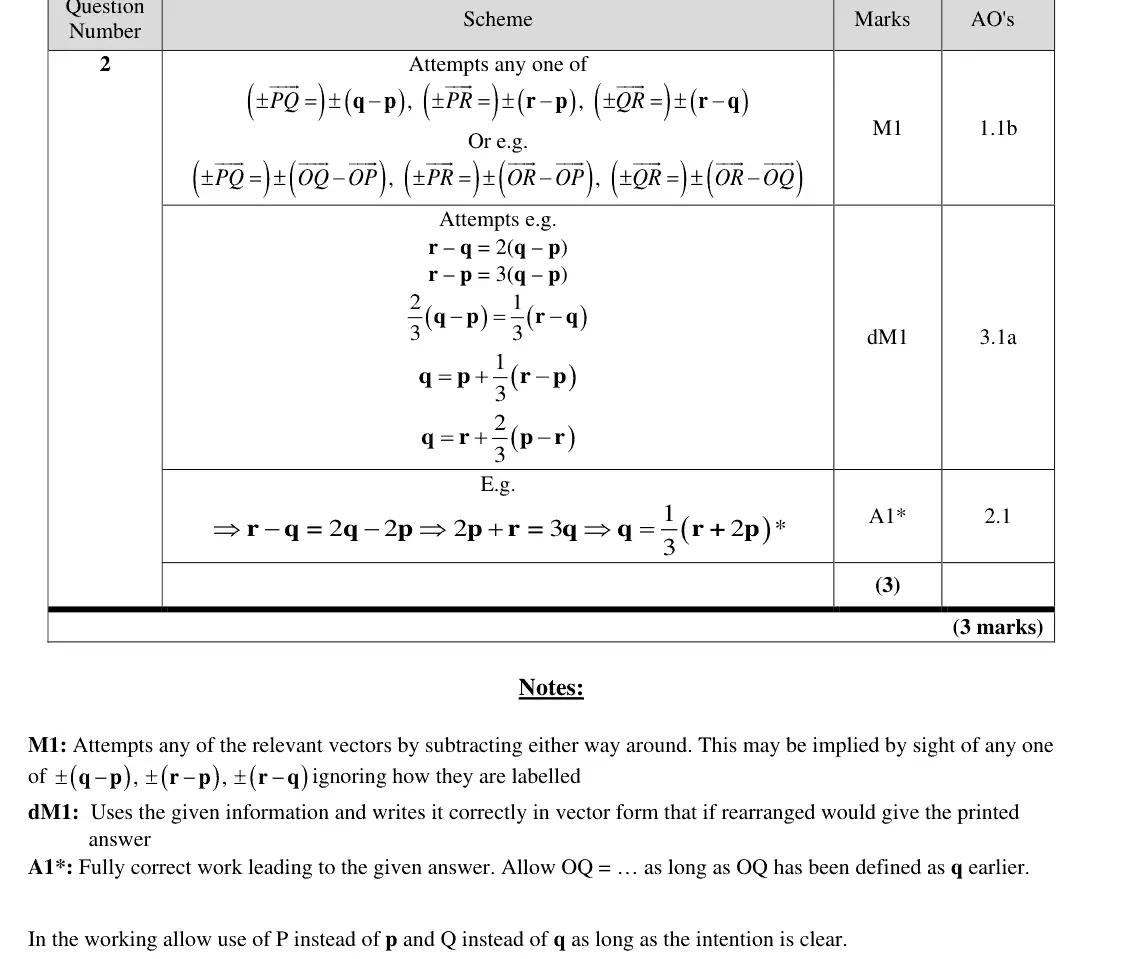
This proved to be a demanding question for many candidates, with false starts and seemingly random statements. Those who were able to make some progress generally gained the initial method mark for expressing one of the line segments in terms of the difference of two position vectors, but many candidates were unable to make further progress. Unfortunately, the addition of two position vectors was a common error. Diagrams helped with some responses, but they frequently depicted OP, OQ and OR as collinear, which tended to cause more confusion. The most common approach amongst those who were able to make further progress were either 𝑃𝑃𝑃𝑃 ሬሬሬሬሬ⃗= 1 3 𝑃𝑃𝑃𝑃 ሬሬሬሬሬ⃗ or 𝑂𝑂𝑂𝑂 ሬሬሬሬሬሬ⃗= 𝑂𝑂𝑂𝑂 ሬሬሬሬሬ⃗+ 1 3 𝑃𝑃𝑃𝑃 ሬሬሬሬሬ⃗. Vector notation was often poor, for example Q being used to denote a vector rather than a point, leading to such confused statements as Q = 1/3 PR.
Common mistakes
PQ = q − p (subtract, do not add, position vectors)
use PR = 3PQ or q = p + ⅓(r − p)
careful vector notation (Q is a point, not a vector)
June 2019 · AS Paper 1 · Q16(i)1 markHard
Mark scheme (whole question; this part is marked with the orange bar)
Examiner's comment
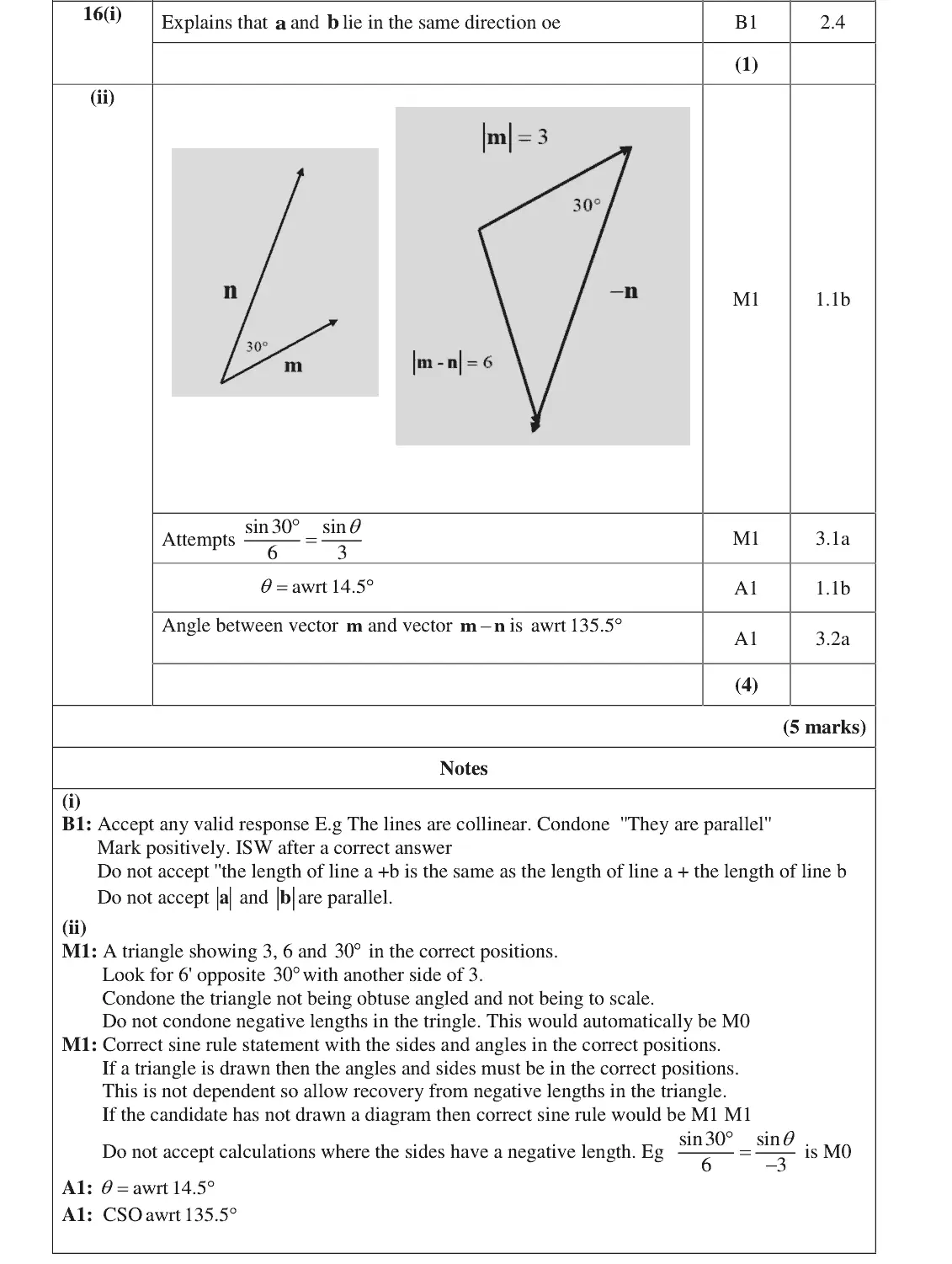
This was a poorly answered question at all levels. In part (a) it was expected that candidates would recognise the fact that the vectors would need to lie in the same direction but many attempted to write out the given expression in words. There was slightly more success in part (b) with most attempting a diagram of sorts to get a feel for the problem. Unfortunately a lack of understanding of vectors 6 m-n 3 n 3 m meant that and was usually followed by . There were however, some excellent and well thought out solutions showing a full understanding of the question,
Common mistakes
a and b are parallel and in the same direction
do not just restate the equation in words
June 2019 · AS Paper 1 · Q16(ii)4 marksHard
Mark scheme (whole question; this part is marked with the orange bar)
Examiner's comment
This was a poorly answered question at all levels. In part (a) it was expected that candidates would recognise the fact that the vectors would need to lie in the same direction but many attempted to write out the given expression in words. There was slightly more success in part (b) with most attempting a diagram of sorts to get a feel for the problem. Unfortunately a lack of understanding of vectors 6 m-n 3 n 3 m meant that and was usually followed by . There were however, some excellent and well thought out solutions showing a full understanding of the question,
Common mistakes
draw the triangle with 6 opposite the 30° and 3 adjacent
sine rule sin 30°/6 = sin θ/3 gives θ = 14.5°
the angle between m and m − n is 180 − 30 − 14.5 = 135.5°
no negative lengths
June 2019 · Paper 2 · Q10(a)2 marks
Mark scheme (whole question; this part is marked with the orange bar)
Examiner's comment
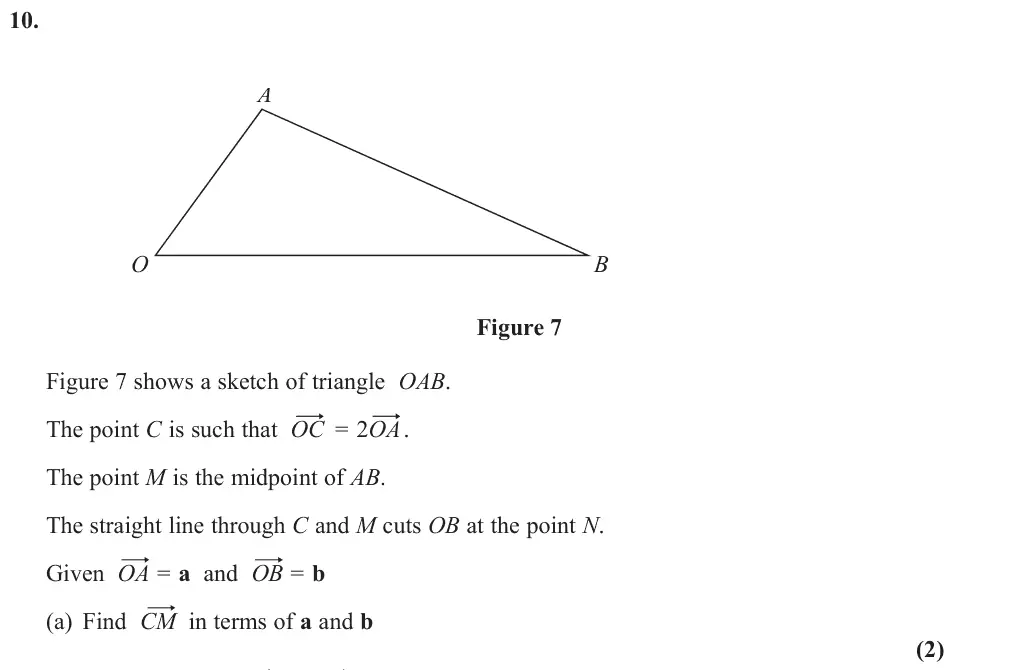
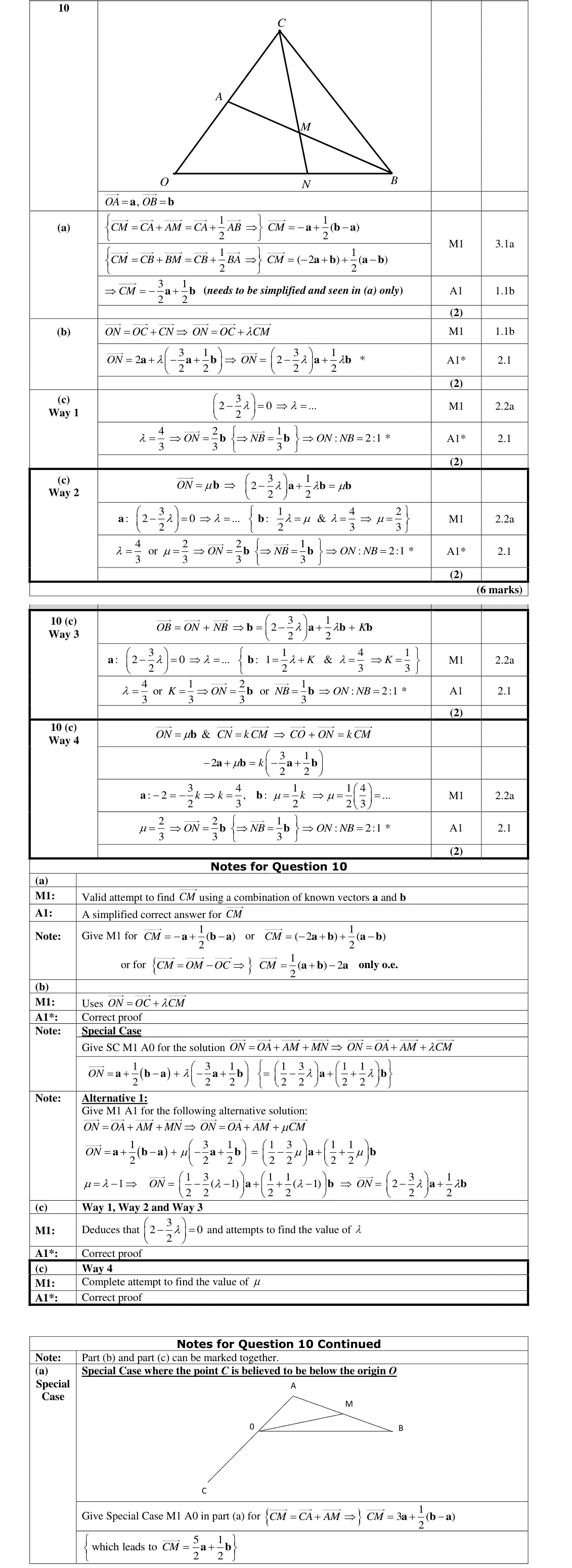
Q10 discriminated well between the medium and higher ability candidates, with lower ability candidates struggling to gain any creditable access. Q10 increased in difficulty as the candidates progressed through the question, and only a small proportion of candidates scored full marks. In Q10(a), most candidates followed a correct method to achieve the correct answer 3 1 CM Of the candidates who identified a suitable route from C to M, the . a b 2 2 1 . CM CA AM CA AB most common approach was Less efficient routes such 2 as CM CO OB BM or even CM CO OA AM were also observed. Some candidates struggled to apply the vectors a and b to the routes they had chosen. Incorrect methods included applying CA a (instead of CA a ) or applying AB AB ). b a a b (instead of There were a few candidates who incorrectly deduced the position of C to be in the opposite direction to OA and they were mostly 1 , CM CO OA AM CO OA AB able to apply the approach, to gain some 2 credit. Q10(b) proved to be demanding, with some candidates struggling to understand what the question required them to do, and many seemed to be confused by the introduction of the scalar multiple . Only a minority deduced that CN CM and applied this . ON OC CN deduction to the route Most of these candidates progressed well to the given answer unless they had found an incorrect CM in Q10(a). Many candidates used ON OC CM MB BN or ON OA AB BN and made no creditable progress. These candidates usually produced solutions which led to the elimination of from the a component of the resulting vector for . ON A few candidates used ON OM MN and proceeded to obtain a correct expression 1 1 3 1 ON a b a b (or ), in terms but only a few deduced that this 2 2 2 2 (or ). 1 could lead to the stated solution by setting 1 Q10(c) proved to be challenging with many candidates failing to make any creditable is parallel to OB progress. The crucial step was to recognise that ON and hence is a multiple of b with no a component. Only a few candidates set the a component ON 3 4 , 2 2 0. to zero to give the equation Almost all of these candidates found 3 2 ON b with many finding and giving a correct explanation of the given ratio. 3
Common mistakes
CM = CA + ½AB with CA = −a (not a) and AB = b − a: −3/2a + ½b, simplified
June 2019 · Paper 2 · Q10(b)2 marks
Mark scheme (whole question; this part is marked with the orange bar)
Examiner's comment
Q10 discriminated well between the medium and higher ability candidates, with lower ability candidates struggling to gain any creditable access. Q10 increased in difficulty as the candidates progressed through the question, and only a small proportion of candidates scored full marks. In Q10(a), most candidates followed a correct method to achieve the correct answer 3 1 CM Of the candidates who identified a suitable route from C to M, the . a b 2 2 1 . CM CA AM CA AB most common approach was Less efficient routes such 2 as CM CO OB BM or even CM CO OA AM were also observed. Some candidates struggled to apply the vectors a and b to the routes they had chosen. Incorrect methods included applying CA a (instead of CA a ) or applying AB AB ). b a a b (instead of There were a few candidates who incorrectly deduced the position of C to be in the opposite direction to OA and they were mostly 1 , CM CO OA AM CO OA AB able to apply the approach, to gain some 2 credit. Q10(b) proved to be demanding, with some candidates struggling to understand what the question required them to do, and many seemed to be confused by the introduction of the scalar multiple . Only a minority deduced that CN CM and applied this . ON OC CN deduction to the route Most of these candidates progressed well to the given answer unless they had found an incorrect CM in Q10(a). Many candidates used ON OC CM MB BN or ON OA AB BN and made no creditable progress. These candidates usually produced solutions which led to the elimination of from the a component of the resulting vector for . ON A few candidates used ON OM MN and proceeded to obtain a correct expression 1 1 3 1 ON a b a b (or ), in terms but only a few deduced that this 2 2 2 2 (or ). 1 could lead to the stated solution by setting 1 Q10(c) proved to be challenging with many candidates failing to make any creditable is parallel to OB progress. The crucial step was to recognise that ON and hence is a multiple of b with no a component. Only a few candidates set the a component ON 3 4 , 2 2 0. to zero to give the equation Almost all of these candidates found 3 2 ON b with many finding and giving a correct explanation of the given ratio. 3
Common mistakes
ON = OC + λCM (CN is a multiple of CM)
routes via M, B or A eliminate λ and get nowhere
June 2019 · Paper 2 · Q10(c)2 marks
Mark scheme (whole question; this part is marked with the orange bar)
Examiner's comment
Q10 discriminated well between the medium and higher ability candidates, with lower ability candidates struggling to gain any creditable access. Q10 increased in difficulty as the candidates progressed through the question, and only a small proportion of candidates scored full marks. In Q10(a), most candidates followed a correct method to achieve the correct answer 3 1 CM Of the candidates who identified a suitable route from C to M, the . a b 2 2 1 . CM CA AM CA AB most common approach was Less efficient routes such 2 as CM CO OB BM or even CM CO OA AM were also observed. Some candidates struggled to apply the vectors a and b to the routes they had chosen. Incorrect methods included applying CA a (instead of CA a ) or applying AB AB ). b a a b (instead of There were a few candidates who incorrectly deduced the position of C to be in the opposite direction to OA and they were mostly 1 , CM CO OA AM CO OA AB able to apply the approach, to gain some 2 credit. Q10(b) proved to be demanding, with some candidates struggling to understand what the question required them to do, and many seemed to be confused by the introduction of the scalar multiple . Only a minority deduced that CN CM and applied this . ON OC CN deduction to the route Most of these candidates progressed well to the given answer unless they had found an incorrect CM in Q10(a). Many candidates used ON OC CM MB BN or ON OA AB BN and made no creditable progress. These candidates usually produced solutions which led to the elimination of from the a component of the resulting vector for . ON A few candidates used ON OM MN and proceeded to obtain a correct expression 1 1 3 1 ON a b a b (or ), in terms but only a few deduced that this 2 2 2 2 (or ). 1 could lead to the stated solution by setting 1 Q10(c) proved to be challenging with many candidates failing to make any creditable is parallel to OB progress. The crucial step was to recognise that ON and hence is a multiple of b with no a component. Only a few candidates set the a component ON 3 4 , 2 2 0. to zero to give the equation Almost all of these candidates found 3 2 ON b with many finding and giving a correct explanation of the given ratio. 3
Common mistakes
ON is parallel to OB so the a-component is 0: λ = 4/3, ON = ⅔b, NB = ⅓b
June 2018 · AS Paper 1 · Q3(a)2 marks
Mark scheme (whole question; this part is marked with the orange bar)
Examiner's comment
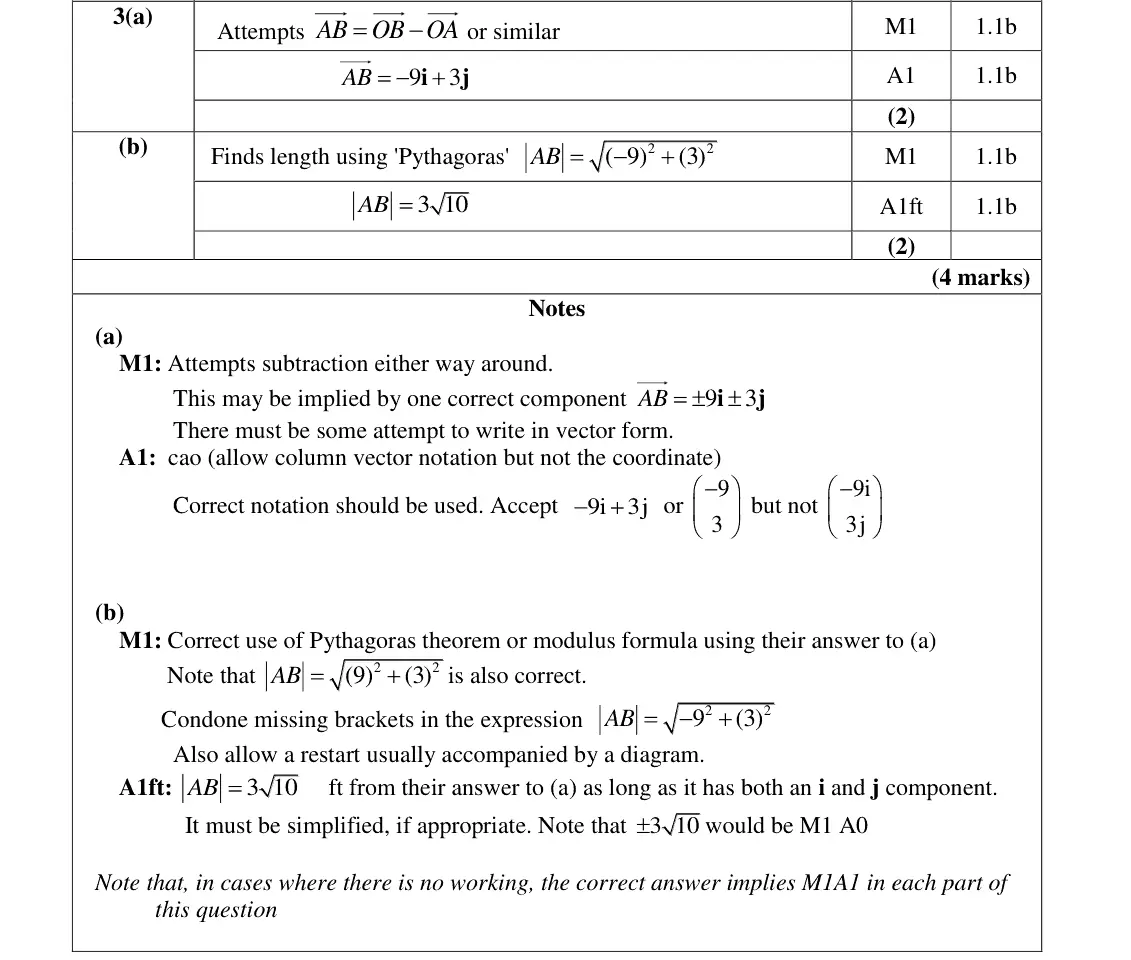
This question was very accessible to the vast majority of students with many scoring full marks. Errors seen in part (a) included finding the sum of the two vectors instead of the difference, or, finding the difference ‘the wrong way around’. Correct vector notation was seen in all but a few cases with incorrect notation such as (-9i,3j) being penalised.
Common mistakes
AB = OB − OA = −9i + 3j
common errors: adding the vectors or OA − OB
incorrect notation such as (−9i, 3j) penalised
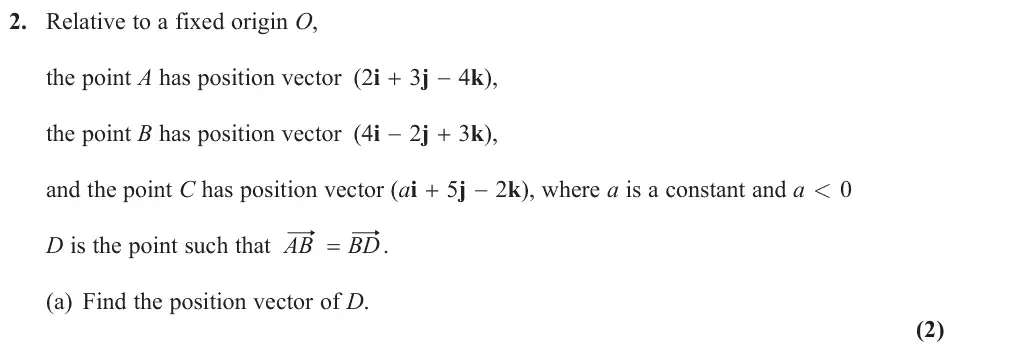
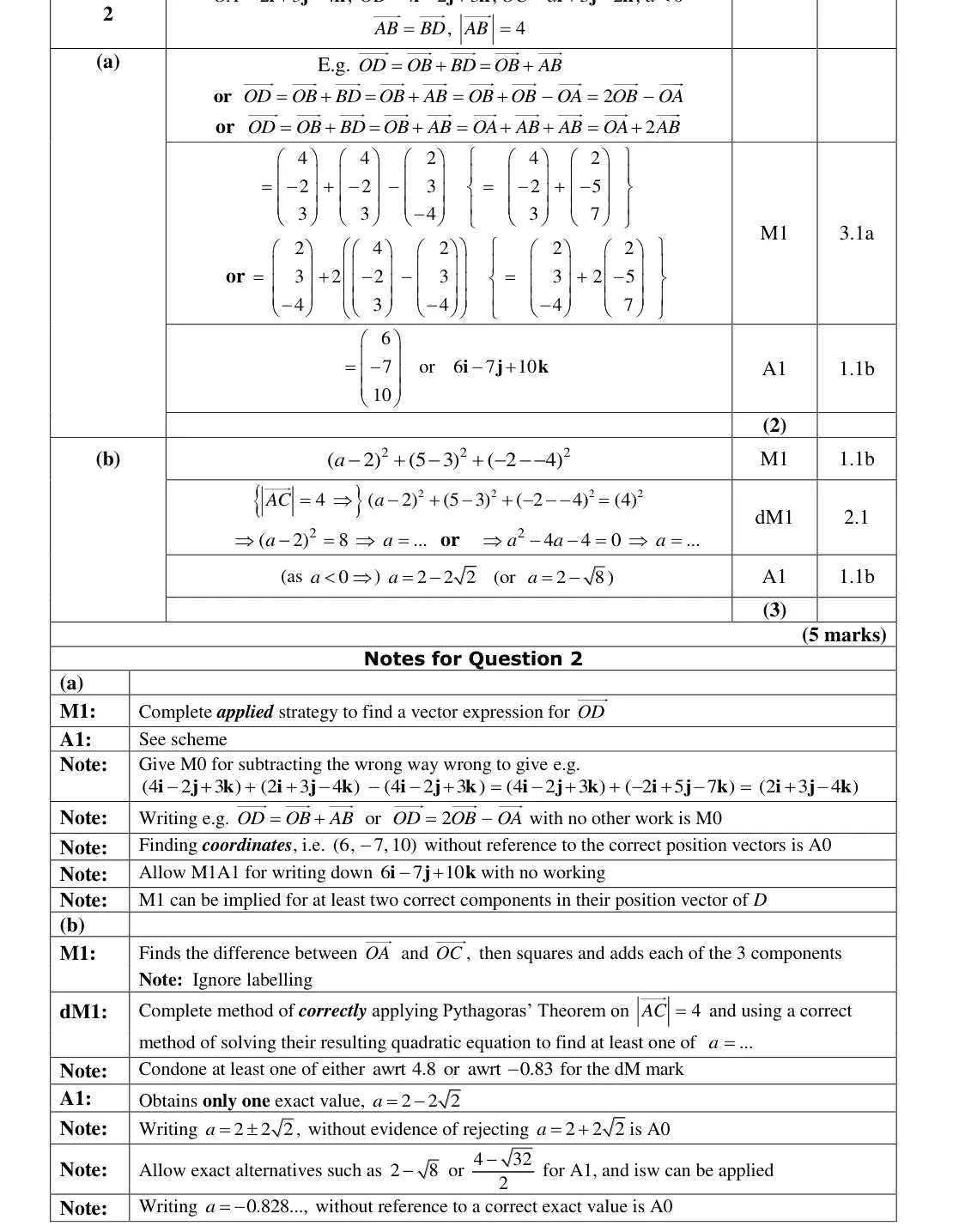
June 2018 · Paper 2 · Q2(a)2 marks
Mark scheme (whole question; this part is marked with the orange bar)
Examiner's comment
This was a well-answered question with most students scoring at least 4 of the 5 marks available. Part (a) was often completed successfully. Most students found AB and used the given result AB BD to deduce and apply . OD OB AB A few students applied 2 . OD OA AB There were some sign, manipulation and bracketing errors seen in this part and students who used column vectors were generally more successful than those who used the , , i j k notation.
Common mistakes
OD = OB + BD = OB + AB = 2OB − OA = 6i − 7j + 10k
sign, bracketing errors with i j k notation (column vectors safer)
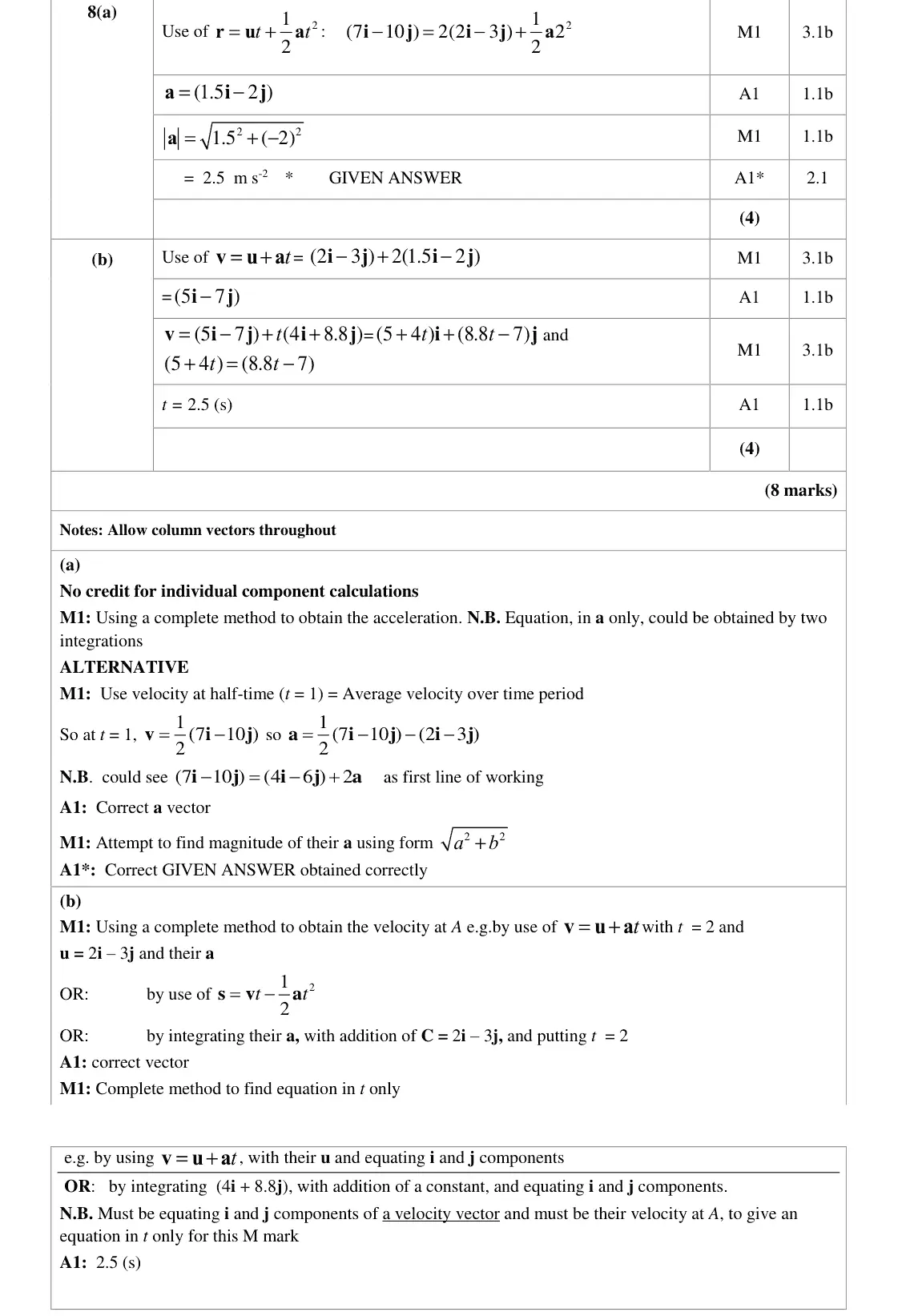
June 2018 · Paper 3 · Q8(b)4 marks
Mark scheme (whole question; this part is marked with the orange bar)
Examiner's comment
Part (b) provided a greater challenge. Here it was necessary to find v after 2 seconds and then use this as the initial velocity for the second part of the motion. The given direction of motion meant that the coefficients of the i and j components of velocity were equal which in turn led to an equation in t. The main errors were in either trying to equate coefficients for a position rather than a velocity vector or in using 7i -10j (a position vector) as the initial velocity. Some students made no valid progress at all with this part of the question. There were, nevertheless, a fair number of entirely correct solutions seen
Common mistakes
velocity at A = (2i − 3j) + 2(1.5i − 2j) = 5i − 7j
north-east means i and j components of velocity equal: 5 + 4t = 8.8t − 7, t = 2.5 s
common errors: equating components of a position vector, using 7i − 10j as the initial velocity
Find an Edexcel maths tutor
Stuck on this? Book a trial session with an Edexcel specialist.