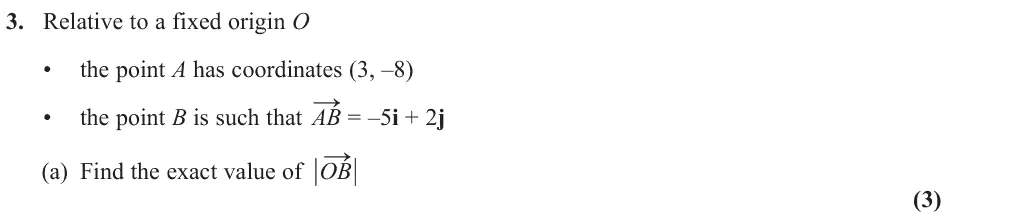
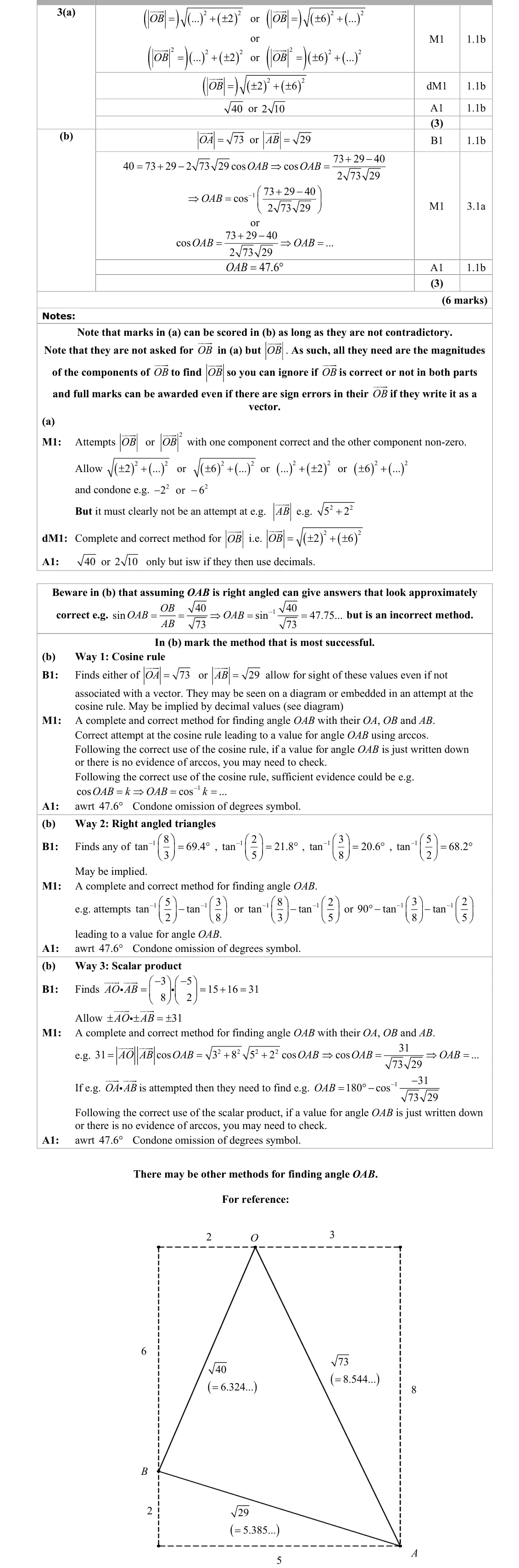
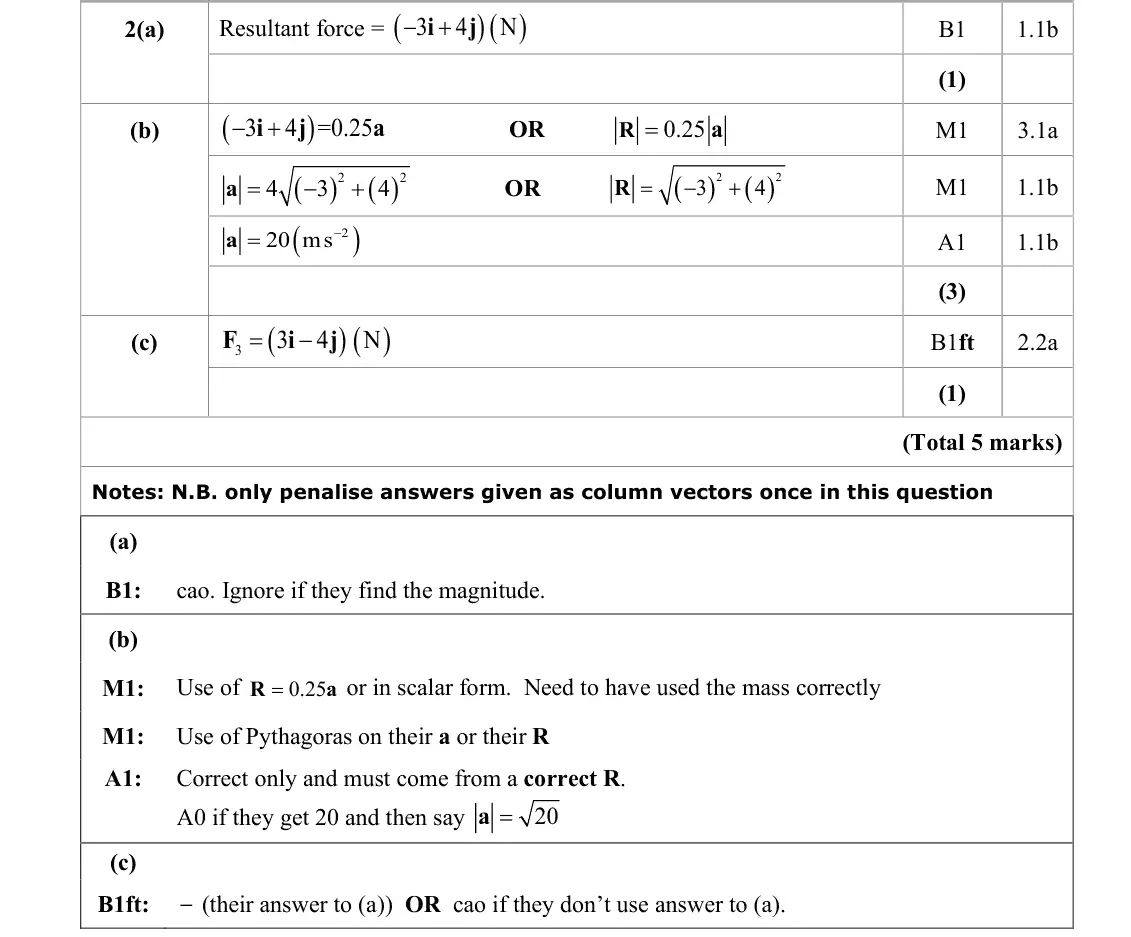
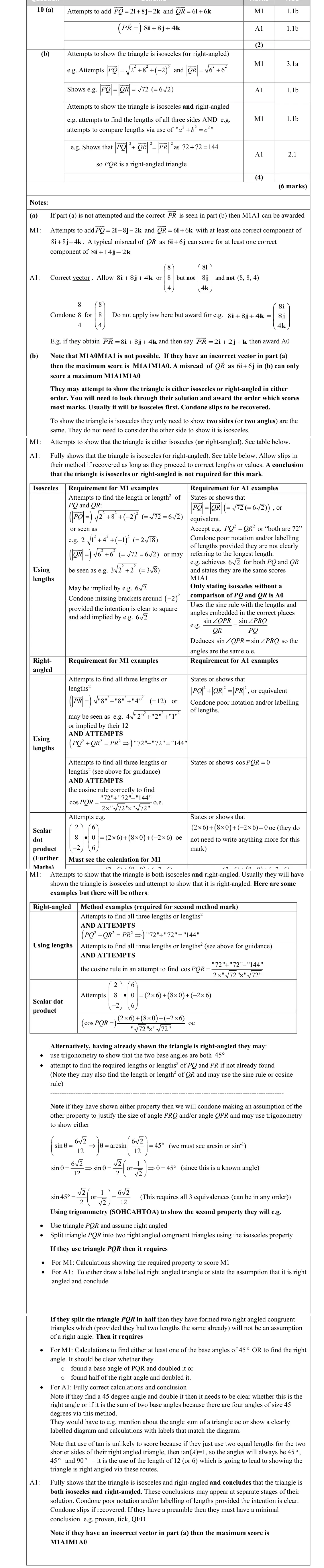
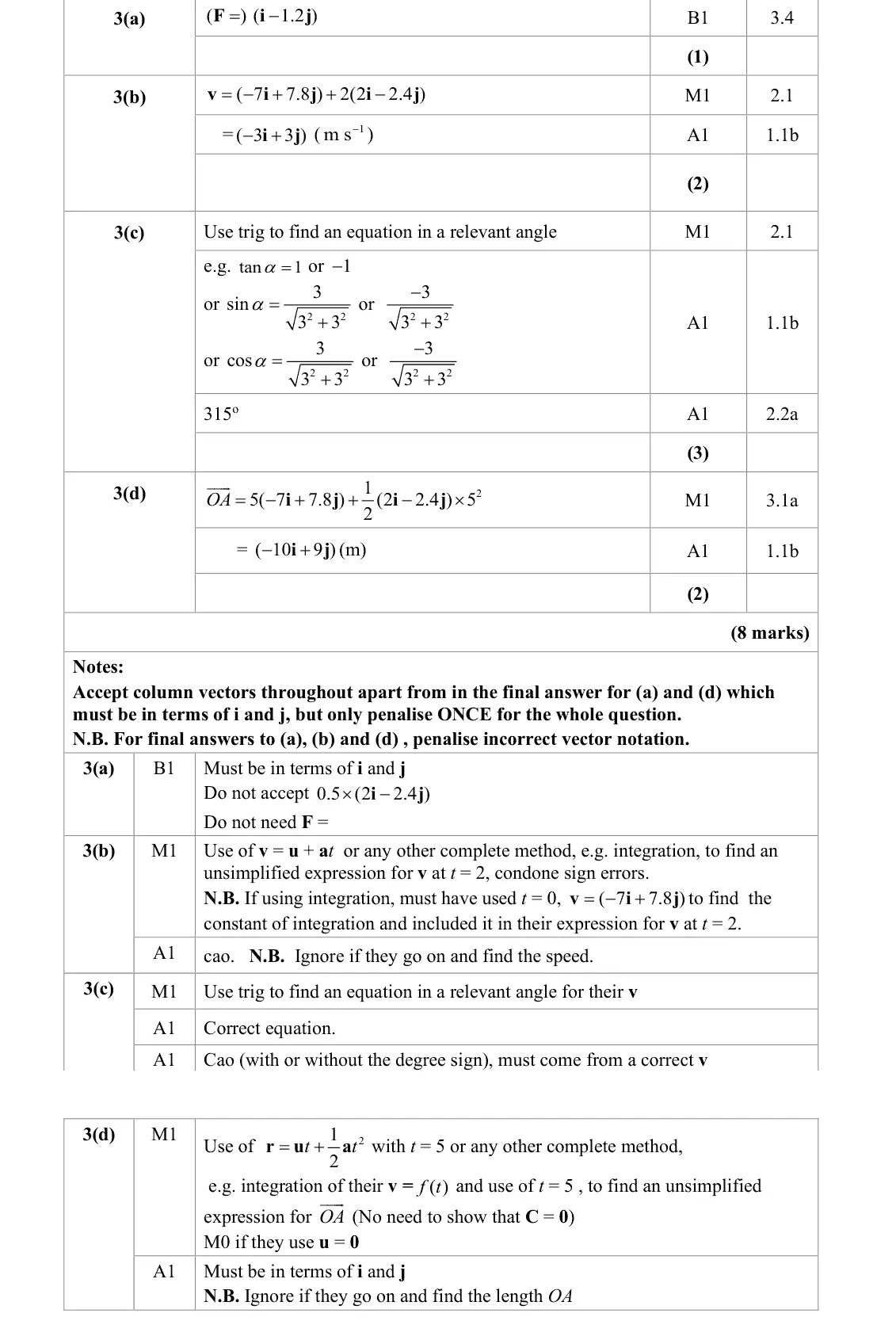
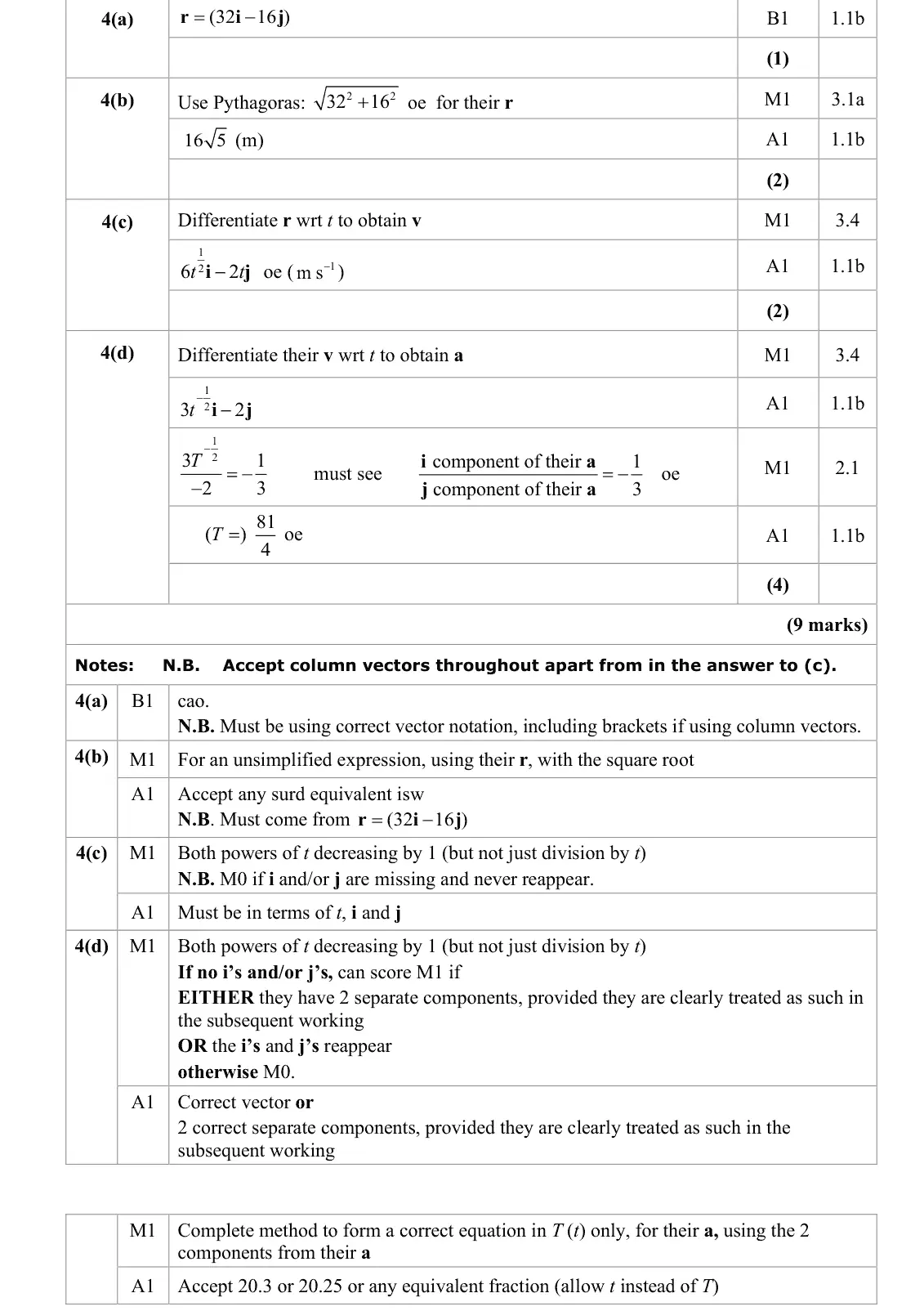
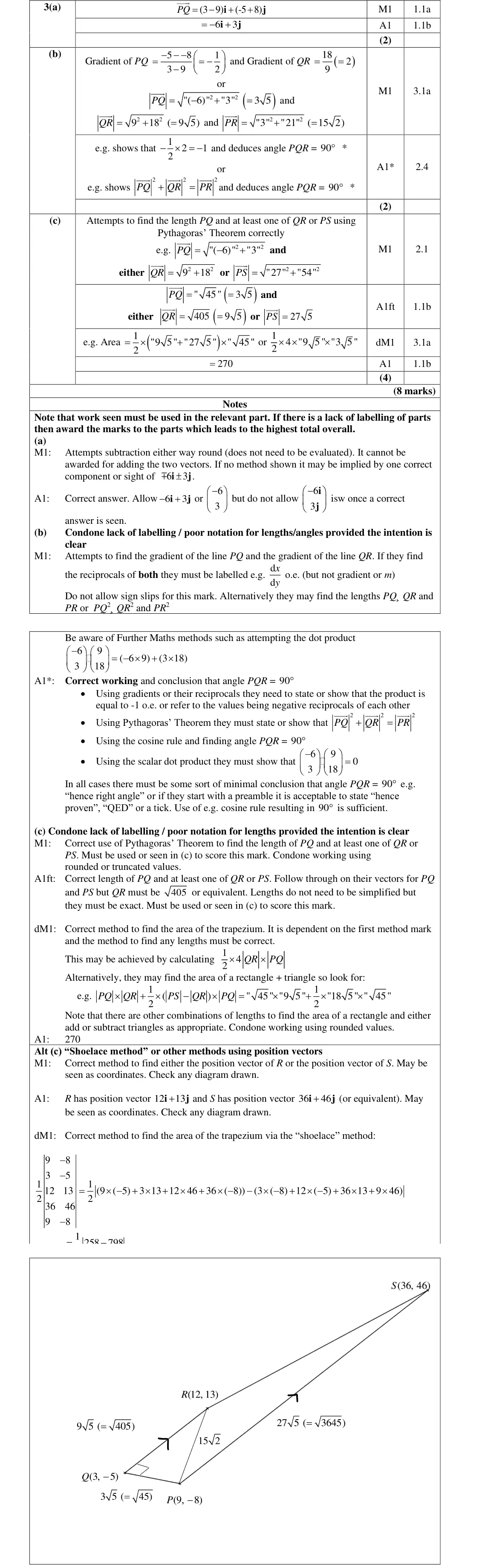
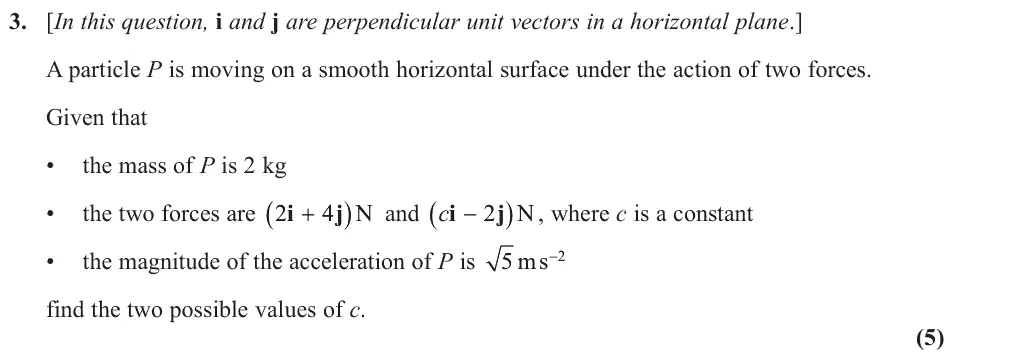
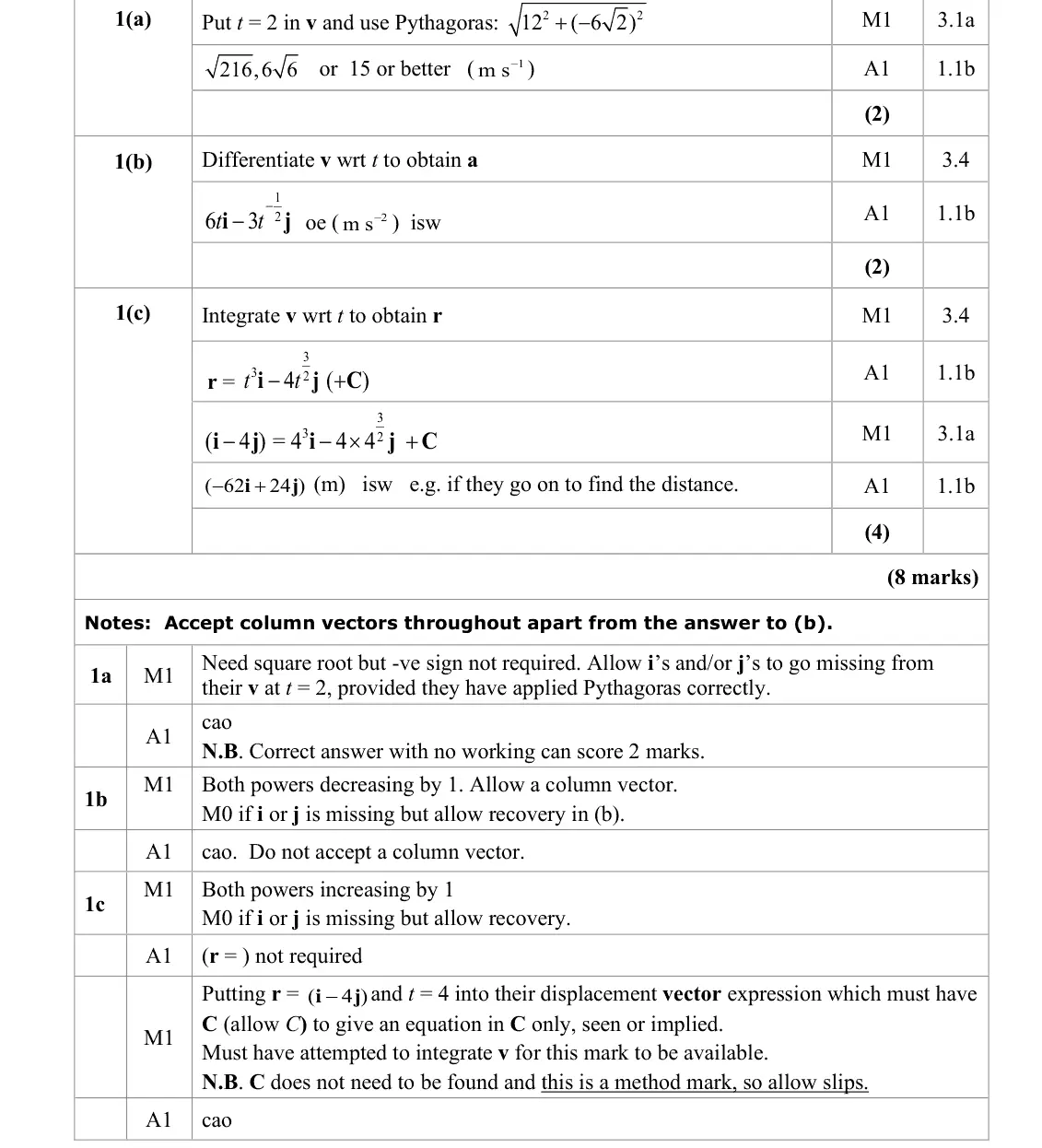
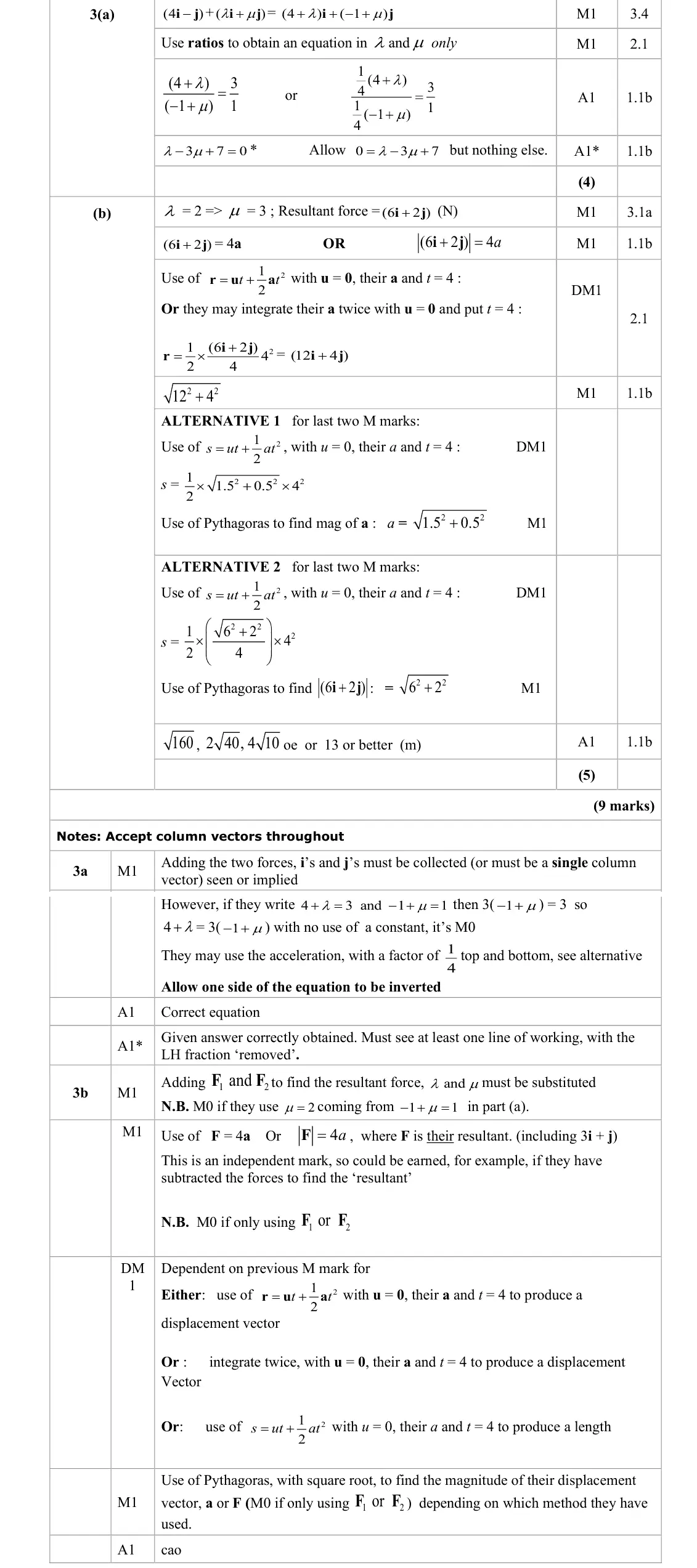
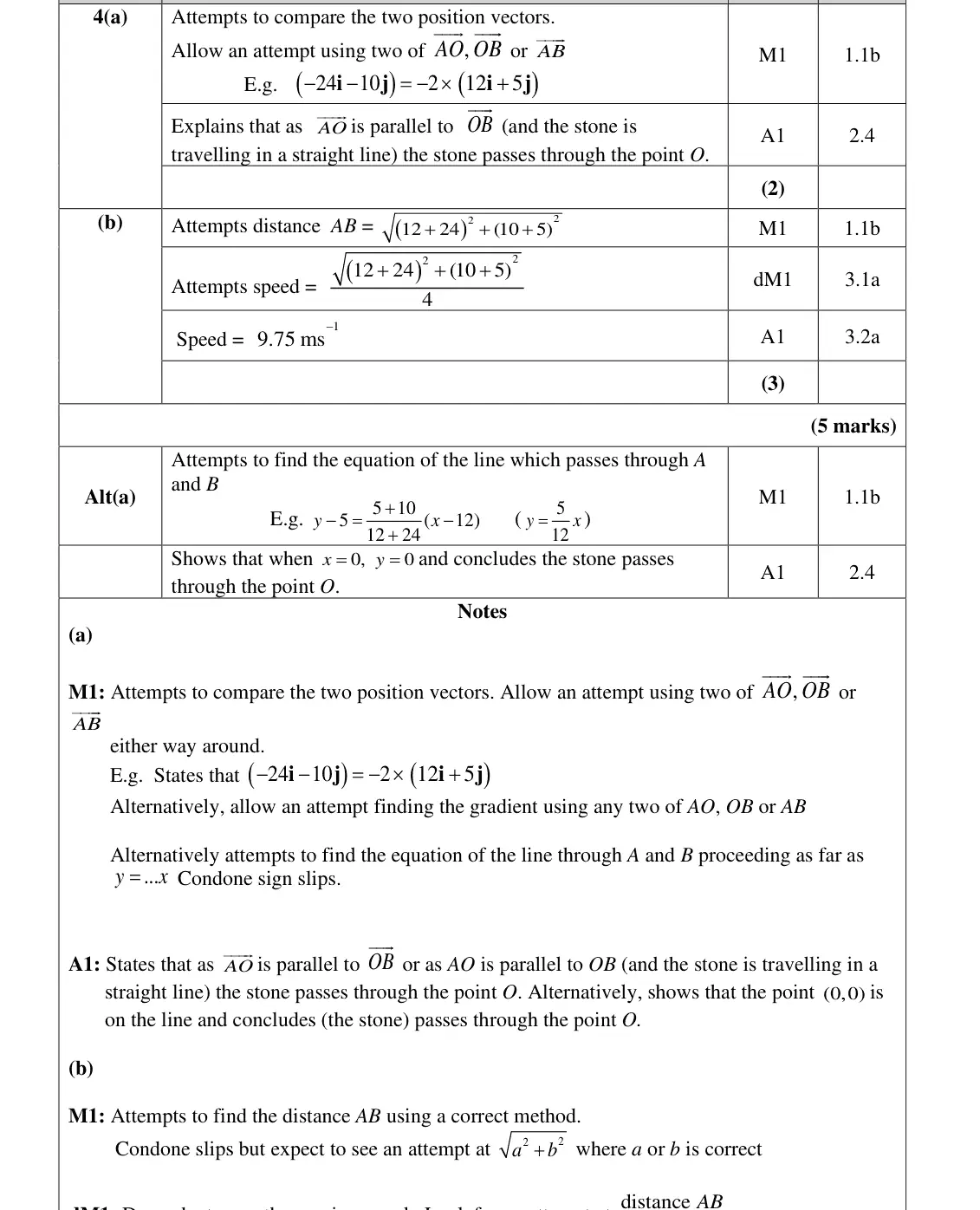
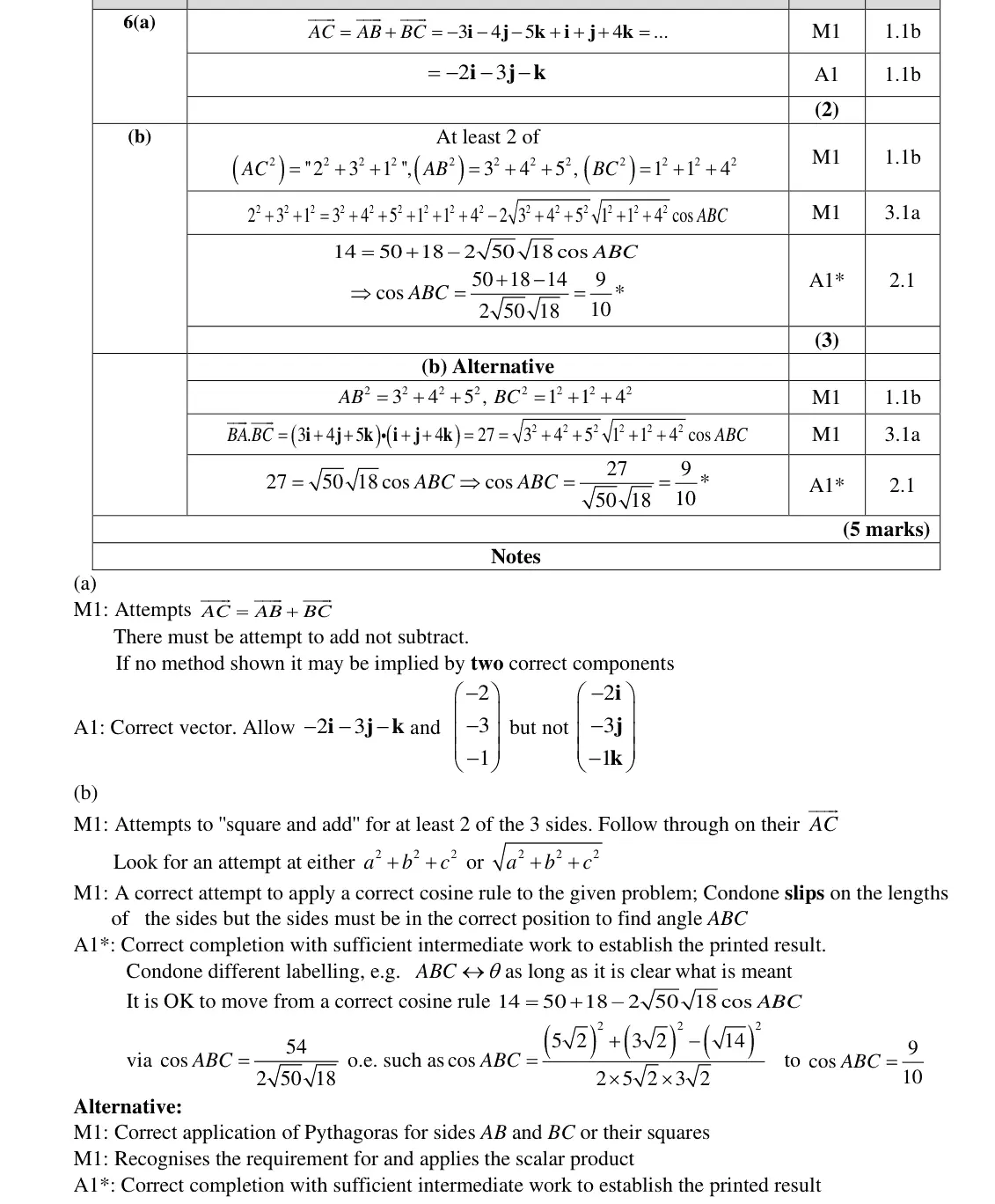
Mark scheme (whole question; this part is marked with the orange bar)
Examiner's comment
In part (a), a good proportion of candidates arrived at the correct value for OB as 40 or 2 10 , either in part (a) or (b). Some candidates mistakenly found OB as OA AB - rather than OA AB + whilst others found OB but not its magnitude, although they were allowed recovery if they subsequently found the magnitude in part (b). A few just found AB in this part and others slipped up on one of the components of OB .
Common mistakes
OB = OA + AB = −2i − 6j (not OA − AB)
exact magnitude √40 = 2√10
stopping at the vector OB or finding the magnitude of AB
June 2025 · AS Paper 1 · Q3(b)3 marks
Mark scheme (whole question; this part is marked with the orange bar)
Examiner's comment
In part (b), many drew a diagram to help and there were many correct answers. Those who did not draw a diagram found this more challenging. The vast majority achieved at least one mark for finding the length of OA or OB . Most understood the need to use the cosine rule, and this was often the rearranged form with cos(OAB) as the subject. A surprising number of candidates found the wrong angle of the triangle by substituting their vector lengths into the wrong places in the cosine rule formula, especially those without a diagram. Others made slips in the rearranging. Some candidates incorrectly assumed that the triangle was right-angled and attempted to find angle OAB using trigonometry in a right-angled triangle. For those with a good diagram, the 1 tan- approach worked well, and many successful strategies were seen. A few students used the scalar product approach, but again those without a diagram often used incorrect vectors and found the wrong angle.
Common mistakes
OA = √73, AB = √29, OB = √40
cosine rule with √40 opposite angle A gives 47.6°
lengths in the wrong places find the wrong angle
do not assume a right angle (sin⁻¹(√40/√73) = 47.75° is wrong)
draw a diagram
June 2025 · AS Paper 2 (Mechanics) · Q2(b)3 marks
Mark scheme (whole question; this part is marked with the orange bar)
Examiner's comment
In part (b), most candidates used Pythagoras correctly but failed to use Newton’s 2nd Law. A significant number, of those that did, multiplied the resultant force by 0.25 instead of dividing it by 0.25.
Common mistakes
Newton's second law F = ma with m = 0.25 then Pythagoras: magnitude of a = 4 × 5 = 20 m s⁻²
most used Pythagoras but forgot F = ma, or multiplied by 0.25 instead of dividing
20 then "√20" loses the A mark
June 2025 · Paper 1 · Q10(b)4 marks
Mark scheme (whole question; this part is marked with the orange bar)
Examiner's comment
This question tested learners’ knowledge of vectors and proof of the properties of a triangle. It should be noted that in part (b) that, despite it being possible to gain full credit by finding the length of vectors and Pythagoras’ Theorem in a few lines, many learners chose to use more involved methods. This often led to them not gaining full marks due to errors in their working. Part (b) was well answered by most learners. Many responses lacked clarity when attempting to prove that the triangle was both isosceles and right-angled. In demonstrating that the triangle is isosceles, some calculated the magnitudes of the sides correctly but did not gain the accuracy mark as they just stated it was isosceles without reference two sides being equal. It seemed that learners found it harder to prove the triangle was right-angled. Most successful responses used Pythagoras’ Theorem to show that the triangle was right-angled and most of these responses gained full marks. When learners used the scalar dot product method, many of them did not show the calculation and therefore did not gain credit, whilst others were not very successful in showing the triangle was right-angled, with some learners incorrectly using it to show a perpendicular gradient of 1 - instead of 0. The least successful responses tended to involve SOHCAHTOA, mainly because this approach was more involved and thus required a fuller explanation, which was not always in evidence. As this was a ‘show’ question, a conclusion (either overall or separate for each property) and an assumption that the triangle was-right angled was required to score full marks. There were lots of incorrect attempts at the cosine rule, which learners either could not remember correctly, or did not rearrange correctly. A significant minority of responses attempted to show the right-angled property by splitting the triangle in half to create two right angled triangles and then used trigonometry. 15
Common mistakes
magnitudes PQ = QR = √72 = 6√2 (state that two sides are equal) and PR = 12 with 72 + 72 = 144 (Pythagoras) or scalar product = 0 shown
conclusion for both properties needed
longer cosine-rule or trigonometry methods led to errors
June 2025 · Paper 3 (Mechanics) · Q3(c)3 marks
Mark scheme (whole question; this part is marked with the orange bar)
Examiner's comment
Finding the bearing of the direction of motion in part (c) proved more challenging for many learners. A good number were able to find an acute angle relating to their velocity vector. Use of basic trigonometry or the properties of a right-angled isosceles triangle were seen in roughly equal measure, but gaining the final mark for a correct bearing was often not achieved. Unrepresentative diagrams and a misunderstanding of bearings appeared to be the cause of this. A significant number did not need to use trigonometry, realising that the components indicated a north west direction and writing down 315o directly. A few learners first worked out the displacement vector and attempted to find the bearing of the position of the particle. This was not what the question had asked for and gained no credit.
Common mistakes
v = −3i + 3j points north-west so bearing 315°
unrepresentative diagrams and misread bearings lose the final mark
using the displacement instead of the velocity scores nothing
June 2025 · Paper 3 (Mechanics) · Q4(b)2 marks
Mark scheme (whole question; this part is marked with the orange bar)
Examiner's comment
In part (b) Pythagoras’ Theorem was generally applied correctly to find the magnitude. An exact (surd) answer was required so those who only stated a decimal approximation did not sqrt 322 -162 thereby not gaining both marks. gain the accuracy mark. A few did not account properly for the negative sign and evaluated In the third part the majority of learners recognised the requirement to differentiate to find the
Common mistakes
exact answer 16√5 needed (decimal loses A1)
square the −16 correctly, not √(32² − 16²)
June 2024 · AS Paper 1 · Q3(b)2 marks
Mark scheme (whole question; this part is marked with the orange bar)
Examiner's comment
Overall, this question proved fairly tricky with lots of candidates losing marks throughout. In part (b), quite a few candidates seemed unclear as to how to show 90 PQR = ; some made no attempt whilst others used the given fact within their proof often finding two angles in a triangle and showing that they were complementary, but they had assumed a right angle in order to utilise trigonometry which achieved no marks. The candidates who tended to be most successful at this were the ones who attempted to show the required property using gradients. There were a small number of signs slips and incorrect attempts at gradients but overall, this approach was usually successful. Quite a lot attempted to use Pythagoras’ theorem but there were a significant number who would only find PQ and QR and either did not attempt to find PR or had a poor attempt at finding it. It is of note that for those who successfully used Pythagoras’ theorem to complete the proof, diagrams proved useful. There were a small number who attempted the dot product or cosine rule and usually these attempts were good enough to achieve the marks. It was disappointing that the most common reasons for the M1A0 score were due to incorrect/incomplete solutions or simply a lack of conclusion.
Common mistakes
gradients −1/2 and 2 multiply to −1
or PQ² + QR² = PR² with PR found
must conclude angle PQR = 90°
assuming the right angle to use trigonometry scores 0
June 2024 · AS Paper 1 · Q3(c)4 marks
Mark scheme (whole question; this part is marked with the orange bar)
Examiner's comment
Overall, this question proved fairly tricky with lots of candidates losing marks throughout. Part (c) proved quite tricky for a lot of candidates many of whom did not seem to have fully understood the shape with which they were working. Those who were successful usually had a good diagram identifying it as a trapezium and were able to find the area. There were a number of attempts at splitting the shape up into a rectangle and triangle or 2 triangles, but often there was a misunderstanding about which lengths were which and how they should be combined to find the area. The most common error in the rectangle and triangle approach was that the candidates failed to spot that the triangle was a right-angled triangle so could use QP as the ‘height.’ The two triangles approach would also often have the same issue. There were quite a few attempts that treated the shape either as just a rectangle or just a triangle. It was pleasing however to see that whilst a large number of candidates were unsure of how to proceed to find the area many did at least acknowledge the need to attempt the lengths of various vectors, which generally resulted in two marks being awarded.
Common mistakes
PQRS is a trapezium (PS parallel to QR) with height PQ = 3√5
QR = 9√5, PS = 27√5
area = ½(9√5 + 27√5)(3√5) = 270
a diagram helps
treating the shape as a rectangle or parallelogram
not spotting the right angle
June 2024 · AS Paper 2 (Mechanics) · Q35 marks
Mark scheme (whole question; this part is marked with the orange bar)
Examiner's comment
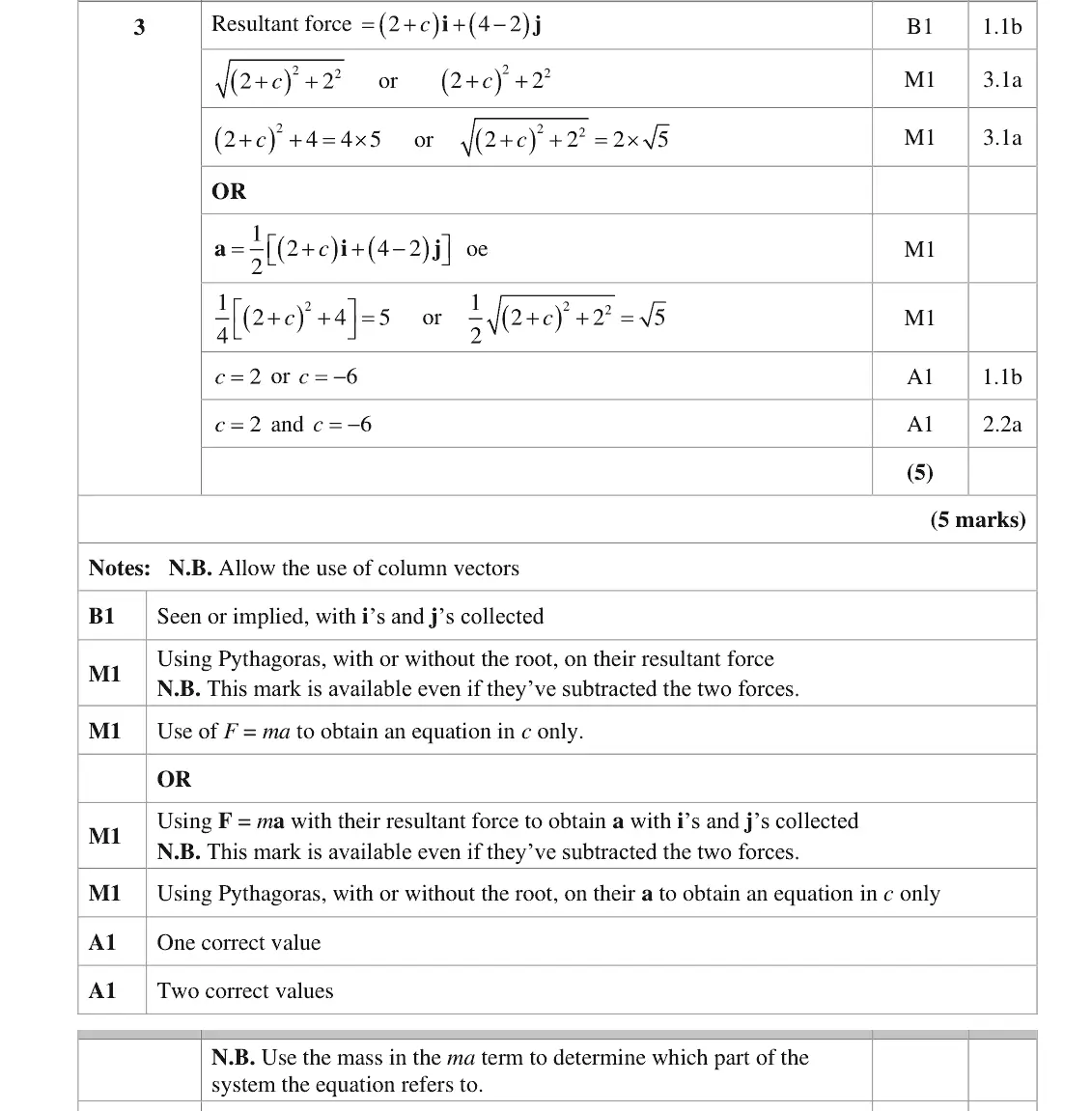
This was a challenging question for many candidates since forces were given as vectors, but the acceleration was given as a scalar. Although most realised that the two forces needed to be combined to produce a resultant, some subtracted the components rather than adding, thererby failing to achieve the first mark. This also required the i and j terms to be collected to enable an expression for the magnitude to be found. A common starting point was to equate the vector sum of the forces to a scalar ‘ma’ term often leading to no further valid progress. Those who attempted to work in scalars sometimes equated the magnitude of their resultant to sqrt 5 (acceleration) rather than 2 sqrt 5 (ma term) and managed to secure one of the two available method marks. Where a correct unsimplified equation in c was reached, processing errors such as not squaring each side or in expanding brackets sometimes led to incorrect answers. The few who found the acceleration vector and equated the magnitude to sqrt 5 or the square of the magnitude to 5 tended to do so successfully despite the slightly harder algebra.
Common mistakes
resultant force (2 + c)i + 2j (add, not subtract, the components)
F = ma with magnitudes: (2 + c)² + 2² = (2√5)² = 20, or acceleration vector with magnitude √5
c = 2 or c = −6
equating a vector to the scalar ma
using √5 instead of 2√5 for ma
June 2024 · Paper 3 (Mechanics) · Q4(a)3 marks
Mark scheme (whole question; this part is marked with the orange bar)
Examiner's comment
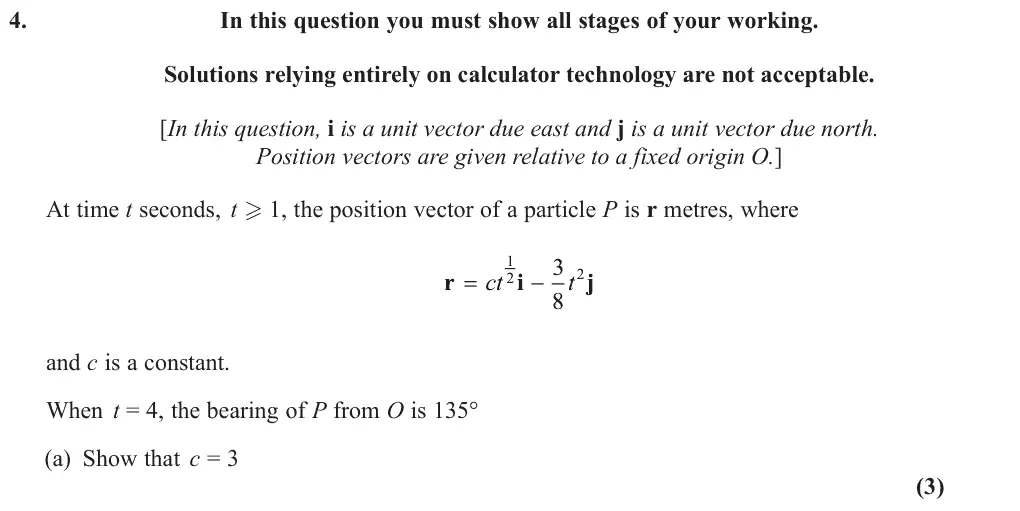
(a) This part of the question was worth three marks and required candidates to produce a rigorous proof to show that c = 3, either by using trigonometry or an isosceles triangle or both. It seemed that many candidates were telling themselves that the answer was obvious but were uncertain as to how to go about justifying the fact. Most candidates struggled to produce a rigorous proof, instead just stating, without justification, that for a bearing of 135o, the distance travelled in the x-direction would have the same magnitude as the distance travelled in the negative y-direction or equivalent. They were able to score two of the three marks available if they then went on the show that c = 3. Those candidates who drew a diagram and labelled it with all the information from the question were generally more successful in scoring all three marks than those who either did not draw a diagram or whose diagram did not include some of the information given. Some - 6 = o tan135 candidates correctly used or the equivalent, without a diagram. Common 2c errors included not being able to correctly sketch a bearing of 135o, or omissions of angles or sides in the diagram. The negative sign caused issues in several instances and was sometimes glossed over. There was also some poor algebra. A few candidates incorrectly wrote 2c + 6 = 0 to obtain c = 3.
Common mistakes
at t = 4, r = 2ci − 6j
bearing 135° means a 45° angle below east so 2c = 6, justified by tan 45° or an isosceles right-angled triangle on a correct diagram
stating equal components without justification loses a mark
2c + 6 = 0 is wrong
June 2024 · Paper 3 (Mechanics) · Q4(b)4 marks
Mark scheme (whole question; this part is marked with the orange bar)
Examiner's comment
(b) The majority of candidates realised the need to differentiate the given expression for r, with c = 3 substituted, to obtain the velocity, and most of these differentiated correctly. They then substituted t = 4 and used Pythagoras to find the speed, giving their answer either as an exact value or an appropriate decimal equivalent. A minority correctly found the velocity but then stopped and lost two marks. A few candidates delayed substituting c = 3 until the end and a few delayed putting t = 4 which made the working a lot more demanding. About half worked with column vectors instead of using i - j form. Common errors included calculation slips when evaluating the speed or when substituting t = 4, misreading the expression such as losing the negative sign in the j-component and losing the i and j and not recovering to use components. A few candidates tried to use a suvat approach not realising that this was not a constant acceleration situation. (c) Many of those who differentiated in (b), successfully differentiated their velocity vector to obtain the acceleration vector. However, a significant number of candidates did not know how to proceed from there and the second stage of the process proved to be a discriminator. It was only the stronger candidates who realised that their acceleration vector had to be a multiple of the given vector. Those who did make this link generally were able to complete the question successfully. A number of unsuccessful candidates just set the i-component of the acceleration equal to -1 (or more rarely to -27). Most of k -- those who compared a to ( 27 ) i j were able to reach an equation in t only which they then tried to solve. Fewer candidates used a ratio approach but a significant minority of these used the reciprocal of the correct ratio but were still able to score the method mark. Having reached a correct equation in t or T only, some then struggled to obtain the correct answer. There were a few candidates who tried to use a suvat approach for this part not realising that this was not a constant acceleration situation and scored nothing.
Common mistakes
differentiate r (powers of t decrease by 1): v = (3/2)t^(−1/2)i − (3/4)tj
put t = 4 in both components then Pythagoras: speed = 3√17/4 ≈ 3.09 m s⁻¹
stopping at the velocity vector
suvat invalid (acceleration not constant)
June 2023 · AS Paper 1 · Q13(b)2 marks
Mark scheme (whole question; this part is marked with the orange bar)
Examiner's comment
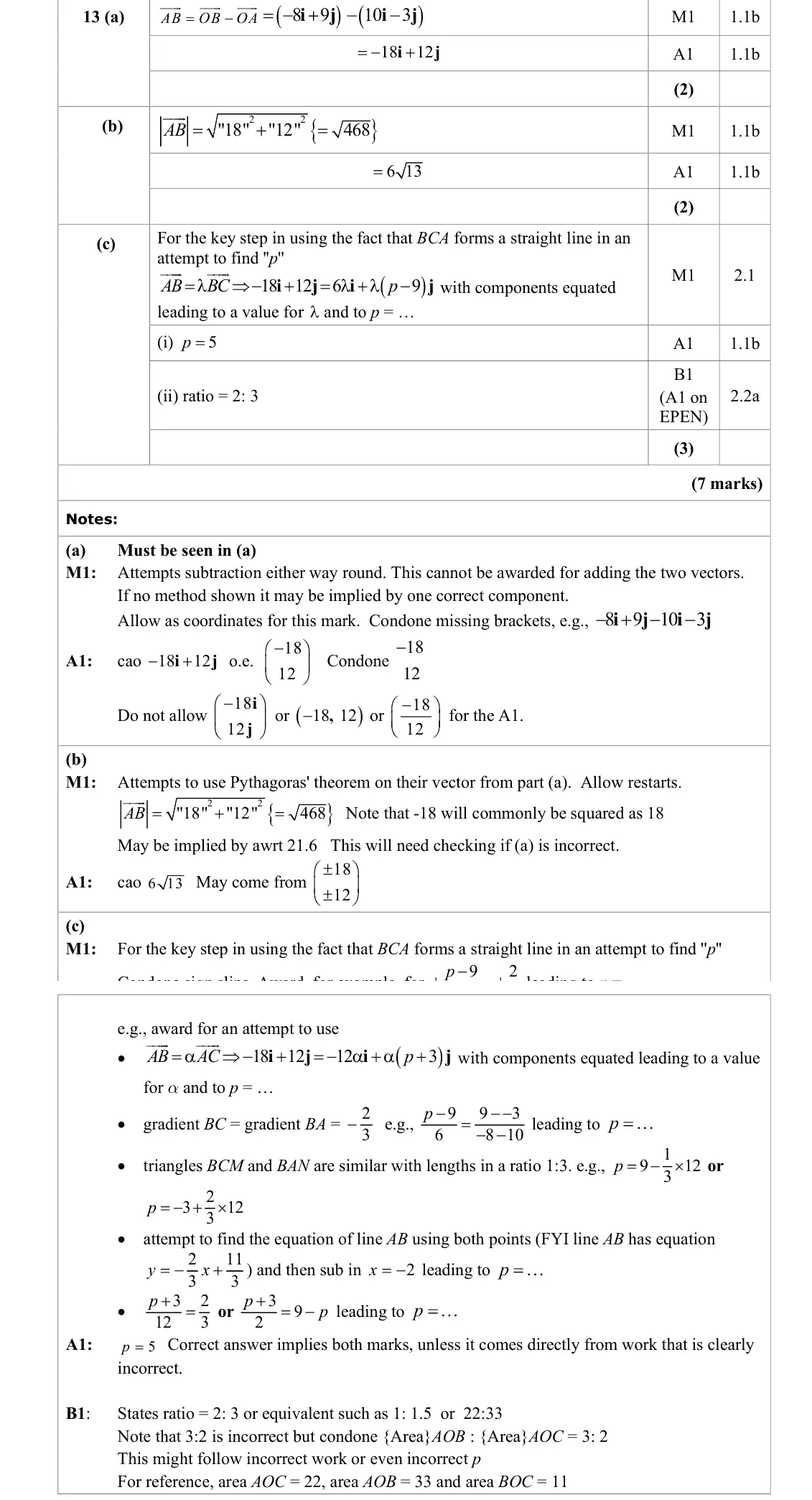
Given that candidates often find vector problems quite challenging, this question proved to be quite accessible, and most candidates made good progress through parts (a) and (b) of this question, with part (c) more mixed. Most were then able to calculate |AB| in (b) using their answer from (a), and many correctly reached 6 13 , which was allowed even if candidates had achieved an incorrect vector in (a), e.g., 18 12 + i j Attempted methods in (c)(i) were many and varied but most did not use vectors. The most common method was to establish the equation of the straight line through A and B, and this was then used with 2 x = - to find 5 p = . Other methods simply looked logically at the information given and found the appropriate scaling factor between, for example, the vectors AB and BC . Methods like this were often poorly written down but were clearly correct and gained full marks.
Common mistakes
√(18² + 12²) = √468 = 6√13, fully simplified surd
June 2023 · Paper 1 · Q3(a)1 mark
Mark scheme (whole question; this part is marked with the orange bar)
Examiner's comment
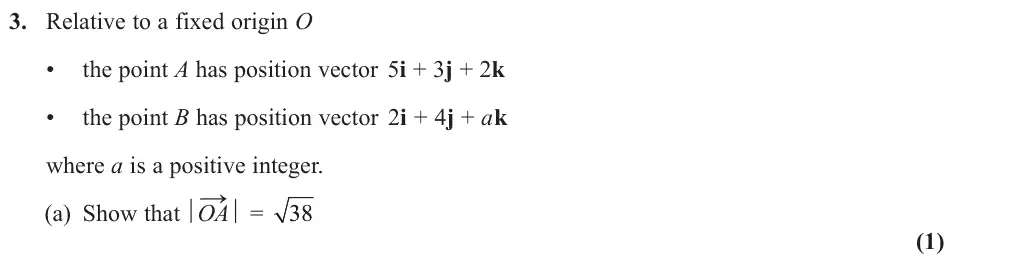
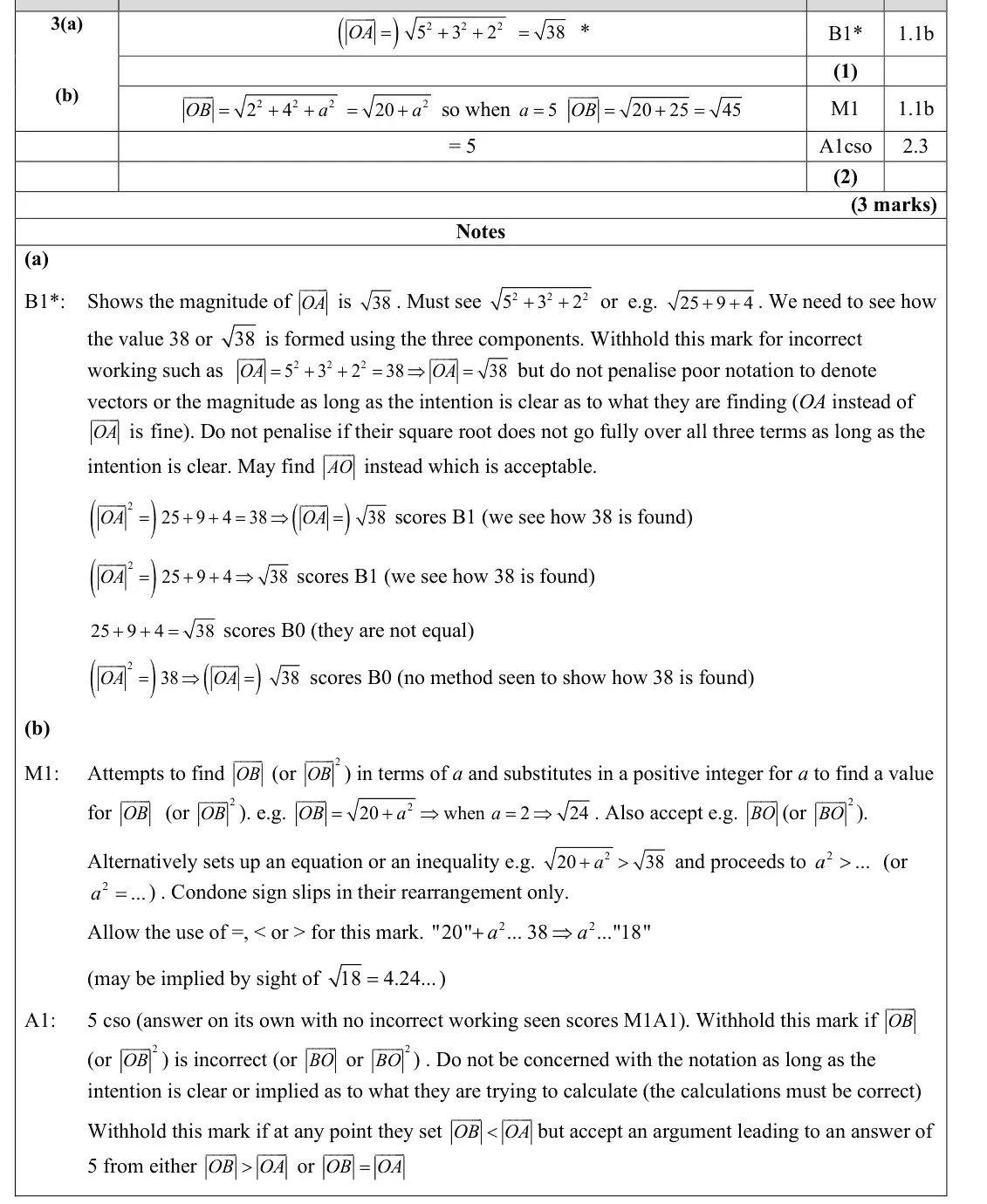
This was another short question on two-dimensional vectors with many candidates able to score 2 out of the 3 marks. Part (a) was generally answered accurately by all candidates. Sometimes the mark was lost because the candidate omitted the square root and wrote 25 9 4 OA = + + . Sometimes the notation was not made clear or i, j and k appeared.
Common mistakes
must show how 38 is formed from the three components
June 2023 · Paper 1 · Q3(b)2 marks
Mark scheme (whole question; this part is marked with the orange bar)
Examiner's comment
This was another short question on two-dimensional vectors with many candidates able to score 2 out of the 3 marks. In part (b), the most common approach was to proceed to 2 18 a or 2 18 a = , and the majority of candidates were able to achieve this. However, a significant number of candidates did not conclude that 5 a = , with some claiming that e.g. 18 is an integer or missing the requirement that “a” had to be an integer. Some other incorrect answers included 19 a = following 18 a and the answer 5 a was not condoned, which lots the final mark for a number of candidates. A common processing error was the simplification of 2 20 a + to 20 a + . Very few candidates used the substitution method and some of those did not reach any conclusion in the end.
Common mistakes
a must be a positive integer: a² > 18 gives a = 5, not a ≥ 5 or √19
√(20 + a²) wrongly split into √20 + a
June 2023 · Paper 2 · Q6(b)4 marks
Mark scheme (whole question; this part is marked with the orange bar)
Examiner's comment
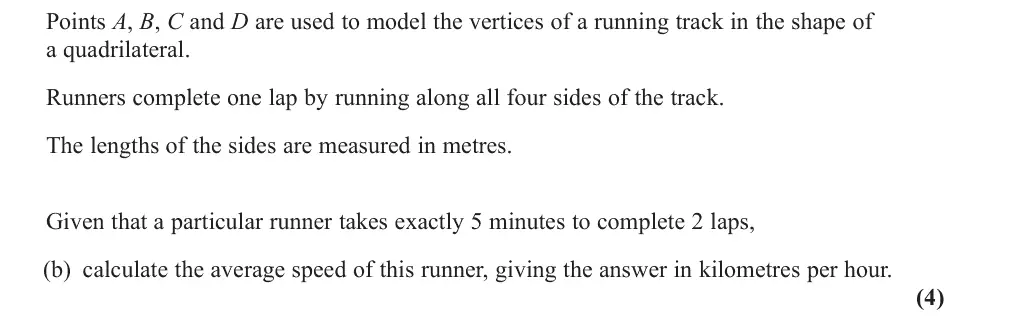
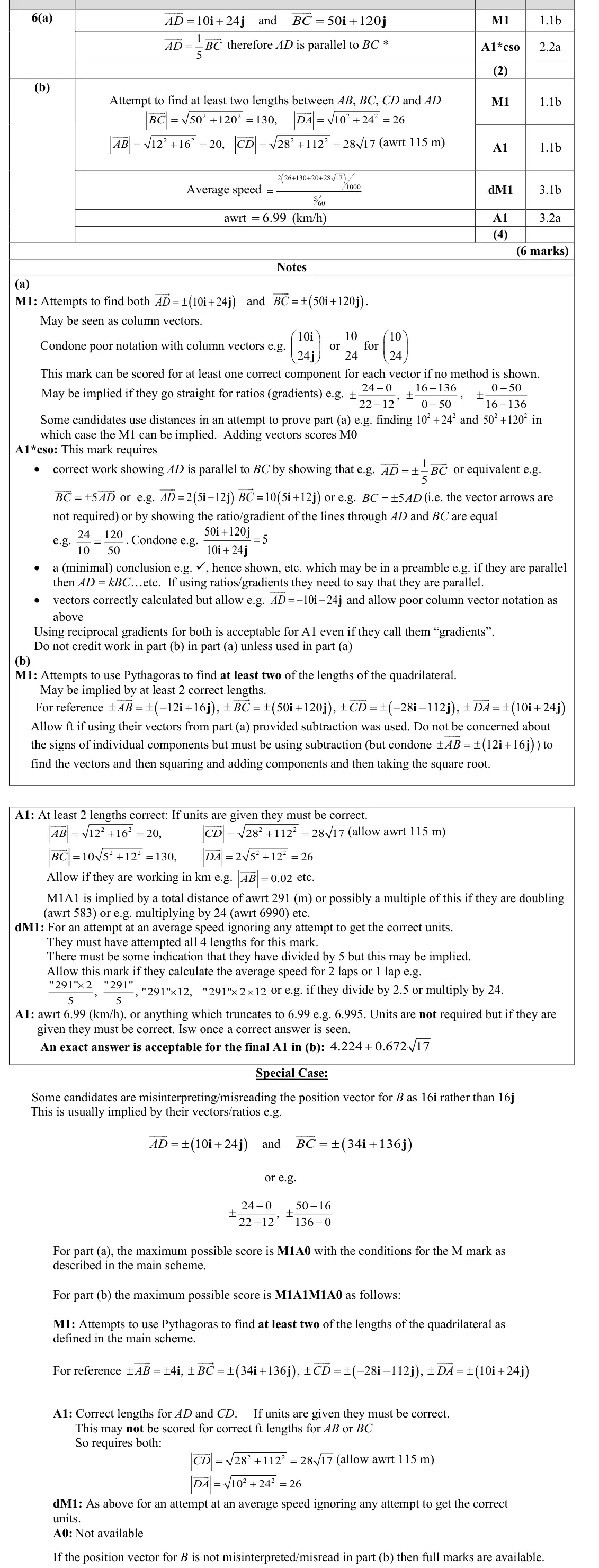
This question was relatively well attempted. Most candidates attempted both parts and scored highly overall. In part (b) most candidates correctly identified the lengths of AB, BC, CD and AD, but many left out their calculations by not showing the application of Pythagoras’ Theorem. This is an important step that should be included to fully demonstrate where their answers came from. There was a misunderstanding by some students who thought they could add the 4 vectors of the sides together to calculate a total vector and work out the length of the resulting vector. A few instead found the lengths of the position vectors and added them. Some also assumed that there were two pairs of equal length lines and/or two pairs of parallel lines and just used the two lengths from part (a) then doubled them. Despite this, candidates often achieved the first two marks. The calculation of the average speed was also done well by many candidates. Although several candidates based their calculation on a single lap and arrived at half the correct answer, the majority completed it correctly and clearly showed division by a fraction equivalent to 5 60 (most commonly 1 12 ) or multiplication by its reciprocal. Candidates should be aware of the general instruction in the rubric to give non-exact answers to 3 significant figures; it was common to see 7 or 7.0 instead of the correct final answer.
adding the vectors or using lengths of position vectors
assuming opposite sides equal
June 2023 · Paper 3 (Mechanics) · Q3(a)3 marks
Mark scheme (whole question; this part is marked with the orange bar)
Examiner's comment
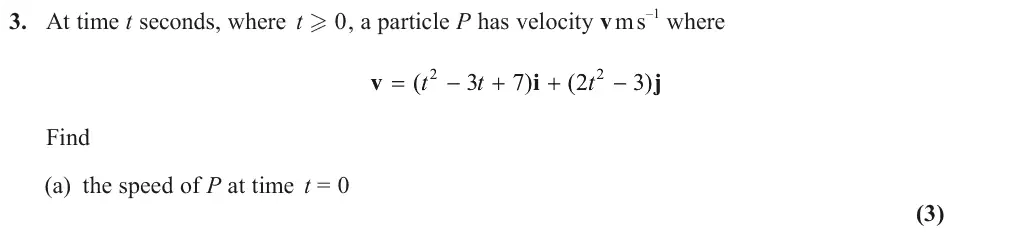
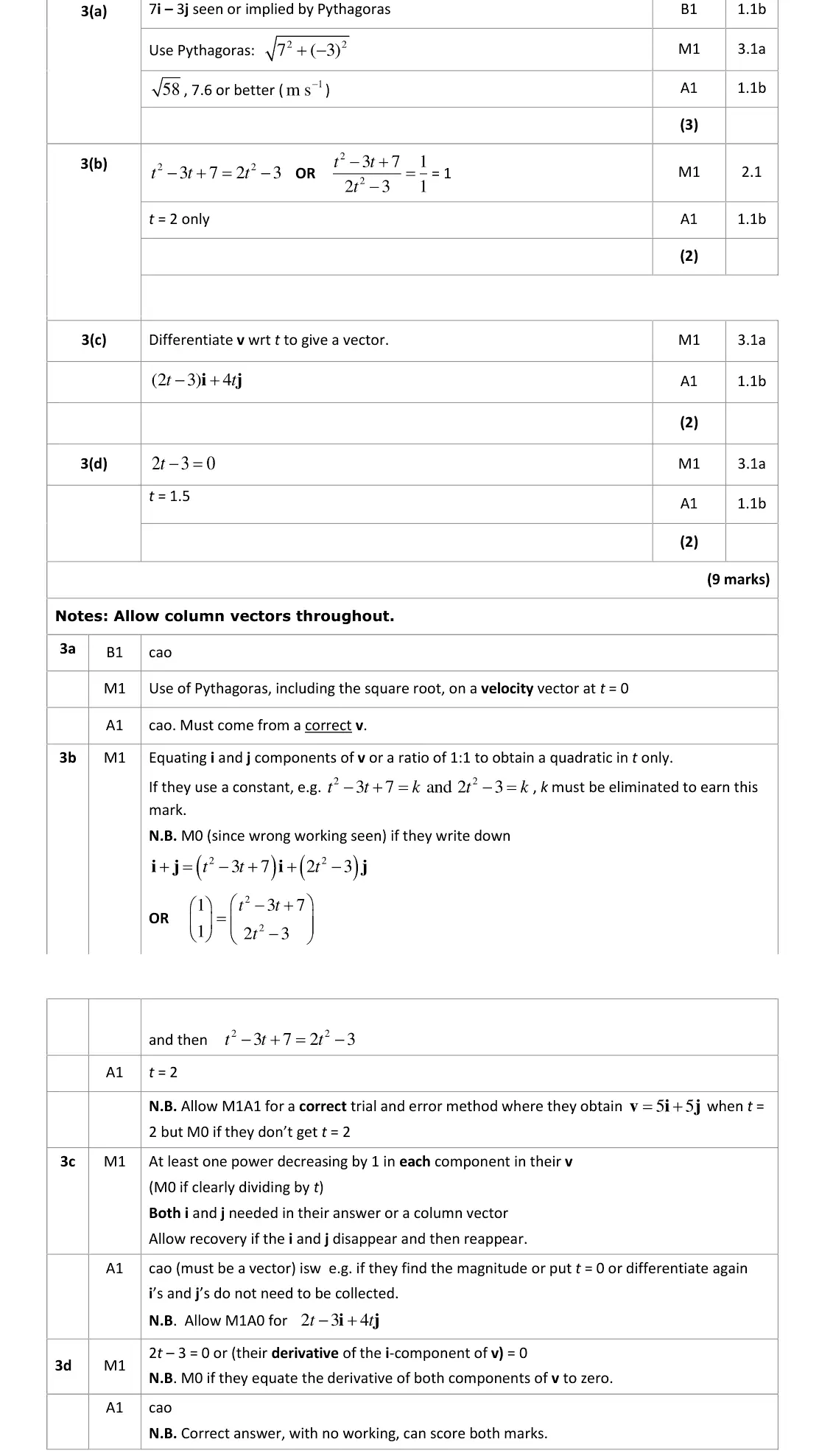
Part (a) was generally a well answered question. Some found the velocity vector at t = 0 and went no further, either forgetting, or not being aware that they needed to use Pythagoras’ Theorem to find the speed. A small number of candidates scored the M mark only, if they had an incorrect velocity vector but used Pythagoras’ Theorem correctly. The majority of candidates who attempted the second part used a correct method, setting
Common mistakes
substitute t = 0 to get 7i − 3j, then speed is the magnitude √58 = 7.6
stopping at the velocity vector
June 2023 · Paper 3 (Mechanics) · Q4(a)4 marks
Mark scheme (whole question; this part is marked with the orange bar)
Examiner's comment
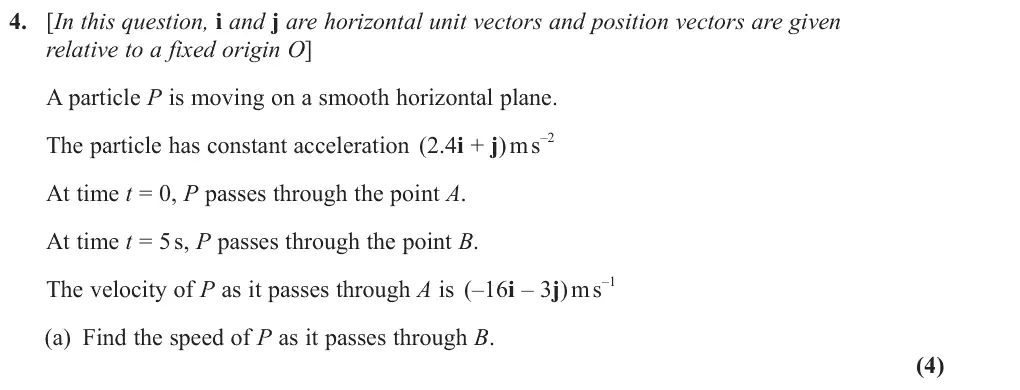
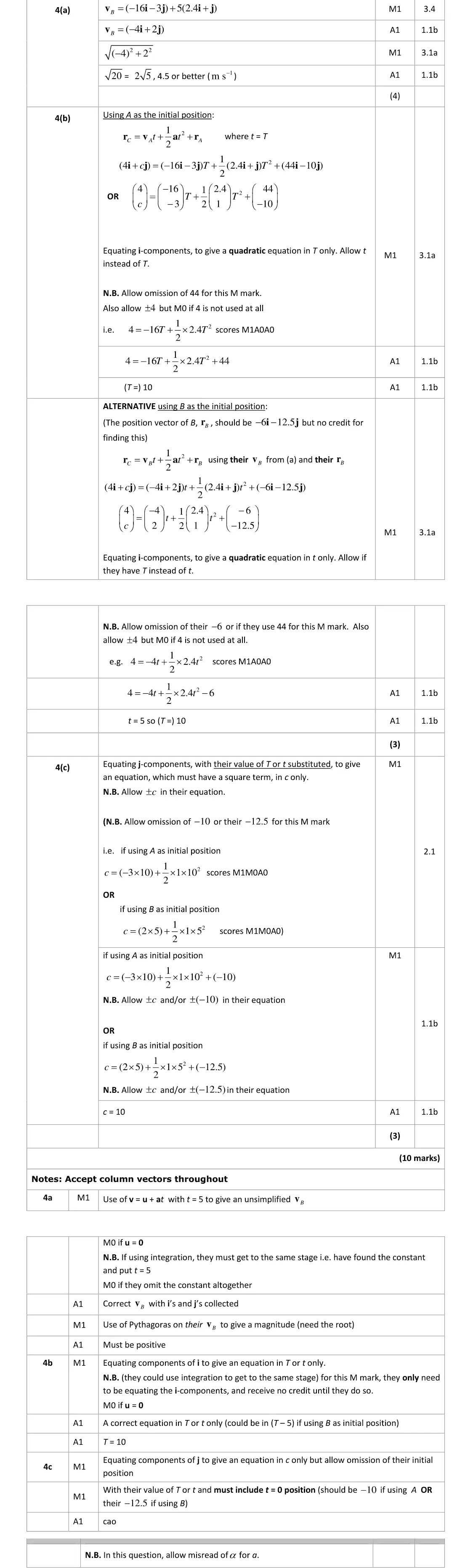
The first part was usually well attempted with most candidates scoring all four marks. The vast majority used v = u + at to find the velocity but a few lost the second two marks by not going on to find the magnitude of their velocity vector. Parts (b) and (c), however,
Common mistakes
v = u + at with t = 5 gives −4i + 2j
then the magnitude √20 = 4.47
stopping at the velocity vector loses the last two marks
June 2022 · AS Paper 1 · Q3(b)2 marks
Mark scheme (whole question; this part is marked with the orange bar)
Examiner's comment
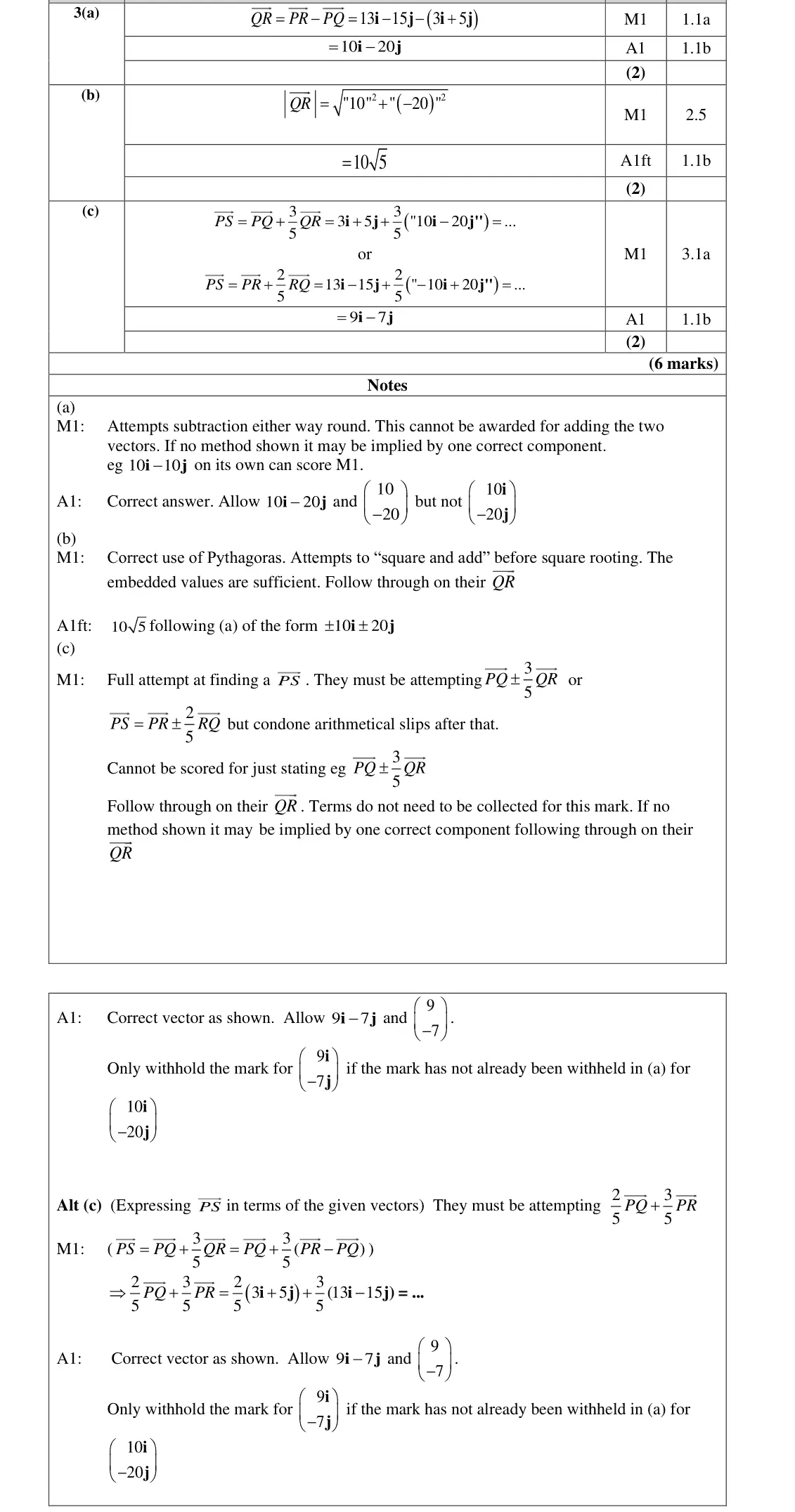
Many candidates tackled this question well, scoring full marks. Only a few made either no attempt or scored 0 for their efforts. The use of diagrams was widespread and seemed to aid those candidates in parts (a) and (c) to clarify their work. In part (b), the concept and calculation of the magnitude of a vector was clearly understood by the vast majority and this was evaluated with very few errors seen; the A mark was usually only being lost by candidates with a component error in (a). A minority of candidates attempted to construct a scale drawing: most of these were unsuccessful at providing sufficient evidence to score the method mark.
Common mistakes
square and add before square rooting
simplified surd 10√5
scale drawing is not a method
June 2022 · Paper 1 · Q9(a)2 marksHard
Mark scheme (whole question; this part is marked with the orange bar)
Examiner's comment
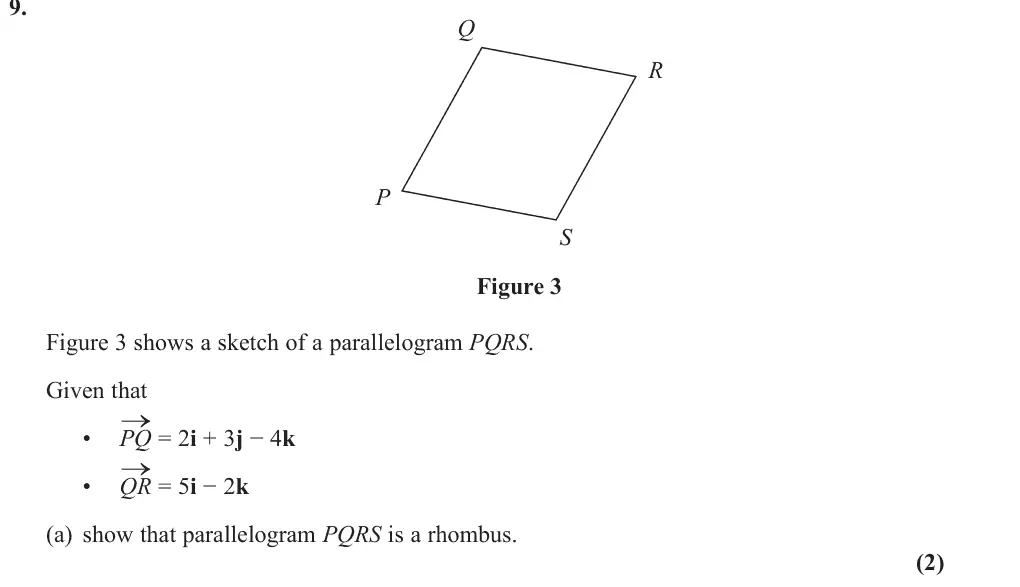
This vector question was set within the context of a rhombus. Surprisingly, many candidates were unable to use (or remember) the basic geometric of a rhombus and over 30% did not manage to make any progress. Part (a) required candidates to show that parallelogram PQRS was a rhombus. Although the requirement to 'show' is becoming more familiar to candidates, a significant number in this case didn't recognise the level of detail expected. So a lack of conclusion, or stating the sides were of length Ö29 without evidence of calculation, led to loss of credit. It was also necessary to conclude that the sides were equal, and not simply find the lengths and leave it to the reader to decide.
Common mistakes
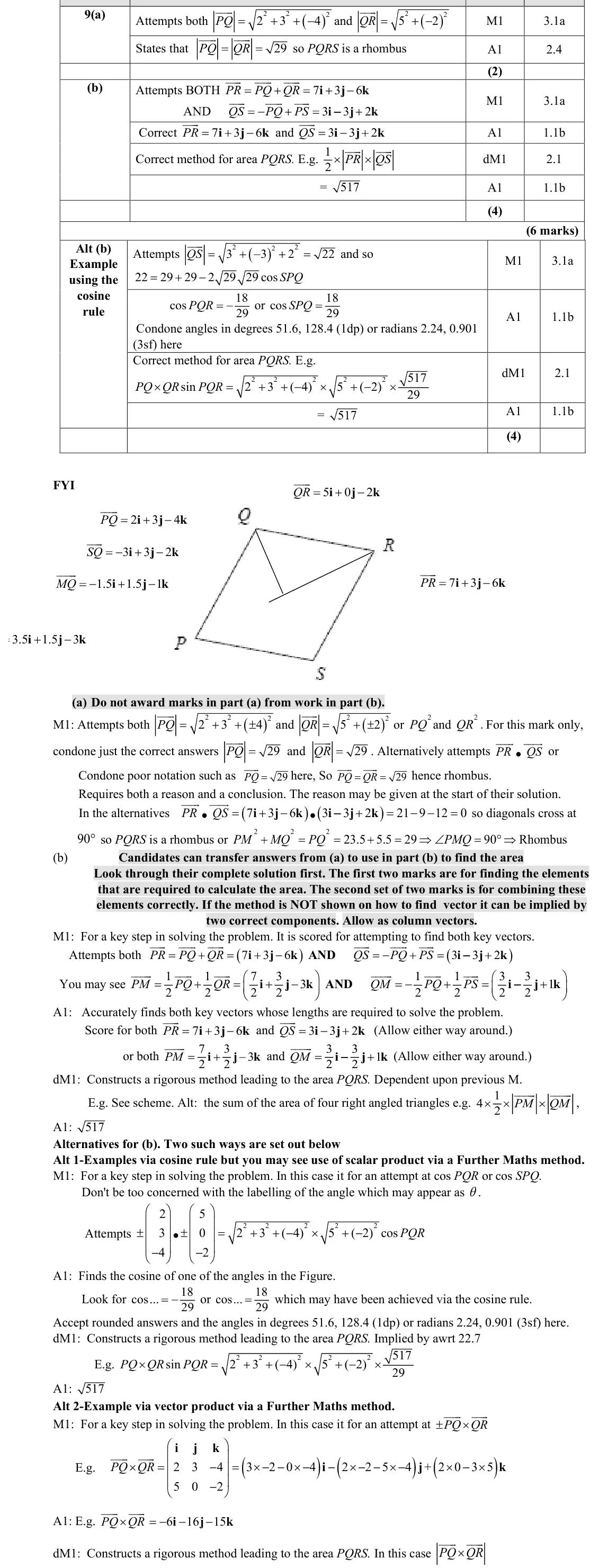
modulus of PQ = modulus of QR = √29 with calculations shown and conclusion "so rhombus"
adjacent sides equal
June 2022 · Paper 1 · Q9(b)4 marksHard
Mark scheme (whole question; this part is marked with the orange bar)
Examiner's comment
This vector question was set within the context of a rhombus. Surprisingly, many candidates were unable to use (or remember) the basic geometric of a rhombus and over 30% did not manage to make any progress. A vast array of approaches were in evidence in part (b) to find the area of the rhombus. The easiest and most direct approach was to find 1 2 PR QS x . A more common method used involved finding the length of one diagonal, followed by the cosine rule to find an internal angle and then use of the formula 'ab sin C '. Unfortunately most attempts using this method only scored 3 marks as it was usual for answers to be given as 22.7 rather than the one required, Ö517. Other methods seen involved use of Heron’s formula, the “shoelace” determinant method, scalar product and vector product….. with many successfully used. Students who added a “narrative” – so explaining what they attempted to do – were in a better position to gain credit if they suffered a processing error early in their solution. This has to be considered good practice. The most common incorrect solution, seen many times over was in stating area = 29 29 29 PQ PS x = x =
the cosine-rule/½ab sin C route often gave 22.7 not √517
over 30% made no progress
June 2022 · Paper 2 · Q13(b)3 marks
Mark scheme (whole question; this part is marked with the orange bar)
Examiner's comment
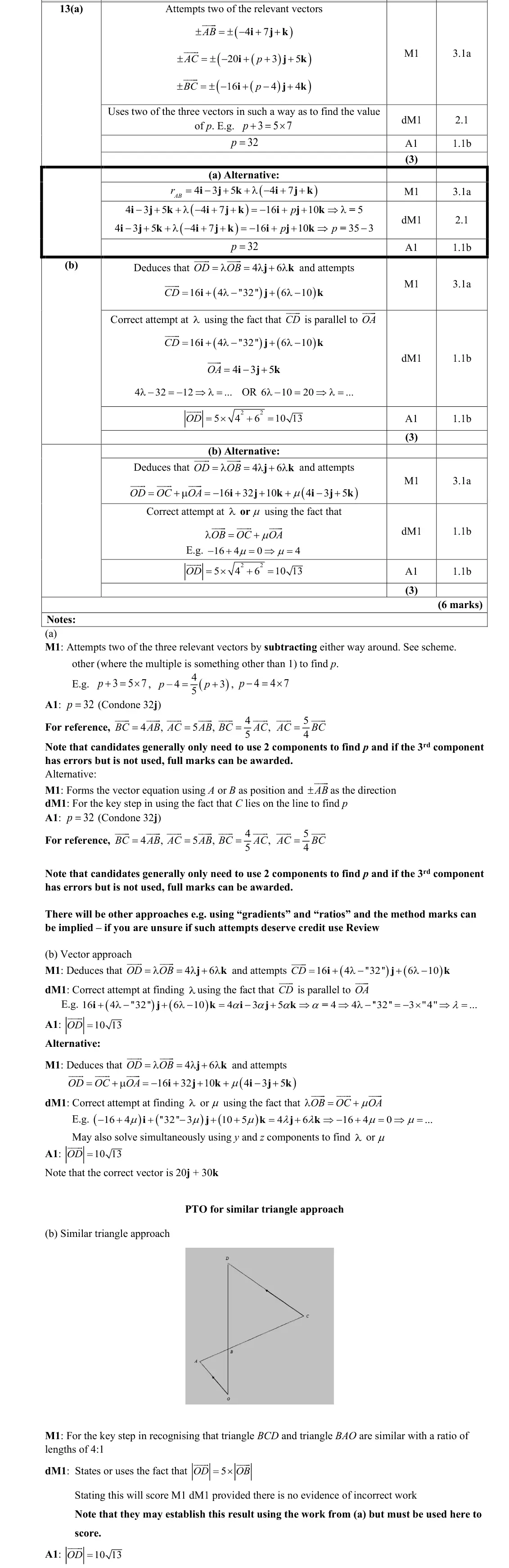
This question was a good differentiator, with the majority of candidates gaining some credit, but only the strongest achieving full marks. Overall, candidates often demonstrated good reasoning skills and were rewarded with good marks on this question but a significant number of candidates struggled with this topic. Throughout, methods of solution were many and varied, and often involved non vector approaches that were sometimes difficult to follow. Part (b) was found to be challenging by most candidates, with few gaining any marks and with many not attempting it. Many candidates again worked with magnitudes of vectors and made no progress. Those candidates who did gain credit usually used the fact that 𝑘𝑘𝑂𝑂𝑂𝑂 ሬሬሬሬሬ⃗-𝑂𝑂𝑂𝑂 ሬሬሬሬሬ⃗= ൭ 16 4𝑘𝑘-𝑝𝑝 6𝑘𝑘-10 ൱ was parallel to 𝑂𝑂𝑂𝑂 ሬሬሬሬሬ⃗ to find 𝑘𝑘= 5 giving 𝑂𝑂𝑂𝑂 ሬሬሬሬሬሬ⃗= ൭ 0 20 30 ൱. Many candidates failed to realise that 𝑂𝑂𝑂𝑂 ሬሬሬሬሬሬ⃗= 𝑘𝑘൭ 0 4 6 ൱, and made no progress, whilst others incorrectly assumed that ൭ 16 4𝑘𝑘-𝑝𝑝 6𝑘𝑘-10 ൱= 𝑂𝑂𝑂𝑂 ሬሬሬሬሬ⃗. Candidates often drew diagrams to visualise the problem but full marks in this part were rarely awarded. A significant number of candidates who had found the correct vector, failed to find its magnitude.
Common mistakes
OD = λOB and CD = OD − OC parallel to OA gives λ = 5, OD = 20j + 30k
modulus 10√13 (fully simplified)
CD is not equal to OA
many stopped at the vector
June 2022 · Paper 3 (Mechanics) · Q1(a)2 marks
Mark scheme (whole question; this part is marked with the orange bar)
Examiner's comment
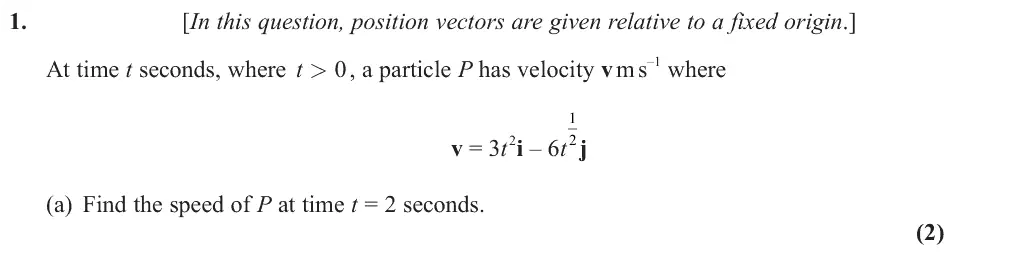
In part (a) most candidates correctly substituted t = 2 into the expression for the velocity and went on to use Pythagoras correctly to find an exact answer or an answer correct to the i and j and then finding 12-6 sqrt 2 rather than apply Pythagoras. A small number 2sf or better. Common mistakes were to stop once the velocity had been found, losing subtracted the squared values rather than adding in their Pythagoras. In the second part, most candidates identified that this was variable acceleration and differentiated correctly
Common mistakes
substitute t = 2 then use Pythagoras for speed (6√6, about 14.7)
stopping at the velocity vector
finding 12 − 6√2 instead of the magnitude
subtracting the squares
June 2022 · Paper 3 (Mechanics) · Q3(b)5 marks
Mark scheme (whole question; this part is marked with the orange bar)
Examiner's comment
answer. In the second part, many candidates were able to find the resultant force and acceleration vectors. Some candidates found the magnitude of the force or acceleration at this stage and proceeded correctly with suvat formulae from there, while others continued with vectors. A number of candidates did not identify the initial velocity as zero, reading back to the information given at the start of the question being important here, so failed to use suvat formulae correctly. Use of u = 3i + j was not uncommon. Although most used suvat formulae, some successfully integrated the constant acceleration to find the velocity and displacement vectors. The majority of candidates knew how to find the magnitude of a vector using Pythagoras. The most significant errors seen included finding the resultant force but then using it as a displacement or velocity, showing a lack of understanding of the situation. A small number of candidates found an incorrect value for mu when substituting λ and there was occasional use of only one of the forces.
Common mistakes
μ = 3 so resultant 6i + 2j and a = (6i + 2j)/4
u = 0 as P starts at rest (u = 3i + j is wrong)
using the force as a displacement
using only one force
AB = √160 = 4√10 ≈ 12.6 m
Oct 2021 · AS Paper 1 · Q4(b)3 marks
Mark scheme (whole question; this part is marked with the orange bar)
Examiner's comment
This question using vectors was generally well answered with most candidates scoring more than half of the marks available. In part (b) most candidates were able to find the vector AB and proceeded to find the magnitude of their vector. Some forgot to then find the speed by dividing by 9, whilst others omitted or gave the wrong unit, or just gave the generic units per second as their unit for speed.
Common mistakes
AB = √(36² + 15²) = 39 m
divide by the 4 seconds: speed 9.75 m s⁻¹
units required (not "units per second")
forgetting to divide by the time
Oct 2021 · Paper 1 · Q6(b)3 marks
Mark scheme (whole question; this part is marked with the orange bar)
Examiner's comment
This was another question where the modal mark was full marks, this time achieved by over 40% of the candidates Part (b) The vast majority of candidates made some progress in this part, realising that the lengths of the vectors would be required to solve this problem. A small minority then simply stopped, having done no more than finding the lengths of the sides of the triangle ABC, with some assuming that the triangle was right angled. However most then went on to use the cosine rule to try to show the required result. In almost all cases a correct cosine rule was stated and used, so that following on from a previous accuracy error, the method marks could be awarded. Fully correct calculations were necessary in order to gain the final accuracy mark and very many candidates managed to do this and so gained full marks for this question. A few candidates, presumably those who had studied further maths, used the scalar correct way around. Many using this method showed that cos ABC = - 9 product. This method would be perfectly acceptable, as long as the vectors are used the 10 but failed to explain why the answer should be positive.
Common mistakes
find magnitudes √50, √18, √14 and use the cosine rule with the sides in the right positions
scalar product (BA.BC, not AB.BC) gives −9/10 if the direction is wrong
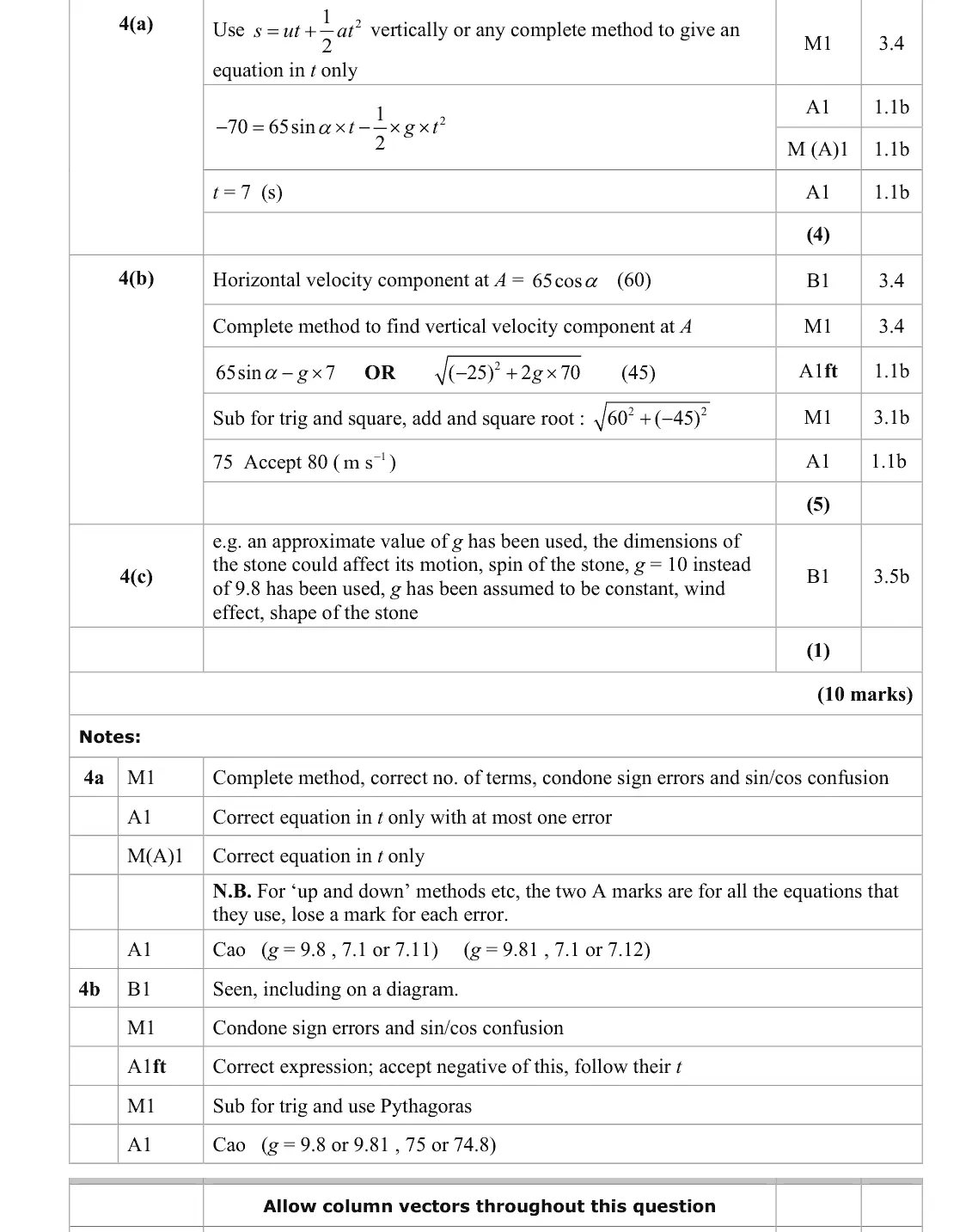
Oct 2021 · Paper 3 (Mechanics) · Q4(b)5 marks
Mark scheme (whole question; this part is marked with the orange bar)
Examiner's comment
Candidates were instructed to use g = 10 in this question but were only penalised once if candidates who used 𝑣𝑣2 = 𝑢𝑢2 + 2𝑎𝑎𝑎𝑎 to find the vertical component of velocity of the in 2/4 marks being scored for this part. A few candidates did not resolve the speed of 65 m s-. This lost the M mark and consequently they scored zero for part (a). In part (b), 1 particle at A were generally more successful than those who used the time found in part (a). Many solutions finished here and did not consider the need to look at the horizontal component as well. Those who had both components usually went on to apply Pythagoras theorem and calculate the actual speed of 75 m s-. For part (c), there were several 1
Common mistakes
need both components: horizontal 65 cos α = 60 (often omitted) and vertical 45 (v² = u² + 2as is more reliable than using t)
Pythagoras gives 75 m/s
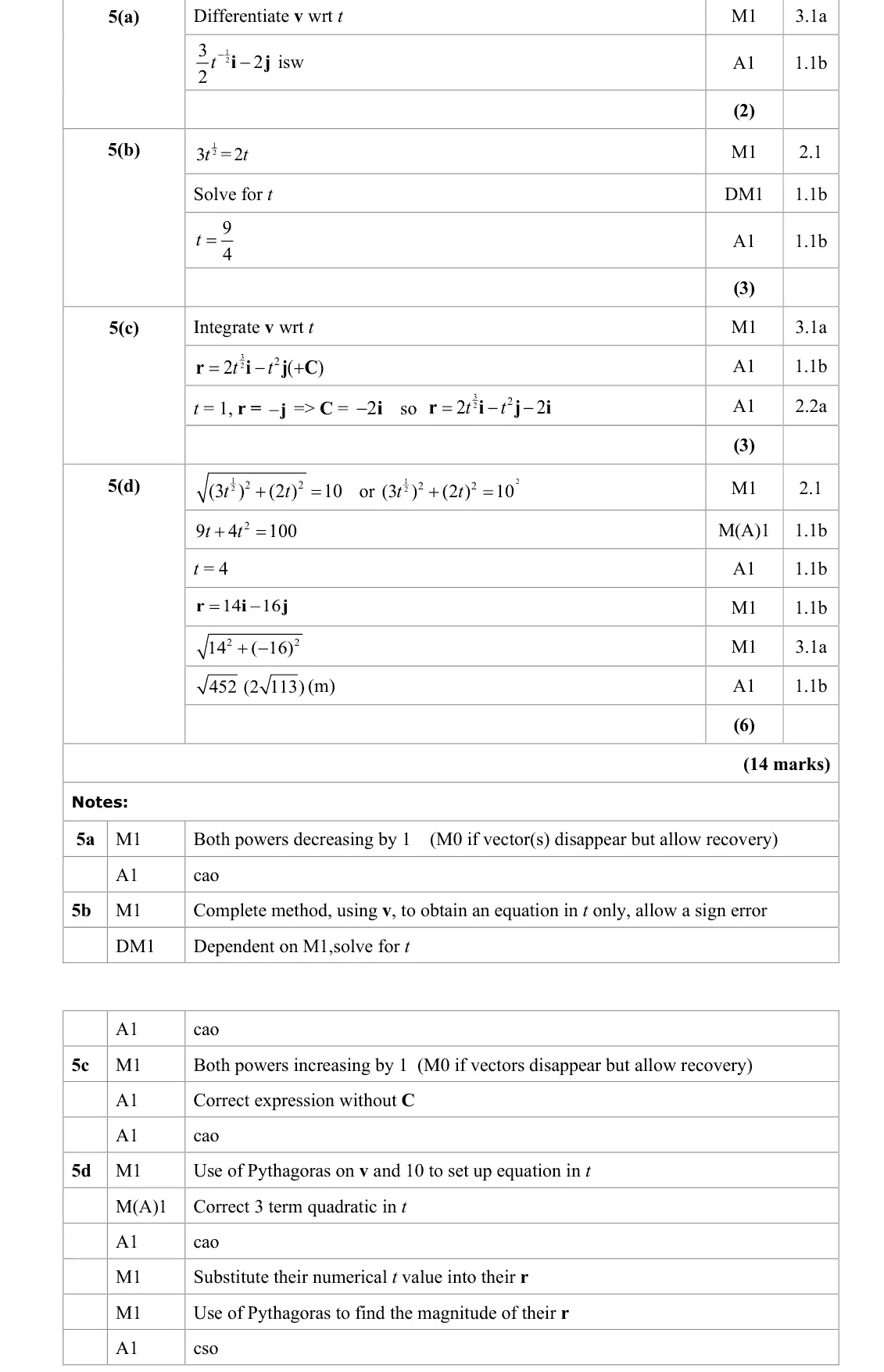
Oct 2021 · Paper 3 (Mechanics) · Q5(d)6 marks
Mark scheme (whole question; this part is marked with the orange bar)
Examiner's comment
acceleration formulae. Part (d) allowed those who had made little progress on the first 3 parts, to score some marks as it only required the use of the given velocity vector to get started. For those who attempted it, the use of Pythagoras’ theorem on the velocity components was very accessible and a number of candidates solved the quadratic to obtain t = 4. Sign errors here were common, however, with many ending up with a wrong t value. Some candidates then scored a further two M marks for substituting their value of t into their position vector and then applying Pythagoras to find the distance. The question required an exact distance and so only surd answers earned the final mark.
Common mistakes
speed 10 means 9t + 4t² = 100, t = 4 (sign errors common)
substitute into r: 14i − 16j
distance is the magnitude of r
exact answer 2√113 (√452), decimals lose the final mark
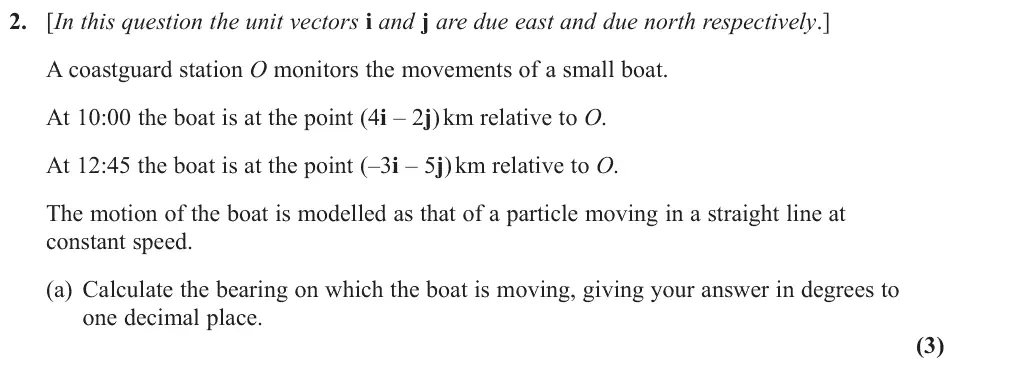
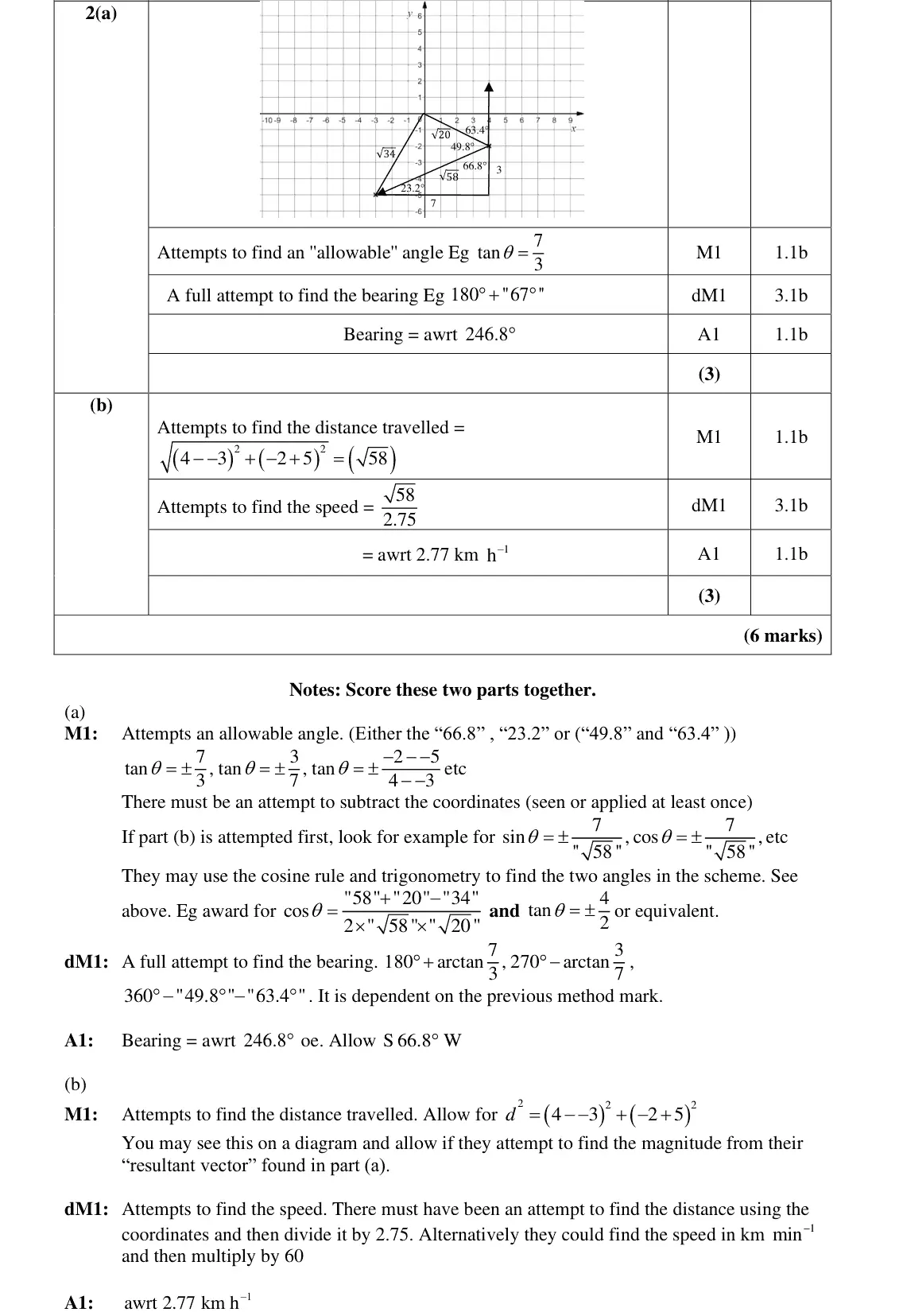
Oct 2020 · AS Paper 1 · Q2(a)3 marks
Mark scheme (whole question; this part is marked with the orange bar)
Examiner's comment
Candidates found the first part of this question challenging, but they were more successful with the second part, with many fully correct responses. There were a number of common mistakes in candidates’ approaches to part (a). Firstly, many candidates tried to find the resultant vector by adding the two given vectors, rather than subtracting them. Secondly, candidates seemed unclear on exactly what angle the question was looking for, with lots of time being spent on finding various different (but unfortunately not relevant) angles in their diagrams. Finally, some candidates took a rather long-winded 4 approach to find the correct angles (through use of the cosine rule to find one part of the required answer, then additional work using tan) as they had not spotted the more straightforward use of 7 arctan 3 . Even those who found a relevant angle were often unable to proceed to find a bearing.
Common mistakes
displacement is (−3i − 5j) − (4i − 2j) = −7i − 3j (subtract, not add)
find the right angle (arctan 7/3) and convert to a bearing 180° + 66.8° = 246.8°
Oct 2020 · AS Paper 1 · Q2(b)3 marks
Mark scheme (whole question; this part is marked with the orange bar)
Examiner's comment
Candidates found the first part of this question challenging, but they were more successful with the second part, with many fully correct responses. Part (b) was generally answered successfully, with a few candidates mistakenly stating that 2 hours and 45 minutes was equal to 2.45 hours, rather than 2.75 hours.
Common mistakes
distance √58 km
time 2 h 45 min = 2.75 h, not 2.45 h
speed ≈ 2.77 km/h
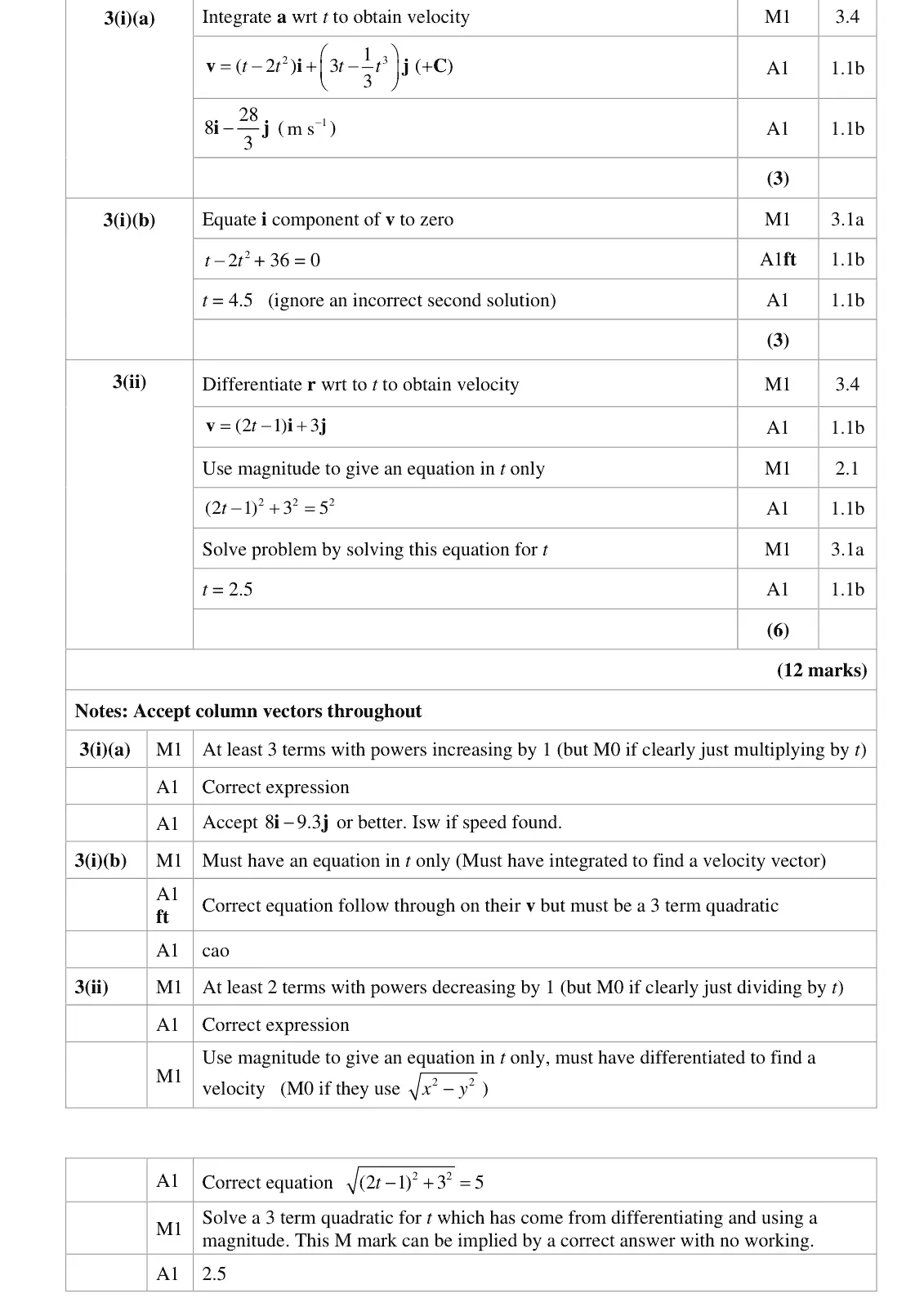
Oct 2020 · Paper 3 (Mechanics) · Q3(ii)6 marks
Mark scheme (whole question; this part is marked with the orange bar)
Examiner's comment
Part (i) involved variable acceleration but a significant minority of candidates tried to apply suvat equations and so achieved no credit. In part (i)(a), many did complete the required integration to find an expression for v and substitute t = 4; a fair number of correct answers were seen with the main errors either being numerical slips or neglecting to include the constant, 36i. In part (i)(b), candidates needed to realise that moving perpendicular to i implies the i component of v is zero; those who equated the j components to zero achieved no marks. Occasionally the i and j components were equated and some candidates did not know how to proceed at all. Some focussed on the displacement vector. Those who knew what to do generally obtained the correct answer. Part (ii) was generally found more accessible and many of the candidates who had used suvat in (i) now realised that they had to differentiate here to find the velocity. Most knew how to use the given speed to create an equation in t, although a few just tried to equate their vector to 5 and then either gave up or just dropped the i and j. A fair number achieved full marks for this part of the question.
Common mistakes
differentiate r to get v = (2t − 1)i + 3j
speed is the magnitude: (2t − 1)² + 3² = 5² gives t = 2.5
equating the vector to 5 or dropping i and j is wrong
not √(x² − y²)
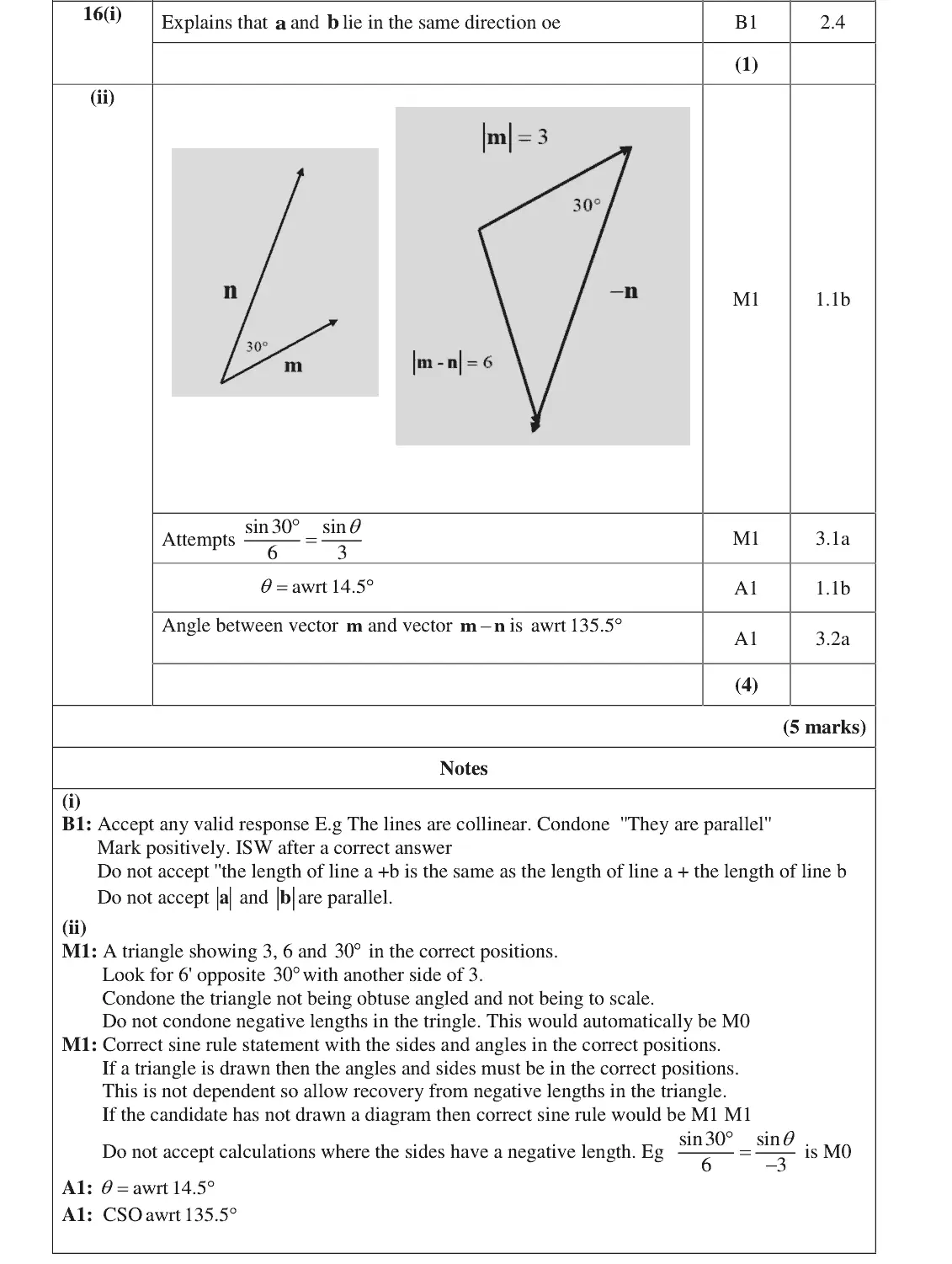
June 2019 · AS Paper 1 · Q16(i)1 markHard
Mark scheme (whole question; this part is marked with the orange bar)
Examiner's comment
This was a poorly answered question at all levels. In part (a) it was expected that candidates would recognise the fact that the vectors would need to lie in the same direction but many attempted to write out the given expression in words. There was slightly more success in part (b) with most attempting a diagram of sorts to get a feel for the problem. Unfortunately a lack of understanding of vectors 6 m-n 3 n 3 m meant that and was usually followed by . There were however, some excellent and well thought out solutions showing a full understanding of the question,
Common mistakes
a and b are parallel and in the same direction
do not just restate the equation in words
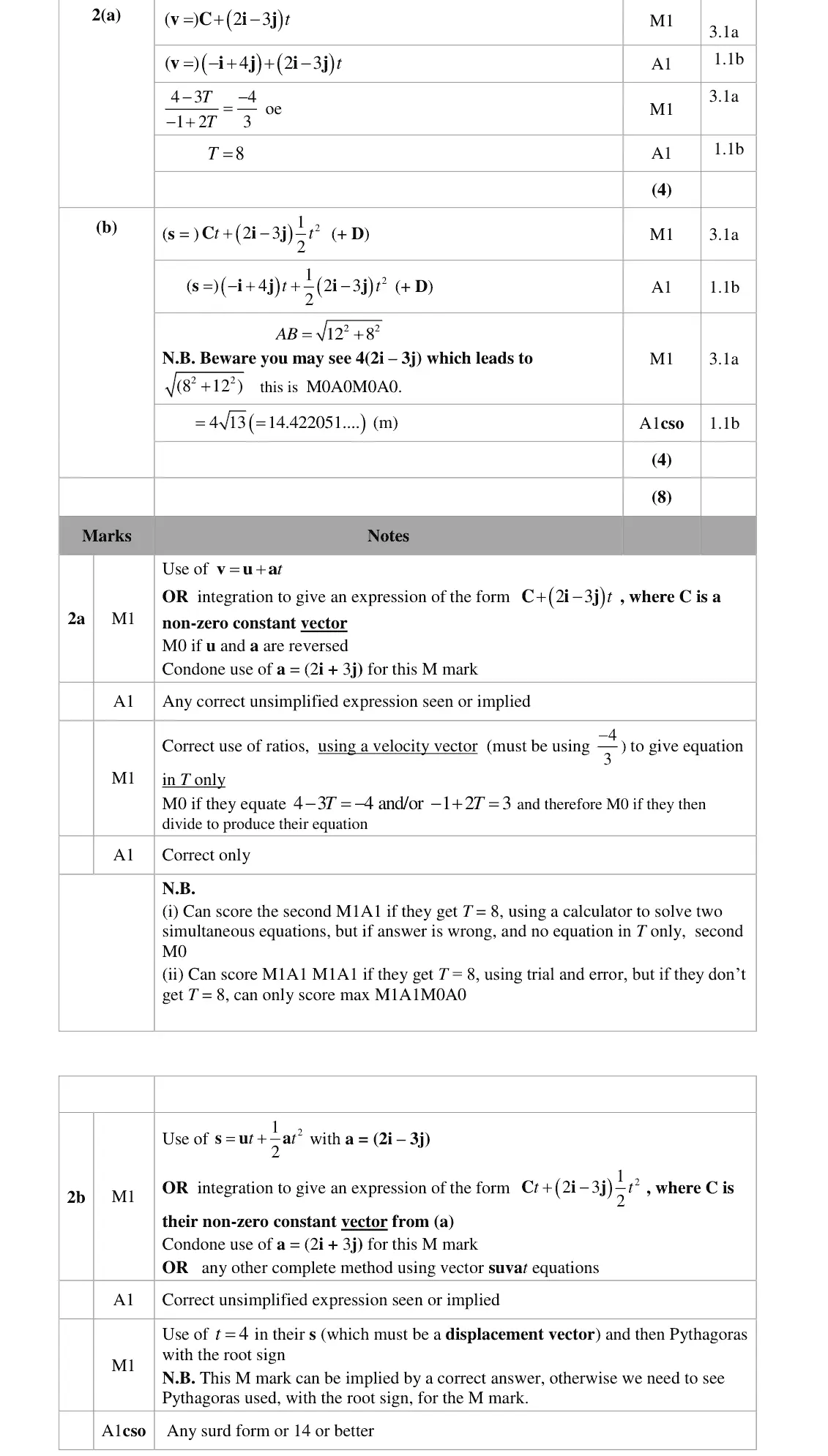
June 2019 · Paper 3 (Mechanics) · Q2(b)4 marks
Mark scheme (whole question; this part is marked with the orange bar)
Examiner's comment
displacement vector showing a lack of understanding of the situation. The second part was generally handled more successfully with many correct answers seen for the displacement vector (using s = ut 1 2 at2) although not all proceeded to find the distance by calculating its magnitude. Although most used + suvat formulae throughout the question, some successfully integrated the given constant acceleration to find the velocity and displacement. Use of magnitudes of vectors throughout and some invalid multiplication/division of vectors were seen on occasion.
Common mistakes
s = ut + ½at² with u = −i + 4j and t = 4 gives 12i − 8j
distance is its magnitude 4√13 ≈ 14.4 m
4(2i − 3j) is not the displacement
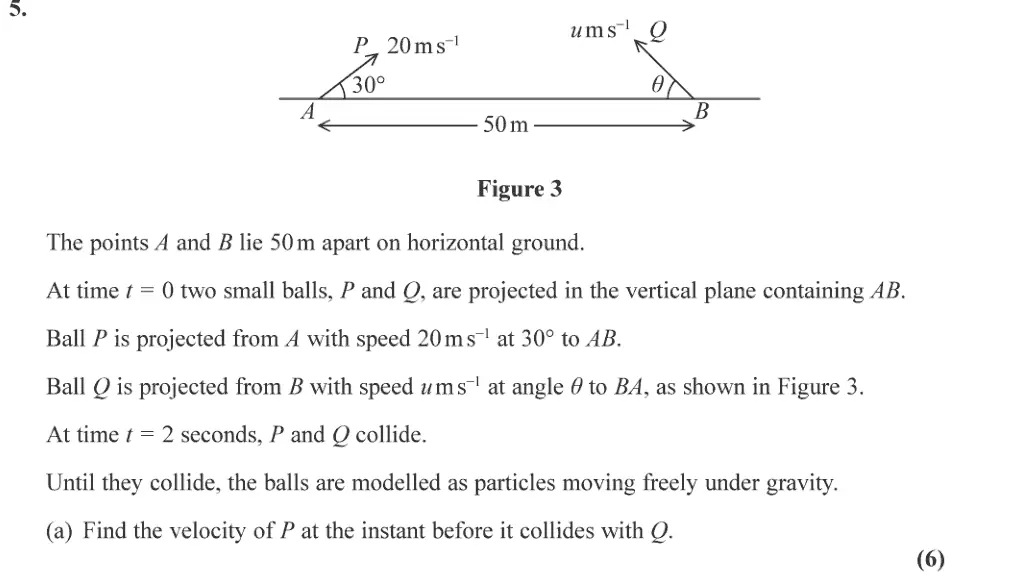
June 2019 · Paper 3 (Mechanics) · Q5(a)6 marks
Mark scheme (whole question; this part is marked with the orange bar)
Examiner's comment
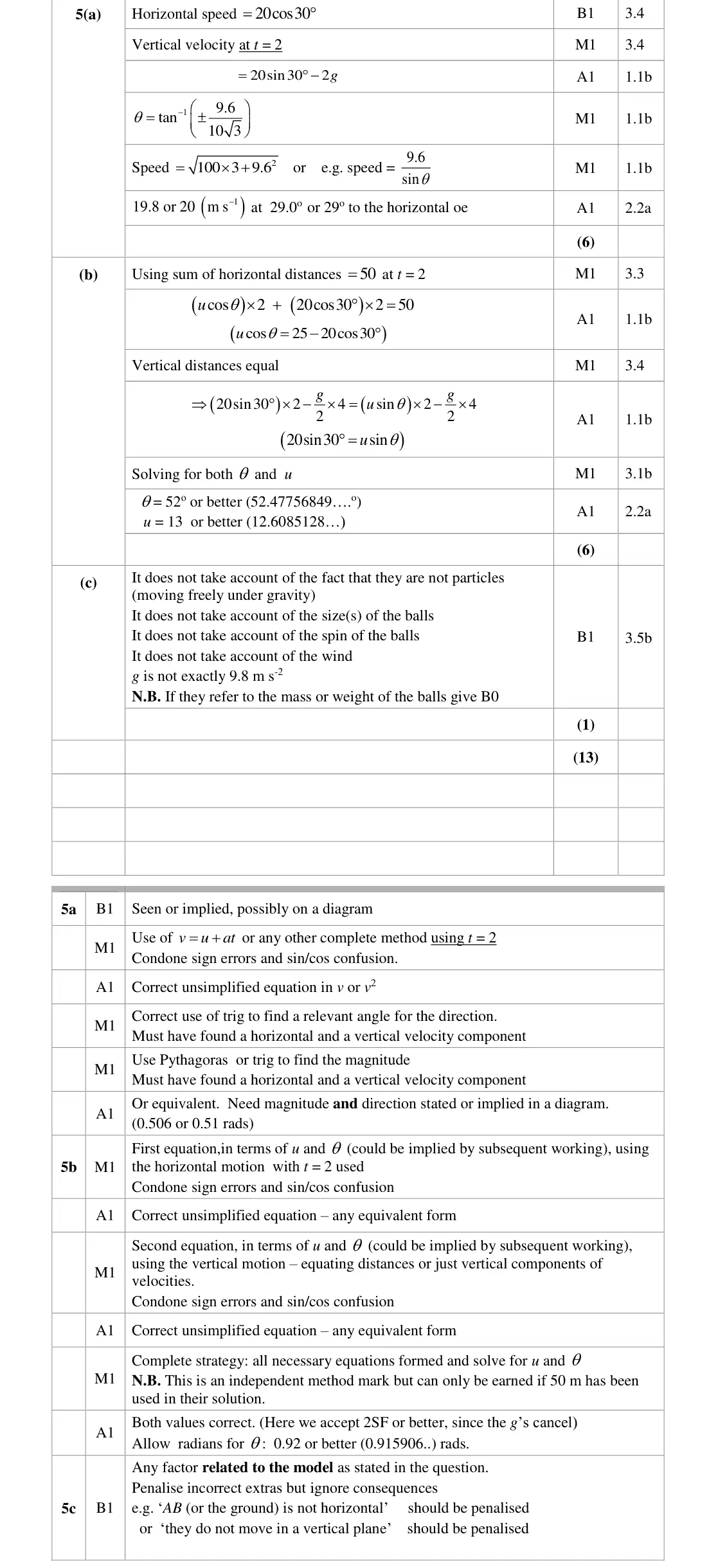
In part (a), the majority of candidates obtained the first mark for the horizontal component and most candidates also made a good attempt to find the vertical component, although sometimes it was seen as part of their working for part (b). Of those who found the horizontal and vertical components of the
need both speed (19.8 m/s) and direction (29° below horizontal)
do not give the answer in i and j (not defined)
June 2018 · AS Paper 1 · Q3(b)2 marks
Mark scheme (whole question; this part is marked with the orange bar)
Examiner's comment
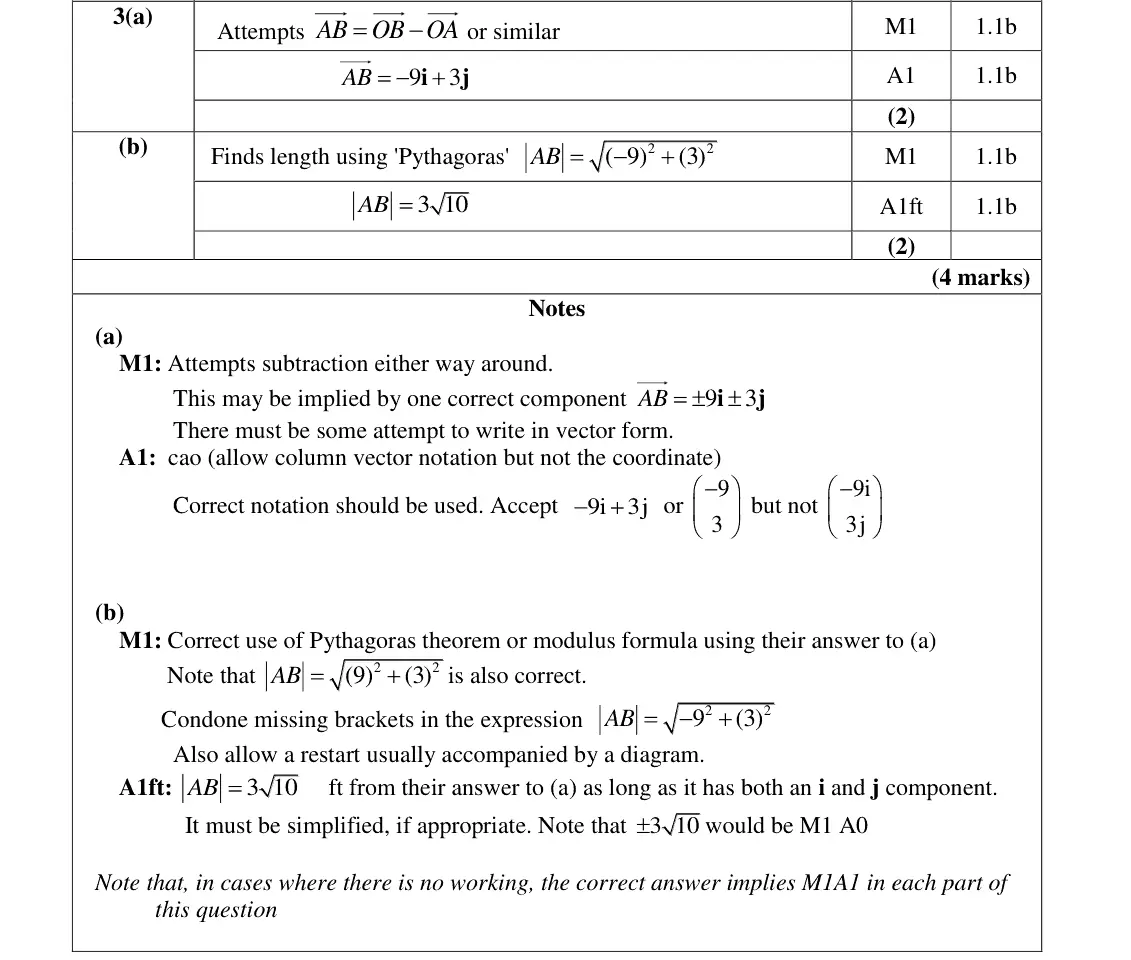
This question was very accessible to the vast majority of students with many scoring full marks. Part (b) was more successful with the vast majority of students knowing how to calculate the length of a vector and simplify the surd. A follow through on their vector from part (a) enabled most students access to both marks.
Common mistakes
modulus √((−9)² + 3²) = √90 = 3√10 as a simplified surd
±3√10 loses the A mark
June 2018 · Paper 2 · Q2(b)3 marks
Mark scheme (whole question; this part is marked with the orange bar)
Examiner's comment
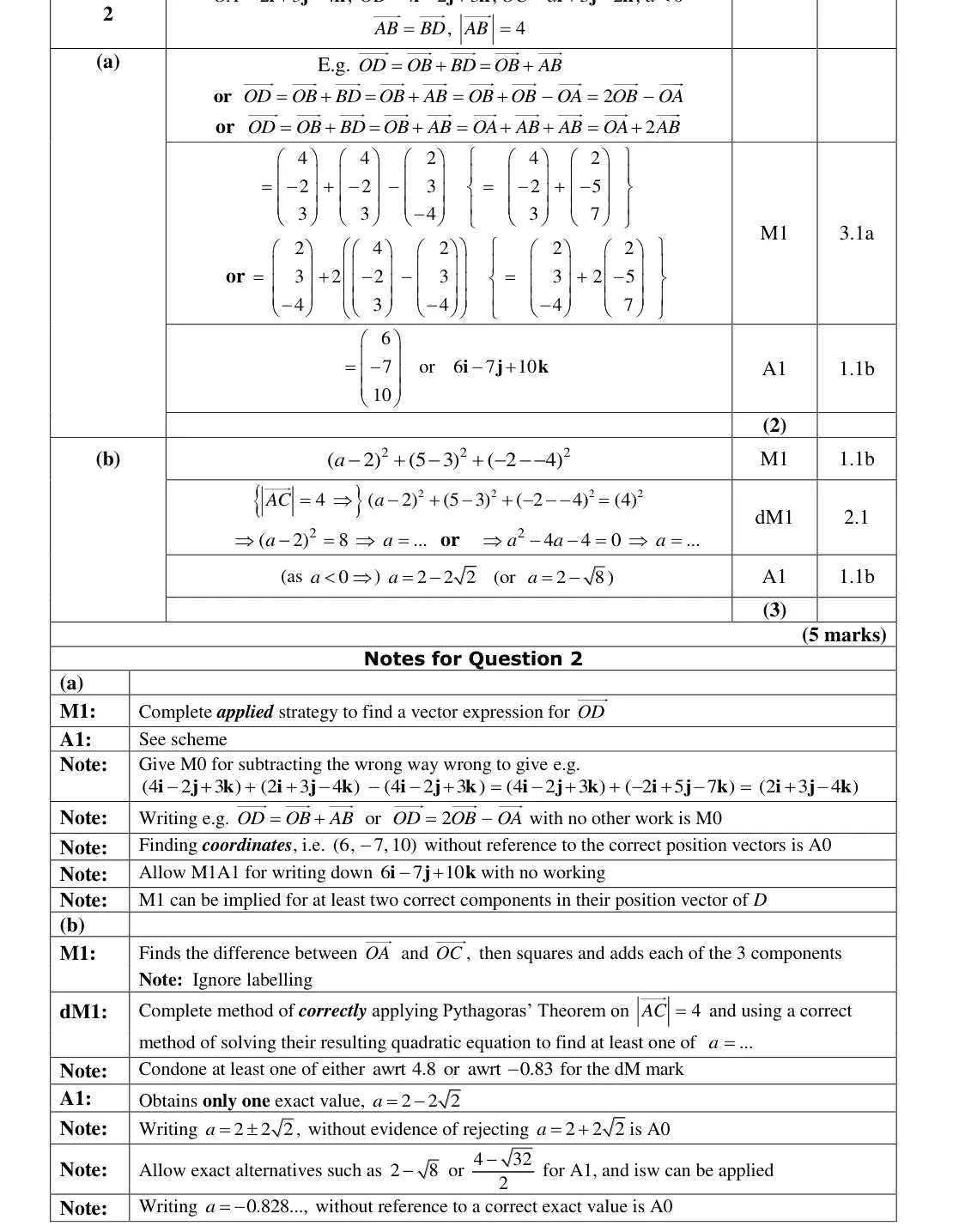
This was a well-answered question with most students scoring at least 4 of the 5 marks available. In part (b), most students found the difference between OC and , OA and applied Pythagoras’ Theorem to 4 AC to give the correct 2 2 2 2 ( 2) (2) (2) (4) . a The resulting quadratic equation was generally solved correctly but not always efficiently. Too often, students expanded to form a 3-term quadratic rather than spotting that their quadratic was already in a ‘completed square’ form. Despite the question stating that 0, a some students gave both solutions 2 2 2 a as their final answer, while others mistakenly rejected 2 2 2 a to leave 2 2 2. a
Common mistakes
AC = OC − OA
(a − 2)² + 2² + 2² = 16 is already completed-square form, (a − 2)² = 8
reject 2 + 2√2 because a < 0, answer a = 2 − 2√2
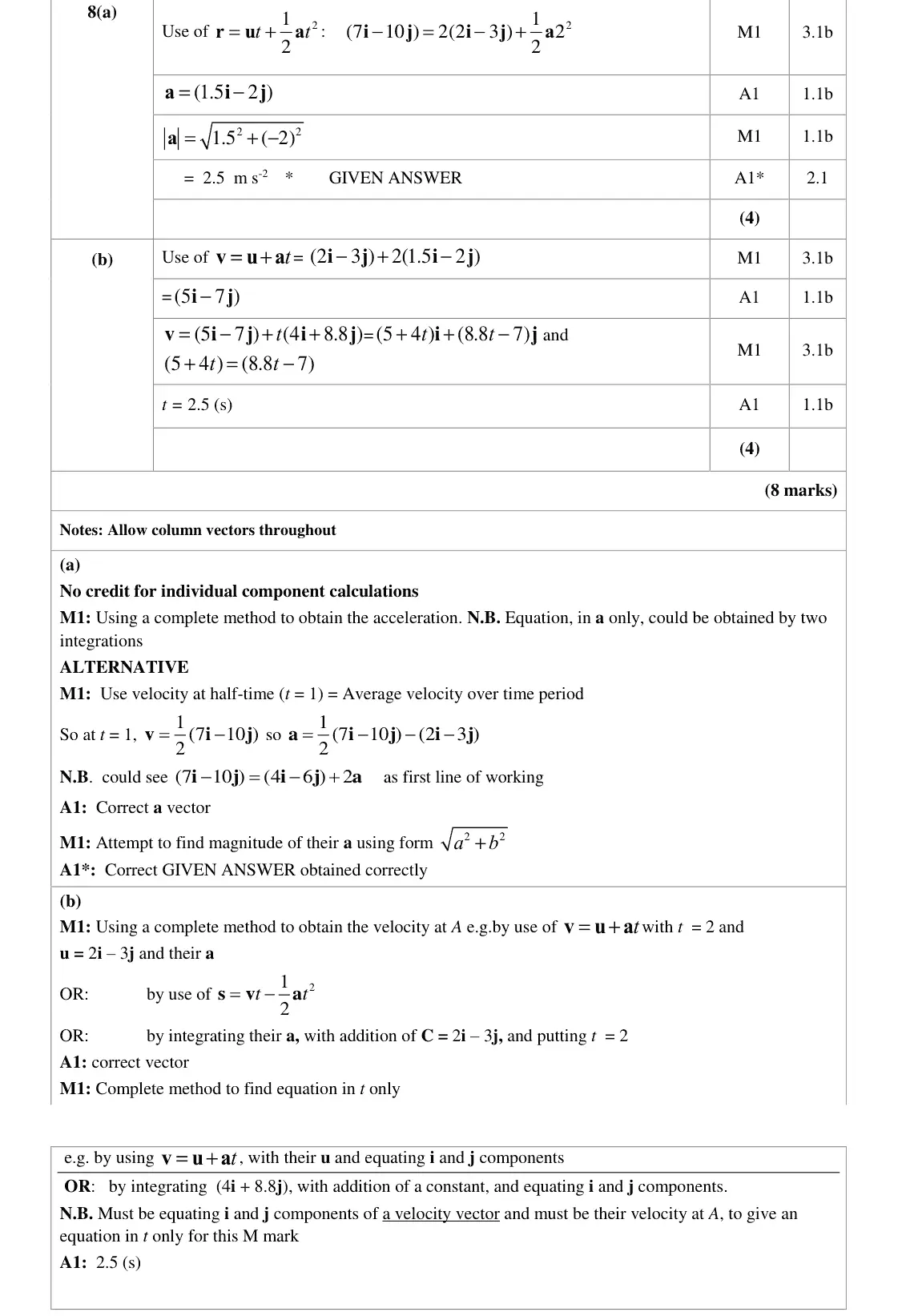
June 2018 · Paper 3 · Q8(a)4 marks
Mark scheme (whole question; this part is marked with the orange bar)
Examiner's comment
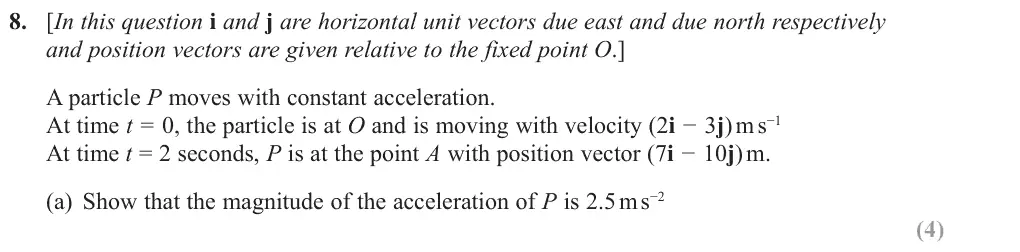
The first part was generally well done with most students using a constant acceleration formula in 1 2 at2) to find a, using the given velocity and position vectors. The few who chose to vectors (r = ut + integrate a constant acceleration vector, and then use the given information to identify the constants of integration, mostly did so successfully. The magnitude of a was almost invariably calculated correctly but, since the answer was given, it was important that there was some working shown. Those who had no valid method for finding a tended to achieve the method mark for calculating the magnitude of their vector. A small minority of students attempted to apply suvat equations to the magnitudes of the given vectors; by chance this led to an answer which rounded to the given 2.5 m s-2. However, such attempts achieved no credit.
Common mistakes
r = ut + ½at² in vector form gives a = 1.5i − 2j, magnitude 2.5
no credit for suvat on the magnitudes or separate components
Find an Edexcel maths tutor
Stuck on this? Book a trial session with an Edexcel specialist.