Mark scheme (whole question; this part is marked with the orange bar)
Examiner's comment
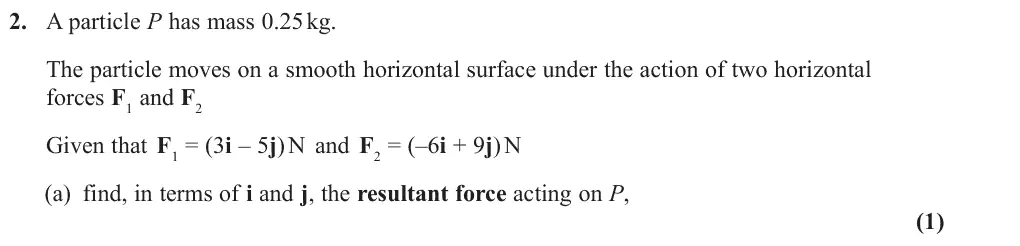
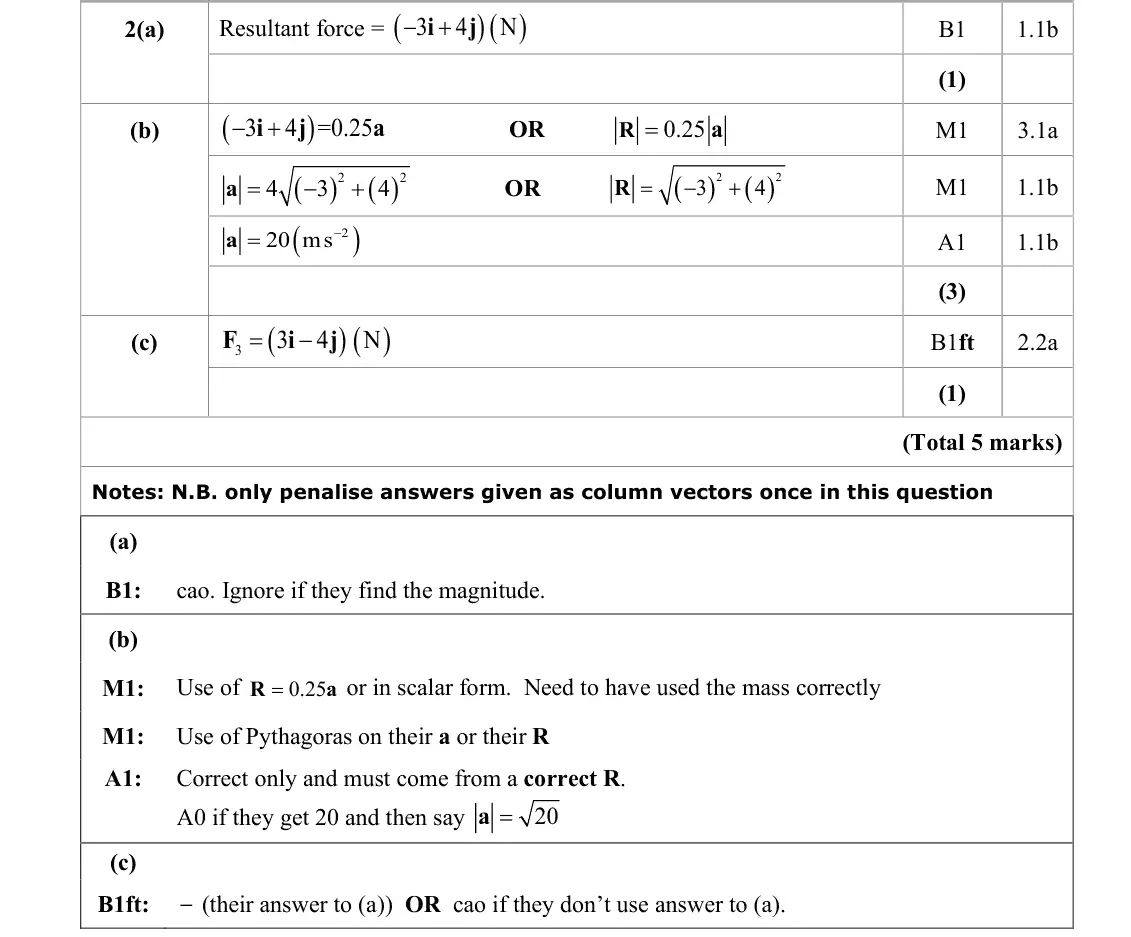
Part (a) was mostly correctly answered, but some candidates were confused as to whether to add or subtract the forces, with 9i + 14j being the most common incorrect answer. This was usually carried through to part (b) but then often replaced in part (c) with the correct answer of 3i – 4j. Many candidiates worked with column vectors but most gave the answer in the required format. Very occasionally the answer was seen in (xi, yj) format or the column vector form of this.
Common mistakes
add the force vectors: (−3i + 4j) N
9i + 14j (subtracting) was the most common error
answer must be in i, j form
June 2025 · AS Paper 2 (Mechanics) · Q2(c)1 mark
Mark scheme (whole question; this part is marked with the orange bar)
Examiner's comment
Part (c) not always correct even if the rest of the question was and often left blank. There was the occasional correct follow through from part (a).
Common mistakes
constant velocity means the resultant force is zero (Newton's first law), so F3 = −(their (a)) = (3i − 4j) N
often left blank
June 2025 · AS Paper 2 (Mechanics) · Q3(d)2 marks
Mark scheme (whole question; this part is marked with the orange bar)
Examiner's comment
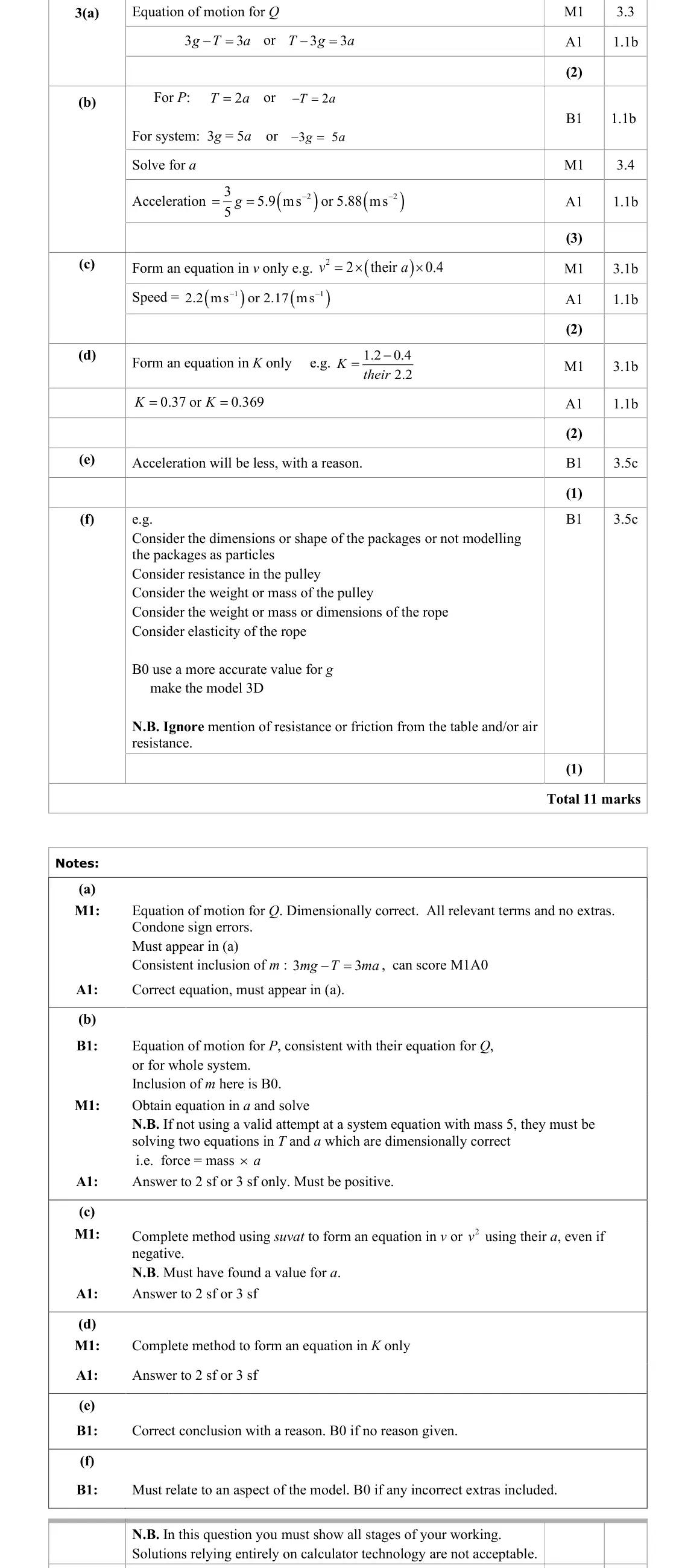
Part (d) required finding the time taken by P to move across the table to the pulley once Q had hit the ground. This proved to be the most challenging part on the paper and few valid approaches were seen. A significant number used the acceleration from the first stage of the motion, or even g, in a suvat equation without realising that P would now travel with constant velocity since the table was modelled as smooth and there was no longer a tension acting. Other common errors seen were to use the distance as 1.2 m, 0.4 m or even 1.6 m rather than 0.8 m. This again showed a lack of appreciation of the mechanics of the situation.
Common mistakes
after Q hits the floor the rope is slack and the table smooth, so P moves at constant speed 2.17 m/s for 1.2 − 0.4 = 0.8 m: K = 0.8/2.17 = 0.37
common errors: using the earlier acceleration or g, distance 1.2, 0.4 or 1.6 m
hardest part on the paper
June 2025 · AS Paper 2 (Mechanics) · Q3(f)1 mark
Mark scheme (whole question; this part is marked with the orange bar)
Examiner's comment
Again, part (f) was generally answered well. The assumptions of the model were clearly stated as bullet points in the question. To gain credit, any suggested refinement had to relate specifically to one of those, and common valid responses included considering the mass of the ropes or modelling the particles with dimensions. Using a more accurate value for g was not credited as it was not a given modelling assumption. A further refinement was required so including resistance/friction or air resistance also did not gain the mark.
Common mistakes
refine one of the listed assumptions: packages not particles (dimensions), mass/weight or friction of the pulley, mass or elasticity of the rope
a more accurate g, "make it 3D", or air resistance/table friction are not credited
June 2025 · Paper 3 (Mechanics) · Q1(b)2 marks
Mark scheme (whole question; this part is marked with the orange bar)
Examiner's comment
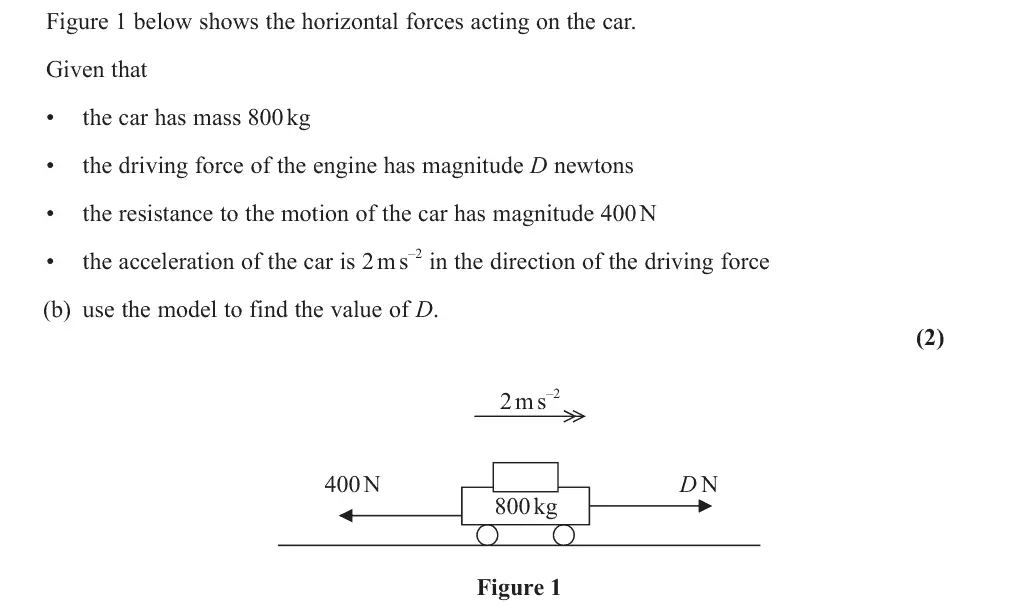
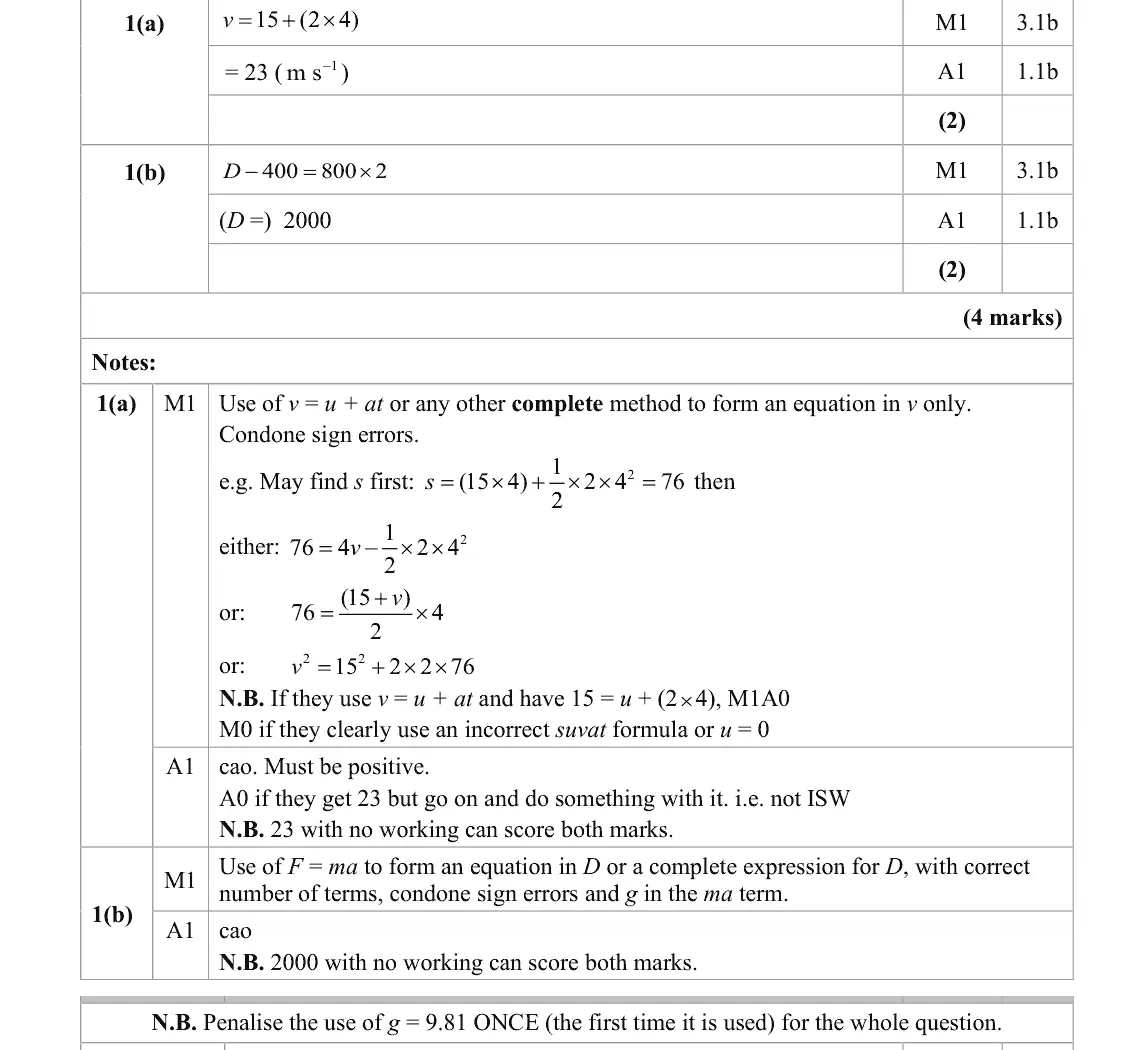
In part (b), most responses scored both marks by correctly finding the value of the driving force of the engine. Many started by quoting F = ma and working with a complete equation. These responses were generally successful, although some made an arithmetic slip when rearranging their formula to make D the subject. Others did not start by formally stating the equation but approached it in a fragmented manner. These responses were far more likely to demonstrate the common error of subtracting the 400 N force from their ‘ma’ term instead of adding it, leading to an incorrect answer of 1200 N. A few responses included g with the mass of 800 in their calculations possibly due to confusion of mass and weight.
Common mistakes
form the full equation D − 400 = 800 × 2 first
common error 1200 (subtracting 400 instead of adding)
mass not weight, no g in the ma term
June 2025 · Paper 3 (Mechanics) · Q2(a)3 marks
Mark scheme (whole question; this part is marked with the orange bar)
Examiner's comment
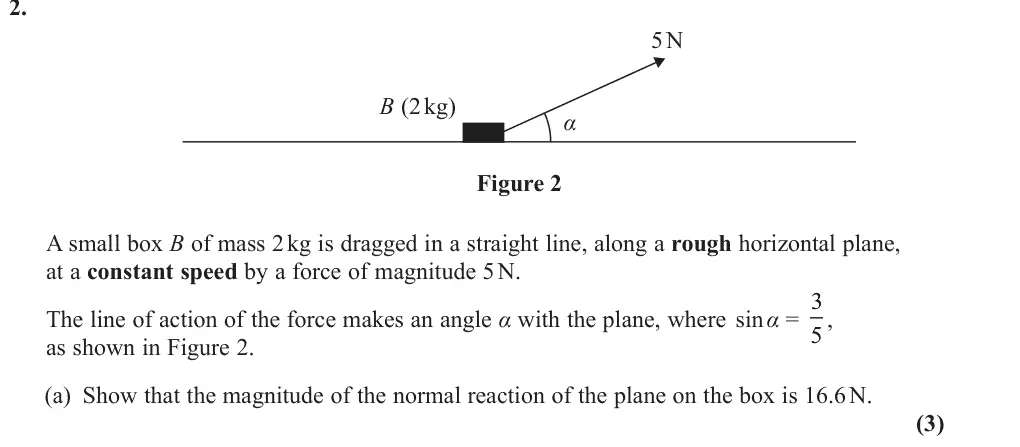
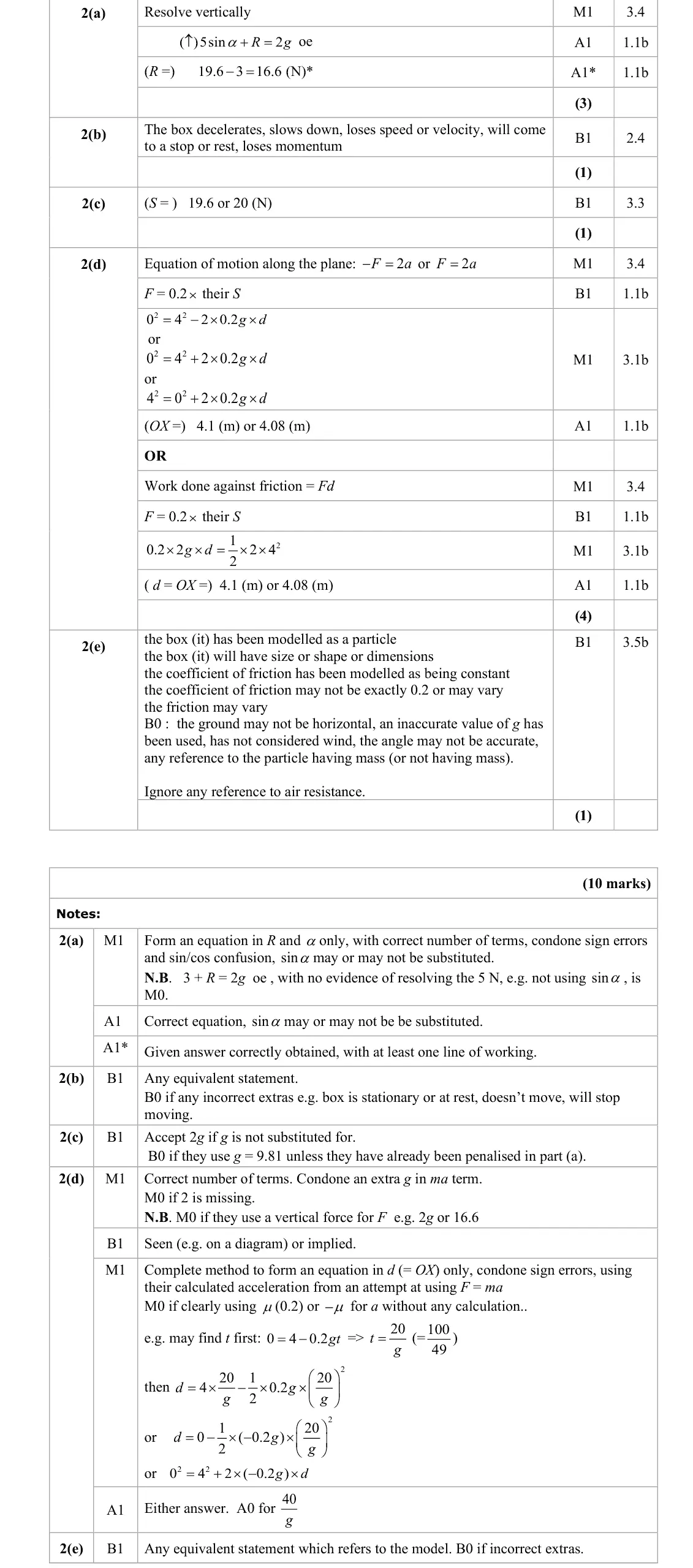
Part (a) was generally well done with some making good use of the diagram. After identifying the three forces, successful responses resolved vertically to form an equation with the vertical component of 5 N clearly found. This was a ‘Show that…’ question and so those who just wrote ‘3’ down, with no supporting evidence of how it had been obtained, received no reward. Very occasionally cosine was used instead of sine and a few learners used the value of g as 9.81, which meant that the accuracy mark was not awarded.
Common mistakes
resolve vertically: 5 sin α + R = 2g
the vertical component 5 × 3/5 = 3 must be shown, just writing 3 scores nothing
sin/cos confusion
g = 9.8 not 9.81
June 2025 · Paper 3 (Mechanics) · Q2(b)1 mark
Mark scheme (whole question; this part is marked with the orange bar)
Examiner's comment
In part (b), most responses gave a good description of the motion ‘as decelerating to a stop or slowing down’. However, a significant number thought that the box would stop immediately or continue at a constant speed.
Common mistakes
the box decelerates to rest (friction still acts)
wrong: stops immediately or continues at constant speed
any incorrect extra loses the mark
June 2025 · Paper 3 (Mechanics) · Q2(c)1 mark
Mark scheme (whole question; this part is marked with the orange bar)
Examiner's comment
Part (c) was well answered and the correct result of 2g or 19.6 (N) was stated for the magnitude of the reaction once the force of 5 N had been removed. Common incorrect answers were 2 or 16.6.
Common mistakes
R = 2g = 19.6 N once the 5 N force is removed
common wrong answers 2 and 16.6
June 2024 · AS Paper 2 (Mechanics) · Q4(e)2 marks
Mark scheme (whole question; this part is marked with the orange bar)
Examiner's comment
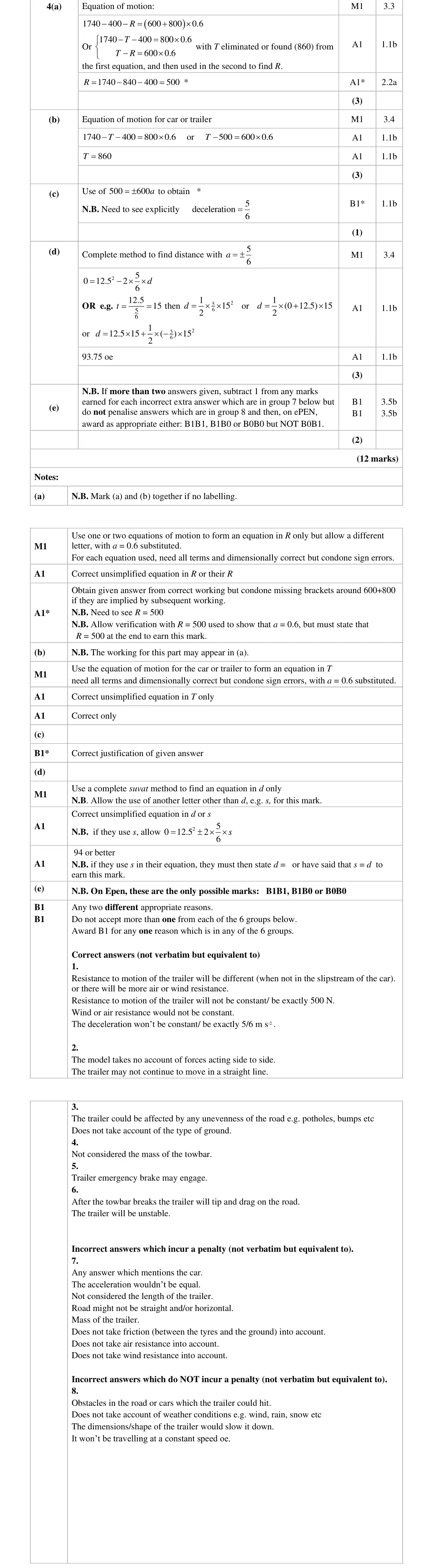
In part (e), it was fairly rare to see two acceptable correct reasons for why the distance was likely to be different from that calculated. Many scored one mark for ‘resistance unlikely to be constant’ or ‘deceleration not constant’; however, these are not independent factors, so they were not credited as different reasons. Other common correct responses included that the mass of the broken tow bar was not considered, and the trailer would be unbalanced. The most common incorrect responses involved claiming that the model did not consider friction or air resistance. Also, some explanations included the car whereas this part was specifically about the trailer. It should be remembered that two reasons were asked for and if a candidate listed more than two then incorrect extra answers were penalised.
Common mistakes
two different reasons: resistance not constant (or more air resistance out of the car's slipstream), mass of the towbar ignored, trailer may not travel in a straight line, uneven road, trailer unstable/tips
"resistance not constant" and "deceleration not constant" count as one reason
answers about the car or "model ignores friction/air resistance" are wrong
extra wrong answers are penalised
June 2024 · Paper 3 (Mechanics) · Q1(a)1 mark
Mark scheme (whole question; this part is marked with the orange bar)
Examiner's comment
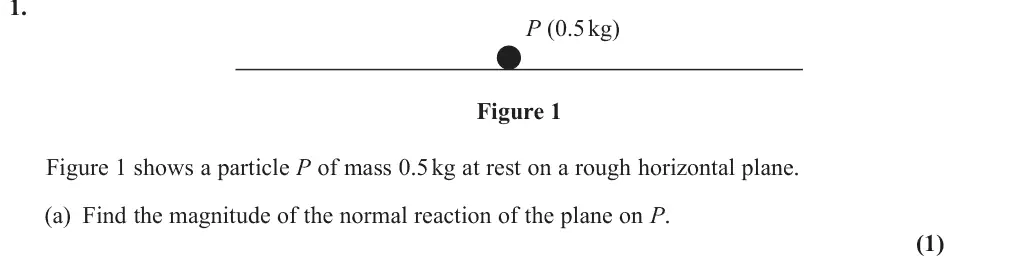
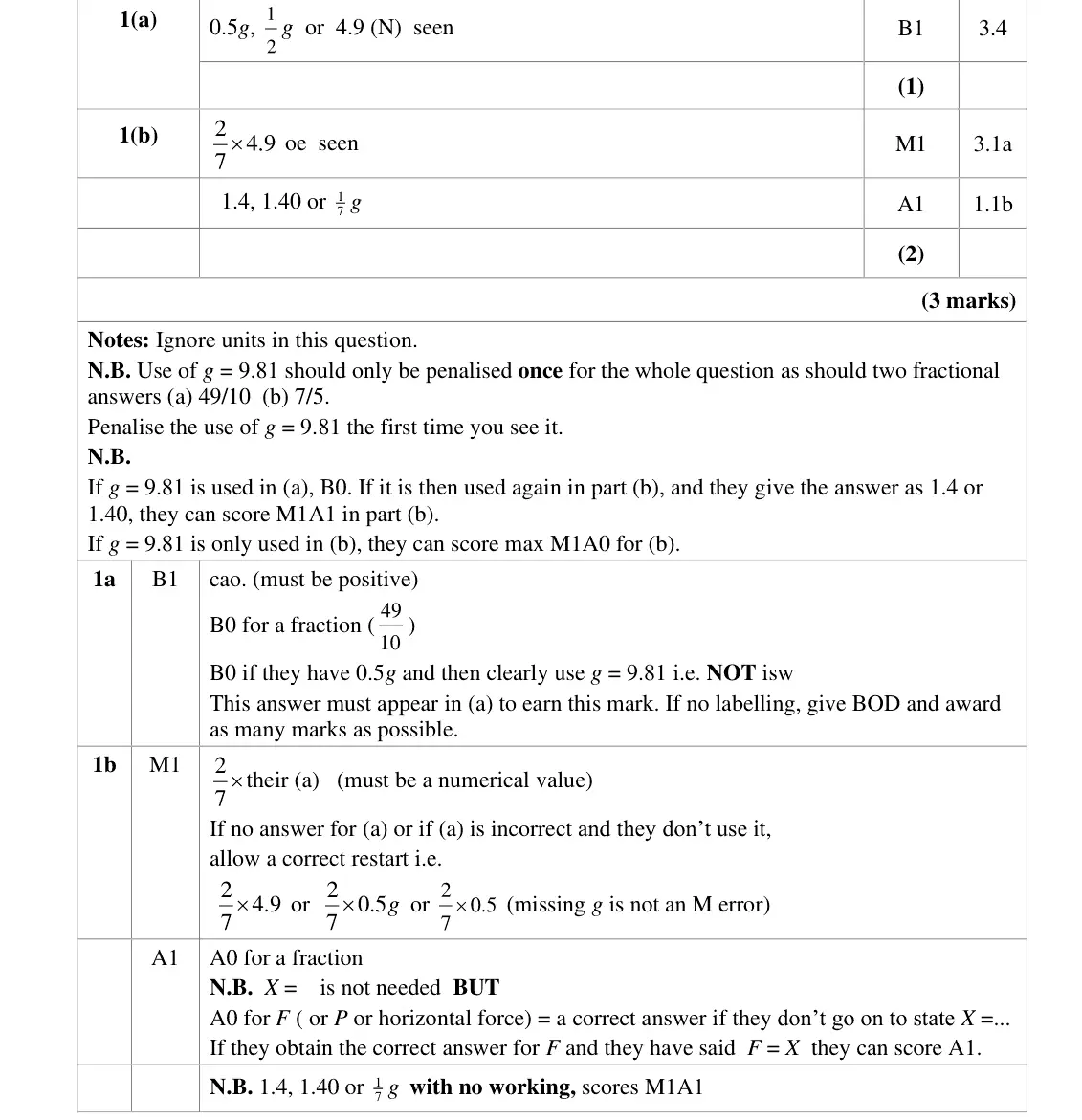
This proved to be a very friendly starter. (a) The vast majority of candidates were able to score the mark, with answers of 0.5g or 4.9 being the most common. The most common error was to omit the g whilst a few used g = 9.81 or gave a fractional answer, both of which were penalised once for the whole question. A few, seeing the word ‘magnitude’, squared and/or square rooted their answer. for (a) by 2 7 which earned the M mark and then realised that X had to be the same value. A significant number lost the A mark after having found the correct value of F for not stating a value for X, as the question required.
Common mistakes
R = weight = 0.5g = 4.9 N (vertical equilibrium)
omitting g
using g = 9.81 or a fraction 49/10 is penalised once
squaring or square-rooting because of "magnitude"
June 2024 · Paper 3 (Mechanics) · Q1(b)2 marks
Mark scheme (whole question; this part is marked with the orange bar)
Examiner's comment
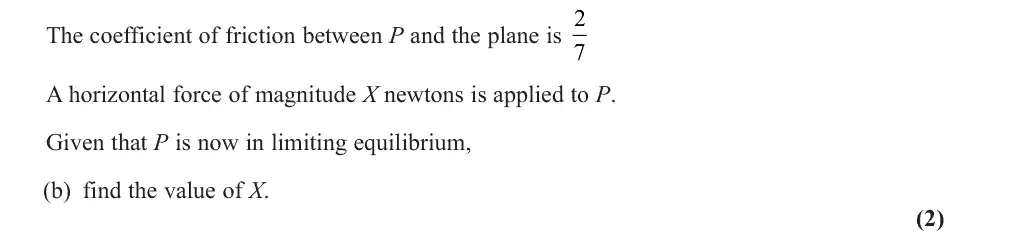
This proved to be a very friendly starter. (b) Most candidates found the value of the limiting friction by multiplying their answer for (a) by 2 7 which earned the M mark and then realised that X had to be the same value.
Common mistakes
limiting friction F = μR = (2/7) × 4.9 = 1.4 N and X equals F (horizontal equilibrium)
finding F but not stating X
fraction answer A0
June 2024 · Paper 3 (Mechanics) · Q3(a)2 marks
Mark scheme (whole question; this part is marked with the orange bar)
Examiner's comment
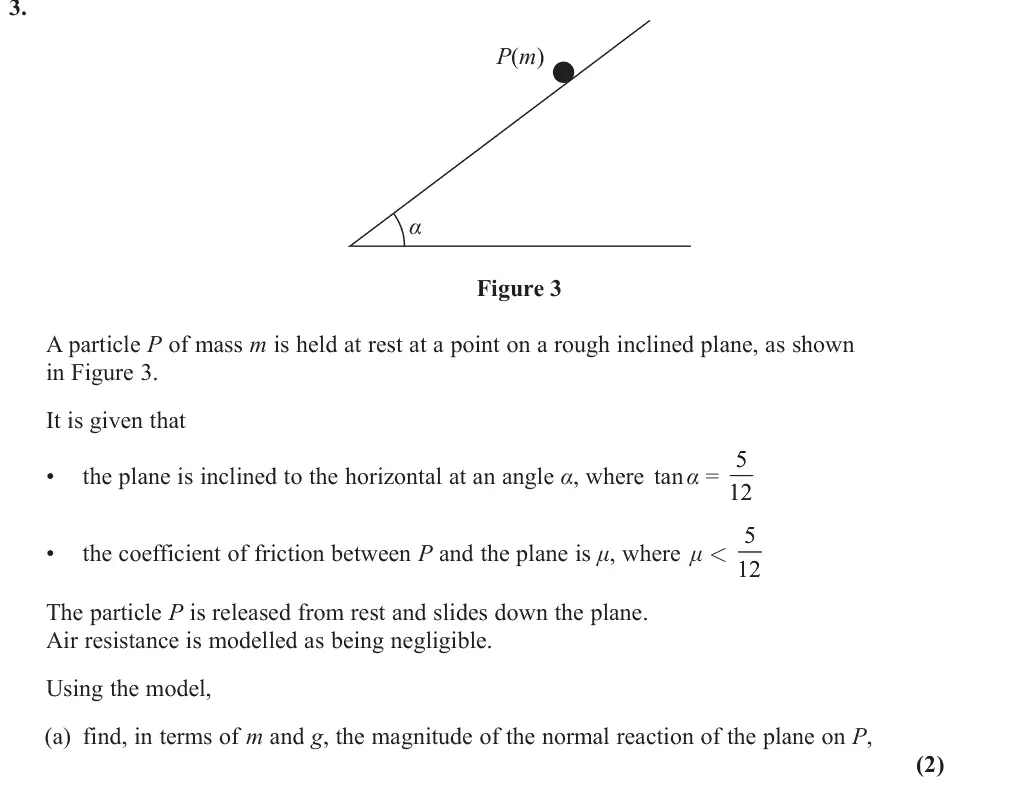
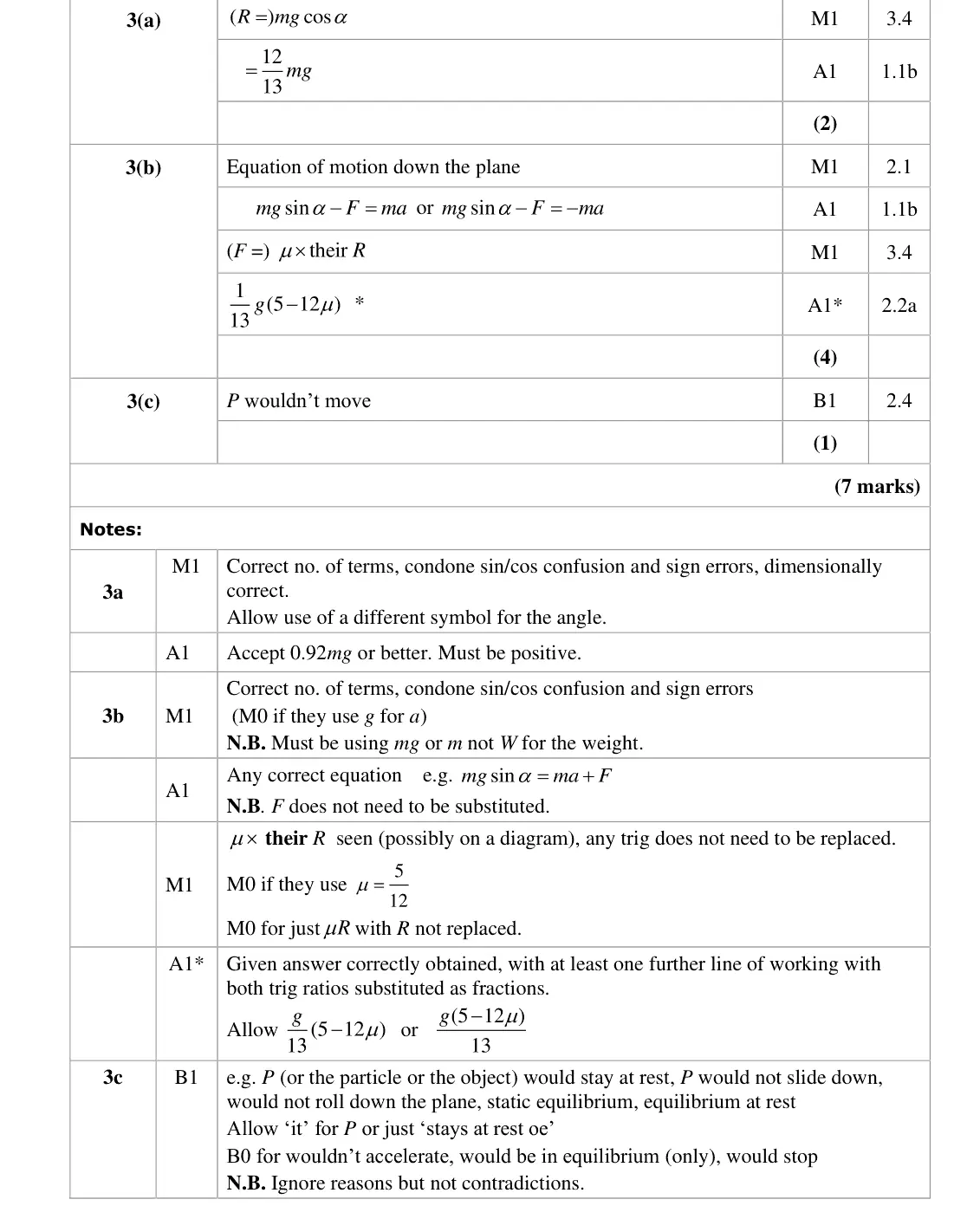
A very well answered question with many candidates using a clearly labelled force diagram and gaining full marks for (a) and (b). It is always good exam technique to annotate the diagram to support the answer. (a) Most candidates were able to resolve perpendicular to the plane to obtain R=mgcos and then replacecos to obtain the required answer. A few multiplied by sin instead of cos but this still earned the M mark. However, those who used tan or divided by sin or cos lost both marks. A few responses chose to use a decimal approximation for the angle which could score both marks in this part.
Common mistakes
resolve perpendicular to the plane R = mg cos α = 12mg/13 with cos α = 12/13 from tan α = 5/12
using tan or dividing by sin or cos scores nothing
June 2024 · Paper 3 (Mechanics) · Q3(c)1 mark
Mark scheme (whole question; this part is marked with the orange bar)
Examiner's comment
A very well answered question with many candidates using a clearly labelled force (c) This was worth one mark, so the answer needed to be clear e.g. the particle does not move, it remains at rest. Some candidates went on to try to justify their answer, but this was not required. A considerable number said it would slide down more slowly, or more worryingly, it would slide up the slope. Stating only that the acceleration was zero or that the forces were in equilibrium did not score the mark, as the particle could still be travelling at constant speed. However, stating that the acceleration was zero or that the forces were in equilibrium and that the particle remained at rest did earn the mark.
Common mistakes
P stays at rest (does not move)
"zero acceleration" or "in equilibrium" alone is B0 (could move at constant speed)
not "slides more slowly" or "slides up"
June 2023 · AS Paper 2 (Mechanics) · Q2(c)1 mark
Mark scheme (whole question; this part is marked with the orange bar)
Examiner's comment
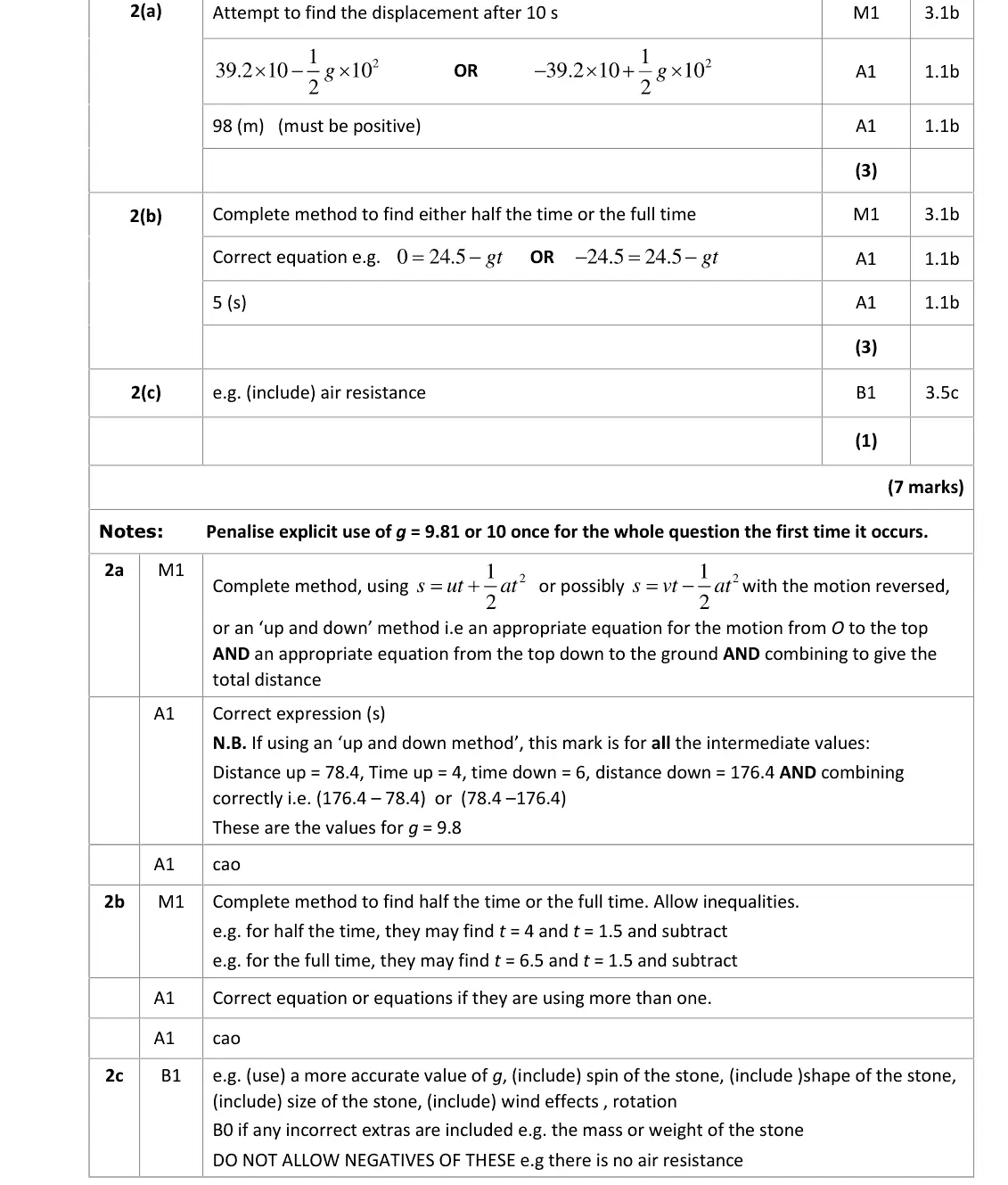
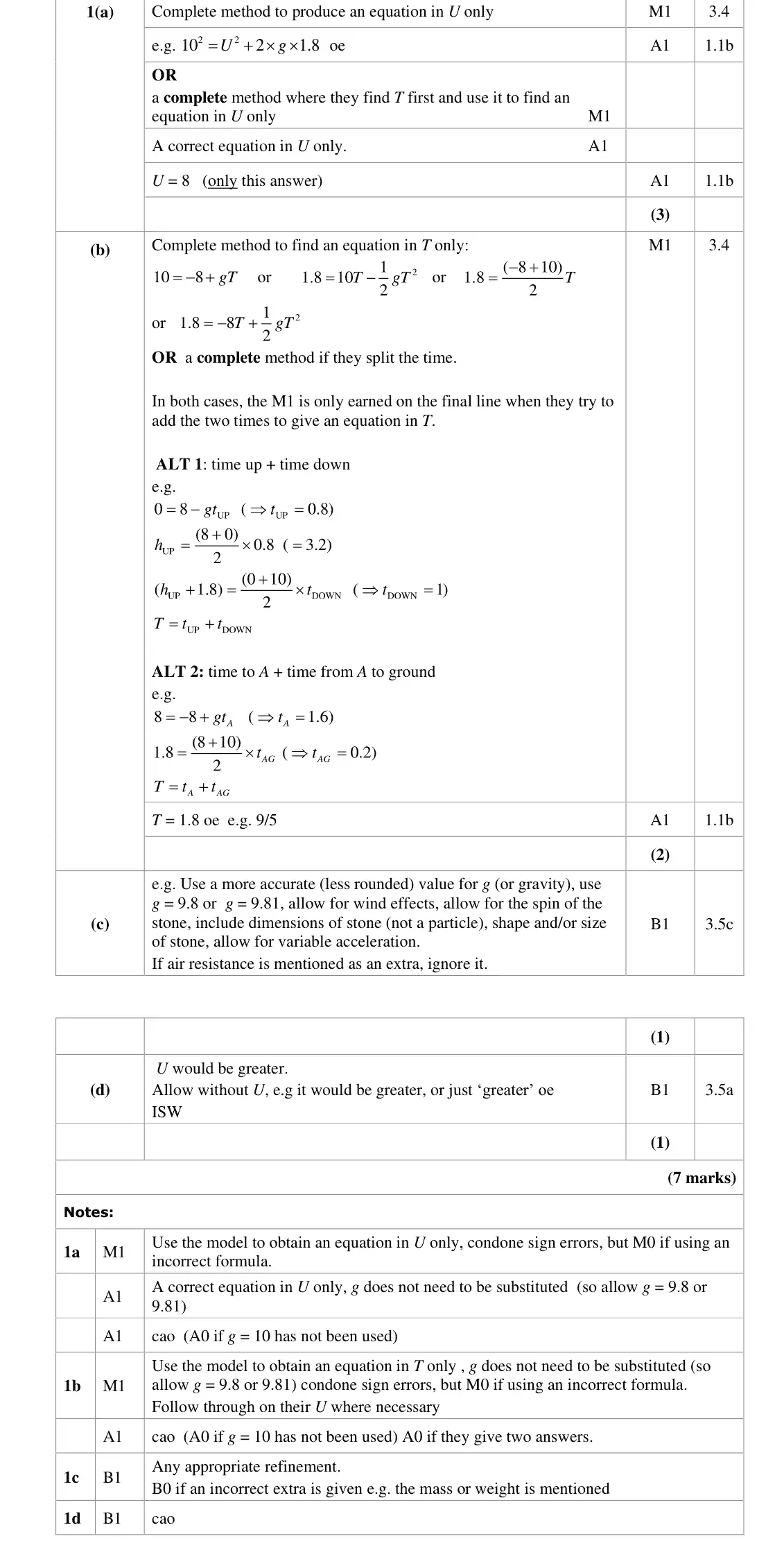
didn’t seem to realise that the speed of the stone reduced as it went upwards. In part (c), “air resistance” was the most common response, followed by “use a more accurate value of g”. A common error was not to reference the model at all, so answers about how accurately the time was measured or throwing the stone indoors to stop the wind having an effect were seen, as well as “consider the mass/weight of the stone”. Some wrongly gave the negative “there is no resistance”.
Common mistakes
include air resistance, or a more accurate value of g, spin, shape or size of the stone
must refer to the model
negatives ("there is no air resistance") and mass/weight of the stone score 0
June 2023 · AS Paper 2 (Mechanics) · Q4(a)5 marks
Mark scheme (whole question; this part is marked with the orange bar)
Examiner's comment
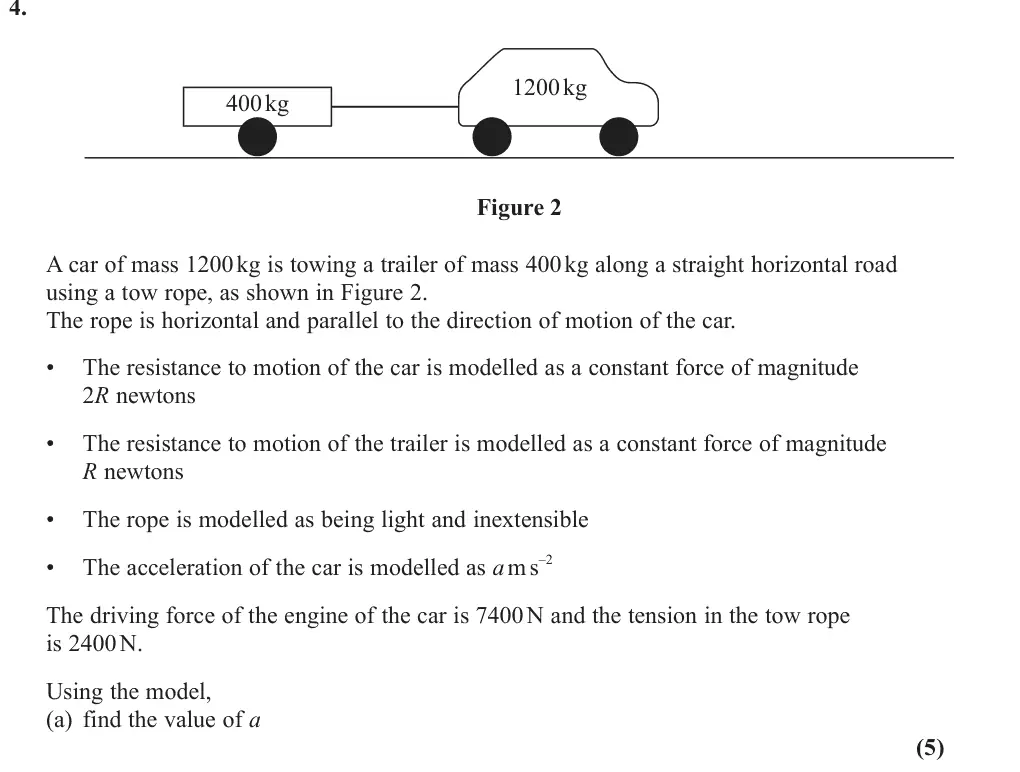
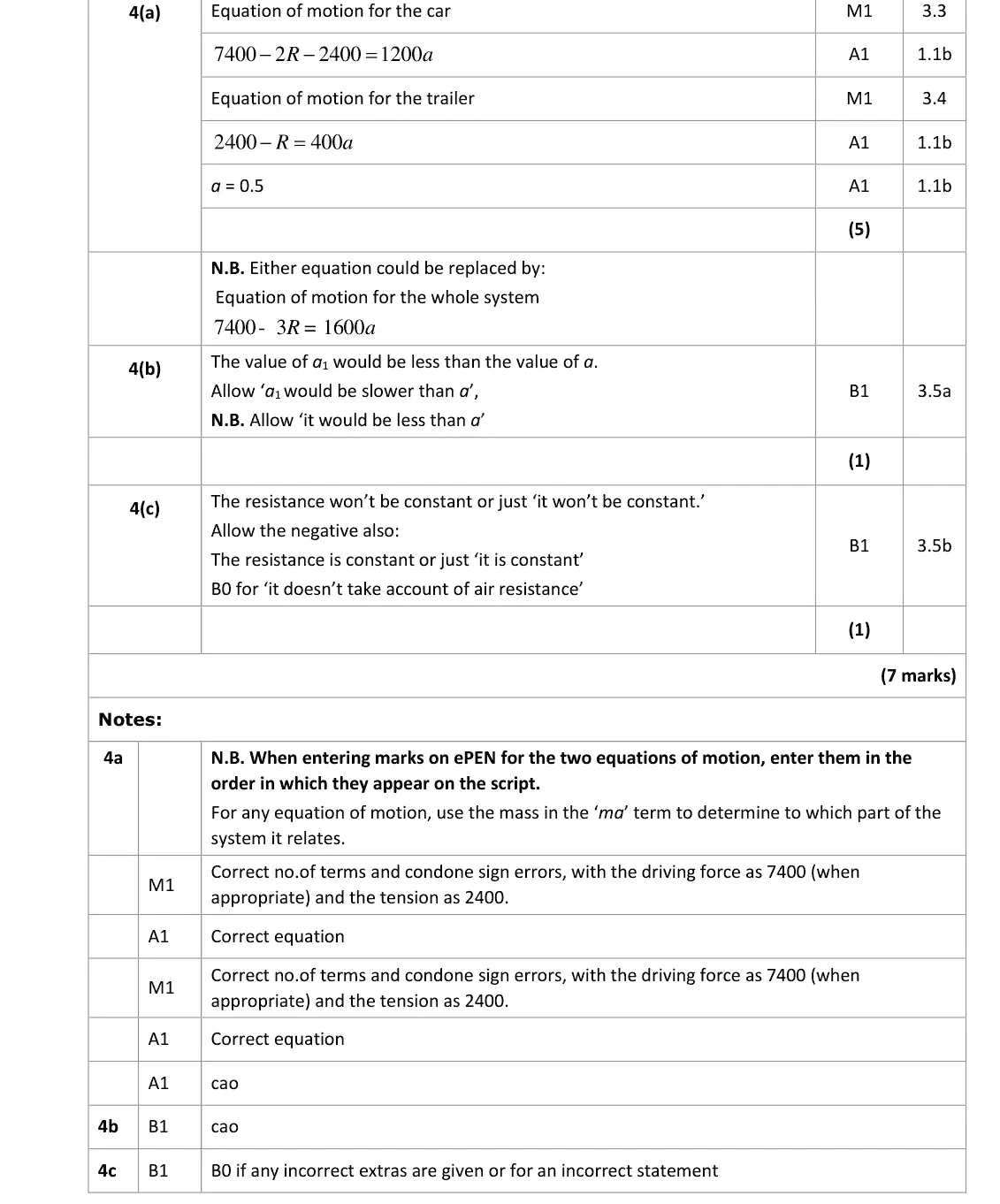
Many candidates made no attempt at part (a). Those who did mostly realised that they needed to use F=ma although many were unable to use the correct combination of forces in their car/trailer/whole system equations. Some never substituted T = 2400 and others omitted the R terms or had extra R’s in their equations of motion. Sign errors in solving their two simultaneous equations were common, especially when solving by substitution. Most who answered the second part were successful although some tied themselves up in knots explaining
Common mistakes
car: 7400 − 2R − 2400 = 1200a
trailer: 2400 − R = 400a (or whole system 7400 − 3R = 1600a)
a = 0.5
missing or extra R terms, not using T = 2400, sign errors solving simultaneously
June 2023 · AS Paper 2 (Mechanics) · Q4(c)1 mark
Mark scheme (whole question; this part is marked with the orange bar)
Examiner's comment
candidates who made no attempt at this part. The most common error in the final part was to make no reference to the modelling of the resistance. Comments about friction and air resistance abounded, along with ones about the rope not being light/inextensible, tyres, road surfaces (which at least had an inkling of the right idea) and the weather. Relatively few scored this final mark.
Common mistakes
the resistance is unlikely to be constant (e.g. varies with speed)
must refer to the resistance model
friction/air resistance, rope, tyres or weather comments score 0
June 2023 · Paper 3 (Mechanics) · Q2(a)1 mark
Mark scheme (whole question; this part is marked with the orange bar)
Examiner's comment
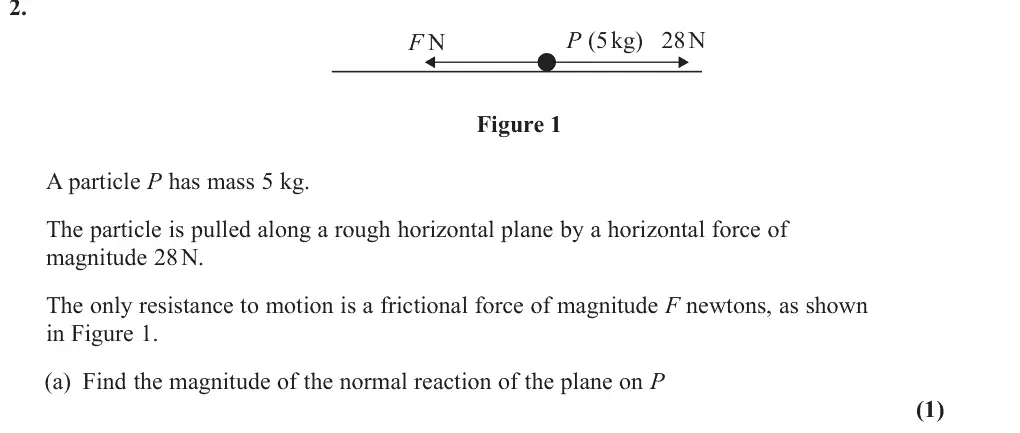
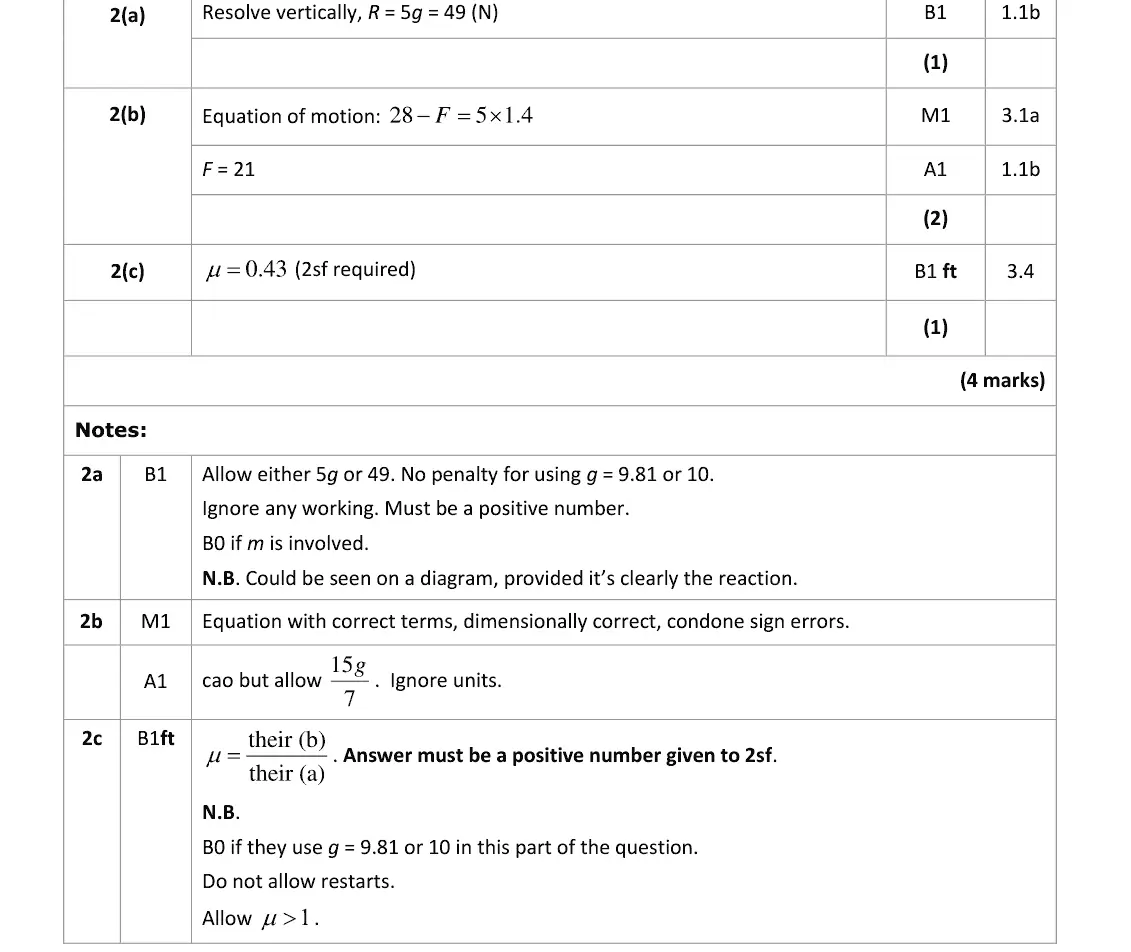
The vast majority were able to score the mark in part (a), with answers of 5g or 49 being the most common. A few candidates used g = 9.81 but were not penalised here. There were very many correct answers for the second part also, but some ignored the 28N force
Common mistakes
resolve vertically: R = 5g = 49 N
must be positive, no m in the answer
June 2022 · AS Paper 2 (Mechanics) · Q1(d)1 mark
Mark scheme (whole question; this part is marked with the orange bar)
Examiner's comment
Candidates who had not read the question and used g as 9.8 or 9.81 were few and far between. what would have been a correct one, and as a result losing the B mark. In the final part, correct answers were in the minority, with most candidates failing to appreciate that if there was air resistance, the stone would have to be projected faster in order to still hit the ground at 10 ms-1.
Common mistakes
U would be greater: the stone must be projected faster to still hit the ground at 10 m/s
"smaller" was the usual wrong answer
Oct 2020 · AS Paper 2 (Mechanics) · Q1(e)1 mark
Mark scheme (whole question; this part is marked with the orange bar)
Examiner's comment
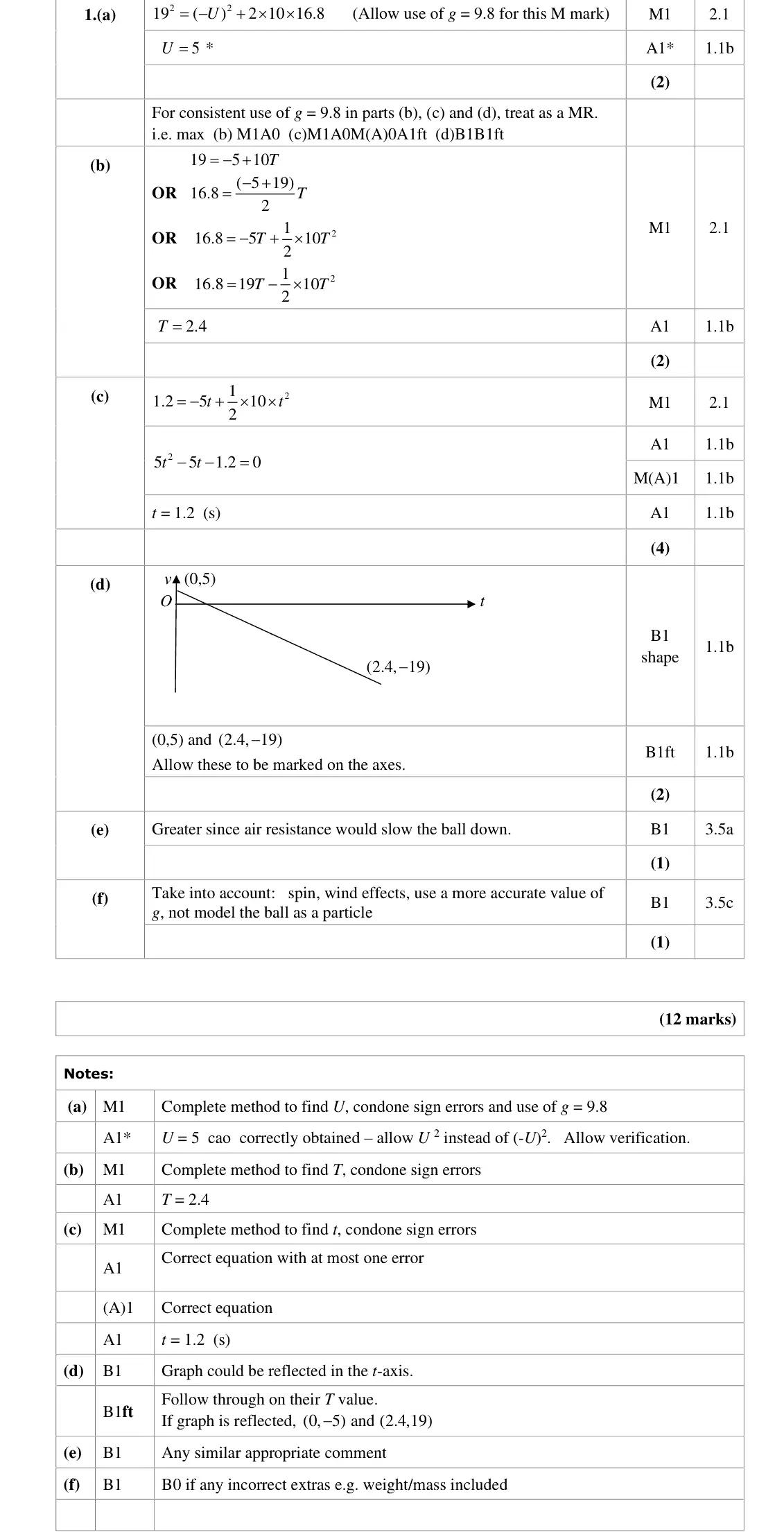
part (e), it was very rare not to see lesser, with the vast majority not realising that for the ball to hit the ground with the given speed of 19.6 ms-1, it would need to be projected with a greater speed to overcome air resistance. In the final part,
Common mistakes
U would be greater because air resistance slows the ball, so a bigger projection speed is needed to reach 19 m/s
"lesser" was the usual wrong answer
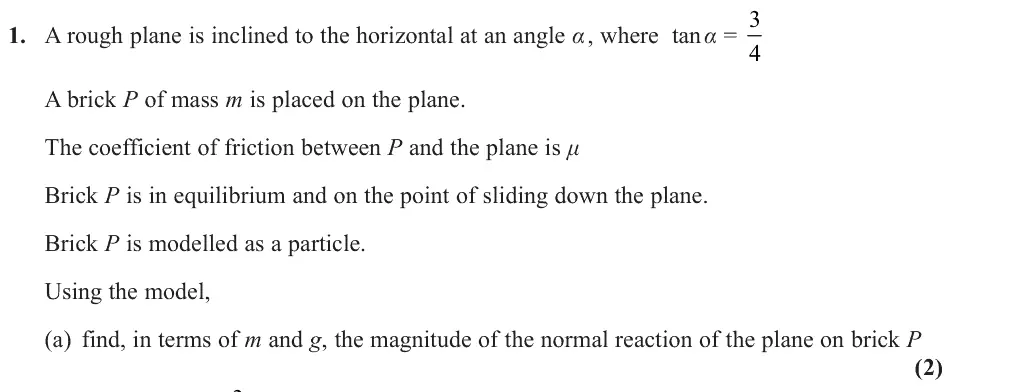
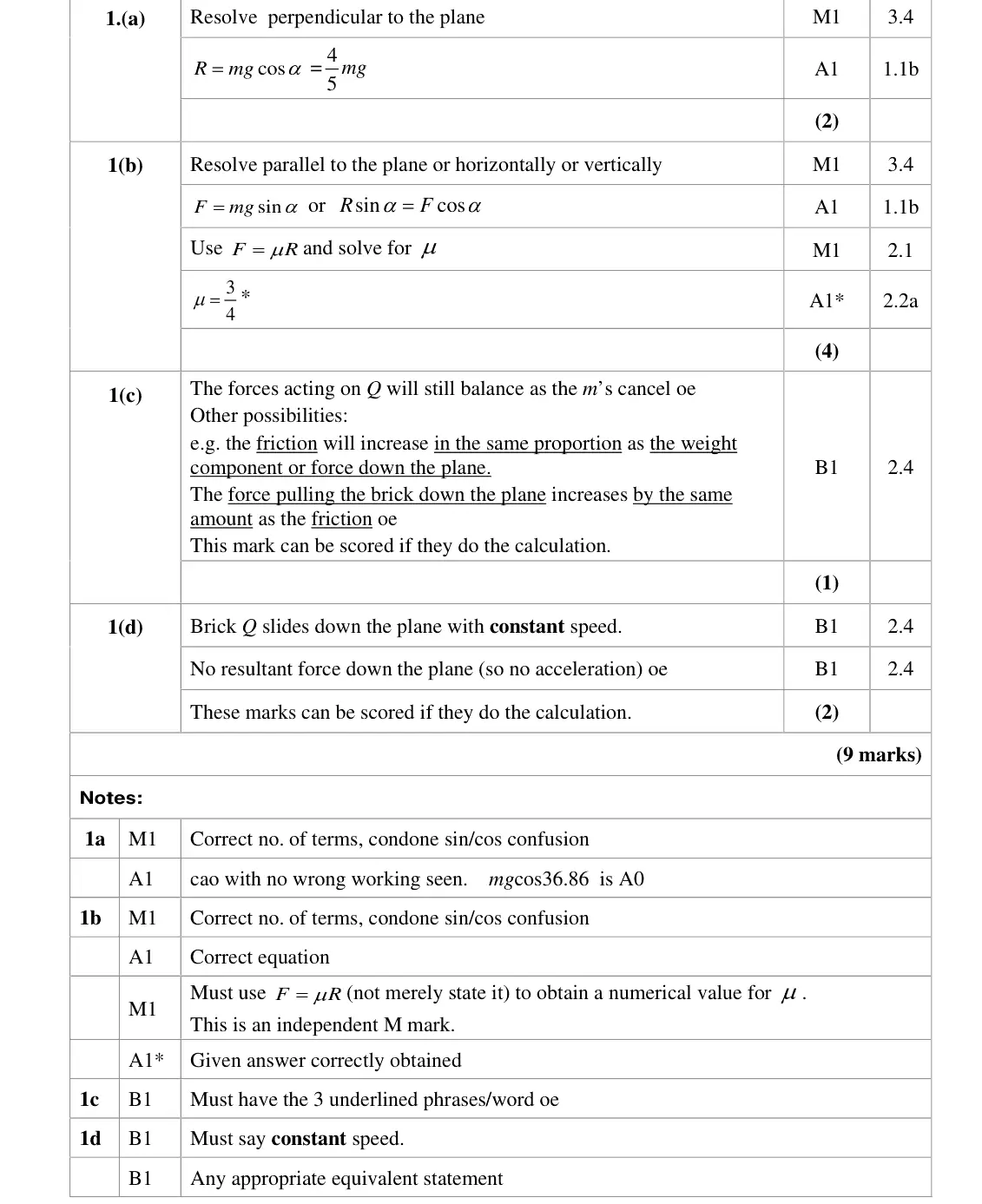
Oct 2020 · Paper 3 (Mechanics) · Q1(a)2 marks
Mark scheme (whole question; this part is marked with the orange bar)
Examiner's comment
The first part was well done by the majority of candidates who resolved perpendicular to the plane to give a correct expression for the normal reaction. In part (b), most resolved
Common mistakes
resolve perpendicular to the plane: R = mg cos α = 4mg/5 with cos α = 4/5 from tan α = 3/4
mg cos 36.86° (decimal angle) is A0
sin/cos confusion
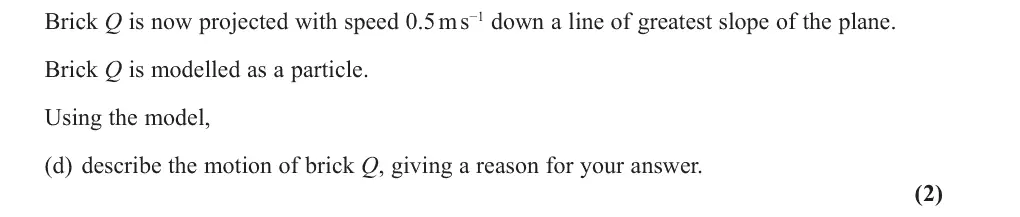
Oct 2020 · Paper 3 (Mechanics) · Q1(d)2 marks
Mark scheme (whole question; this part is marked with the orange bar)
Examiner's comment
sufficient. In part (d), few were able to relate their earlier work to help them answer this question and the majority of candidates failed to realise that the brick would continue to move down the plane with a constant speed since there would be no resultant force. Most thought it would move with acceleration because of weight/gravity or with deceleration because of friction. A few just stated it would move slowly down the plane.
Common mistakes
Q slides down with constant speed because there is no resultant force (Newton's first law)
most wrongly said it accelerates (gravity) or decelerates (friction)
must say constant
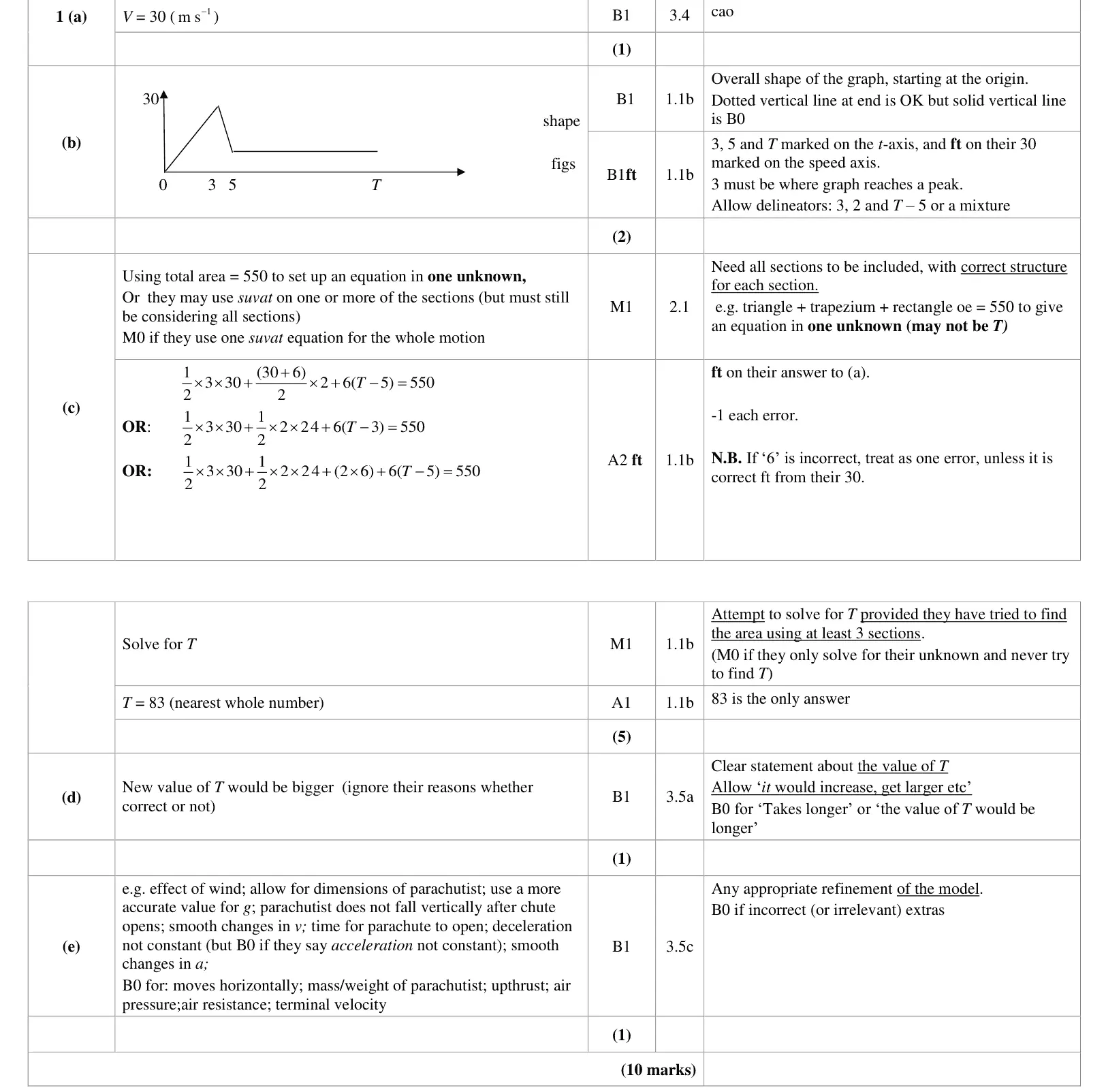
June 2019 · AS Paper 2 (Mechanics) · Q1(d)1 mark
Mark scheme (whole question; this part is marked with the orange bar)
Examiner's comment
Part (d) required recognition of the fact that including the effect of air resistance would lead to an increased value of T. Although this was widely understood, some candidates commented that ‘it would take longer’ which did not answer the question as stated.
Common mistakes
air resistance reduces the speed before the parachute opens, so the new value of T is bigger
must refer to T ("takes longer" alone is B0)
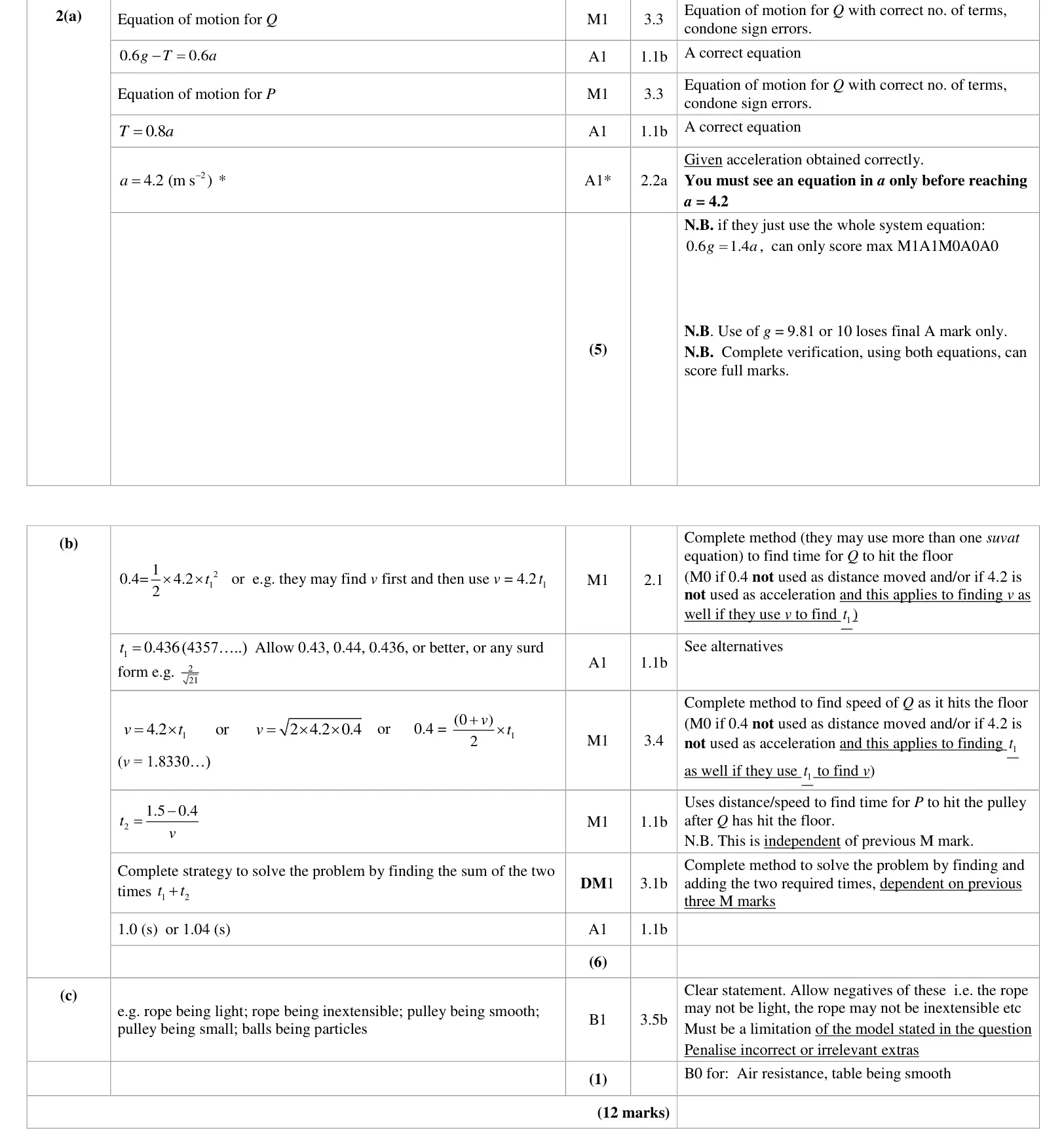
June 2019 · AS Paper 2 (Mechanics) · Q2(b)6 marks
Mark scheme (whole question; this part is marked with the orange bar)
Examiner's comment
Part (b) was also completed with mixed degrees of success. To solve the problem it was necessary to split the motion into two stages, before and after one mass hits the ground. Those who attempted to use a single suvat equation to cover the whole motion could achieve no credit. Some successfully found the time it took for Q to fall to the ground but were then unsure how to proceed. Those who calculated the speed with which Q hit the ground generally used this in considering the subsequent motion of P as it continued to move across the table. However, the most common error at this stage was in not realising that P would move with constant speed since there was no tension and the table surface was smooth; some included an acceleration of 4.2 ms-2 (or even 9.8 ms-2) in the relevant suvat equation or, more 1 commonly, used s = 2 (u + v)t with v = 0. These candidates generally scored three out of a possible six marks. The final part required the identification of a possible limitation of the model. The assumptions of this
Common mistakes
two stages: 0.4 = ½ × 4.2 × t₁² gives t₁ = 0.436 and v = 1.83
after Q hits the floor the rope is slack and the table smooth, so P moves at constant speed for the remaining 1.1 m (not with a = 4.2 or 9.8, and not v = 0 at the pulley)
total time 1.04 s
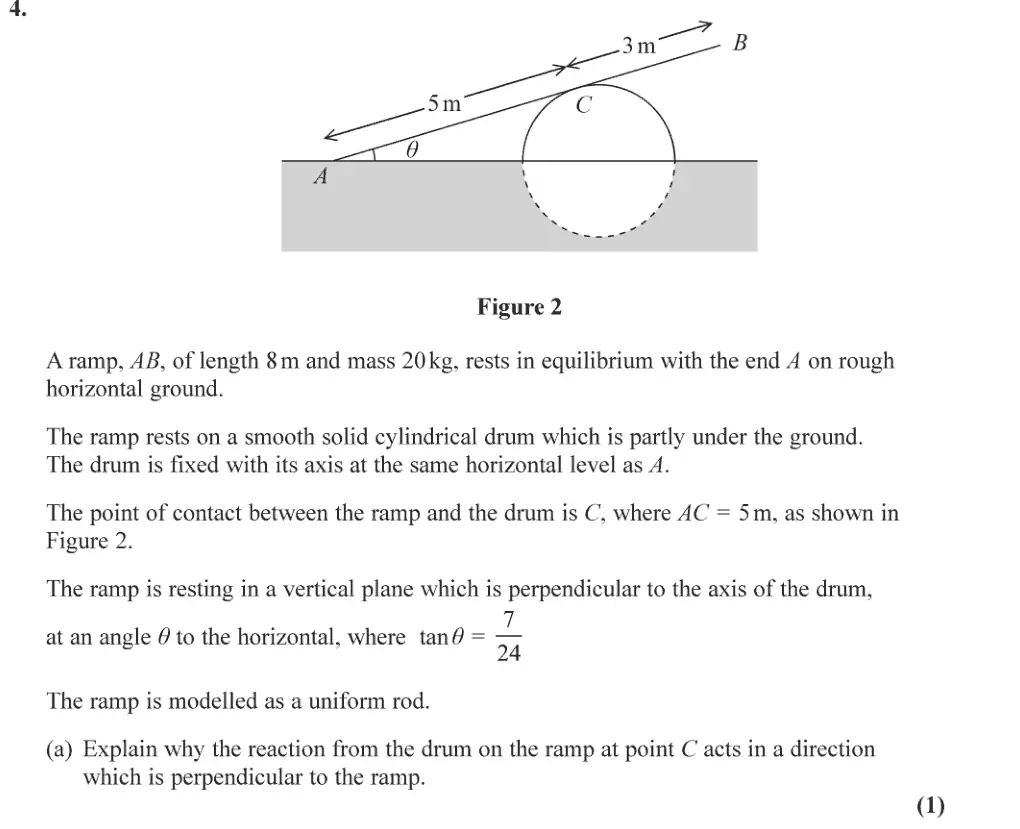
June 2019 · Paper 3 (Mechanics) · Q4(a)1 mark
Mark scheme (whole question; this part is marked with the orange bar)
Examiner's comment
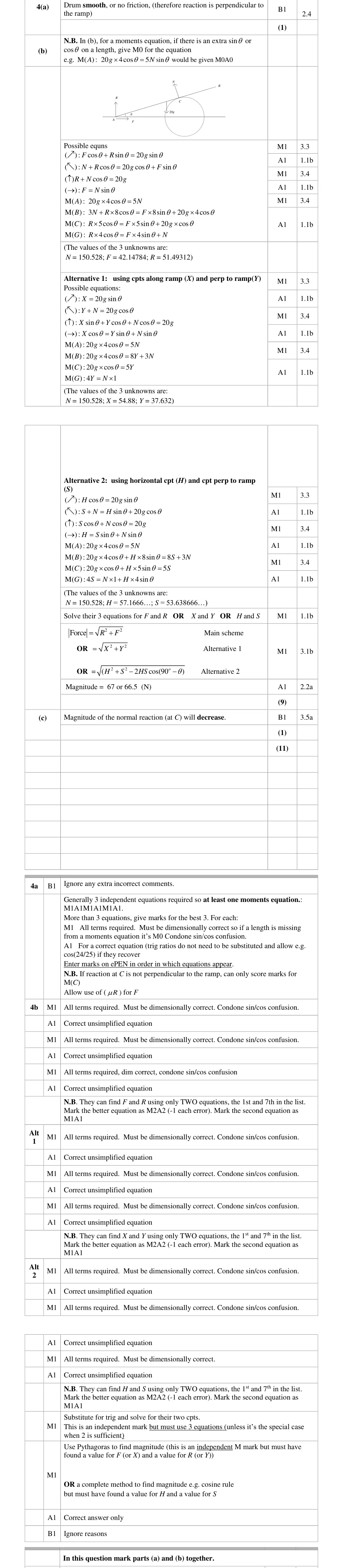
In part (a), the majority of candidates either produced a geometric reason for the reaction acting perpendicular to the ramp (such as the ramp being tangential to the circular drum) or gave an argument about action being equal and opposite to reaction. Many seemed to think that a reaction is, by definition, at right angles to the surface. Very few recognised the significance of the drum being smooth with the consequence that there is no frictional force and hence only a normal component of the reaction. The second part involved finding the components of the resultant force on the ramp at the point of contact
Common mistakes
the drum is smooth so there is no friction at C
"tangent to the circle" or "action and reaction" alone is not the reason
Find an Edexcel maths tutor
Stuck on this? Book a trial session with an Edexcel specialist.