Understand, use and derive the formulae for constant acceleration for motion in a straight line. Extend to 2 dimensions using vectors.
Guidance
Derivation may use knowledge of sections 7.2 and/or 7.4. Understand and use suvat formulae for constant acceleration in 2-D, e.g. v = u + at, r = ut + ½at² with vectors given in i–j or column vector form. Use vectors to solve problems.
A-level only
constant acceleration in 2 dimensions using vectors
Mark scheme (whole question; this part is marked with the orange bar)
Examiner's comment
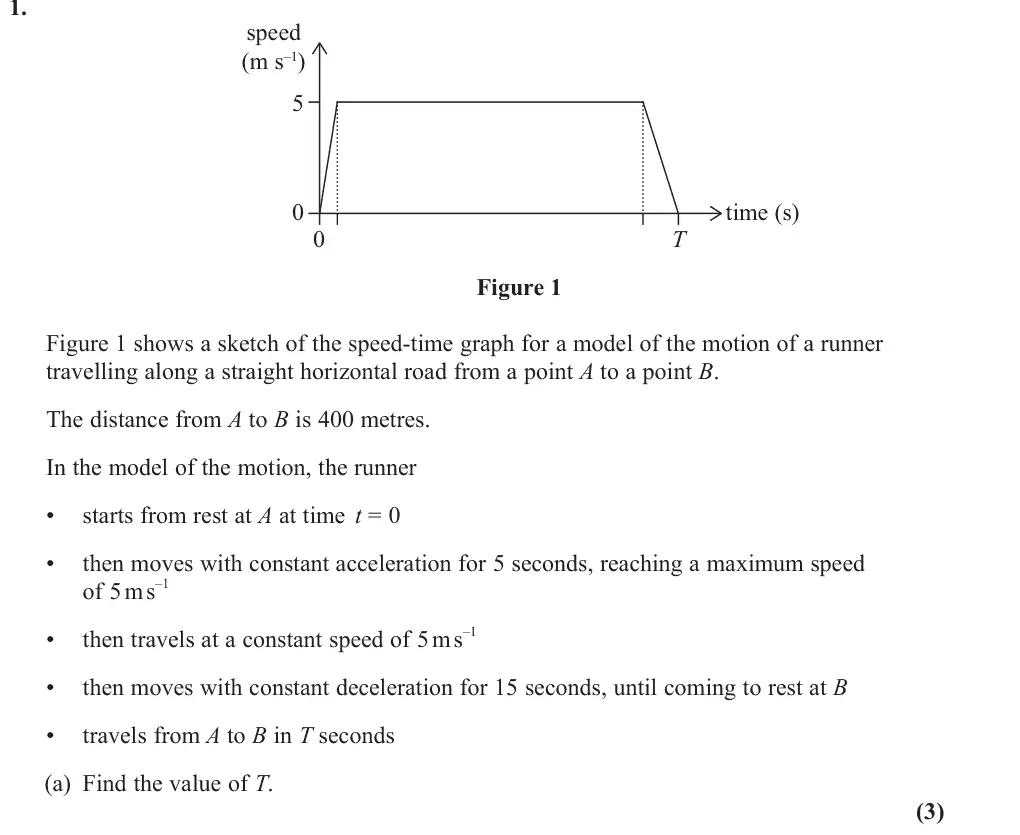
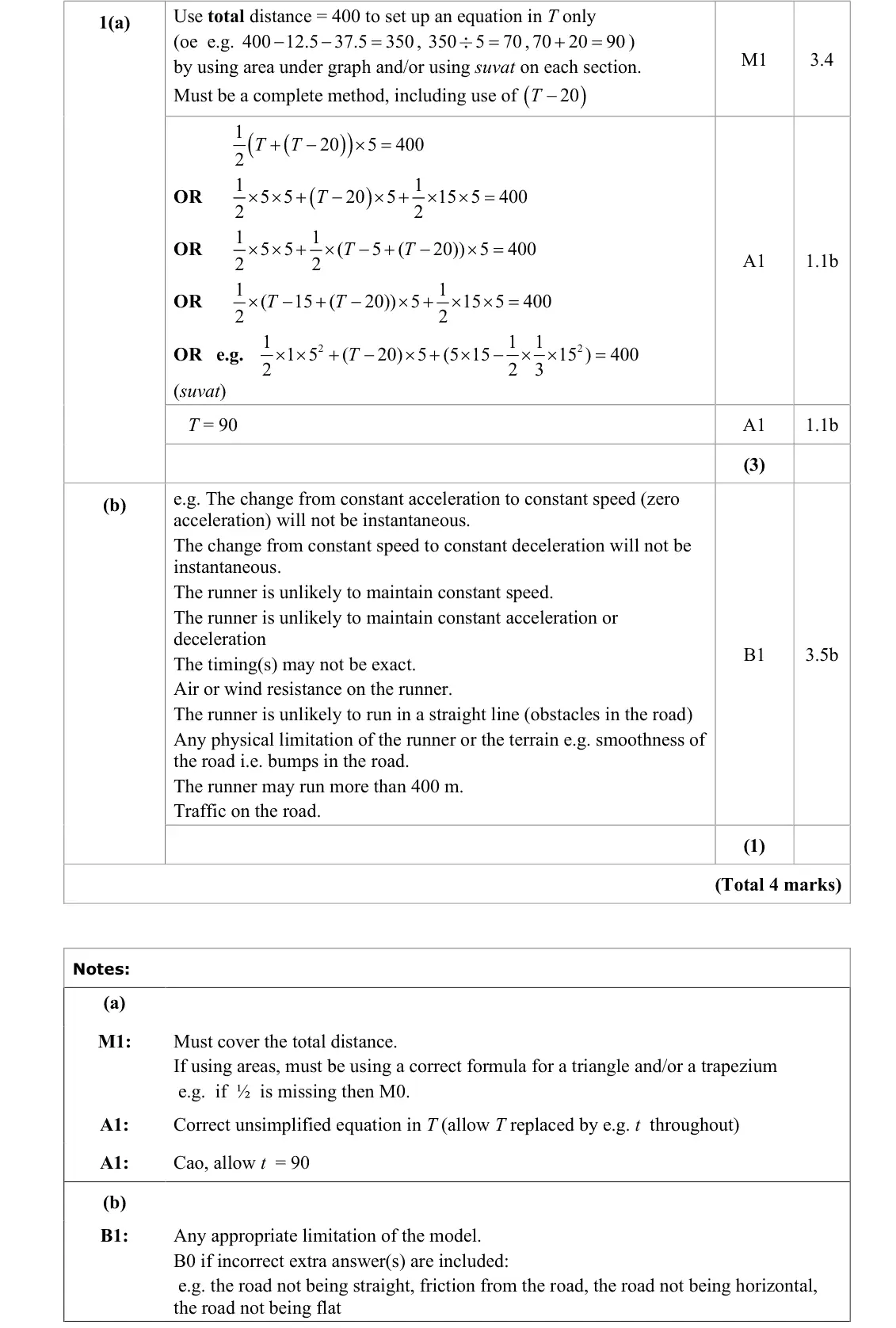
In part (a), the majority of candidates made an attempt to equate the area under the graph to the distance covered. Some used the formula for the area of a trapezium to form an equation in T but the parallel sides were not always identified correctly as T and (T -20). However, the most common approach was to use the area of a triangle, rectangle and triangle respectively for each of the three stages of the motion. Many who used this approach found the time for the constant speed was 70 seconds and then added 5 and 15 to find T= 90 as required. Those who just left their final answer as 70 gained no credit as there was no complete method to find T. A few added the distances rather than the times to 70 showing confusion in their understanding. A small number of candidates used suvat equations for each of the three stages but those using this approach seemed more likely to make an error with one or more of the values. Occasionally attempts were seen using a single suvat equation with s = 400.
Common mistakes
total area under the speed-time graph = 400: ½(T + (T − 20)) × 5 = 400 or triangle + rectangle + triangle gives T = 90
the parallel sides of the trapezium are T and T − 20
leaving 70 (the constant-speed time) scores 0
adding distances to 70 instead of the times 5 and 15
the ½ is needed for the M mark
June 2025 · AS Paper 2 (Mechanics) · Q3(c)2 marks
Mark scheme (whole question; this part is marked with the orange bar)
Examiner's comment
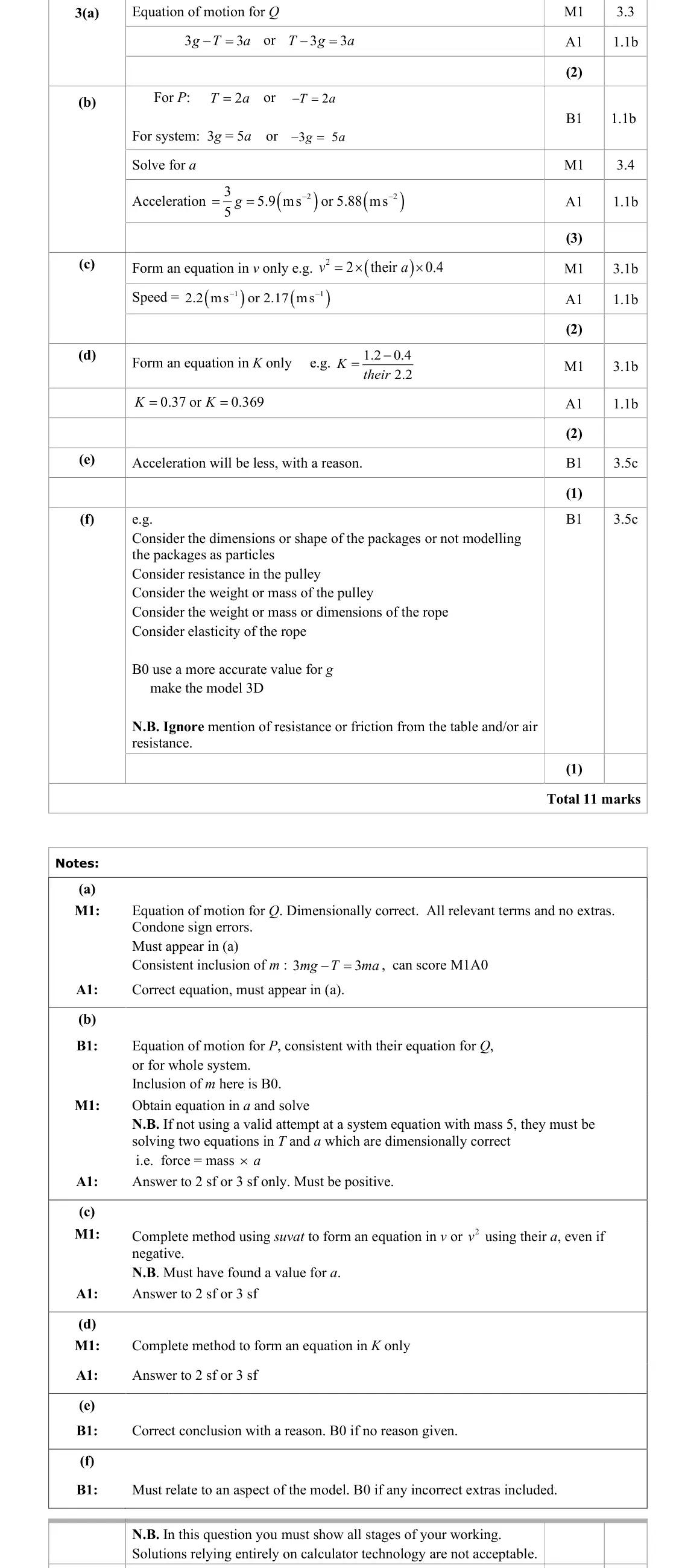
Part (c) was generally well attempted with the majority of candidates using v2 = u2+2as to find the required speed. Although most used their acceleration found in part (b) as required, a small minority substituted a = g despite it not following from previous work. A few confused u and v by assuming the final velocity when Q hit the ground was zero, but such instances were rare. The answer was required to 2 or 3 significant figures following the use of g = 9.8 ms-2.
Common mistakes
v² = 2 × their a × 0.4 gives 2.2 m s⁻¹ (2 or 3 s.f.)
use their a from (b), not g
v is not 0 at the floor
June 2025 · AS Paper 2 (Mechanics) · Q3(d)2 marks
Mark scheme (whole question; this part is marked with the orange bar)
Examiner's comment
Part (d) required finding the time taken by P to move across the table to the pulley once Q had hit the ground. This proved to be the most challenging part on the paper and few valid approaches were seen. A significant number used the acceleration from the first stage of the motion, or even g, in a suvat equation without realising that P would now travel with constant velocity since the table was modelled as smooth and there was no longer a tension acting. Other common errors seen were to use the distance as 1.2 m, 0.4 m or even 1.6 m rather than 0.8 m. This again showed a lack of appreciation of the mechanics of the situation.
Common mistakes
after Q hits the floor the rope is slack and the table smooth, so P moves at constant speed 2.17 m/s for 1.2 − 0.4 = 0.8 m: K = 0.8/2.17 = 0.37
common errors: using the earlier acceleration or g, distance 1.2, 0.4 or 1.6 m
hardest part on the paper
June 2025 · Paper 3 (Mechanics) · Q1(a)2 marks
Mark scheme (whole question; this part is marked with the orange bar)
Examiner's comment
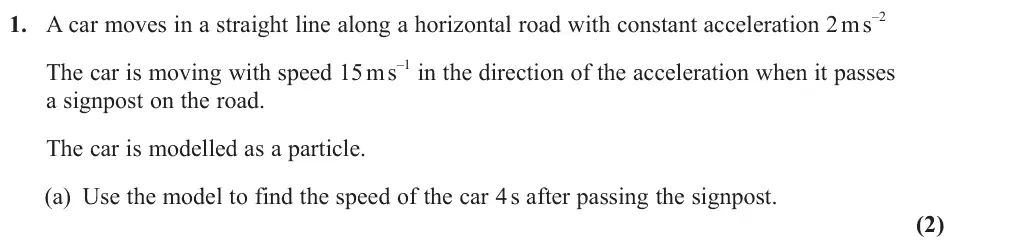
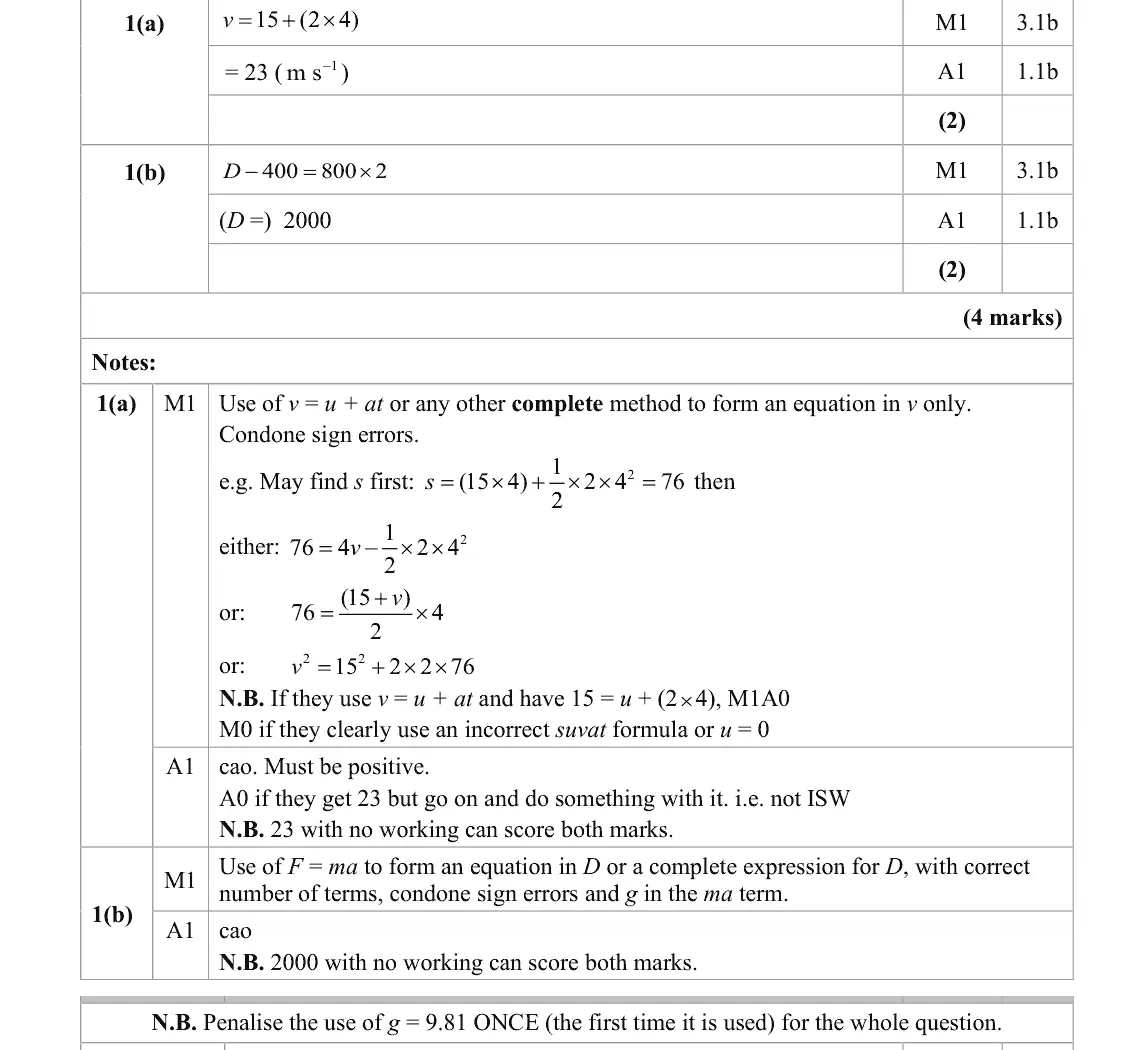
Part (a) proved to be a friendly starter and the vast majority of responses successfully quoted and used the correct suvat equation for final velocity. Arithmetic slips, such as 2 4 6 x = , were the main cause of any marks not being awarded. Very few responses did not gain marks by assuming u = 0.
Common mistakes
v = u + at with u = 15, not u = 0
arithmetic slips (2 × 4 = 6)
answer 23 must be positive
June 2025 · Paper 3 (Mechanics) · Q2(d)4 marks
Mark scheme (whole question; this part is marked with the orange bar)
Examiner's comment
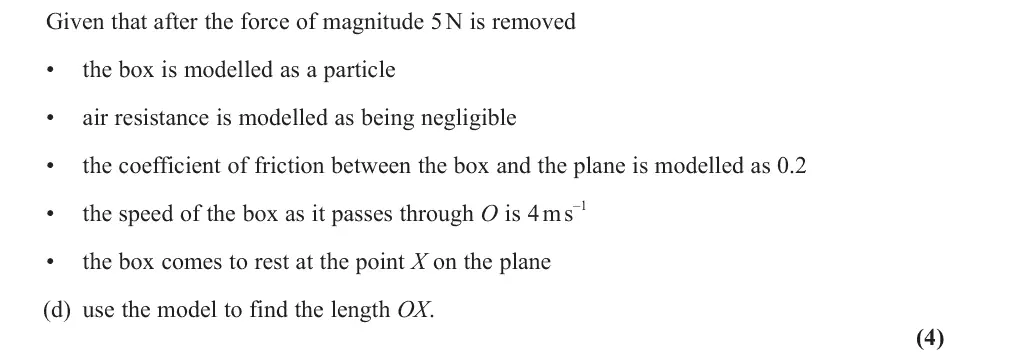
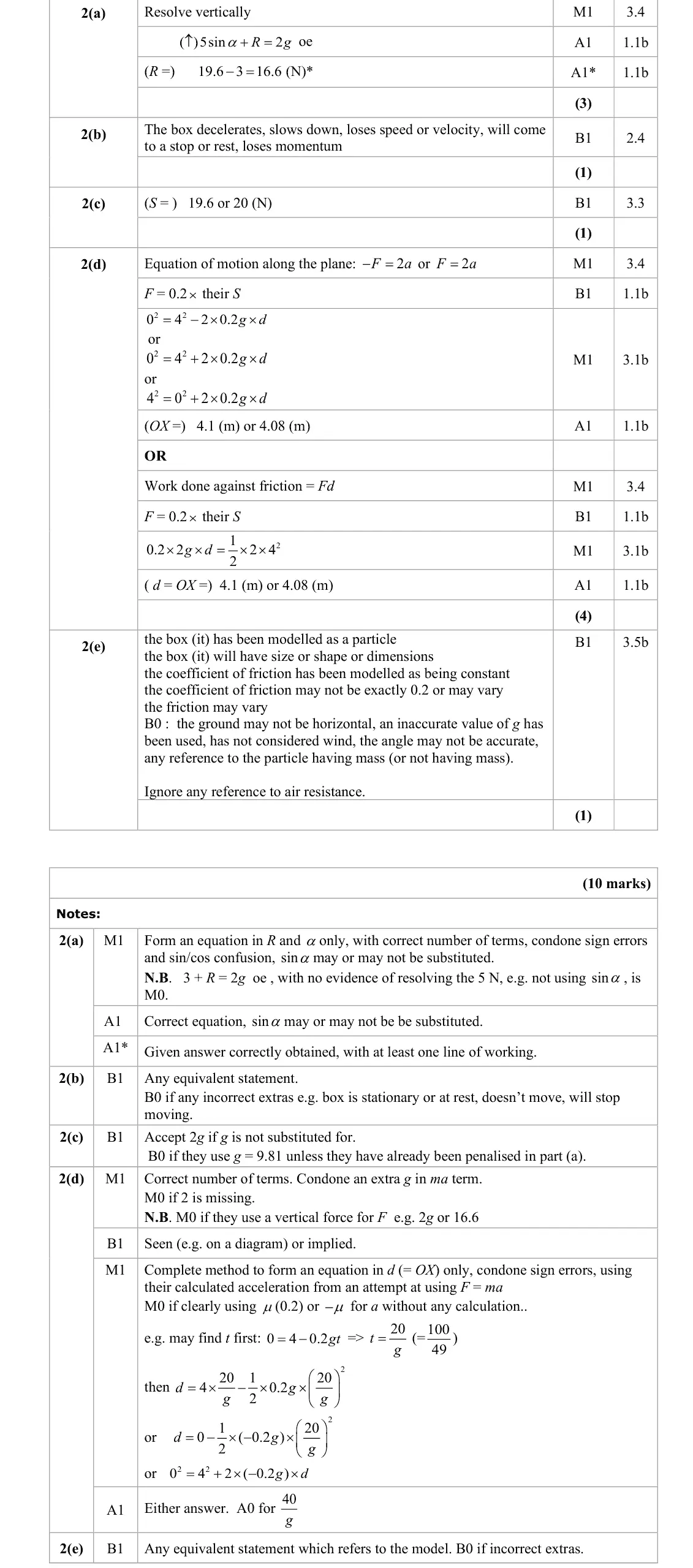
In part (d), learners needed to plan their method carefully. Most responses gained the mark for finding the value of the friction as 𝐹𝐹𝑚𝑚𝑚𝑚𝑚𝑚= 𝜇𝜇𝜇𝜇= 0.2 x 19.6. Successful responses then applied Newton’s 2nd law, ±𝐹𝐹= 𝑚𝑚𝑚𝑚= 2𝑎𝑎 and then used a suvat approach to arrive at the distance as 4.1 or 4.08(m) to 2 or 3 s.f. Leaving the final answer to more than 3 s.f resulted in the final mark not being awarded. Errors were mainly in the 𝐹𝐹= 𝑚𝑚𝑚𝑚 equation when the force was incorrectly formed. Use of a = 0.4g or a mu = - were common mistakes. Fractional answers, after the use of g = 9.8, were not acceptable.
Common mistakes
F = 0.2 × 19.6 (use the new reaction, not 16.6)
−F = 2a gives a = −0.2g
wrong a = μ or 0.4g
then v² = u² + 2as
answer 4.1 or 4.08 m to 2 or 3 s.f., not 40/g
June 2025 · Paper 3 (Mechanics) · Q3(b)2 marks
Mark scheme (whole question; this part is marked with the orange bar)
Examiner's comment
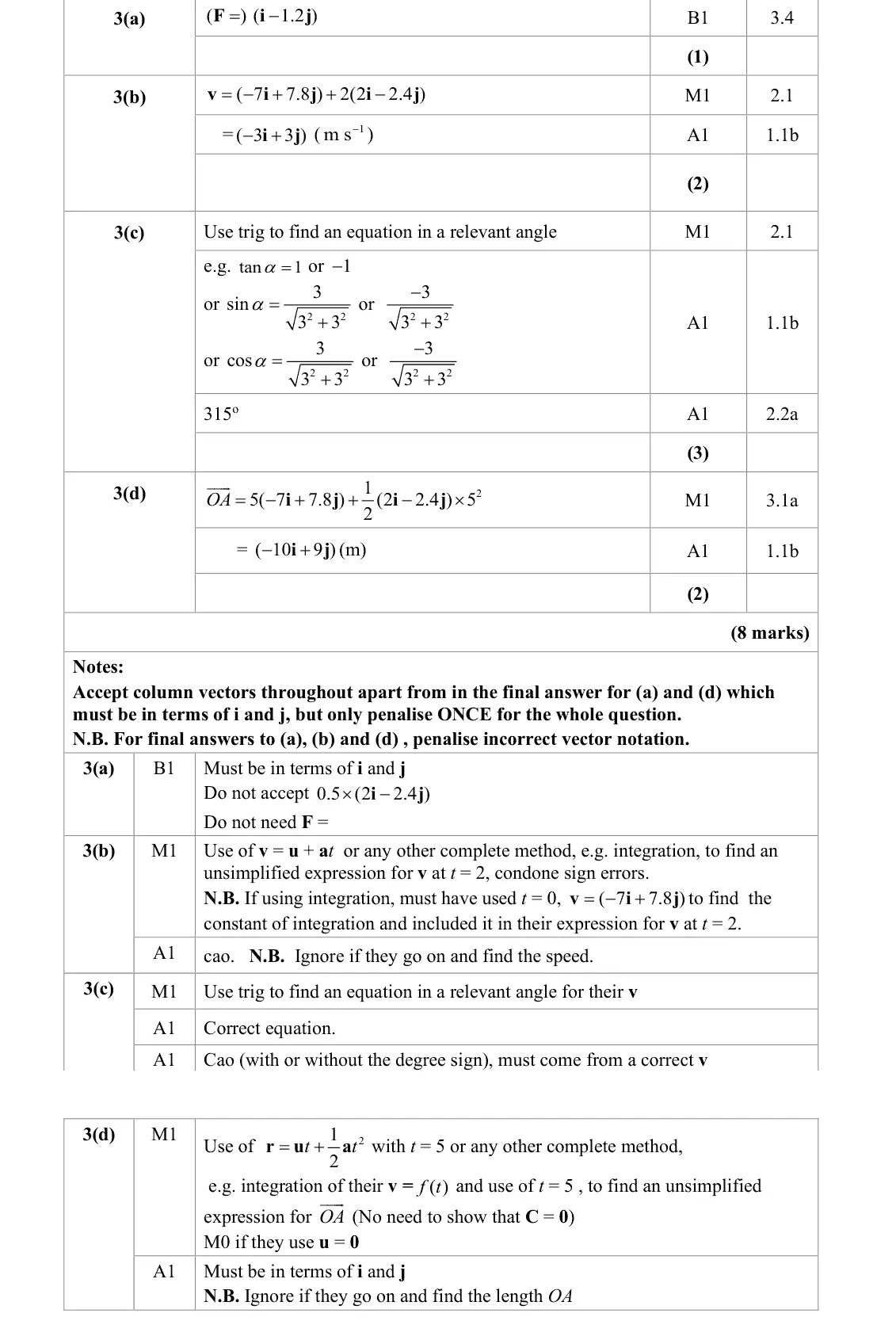
In part (b) most responses scored both marks by quoting and correctly using t = + v u a with their vector quantities. A few used their F for a. Arithmetical slips were occasionally seen. It was relatively rare to see the method of integration deployed. This was more mixed in terms of levels of success with some not considering the constant of integration. Others made arithmetical slips, the longer method providing more opportunity to make an error. Many responses demonstrated a preference for column vectors and used them in this part.
Common mistakes
v = u + at with vectors
use a, not F
if integrating, include the constant from v at t = 0
June 2025 · Paper 3 (Mechanics) · Q3(c)3 marks
Mark scheme (whole question; this part is marked with the orange bar)
Examiner's comment
Finding the bearing of the direction of motion in part (c) proved more challenging for many learners. A good number were able to find an acute angle relating to their velocity vector. Use of basic trigonometry or the properties of a right-angled isosceles triangle were seen in roughly equal measure, but gaining the final mark for a correct bearing was often not achieved. Unrepresentative diagrams and a misunderstanding of bearings appeared to be the cause of this. A significant number did not need to use trigonometry, realising that the components indicated a north west direction and writing down 315o directly. A few learners first worked out the displacement vector and attempted to find the bearing of the position of the particle. This was not what the question had asked for and gained no credit.
Common mistakes
v = −3i + 3j points north-west so bearing 315°
unrepresentative diagrams and misread bearings lose the final mark
using the displacement instead of the velocity scores nothing
June 2025 · Paper 3 (Mechanics) · Q3(d)2 marks
Mark scheme (whole question; this part is marked with the orange bar)
Examiner's comment
Part (d) was well answered with a suvat equation being the preferred and most successful method for the majority. A few attempted to use integration, and with the constant of integration being the zero vector, this was generally successful albeit a longer method. Almost all responses gave the answer in terms of i’s and j’s, as required by the question.
Common mistakes
r = ut + ½at² with t = 5 and u = −7i + 7.8j (not u = 0)
answer −10i + 9j in i and j
June 2025 · Paper 3 (Mechanics) · Q5(b)3 marks
Mark scheme (whole question; this part is marked with the orange bar)
Examiner's comment
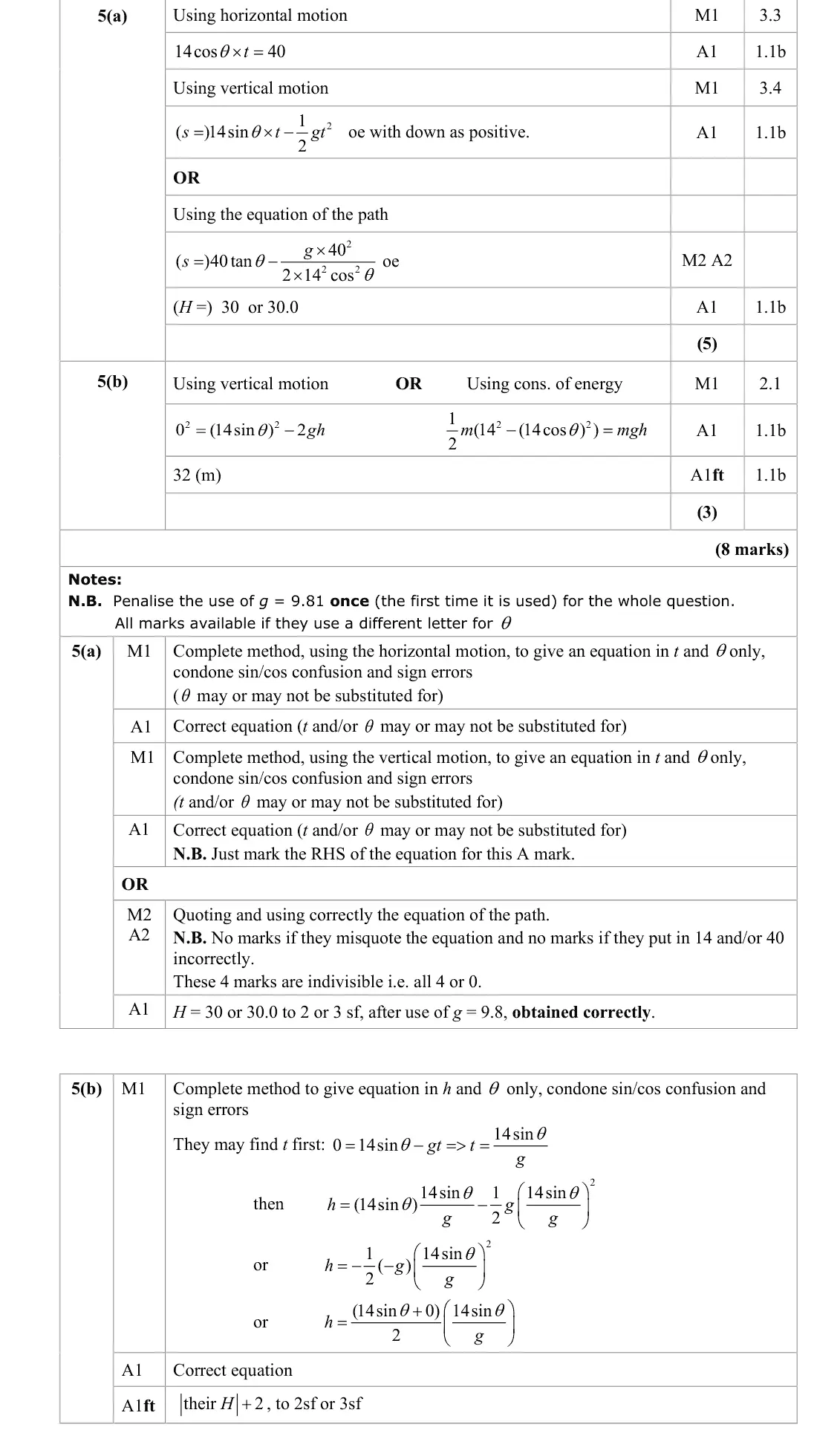
In part (b), finding the maximum height above the ground was done well by nearly all learners, with most using 2 2 2 v u as = + . Common errors seen were to round values prematurely or drop a square from a term after stating a correct initial equation. Those who used two equations were generally less successful. A few others did not gain the final follow through accuracy mark as they did not give their final answer to 2 or 3 significant figures.
Common mistakes
0 = (14 sin θ)² − 2gh gives 2 m above O
answer is H + 2 = 32 m above the ground
do not drop the square or round early
2 or 3 s.f.
June 2024 · AS Paper 2 (Mechanics) · Q1(b)3 marks
Mark scheme (whole question; this part is marked with the orange bar)
Examiner's comment
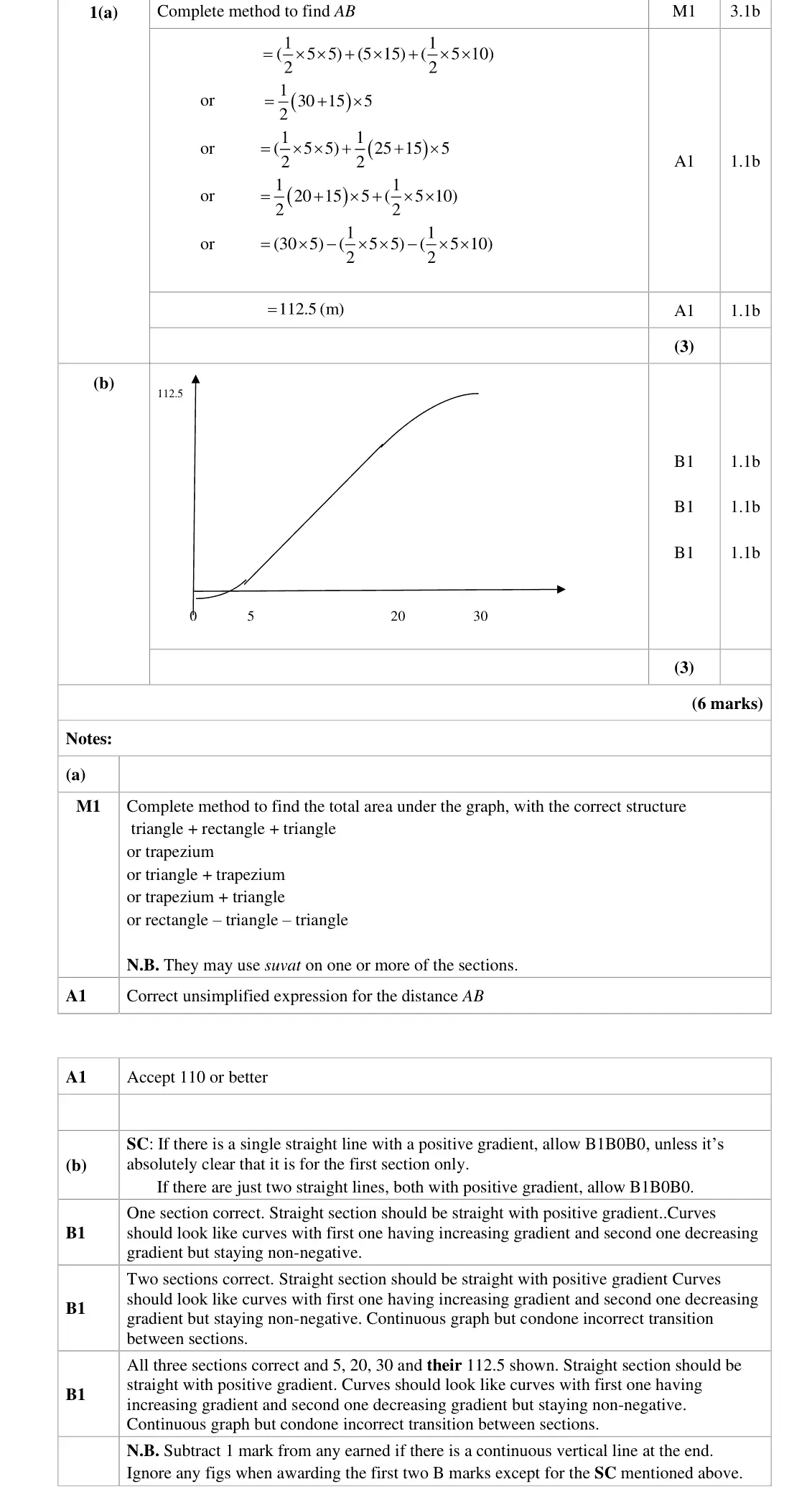
The second part proved to be much more of a challenge, although the majority of candidates did offer a graph with three sections. Most had three straight lines with different positive gradients or one continuous straight line but quite a few attempts included lines with negative gradients or horizontal lines for the first and/or last sections. Most candidates only gained one mark out of three in this part of the question. Successful candidates realised that the first and third sections of the graph needed to be quadratic, from suvat formula, whilst the middle section was a straight line with positive gradient. In addition, the numbers 5, 20, 30 and their total distance were not always clearly shown on the axes. Some candidates had graphs that were unclearly drawn, often without straight lines. Many candidates with the three sections correct struggled with the transition between the sections and failed to produce a smooth curve, often exaggerating the curves, but they were not penalised for this. A few candidates simply recreated the speed-time graph trapezium with different axis labels.
Common mistakes
distance-time graph: curve with increasing gradient for 0–5 s, straight line with positive gradient 5–20 s, curve with decreasing gradient levelling off at 112.5 at 30 s
label 5, 20, 30 and 112.5
negative gradients, horizontal sections or redrawing the trapezium are wrong
no vertical line at the end
June 2024 · AS Paper 2 (Mechanics) · Q4(d)3 marks
Mark scheme (whole question; this part is marked with the orange bar)
Examiner's comment
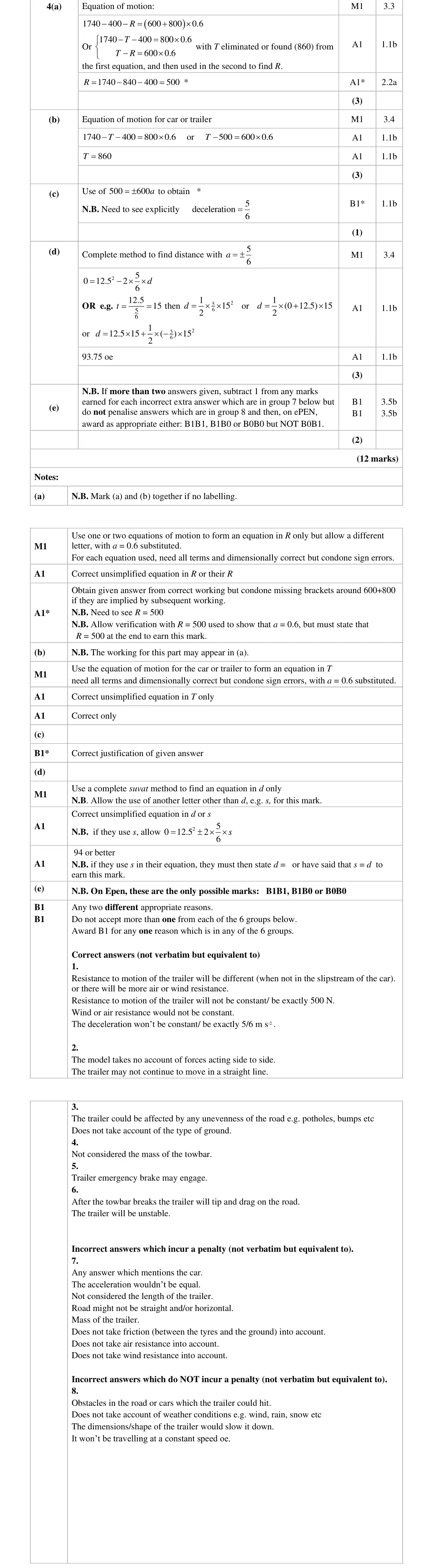
to use a correct suvat method in part (d) to find the distance travelled by the trailer once the tow bar had broken. Occasionally the acceleration from before the break was used but generally this was well done with the correct numerical value obtained. The question required the value of ‘d’ so some indication was expected that the calculated distance was actually d.
Mark scheme (whole question; this part is marked with the orange bar)
Examiner's comment
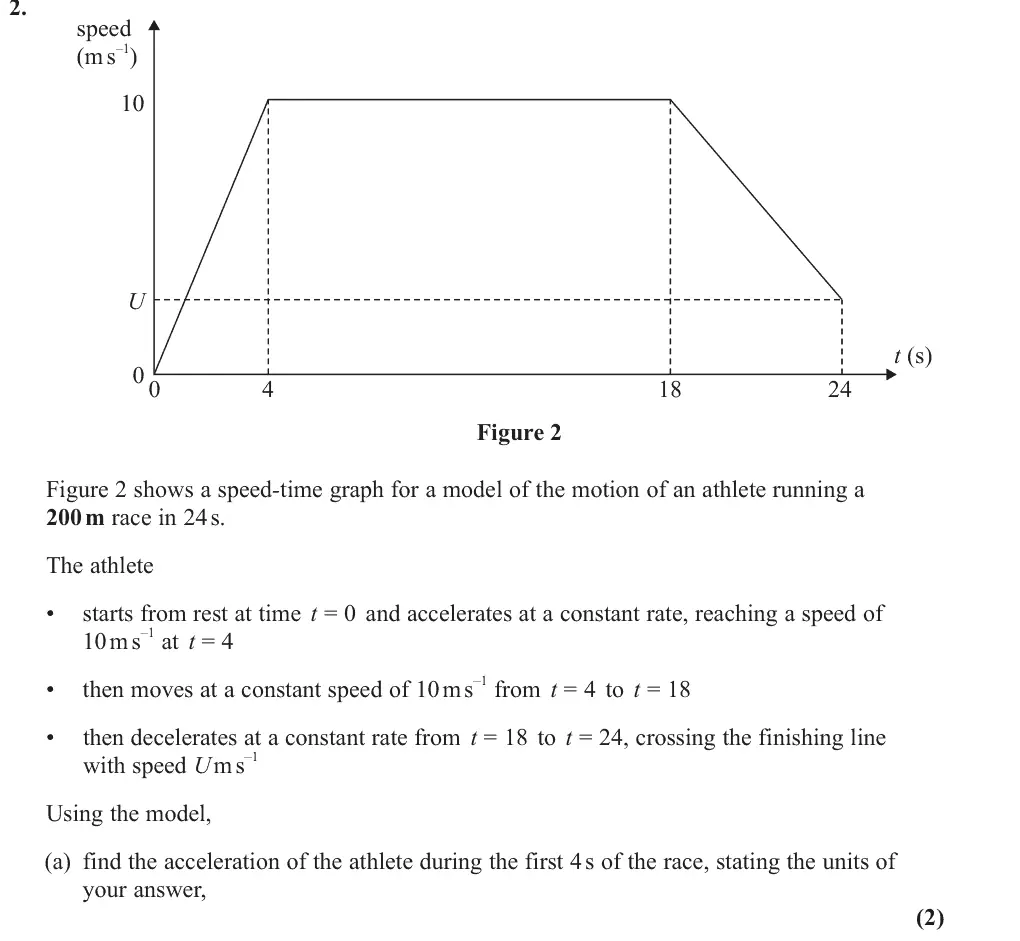
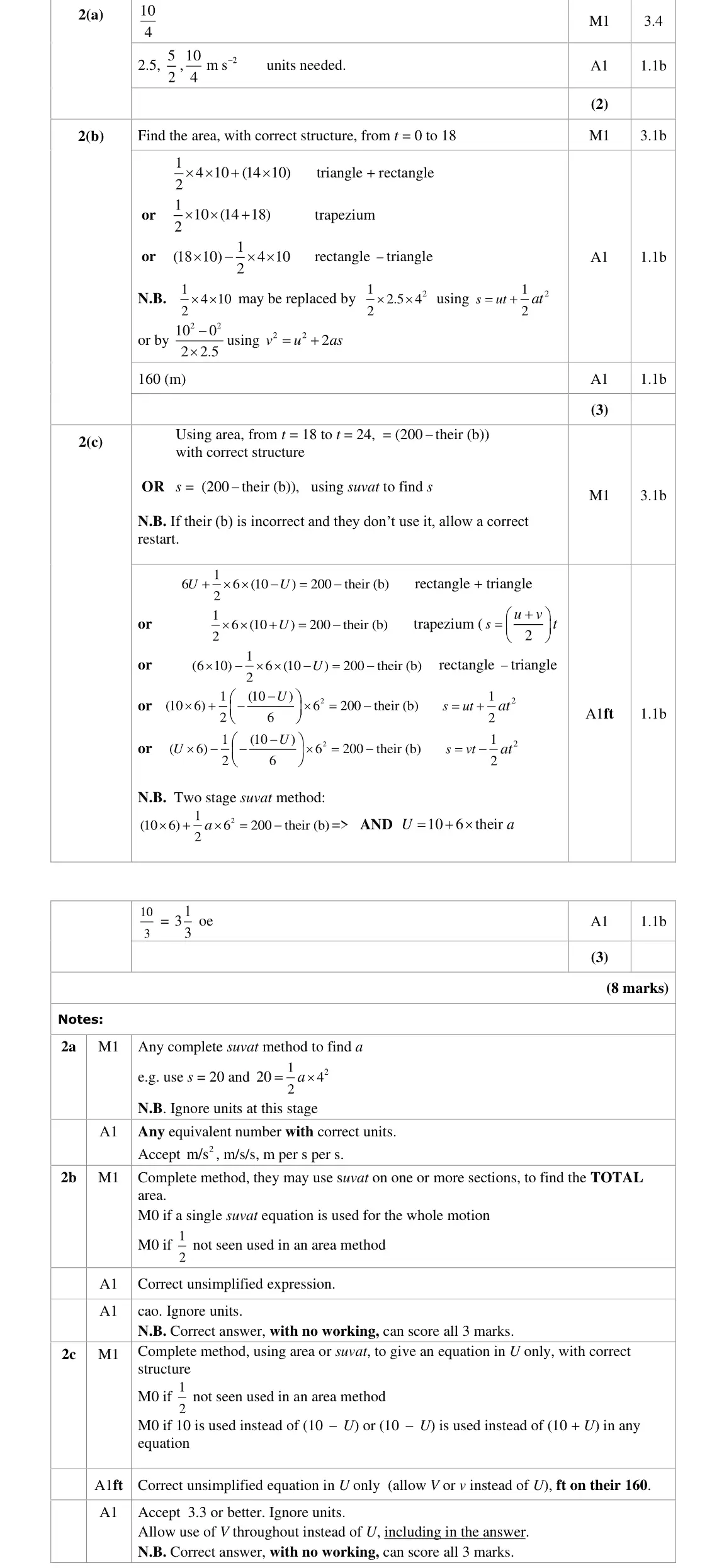
This question was accessible to all candidates, particularly parts (a) and (b). (a) This was generally answered very well either using a suvat equation or by finding the gradient of the first section of the graph. Some lost the second mark for writing incorrect m s- being the most common error 1 units or, occasionally, omitting the units altogether ( with the units). A few candidates confused acceleration with distance and found the area under the graph during the first six seconds.
Common mistakes
acceleration = gradient 10/4 = 2.5 m s⁻²
units needed (m s⁻¹ or none loses the A mark)
finding the area instead of the gradient
June 2024 · Paper 3 (Mechanics) · Q2(b)3 marks
Mark scheme (whole question; this part is marked with the orange bar)
Examiner's comment
This question was accessible to all candidates, particularly parts (a) and (b). (b) The vast majority scored all three marks here. The most popular approach was to sum the separate areas of the triangle and the rectangle or alternatively to find the area of the trapezium. Occasionally the ‘ 1 2 ’ was missing from either the area of the triangle or the trapezium. This error scored no marks for use of an incorrect formula. Those who used suvat methods tended to be less successful than those using an area approach.
Common mistakes
distance = area: triangle + rectangle or trapezium ½ × 10 × (14 + 18) = 160 m
missing the ½ scores nothing
a single suvat equation for the whole motion is M0
June 2024 · Paper 3 (Mechanics) · Q2(c)3 marks
Mark scheme (whole question; this part is marked with the orange bar)
Examiner's comment
(c) This part was more challenging. Most candidates recognised that they needed to subtract their answer to (b) from 200 to get the distance travelled from t = 18 to t = 24. 1 = + 2 ( ) s u v t Whilst some used , the most common successful approaches were to find an expression for the sum of the area of the triangle and rectangle or the area of the trapezium and equate that to 40. However, a significant number of candidates used the = ) 6 40 area of a triangle rather than a trapezium and wrote 1 - 2 (10 U leading to U = - 10 then ignored the sign and wrote it as a positive answer which coincidentally 3 was the correct answer but they scored no marks for an incorrect method. A small number of students attempted to find U by using suvat methods for the whole race, usually without success.
Common mistakes
distance from t = 18 to 24 is 200 − 160 = 40 m = trapezium ½ × 6 × (10 + U)
using a triangle ½ × 6 × (10 − U) gives −10/3 (no marks even if the sign is dropped)
U = 10/3
June 2024 · Paper 3 (Mechanics) · Q5(a)6 marks
Mark scheme (whole question; this part is marked with the orange bar)
Examiner's comment
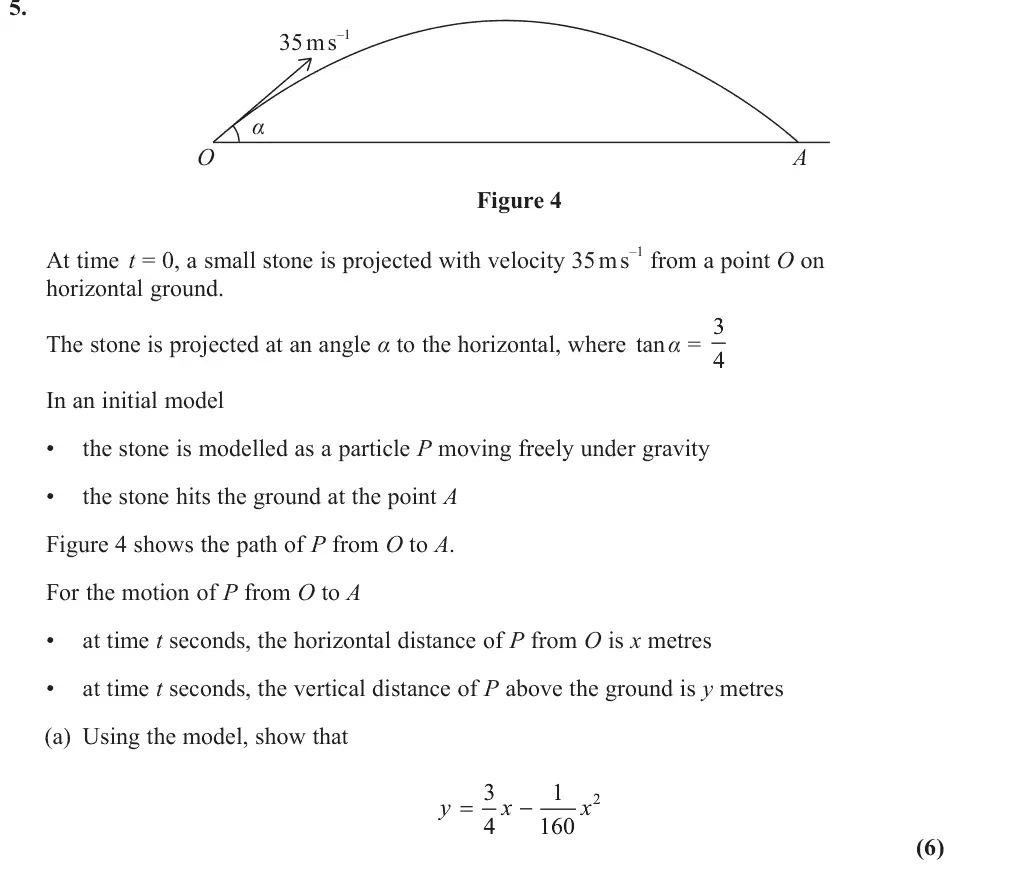
(a)This part required the derivation of an equation for the flight path of a stone moving freely under gravity given the initial speed and angle of projection. There were many excellent responses seen where candidates used horizontal and vertical components of the = + 2 s ut at initial velocity in to find expressions for x and y in terms of t, with the 1 2 majority realising that the acceleration was zero in the horizontal direction. Occasionally the velocities were not resolved or the acceleration in both directions was taken as g, but such instances were rare. Most proceeded to eliminate t correctly and obtain the printed equation. Since it was a given answer any slips in working tended to be rectified including any previous cos/sin confusion. The final mark did require 9.8 for the value of g to be seen being used explicitly in the working. Although full marks were often achieved in this part of the question, there were candidates who failed to make any valid progress, often because they equated their vertical distance to zero, possibly proceeding to calculate t and then realising they had no strategy for finding a general equation. Those who quoted the general equation for a trajectory and substituted in the given angle achieved no credit, but this was only very rarely seen. Some omitted this part of the question entirely, but it did not preclude them from accessing all marks in the subsequent parts. An alternative but significantly less common approach was to quote the general equation of a parabola as y = ax2 + bx + c and use the coordinates of three specific points to find the constants. Most realised that c = 0 and achieved the first two marks. Generally, the points corresponding to the range and the greatest height were found using suvat equations, although other points were possible. Some attempted to use completing the square with the maximum point at (60, 22.5) but failed to deal properly with the coefficients. Occasionally the derivative at x = 0 was used successfully to find the value of b. There were a fair number of entirely correct solutions seen using this method but also some which lacked organisation and a clear strategy. made no progress in part (a) often achieved the marks here.
Common mistakes
x = 35cos α × t (no horizontal acceleration) and y = 35sin α × t − ½gt², eliminate t
g = 9.8 must be seen explicitly
setting y = 0 gives no general equation
quoting the trajectory formula scores nothing
June 2023 · AS Paper 2 (Mechanics) · Q1(b)1 mark
Mark scheme (whole question; this part is marked with the orange bar)
Examiner's comment
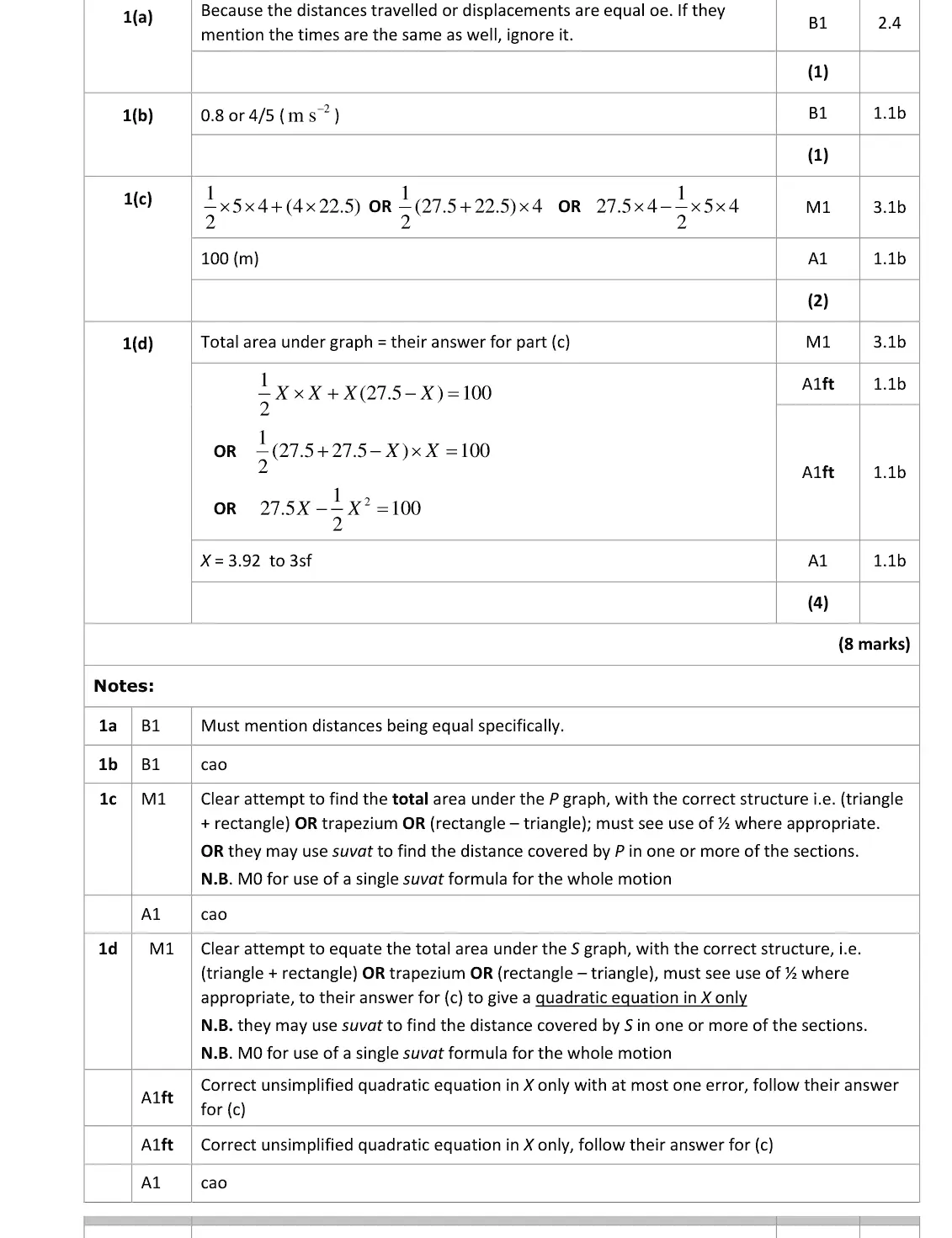
children had covered the same distance. In the second part, a few used Pythagoras or found the area but most either used the gradient or a suvat approach. A number went from 5a = 4 to 5 a = 4. Most candidates, in part (c), found the area correctly using Pat’s graph. Some made
Common mistakes
gradient of the first section = 4/5 = 0.8 m s⁻²
slips such as 5a = 4 giving a = 5/4
June 2023 · AS Paper 2 (Mechanics) · Q1(c)2 marks
Mark scheme (whole question; this part is marked with the orange bar)
Examiner's comment
5 a = 4. Most candidates, in part (c), found the area correctly using Pat’s graph. Some made 1 errors with lengths of sides or omitted the 2. Very few used suvat for the whole motion and a few left out the triangle thus getting either 90 or 110. There were many poor responses for the final part. Since the shape of the graph used in part (d) was the same shape as the graph used in part (c), it was surprising to see so many candidates using a different approach for finding this area even though they realised that the areas were the same. Many candidates either didn’t even attempt it or gave up after writing one equation in two variables. Of those who realised that the acceleration meant that X = t, or whatever variable they had used, a number were not able to use that to obtain an equation in X only and so scored no marks. There were a few suvat attempts and a common error was to use 22.5 instead of 27.5. Those who were able to get to a correct quadratic equation almost always selected the correct root as their final answer and usually gave it to 3sf although there were a few 3.91’s seen.
Common mistakes
total area under P's graph = ½ × 5 × 4 + 4 × 22.5 = 100 m (triangle + rectangle or trapezium)
omitting the ½ or the triangle (90 or 110)
one suvat formula for the whole motion scores 0
June 2023 · AS Paper 2 (Mechanics) · Q1(d)4 marks
Mark scheme (whole question; this part is marked with the orange bar)
Examiner's comment
final part. Since the shape of the graph used in part (d) was the same shape as the graph used
Common mistakes
acceleration 1 m s⁻² means Sam reaches X after X seconds
area ½X² + X(27.5 − X) = 100 gives a quadratic in X only
X = 3.92 (3 s.f., choose the root less than 27.5)
common errors 22.5 instead of 27.5, one equation in two unknowns
June 2023 · AS Paper 2 (Mechanics) · Q2(a)3 marks
Mark scheme (whole question; this part is marked with the orange bar)
Examiner's comment
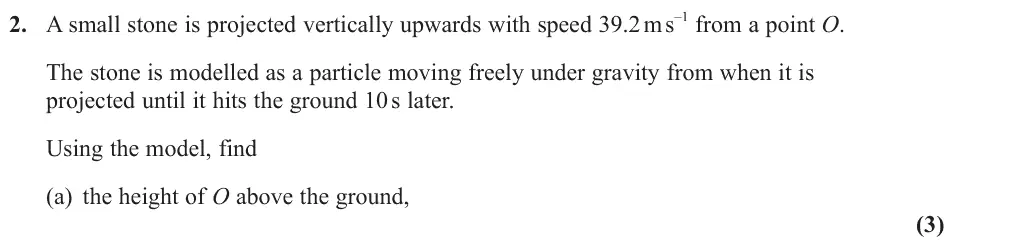
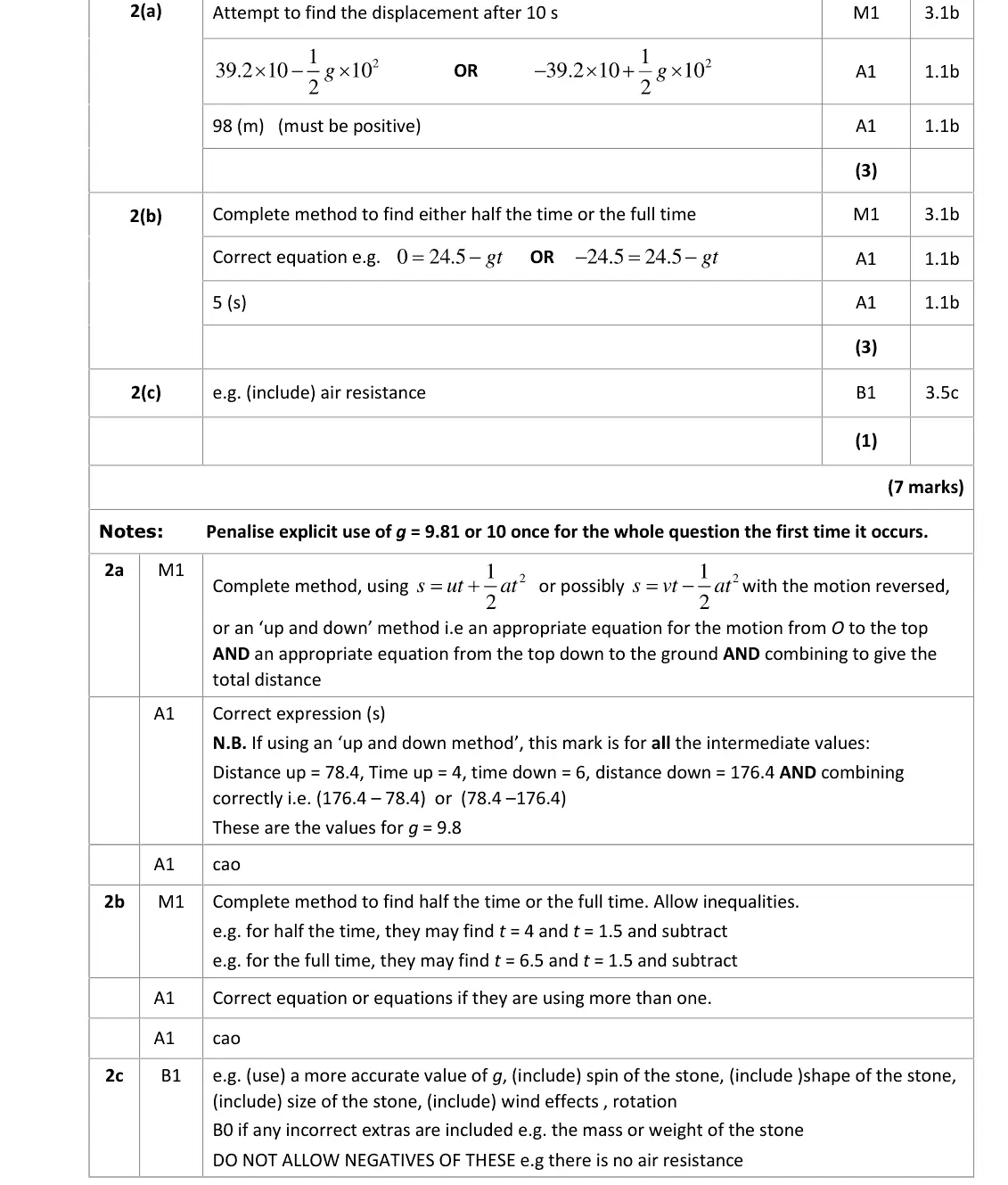
In part (a), there were surprisingly few diagrams seen and this would have helped candidates to understand the situation. The most common error was to set v = 0 leading to a height of 78.4 m. A few used t = 5 s or t = 10 s for both the up part and the down part of the motion. The most successful approach was the “whole motion” one, possibly because it is only the most able students who ever really grasp this. A significant number of candidates gave a negative answer. Many candidates, in the second part, managed to stumble across 2.5 s for half the time m s- or to treat this speed as a height. Some candidates 1 distance from part (a) along with 24.5 didn’t seem to realise that the speed of the stone reduced as it went upwards. In part (c), “air
Common mistakes
whole-motion s = ut + ½at² with u = 39.2, a = −9.8, t = 10 gives s = −98, height 98 m (must be positive)
setting v = 0 gives 78.4 (height above O only)
up-and-down method needs 78.4 and 176.4 combined
a diagram helps
June 2023 · AS Paper 2 (Mechanics) · Q2(b)3 marks
Mark scheme (whole question; this part is marked with the orange bar)
Examiner's comment
answer. Many candidates, in the second part, managed to stumble across 2.5 s for half the time but then failed to either find the other half or to double it. Some of the better candidates found t =1.5 s and t = 6.5 s and then subtracted which showed a clear understanding of the situation. Some successfully combined the various elements of times up and times down but the most successful approach was to find half the time and double it. A common error was to use the m s- or to treat this speed as a height. Some candidates 1 distance from part (a) along with 24.5
Common mistakes
speed ≤ 24.5 either side of the top: 0 = 24.5 − 9.8t gives 2.5 s, double to 5 s (or times 1.5 and 6.5 s and subtract)
forgetting to double
treating 24.5 as a height
June 2023 · Paper 3 (Mechanics) · Q1(a)1 mark
Mark scheme (whole question; this part is marked with the orange bar)
Examiner's comment
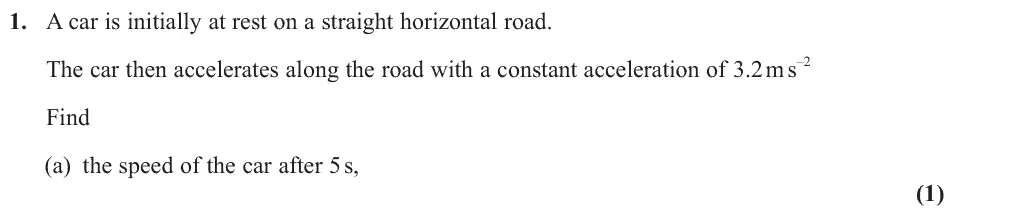
This proved to be a very friendly starter. In part (a), almost all of the candidates were able to score the mark. In some rare instances it was lost for incorrect subsequent working = such as 16 . In the second part, the vast majority used a correct method with most 4
Common mistakes
v = u + at with u = 0: 16 m s⁻¹
must be positive
June 2023 · Paper 3 (Mechanics) · Q1(b)2 marks
Mark scheme (whole question; this part is marked with the orange bar)
Examiner's comment
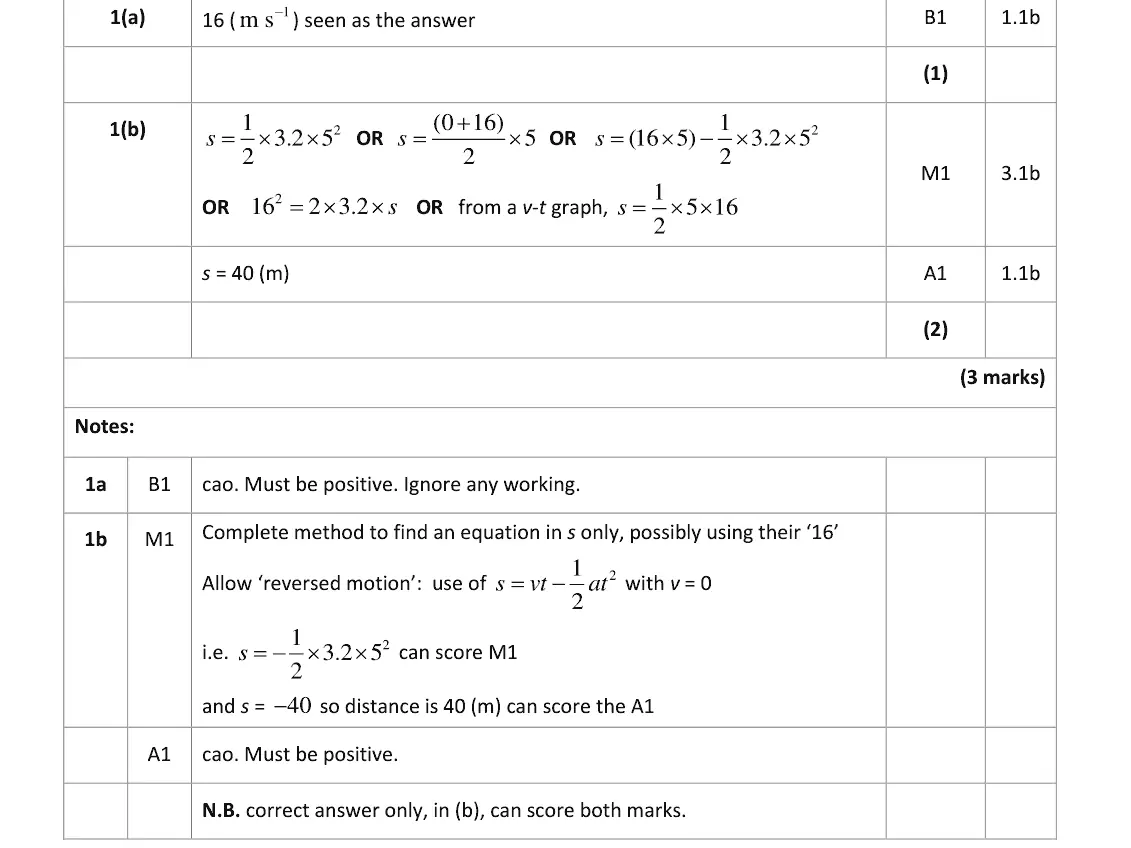
= such as 16 . In the second part, the vast majority used a correct method with most 4 1 = + 2 s ut at using but other suvat formulae were seen. Area under a v-t graph and 2 integration were employed very occasionally but usually with success. The most common mistake was to assume constant velocity and a few made an error with the arithmetic and lost the final mark. A surprising number wrote 3.2 for acceleration but used 3.5 in their calculation. Candidates would be well advised to state the formula being used before doing their calculation, so that method marks can still be awarded in the event of an arithmetical slip.
Common mistakes
s = ut + ½at² (or average speed, or area under v-t graph) = 40 m
assuming constant velocity (16 × 5) is wrong
state the formula before substituting so a slip still earns the method mark
June 2023 · Paper 3 (Mechanics) · Q4(a)4 marks
Mark scheme (whole question; this part is marked with the orange bar)
Examiner's comment
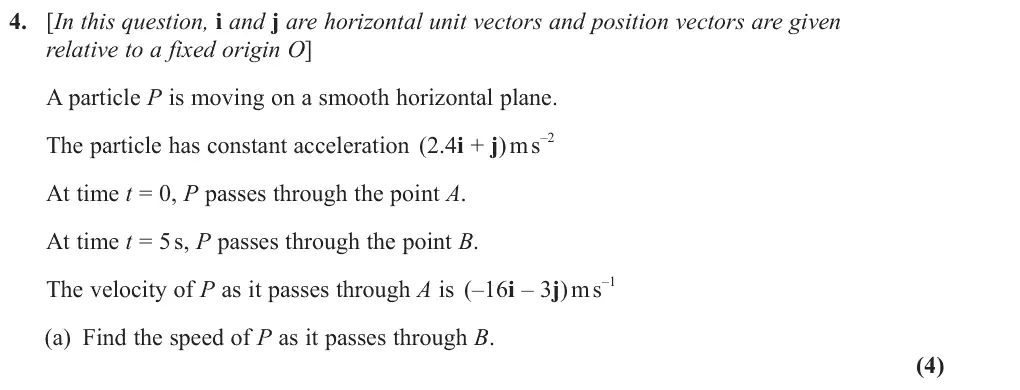
The first part was usually well attempted with most candidates scoring all four marks. The vast majority used v = u + at to find the velocity but a few lost the second two marks by not going on to find the magnitude of their velocity vector. Parts (b) and (c), however,
Common mistakes
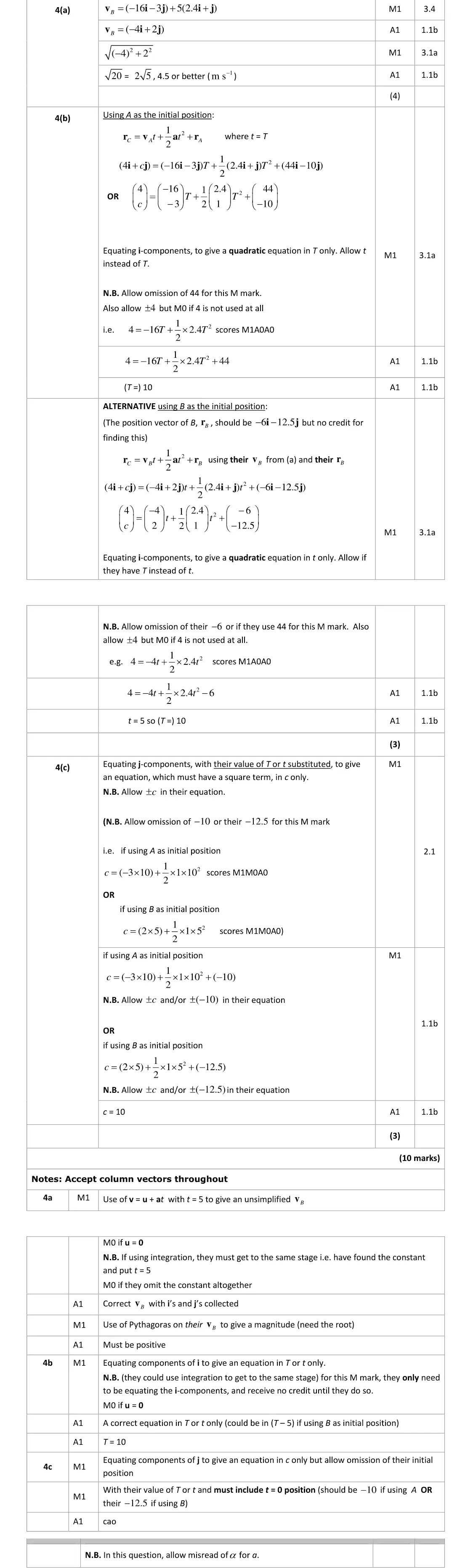
v = u + at with t = 5 gives −4i + 2j
then the magnitude √20 = 4.47
stopping at the velocity vector loses the last two marks
June 2023 · Paper 3 (Mechanics) · Q4(b)3 marks
Mark scheme (whole question; this part is marked with the orange bar)
Examiner's comment
by not going on to find the magnitude of their velocity vector. Parts (b) and (c), however, proved to be significantly more challenging. A few candidates wrote down a correct vector equation but were unable to make any further progress without focussing on separate components. Those who used integration to find r were often more successful, because the initial position of A was the integration constant. Of those who used r = ut + 0.5at2, many forgot to include the initial position of A and/or made a sign error and lost marks in both (b) and (c). In part (b), occasionally the quadratic equation was solved correctly but the wrong value of T was selected and in part (c) there was often a
Common mistakes
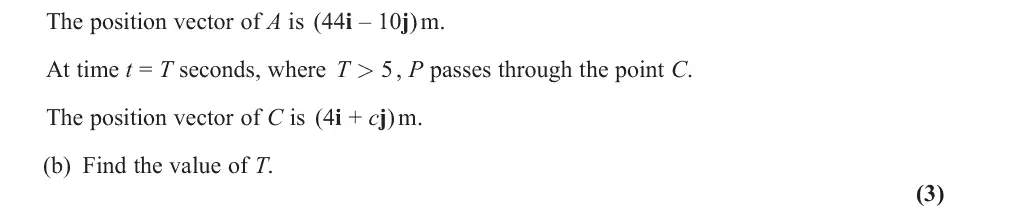
r = r_A + ut + ½at² must include the initial position 44i − 10j
equate i-components for a quadratic in T
choose T = 10 since T > 5
June 2023 · Paper 3 (Mechanics) · Q4(c)3 marks
Mark scheme (whole question; this part is marked with the orange bar)
Examiner's comment
by not going on to find the magnitude of their velocity vector. Parts (b) and (c), however, proved to be significantly more challenging. A few candidates wrote down a correct vector equation but were unable to make any further progress without focussing on separate components. Those who used integration to find r were often more successful, because the initial position of A was the integration constant. Of those who used r = ut + 0.5at2, many forgot to include the initial position of A and/or made a sign error and lost marks in both (b) and (c). In part (b), occasionally the quadratic equation was solved correctly but the wrong value of T was selected and in part (c) there was often a sign error on the 30 term. It was very rare to see candidates working with B as their initial position.
Common mistakes
equate j-components with T = 10, including the −10 initial position
sign error on the −30 term
c = 10
June 2022 · AS Paper 2 (Mechanics) · Q1(a)3 marks
Mark scheme (whole question; this part is marked with the orange bar)
Examiner's comment
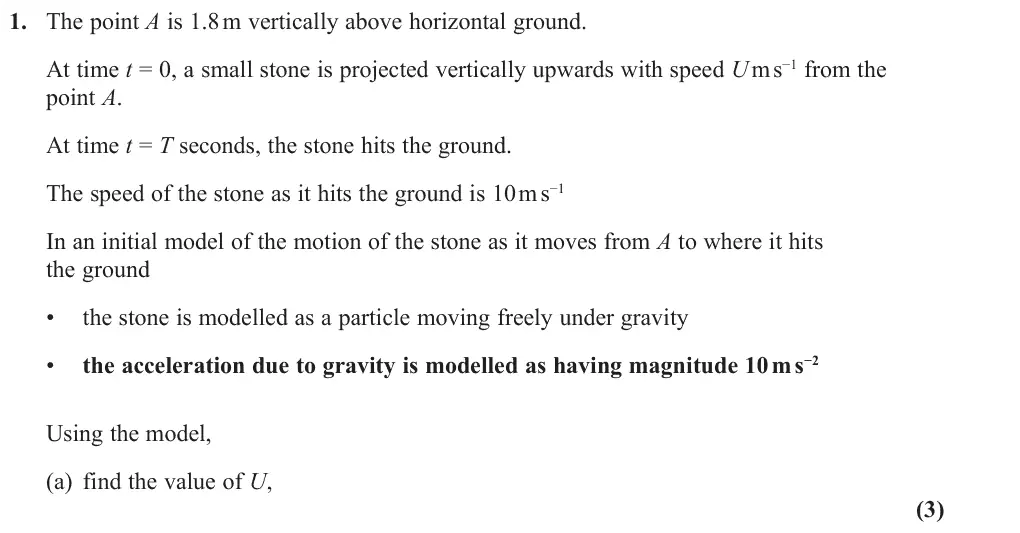
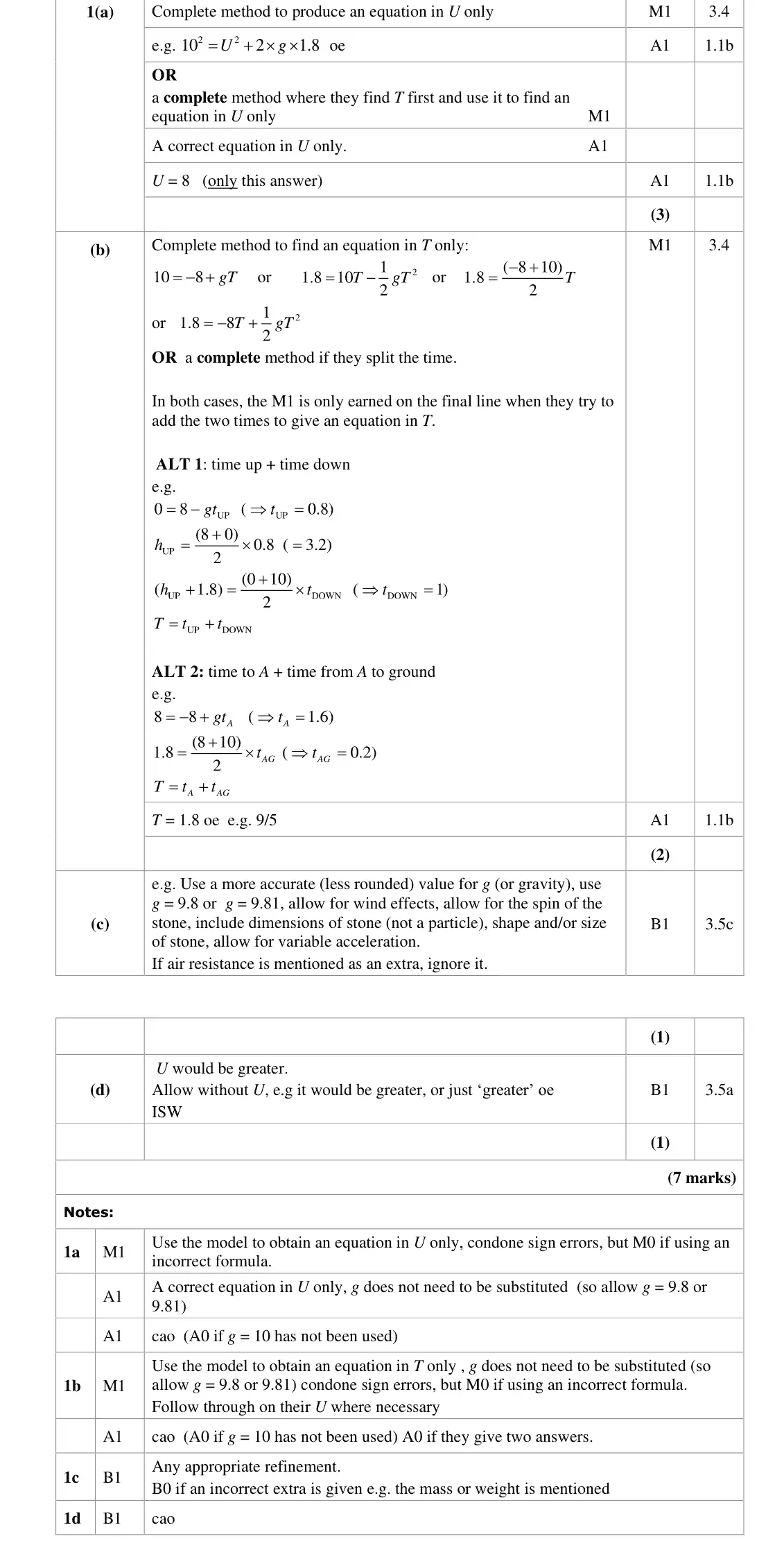
Candidates who had not read the question and used g as 9.8 or 9.81 were few and far between. Part (a) was generally well done with most candidates using the figures 10, 10 and 1.8 in a correct constant acceleration formula to obtain the given ‘U = 8’. Occasionally there was a sign error and although the correct answer was quoted, it did not actually follow from the working. A few used 0 as opposed to 10 for the final velocity. Some considered the motion ‘up’ and ‘down’ separately and used the distances to successfully derive the value of ‘U’. The most common approach in part (b) was to write down a quadratic equation in t and to solve it using
Common mistakes
v² = u² + 2as with v = 10, s = 1.8 down and g = 10 (not 9.8)
consistent sign convention
using 0 for the final velocity
U = 8 only
June 2022 · AS Paper 2 (Mechanics) · Q1(b)2 marks
Mark scheme (whole question; this part is marked with the orange bar)
Examiner's comment
Candidates who had not read the question and used g as 9.8 or 9.81 were few and far between. common approach in part (b) was to write down a quadratic equation in t and to solve it using the quadratic formula. There were occasional sign errors in the equation and some were either unable to deal with the quadratic or misquoted the formula. Nevertheless, a significant number did successfully find the two values of t and gave the correct one as their answer. The alternative approach of ‘up’ and ‘down’ separately was seen, but often only one of the times was calculated correctly. The other most common method being use of v = u + at but a significant number made a sign error in their equation and 0.2 was a very common wrong answer. In part (c), correct refinements seemed to be in the majority but only just. A more
Common mistakes
e.g. 10 = −8 + 10T or 1.8 = −8T + 5T² gives T = 1.8
sign errors and misquoted quadratic formula
reject the second root (two answers is A0)
if split up/down, both times needed
June 2022 · AS Paper 2 (Mechanics) · Q1(d)1 mark
Mark scheme (whole question; this part is marked with the orange bar)
Examiner's comment
Candidates who had not read the question and used g as 9.8 or 9.81 were few and far between. what would have been a correct one, and as a result losing the B mark. In the final part, correct answers were in the minority, with most candidates failing to appreciate that if there was air resistance, the stone would have to be projected faster in order to still hit the ground at 10 ms-1.
Common mistakes
U would be greater: the stone must be projected faster to still hit the ground at 10 m/s
"smaller" was the usual wrong answer
June 2022 · AS Paper 2 (Mechanics) · Q2(b)3 marks
Mark scheme (whole question; this part is marked with the orange bar)
Examiner's comment
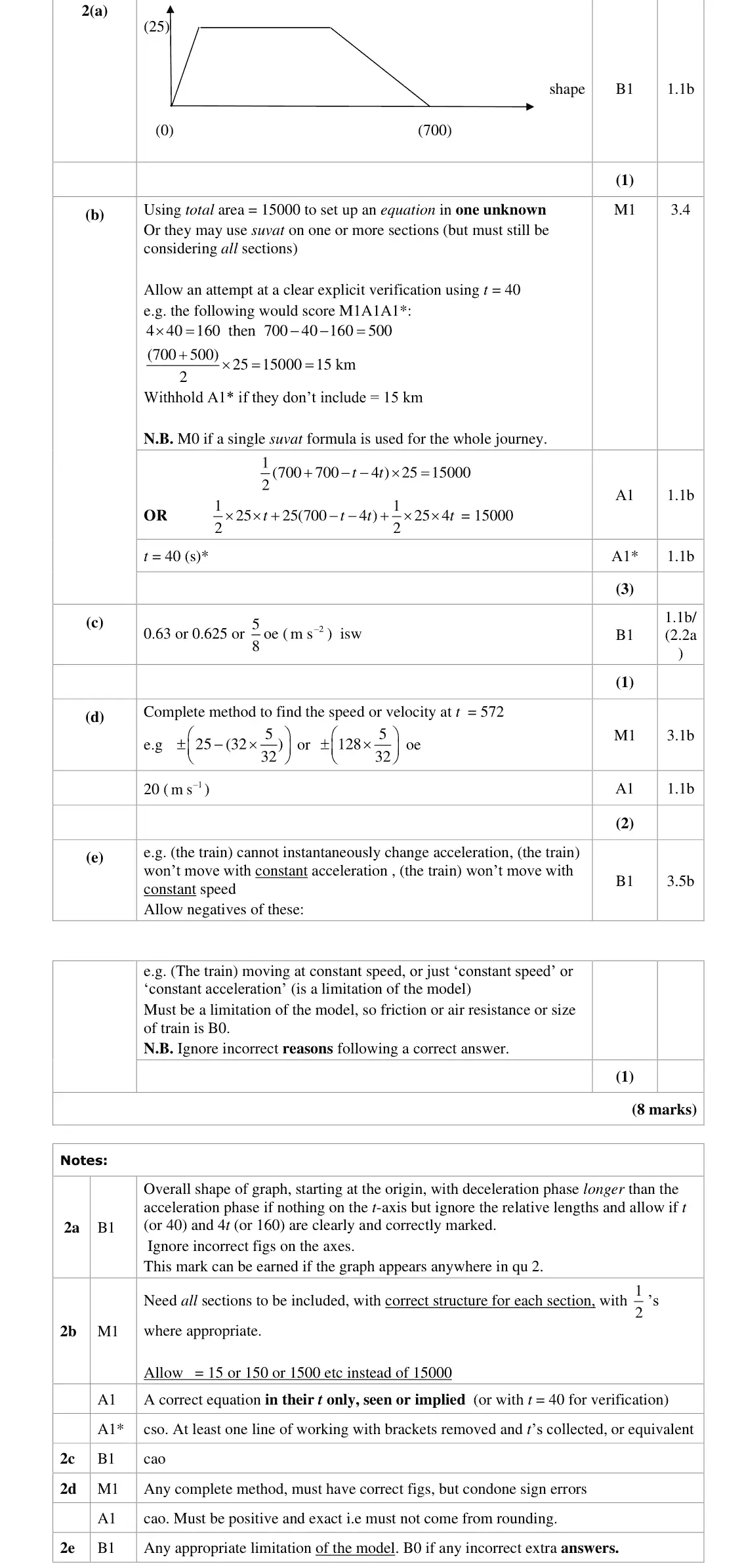
In the second part, most candidates connected the area under the graph to the distance of 15 km travelled, although some forgot to change km into m or converted it wrongly. Some chose to use the formula for the area of a trapezium directly, others divided the area into two triangles and a rectangle and a small number used a rectangle with two triangles subtracted. A significant number of candidates chose to solve the problem by using an explicit verification method, using t = 40 and the information given about the acceleration and deceleration times and the total time to show that the distance travelled was 15000 m but lost the final mark if they did not say that this was equal to 15 km. The vast majority of candidates scored the mark in part
Common mistakes
total area under the graph = 15000 m (convert km to m)
½(700 + 700 − 5t) × 25 = 15000 gives t = 40
a single suvat for the whole journey scores 0
verification must conclude = 15 km
June 2022 · AS Paper 2 (Mechanics) · Q2(c)1 mark
Mark scheme (whole question; this part is marked with the orange bar)
Examiner's comment
(c) for the acceleration. Part (d) was the most challenging part, with only better candidates able to come up with a method and of those, having worked out that the change in velocity was 5 ms-1, forgot that it was decelerating at this stage and added it on to 25 ms-1 instead of subtracting it.
Common mistakes
a = 25/40 = 0.625 m/s² (gradient of the first section)
June 2022 · AS Paper 2 (Mechanics) · Q2(d)2 marks
Mark scheme (whole question; this part is marked with the orange bar)
Examiner's comment
(c) for the acceleration. Part (d) was the most challenging part, with only better candidates able to come up with a method and of those, having worked out that the change in velocity was 5 ms-1, forgot that it was decelerating at this stage and added it on to 25 ms-1 instead of subtracting it.
Common mistakes
deceleration 25/160 = 5/32
t = 572 is 128 s before the end (or 32 s into deceleration): v = 25 − 32 × 5/32 = 20
common error adding the 5 m/s change to 25
June 2022 · AS Paper 2 (Mechanics) · Q2(e)1 mark
Mark scheme (whole question; this part is marked with the orange bar)
Examiner's comment
In part (a), most diagrams were drawn with the correct shape. The most common error was to not have the deceleration phase clearly longer than the acceleration phase. Also a few candidates didn't account for the time travelling at constant speed and drew a triangle which generally meant that they were unable to score many marks in the remainder of the question. In the second part, most candidates connected the area under the graph to the distance of 15 km travelled, although some forgot to change km into m or converted it wrongly. Some chose to use the formula for the area of a trapezium directly, others divided the area into two triangles and a rectangle and a small number used a rectangle with two triangles subtracted. A significant number of candidates chose to solve the problem by using an explicit verification method, using t = 40 and the information given about the acceleration and deceleration times and the total time to show that the distance travelled was 15000 m but lost the final mark if they did not say that this was equal to 15 km. The vast majority of candidates scored the mark in part (c) for the acceleration. Part (d) was the most challenging part, with only better candidates able to come up with a method and of those, having worked out that the change in velocity was 5 ms-1, forgot that it was decelerating at this stage and added it on to 25 ms-1 instead of subtracting it.
Common mistakes
the train cannot change acceleration instantaneously or will not have constant acceleration/speed
friction, air resistance or size of train are not limitations of this model
June 2022 · Paper 3 (Mechanics) · Q3(b)5 marks
Mark scheme (whole question; this part is marked with the orange bar)
Examiner's comment
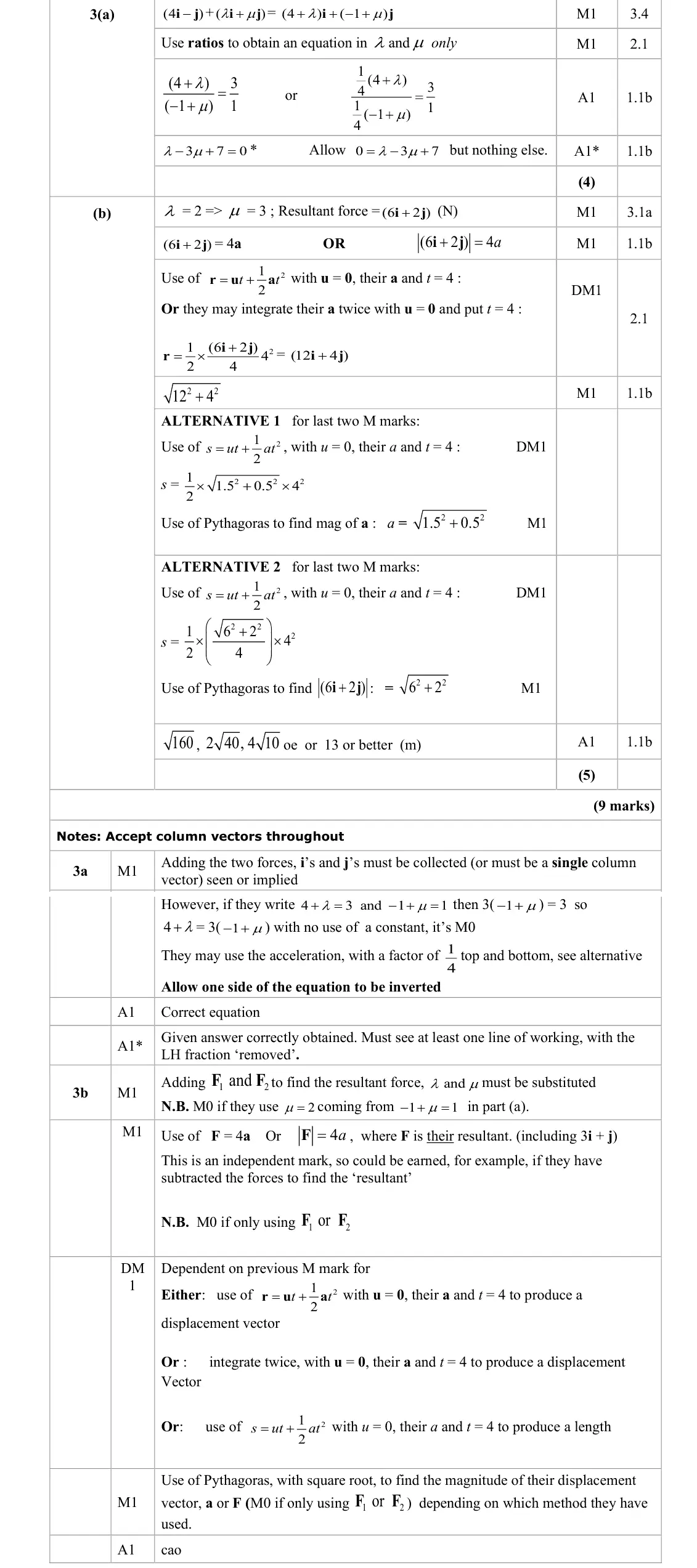
answer. In the second part, many candidates were able to find the resultant force and acceleration vectors. Some candidates found the magnitude of the force or acceleration at this stage and proceeded correctly with suvat formulae from there, while others continued with vectors. A number of candidates did not identify the initial velocity as zero, reading back to the information given at the start of the question being important here, so failed to use suvat formulae correctly. Use of u = 3i + j was not uncommon. Although most used suvat formulae, some successfully integrated the constant acceleration to find the velocity and displacement vectors. The majority of candidates knew how to find the magnitude of a vector using Pythagoras. The most significant errors seen included finding the resultant force but then using it as a displacement or velocity, showing a lack of understanding of the situation. A small number of candidates found an incorrect value for mu when substituting λ and there was occasional use of only one of the forces.
Common mistakes
μ = 3 so resultant 6i + 2j and a = (6i + 2j)/4
u = 0 as P starts at rest (u = 3i + j is wrong)
using the force as a displacement
using only one force
AB = √160 = 4√10 ≈ 12.6 m
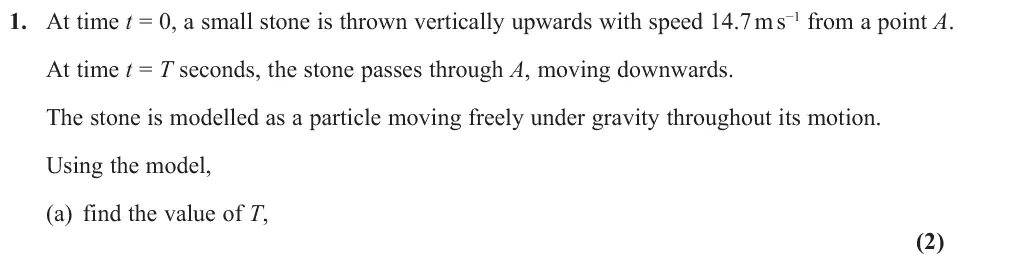
Oct 2021 · AS Paper 2 (Mechanics) · Q1(a)2 marks
Mark scheme (whole question; this part is marked with the orange bar)
Examiner's comment
(a) Many candidates just found the time to the top, losing both marks.
Common mistakes
displacement 0 at time T: 0 = 14.7T − 4.9T² gives T = 3
finding only the time to the top (1.5 s) scores nothing
use g = 9.8
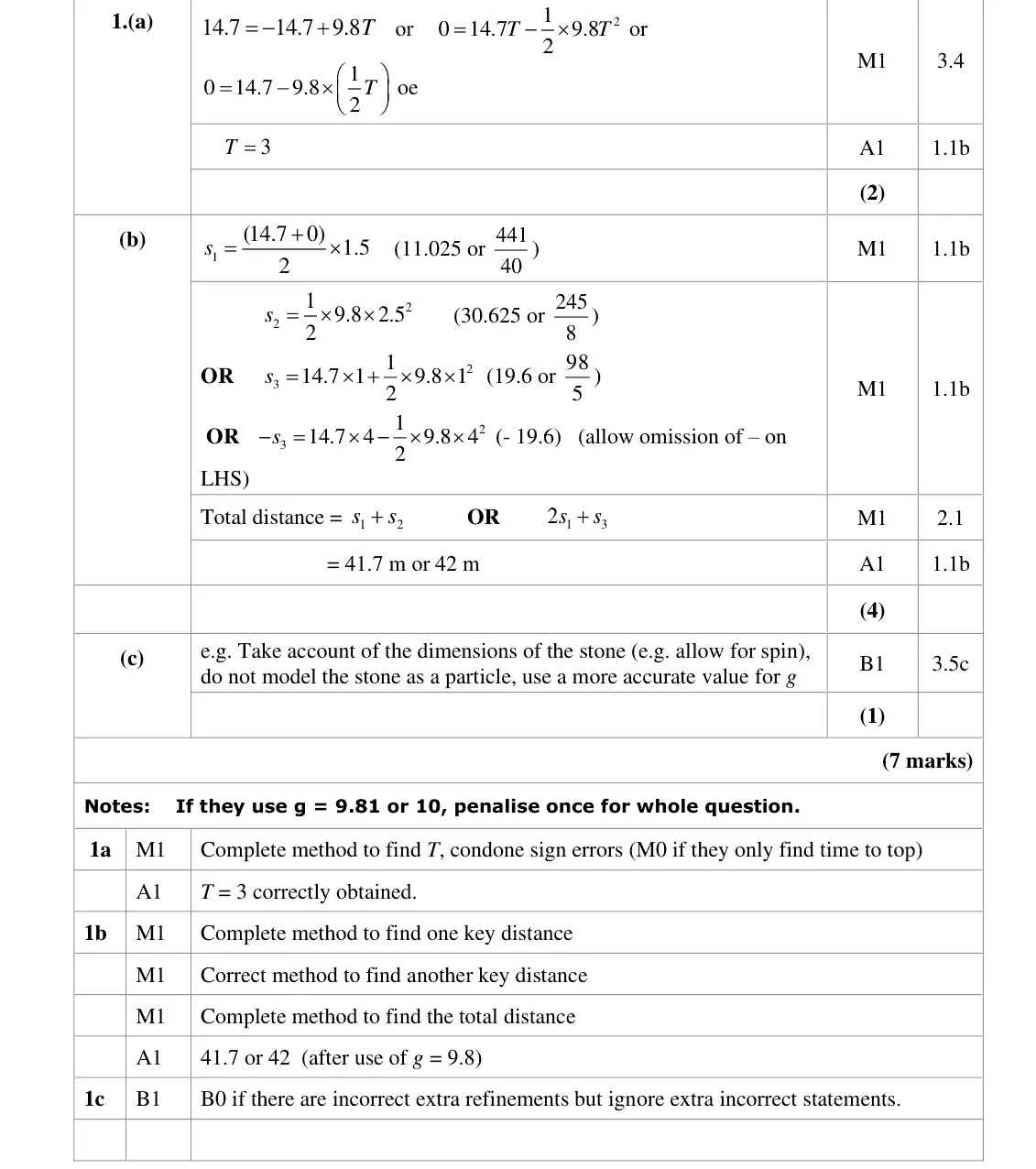
Oct 2021 · AS Paper 2 (Mechanics) · Q1(b)4 marks
Mark scheme (whole question; this part is marked with the orange bar)
Examiner's comment
(b) There were very few fully correct answers because most candidates did not realise that they had to consider the change in direction and just put t = 4 into a suvat equation. Some found the distance to the top and then used t = 2.5 to find the remaining distance but then did not round the answer to 2 or 3 sf following use of g = 9.8. A few used g = 9.81 or 10 despite the clear instruction on the front of the paper.
Common mistakes
distance, not displacement: the stone changes direction at t = 1.5, so add 11.025 up and 30.625 down = 41.7 m
substituting t = 4 into one suvat equation gives the displacement (19.6) only
2 or 3 s.f. after g = 9.8
Oct 2021 · AS Paper 2 (Mechanics) · Q3(b)7 marks
Mark scheme (whole question; this part is marked with the orange bar)
Examiner's comment
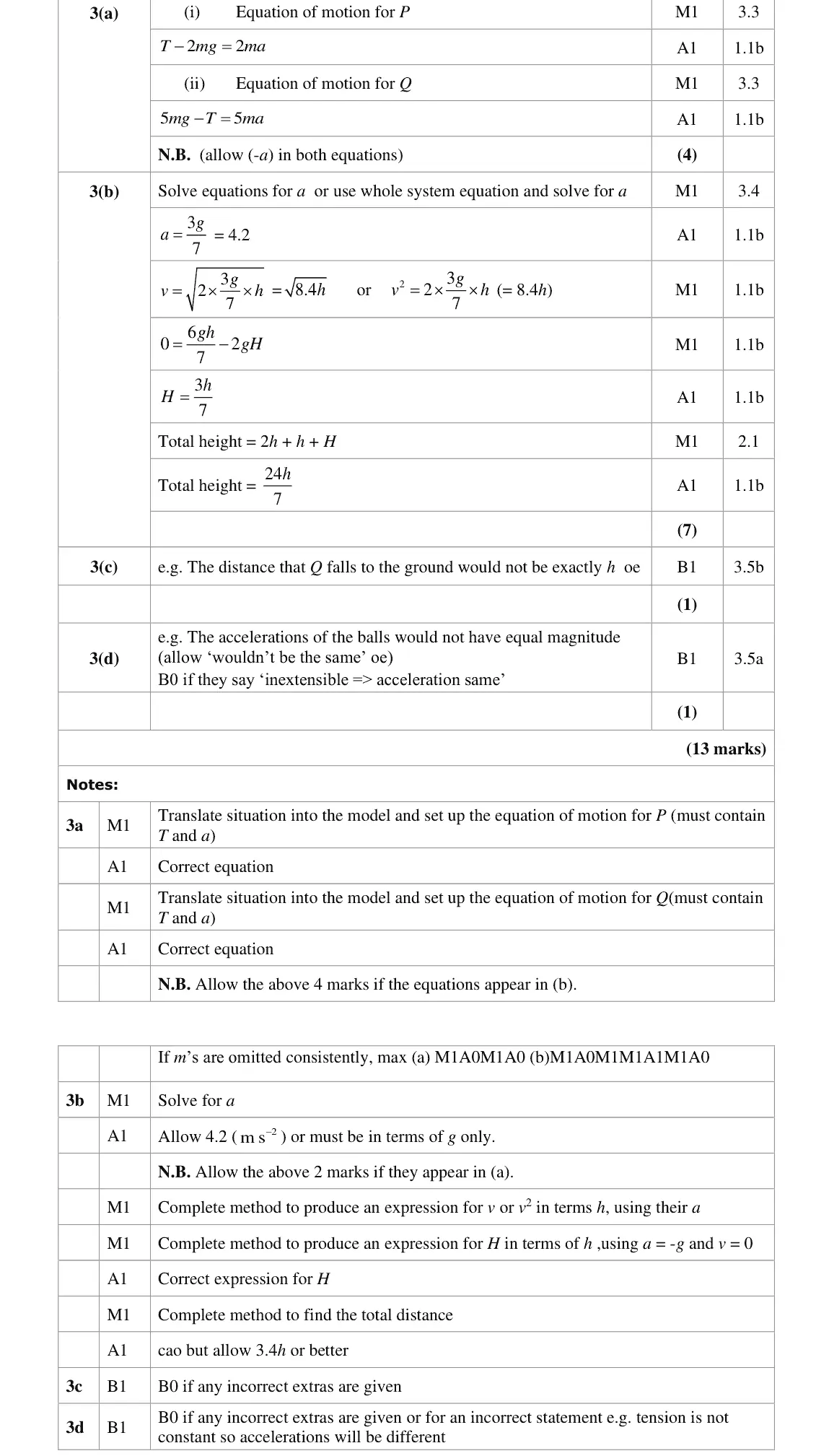
motion for P and Q but if they went on to use correct equations of motion in part (b) they scored the marks for part (a). Some had no idea at all and T never appeared. (b)Those who had correct equations of motion generally went on to find the acceleration but some missed g in their answer. Not many progressed successfully after this - some found T because that is what is usually required but in this question, it was not necessary. Some calculated the time taken for Q to reach the ground and used it in an equation for P, not realising that they had to find the velocity that P had acquired. Of those who did make progress, some missed the h in their answer for v, and others only added 2h instead of 3h in the final step.
Common mistakes
a = 3g/7
P's speed when Q lands from v² = 2ah (P has risen h)
then P moves freely under gravity: H = 3h/7
total height 2h + h + H = 24h/7
T is not needed
adding only 2h, or using the time Q takes to fall, are common errors
Oct 2021 · Paper 3 (Mechanics) · Q1(a)2 marks
Mark scheme (whole question; this part is marked with the orange bar)
Examiner's comment
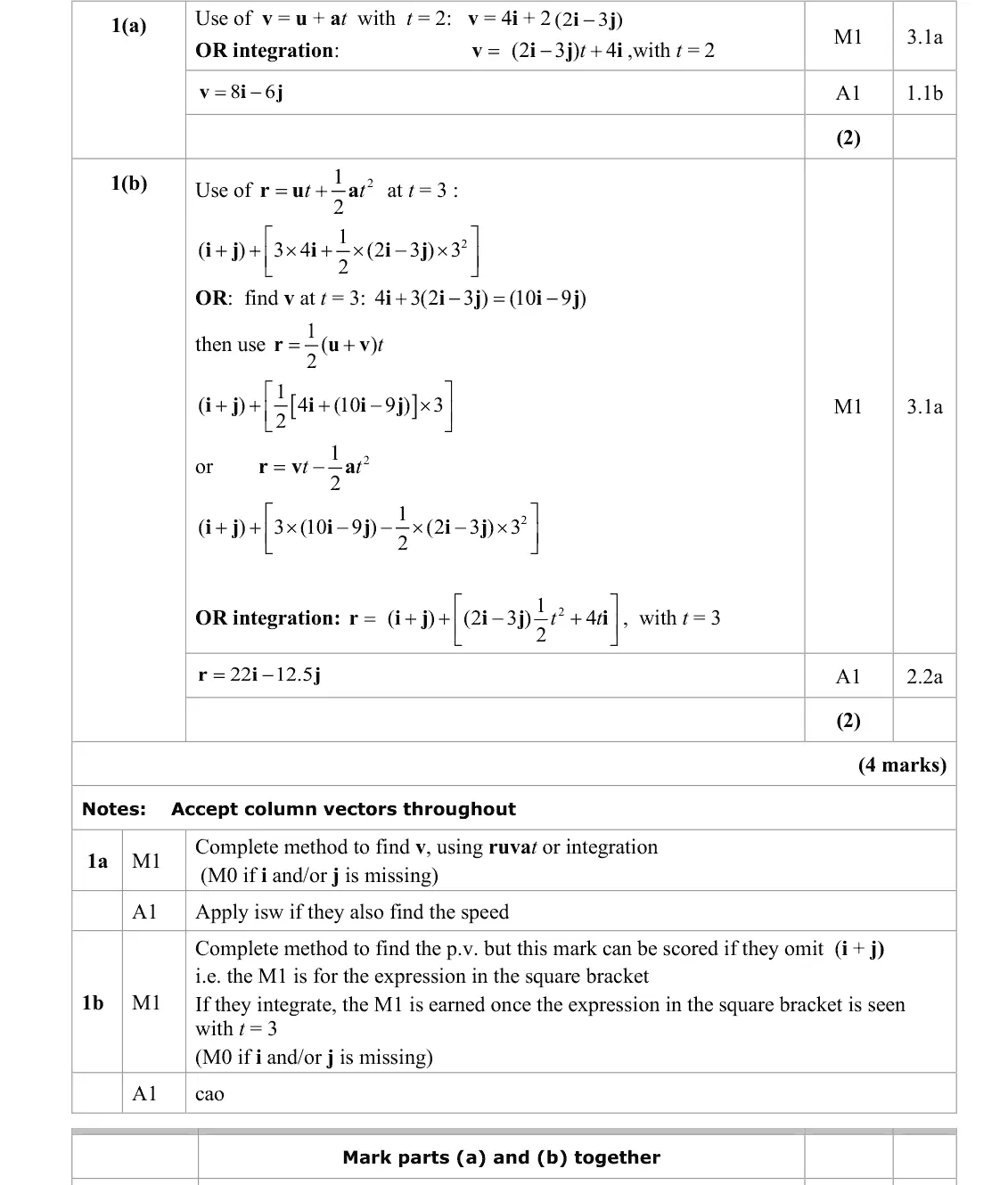
Part (a) was well answered with most students making use of v = u + at to arrive at the correct answer 8 6 = - v i j. It is important to note that this uses the initial velocity of 4i. The alternative method was to use integration, so the equivalent of the first stage was to integrate and use the 4i when calculating the constant of integration. A few made careless arithmetic errors and others forgot to use the 4i in the integration. A small number either differentiated or made no progress.
Common mistakes
v = u + at with u = 4i (if integrating, the 4i is the constant of integration and is often forgotten)
keep i and j (M0 if lost)
answer 8i − 6j
Oct 2021 · Paper 3 (Mechanics) · Q1(b)2 marks
Mark scheme (whole question; this part is marked with the orange bar)
Examiner's comment
Part (b) proved to be more challenging. Although there were many good solutions employing 2 1 2 t t = + r u a to find the change in displacement from t = 0 to t = 3, earning the method mark, a sizeable number of candidates forgot to add on i + j. The equivalent to the first stage using integration was 2 1 (2 3 ) 4 2 t t = - + r i j i . It was essential to include use of the 4i to earn the method mark, but the use of i + j was only required for the A mark. Some students chose to answer the question in stages, working out position vectors at t = 1, 2 and then t = 3. Other errors involved not keeping the question in i and j or column vector form, which lost the M mark, or incorrectly trying to turn the problem into a scalar problem.
Common mistakes
s = ut + ½at² gives the displacement only: add the initial position i + j (commonly forgotten)
stay in vector form, not a scalar problem
answer 22i − 12.5j
Oct 2021 · Paper 3 (Mechanics) · Q4(a)4 marks
Mark scheme (whole question; this part is marked with the orange bar)
Examiner's comment
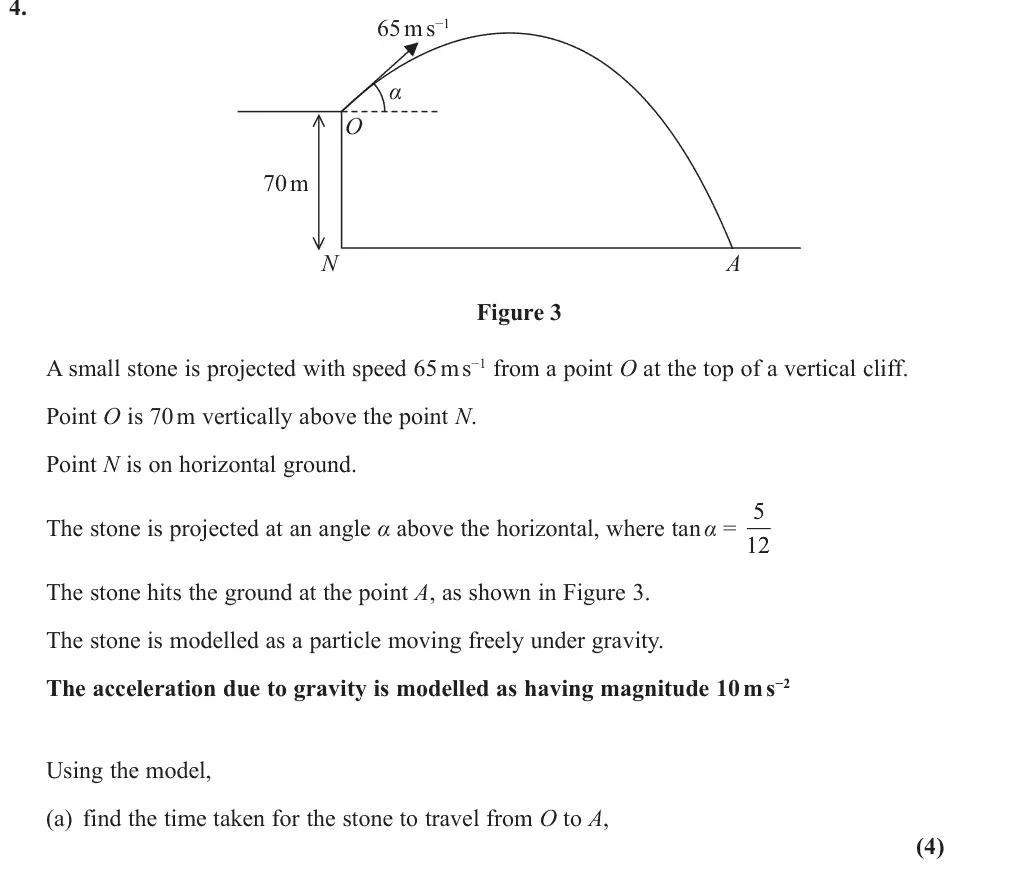
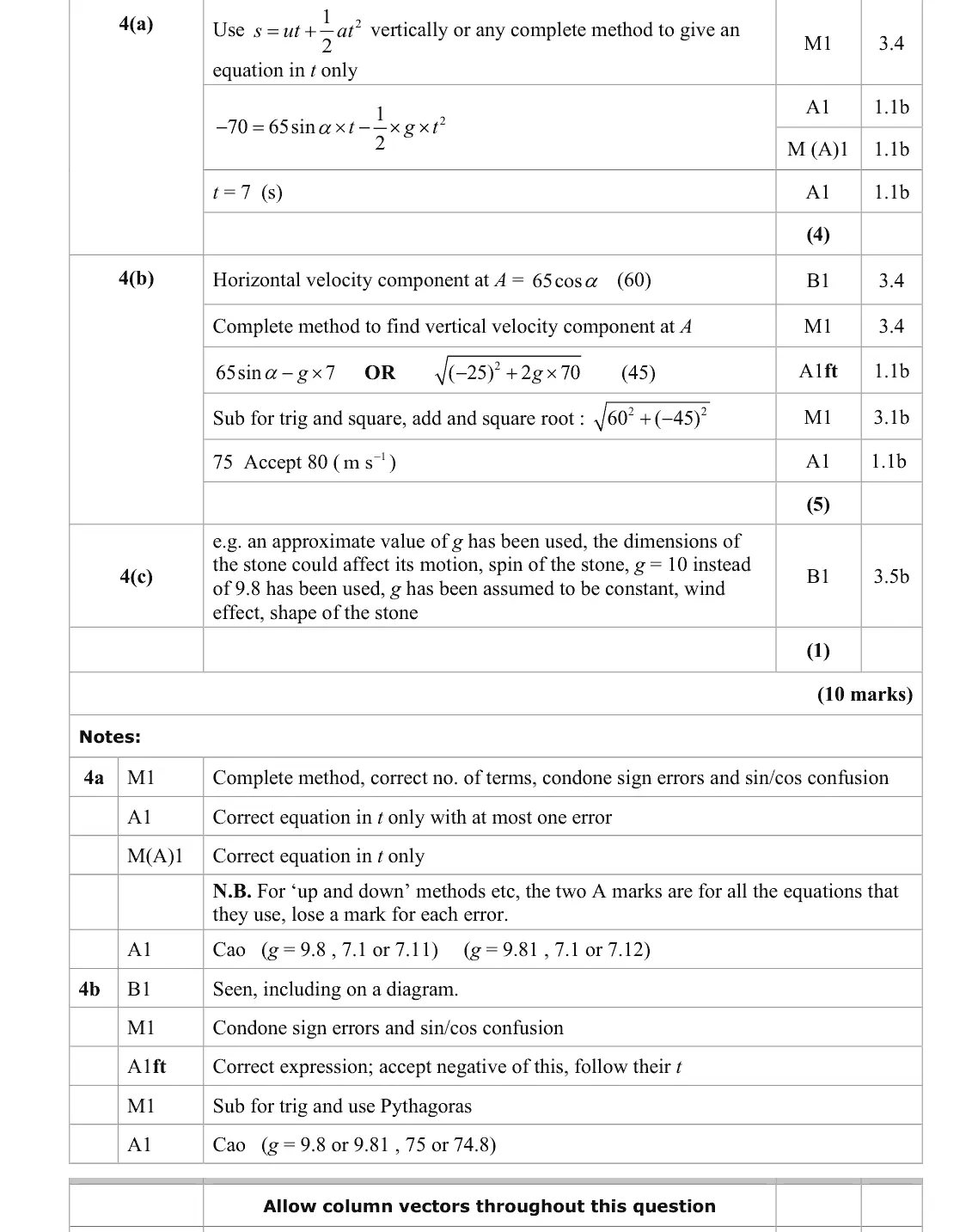
Candidates were instructed to use g = 10 in this question but were only penalised once if another value was used. In part (a), the majority of successful candidates employed the 1 most efficient method using a single application of to find the time to the 2 s ut at = + 2 ground. Other successful methods found the time to the top of the flight and then the time to go from the top to the ground and added. However, sign errors were common resulting candidates who used 𝑣𝑣2 = 𝑢𝑢2 + 2𝑎𝑎𝑎𝑎 to find the vertical component of velocity of the in 2/4 marks being scored for this part. A few candidates did not resolve the speed of 65 m s-. This lost the M mark and consequently they scored zero for part (a). In part (b), 1 particle at A were generally more successful than those who used the time found in part (a). Many solutions finished here and did not consider the need to look at the horizontal component as well. Those who had both components usually went on to apply Pythagoras theorem and calculate the actual speed of 75 m s-. For part (c), there were several 1
Common mistakes
resolve the 65: vertical component 65 sin α = 25 (tan α = 5/12)
s = ut + ½at² vertically with s = −70 and g = 10 (sign errors common)
up-and-down methods possible
t = 7 s
Oct 2021 · Paper 3 (Mechanics) · Q4(b)5 marks
Mark scheme (whole question; this part is marked with the orange bar)
Examiner's comment
Candidates were instructed to use g = 10 in this question but were only penalised once if candidates who used 𝑣𝑣2 = 𝑢𝑢2 + 2𝑎𝑎𝑎𝑎 to find the vertical component of velocity of the in 2/4 marks being scored for this part. A few candidates did not resolve the speed of 65 m s-. This lost the M mark and consequently they scored zero for part (a). In part (b), 1 particle at A were generally more successful than those who used the time found in part (a). Many solutions finished here and did not consider the need to look at the horizontal component as well. Those who had both components usually went on to apply Pythagoras theorem and calculate the actual speed of 75 m s-. For part (c), there were several 1
Common mistakes
need both components: horizontal 65 cos α = 60 (often omitted) and vertical 45 (v² = u² + 2as is more reliable than using t)
Pythagoras gives 75 m/s
Oct 2020 · AS Paper 2 (Mechanics) · Q1(a)2 marks
Mark scheme (whole question; this part is marked with the orange bar)
Examiner's comment
Part (a) was well answered with most candidates using one equation but a few found the maximum height first. There were a variety of methods seen for the second part, with the most common being use of v = u + at, but a significant
Common mistakes
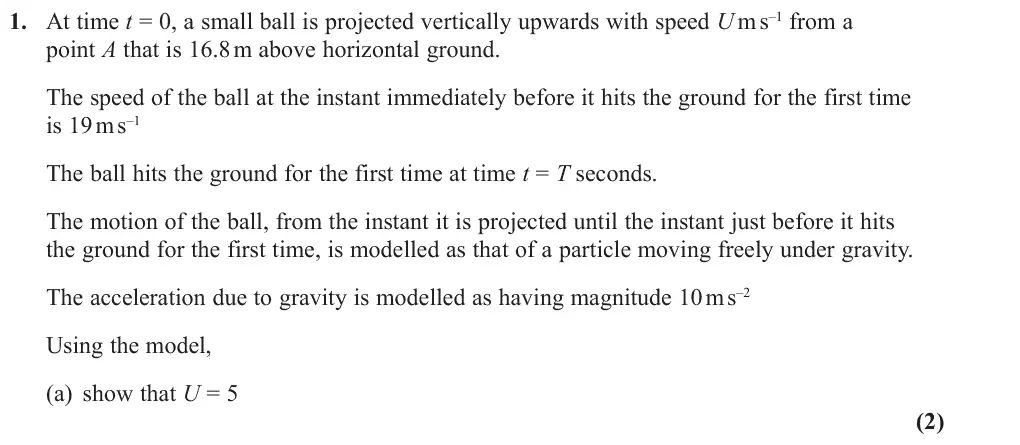
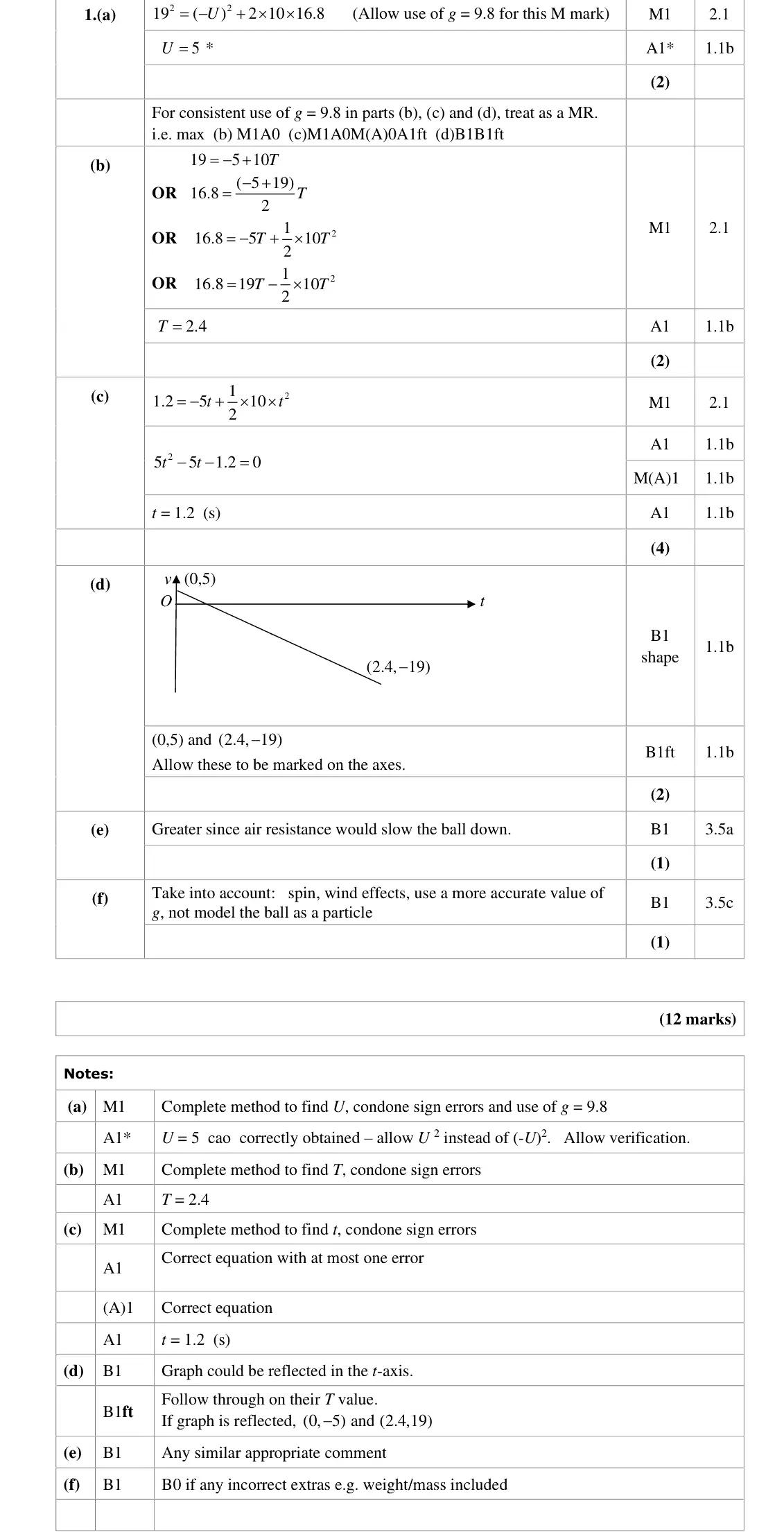
v² = u² + 2as with s = 16.8 down and g = 10 (not 9.8)
sign convention for U and 19 consistent
allow verification
Oct 2020 · AS Paper 2 (Mechanics) · Q1(b)2 marks
Mark scheme (whole question; this part is marked with the orange bar)
Examiner's comment
second part, with the most common being use of v = u + at, but a significant number made a sign error in their equation and 1.4 was a very common wrong answer. In part (c), a significant minority failed to understand that s = 1.2 was
Common mistakes
19 = −5 + 10T gives T = 2.4
sign errors (e.g. 19 = 5 + 10T, giving 1.4) very common
Oct 2020 · AS Paper 2 (Mechanics) · Q1(c)4 marks
Mark scheme (whole question; this part is marked with the orange bar)
Examiner's comment
answer. In part (c), a significant minority failed to understand that s = 1.2 was required with many using 15.6. Those using one equation often made a sign error. Calculators were usually used to solve the resulting quadratic equation. The other method which seemed to produce fewer errors was to find the time to the top and the time down and then add. In part (d), very few correct graphs seen. Many
Common mistakes
displacement is 1.2 m below A, not 15.6 m
1.2 = −5t + 5t² gives 5t² − 5t − 1.2 = 0, t = 1.2 s
sign errors in the one-equation method
Oct 2020 · AS Paper 2 (Mechanics) · Q1(e)1 mark
Mark scheme (whole question; this part is marked with the orange bar)
Examiner's comment
part (e), it was very rare not to see lesser, with the vast majority not realising that for the ball to hit the ground with the given speed of 19.6 ms-1, it would need to be projected with a greater speed to overcome air resistance. In the final part,
Common mistakes
U would be greater because air resistance slows the ball, so a bigger projection speed is needed to reach 19 m/s
"lesser" was the usual wrong answer
Oct 2020 · Paper 3 (Mechanics) · Q2(a)2 marks
Mark scheme (whole question; this part is marked with the orange bar)
Examiner's comment
In the first part, the majority of candidates used v = u + at with t = 2 to obtain a correct constant, in this case, the initial velocity. In part (b), most used r = ut + 1 velocity. Some chose to integrate, often successfully, although some failed to include a 2 at2 to find a displacement vector. Again, some chose to integrate, mostly correctly. Having equated their displacement expression to λi – 4.5j, some did not know how to proceed. A few tried to use magnitudes and reduce the problem to scalars and some had mixed up velocity and displacement. Those who realised that equating j components gave an equation in T generally solved the resulting quadratic and found the correct answer. Part (c) required
Common mistakes
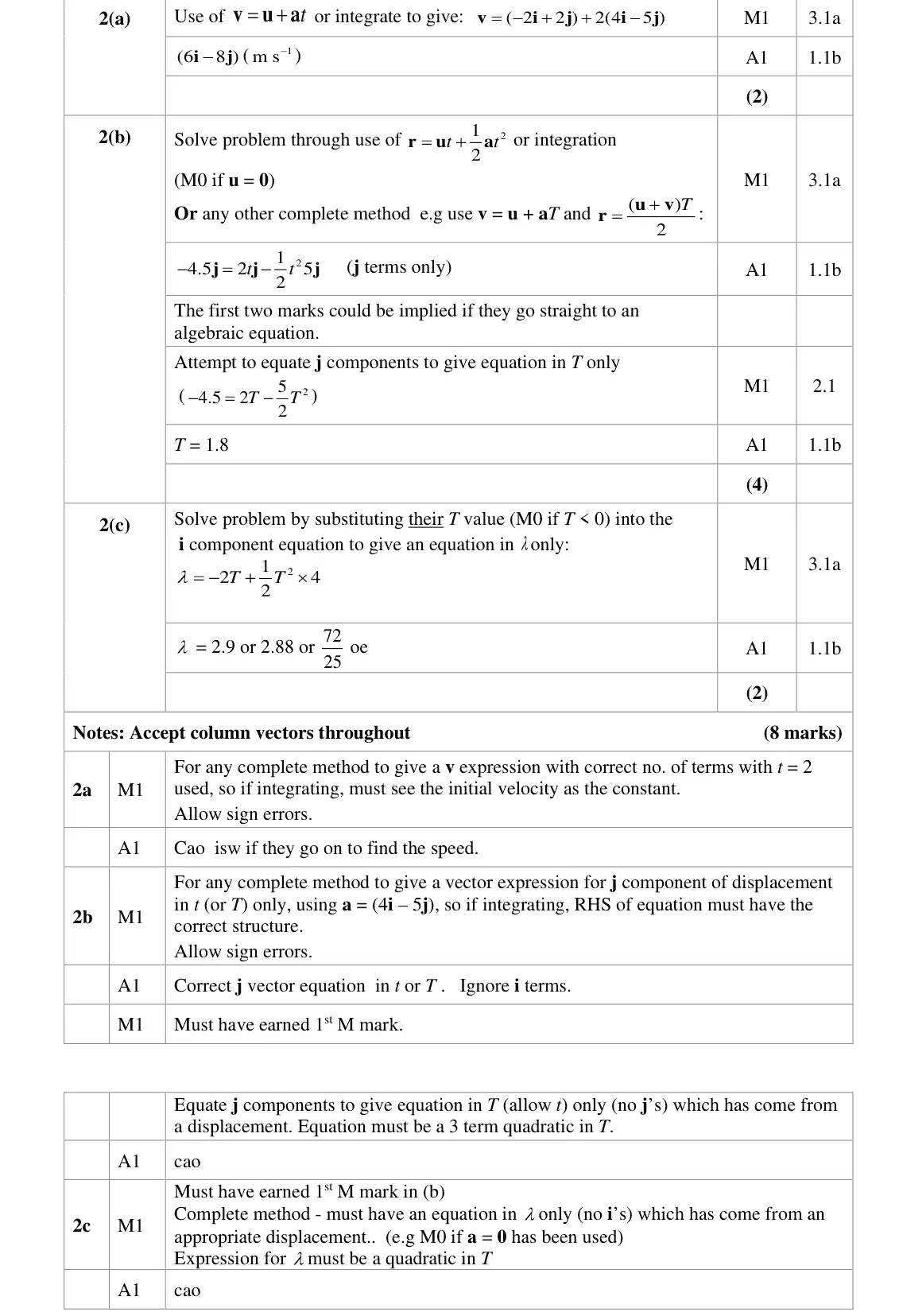
v = u + at with vectors: (−2i + 2j) + 2(4i − 5j) = 6i − 8j
if integrating, the initial velocity is the constant
velocity is a vector, the speed is not needed
Oct 2020 · Paper 3 (Mechanics) · Q2(b)4 marks
Mark scheme (whole question; this part is marked with the orange bar)
Examiner's comment
In the first part, the majority of candidates used v = u + at with t = 2 to obtain a correct constant, in this case, the initial velocity. In part (b), most used r = ut + 1 velocity. Some chose to integrate, often successfully, although some failed to include a 2 at2 to find a displacement vector. Again, some chose to integrate, mostly correctly. Having equated their displacement expression to λi – 4.5j, some did not know how to proceed. A few tried to use magnitudes and reduce the problem to scalars and some had mixed up velocity and displacement. Those who realised that equating j components gave an equation in T generally solved the resulting quadratic and found the correct answer. Part (c) required the marks in part (b) went on to gain the two marks here. A method mark was available for those carrying through a wrong value for T provided that it had been found from a valid method in part (b).
Common mistakes
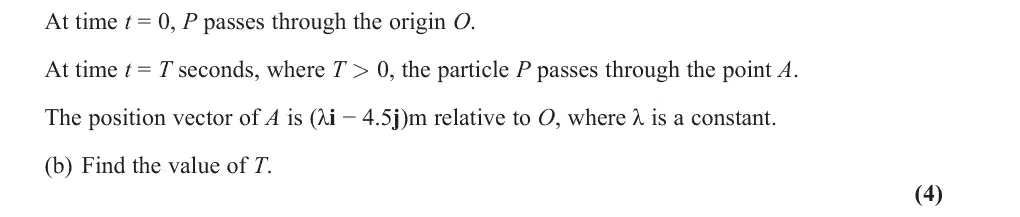
r = ut + ½at² (not with u = 0)
equate the j components only: −4.5 = 2T − (5/2)T² gives T = 1.8
do not take magnitudes or mix up velocity and displacement
Oct 2020 · Paper 3 (Mechanics) · Q2(c)2 marks
Mark scheme (whole question; this part is marked with the orange bar)
Examiner's comment
generally solved the resulting quadratic and found the correct answer. Part (c) required the value for T to be substituted into the i component and virtually all those who achieved the marks in part (b) went on to gain the two marks here. A method mark was available
Common mistakes
substitute T = 1.8 into the i component: λ = −2T + 2T² = 2.88 (72/25)
reject a negative T
Oct 2020 · Paper 3 (Mechanics) · Q5(b)3 marks
Mark scheme (whole question; this part is marked with the orange bar)
Examiner's comment
complete a solution for U could go on to gain full marks for part (b) which was generally well attempted. Nearly all recognised that the vertical velocity was zero at the highest point. A few failed to use the vertical component of U and so did not achieve the method mark. Others assumed the highest point occurred when the horizontal distance was 50 m, half the range, which was not the case here since the start and end points were not on the same level. The most common error was in giving the answer as a height above the level of projection rather than above ground level. For part (c) there were certain statements
Common mistakes
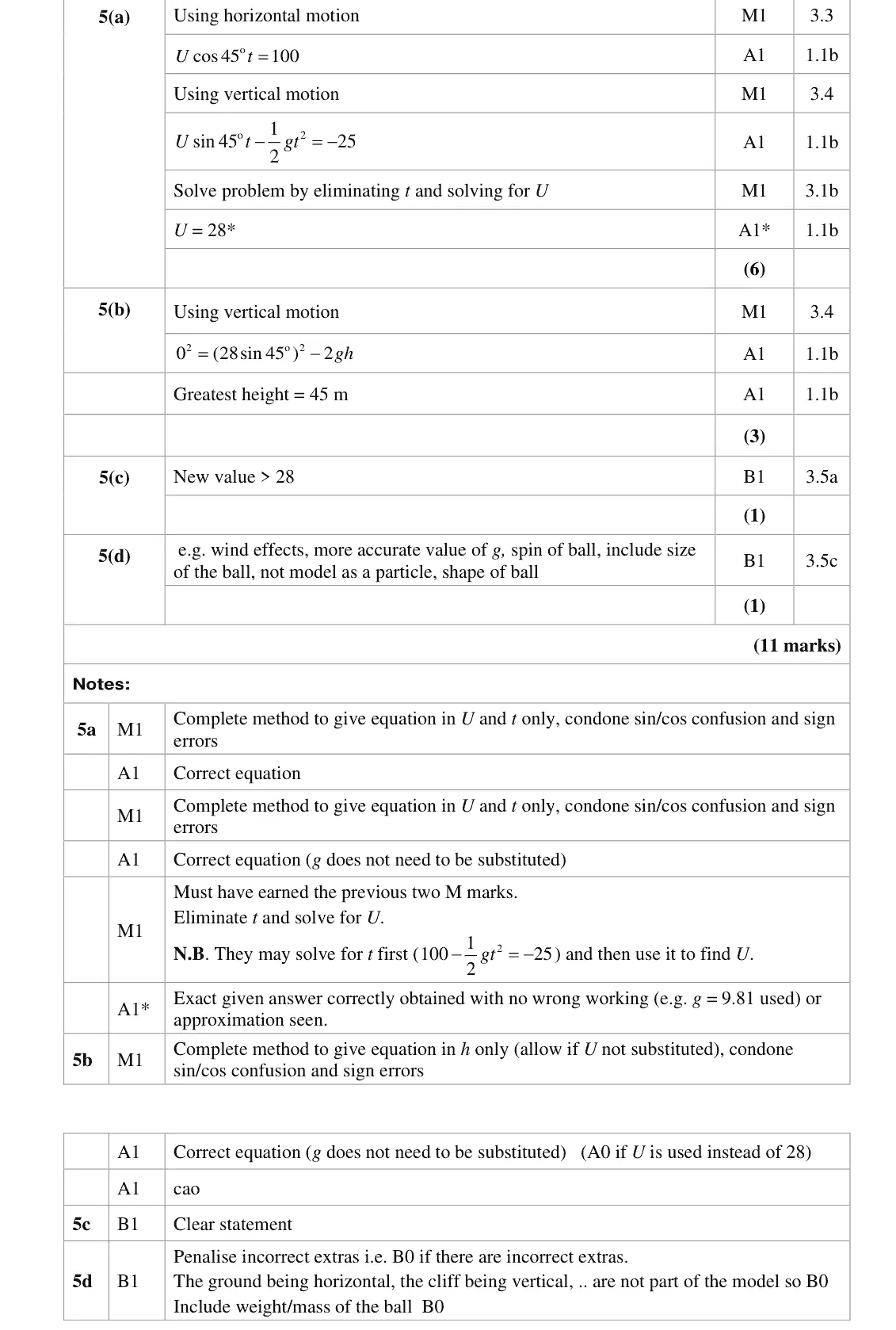
vertical velocity zero at the top: 0 = (28 sin 45°)² − 2gh gives 20 m
add the 25 m cliff, answer 45 m above the ground
use the vertical component of U
the top is not at half the range (50 m)
June 2019 · AS Paper 2 (Mechanics) · Q1(a)1 mark
Mark scheme (whole question; this part is marked with the orange bar)
Examiner's comment
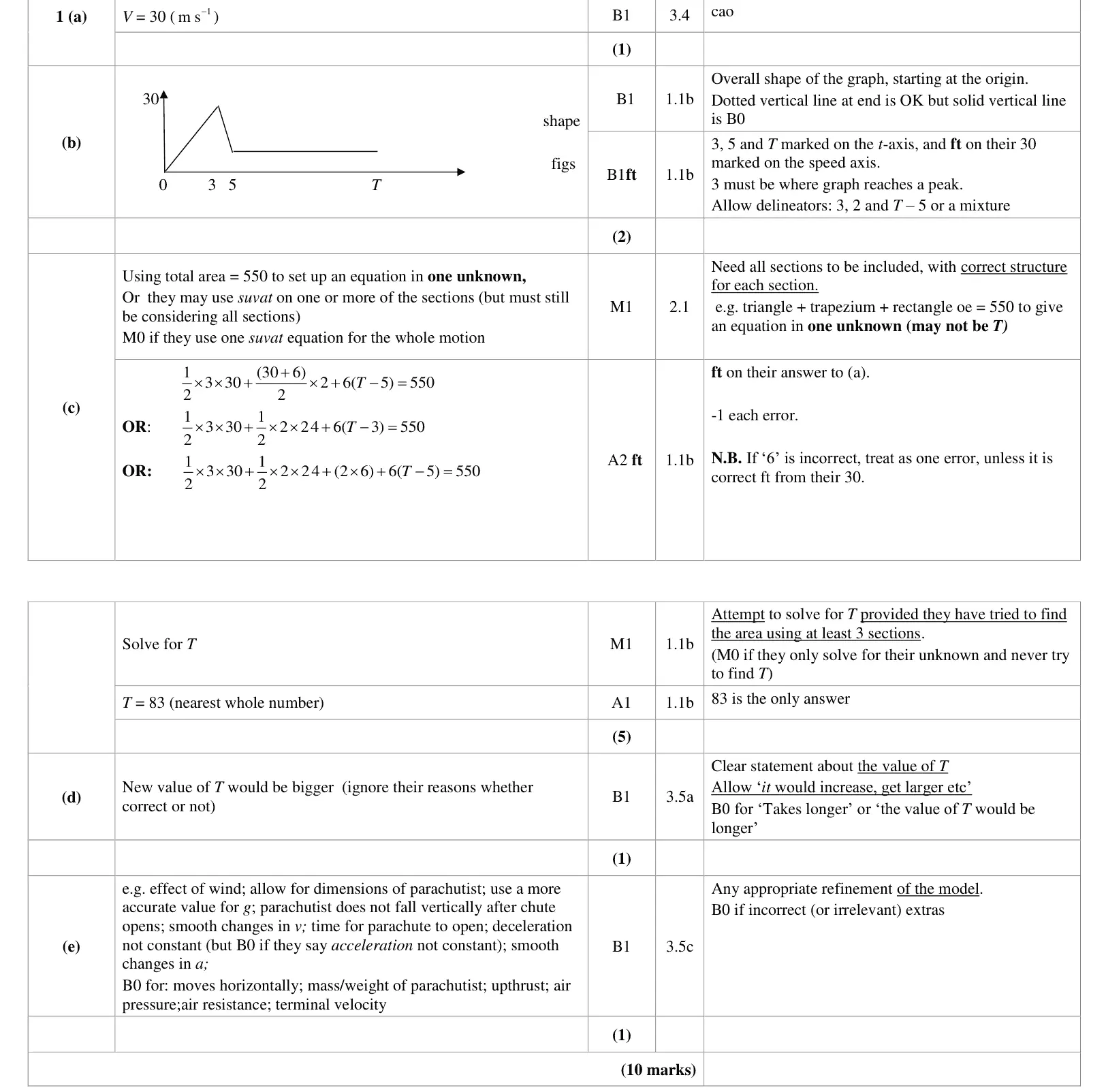
The first part was well done by the majority of candidates who used a suvat equation to find the required speed after 3 seconds.
Common mistakes
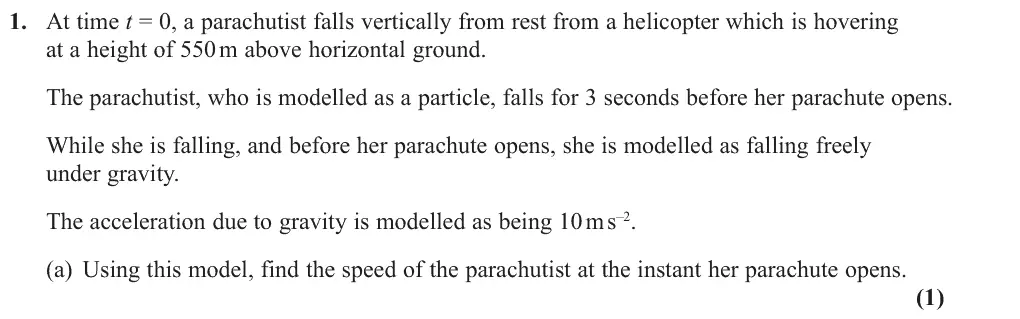
free fall from rest with g = 10: v = 0 + 10 × 3 = 30 m s⁻¹
June 2019 · AS Paper 2 (Mechanics) · Q1(c)5 marks
Mark scheme (whole question; this part is marked with the orange bar)
Examiner's comment
one or two were omitted but many did achieve this mark. In the third part the majority of the candidates realised that the area under the graph represented the distance travelled. However, not all used the correct structure, namely a triangle, rhombus and rectangle (or equivalent) and the relevant correct formulae for their areas. There was often confusion in the use of T (which was defined in the question) so that effectively the final stated answer was 5 less than the actual value. Some used suvat equations for each stage of the motion, often more or less successfully, although a fairly common error was to use a final velocity of zero in the third section. Attempts to use a single suvat equation to cover the entire distance were seen on occasion; these showed a lack of understanding of the situation and achieved no credit. Those with correct working did not always round the final answer to the nearest whole number as required.
Common mistakes
total area under the speed-time graph = 550: ½ × 3 × 30 + ½(30 + 6) × 2 + 6(T − 5) = 550
constant speed after t = 5 is 6 m s⁻¹
use T − 5 (not T) for the last section
one suvat equation for the whole motion scores nothing
T = 83 to the nearest whole number
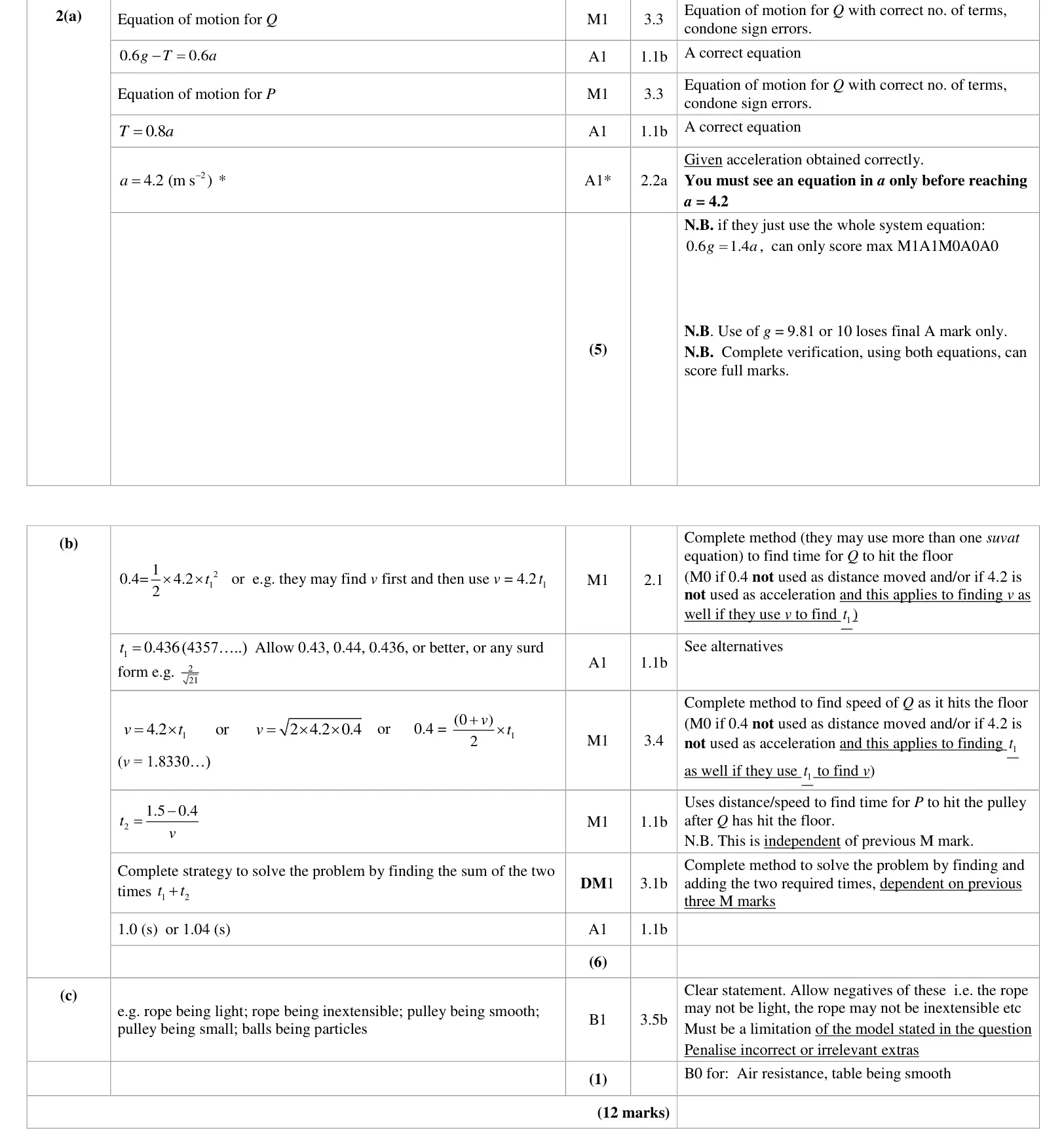
June 2019 · AS Paper 2 (Mechanics) · Q2(b)6 marks
Mark scheme (whole question; this part is marked with the orange bar)
Examiner's comment
Part (b) was also completed with mixed degrees of success. To solve the problem it was necessary to split the motion into two stages, before and after one mass hits the ground. Those who attempted to use a single suvat equation to cover the whole motion could achieve no credit. Some successfully found the time it took for Q to fall to the ground but were then unsure how to proceed. Those who calculated the speed with which Q hit the ground generally used this in considering the subsequent motion of P as it continued to move across the table. However, the most common error at this stage was in not realising that P would move with constant speed since there was no tension and the table surface was smooth; some included an acceleration of 4.2 ms-2 (or even 9.8 ms-2) in the relevant suvat equation or, more 1 commonly, used s = 2 (u + v)t with v = 0. These candidates generally scored three out of a possible six marks. The final part required the identification of a possible limitation of the model. The assumptions of this
Common mistakes
two stages: 0.4 = ½ × 4.2 × t₁² gives t₁ = 0.436 and v = 1.83
after Q hits the floor the rope is slack and the table smooth, so P moves at constant speed for the remaining 1.1 m (not with a = 4.2 or 9.8, and not v = 0 at the pulley)
total time 1.04 s
June 2019 · Paper 3 (Mechanics) · Q2(a)4 marks
Mark scheme (whole question; this part is marked with the orange bar)
Examiner's comment
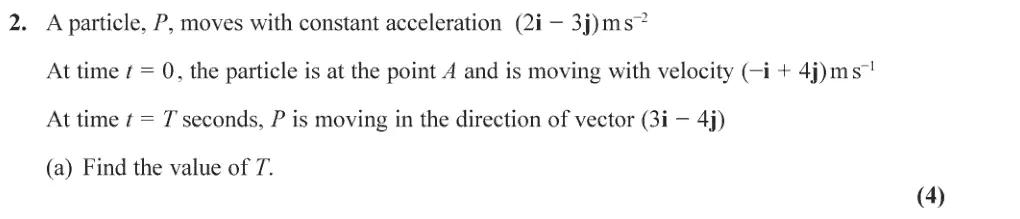
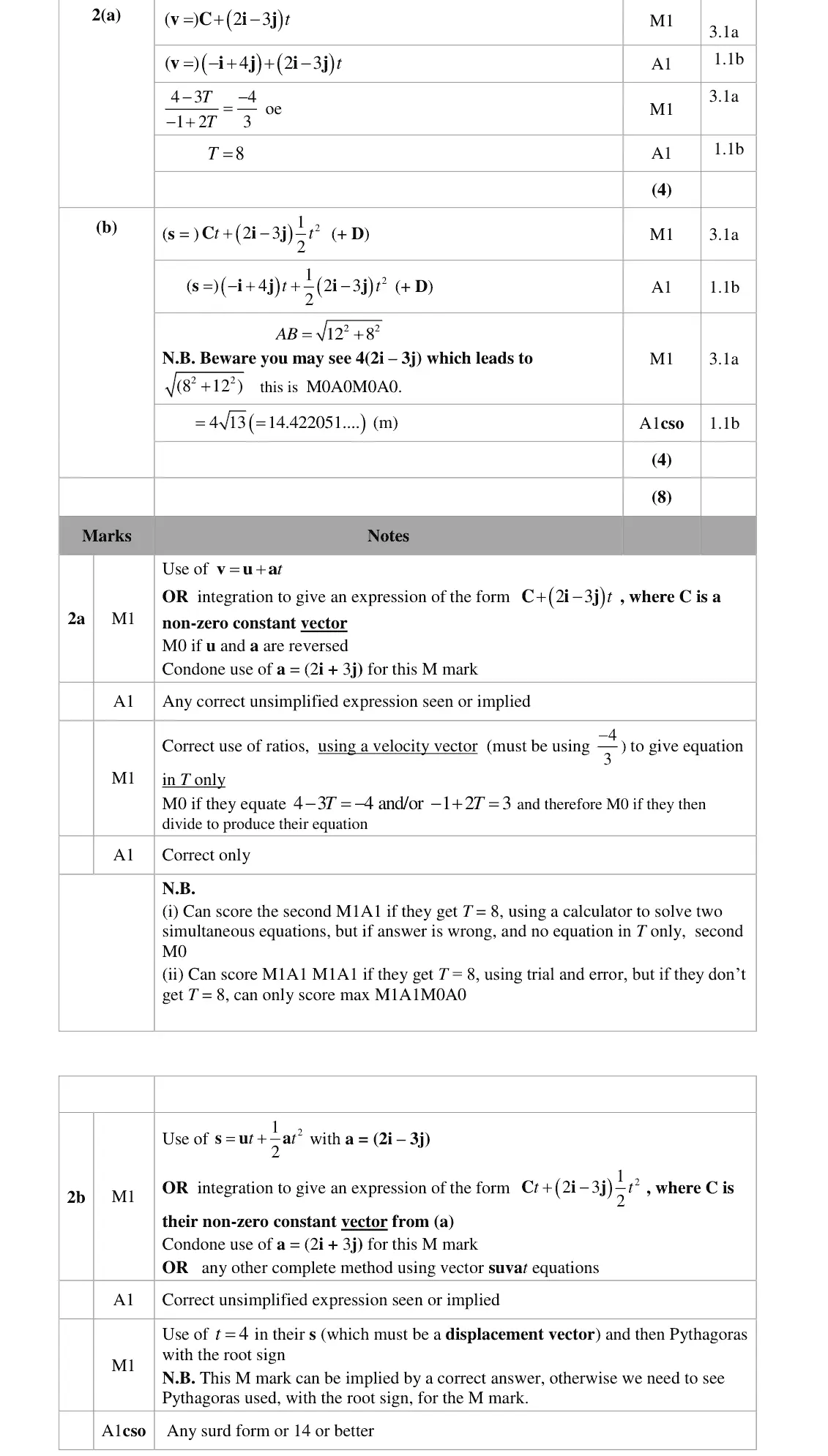
In part (a), although many candidates realised that finding an expression for the velocity was relevant to determining the direction of motion, only a minority could use the fact that it was specified as being in the direction of 3i – 4j. The most common error was in equating the actual vectors rather than either equating the ratios of components or equating to a multiple of 3i – 4j. A fair number attempted to use a displacement vector showing a lack of understanding of the situation. The second part was generally
Common mistakes
v = (−1 + 2T)i + (4 − 3T)j
parallel to 3i − 4j means ratio of components (4 − 3T)/(−1 + 2T) = −4/3, not equating the vectors themselves
using displacement is wrong
T = 8
June 2019 · Paper 3 (Mechanics) · Q2(b)4 marks
Mark scheme (whole question; this part is marked with the orange bar)
Examiner's comment
displacement vector showing a lack of understanding of the situation. The second part was generally handled more successfully with many correct answers seen for the displacement vector (using s = ut 1 2 at2) although not all proceeded to find the distance by calculating its magnitude. Although most used + suvat formulae throughout the question, some successfully integrated the given constant acceleration to find the velocity and displacement. Use of magnitudes of vectors throughout and some invalid multiplication/division of vectors were seen on occasion.
Common mistakes
s = ut + ½at² with u = −i + 4j and t = 4 gives 12i − 8j
distance is its magnitude 4√13 ≈ 14.4 m
4(2i − 3j) is not the displacement
June 2018 · AS Paper 2 · Q64 marks
Mark scheme (whole question; this part is marked with the orange bar)
Examiner's comment
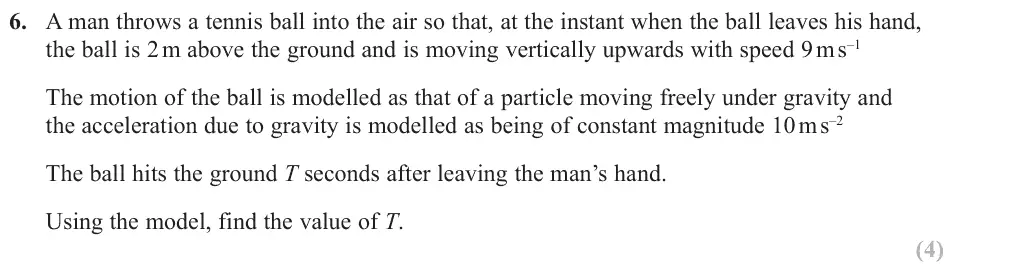
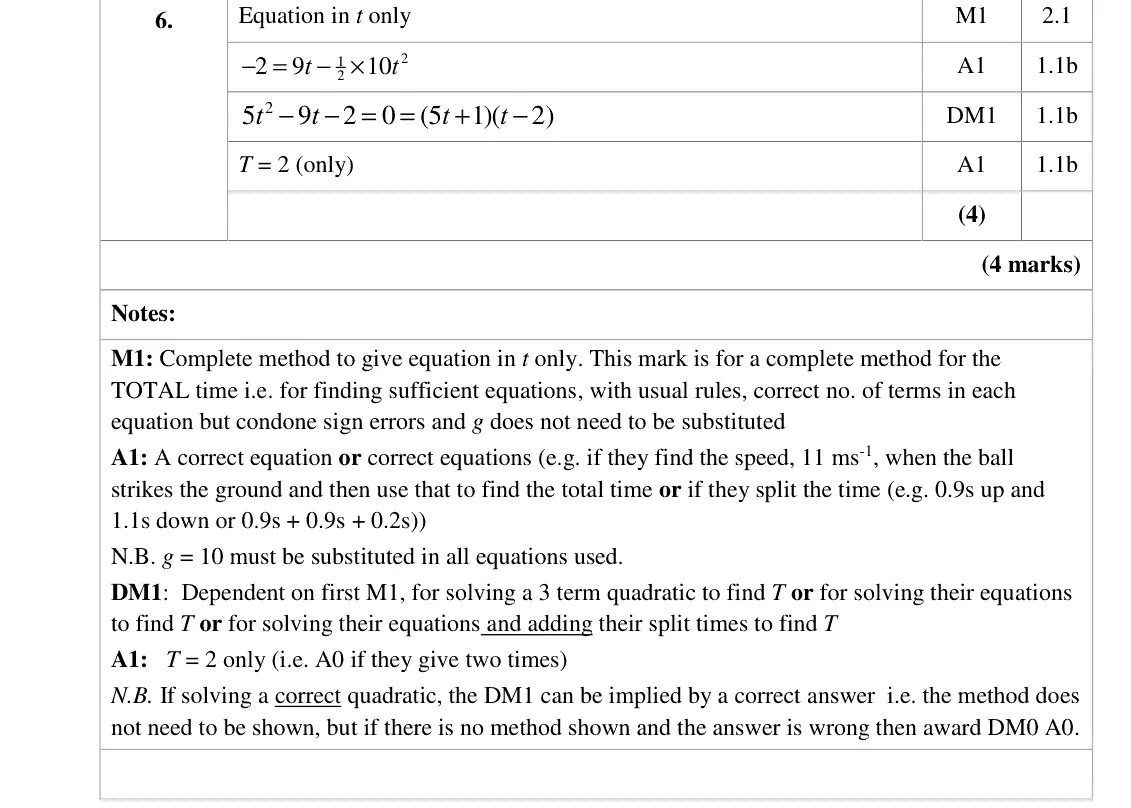
This proved to be a reasonably accessible starter to the Mechanics section with a modal mark of 4 out of 4, achieved by just over a third of the students. There were various possible approaches to this question which involved a ball moving up and down freely under gravity. Those who attempted a solution using one suvat equation generally included appropriate terms, but sign errors were very common. If the resulting quadratic equation was incorrect an explicit method (such as factorising or using the quadratic formula) was required for the second method mark. Some split the motion into two or three separate stages with a fair degree of success. Again, however, sign errors (showing a lack of understanding of how to incorporate directions) were often seen. Those who just found the time to the greatest height or to the same horizontal level received no credit, and use of g = 9.8 m s-2 rather than 10 m s-2 as specified in the question was penalised as an accuracy error.
Common mistakes
one suvat for the whole flight with up positive: −2 = 9t − 5t², so 5t² − 9t − 2 = 0 and T = 2 only (reject −0.2)
sign errors are common
use g = 10 as given (9.8 is penalised)
time to greatest height alone scores 0
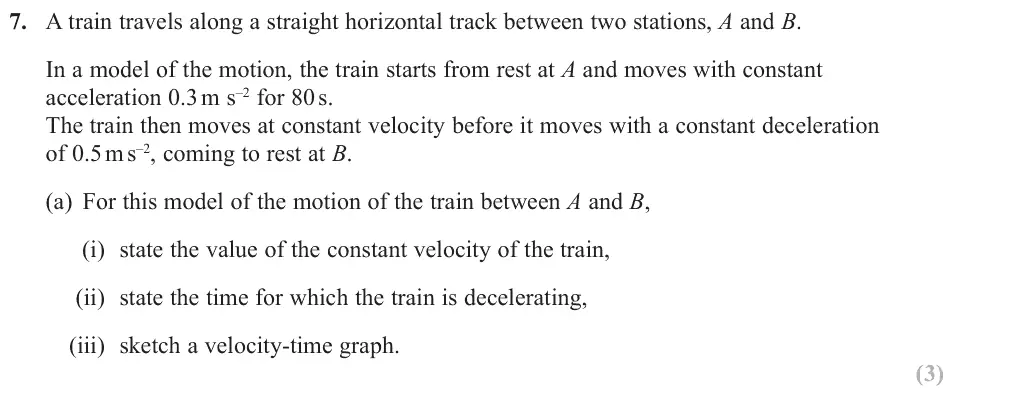
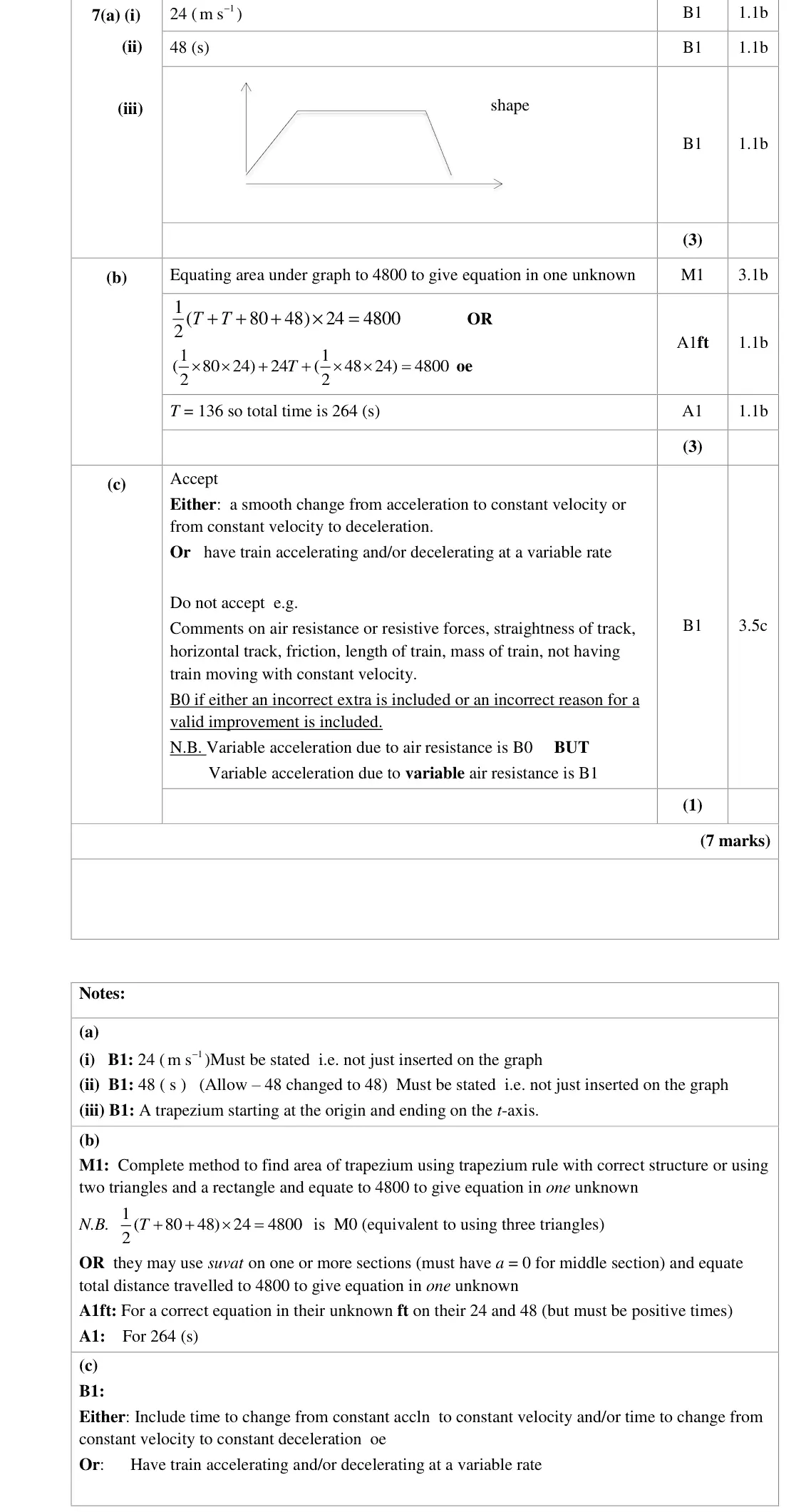
June 2018 · AS Paper 2 · Q7(a)3 marks
Mark scheme (whole question; this part is marked with the orange bar)
Examiner's comment
The majority of students identified a correct value for the required constant speed (24 m s-1) and then for the time of deceleration (48 s) although ‘24÷0.5=12’ was a surprisingly common error. Most, but not all, produced a velocity-time graph in the shape of a trapezium starting at the origin and finishing on the t axis.
Common mistakes
constant velocity 0.3 × 80 = 24 m/s
deceleration time 24 ÷ 0.5 = 48 s (24 × 0.5 = 12 is a common error)
values must be stated, not only marked on the graph
v–t graph a trapezium from the origin ending on the t-axis
June 2018 · AS Paper 2 · Q7(b)3 marks
Mark scheme (whole question; this part is marked with the orange bar)
Examiner's comment
In part (b), those who tried to equate the area under the graph to the distance travelled sometimes did so successfully, although an unknown ‘T’ value was often used inconsistently in the 3 sections of the motion. Some failed to use the correct structure (a trapezium or two triangles and a rectangle) or attempted a single suvat equation for the whole journey; such attempts gained no credit. Having found a correct relevant ‘T’ value, a number of students forgot that the question required the time for the complete journey.
Common mistakes
area under the v–t graph = 4800: ½(T + T + 128) × 24 = 4800 gives T = 136, so total time 264 s (not 136)
½(T + 128) × 24 is wrong
a single suvat for the whole journey scores 0
June 2018 · AS Paper 2 · Q7(c)1 mark
Mark scheme (whole question; this part is marked with the orange bar)
Examiner's comment
Part (c) required the identification of a possible improvement to the model. The model assumed periods of constant acceleration and instantaneous changes between constant acceleration and constant velocity. Therefore possible improvements to the model would be to allow variable acceleration and smooth changes between acceleration and constant velocity. However, valid responses were relatively rare; examples of the various comments seen included reference to the mass or length of the train, traffic lights, number of passengers and even the weather.
Common mistakes
allow a smooth change between acceleration and constant velocity, or variable acceleration/deceleration
air resistance, mass or length of the train, traffic lights or weather score 0
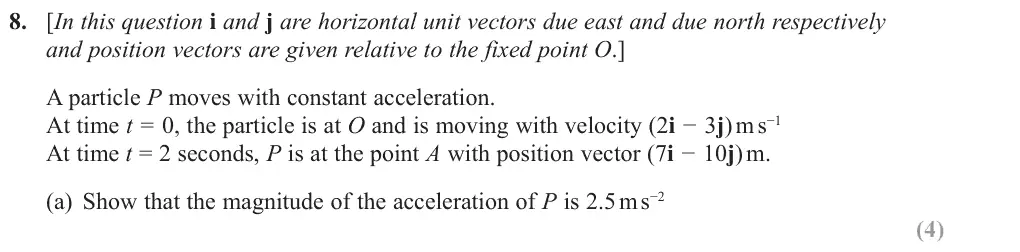
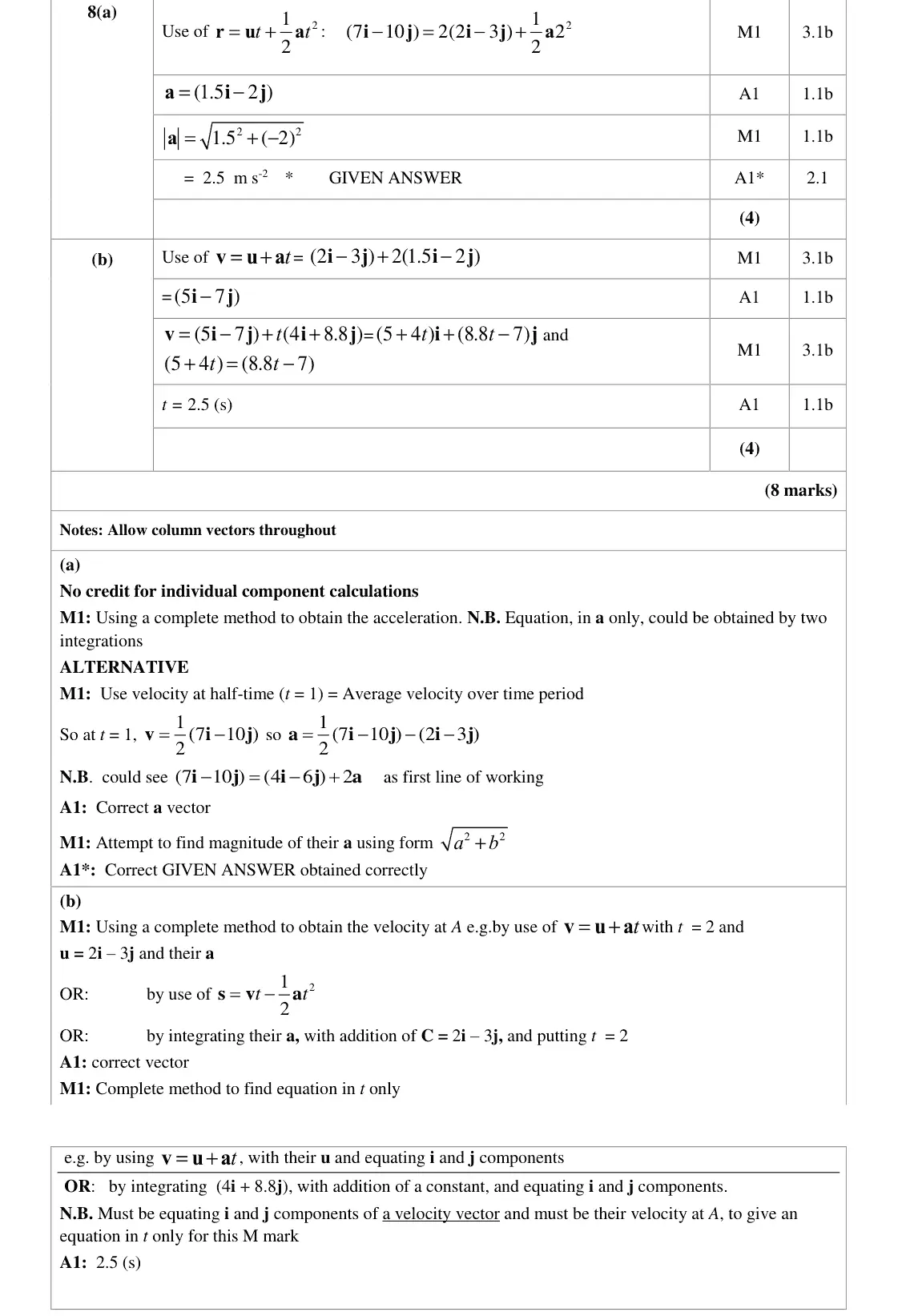
June 2018 · Paper 3 · Q8(a)4 marks
Mark scheme (whole question; this part is marked with the orange bar)
Examiner's comment
The first part was generally well done with most students using a constant acceleration formula in 1 2 at2) to find a, using the given velocity and position vectors. The few who chose to vectors (r = ut + integrate a constant acceleration vector, and then use the given information to identify the constants of integration, mostly did so successfully. The magnitude of a was almost invariably calculated correctly but, since the answer was given, it was important that there was some working shown. Those who had no valid method for finding a tended to achieve the method mark for calculating the magnitude of their vector. A small minority of students attempted to apply suvat equations to the magnitudes of the given vectors; by chance this led to an answer which rounded to the given 2.5 m s-2. However, such attempts achieved no credit.
Common mistakes
r = ut + ½at² in vector form gives a = 1.5i − 2j, magnitude 2.5
no credit for suvat on the magnitudes or separate components
June 2018 · Paper 3 · Q8(b)4 marks
Mark scheme (whole question; this part is marked with the orange bar)
Examiner's comment
Part (b) provided a greater challenge. Here it was necessary to find v after 2 seconds and then use this as the initial velocity for the second part of the motion. The given direction of motion meant that the coefficients of the i and j components of velocity were equal which in turn led to an equation in t. The main errors were in either trying to equate coefficients for a position rather than a velocity vector or in using 7i -10j (a position vector) as the initial velocity. Some students made no valid progress at all with this part of the question. There were, nevertheless, a fair number of entirely correct solutions seen
Common mistakes
velocity at A = (2i − 3j) + 2(1.5i − 2j) = 5i − 7j
north-east means i and j components of velocity equal: 5 + 4t = 8.8t − 7, t = 2.5 s
common errors: equating components of a position vector, using 7i − 10j as the initial velocity
Find an Edexcel maths tutor
Stuck on this? Book a trial session with an Edexcel specialist.