Examiner's comment
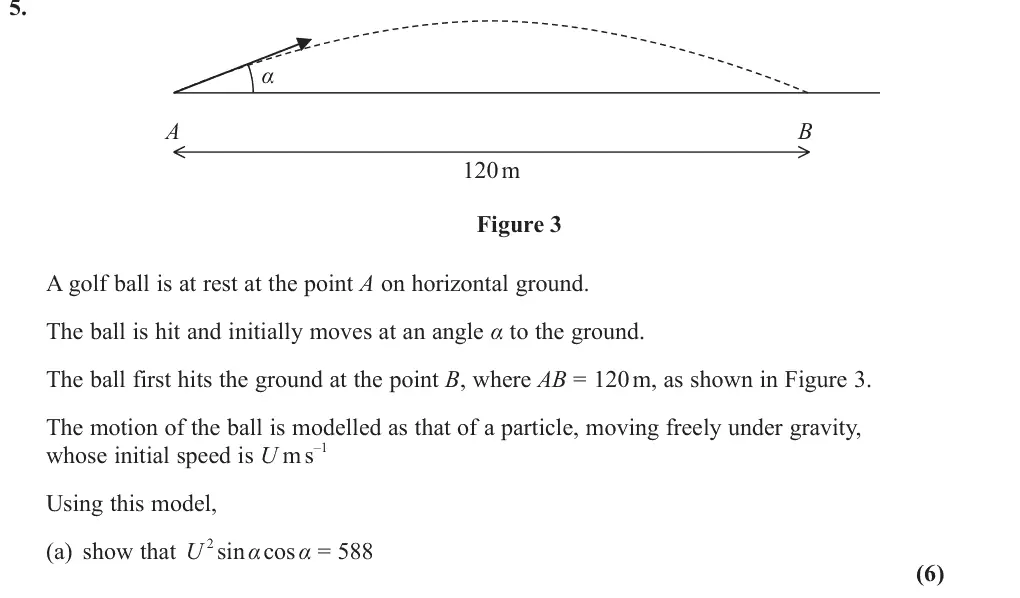
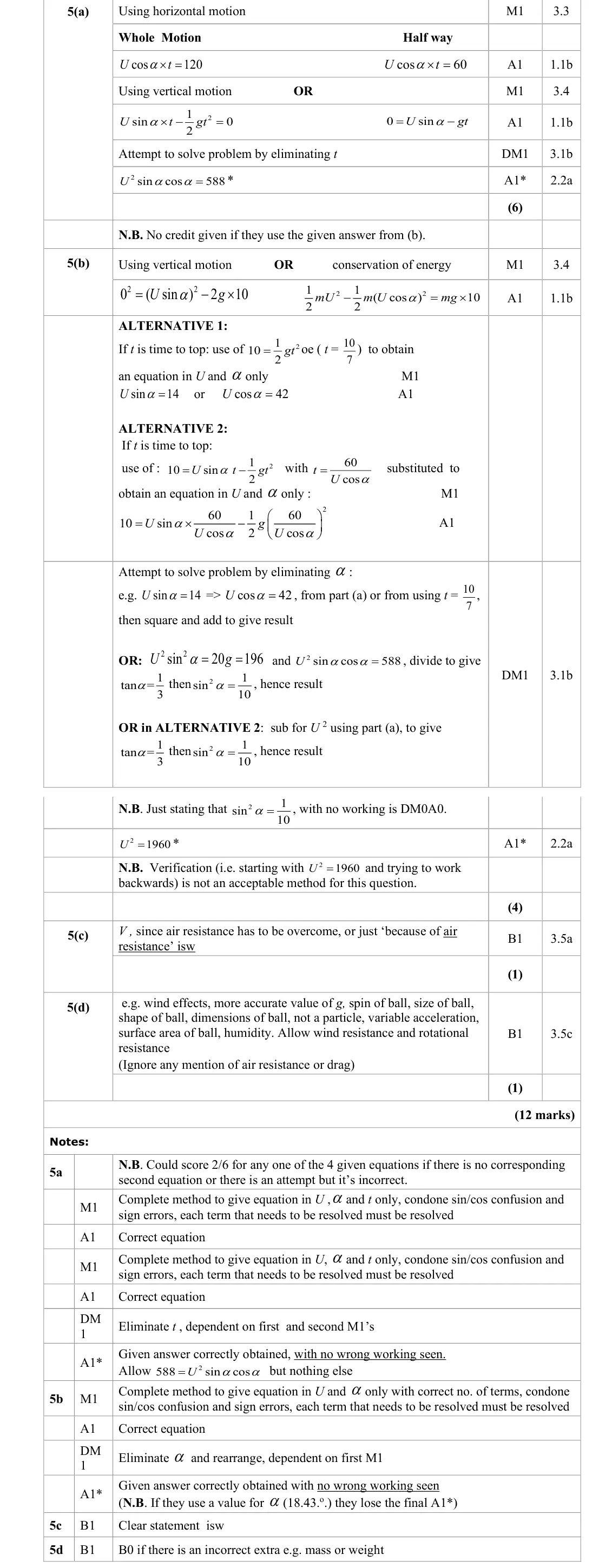
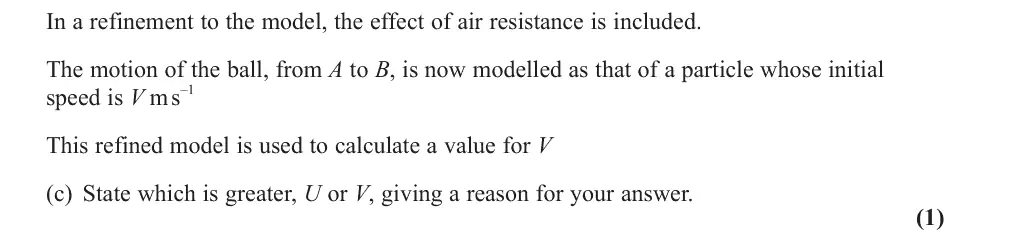
In part (a), the majority of candidates found an equation for the horizontal motion in terms of t. Most then used this to substitute t =120/Ucos alpha into 0 = Usin alpha t – ½ gt2, the vertical motion equation for the whole trajectory. This was generally rearranged to give the required answer although cancelling the common factor of t from the quadratic before substitution led to a neater solution. A minority chose to consider just half the motion with v = u + at and v = 0 at the greatest height which also led to a neat solution. Some candidates failed to identify that the vertical displacement would be zero over the whole motion, and some were inconsistent in considering the time for the whole or half trajectory. A small but surprising number of answers were seen where 120 m was used as the vertical distance. It should again be emphasised that candidates, when required to derive a given result, should write the final answer in exactly the same form as that stated in the question. In the second part, many candidates correctly arrived at an equation in from part (a) and, of those who did, some struggled with the required algebra. Many who correctly identified the value of alpha as tan-1 (1/3) used the decimal value for the angle in degrees rather than calculating an exact value for sin alpha with which to substitute, and lost the final mark. A few candidates set up an equation by using s = ut + ½at2 with s = 10 and substituting in the time to travel 60 m horizontally, but again had trouble finishing off for the last 2 marks having more difficulty with the slightly more complicated algebra required. Part (c) required a comparison of the initial velocity in the model without air