3.03t The coefficient of friction and the F ≤ μR model of friction in one…
Section
3.03 Forces and Newton's Laws
Level
A level only
Statement
Understand and be able to use the coefficient of friction and the F ≤ μR model of friction in one and two dimensions, including the concept of limiting friction.
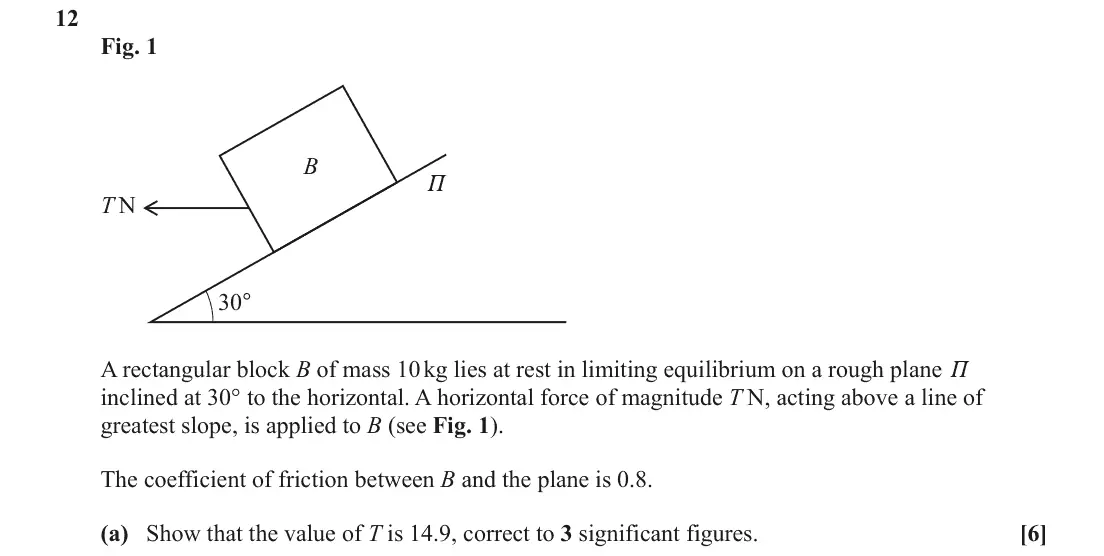
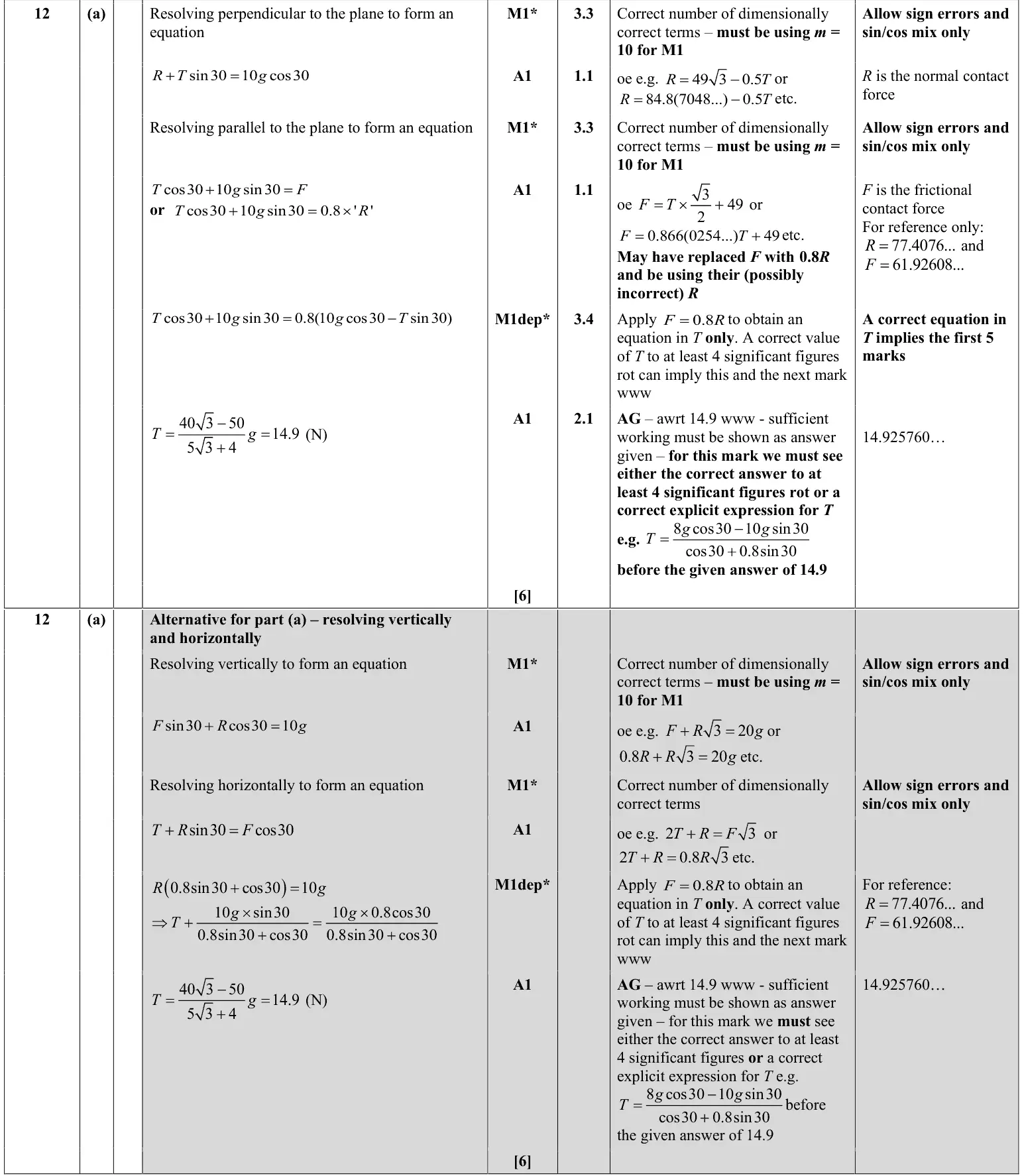
Most candidates attempted to resolve parallel and perpendicular to the plane for B, but they were not always successful. Aside from the usual sin/cos confusion and sign errors a number of candidates stated the correct expression for the friction component, namely, 𝑇cos30 + 10𝑔sin30 but incorrectly stated the normal contact force as 10𝑔cos30 only. Those candidates that annotated the copy of the diagram in the answer space were less likely to make mistakes with the components of each force. Those candidates who did resolve in both directions correctly usually went on to apply 𝐹= 𝜇𝑅 correctly and obtained a correct expression (and hence value) for T. While some candidates attempted to resolve vertically and horizontally (rather than perpendicular and parallel to the plane) these responses were rarely as successful. Furthermore, as this part was a ‘show that’ style question, examiners needed to see either the correct answer to at least 4 significant figures or a correct expression for T before stating the given answer of 14.9. The candidate has correctly resolved parallel and perpendicular to the plane and correctly applied 𝐹= 𝜇𝑅. However, to be awarded full marks, as this part was a ‘show that’, examiners needed to see either the correct answer to at least 4 significant figures or a correct expression for T before stating the given answer of 14.9.
Key points and common errors
perpendicular: R + T sin 30 = 10g cos 30
parallel: T cos 30 + 10g sin 30 = F
F = 0.8R
T = 14.9 to 3 s.f.
normal reaction must include the T component
June 2025 · Paper 3 · Q12(b)4 marksMedium
Show the start of this question
Mark scheme for this part
Examiner's comment
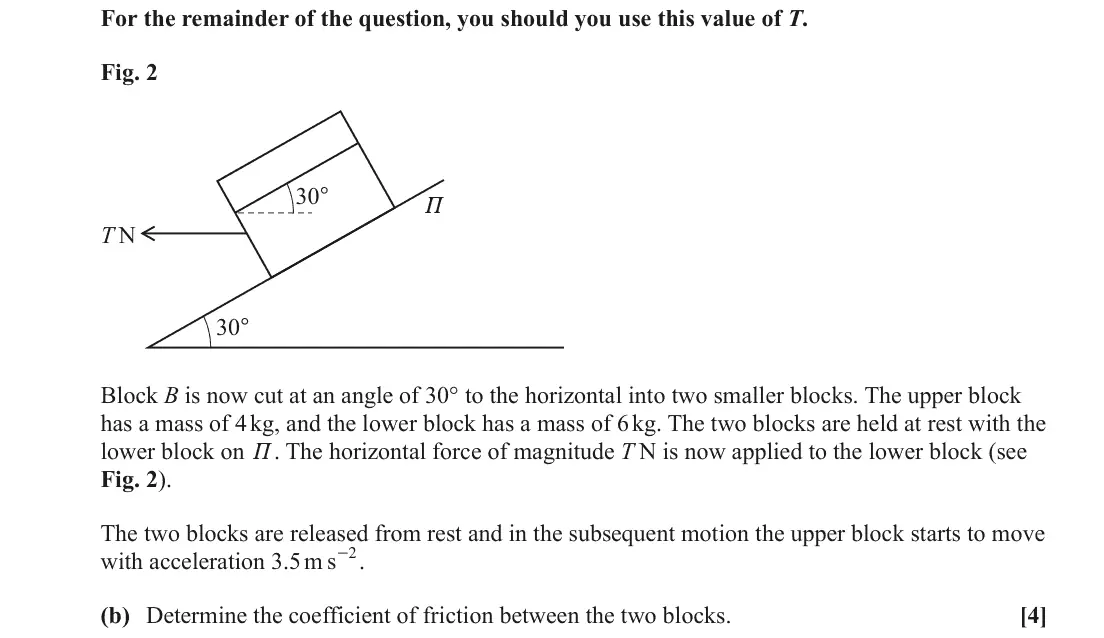
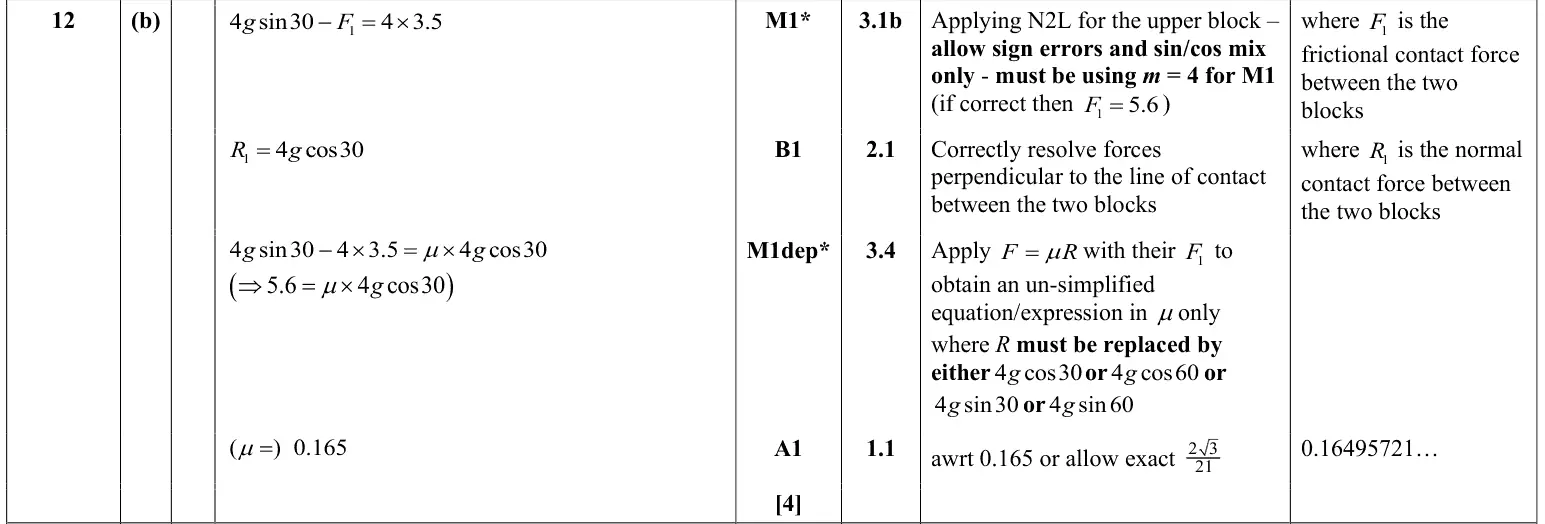
This part was answered relatively well with many candidates correctly applying Newton’s second law for the upper block and obtaining an equation for the coefficient of friction between the two blocks. The most common errors were to include T in their equation (even though this force was being applied to the lower block only) or to include other forces that were not acting on the upper block.
Key points and common errors
N2L for the upper block: 4g sin 30 − F = 4 × 3.5 so F = 5.6
R = 4g cos 30
μ = 0.165
T acts on the lower block only
June 2025 · Paper 3 · Q12(c)3 marksHard
Show the start of this question
Mark scheme for this part
Examiner's comment
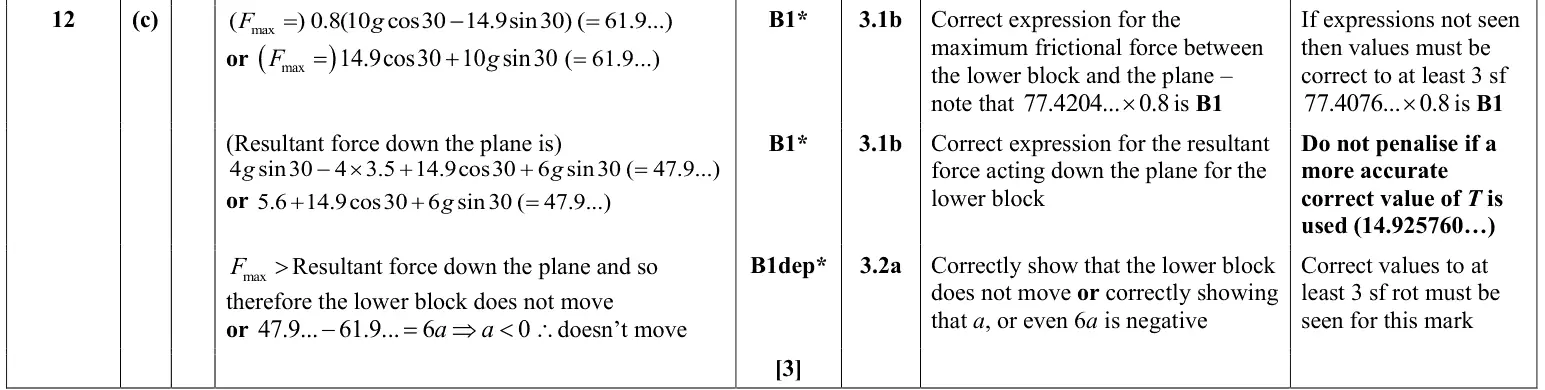
This part was extremely demanding with only the most able candidates making any real progress. Some managed to find a correct expression for the maximum frictional force between the lower block and the plane but only the most able could then find a correct expression for the resultant force acting down the plane for the lower block (with most attempts missing at least one required term). Those that did find both correct expressions usually argued correctly that as 𝐹𝑚𝑎𝑥> Resultant force down the plane, this implied that the lower block would not move.
Key points and common errors
F max on the lower block = 0.8(10g cos 30 − 14.9 sin 30) = 61.9
force down the plane = 5.6 + 14.9 cos 30 + 6g sin 30 = 47.9 < 61.9 so it does not move
June 2024 · Paper 3 · Q11(b)3 marksHard
Show the start of this question
Mark scheme for this part
Examiner's comment
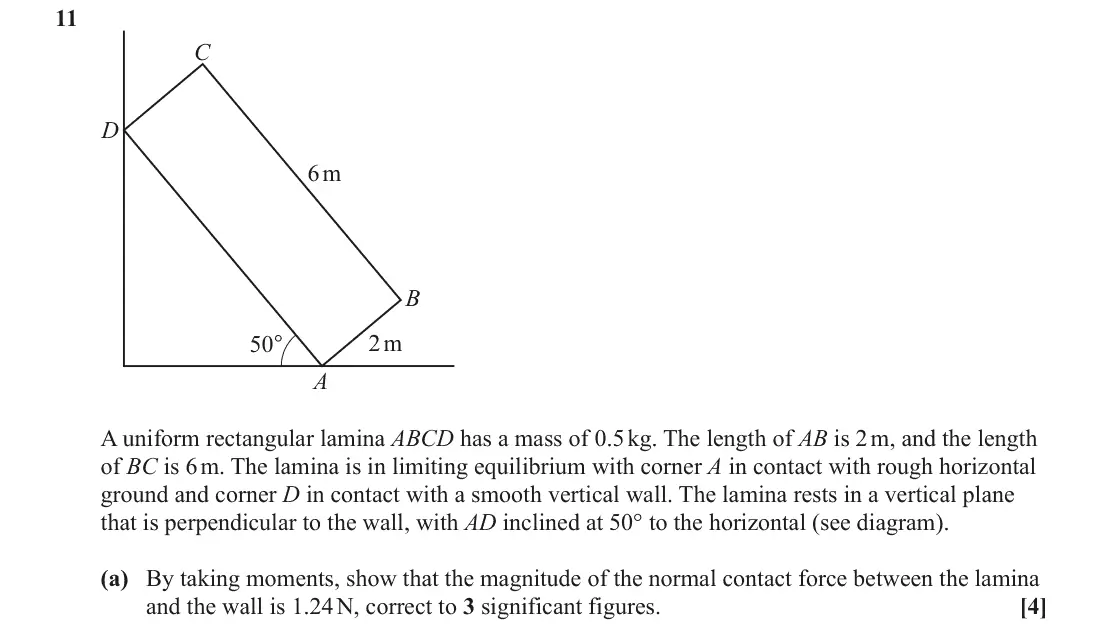
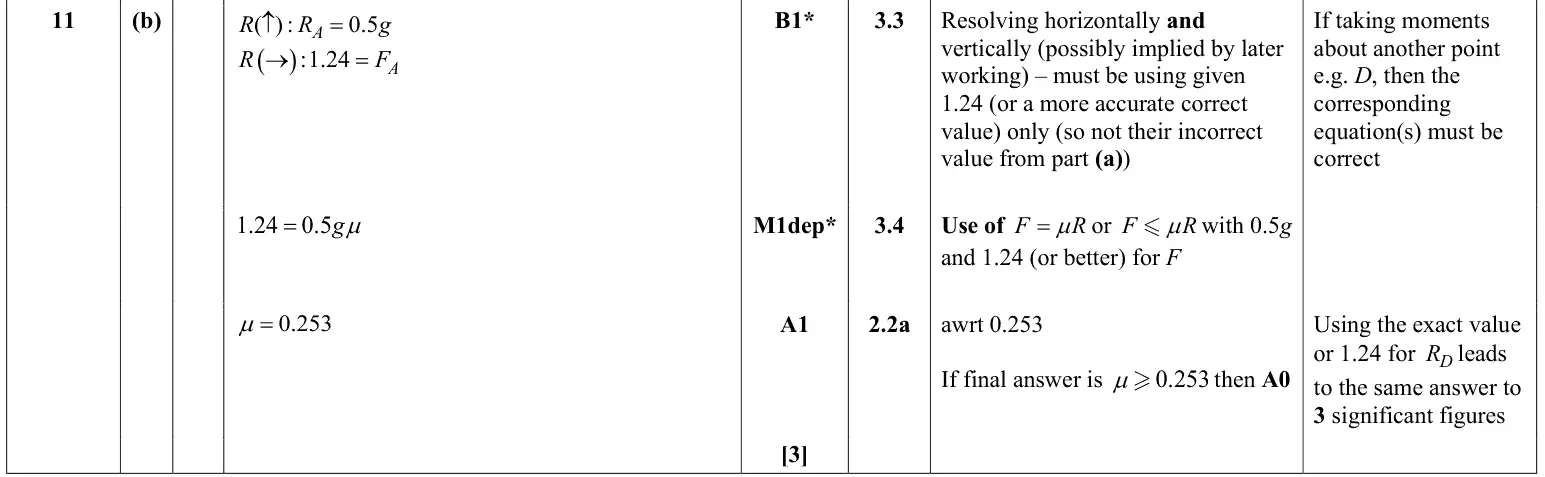
Many candidates left this relatively straightforward part blank (most likely due to their inability in obtaining the given answer in part (a)). It is clear that many candidates did not realise the direction of the forces acting at 𝐴 and/or 𝐷 and included unnecessary trigonometric terms. Occasionally candidates gave an answer that was not correct to 3 significant figures.
Key points and common errors
R_A = 0.5g
F_A = 1.24 N
limiting: 1.24 = 0.5gμ so μ = 0.253
unnecessary trig terms at A or D
June 2024 · Paper 3 · Q13(a)6 marksHard
Mark scheme for this part
Examiner's comment
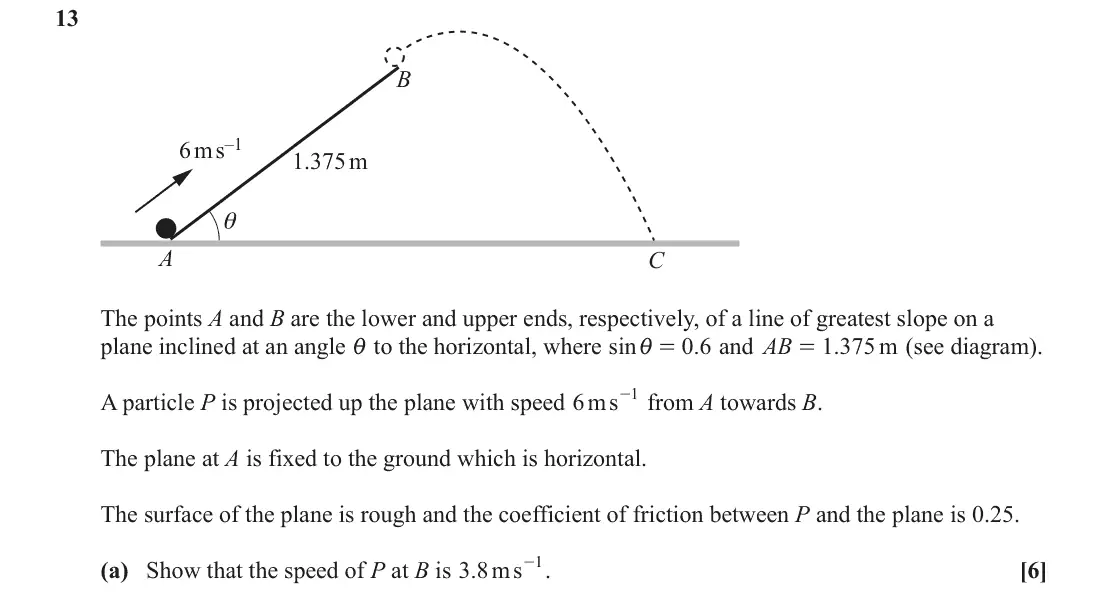
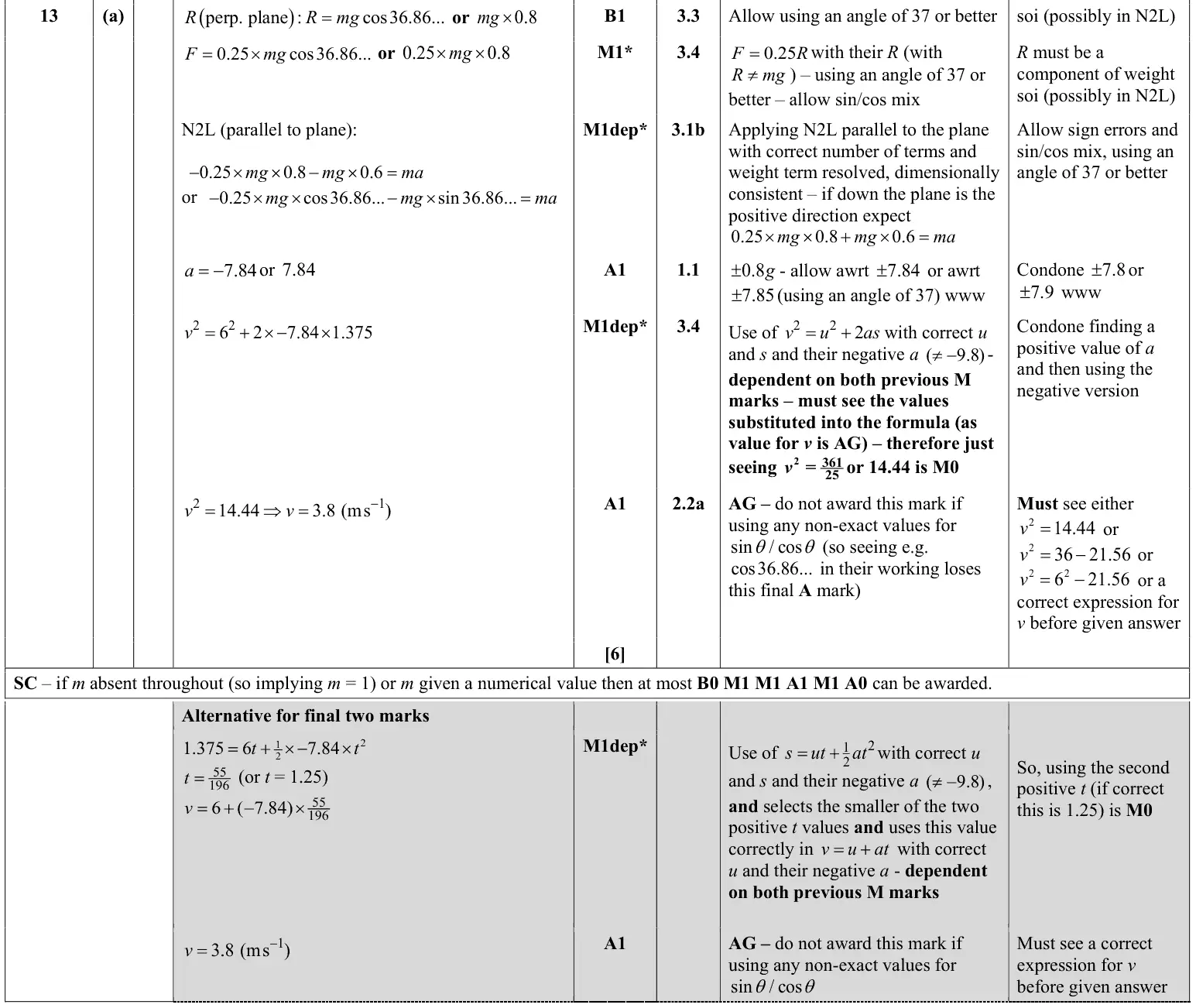
The responses to this part were mixed. Many candidates did not make any significant progress towards the given answer as they seemed to believe that the entire question could be solved by only applying the equations of constant acceleration. Very few candidates applied Newton’s second law parallel to the plane correctly (with the correct number of relevant terms) to find the acceleration of 𝑃 as it moved up the plane from 𝐴 to 𝐵. While some did correctly state that 𝑎= −0.25𝑔cos 𝜃−𝑔sin𝜃 many gave no indication of where the value of −7.84 for the acceleration came from; as this is a ‘show that’ question candidates were expected to substitute the given values of sin𝜃= 0.6 and therefore cos𝜃= 0.8 into this equation to make it clear that they hadn’t simply worked backwards to find the acceleration from the given final speed. Some candidates calculated 𝜃 as 36.8… and so therefore did not show that the speed of 𝑃 at 𝐵 was the exact (given) value of 3.8. This candidate made very good progress in showing that the speed of 𝑃 at 𝐵 was 3.8. The only issue was one of accuracy in that the candidate used an approximate value for the angle (in this case using 36.87) which leads to an inaccurate value of −7.8400113 … for the acceleration and therefore they could not score the final accuracy mark (and so instead scored 5 of the 6 marks available).
Key points and common errors
R = 0.8mg
F = 0.25R
N2L up the plane a = −0.8g = −7.84
v² = 36 − 2 × 7.84 × 1.375 = 14.44 so v = 3.8
exact sin/cos values
many used suvat only
June 2023 · Paper 3 · Q9(b)5 marksMedium
Show the start of this question
Mark scheme for this part
Examiner's comment
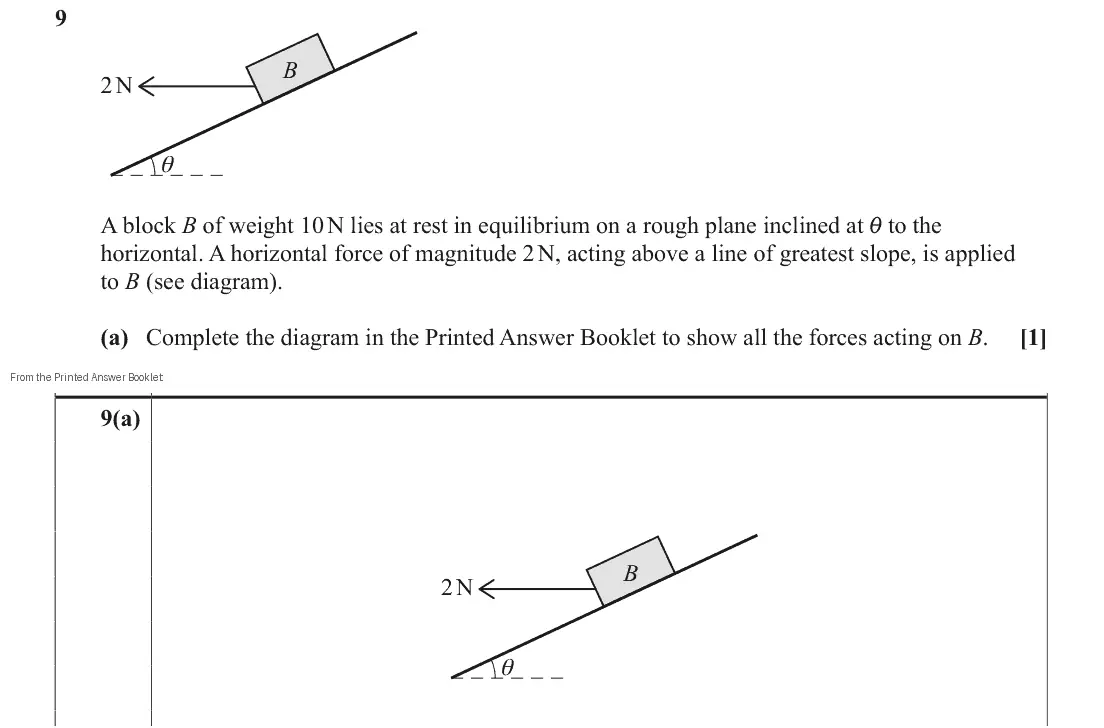
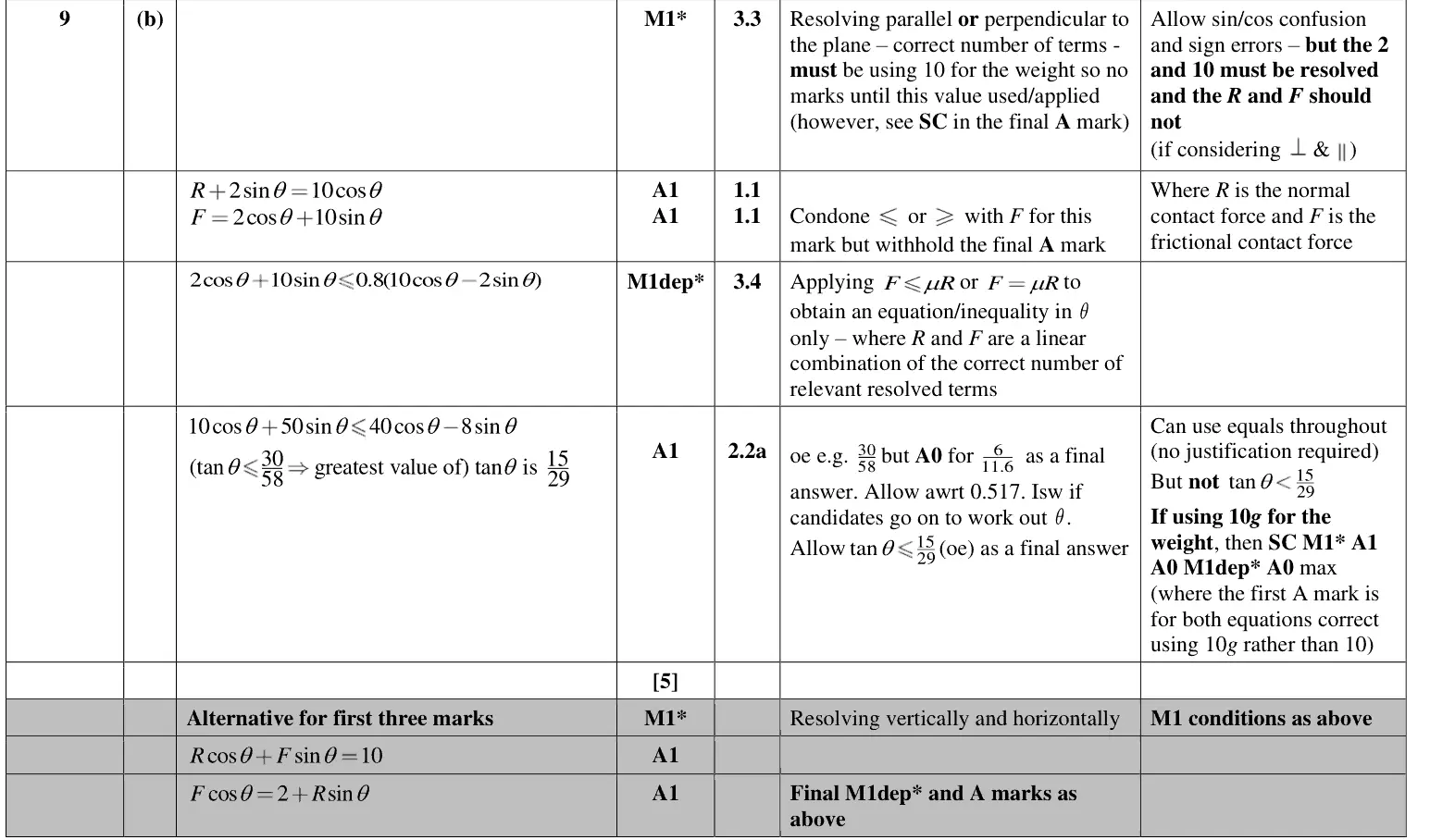
Most candidates attempted to resolve parallel and perpendicular to the plane for B but they were not candidates stated the correct expression for the friction component, namely, 2cos𝜃𝜃+ 10sin𝜃𝜃 but always successful. Aside from the usual sin/cos confusion and sign errors it was surprising how many incorrectly stated the normal contact force as 10cos𝜃𝜃 only (or vice-versa). Those candidates who did resolve in both directions correctly usually went on to apply 𝐹𝐹= 𝜇𝜇𝜇𝜇 correctly and obtain the greatest value of tan𝜃𝜃. While some candidates attempted to resolve vertically and horizontally (rather than perpendicular and parallel to the plane) these responses were rarely successful. This response scored 2 marks. This candidate has derived a correct expression for the normal contact force but their corresponding expression for the frictional contact force only contains a component of the terms the second method mark for applying 𝐹𝐹= 𝜇𝜇𝜇𝜇 could not be awarded. weight (and not the 2 N force too). As their expression for F does not contain the correct number of
Key points and common errors
R = 10cos θ − 2sin θ, F = 2cos θ + 10sin θ
F ≤ 0.8R gives tan θ ≤ 15/29
errors R = 10cos θ only, sin/cos confusion
June 2023 · Paper 3 · Q13(a)7 marksMedium
Mark scheme for this part
Examiner's comment
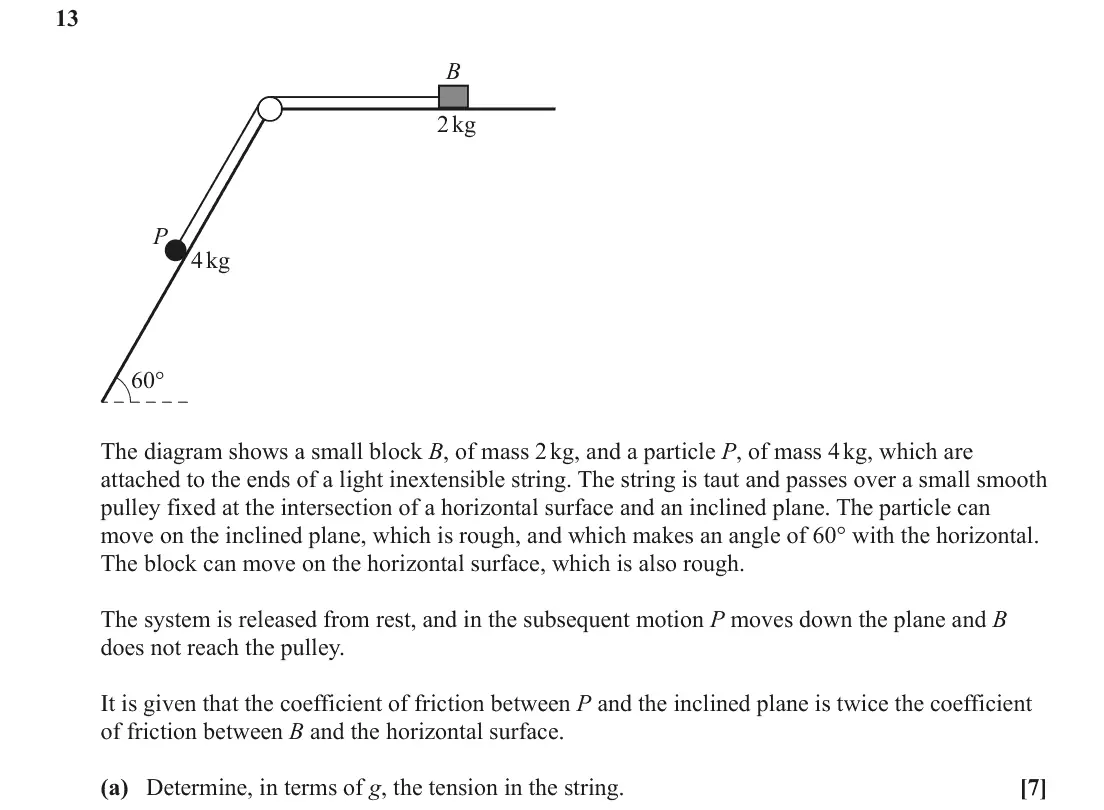
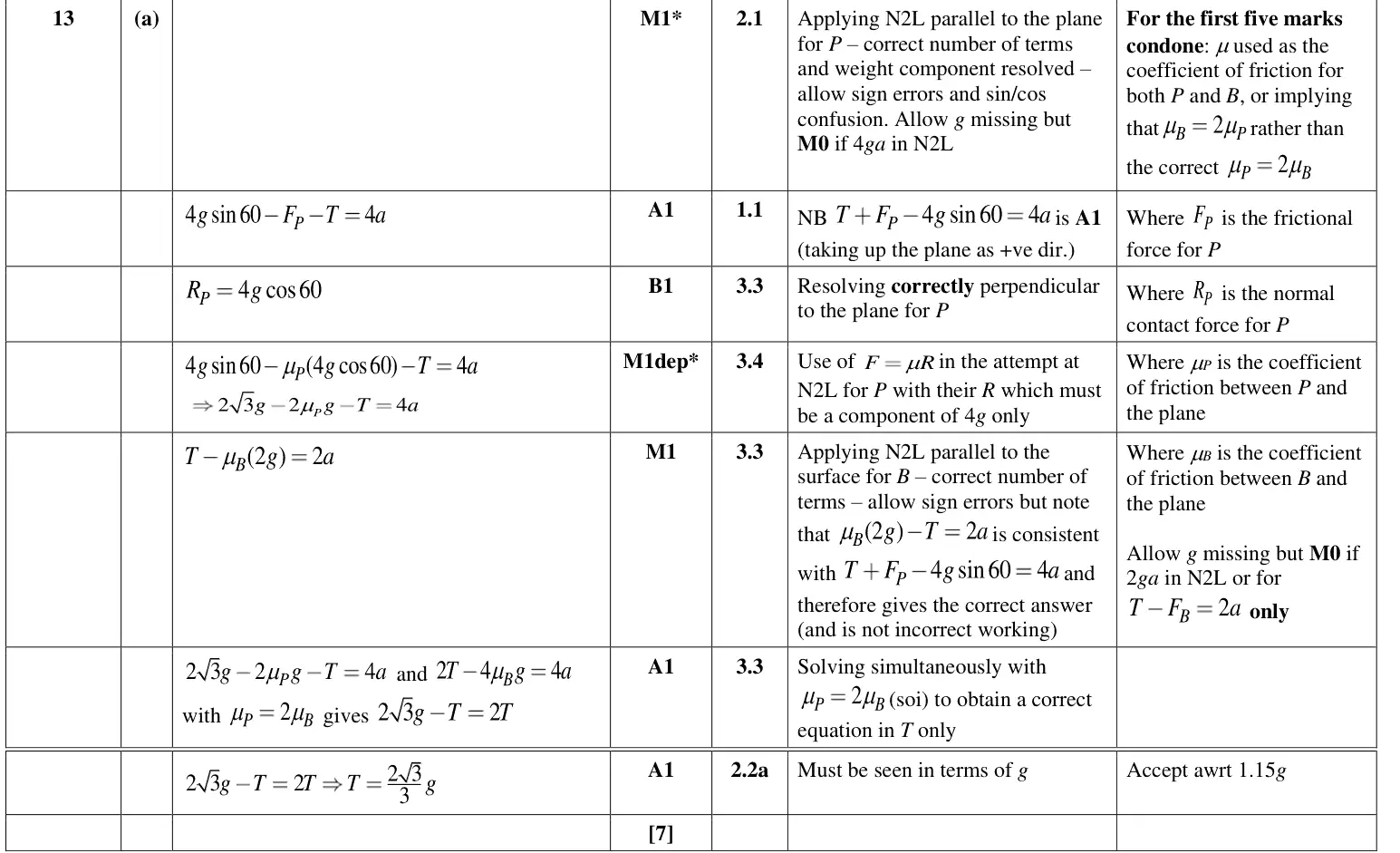
Most candidates in this part attempted to apply Newton’s second law for the motion of P and B the coefficients of friction of P and B. If done correctly this resulted in the equations: 4𝑔𝑔𝑔𝑔𝑔𝑔𝑔𝑔60 − separately to obtain two equations relating the tension in the string, the acceleration of the system and 𝜇𝜇𝑃𝑃(4𝑔𝑔𝑔𝑔𝑔𝑔𝑔𝑔60) −𝑇𝑇= 4𝑎𝑎 and 𝑇𝑇−𝜇𝜇𝐵𝐵(2𝑔𝑔) = 2𝑎𝑎. It was surprising therefore how many candidates derived eliminating 𝑎𝑎, and use the given result that 𝜇𝜇𝑃𝑃= 2𝜇𝜇𝐵𝐵, to find the required tension in the string. Apart from these two equations correctly (and so scored the first 5 marks) but did not complete the problem by acceleration of the system was zero or assuming that as 𝜇𝜇𝑃𝑃= 2𝜇𝜇𝐵𝐵 then this implied that 𝐹𝐹𝑃𝑃= 2𝐹𝐹𝐵𝐵 (which the common sign errors and sine/cosine confusion other errors seen in this part were assuming that the although true in this particular case it could not be assumed to be true without evidence of considering the relevant normal contact forces). This response scored the first 5 marks. This candidate has set their working out in a clear and logical manner (and included a diagram to assist them in setting up the required equations of motion). The candidate manages to set up both equations for P and B correctly but then makes an error when they write sin 30 rather than sin 60 which leads to an incorrect expression for the tension in the string.
Key points and common errors
N2L for P down the plane: 4g sin60° − μ_P(4g cos60°) − T = 4a
for B: T − μ_B(2g) = 2a
use μ_P = 2μ_B and eliminate a and μ: T = (2√3/3)g
many stopped after the two equations
June 2023 · Paper 3 · Q13(b)5 marksHard
Show the start of this question
Mark scheme for this part
Examiner's comment
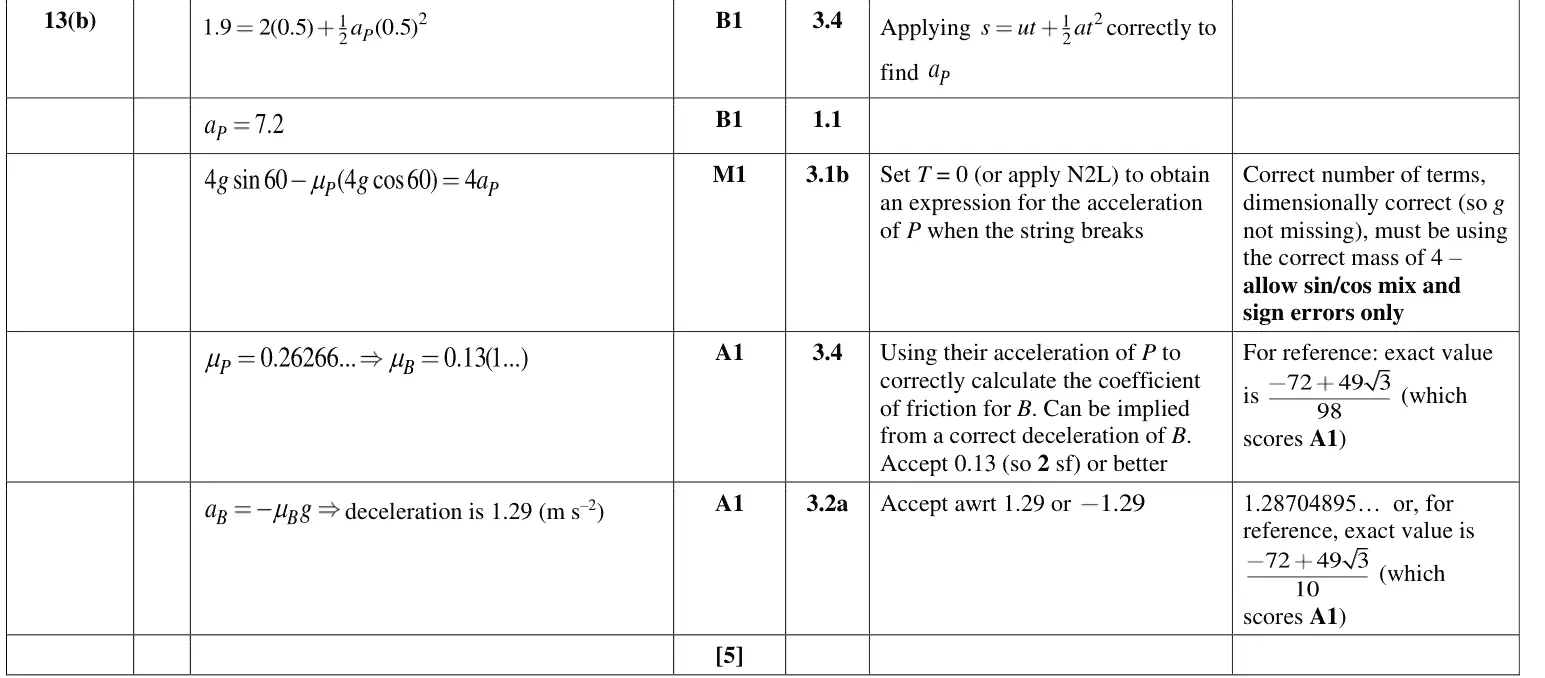
This part proved challenging for the majority of candidates, with most only getting as far as calculating the acceleration of P as it moved down the plane. Only the highest scoring candidates set T = 0 in their attempt at Newton’s second law for P (from part (a)) to obtain the coefficient of friction for P. Those that did this were usually successful in obtaining the correct coefficient of friction for B and hence its deceleration.
Key points and common errors
1.9 = 2(0.5) + ½a(0.5)² gives a_P = 7.2
T = 0 in N2L for P gives μ_P = 0.263, μ_B = 0.131
deceleration of B = μ_B g = 1.29 m s⁻²
June 2022 · Paper 3 · Q10(b)3 marksEasy
Show the start of this question
Mark scheme for this part
Examiner's comment
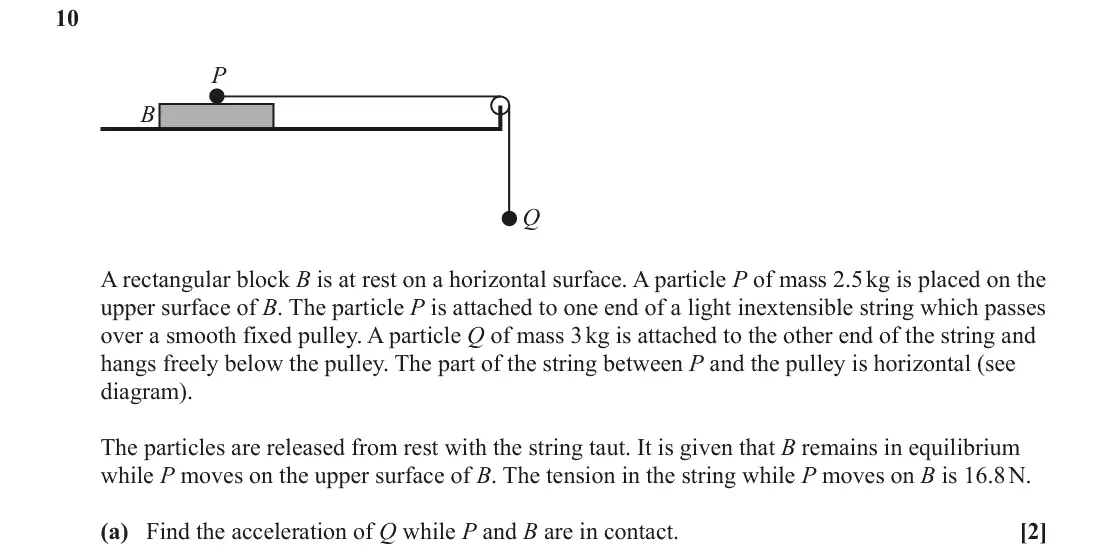
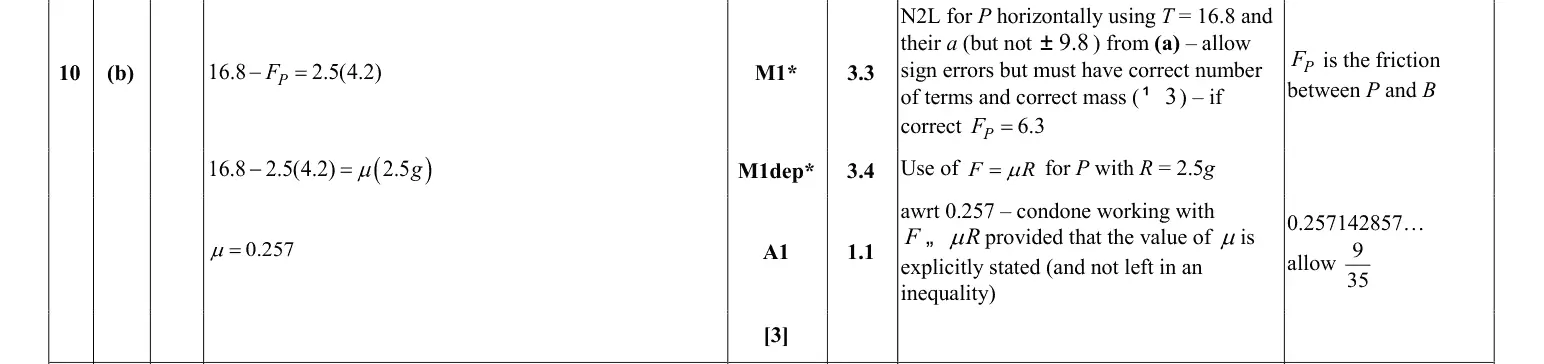
Like part (a) this question was answered extremely well with most candidates scoring the method marks for applying Newton’s second law horizontally for P and using F = R . Occasionally, candidates incorrectly used the mass of Q in their equation or attempted to apply Newton’s second law for the entire system, but these were almost always unsuccessful.
Key points and common errors
N2L for P: 16.8 − F = 2.5 × 4.2 so F = 6.3
μ = 6.3/(2.5g) = 0.257
June 2022 · Paper 3 · Q10(c)3 marksHard
Show the start of this question
Mark scheme for this part
Examiner's comment
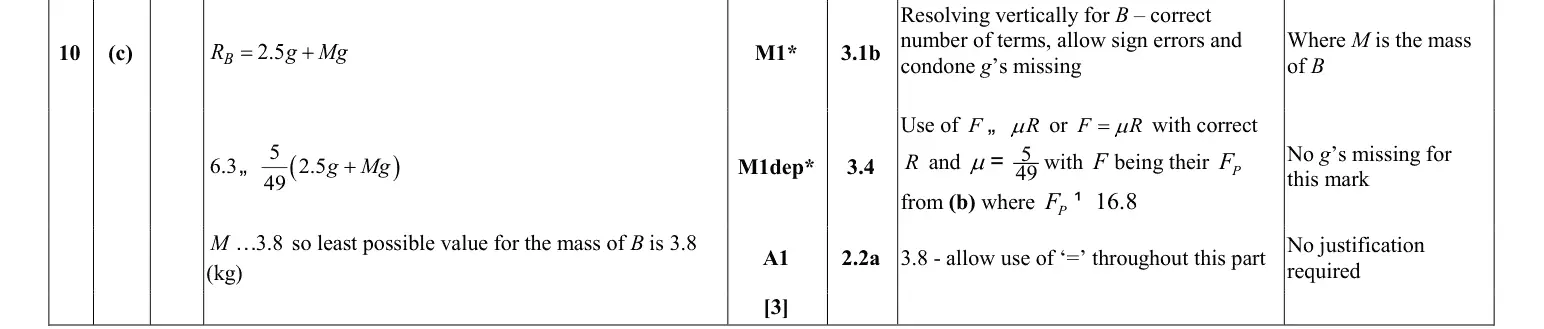
Not very many candidates made any real progress with this question even though it was a relatively straightforward application of Newton’s third law. Very few candidates realised that when resolving = + R 2.5 g Mg vertically for B that (where M was the mass of B), and that horizontally for B the frictional forces acted in opposite directions but were of equal magnitude. It was very rare for examiners to see the correct response of 3.8 (with the most common incorrect response being 6.3 coming from = R Mg , so ignoring the normal contact force of P on B). This response scored zero. Although the candidate has used the correct value of 6.3 for the friction between P and B, they have not considered the force of P acting on B vertically. This is indicated by the candidate suggesting that the magnitude of the contact force between the horizontal surface and B is only equal to weight of B which therefore ignores the fact that P exists and lies on the upper surface of B.
Key points and common errors
R on B = 2.5g + Mg
friction on B from P equals 6.3 N
6.3 ≤ (5/49)(2.5g + Mg) gives M ≥ 3.8 kg
ignoring P's weight gives 6.3
June 2022 · Paper 3 · Q11(b)4 marksHard
Show the start of this question
Mark scheme for this part
Examiner's comment
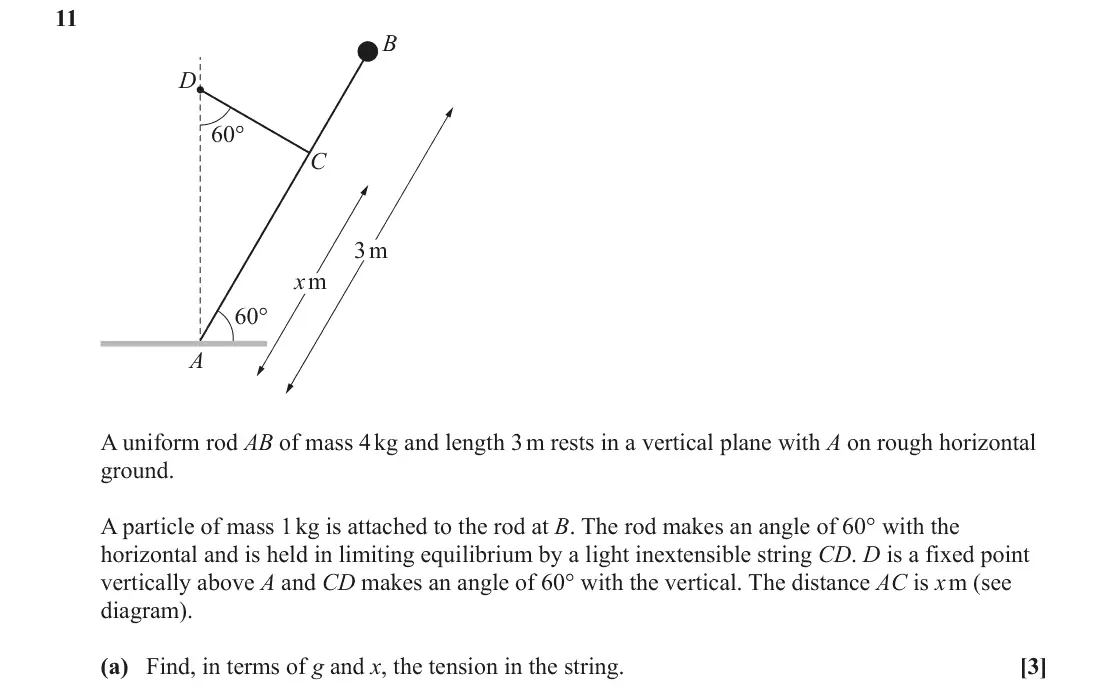
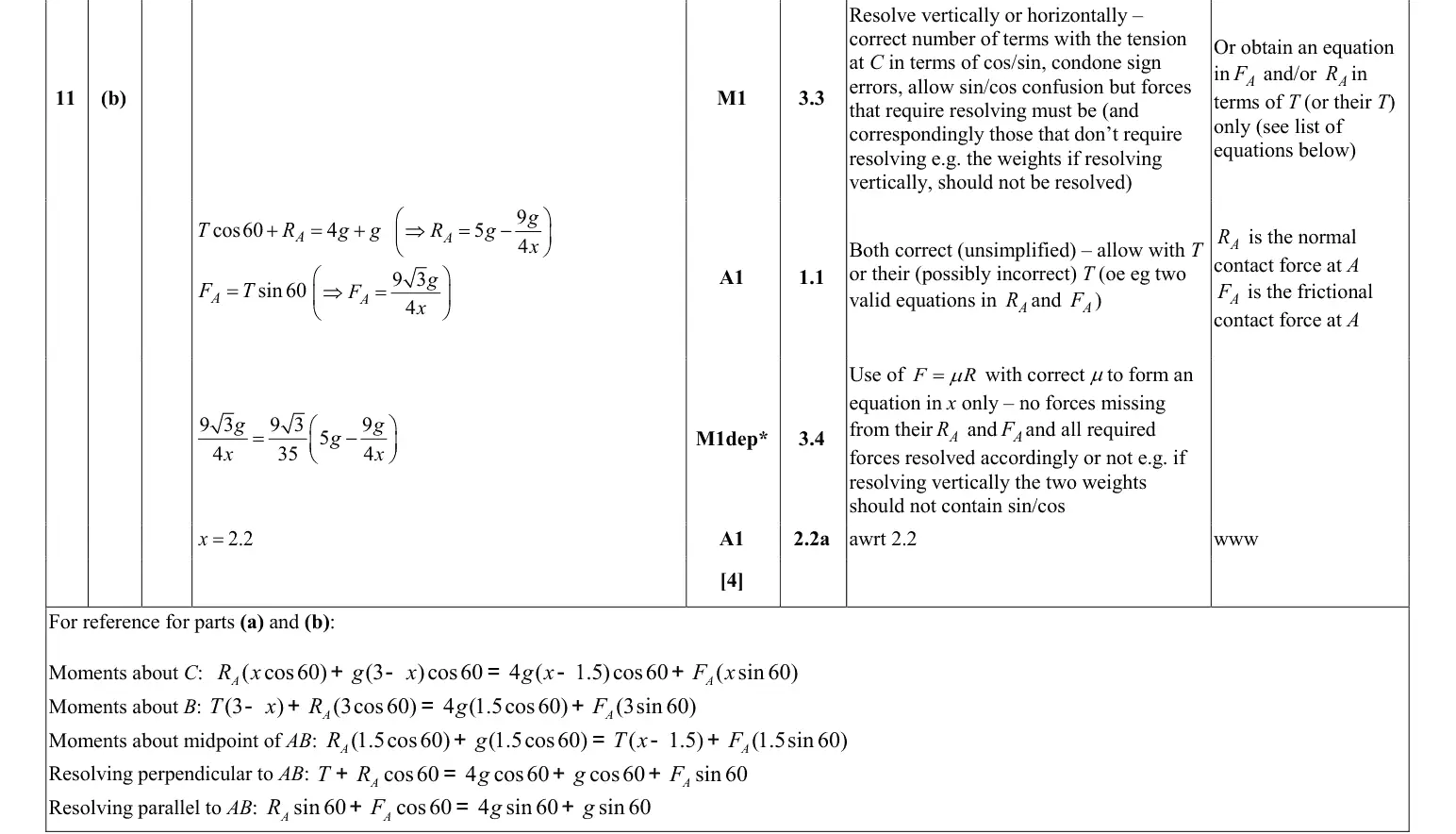
Many struggled with this part and even those candidates who realised that the most efficient way of determining the value of x was to resolve vertically and horizontally for the rod (and then apply F = ) R many could not cope with the mechanics of the situation or the corresponding algebraic demands.
Key points and common errors
resolve: R = 5g − T cos60°, F = T sin60°
F = μR with μ = 9√3/35
x = 2.2
Autumn 2021 · Paper 3 · Q10(b)5 marksMedium
Show the start of this question
Mark scheme for this part
Examiner's comment
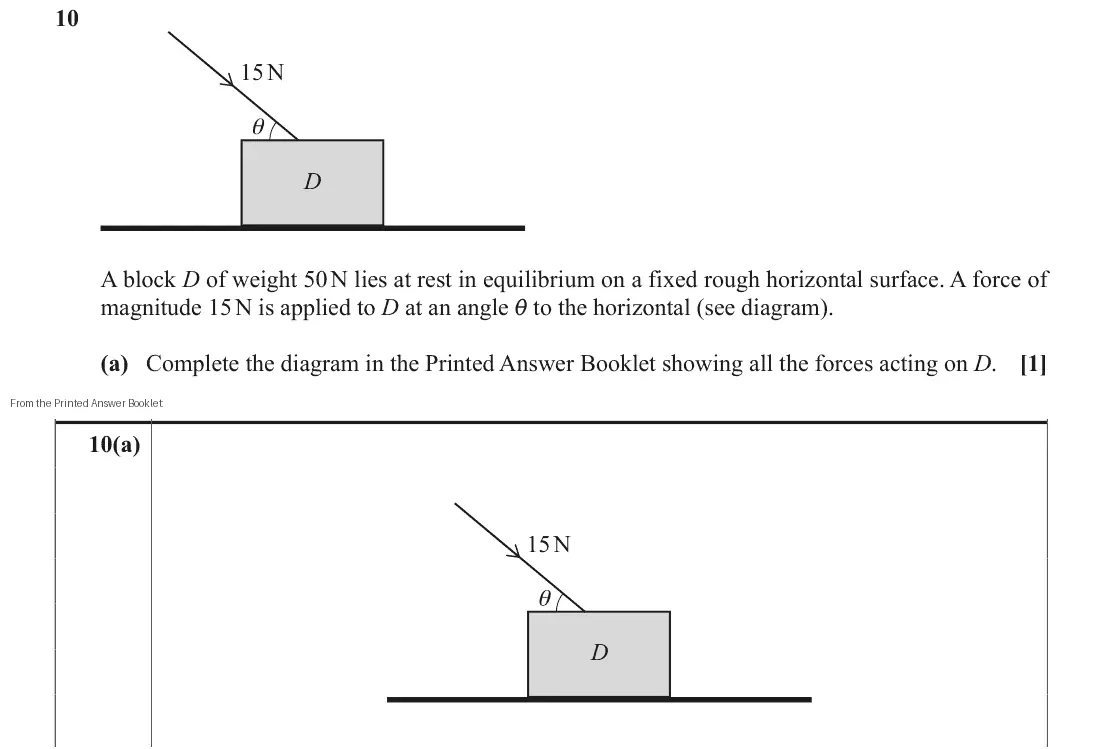
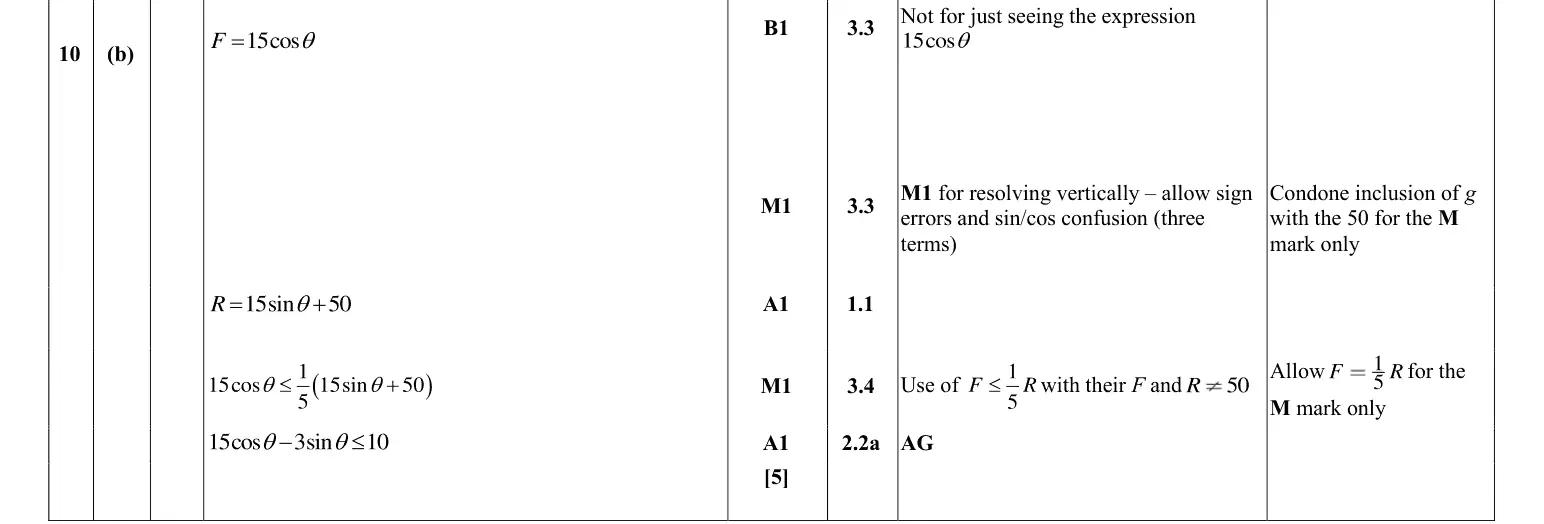
(From the general report) Themes in candidate responses in Section B Question 10(b) Misconception It was clear that in this question candidates had the misconception that as the ‘show that’ contained an inequality that this meant that the magnitude of the frictional contact force F was either F 15cos or F 15cos . As the block was at rest, the forces acting on the block horizontally were in F 15cos . balance and therefore As the block was not in limiting equilibrium then F 0.2 R and the normal contact force R could be found by R 15sin 50. resolving vertically (and if done correctly was given by ) Question 12(b) This was found to be the most demanding part of the paper.
Key points and common errors
F = 15cos θ (equality, not inequality)
R = 50 + 15sin θ
F ≤ 0.2R gives 15cos θ − 3sin θ ≤ 10
common misconception putting the inequality into F
Autumn 2021 · Paper 3 · Q14(a)7 marksMedium
Mark scheme for this part
Examiner's comment
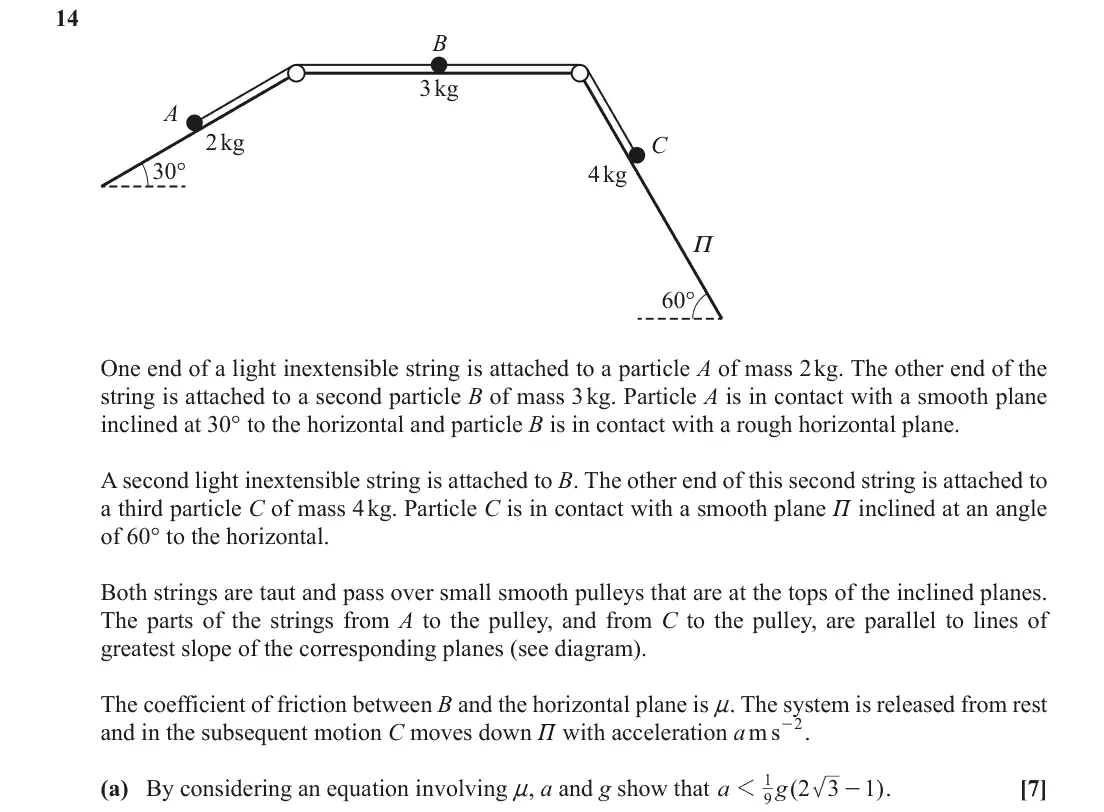
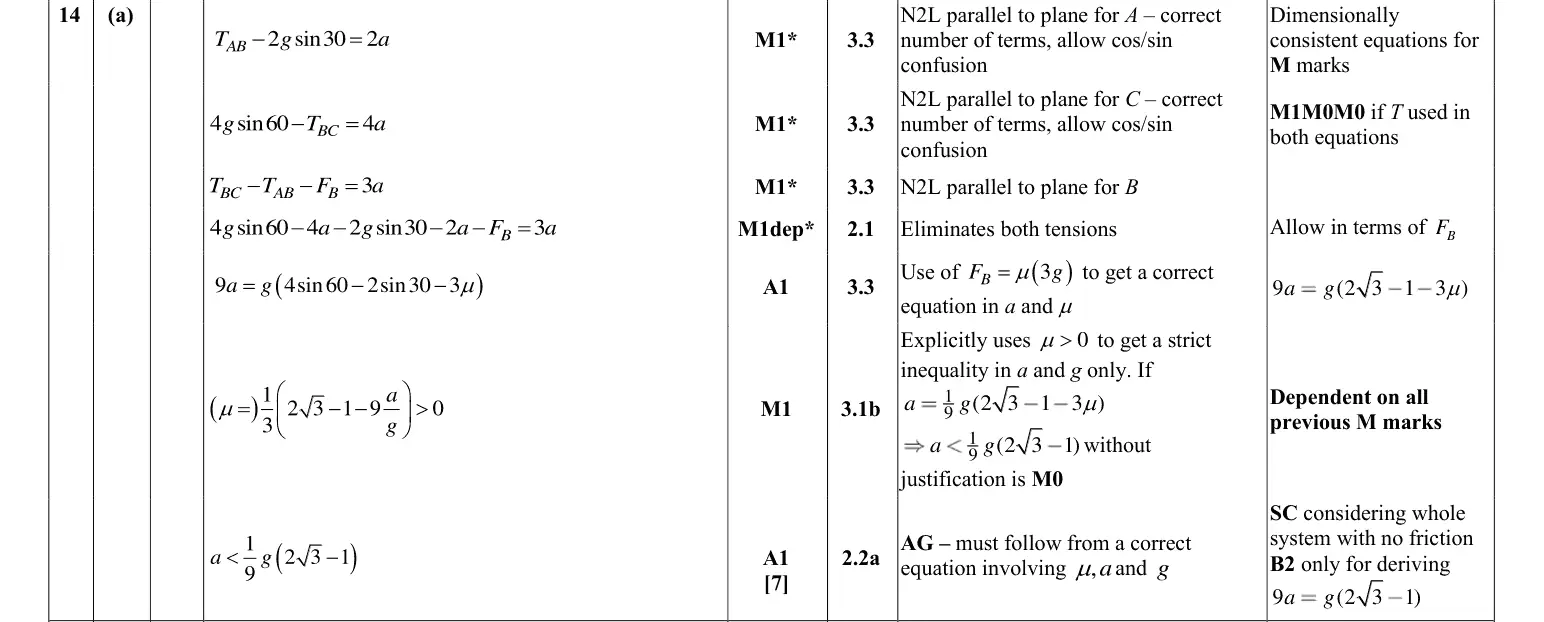
Candidates are reminded to read the question carefully as the question asked candidates to find an equation involving , a and g , many instead tried to find an inequality involving a and g only.
Key points and common errors
N2L for A, B and C separately
eliminate tensions
F_B = 3μg gives 9a = g(2√3 − 1 − 3μ)
use μ > 0 for the strict inequality
must find an equation involving μ, a and g first
Autumn 2021 · Paper 3 · Q14(b)4 marksMedium
Show the start of this question
Mark scheme for this part
Examiner's comment
(From the general report) Question 14(b) Misconception The ‘magnitude of the contact force’ is not simply the sum of the frictional contact force F and the normal contact force R (or even just R ) but is given 2. by F R Supporting you Review of results If any of your students’ results are not as expected, you may wish to consider one of our review of results services.
Key points and common errors
a = g/9 gives μ = ⅔(√3 − 1)
F_B = 2(√3 − 1)g
contact force √((3g)² + F_B²) = 32.7 N
Autumn 2020 · Paper 3 · Q9(c)5 marksMedium
Show the start of this question
Mark scheme for this part
Examiner's comment
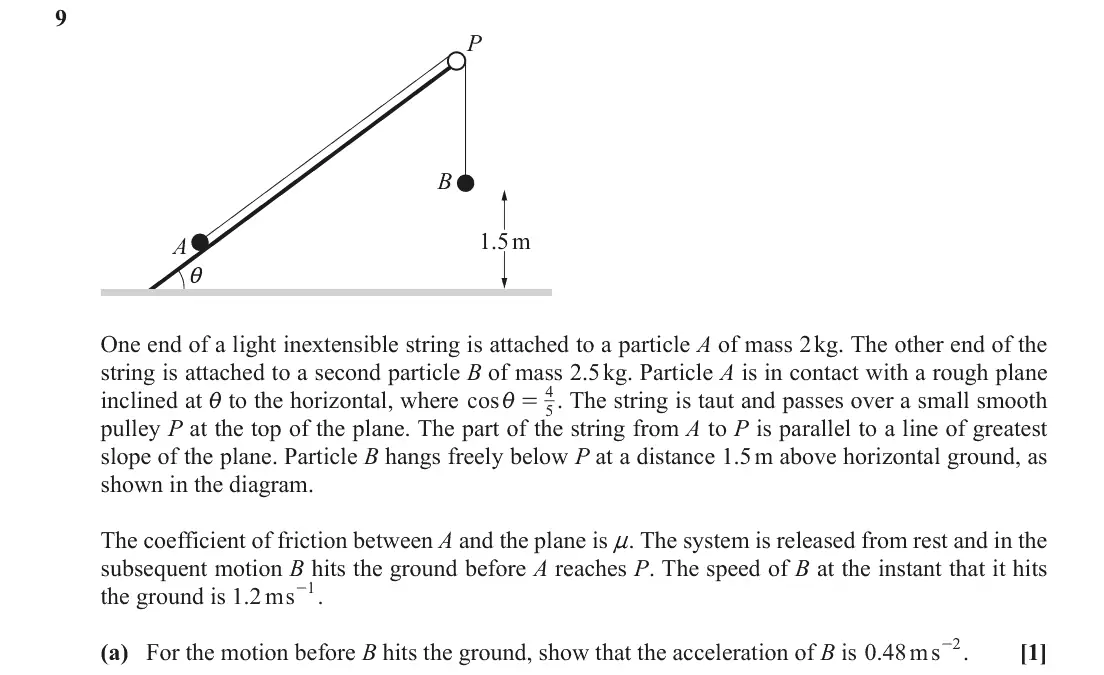
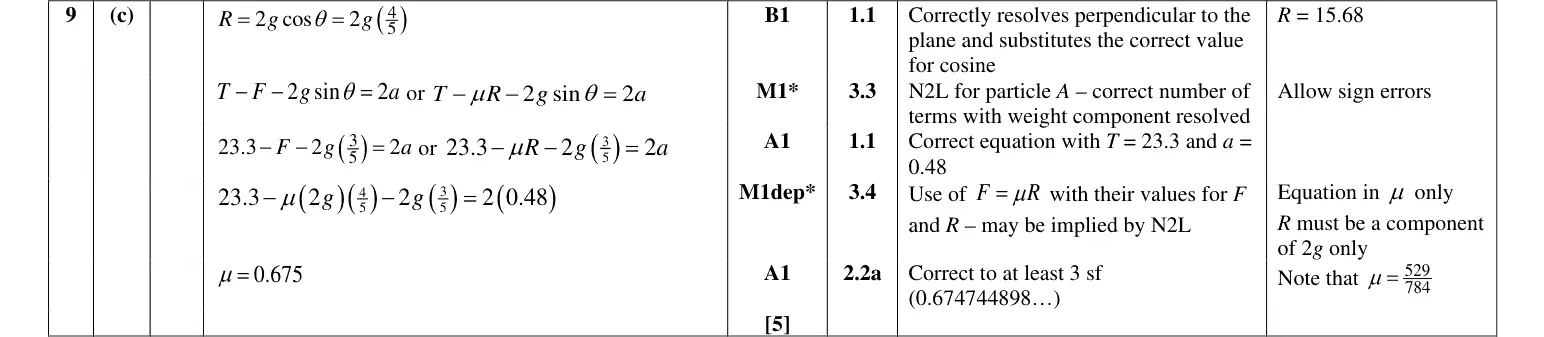
(Comment on Question 09 as a whole) 4 In this question the angle θ was defined as cosθ = . Candidates should resist the temptation to 5 calculate the decimal approximation for θ and instead use their knowledge of Pythagoras Triples to state the exact values for sinθ (and tanθ if required). The exact values have been chosen to make the arithmetic easier. Similarly, some questions will use the values of θ that candidates are expected to know the exact values for, and these should be used rather than the decimal approximation. If the examiner wants the decimal approximations to be used, then the angle θ will simply be defined as a numerical value. Most candidates showed sufficient working using for part (a). There was evidence that most candidates understood how to obtain the given answer in part (b), but some responses did not fully justify their working. A few students used mass rather than weight and did not include g in their equations. Part (c) was attempted by all candidates but one or more of the following mistakes were made: ● Assumed a = 0 . ● Used rather than using components. R = 2g ● Sine/Cosine confusion when stating the components of any force. 4 3 ● Rounding errors with calculated values of θ rather than using cosθ = and sinθ = . 5 5 ● Incorrect directions used leading to sign errors. ● Under-specifying the final answer given to less than 3 sf. Although a fairly standard question, part (d) is traditionally expected to be a challenge for most candidates. For this reason, it was pleasing to see the number of fully correct answers. Common mistakes included: ● Tension was still applied. ● Incorrect acceleration; either the same a = 0 48 . , or a > 0 , or even a = 9 8. . ● Distance = speed × time used rather than ‘suvat’.
Key points and common errors
R = 2g cos θ = 15.68 with cos θ = 4/5, sin θ = 3/5 exactly
T − μR − 2g sin θ = 2a
μ = 0.675
errors: a = 0, R = 2g, sin/cos confusion, rounding θ
June 2019 · Paper 3 · Q9(b)5 marksHard
Show the start of this question
Mark scheme for this part
Examiner's comment
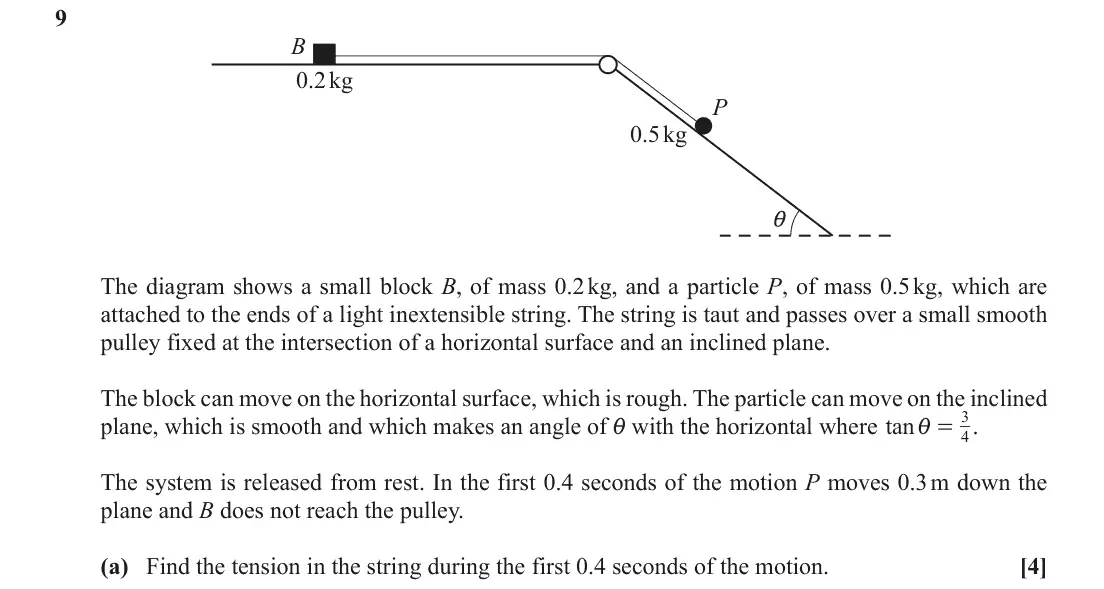
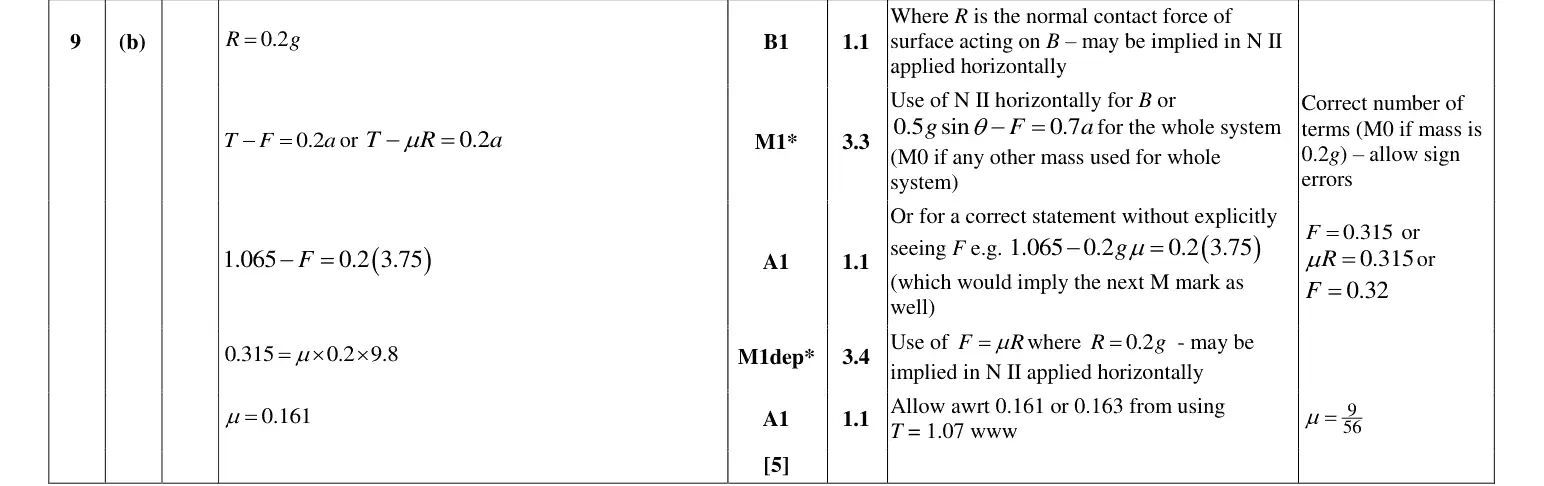
Some candidates only managed to score the mark for realising that the normal contact force R, at B, was equal to 0.2g. Many then incorrectly believed that the coefficient of friction was simply given by the value found in (a) divided by 0.2g. Of those that correctly applied Newton’s second law for block B as T −µ R = 0 2 . a most went on to obtain a correct value for . µ As mentioned in the Section B overview candidates are advised to apply Newton’s second law to each particle separately and not attempt to apply it to the whole system as very few obtained the correct equation of 0 5gsin 0 7 . θ −µ R = . a.
Key points and common errors
R = 0.2g
N2 for B: T − μR = 0.2a
μ = 0.161
whole-system equation usually wrong
dividing T by 0.2g
June 2019 · Paper 3 · Q11(b)7 marksHard
Show the start of this question
Mark scheme for this part
Examiner's comment
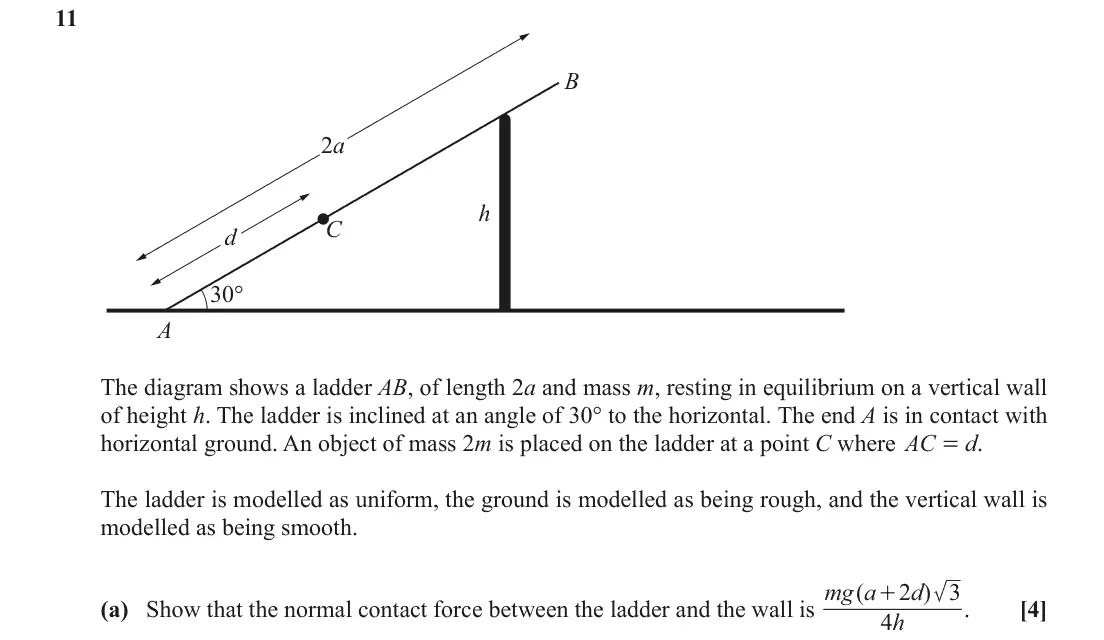
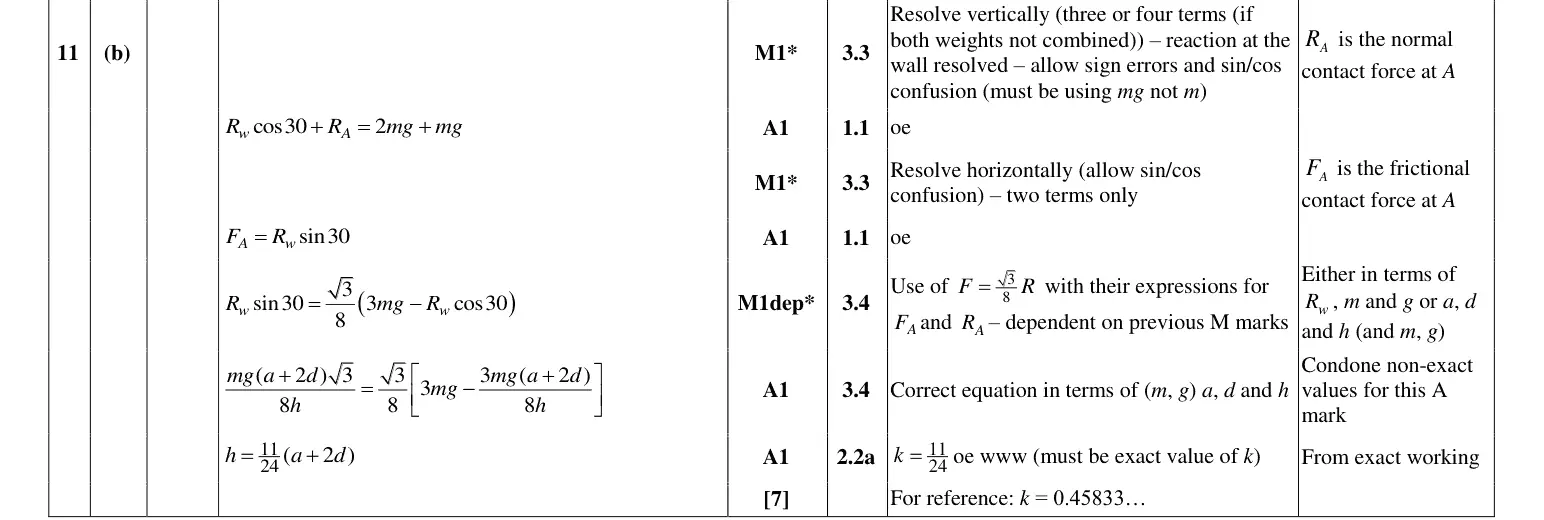
For those candidates who realised that resolving vertically and horizontally for the system and then applying F = µ R was the way of deriving the ‘Show that’ in this part most came unstuck due to the early error in part (a) of not having the correct direction for the normal contact force at the wall. Of those that did resolve correctly, a number then struggled with the corresponding algebra and very few achieved the correct answer of k = . A completely correct solution in which the candidate has clearly shown each stage of working from resolving horizontally and vertically to applying F leading to the correct expression for h in terms of = µ R a and d.
Key points and common errors
resolve vertically and horizontally with the wall reaction at 30° to the vertical
F = μR with μ = √3/8
k = 11/24
algebra errors
June 2018 · Paper 3 · Q12(i)(a)7 marksEasy
Mark scheme for this part
Examiner's comment
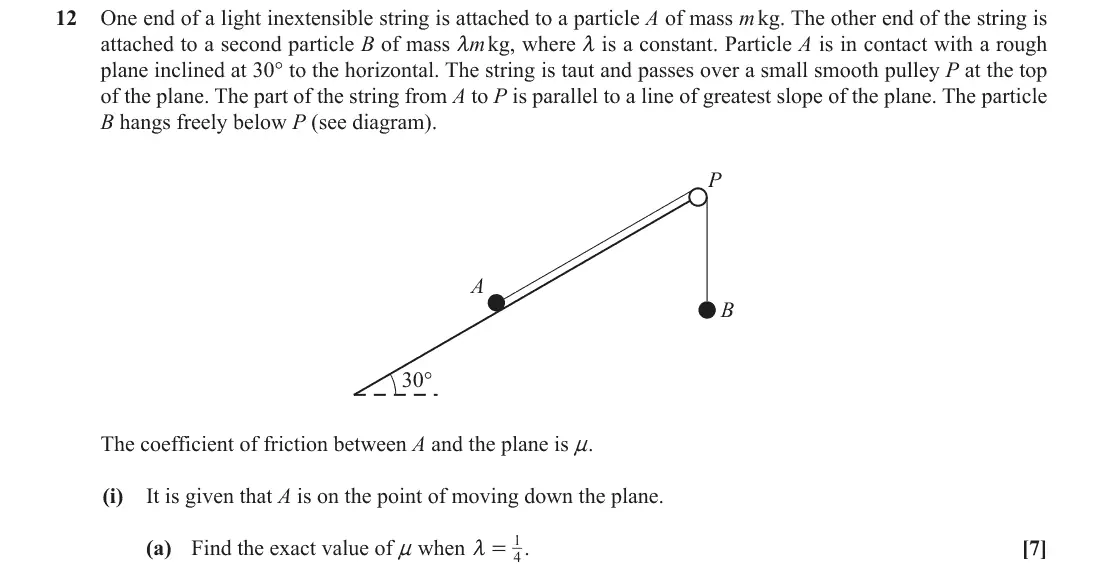
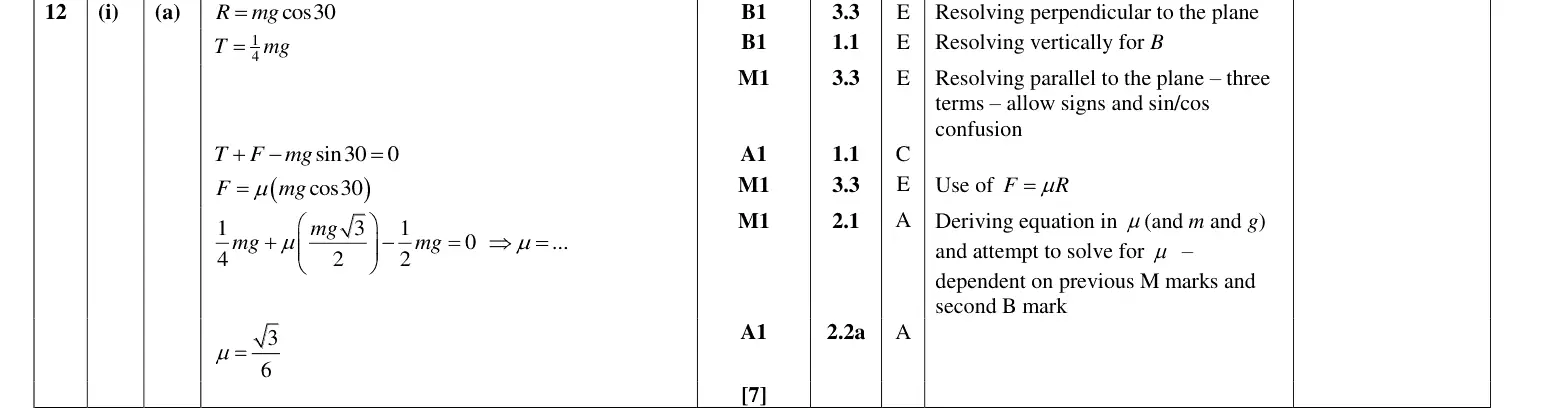
(Comment on Question 12(i) as a whole) This question was answered extremely well with most candidates setting out their working clearly and explaining what they were doing at each step. As mentioned in the overview candidates are strongly advised to deal with each particle separately and many correctly resolved vertically for B, and resolved both parallel and perpendicular to the plane for A using F ≤ µ R to find the value of µ when λ = 1 4 . This part differentiated well with very few candidates showing clearly why λ < 1 2 . Only the most able realised that resolving parallel to the plane and then considering the fact that frictional force had to be positive was the easiest way of tackling this part. A number of candidates started by assuming that λ = 1 2 and then concluding that the magnitude of the frictional force would therefore be zero. It was rarely felt by examiners that in these situations candidates made it clear why it was therefore less than (and not greater than) a half. In general, candidates are reminded that ‘show that’ questions are just that; the information in the question should be used to show a given result and therefore the result (or a limiting case of it) should not be used in an attempt to show that the given result is indeed true.
Key points and common errors
R = mg cos 30
T = ¼mg from B
T + F = mg sin 30 with friction up the plane
F = μR
μ = √3/6
treat each particle separately
June 2018 · Paper 3 · Q12(ii)5 marksHard
Show the start of this question
Mark scheme for this part
Examiner's comment
Like part (ii) this part differentiated well with many candidate unaware that if the value of λ was now greater than a half then particle A would move up the plane; many candidates assumed that the motion of A was down the plane. Of those that did have the correct direction of motion most correctly applied Newton’s second law to both particles separately and obtained the correct value for the coefficient of friction. Clear diagrams, with arrows showing the direction of motion and/or acceleration help to reduce the risk of sign errors when identifying the direction that any frictional force will act.
Key points and common errors
λ = 2 so A moves up the plane and friction acts down
for A: T − F − mg sin 30 = m(g/4)
for B: 2mg − T = 2m(g/4)
μ = √3/2
many assumed A moves down
Find an A-level maths tutor
Stuck on this? Book a trial session with an A-level maths tutor.