3.03p The term 'resultant' as applied to two or more forces acting at a…
Section
3.03 Forces and Newton's Laws
Level
A level only
Statement
Understand the term 'resultant' as applied to two or more forces acting at a point and be able to use vector addition in solving problems involving resultants and components of forces.
Guidance
Includes understanding that the velocity vector gives the direction of motion and the acceleration vector gives the direction of resultant force. Includes being able to find and use perpendicular components of a force, for example to find the resultant of a system of forces or to calculate the magnitude and direction of a force. [Solutions will involve calculation, not scale drawing.]
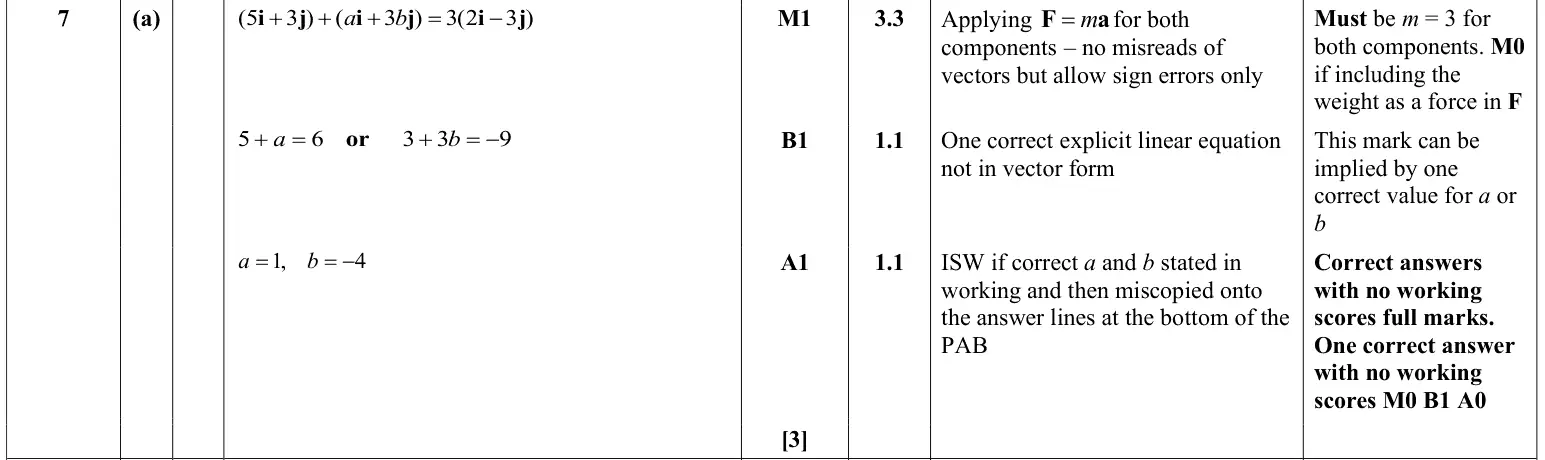
While most candidates correctly set up a vector equation using F = ma to find the values of a and b it was surprising how many candidates either misread the second force vector as (𝑎𝐢+ 𝑏𝐣) or included gravity as an additional force. Those that did set up the correct equation usually obtained both correct values of a and b.
Key points and common errors
(5i + 3j) + (ai + 3bj) = 3(2i − 3j)
a = 1, b = −4
misreading the force as ai + bj or including weight
June 2024 · Paper 3 · Q9(a)6 marksMedium
Mark scheme for this part
Examiner's comment
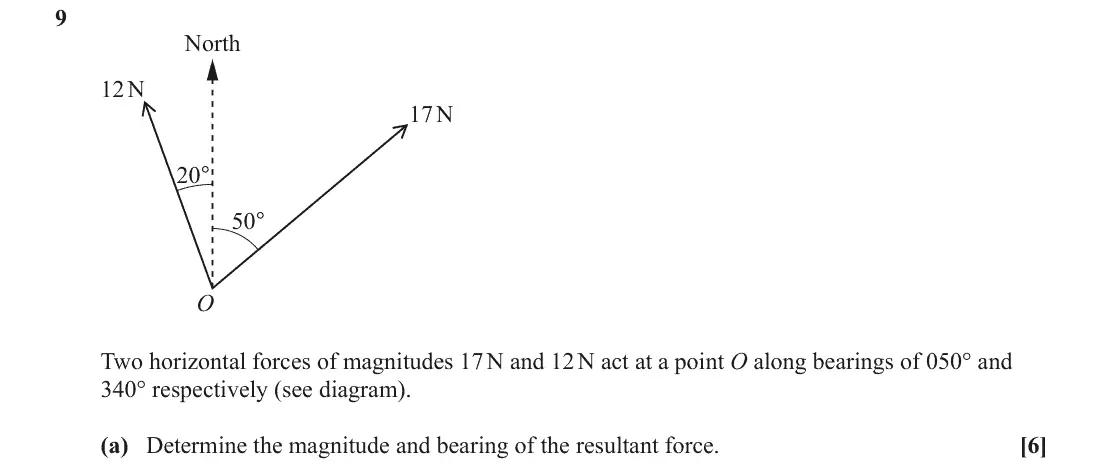
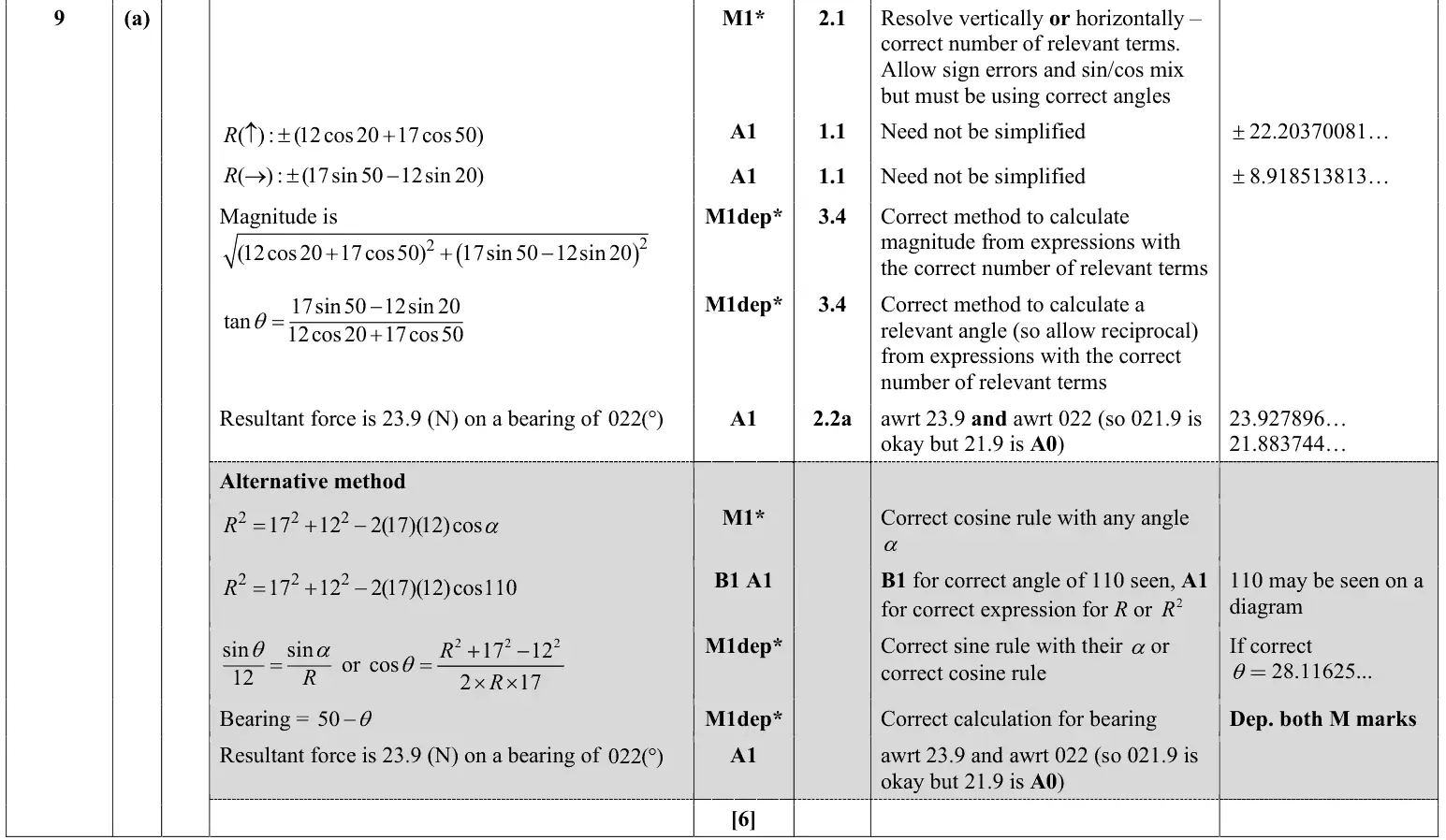
Most candidates resolved in a northerly and easterly direction in their attempts to find the magnitude and bearing of the resultant force (although attempts using a triangle of forces and the sine/cosine rules were just as successful). While many resolved correctly there were the usual sin/cos confusion and sign errors. It was surprising how many candidates, who found the magnitude correctly, did not find the correct bearing (and many who did not give the bearing in a correct three-figure form even though an example of a three-figure bearing was given in the question).
Key points and common errors
resolve N: 12cos20 + 17cos50 = 22.20
E: 17sin50 − 12sin20 = 8.92
R = 23.9 N on bearing 022°
or cosine rule with 110°
many found the magnitude but not the bearing
June 2024 · Paper 3 · Q9(b)2 marksEasy
Show the start of this question
Mark scheme for this part
Examiner's comment
Most candidates recognised in this part that the magnitude of F would be the same as the magnitude of their resultant force in part (a) and that the bearing would be a difference of 180 from their answer to part (a).
Key points and common errors
F is equal and opposite to the resultant: 23.9 N on bearing 202°
June 2023 · Paper 3 · Q10(a)3 marksMedium
Mark scheme for this part
Examiner's comment
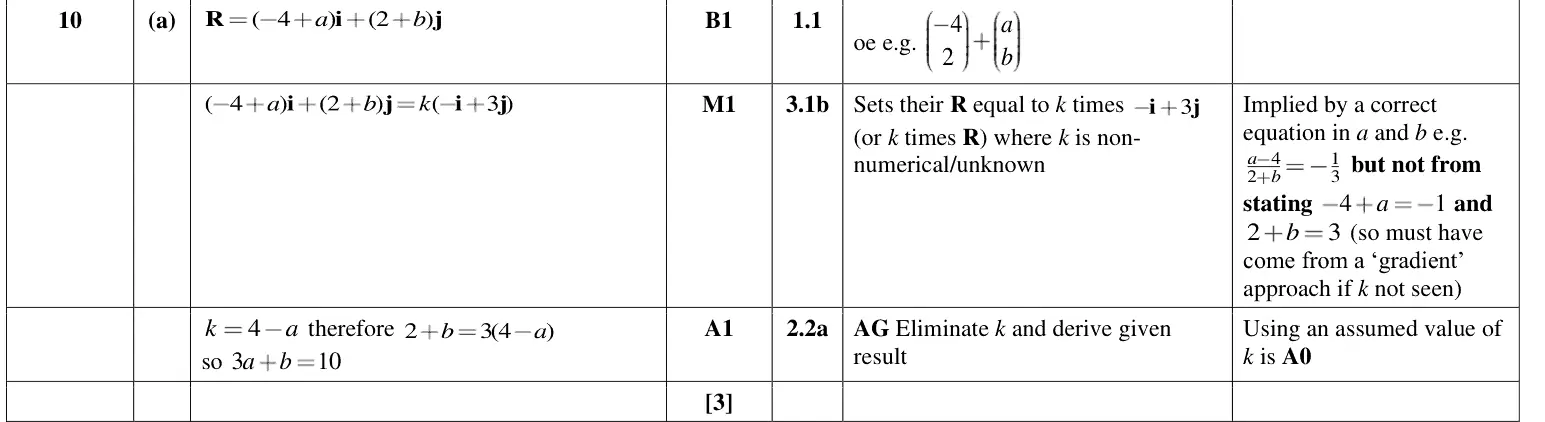
There were two common errors in this part. The first was the incorrect assumption that the resultant of the two forces was found by subtracting rather than adding the two horizontal forces together (possibly the resultant of the two forces equal to −𝐢𝐢+ 3𝐣𝐣 and not a multiply of this vector. Those that did state that candidates were confusing ‘resultant’ vector with ‘direction’ vector). The other common error was setting ቀ−4 + 𝑎𝑎 2 + 𝑏𝑏ቁ= 𝑘𝑘ቀ−1 3 ቁ usually eliminated k and derived the given result correctly.
Key points and common errors
R = (a − 4)i + (2 + b)j = k(−i + 3j)
eliminate k to get 3a + b = 10
errors: subtracting the forces, setting R equal to −i + 3j itself
June 2023 · Paper 3 · Q10(b)4 marksEasy
Show the start of this question
Mark scheme for this part
Examiner's comment
determine that 𝐑𝐑= 2𝐢𝐢−6𝐣𝐣. Most then went on to correctly apply |𝐅𝐅| = 𝑚𝑚|𝐚𝐚| and found the correct value This part was answered well with most candidates using the given value of a to then find b and hence of m.
Key points and common errors
b = −8 so R = 2i − 6j
magnitude √40 = m × 5√10 so m = 0.4
Autumn 2021 · Paper 3 · Q13(a)2 marksMedium
Mark scheme for this part
Examiner's comment
(From the general report) Question 9 states constant acceleration so ‘suvat’ can be used, whereas Question 13 has a variable force term so calculus must be used.
Key points and common errors
resultant (4t − 8)i + 6((2t − 1)² − 9)j = 0
t = 2 only
Autumn 2020 · Paper 3 · Q10(b)(i)4 marksMedium
Show the start of this question
Mark scheme for this part
Examiner's comment
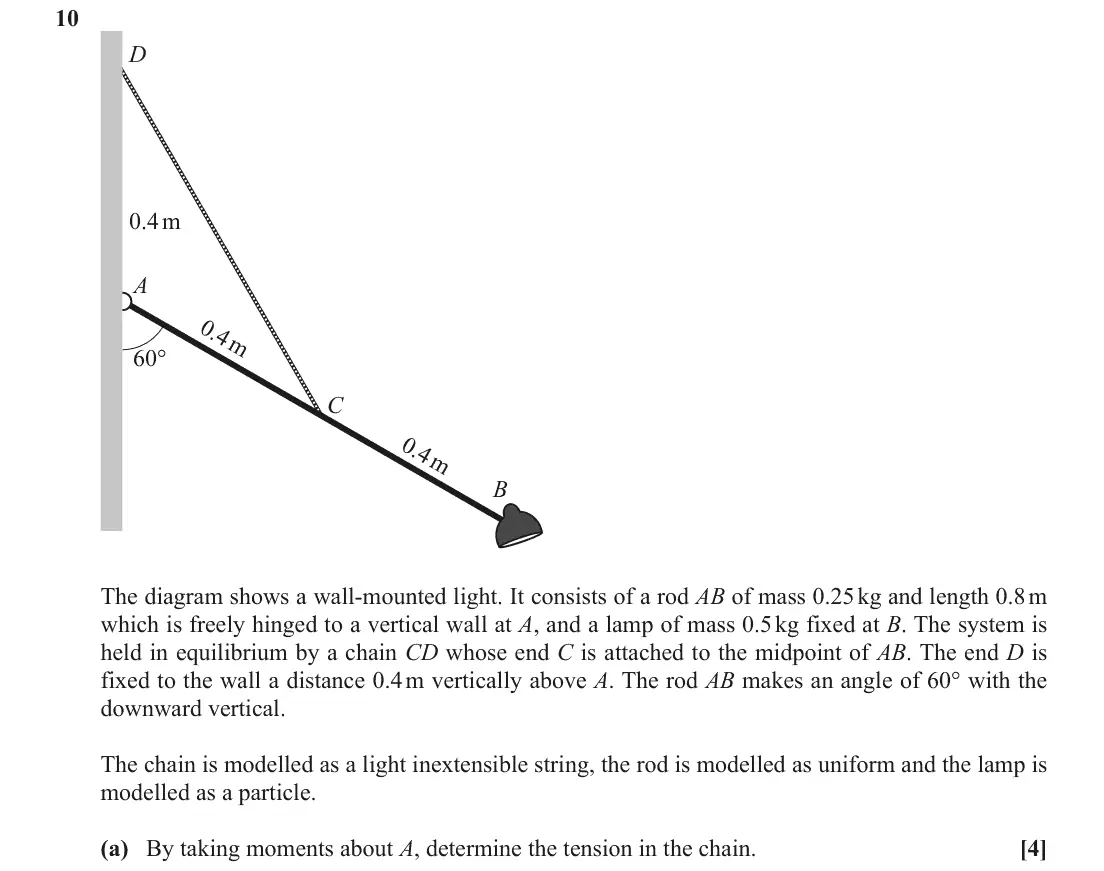
(Comment on Question 10 as a whole) A significant number of candidates did not follow the instruction to take moments about point A in part (a). It was also common to see candidates use mass rather than weight or miss some of the terms. Mixing sine and cosine was also common. In part (b) (i) it was mathematically easier to work with vertical and horizontal components of the force exerted on the rod at A rather than components parallel and perpendicular to the rod. Candidates that picked up marks on this question generally provided an annotated sketch with some degree of success. Part (b) (ii) was generally answered well by those that attempted it from their work on part (b) (i). However, of those, a few did not score both marks due to not clearly indicating what their angle was measured from (below the horizontal or measured from the downward vertical).
Key points and common errors
resolve horizontally and vertically: X = T cos 60°, Y = T sin 60° − 0.75g
magnitude 15.3 N
an annotated sketch helps
Autumn 2020 · Paper 3 · Q10(b)(ii)2 marksMedium
Show the start of this question
Mark scheme for this part
Examiner's comment
(Comment on Question 10 as a whole) A significant number of candidates did not follow the instruction to take moments about point A in part (a). It was also common to see candidates use mass rather than weight or miss some of the terms. Mixing sine and cosine was also common. In part (b) (i) it was mathematically easier to work with vertical and horizontal components of the force exerted on the rod at A rather than components parallel and perpendicular to the rod. Candidates that picked up marks on this question generally provided an annotated sketch with some degree of success. Part (b) (ii) was generally answered well by those that attempted it from their work on part (b) (i). However, of those, a few did not score both marks due to not clearly indicating what their angle was measured from (below the horizontal or measured from the downward vertical).
Key points and common errors
tan θ = Y/X: 46.1° below the horizontal
say what the angle is measured from
June 2018 · Paper 3 · Q10(iii)(a)3 marksMedium
Show the start of this question
Mark scheme for this part
Examiner's comment
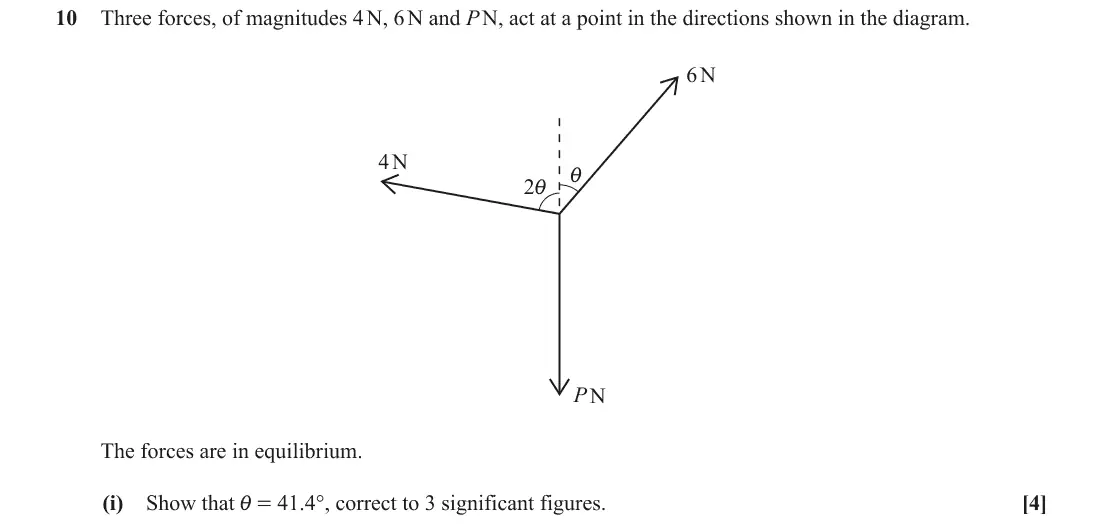
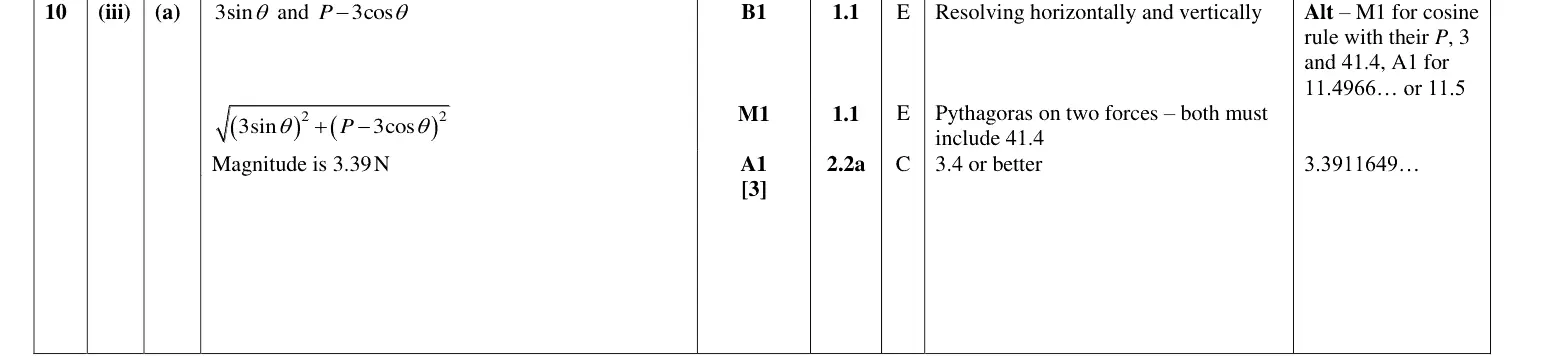
(Comment on Question 10(iii) as a whole) While nearly all candidates understood the method for finding the magnitude of the resultant of the two remaining forces it was generally those candidates who resolved horizontally and vertically and then applied Pythagoras who were the more successful. Examiners noted that those candidates who attempted to form a triangle of forces and then use the cosine rule were generally not as successful making errors with the correct placement of the required lengths (representing the magnitudes) on the sides of the triangle. When giving the direction of a force candidates are reminded that giving just the angle is insufficient. Candidates are strongly advised to draw a diagram (with an arrow on the resultant and/or the components) and to state that their angle is either ‘below/above the horizontal’ or ‘to the upward/downward vertical’.
Key points and common errors
components 3 sin θ and P − 3 cos θ
magnitude √((3 sin θ)² + (P − 3 cos θ)²) = 3.39 N
resolving then Pythagoras more successful than a triangle of forces
June 2018 · Paper 3 · Q10(iii)(b)2 marksMedium
Show the start of this question
Mark scheme for this part
Examiner's comment
(Comment on Question 10(iii) as a whole) While nearly all candidates understood the method for finding the magnitude of the resultant of the two remaining forces it was generally those candidates who resolved horizontally and vertically and then applied Pythagoras who were the more successful. Examiners noted that those candidates who attempted to form a triangle of forces and then use the cosine rule were generally not as successful making errors with the correct placement of the required lengths (representing the magnitudes) on the sides of the triangle. When giving the direction of a force candidates are reminded that giving just the angle is insufficient. Candidates are strongly advised to draw a diagram (with an arrow on the resultant and/or the components) and to state that their angle is either ‘below/above the horizontal’ or ‘to the upward/downward vertical’.
Key points and common errors
tan α = (P − 3 cos θ)/(3 sin θ)
54.2° below the horizontal
direction must be described
Find an A-level maths tutor
Stuck on this? Book a trial session with an A-level maths tutor.