3.03m The principle that a particle is in equilibrium if and only if the…
Section
3.03 Forces and Newton's Laws
Level
A level only
Statement
Be able to use the principle that a particle is in equilibrium if and only if the sum of the resolved parts in a given direction is zero.
Guidance
Problems may involve the resolving of forces, including cases where it is sensible to: 1. resolve horizontally and vertically, 2. resolve parallel and perpendicular to an inclined plane, 3. resolve in directions to be chosen by the learner, or 4. use a polygon of forces.
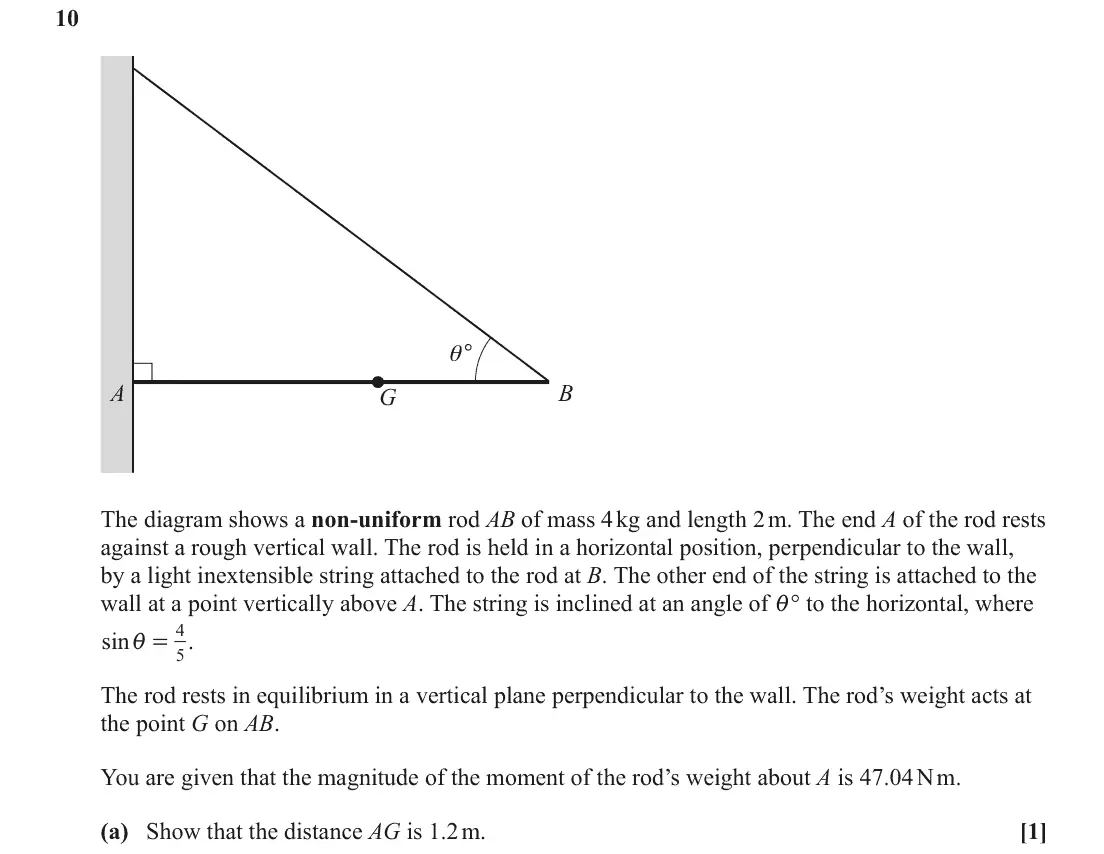
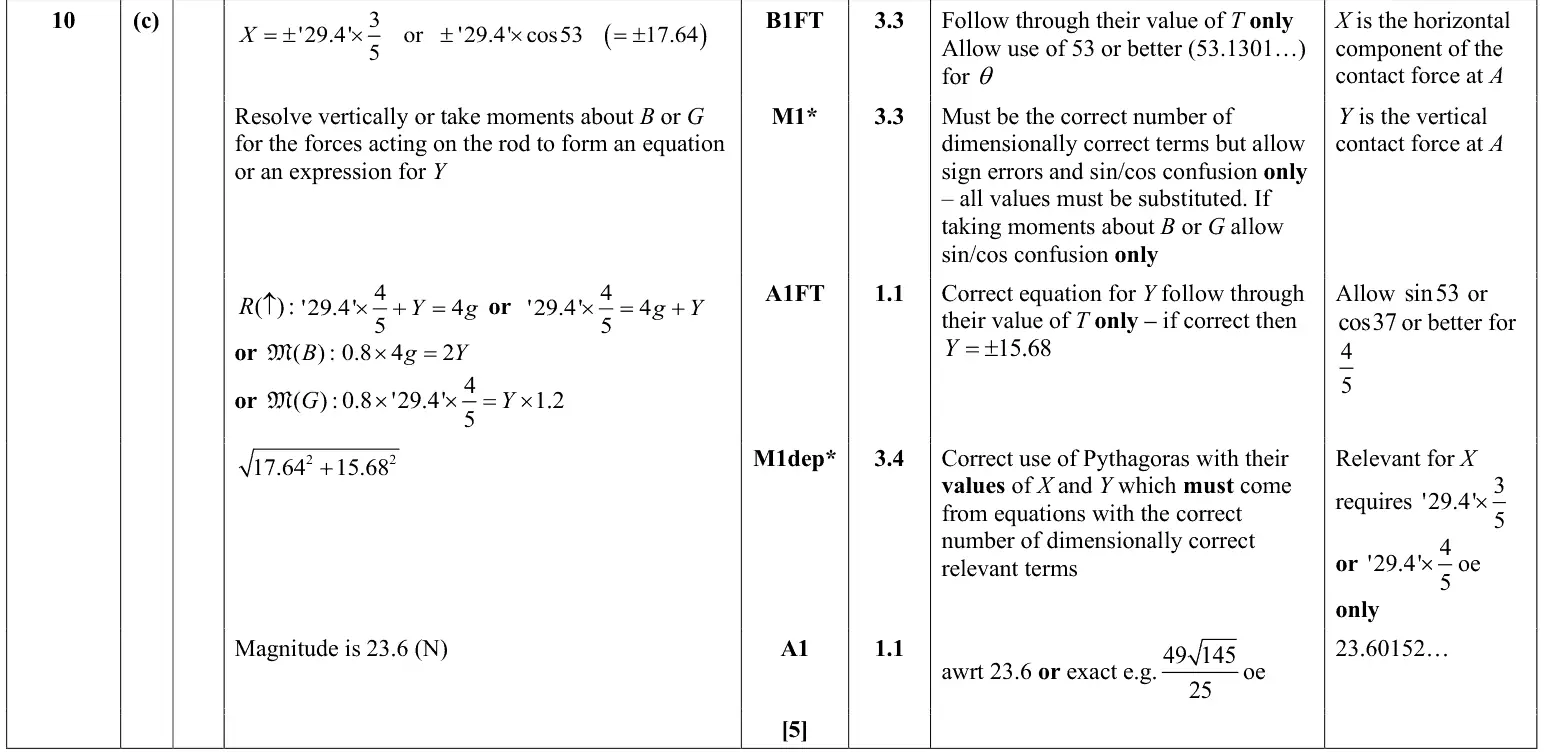
There was a common misconception in this part that the ‘magnitude of the contact force exerted on the rod by the wall at A’ referred only to a force with a horizontal component at the wall and not a vertical component too. Some candidates attempted to take moments again (most commonly about either points G or B) but these attempts were usually not as successful as those who resolved vertically and horizontally (and then completed the problem by used Pythagoras).
Key points and common errors
horizontal X = 29.4 × 3/5 = 17.64
vertical Y = 4g − 29.4 × 4/5 = 15.68
magnitude √(X² + Y²) = 23.6 N
contact force has a vertical component too
June 2024 · Paper 3 · Q10(a)3 marksEasy
Mark scheme for this part
Examiner's comment
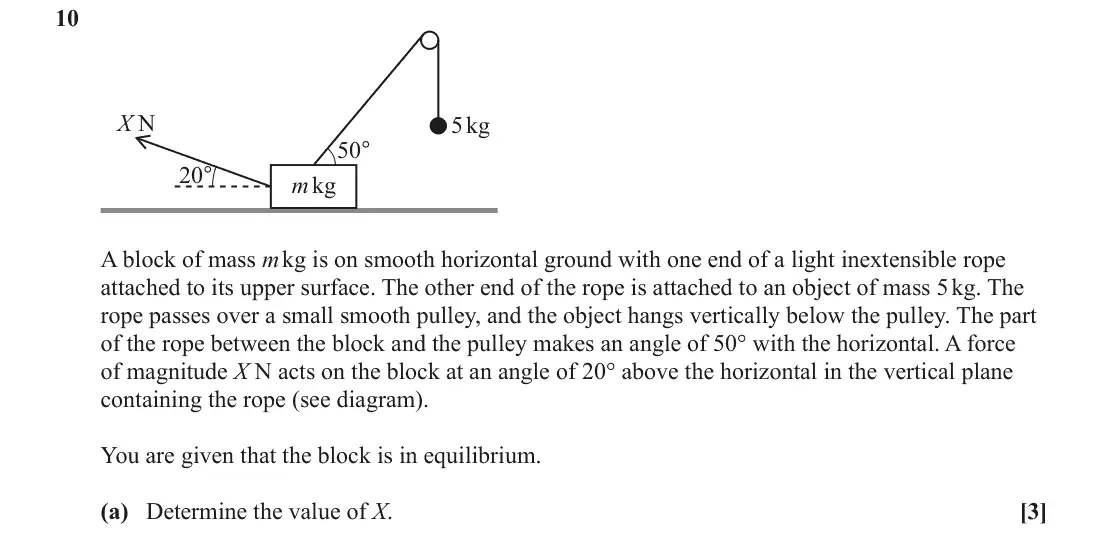
This part was answered very well with most candidates resolving vertically for the object (so obtaining the tension in the rope as 5𝑔), and then resolving horizontally for the block to obtain the correct value for 𝑋.
Key points and common errors
object: T = 5g
block horizontally: T cos50 = X cos20
X = 33.5
June 2024 · Paper 3 · Q10(b)3 marksMedium
Show the start of this question
Mark scheme for this part
Examiner's comment
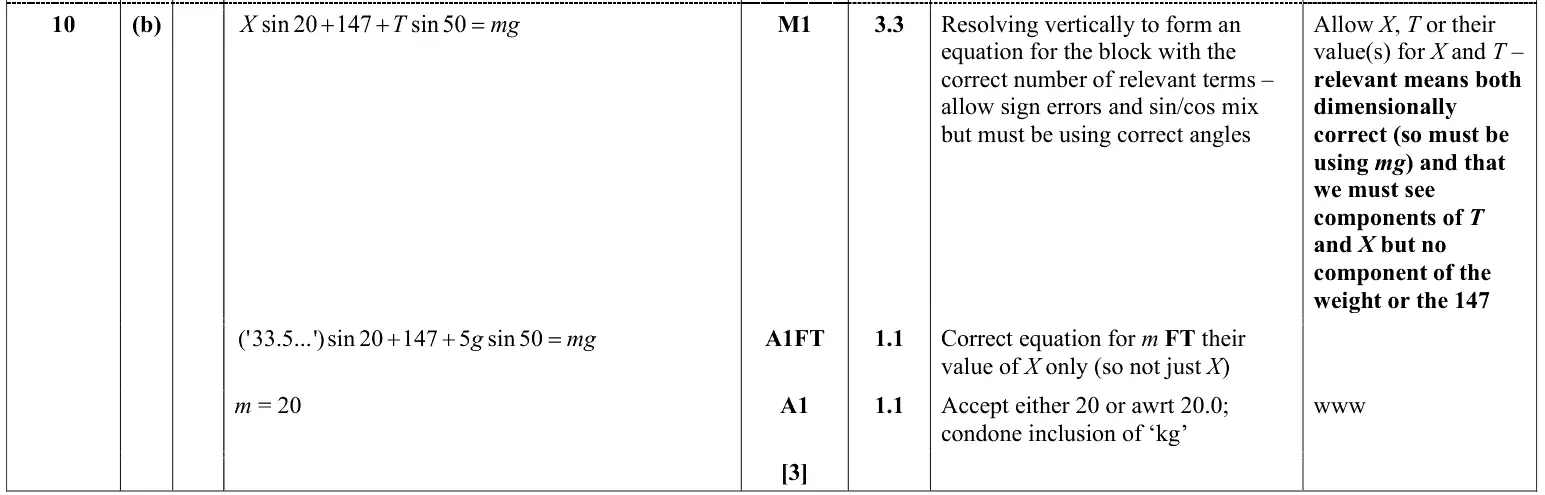
The responses to this part were more mixed with many candidates either making sign errors or failing, when resolving vertically for the block, to include all four forces that were required to find the correct value of 𝑚. It was also common to see some candidates forgetting the 𝑔 and therefore only having the mass (and not the weight) as one of the terms in their equation.
Key points and common errors
vertically on block: X sin20 + 147 + T sin50 = mg
m = 20
all four forces needed
weight mg not m
June 2023 · Paper 3 · Q9(b)5 marksMedium
Show the start of this question
Mark scheme for this part
Examiner's comment
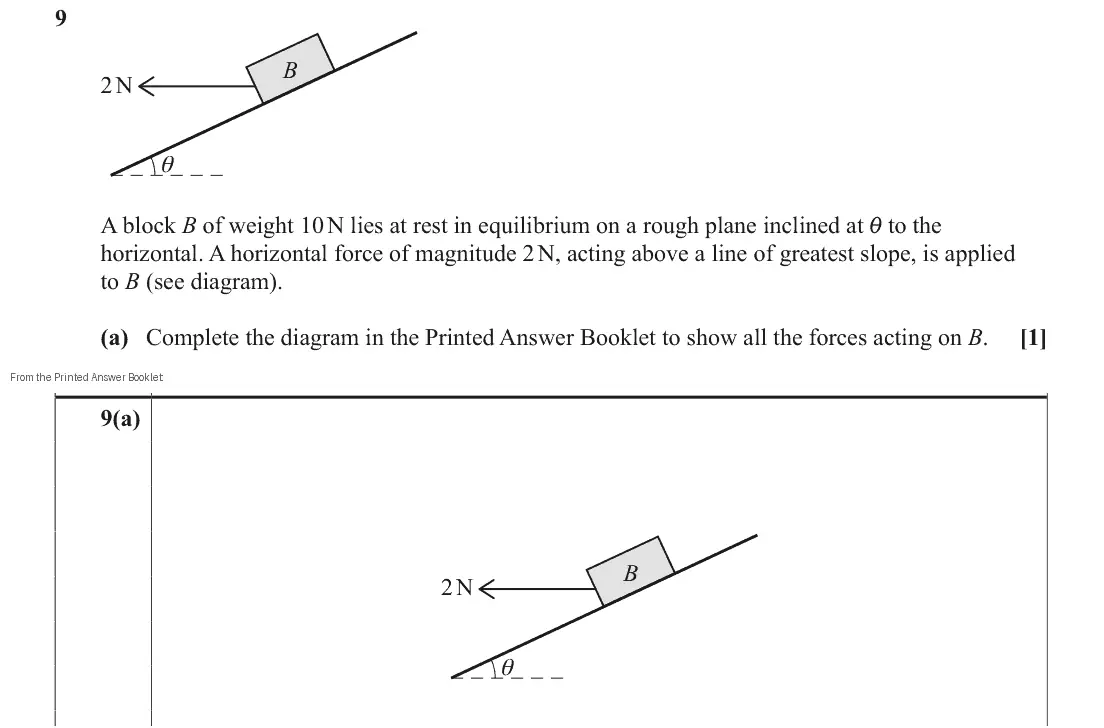
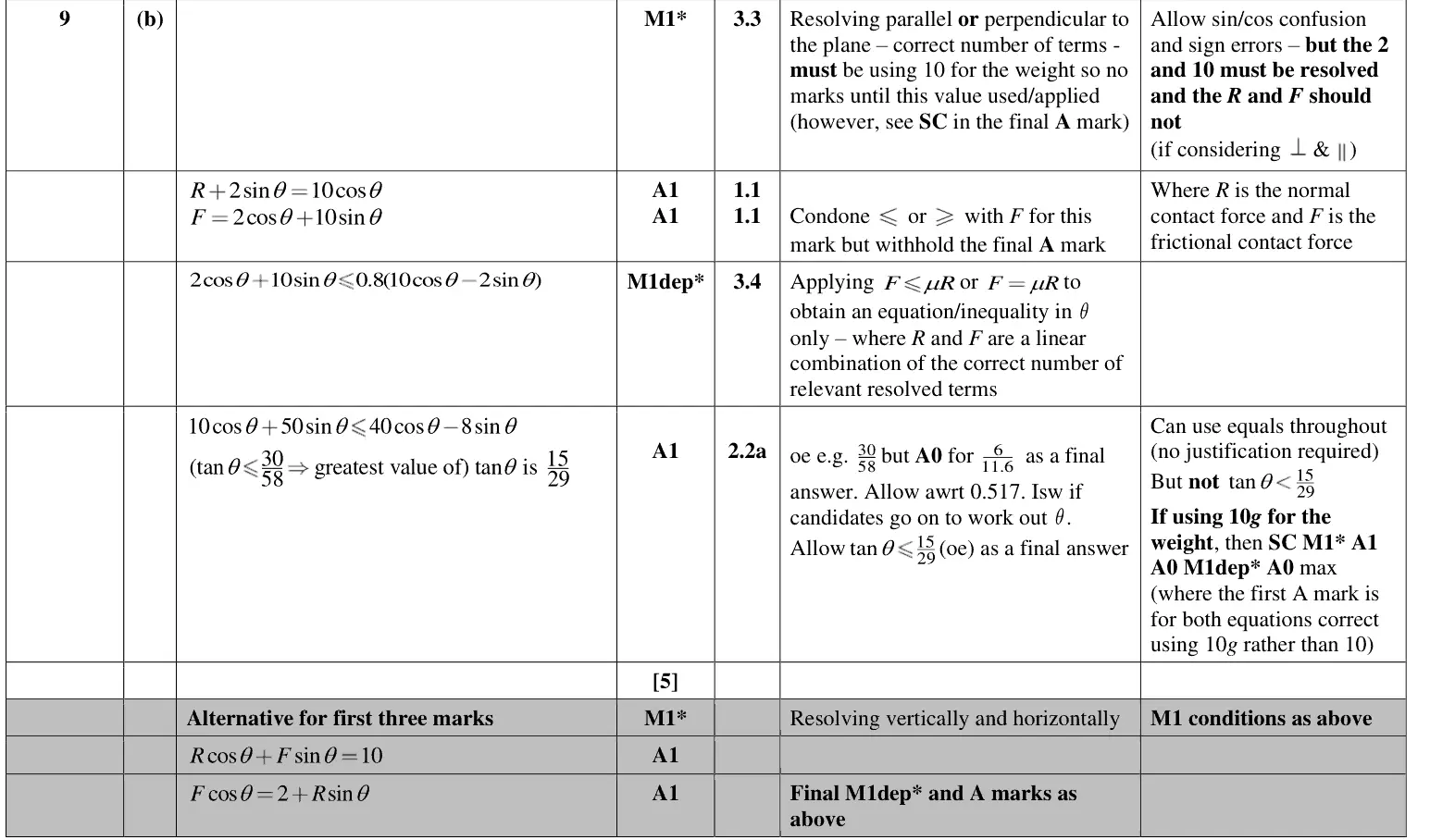
Most candidates attempted to resolve parallel and perpendicular to the plane for B but they were not candidates stated the correct expression for the friction component, namely, 2cos𝜃𝜃+ 10sin𝜃𝜃 but always successful. Aside from the usual sin/cos confusion and sign errors it was surprising how many incorrectly stated the normal contact force as 10cos𝜃𝜃 only (or vice-versa). Those candidates who did resolve in both directions correctly usually went on to apply 𝐹𝐹= 𝜇𝜇𝜇𝜇 correctly and obtain the greatest value of tan𝜃𝜃. While some candidates attempted to resolve vertically and horizontally (rather than perpendicular and parallel to the plane) these responses were rarely successful. This response scored 2 marks. This candidate has derived a correct expression for the normal contact force but their corresponding expression for the frictional contact force only contains a component of the terms the second method mark for applying 𝐹𝐹= 𝜇𝜇𝜇𝜇 could not be awarded. weight (and not the 2 N force too). As their expression for F does not contain the correct number of
Key points and common errors
R = 10cos θ − 2sin θ, F = 2cos θ + 10sin θ
F ≤ 0.8R gives tan θ ≤ 15/29
errors R = 10cos θ only, sin/cos confusion
June 2022 · Paper 3 · Q82 marksEasy
Mark scheme for this part
Examiner's comment
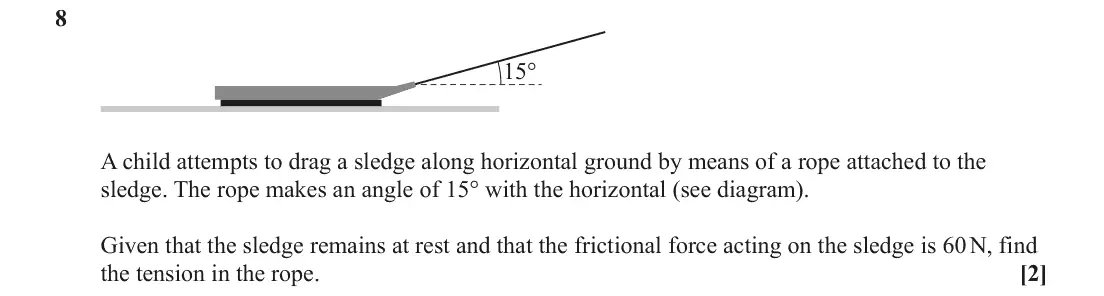
This was answered extremely well with nearly all candidates correctly resolving horizontally and T cos15 = 60. obtaining the correct value for tension in the rope from the equation The most common errors were to either use sine rather than cosine or to use an inequality rather than equals when finding the required tension.
Key points and common errors
resolve horizontally T cos15° = 60
T = 62.1 N
errors: sine, inequality
June 2022 · Paper 3 · Q11(b)4 marksHard
Show the start of this question
Mark scheme for this part
Examiner's comment
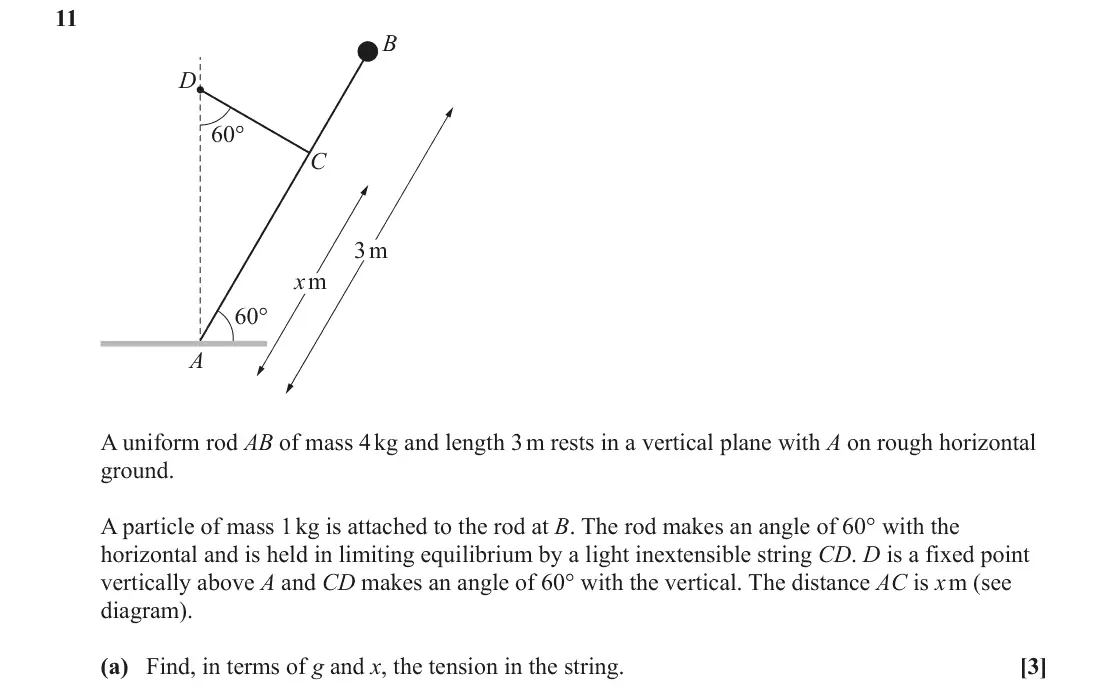
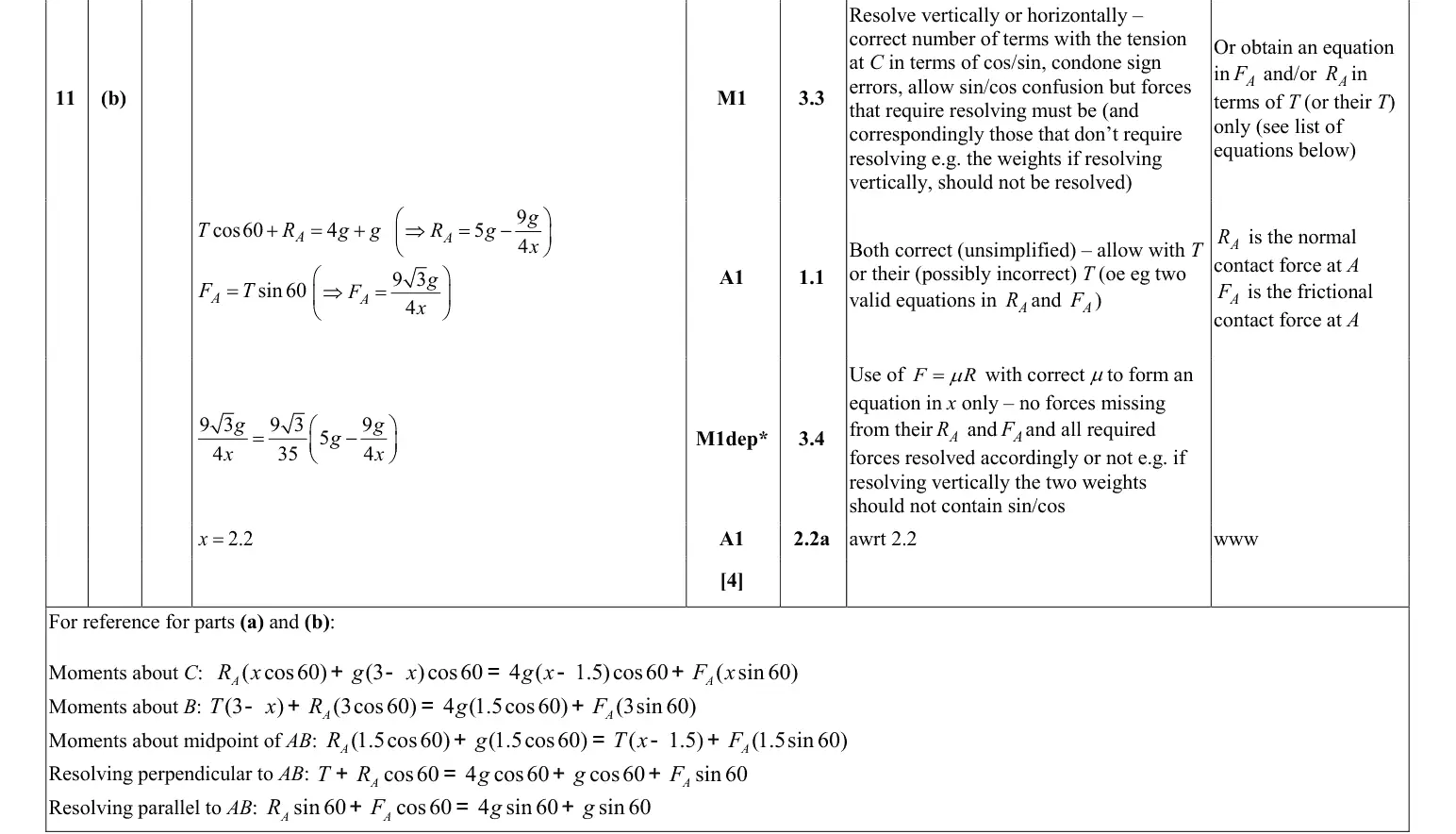
Many struggled with this part and even those candidates who realised that the most efficient way of determining the value of x was to resolve vertically and horizontally for the rod (and then apply F = ) R many could not cope with the mechanics of the situation or the corresponding algebraic demands.
Key points and common errors
resolve: R = 5g − T cos60°, F = T sin60°
F = μR with μ = 9√3/35
x = 2.2
Autumn 2021 · Paper 3 · Q10(b)5 marksMedium
Show the start of this question
Mark scheme for this part
Examiner's comment
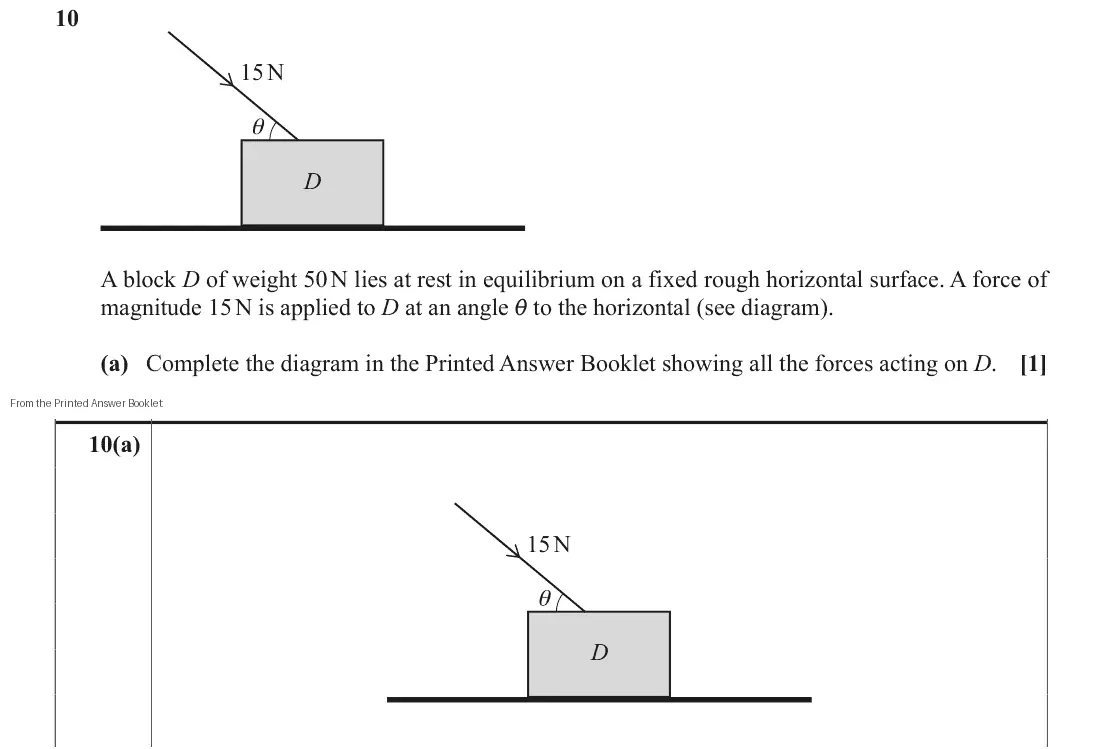
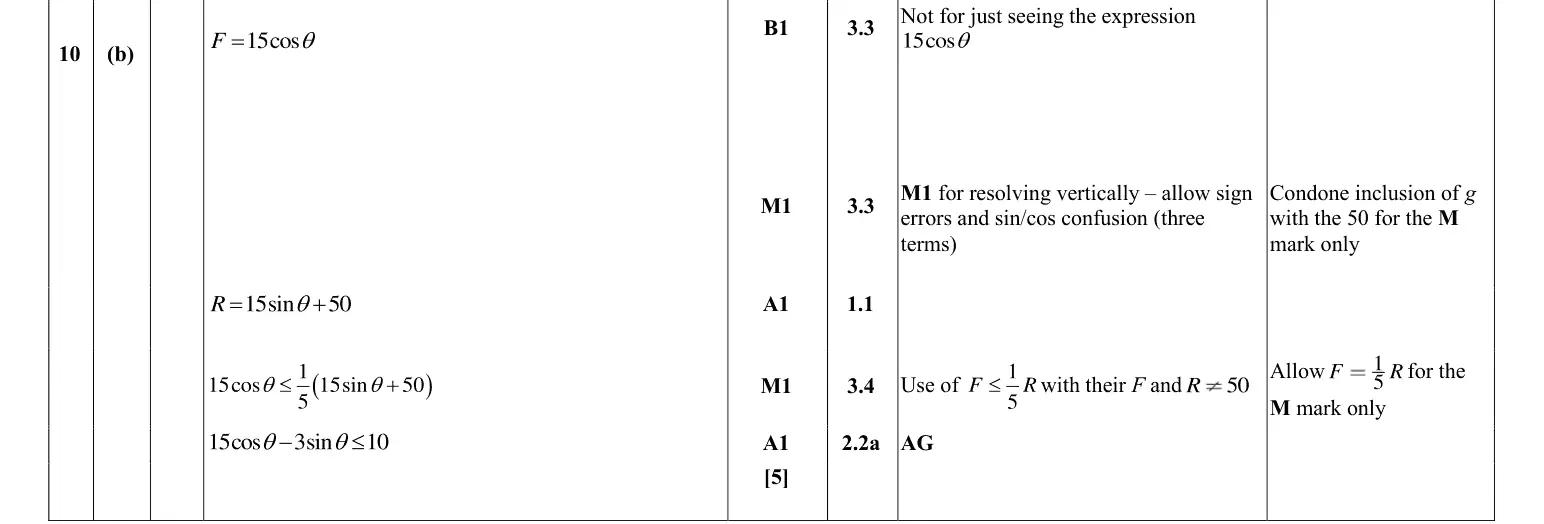
(From the general report) Themes in candidate responses in Section B Question 10(b) Misconception It was clear that in this question candidates had the misconception that as the ‘show that’ contained an inequality that this meant that the magnitude of the frictional contact force F was either F 15cos or F 15cos . As the block was at rest, the forces acting on the block horizontally were in F 15cos . balance and therefore As the block was not in limiting equilibrium then F 0.2 R and the normal contact force R could be found by R 15sin 50. resolving vertically (and if done correctly was given by ) Question 12(b) This was found to be the most demanding part of the paper.
Key points and common errors
F = 15cos θ (equality, not inequality)
R = 50 + 15sin θ
F ≤ 0.2R gives 15cos θ − 3sin θ ≤ 10
common misconception putting the inequality into F
Autumn 2020 · Paper 3 · Q10(b)(i)4 marksMedium
Show the start of this question
Mark scheme for this part
Examiner's comment
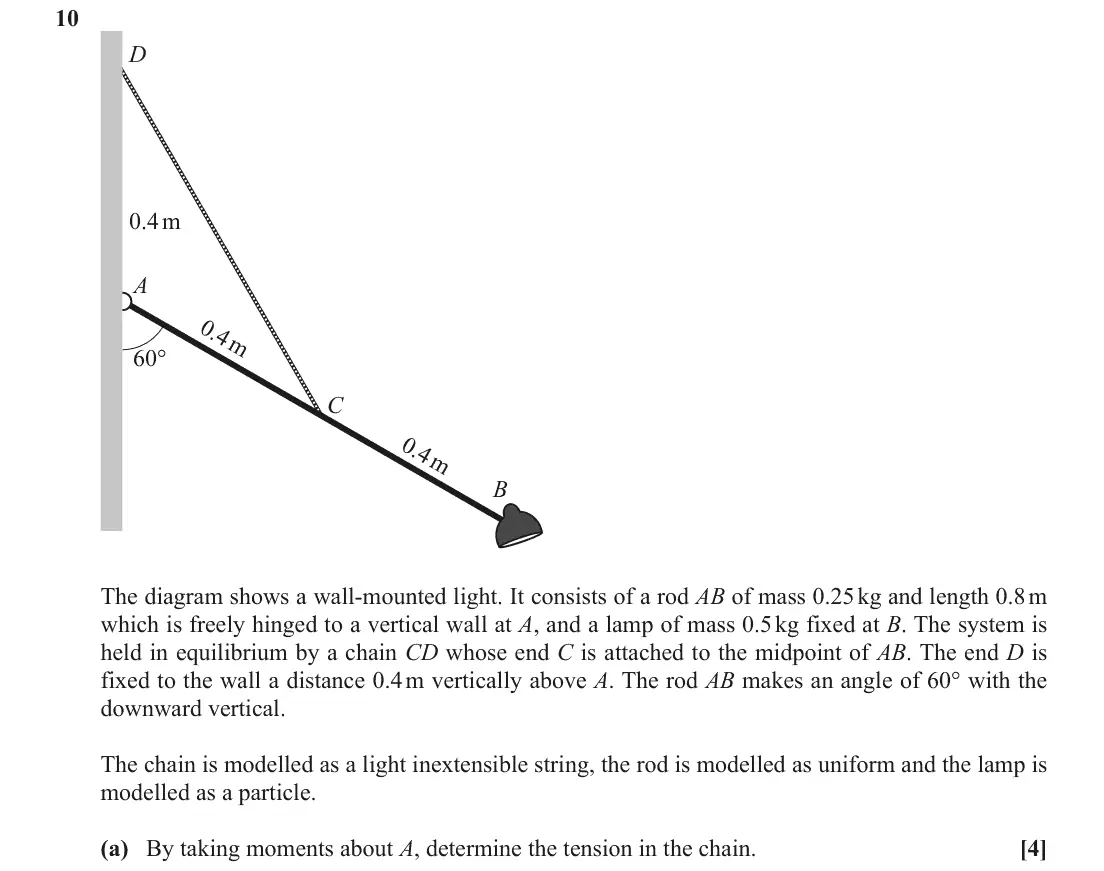
(Comment on Question 10 as a whole) A significant number of candidates did not follow the instruction to take moments about point A in part (a). It was also common to see candidates use mass rather than weight or miss some of the terms. Mixing sine and cosine was also common. In part (b) (i) it was mathematically easier to work with vertical and horizontal components of the force exerted on the rod at A rather than components parallel and perpendicular to the rod. Candidates that picked up marks on this question generally provided an annotated sketch with some degree of success. Part (b) (ii) was generally answered well by those that attempted it from their work on part (b) (i). However, of those, a few did not score both marks due to not clearly indicating what their angle was measured from (below the horizontal or measured from the downward vertical).
Key points and common errors
resolve horizontally and vertically: X = T cos 60°, Y = T sin 60° − 0.75g
magnitude 15.3 N
an annotated sketch helps
June 2019 · Paper 3 · Q11(b)7 marksHard
Show the start of this question
Mark scheme for this part
Examiner's comment
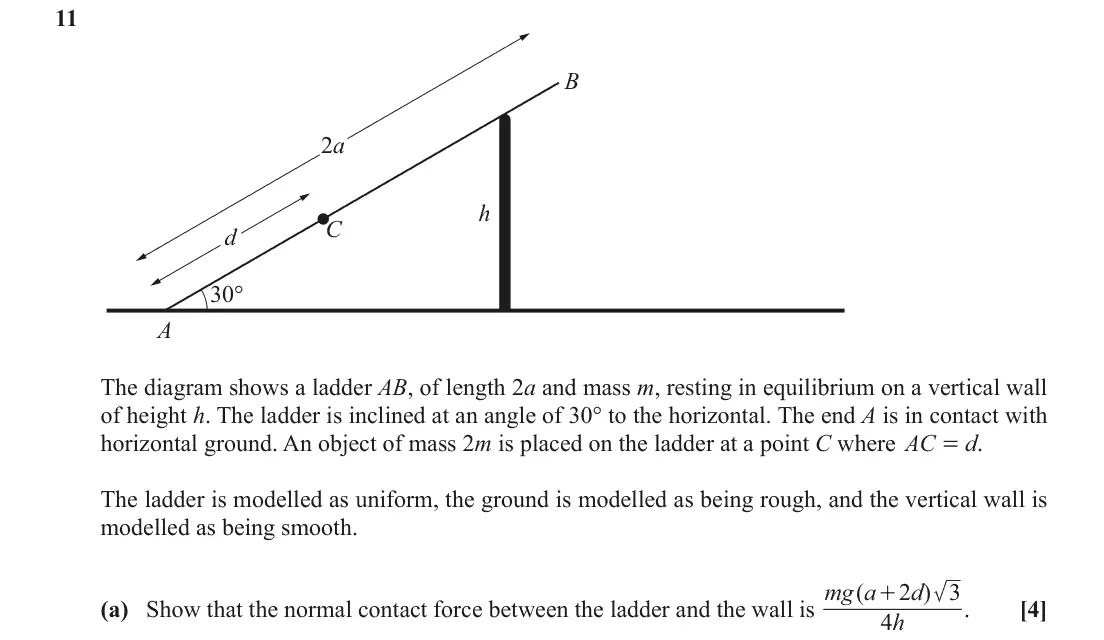
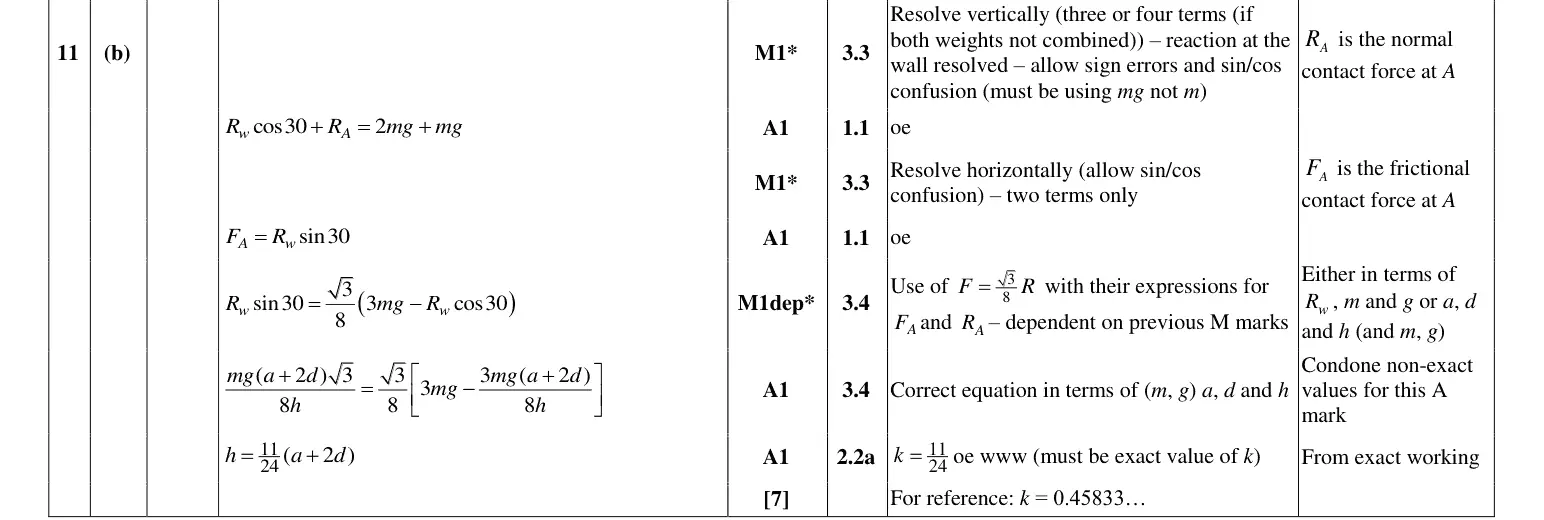
For those candidates who realised that resolving vertically and horizontally for the system and then applying F = µ R was the way of deriving the ‘Show that’ in this part most came unstuck due to the early error in part (a) of not having the correct direction for the normal contact force at the wall. Of those that did resolve correctly, a number then struggled with the corresponding algebra and very few achieved the correct answer of k = . A completely correct solution in which the candidate has clearly shown each stage of working from resolving horizontally and vertically to applying F leading to the correct expression for h in terms of = µ R a and d.
Key points and common errors
resolve vertically and horizontally with the wall reaction at 30° to the vertical
F = μR with μ = √3/8
k = 11/24
algebra errors
June 2018 · Paper 3 · Q10(i)4 marksMedium
Mark scheme for this part
Examiner's comment
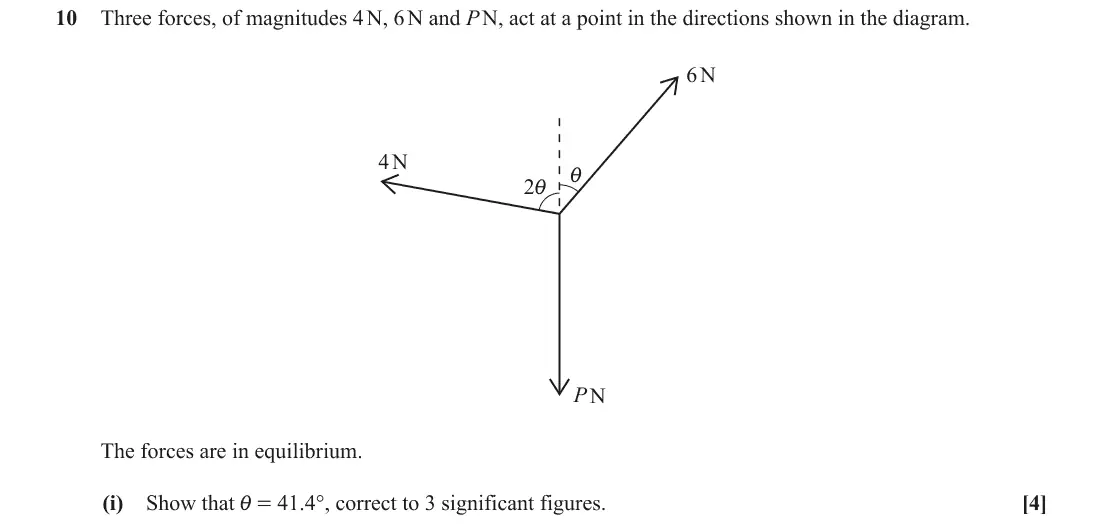
For those candidates who correctly resolve horizontally and stated that 4sin2 θ = 6sin θ most went on to show with sufficient detail the required given answer. The most common errors, as expected, were those that did not deal correctly with the two different angles or those that had the standard confusion with sine and cosine when resolving forces.
Key points and common errors
resolve horizontally: 4 sin 2θ = 6 sin θ
double angle: 8 sin θ cos θ = 6 sin θ so cos θ = 3/4
θ = 41.4°
sin/cos confusion and mixing the two angles
June 2018 · Paper 3 · Q10(ii)2 marksEasy
Show the start of this question
Mark scheme for this part
Examiner's comment
This part was answered extremely well with the majority of candidates correctly resolving vertically and obtaining P = 4cos2 θ + 6cos θ ⇒ P = 5 .
Key points and common errors
resolve vertically: P = 4 cos 2θ + 6 cos θ = 5
Find an A-level maths tutor
Stuck on this? Book a trial session with an A-level maths tutor.