3.03c Newton's second law (F = ma) for motion in a straight line for…
Section
3.03 Forces and Newton's Laws
Level
AS & A level
Statement
Understand and be able to use Newton's second law (F = ma) for motion in a straight line for bodies of constant mass moving under the action of constant forces.
Guidance
e.g. A car moving along a road, a passenger riding in a lift or a crane lifting a weight. For stage 1 learners, examples can be restricted to problems in which the forces acting on the body will be collinear, in two perpendicular directions or given as 2-D vectors.
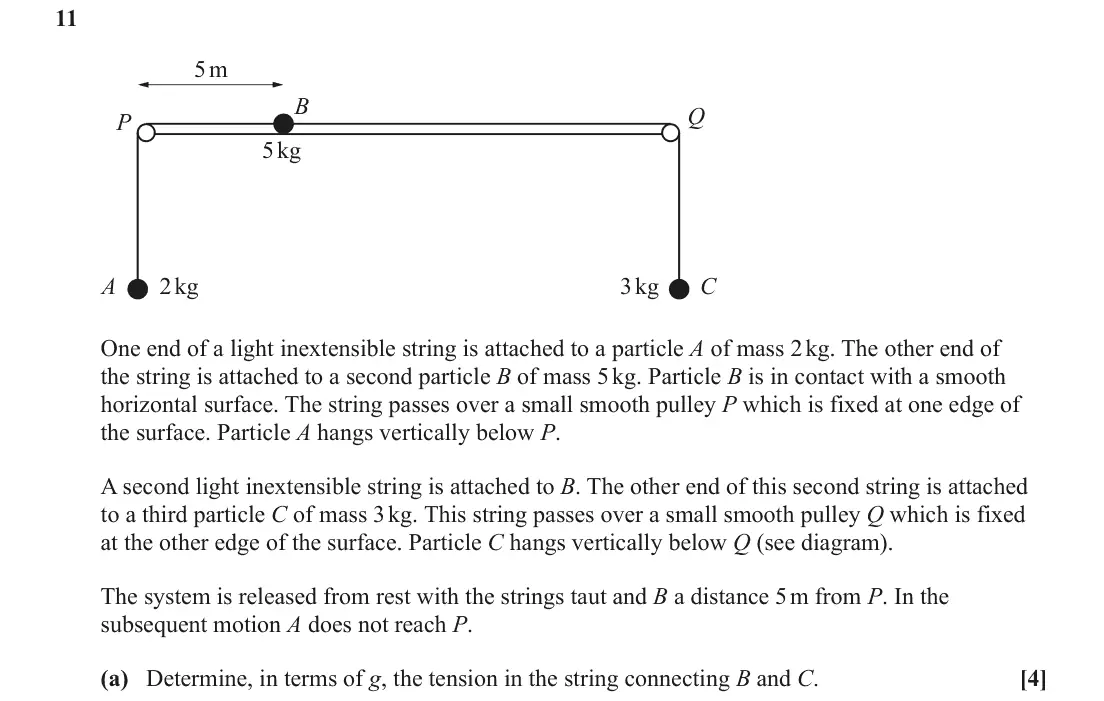
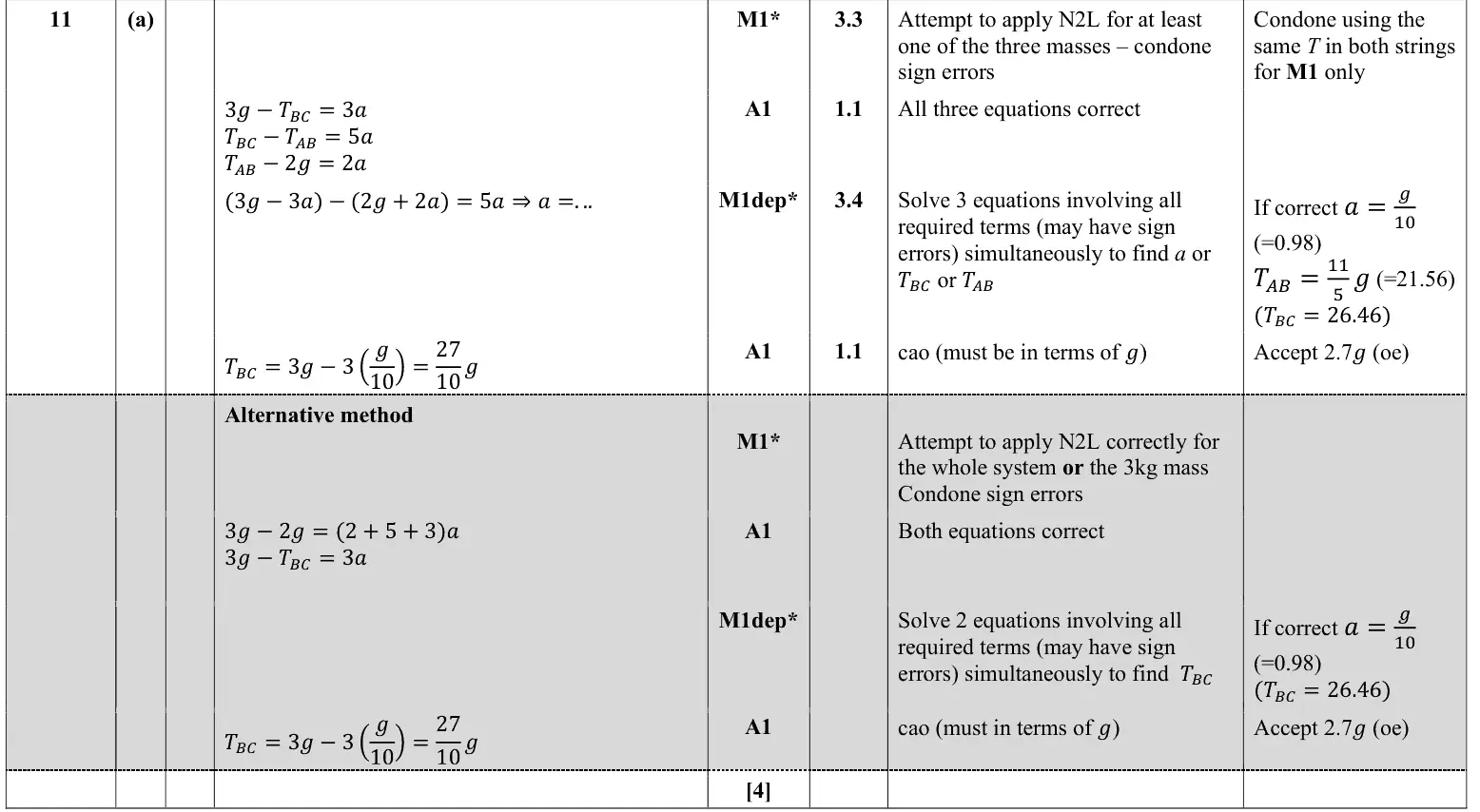
Those candidates who realised that the tension in AB was not the same as the tension in BC were generally very successful in this part, usually providing accurate working. Occasionally the answer was not given in terms of g as requested. Many assumed there was only one tension to find, which gained at most the first M mark.
Key points and common errors
two different tensions: 3g − T_BC = 3a, T_BC − T_AB = 5a, T_AB − 2g = 2a
a = g/10
T_BC = 27g/10
answer in terms of g
June 2025 · AS Paper 2 · Q11(b)6 marksHard
Show the start of this question
Mark scheme for this part
Examiner's comment
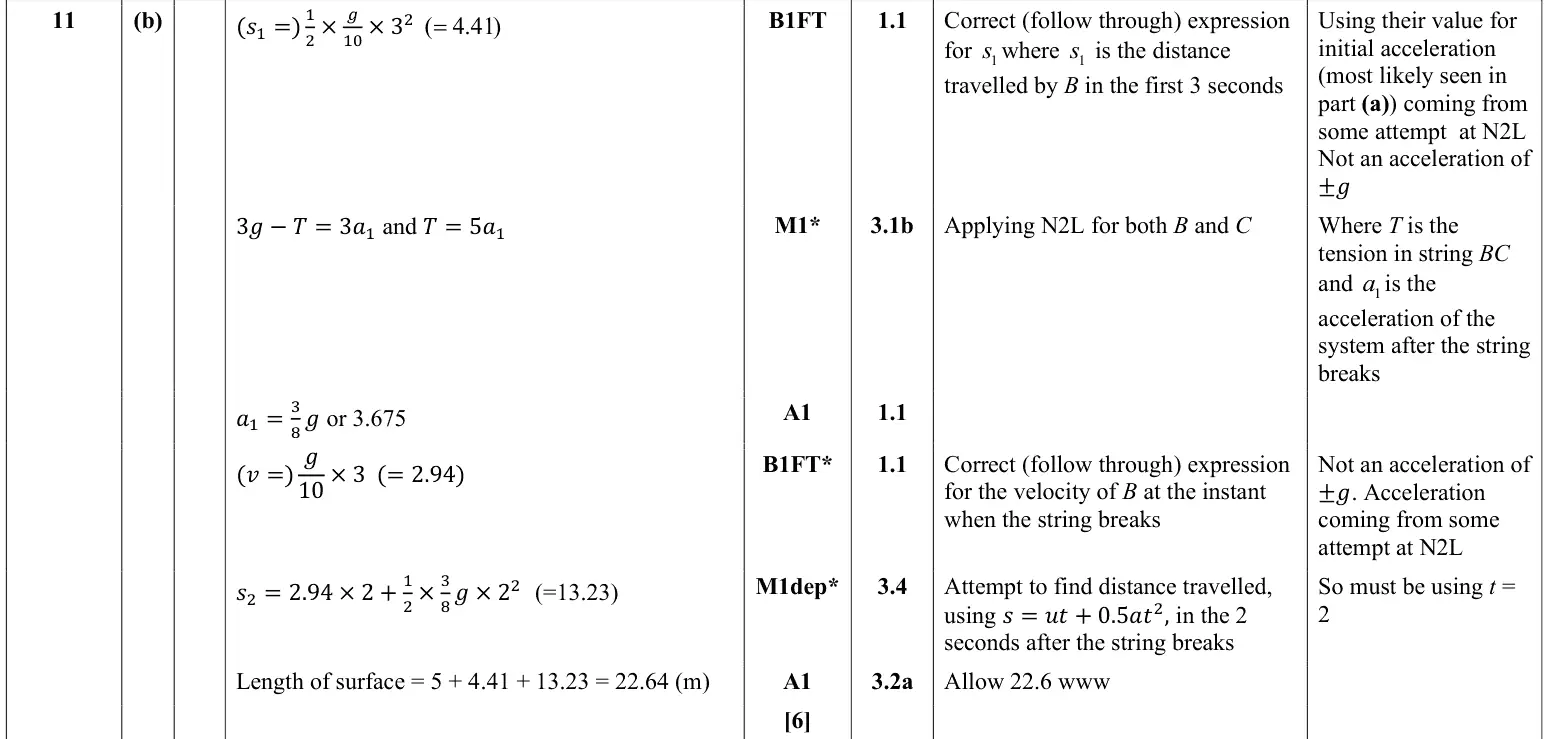
This question proved difficult for many candidates. There were some good solutions to this part seen, but full marks depended on a correctly obtained acceleration in (a). A few ignored the 5m when giving their final answer. Many candidates did not apply Newton’s Second Law to the situation after the string broke, using their previous acceleration, or g, or 0, so gaining at most the 2 B marks. In this solution, which follows from a fully correct part (a), the acceleration g/10 is correctly found although this had already been done in (a) actually so there was no need to repeat the calculation. It is used correctly for the 2 B marks to be given. Then T = 5a, one of the correct equations needed, is used with the tension found in part (a) and the equation 3g – T = 3a never appears. So M0 and no further marks were awarded.
Key points and common errors
first 3 s: s₁ = 4.41 m, v = 2.94
after break N2L for B and C: a₁ = 3g/8
s₂ = 2.94 × 2 + ½(3g/8)(4) = 13.23
PQ = 5 + 4.41 + 13.23 = 22.6 m
June 2025 · Paper 3 · Q8(a)2 marksEasy
Mark scheme for this part
Examiner's comment
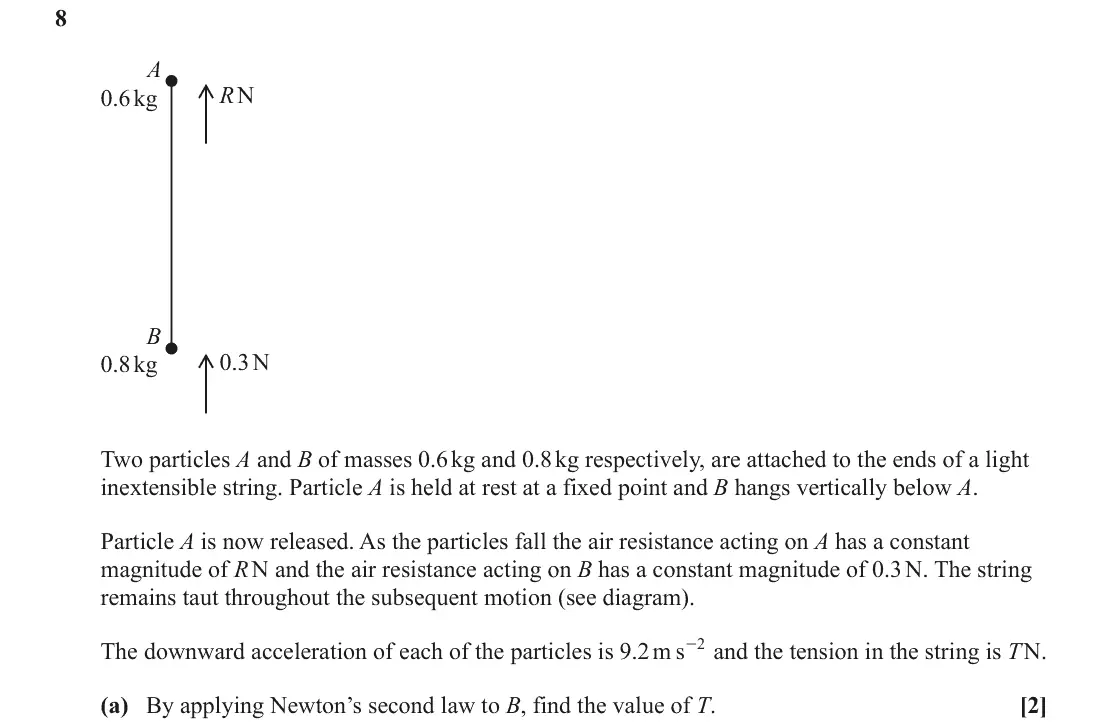
Although answered well by most candidates some struggled to include all the forces acting on B with many forgetting to include the weight of B. Of those that did include all three forces acting on B many made sign error with the acceleration term which led to a common incorrect answer of 14.9 for the tension in the string.
Key points and common errors
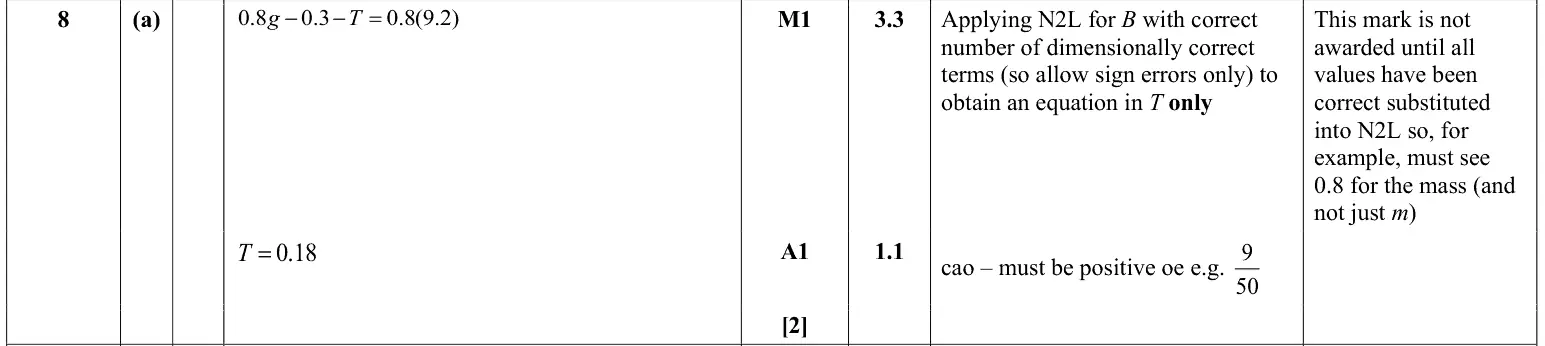
N2L for B: 0.8g − 0.3 − T = 0.8 × 9.2 so T = 0.18
weight of B often omitted
sign error gives 14.9
June 2025 · Paper 3 · Q8(b)2 marksMedium
Show the start of this question
Mark scheme for this part
Examiner's comment
Candidates were evenly split between applying Newton’s second law to A or the system to answer this part. Those who attempted the former were usually more successful as many who attempted a ‘system’ equation included, in error, the tension in the string (or missed off one of the forces).
Key points and common errors
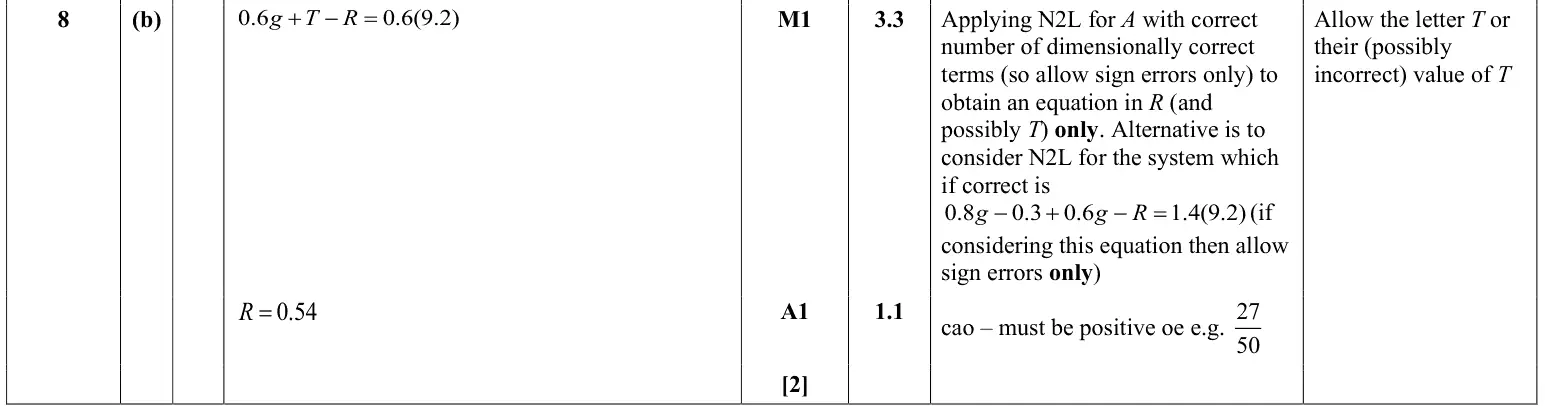
N2L for A: 0.6g + T − R = 0.6 × 9.2 so R = 0.54
system equations wrongly include T
June 2024 · AS Paper 2 · Q10(a)4 marksEasy
Mark scheme for this part
Examiner's comment
This part was successfully done by many. The need to use Newton’s Second law was well recognised and the correct answer was often seen. Most found a first and then T. We still saw equations like 3g – T = T – 2g with no mention of a, but these seemed less common than in the past.
Key points and common errors
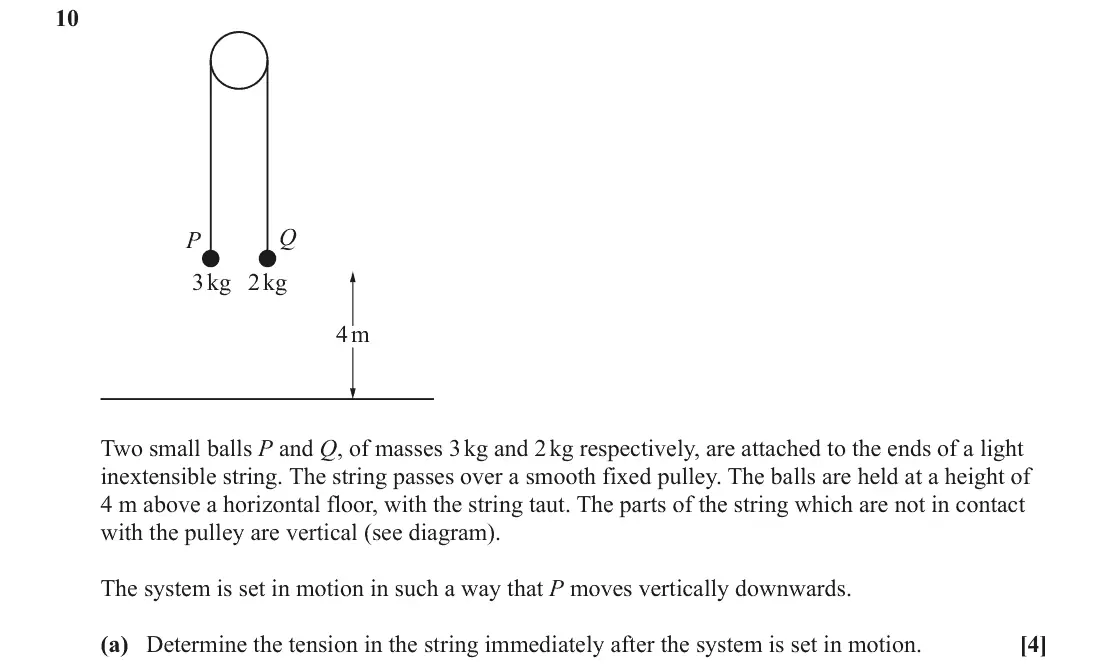
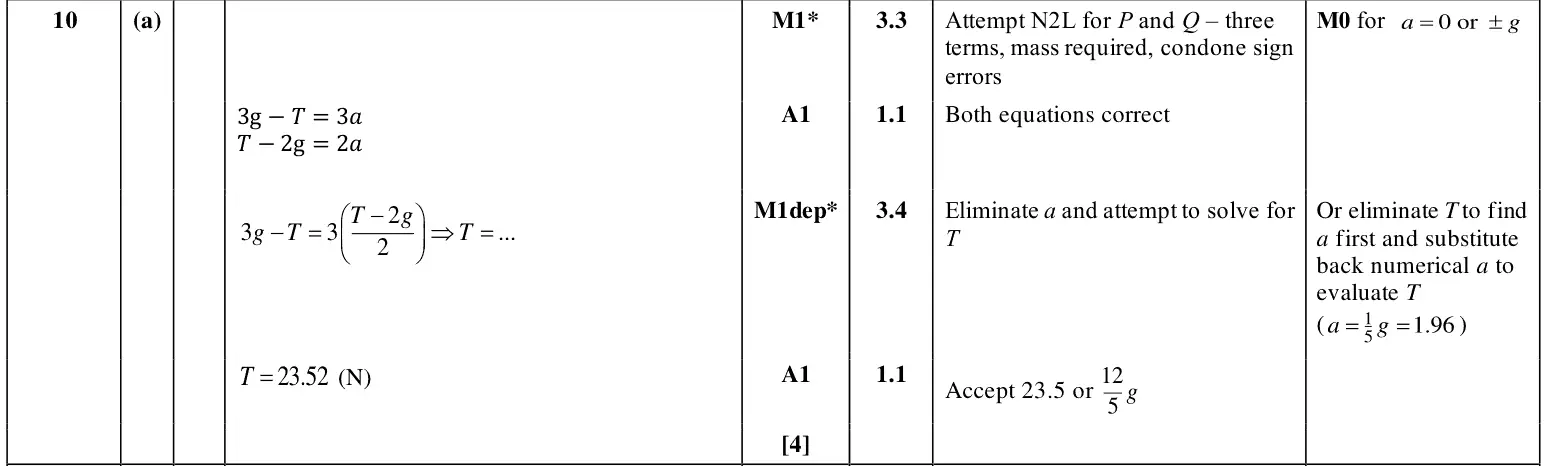
N2L: 3g − T = 3a and T − 2g = 2a
a = g/5 = 1.96
T = 23.52 N
June 2023 · AS Paper 2 · Q11(a)2 marksMedium
Mark scheme for this part
Examiner's comment
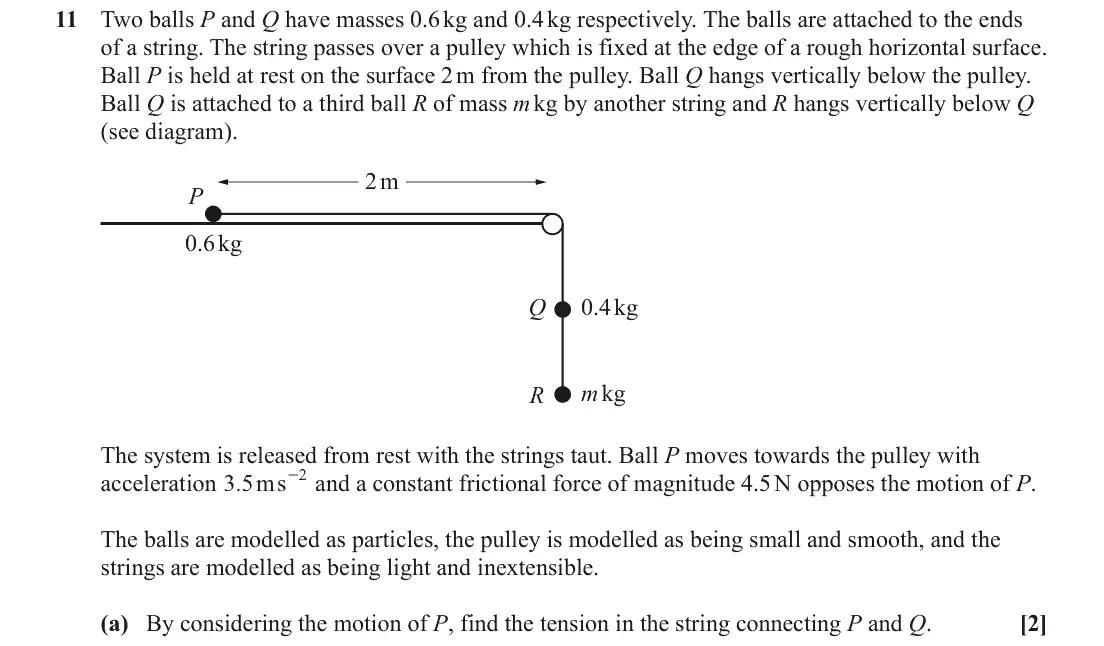
This part of Question 11 was done reasonably well. The question stated ‘By considering the motion of P’ to hopefully help focus candidates’ minds, although some equations involved 0.6 g. Some less successful responses also introduced 0.4 into their equation(s).
Key points and common errors
N2L for P: T − 4.5 = 0.6 × 3.5 so T = 6.6 N
0.6g does not belong in the horizontal equation
June 2023 · AS Paper 2 · Q11(b)4 marksMedium
Show the start of this question
Mark scheme for this part
Examiner's comment
We saw some good solutions to this part, but quite a lot of equations had extra or missing terms. In the equation for R the value found for T1 was sometimes placed where T2 should have been, resulting in this equation alone being used to find m. Those considering Q and R together here needed to be careful (see the comment in (a)). 04m was used in some equations. The request for 3 significant figures was well followed here.
Key points and common errors
for Q: T₂ + 0.4g − 6.6 = 0.4 × 3.5
for R: mg − T₂ = 3.5m
m = 0.648 (3 s.f.)
missing or extra terms
tensions mixed up
June 2022 · AS Paper 2 · Q12(b)5 marksHard
Show the start of this question
Mark scheme for this part
Examiner's comment
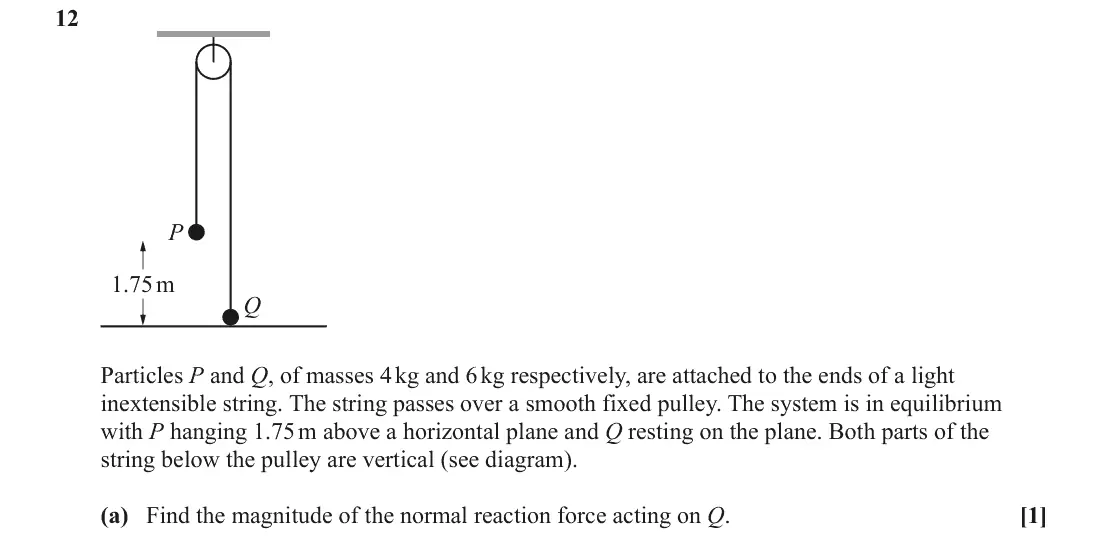
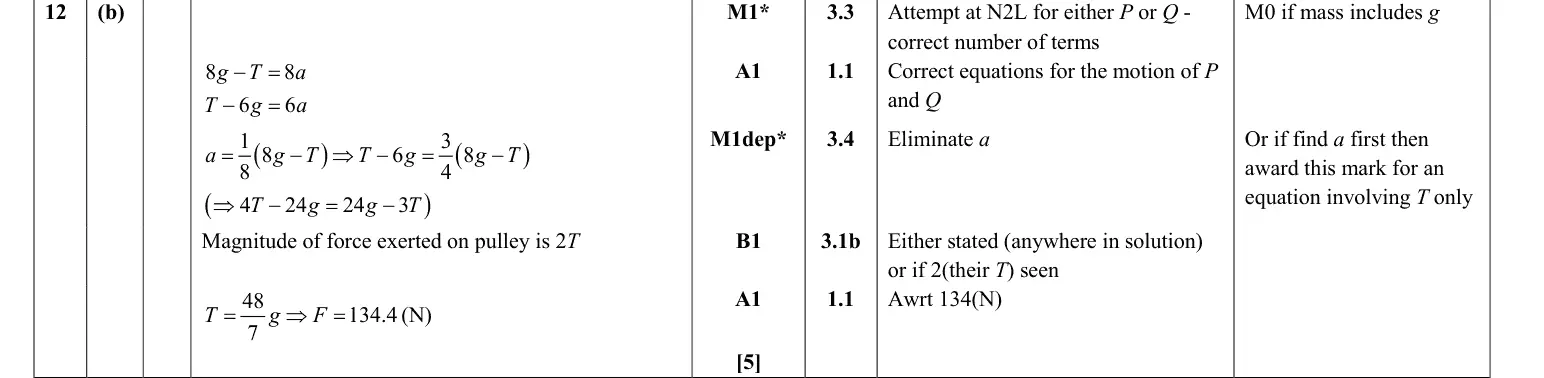
In this part many just gained the first 3 marks, applying Newton’s Second Law to both particles and calculating a and T. Few realised that the magnitude of the force exerted on the pulley by the string was 2T. One examiner mentioned that when teaching this topic, they got students to draw the tensions acting downwards from the pulley as well as the tensions acting upwards just in case this sort of question came up! In this type of question, a good diagram of the forces involved is to be encouraged. Those who considered the system as a whole, which is to be discouraged, often did not score full marks . If they succeeded in finding a sensibly, they did not then show clarity when trying to find T.
Key points and common errors
8g − T = 8a, T − 6g = 6a
T = 48g/7
force on pulley 2T = 134 N
few realised 2T
June 2022 · Paper 3 · Q10(a)2 marksEasy
Mark scheme for this part
Examiner's comment
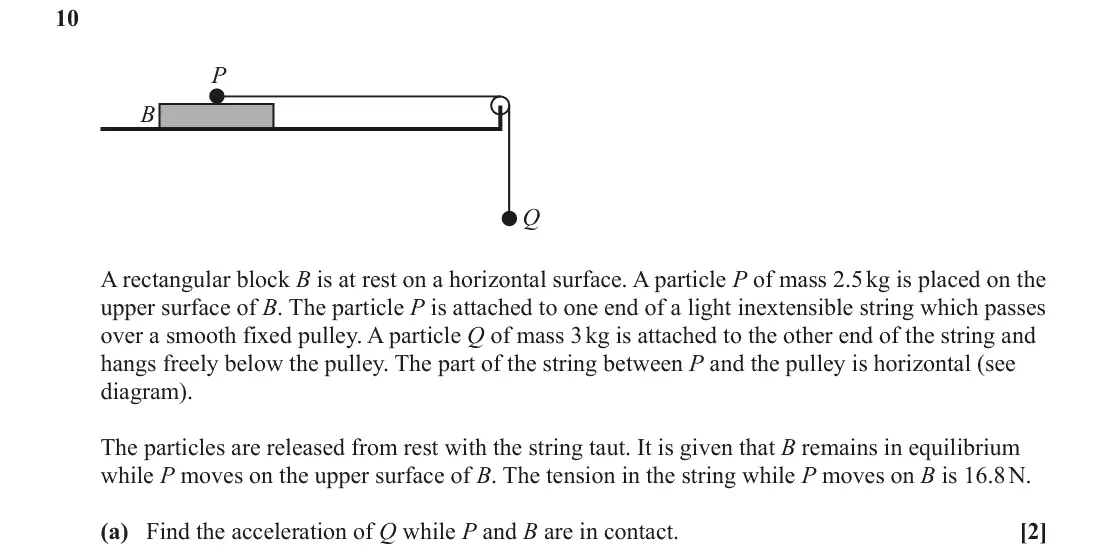
This question was answered very well with most candidates correctly applying Newton’s second law vertically for particle Q. Occasionally, candidates attempted to apply Newton’s second law to either the entire system or to P (but without any success).
Key points and common errors
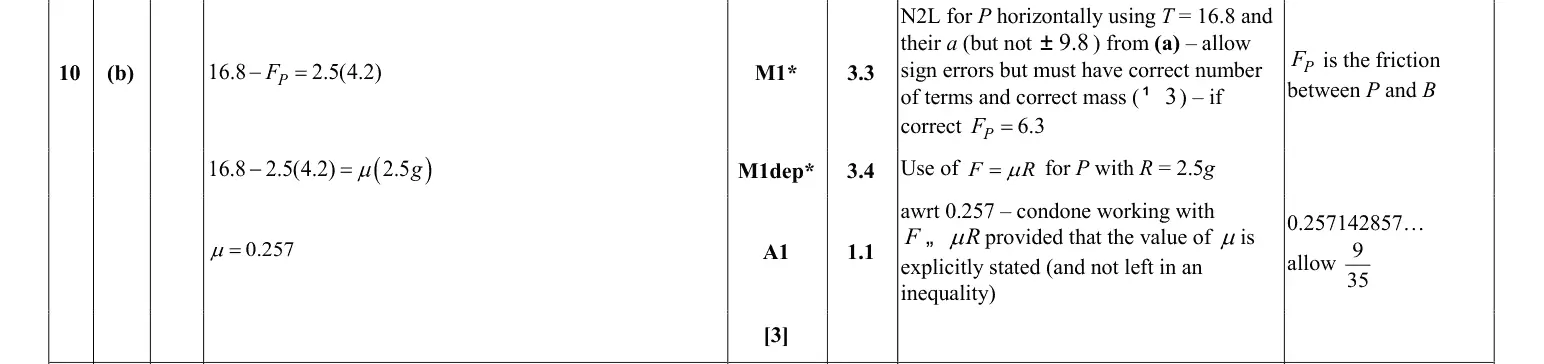
N2L for Q: 3g − 16.8 = 3a
a = 4.2 m s⁻²
June 2022 · Paper 3 · Q10(b)3 marksEasy
Show the start of this question
Mark scheme for this part
Examiner's comment
Like part (a) this question was answered extremely well with most candidates scoring the method marks for applying Newton’s second law horizontally for P and using F = R . Occasionally, candidates incorrectly used the mass of Q in their equation or attempted to apply Newton’s second law for the entire system, but these were almost always unsuccessful.
Key points and common errors
N2L for P: 16.8 − F = 2.5 × 4.2 so F = 6.3
μ = 6.3/(2.5g) = 0.257
Autumn 2021 · AS Paper 2 · Q11(b)2 marksMedium
Show the start of this question
Mark scheme for this part
Key points and common errors
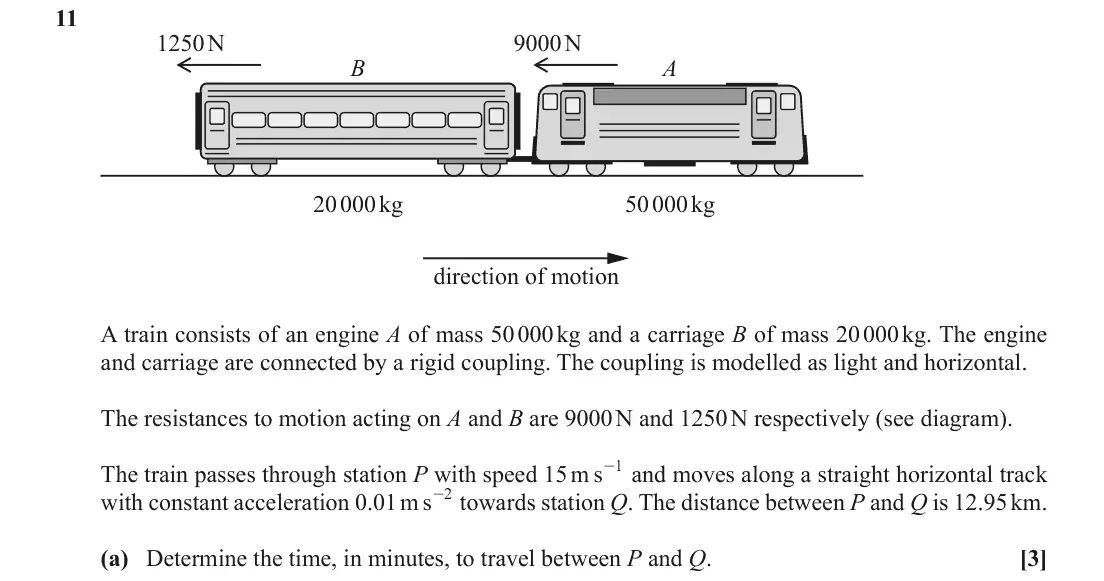
N2L for the whole train: D − 1250 − 9000 = 70 000 × 0.01
D = 10 950 N
Autumn 2020 · AS Paper 2 · Q9(a)2 marksMedium
Mark scheme for this part
Examiner's comment
(Comment on Question 09 as a whole) Part (a) - 9500 = 885a prevalent. Examiners really want to see the correct number of terms in Newton’s second law, else it is regarded as a fundamental misunderstanding. Also, of course, weight and mass must not be confused. Part (b) - This did not appear to be understood at all well by most candidates. Many candidates could not isolate the forces on the crate and display just those on a diagram. R often missing. Part (c) - Much confusion with the use of Newton’s second law ; 885 appearing in equations with R.
Key points and common errors
9500 − 885g = 885a: a = 0.934 m/s²
9500 = 885a common
weight and mass confused
Autumn 2020 · AS Paper 2 · Q9(c)3 marksHard
Show the start of this question
Mark scheme for this part
Examiner's comment
(Comment on Question 09 as a whole) Part (a) - 9500 = 885a prevalent. Examiners really want to see the correct number of terms in Newton’s second law, else it is regarded as a fundamental misunderstanding. Also, of course, weight and mass must not be confused. Part (b) - This did not appear to be understood at all well by most candidates. Many candidates could not isolate the forces on the crate and display just those on a diagram. R often missing. Part (c) - Much confusion with the use of Newton’s second law ; 885 appearing in equations with R.
Key points and common errors
N2 for car: R − 830g = 830a or for crate
R = 8910 N
using 885 with R
Autumn 2020 · Paper 3 · Q9(b)3 marksMedium
Show the start of this question
Mark scheme for this part
Examiner's comment
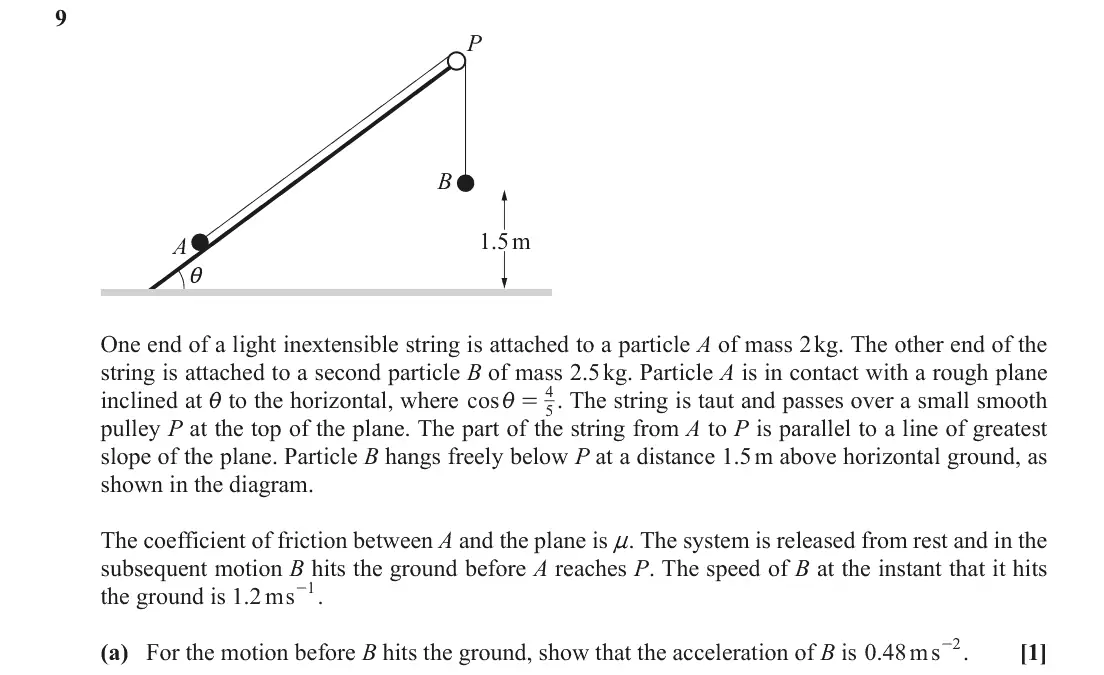
(Comment on Question 09 as a whole) 4 In this question the angle θ was defined as cosθ = . Candidates should resist the temptation to 5 calculate the decimal approximation for θ and instead use their knowledge of Pythagoras Triples to state the exact values for sinθ (and tanθ if required). The exact values have been chosen to make the arithmetic easier. Similarly, some questions will use the values of θ that candidates are expected to know the exact values for, and these should be used rather than the decimal approximation. If the examiner wants the decimal approximations to be used, then the angle θ will simply be defined as a numerical value. Most candidates showed sufficient working using for part (a). There was evidence that most candidates understood how to obtain the given answer in part (b), but some responses did not fully justify their working. A few students used mass rather than weight and did not include g in their equations. Part (c) was attempted by all candidates but one or more of the following mistakes were made: ● Assumed a = 0 . ● Used rather than using components. R = 2g ● Sine/Cosine confusion when stating the components of any force. 4 3 ● Rounding errors with calculated values of θ rather than using cosθ = and sinθ = . 5 5 ● Incorrect directions used leading to sign errors. ● Under-specifying the final answer given to less than 3 sf. Although a fairly standard question, part (d) is traditionally expected to be a challenge for most candidates. For this reason, it was pleasing to see the number of fully correct answers. Common mistakes included: ● Tension was still applied. ● Incorrect acceleration; either the same a = 0 48 . , or a > 0 , or even a = 9 8. . ● Distance = speed × time used rather than ‘suvat’.
Key points and common errors
N2L for B: 2.5g − T = 2.5a
T = 23.3 N
use weight not mass
June 2019 · AS Paper 2 · Q11(a)5 marksMedium
Mark scheme for this part
Examiner's comment
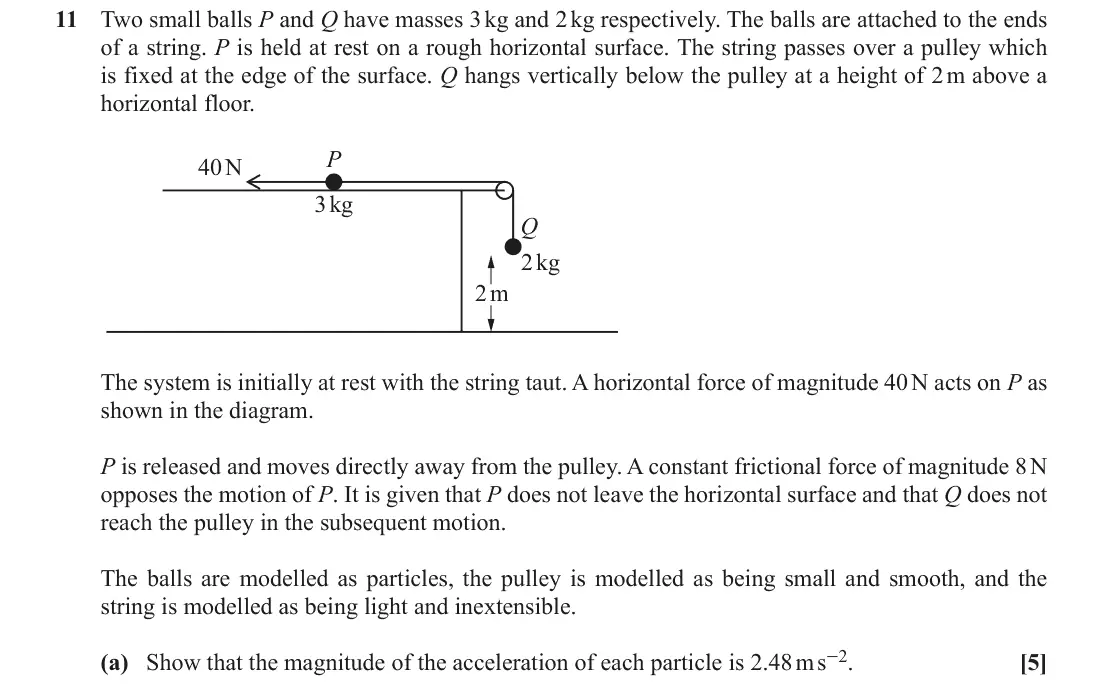
Candidates should be completely discouraged from treating the system as a whole (this is a high risk strategy because when thing go wrong it nearly always scores 0) and keep things simple by applying F = ma to each particle. It is good practice to draw a diagram of the forces involved for each particle and show the direction of positive acceleration. This helps to avoid missing forces in the two equations, examiners considered this quite a serious error, and also encourages sensible consistent use of signs. Use of mga also lost the method marks. If - 2.48 appeared we expected the negative to be explained.
Key points and common errors
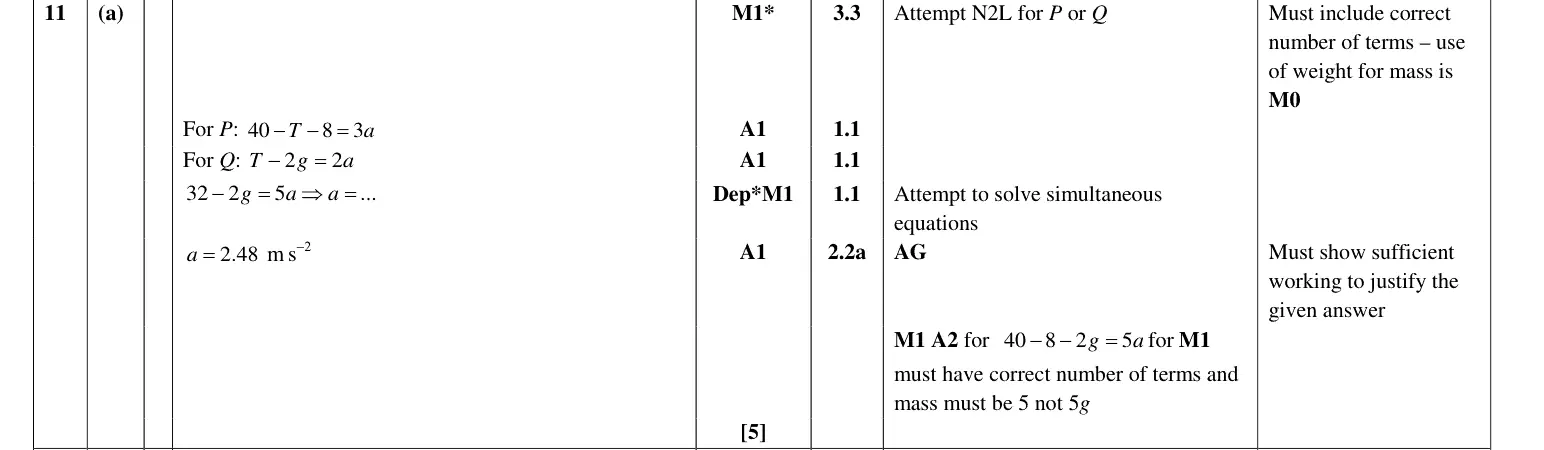
N2L for each particle: 40 − T − 8 = 3a and T − 2g = 2a gives a = 2.48
whole-system equations risky
missing forces
mass not weight on the right
June 2019 · AS Paper 2 · Q11(b)2 marksMedium
Show the start of this question
Mark scheme for this part
Examiner's comment
We expected 2.48 to be used here. 2g – T = 2a with this value gained the method mark.
Key points and common errors
T − 2g = 2 × 2.48 so T = 24.56 N
June 2018 · AS Paper 2 · Q94 marksHard
Mark scheme for this part
Examiner's comment
This question proved to be challenging for the majority of candidates. The need to find the magnitude of the acceleration was not well understood. For those who did use it, algebraic and numerical errors sometimes marred the solution. (±)10 = 2(3(2t – 5)i + 4j) was common, even when the correct methods then followed, but in many cases equations like 10 = 12t – 30 were used. A number of candidates ignored the mass and F = a pursued.
Key points and common errors
F = ma with magnitude: 2√(9(2T − 5)² + 16) = 10 gives 2T − 5 = ±1 so T = 2 or 3
magnitude of acceleration was often ignored
F = a ignoring mass
June 2018 · AS Paper 2 · Q10(i)4 marksEasy
Mark scheme for this part
Examiner's comment
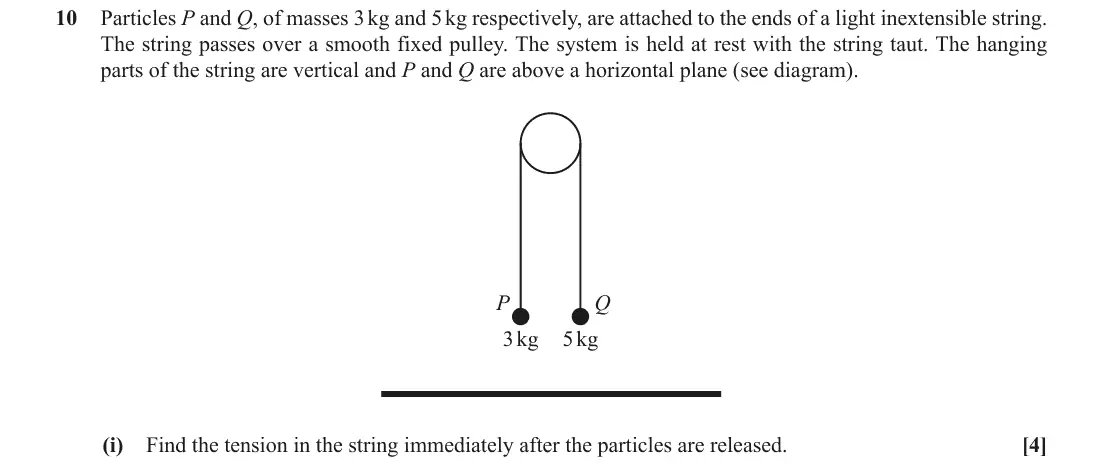
Whilst this standard situation was generally well understood, it was not uncommon to see attempts which assumed the acceleration after release was g or 0. Those who produced initial appropriate equations generally produced fully accurate solutions, although sign errors were sometimes seen.
Key points and common errors
T − 3g = 3a and 5g − T = 5a
T = 36.75 N (15g/4)
assuming acceleration g or 0
Find an A-level maths tutor
Stuck on this? Book a trial session with an A-level maths tutor.