Examiner's comment
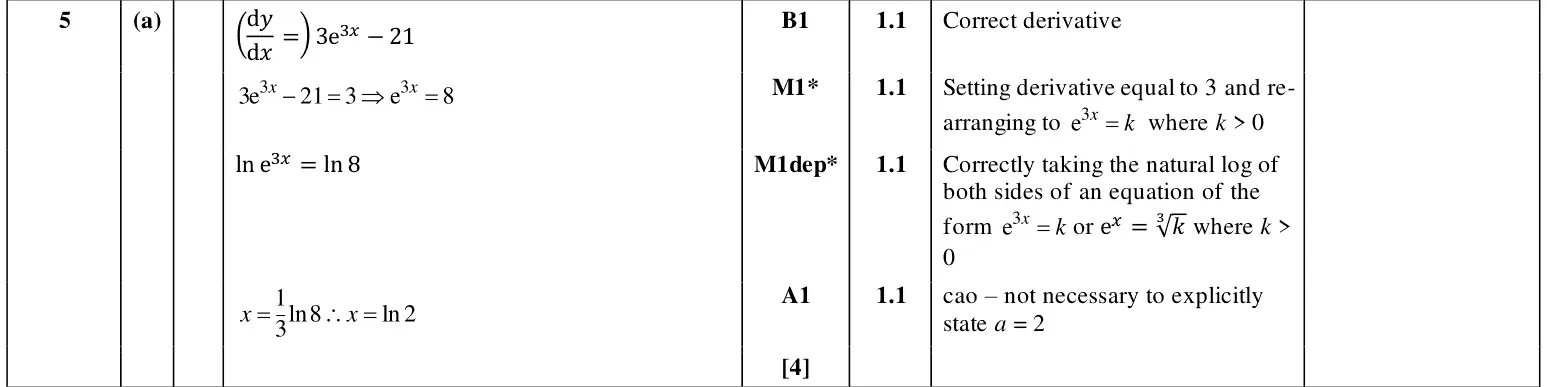
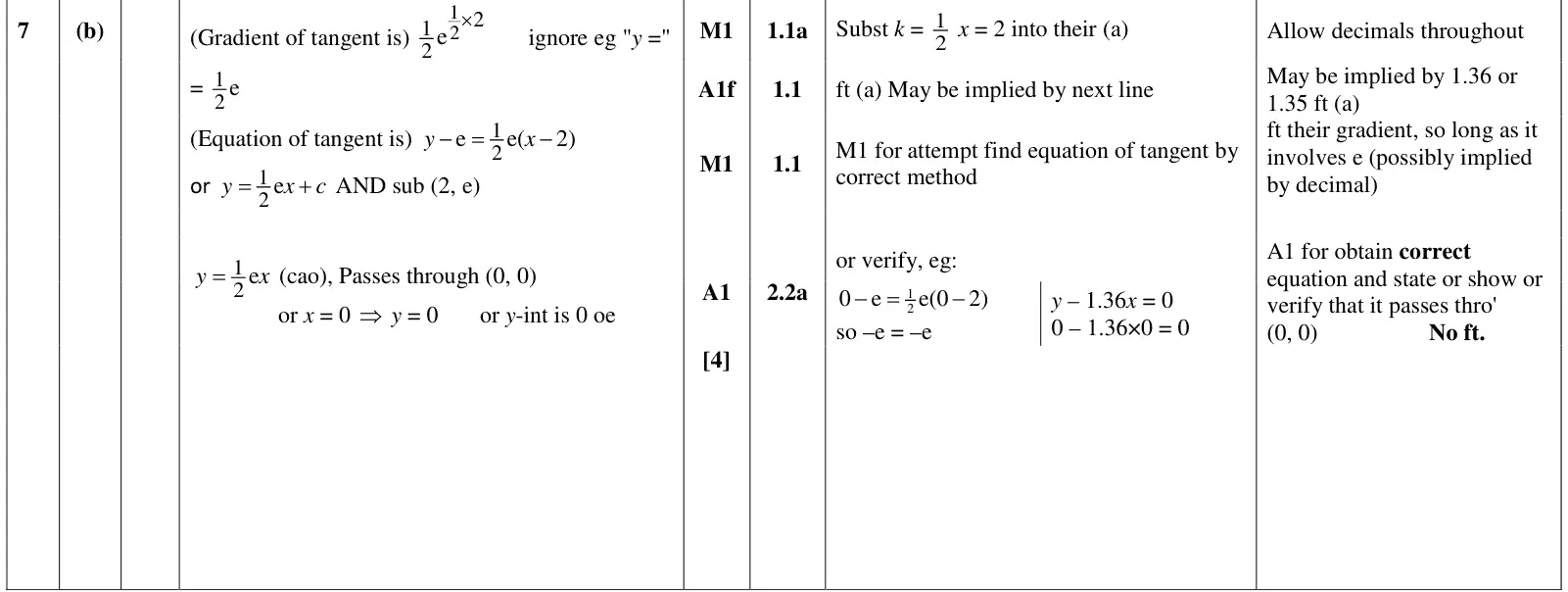
Many candidates correctly used their response to part (b) to find the gradient of the curve at x = 2. But then a large minority found the negative reciprocal and used this as the gradient of the tangent. Most candidates used one of the two usual methods for the equation a straight line. Some used the form y = mx + c, although a few found c = 0 without stating explicitly the equation of the tangent. This was not regarded as an adequate response to the instruction "Show that . . .” Others found the equation correctly and stated (rather than showed) that the line passed through O. These were allowed the final mark because the equation concerned was so simple. However, in similar questions in the future, the corresponding mark might be withheld if no explanation is given. 2 into their d y Some candidates, having differentiated correctly in part (a), substituted k = 1 x , but did not d substitute x = 2. In some cases, they went on to try to find the equation of the tangent, with their gradient 1 x 1 2 e 2 still given as a function of x; thus: y – e = (x – 2). Other candidates appeared not to recognise that their response to part (a) could be used in part (b), and they started from scratch. A common error was to find the gradient, not of the tangent, but of the line joining the origin to the point where x = e. The relevant marks were not gained despite the fact that these are, fortuitously, the same line.