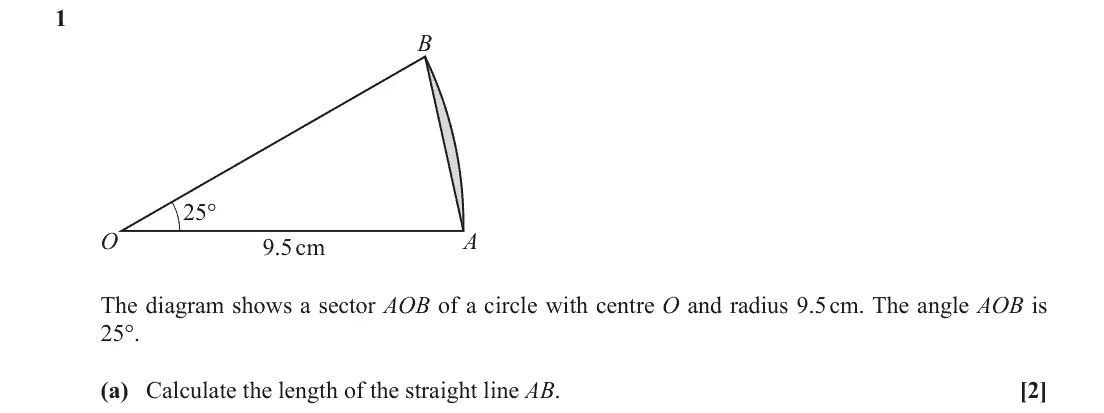
The formula ½absinC was well known and usually applied correctly, often with C = 48.2° rather than with 3). exact working. A few evaluated ½(4)(9)(
Key points and common errors
area = ½ × 4 × 9 × √5/3 = 6√5 exact
using 48.2° gives an inexact answer
June 2025 · Paper 1 · Q6(b)2 marksEasy
Show the start of this question
Mark scheme for this part
Examiner's comment
Once again, this question was very well answered with a significant majority of candidates gaining both of the marks available. The question was expected to be a straightforward test of using the formula for the area of a non-right-angled triangle (which is a GCSE topic). As such, it was surprising to see a number of candidates attempt to split the area into right-angled triangles. While long-winded, this approach could still gain full credit if done correctly.
Key points and common errors
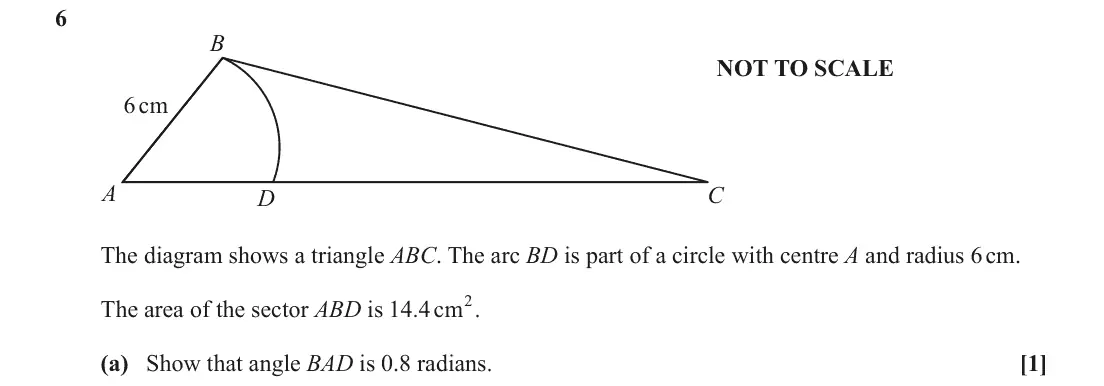
½ × 6 × AC × sin 0.8 = 3 × 14.4: AC = 20.1
June 2025 · Paper 3 · Q6(b)4 marksHard
Mark scheme for this part
Examiner's comment
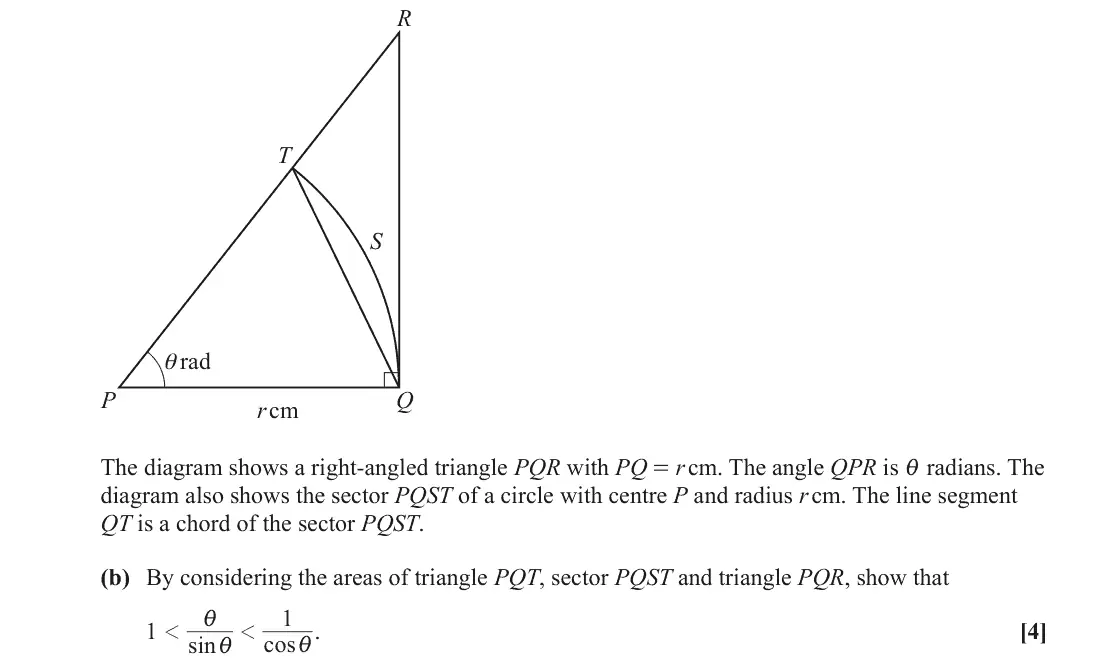
While most candidates scored at least 1 mark for correctly stating the area of sector PQST or the area of triangle PQT many struggled with finding the area of triangle PQR with many not realising that 𝑄𝑅= 2 𝑟2𝜃 for the area of a sector of a circle 𝑟tan𝜃. Very few candidates referred directly to the formula 𝐴= with 𝜃 measured in radians, with many either quoting incorrect formulae or having to convert from a corresponding formula with the angle given in degrees. Of those that did have a correct inequality, e.g. 2 𝑟2 sin 𝜃< 2 𝑟2 tan 𝜃 most then went on to correctly derive the given answer (although some did 2 𝑟2𝜃< not show sufficient working or justification for why cos 𝜃). sin𝜃=
Key points and common errors
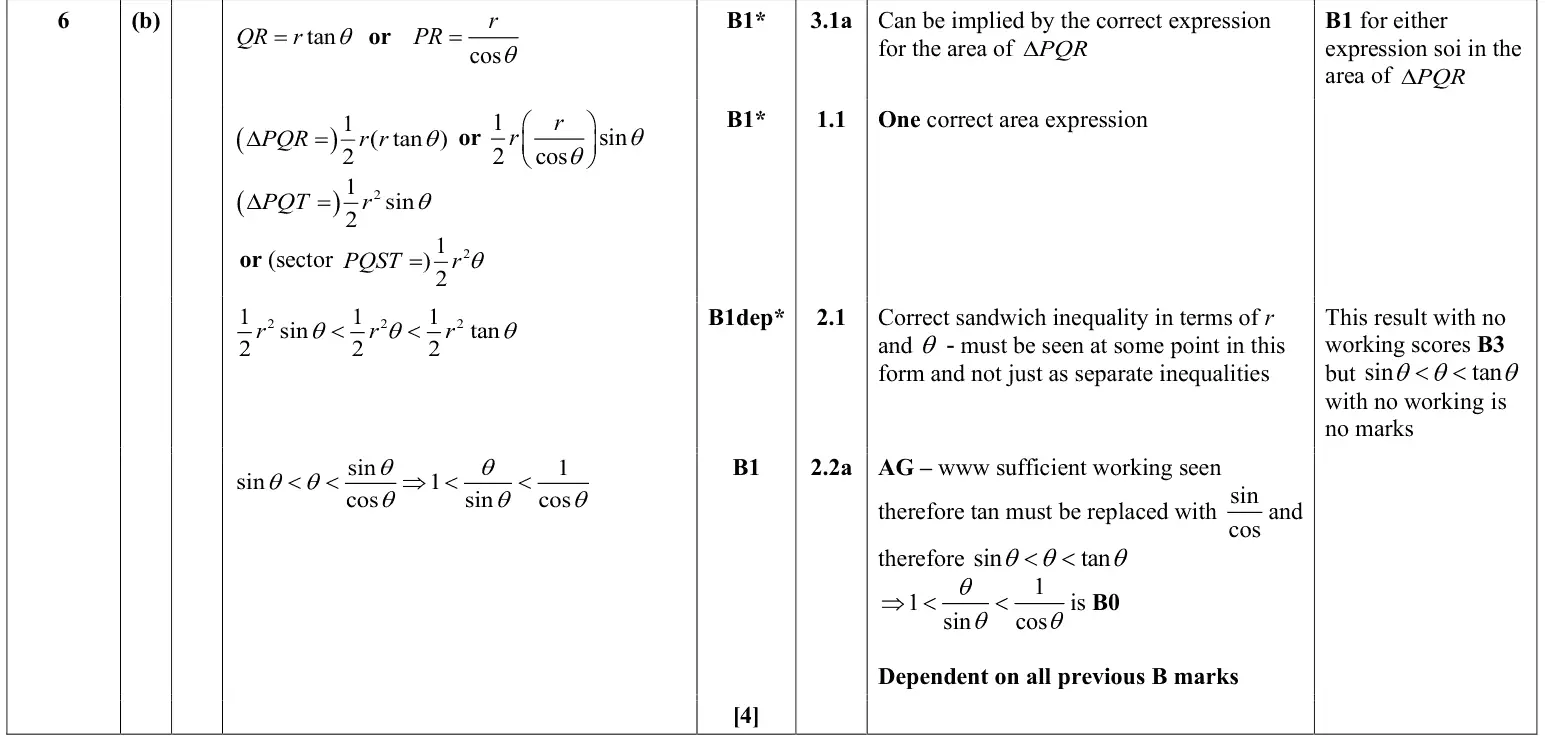
QR = r tan θ
½r² sin θ < ½r²θ < ½r² tan θ
divide by ½r² sin θ to get 1 < θ/sin θ < 1/cos θ
sector area needs θ in radians
June 2024 · AS Paper 1 · Q35 marksHard
Mark scheme for this part
Examiner's comment
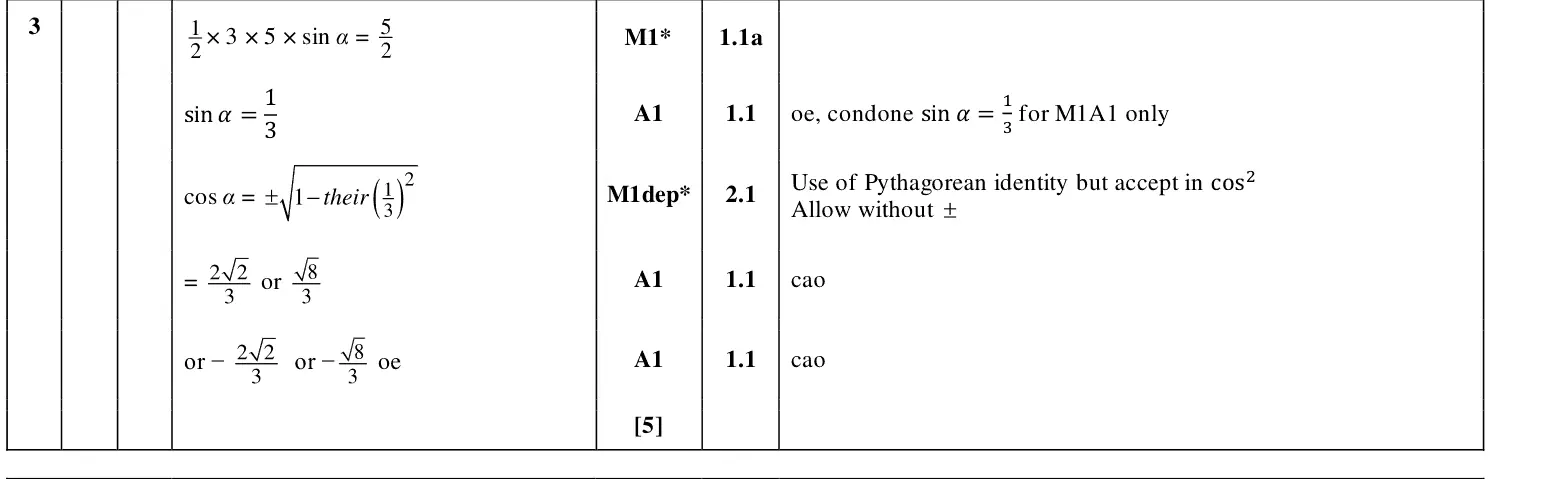
2 𝑎𝑎𝑎𝑎sin𝐶𝐶 to form an equation in alpha, although some The majority of candidates correctly applied both common). Of those who had the equation correct, most reached the equation sin𝛼𝛼= candidates made errors when recalling this formula (writing cos instead of sin, or omitting the ½ were 3 but very few proceeded correctly beyond this point. Noting that the instruction on this question was ‘Determine’ and their calculator to find an (inexact) value for cos (sin−1 ቀ 3ቁ). Some candidates used a triangle with that exact answers were required, none of the final three marks could be given to candidates who used opposite side 1 and hypotenuse 3 to correctly deduce the required answer. This is a typical example of a candidate who has completed the first few steps in the working correctly, but then uses their calculator to obtain an inexact pair of values, scoring M0A0A0 for the final three marks.
Key points and common errors
½ × 3 × 5 sin α = 5/2 so sin α = ⅓
cos α = ±√(1 − 1/9) = ±2√2/3 (acute and obtuse)
very few progressed beyond sin α
exact working required
June 2024 · AS Paper 2 · Q2(a)3 marksMedium
Mark scheme for this part
Examiner's comment
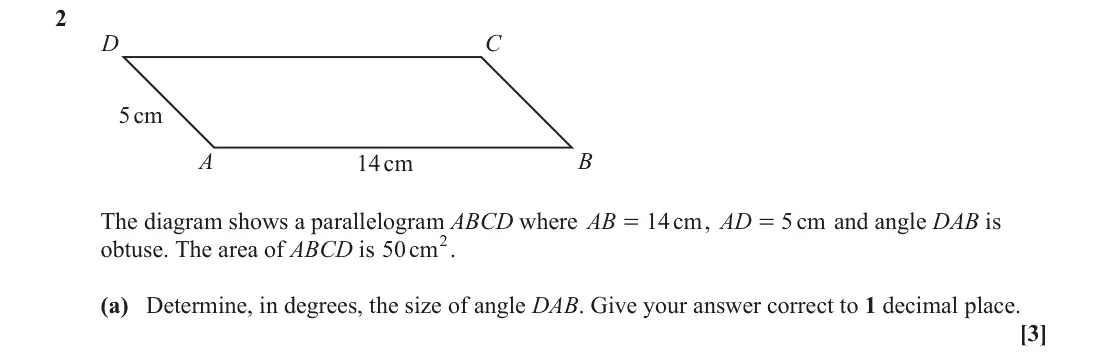
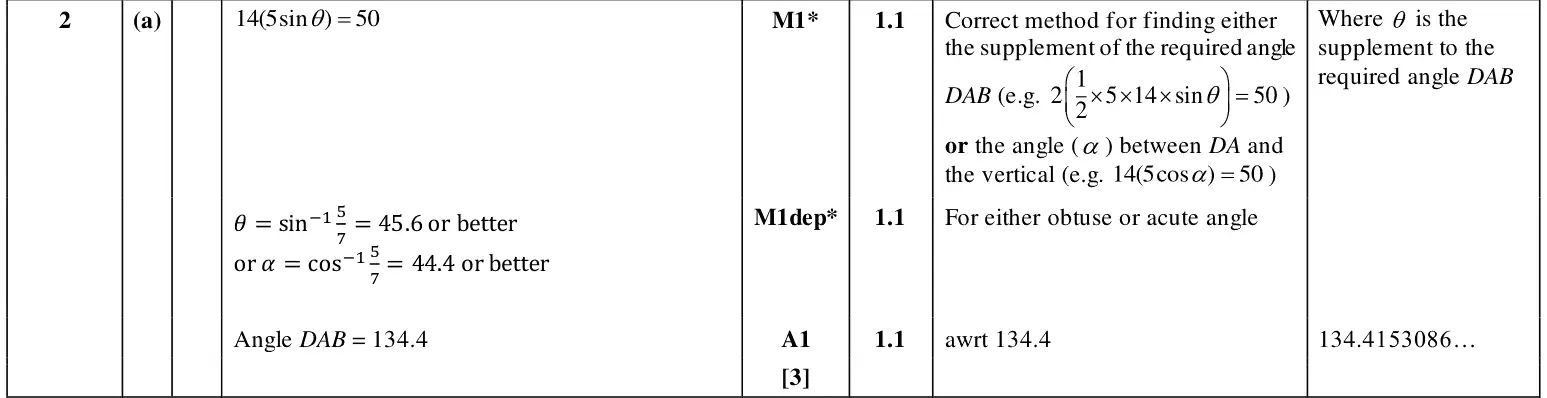
Both methods outlined in the mark scheme were seen and applied well. Despite being told in the stem of the question (and shown in the diagram) that DAB was obtuse, quite a few candidates gave an acute angle as the final answer. The last mark required 134.4° or better to be seen.
Key points and common errors
area 14 × 5 sin θ = 50 gives 45.6°
DAB is obtuse so 134.4°
acute answer is wrong
June 2023 · Paper 2 · Q6(a)7 marksHard
Mark scheme for this part
Examiner's comment
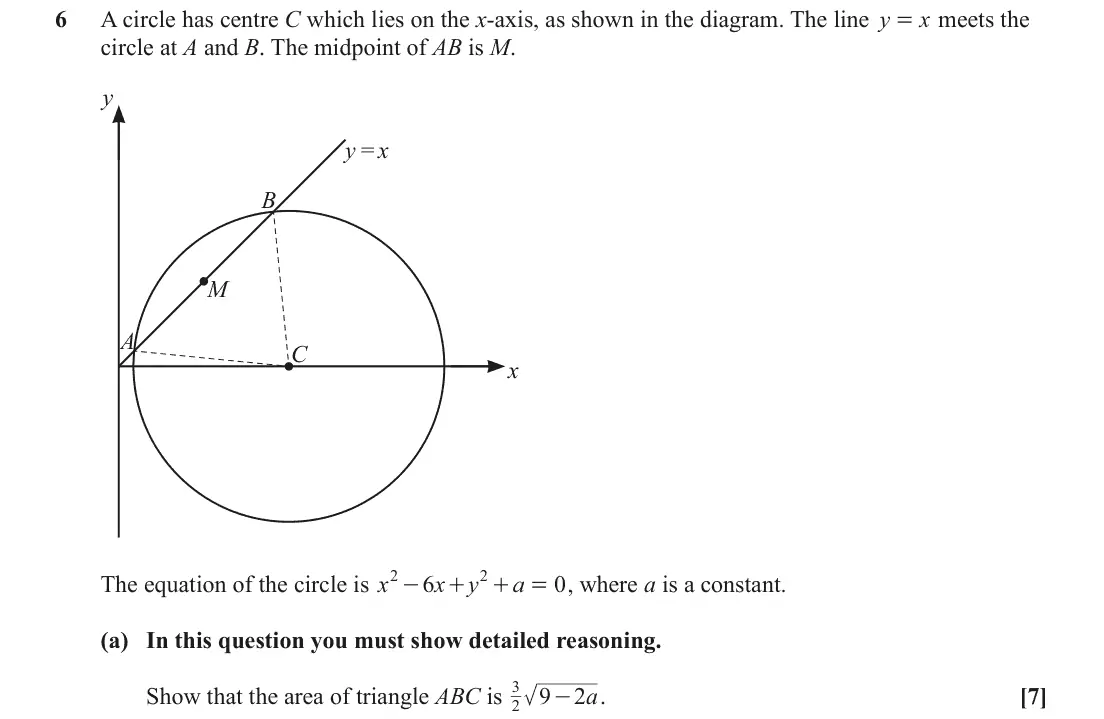
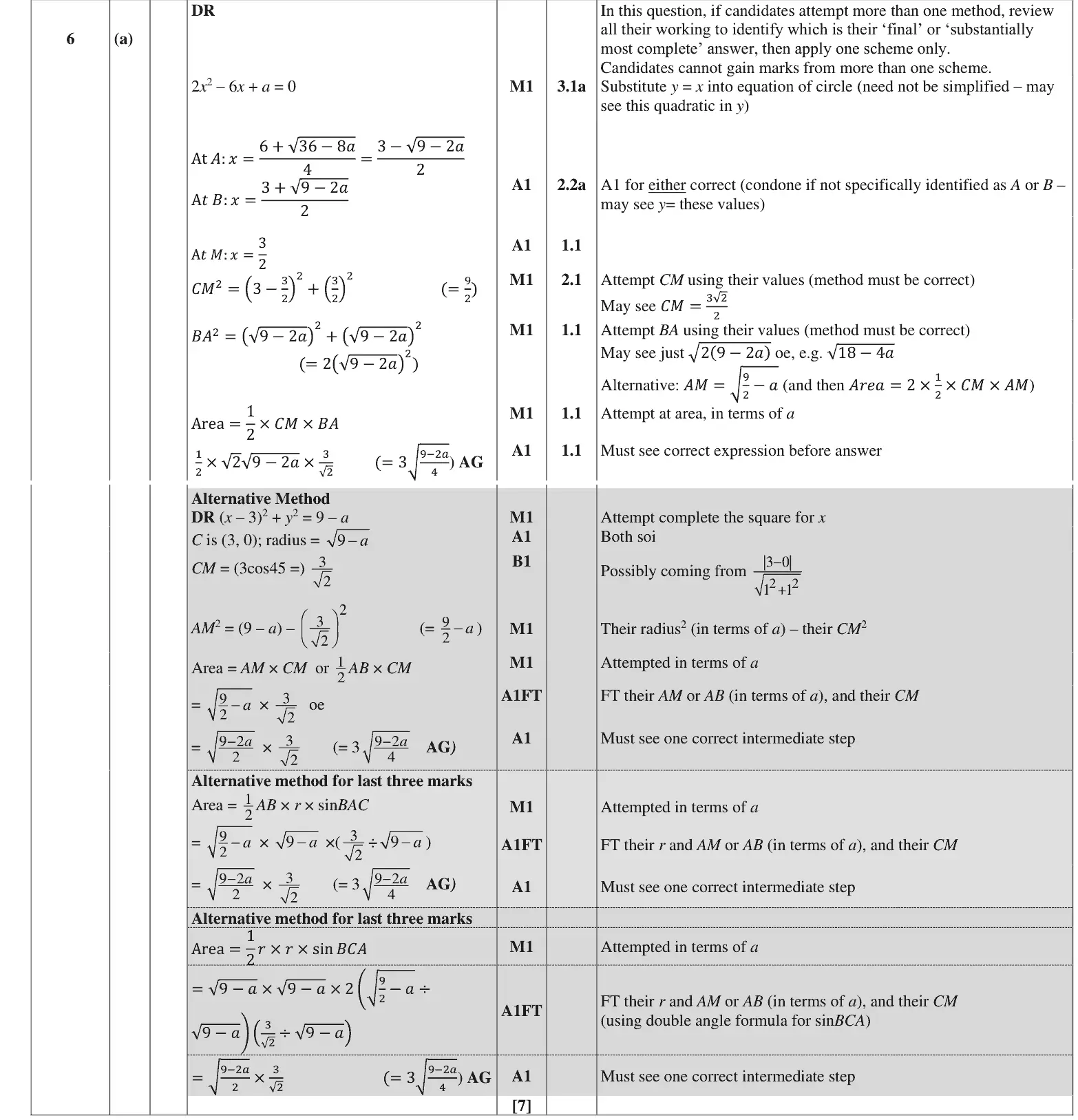
Many candidates appeared to find this question very challenging. A good number of candidates were able to obtain the first 1-2 marks by either attempting to complete the square or substitute in y = x and solve for one or both coordinates of the points of intersection A and B. Many candidates started with the alternative method (attempting to complete the square) and then reverted to the main method. Those candidates who proceeded beyond that first stage generally went on to successfully reach (or almost reach) the given answer - deducing the coordinates of M and finding two of the required lengths to allow them to form an expression for the area of the triangle. Many of these correctly handled the length of AB and were able to write down a correct expression for the required area. There was (despite the Detailed reasoning instruction) some evidence of candidates attempting to reverse-engineer the given result from ‘similar-looking’ terms in their expressions. A small number of candidates provided elegant alternative solutions, such as finding the area of triangle OBC and subtracting OAC, or (more commonly) finding CM and either AM or BM, then using 2x the area of triangle ACM or BCM.
Key points and common errors
substitute y = x: 2x² − 6x + a = 0
M has x = 3/2
CM = 3/√2 and AB from the roots
area = ½ × AB × CM = (3/2)√(9 − 2a)
June 2022 · AS Paper 2 · Q7(c)2 marksMedium
Show the start of this question
Mark scheme for this part
Examiner's comment
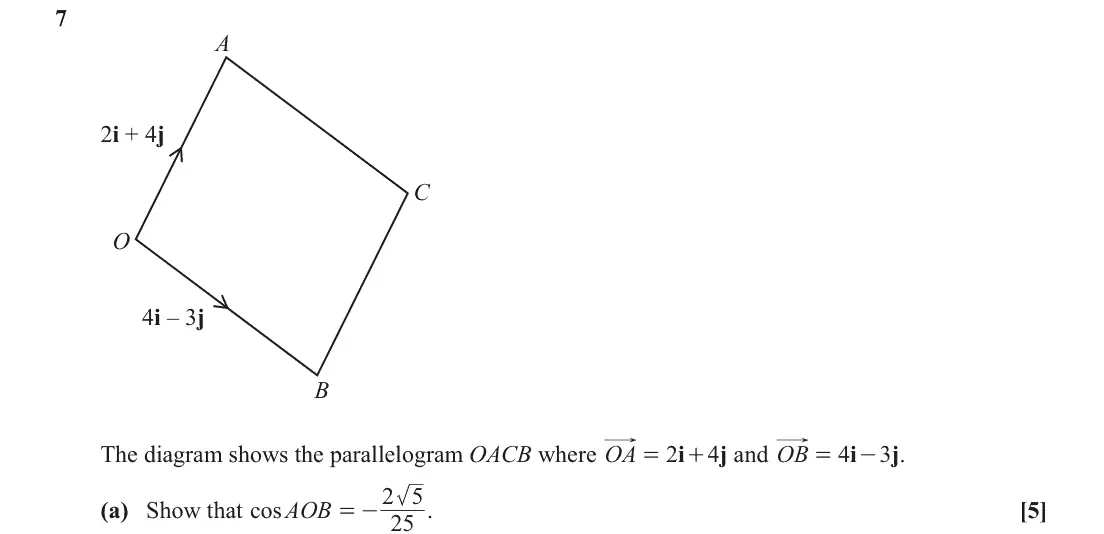
Less successful attempts simply found IOAI x IOBI. Those who found the area of the triangle AOB sometimes struggled to find sin AOB or forgot to double their answer. They did not have to use exact values in this part.
Key points and common errors
area of parallelogram = 2 × ½ × √20 × 5 × sin AOB = 22
forgetting to double, or OA × OB
June 2022 · Paper 1 · Q10(a)4 marksHard
Mark scheme for this part
Examiner's comment
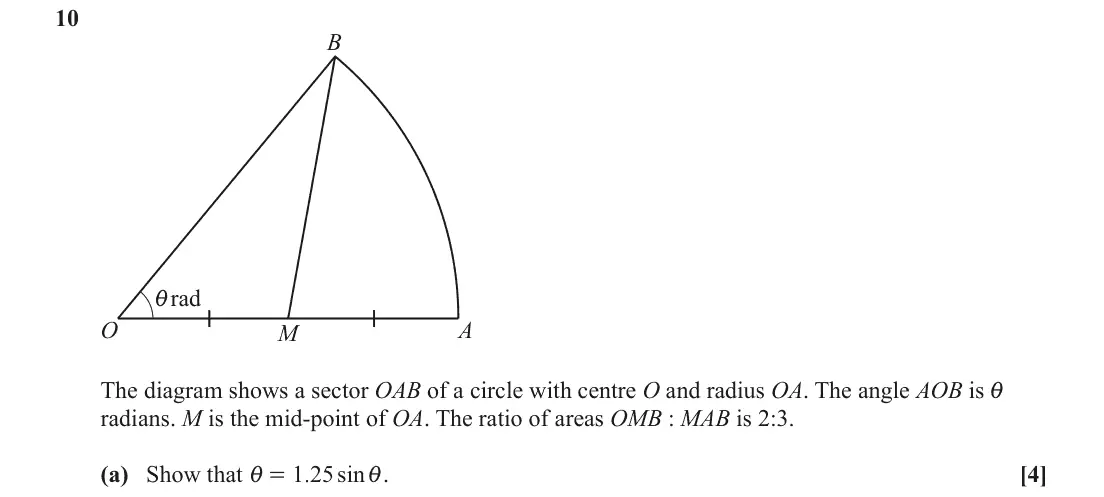
This proved to be a challenging question, with over half of the candidates unable to state a correct expression for the area of triangle OMB. While most did attempt to use 0.5absinC, the most common errors were to use a = b = r, or to use a = OB and b = OM but never obtain an expression in just a single variable. Of those who obtained two correct areas, most could attempt to use the relevant ratio although this was sometimes the wrong way around. A lack of explanation, and too many steps being undertaken in one line of working, did sometimes result in solutions that were not entirely convincing. Both correct areas are stated, then the candidate makes it clear how the ratio is being applied. Here is sufficient detail before the given answer appears.
Key points and common errors
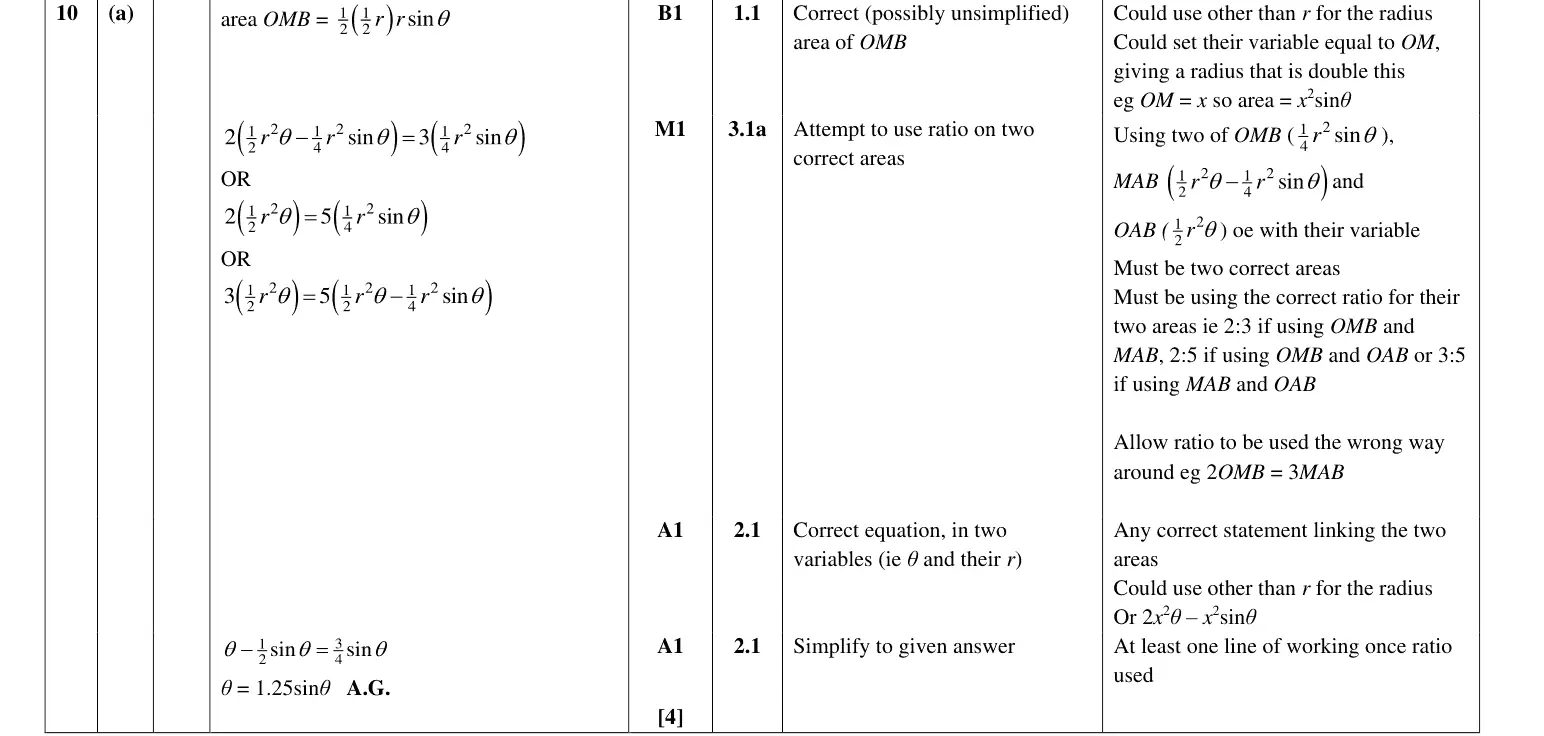
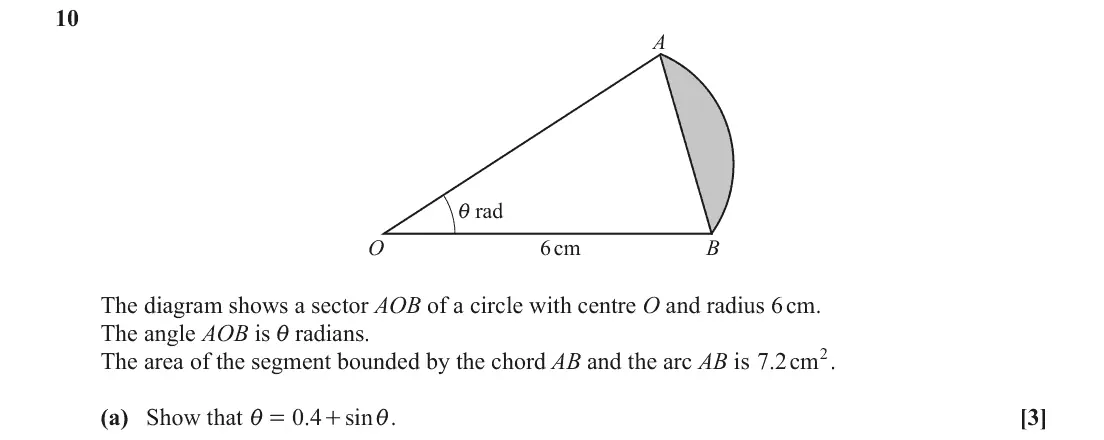
OMB = ½(½r)r sinθ, MAB = ½r²θ − ¼r² sinθ
3 × OMB = 2 × MAB gives θ = 1.25sinθ
over half could not find area OMB
ratio used the wrong way round
Autumn 2021 · AS Paper 1 · Q1(a)2 marksMedium
Mark scheme for this part
Key points and common errors
area = ½ × 3 × 4 × sin 30° = 3
Autumn 2021 · Paper 1 · Q10(a)(ii)1 markMedium
Show the start of this question
Mark scheme for this part
Examiner's comment
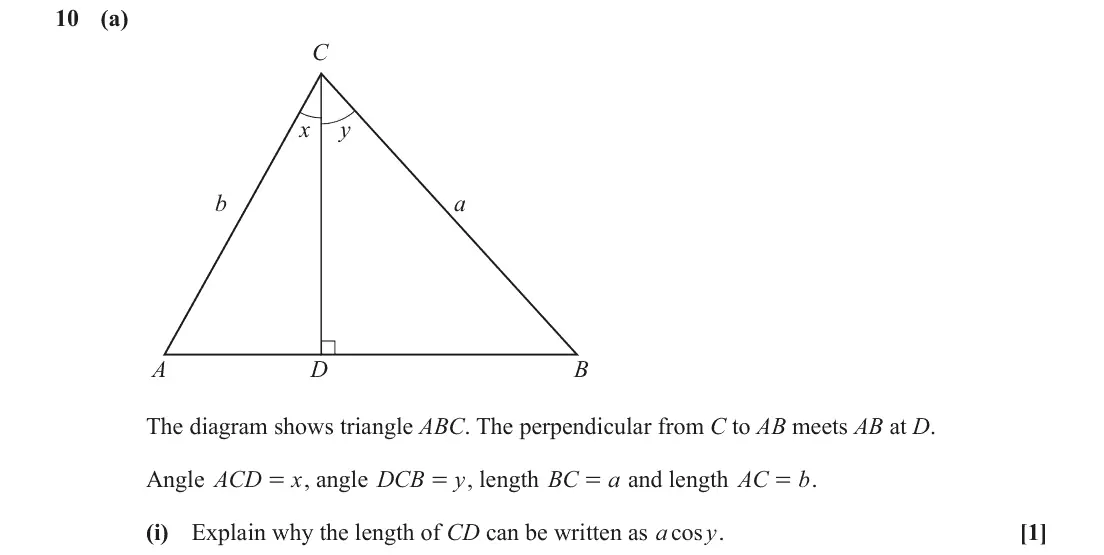
(From the general report) Some structure was given at the start of Question 10(a) to support candidates in making progress through the geometric proof of the trigonometric identity.
Key points and common errors
area = ½ × AC × CD × sin x = ½ab sin x cos y
sides used must be clearly identified
Autumn 2021 · Paper 1 · Q10(a)(iii)4 marksMedium
Show the start of this question
Mark scheme for this part
Examiner's comment
(From the general report) In Question 10(a)(iii) the more successful candidates clearly identified which lengths, angles and triangles were being considered.
Key points and common errors
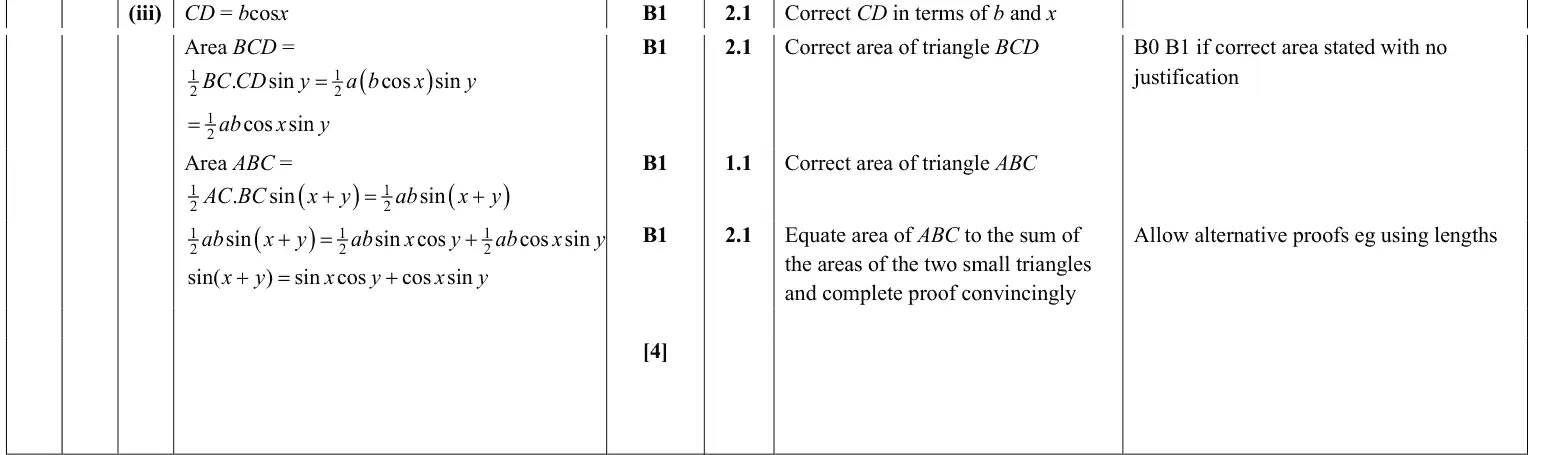
CD = b cos x
area BCD = ½ab cos x sin y
area ABC = ½ab sin(x + y)
equate area ABC to sum of the two triangles
clearly identify lengths, angles and triangles
Autumn 2020 · AS Paper 2 · Q1(b)3 marksMedium
Show the start of this question
Mark scheme for this part
Examiner's comment
(From the general report) OCR support A summary guide of the A Level Maths command words can be downloaded for the qualification website: A Level Maths command words poster A4 size The command word ‘Find’, used for example in Question 1(b), meant that a correct answer with no working shown would have gained full credit.
This proved to be a nice introduction to the paper, with the majority of candidates scoring full marks. However, it is worth noting here that method marks are for an attempt to use a correct formulae. Those candidates that stated the area formulae 1 sin C and then quoted the answer obtained from their ab 2 calculator scored either the full 2 marks for the correct answer or zero if their stated answer did not round to 15.1 3 sf. A few candidates attempted to find the height of the triangle first, to use 1 2 bh , with mixed success.
Key points and common errors
½ × 8.5 × 6.2 × sin 35° = 15.1 cm²
state the formula before the calculator value
June 2019 · AS Paper 1 · Q6(a)2 marksEasy
Mark scheme for this part
Examiner's comment
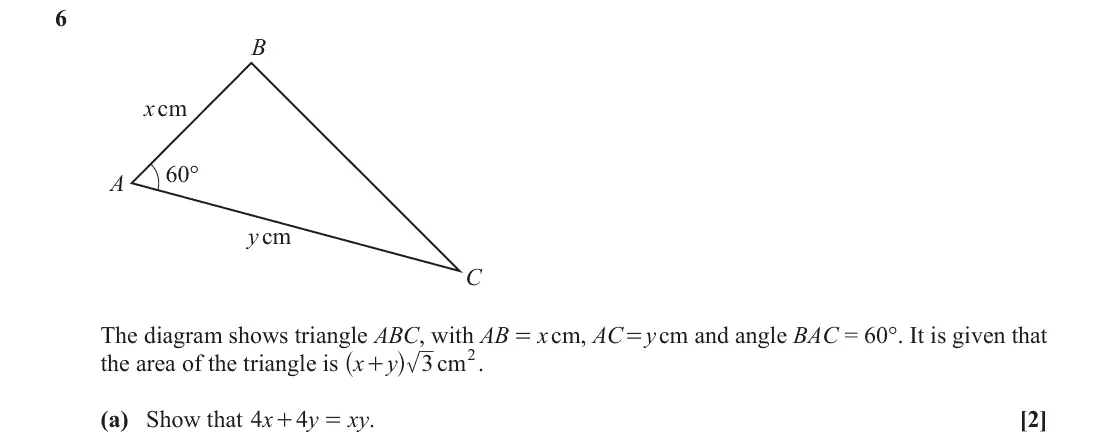
Most candidates answered this question correctly. A few used a verification method, rather than a linear proof, which was accepted if the mathematical argument was clear. In general it is worth noting that for questions involving "Show that . . " using the given answer as a starting point is not guaranteed to gain 3 3 3 full marks. Some candidates made errors such as 1 2 xy 2 = 4 x × 4 y , but attempted to "fudge" the remaining steps to arrive at the given equation.
Key points and common errors
½xy sin60° = (x + y)√3 gives 4x + 4y = xy
show enough working for the given answer
June 2019 · Paper 1 · Q2(b)2 marksMedium
Show the start of this question
Mark scheme for this part
Examiner's comment
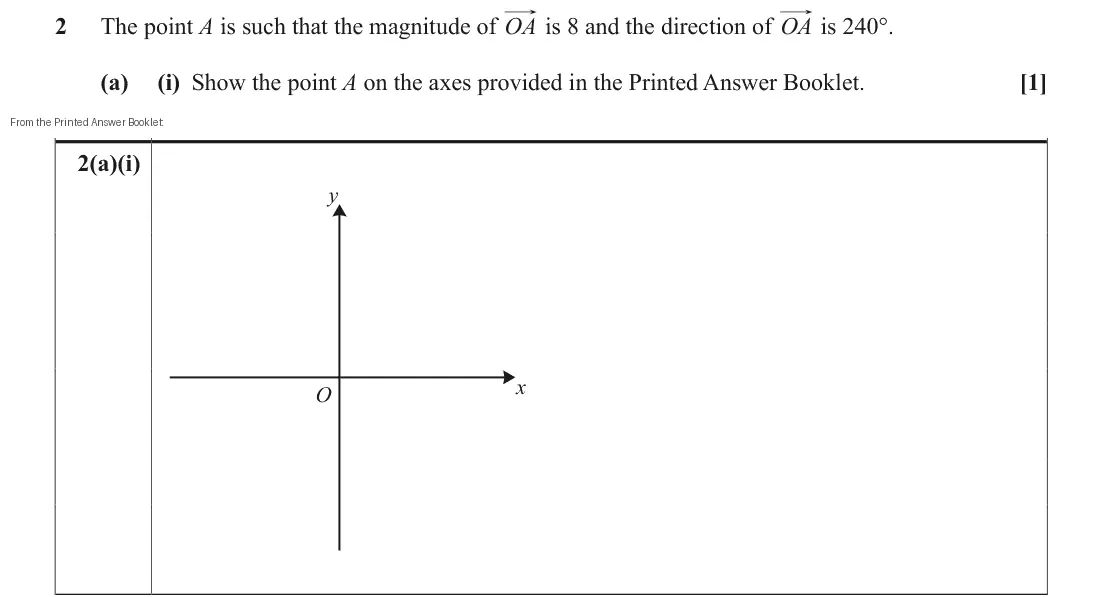
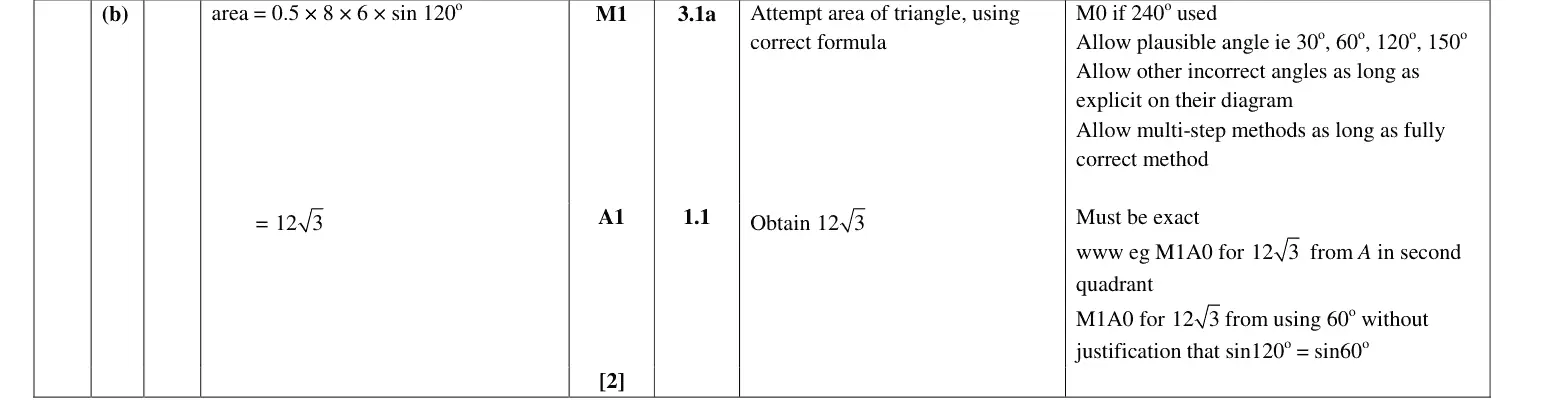
Most candidates were able to attempt the area of the triangle, using what they believed angle AOB to be. Notice that this question explicitly asked for the ‘exact area’; full marks would not be given for a decimal approximation of the surd, regardless of the number of decimal places quoted.
Key points and common errors
½ × 8 × 6 × sin120° = 12√3
exact answer required, decimals lose the mark
June 2019 · Paper 1 · Q10(a)3 marksEasy
Mark scheme for this part
Examiner's comment
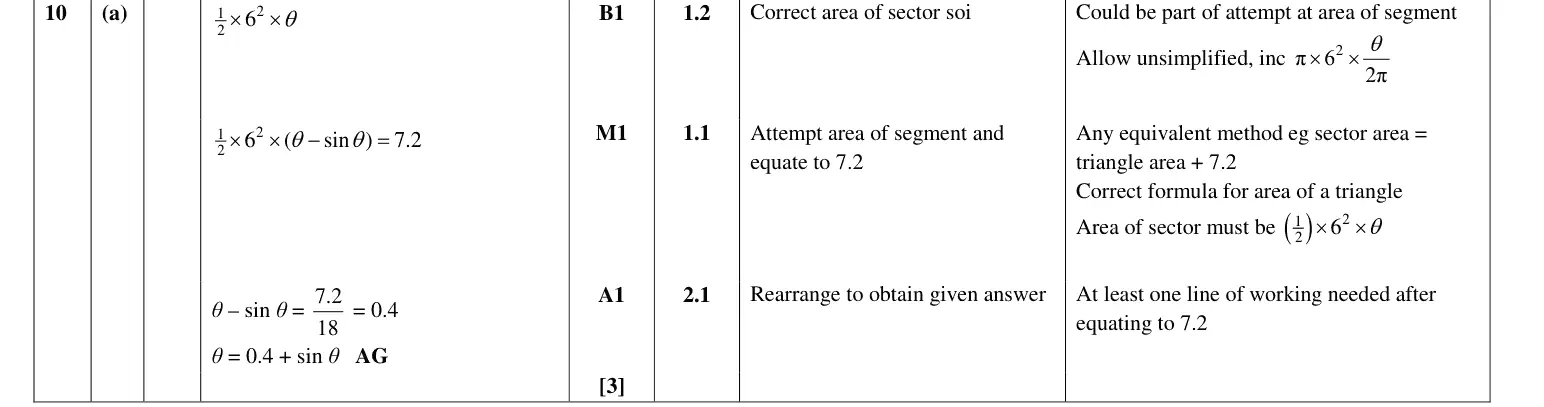
This part of the question was very well answered, with the majority of the candidates able to quote the relevant formulae, set up an equation and manipulate this to obtain the given answer.
Those who understood ½absinC was needed were quite successful. Some did not realise the significance if the word ‘instead’ and used ½x16x(BC)sin62.1ᵒ . The manipulation to find BC was usually accurate. A small minority attempted to use ½bh.
Key points and common errors
½ × BC × 20 × sin45° = 75√2 so BC = 15
'instead' means angle C from (i) is not used
Find an A-level maths tutor
Stuck on this? Book a trial session with an A-level maths tutor.