1.04h Work with arithmetic sequences and series, including the formulae…
Section
1.04 Sequences and Series
Level
A level only
Statement
Understand and be able to work with arithmetic sequences and series, including the formulae for the nth term and the sum to n terms.
Guidance
The term arithmetic progression (AP) may also be used. The first term will usually be denoted by a, the last term by l and the common difference by d. The sum to n terms will usually be denoted by Sₙ.
Most candidates answered this part well, demonstrating understanding of the two sequences described in the question to deduce the given fact. Some candidates did not score the mark because they did not approach this as a ‘proof’ – although the result is straightforward to deduce, candidates still needed to demonstrate their understanding of the setup before writing down the expression given in the question. When an answer is given, candidates should be reminded to make sure that they provide a logical argument that shows how that answer is reached.
Key points and common errors
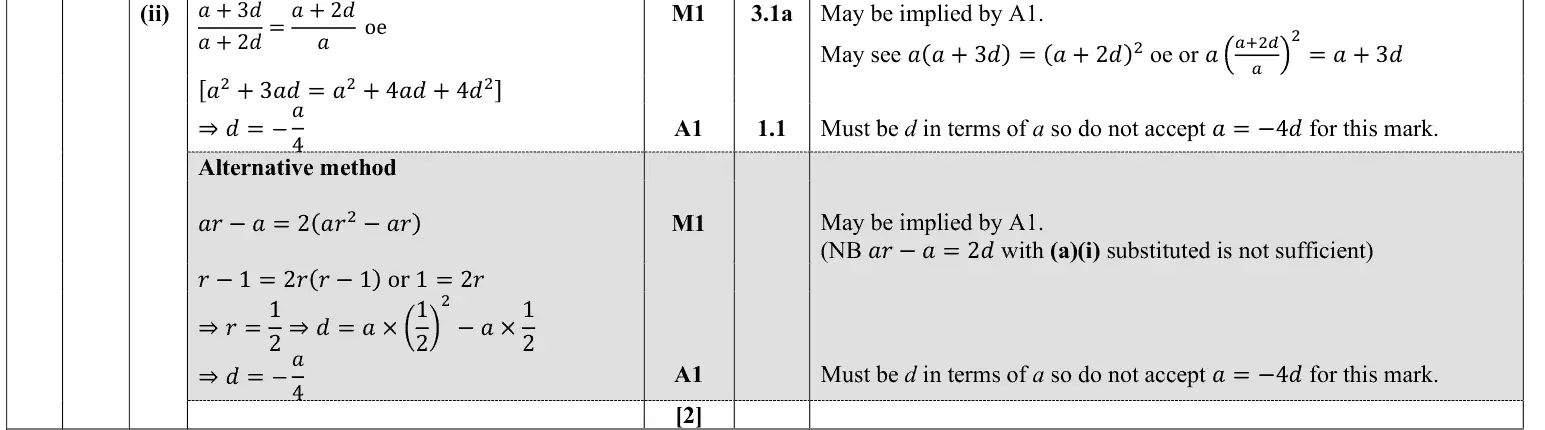
third term of AP is a + 2d = ar
must show a + 2d before the given result
June 2025 · Paper 2 · Q7(a)(ii)2 marksHard
Show the start of this question
Mark scheme for this part
Examiner's comment
This part was much less well answered than (a) (i), with some candidates appearing unsure about how to translate the given information into a mathematical expression. As shown on the scheme, several different approaches were possible – with the key requirement being to write down an equation in a and d only. Most candidates identified that this meant using the expression for r from part (a) (i) to eliminate r but were often unable to make further progress. A common incorrect answer was 𝑑= −𝑎. The question specifically requested ‘d in terms of a’ which meant that 𝑎= −4𝑑 was not sufficient for the final mark.
Key points and common errors
(a + 3d)/(a + 2d) = (a + 2d)/a gives d = −a/4
a = −4d not accepted
common wrong answer d = −a
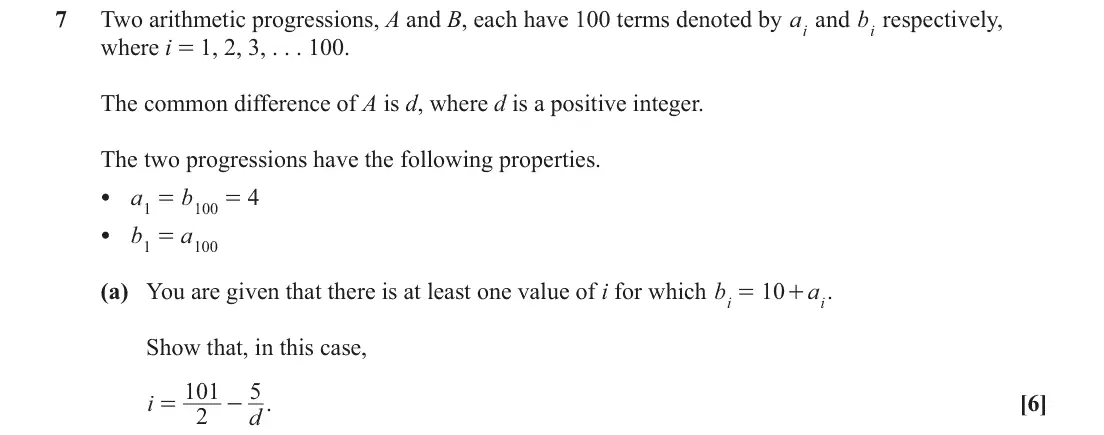
June 2024 · Paper 2 · Q7(a)6 marksHard
Mark scheme for this part
Examiner's comment
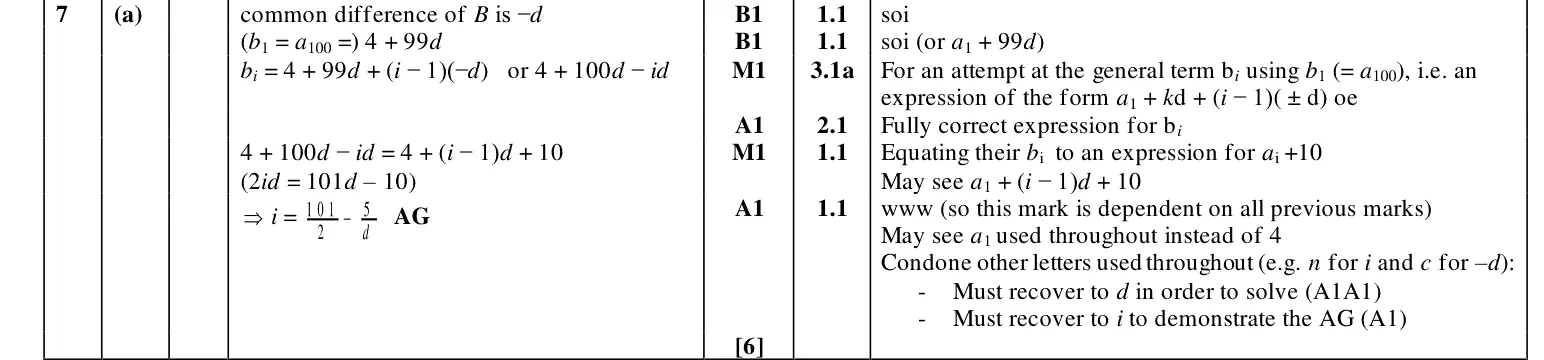
Although few candidates scored all 6 marks in this part, most candidates were able to interpret part of the information in the question to deduce the expression for 𝑏1 = 4 + 99𝑑 (B1). Fewer candidates identified that the common difference of B is –d, either assigning another letter or attempting to use d (and only a few of those deduced later that this needs to be –d). This meant that, while many of these candidates were able to set up the required equation (M1M1) they could not score either accuracy mark. Many candidates attempted to ‘fudge’ the given response and a few misinterpreted the 2 term as implying that they needed to use the summation formula. Some candidates demonstrated excellent understanding by making clear use of the given set up (for instance using reverse indexing).
Key points and common errors
common difference of B is −d
b₁ = a₁₀₀ = 4 + 99d
equate bᵢ = 10 + aᵢ
June 2024 · Paper 2 · Q7(b)2 marksHard
Show the start of this question
Mark scheme for this part
Examiner's comment
Very few candidates achieved either mark here, despite it relying only on the given answer to part (a). Some candidates identified that i needed to be an integer and this restricted the values for d, but very few gave both values correctly. This question had a very high omit rate, even though it did not depend on part (a).
Key points and common errors
i must be an integer between 1 and 100, so d = 2 or 10
June 2023 · Paper 3 · Q6(a)3 marksEasy
Mark scheme for this part
Examiner's comment
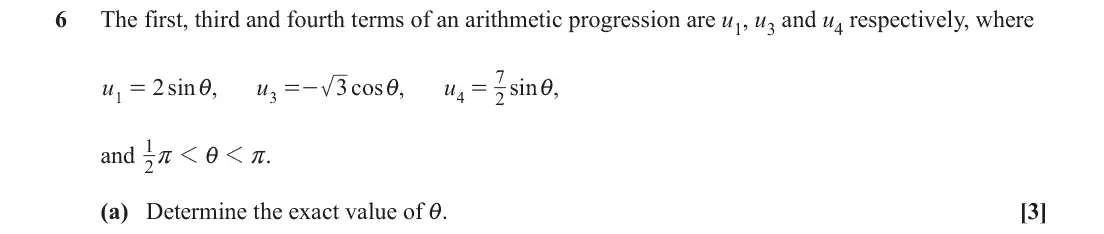
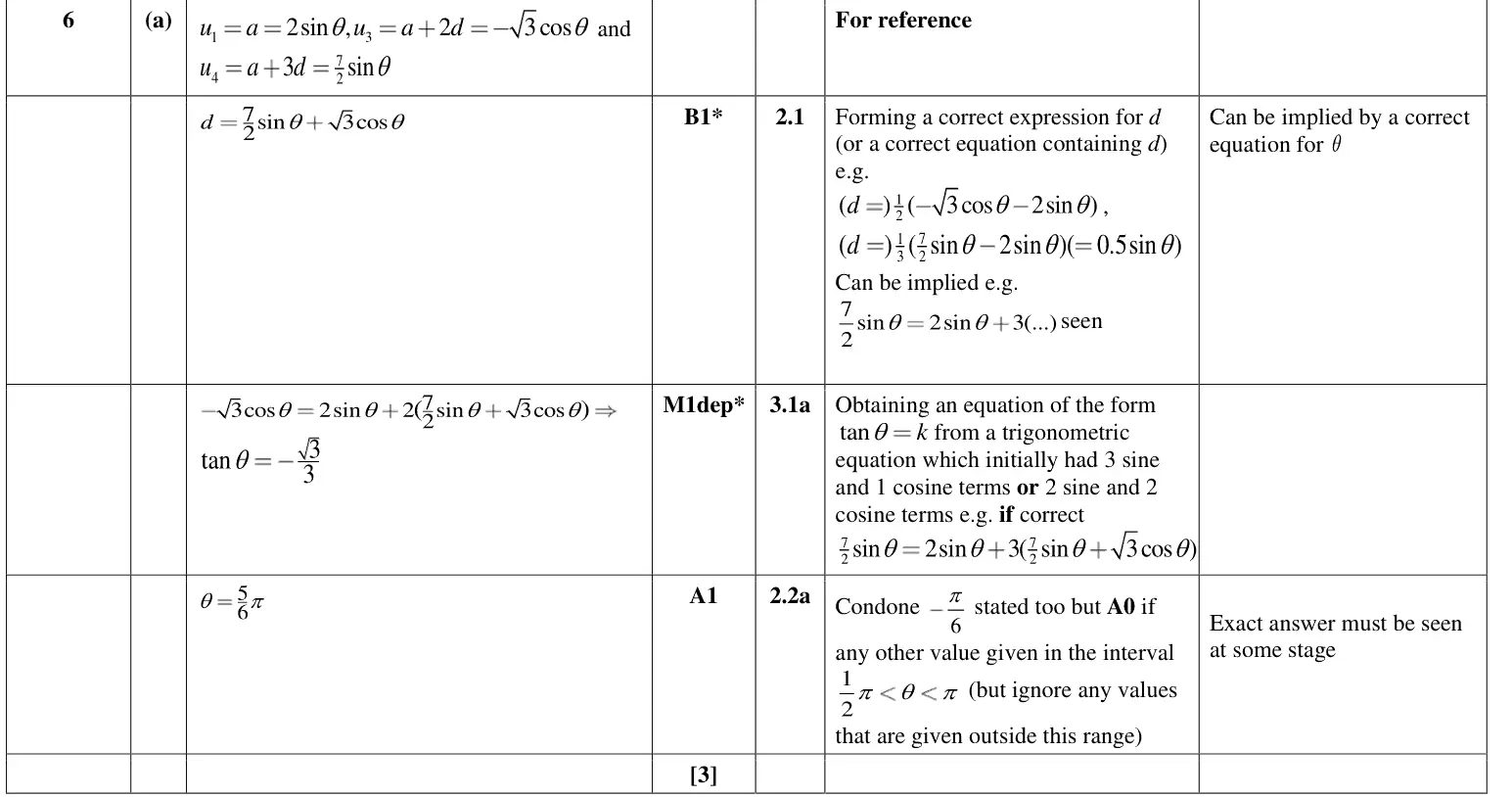
and cosine using the fact that 2(𝑢𝑢4 −𝑢𝑢3) = 𝑢𝑢3 −𝑢𝑢1. Most solved this equation correctly using tan and This part was answered particularly well with most candidates correctly setting up an equation in sine obtained the correct value of 𝜃𝜃. The most common error was to misread the question as giving the first three terms of an AP and not the first, third and fourth terms.
Key points and common errors
u₃ − u₁ = 2(u₄ − u₃) gives tan θ = −√3/3
θ = 5π/6 in the given interval
misreading as the first three terms
June 2023 · Paper 3 · Q6(b)3 marksEasy
Show the start of this question
Mark scheme for this part
Examiner's comment
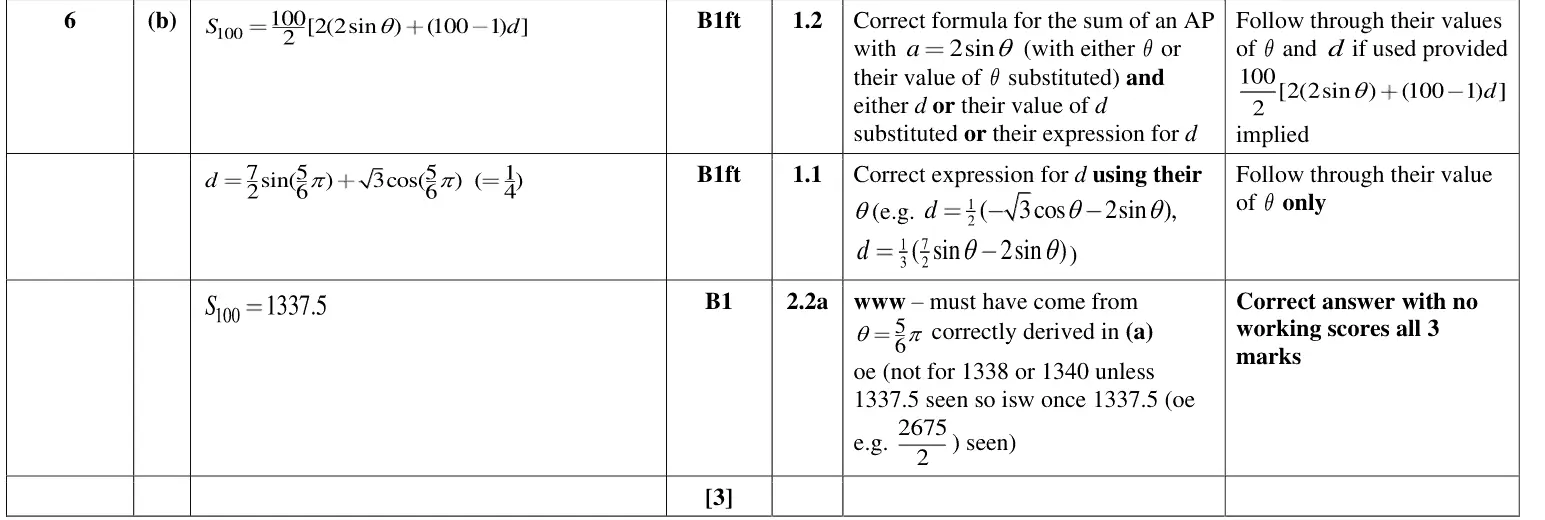
Most candidates used their value of 𝜃𝜃 to obtain a value for the common difference and then applied the correct formula for the sum of the first hundred terms of an AP. Occasionally candidates used the formula for the sum of a GP or incorrectly subtracted the first term from what would have been a correct answer.
Key points and common errors
d = 1/4, a = 2sin θ = 1
S₁₀₀ = 50(2 + 99/4) = 1337.5
errors: GP formula, subtracting the first term
June 2022 · Paper 3 · Q4(a)4 marksHard
Mark scheme for this part
Examiner's comment
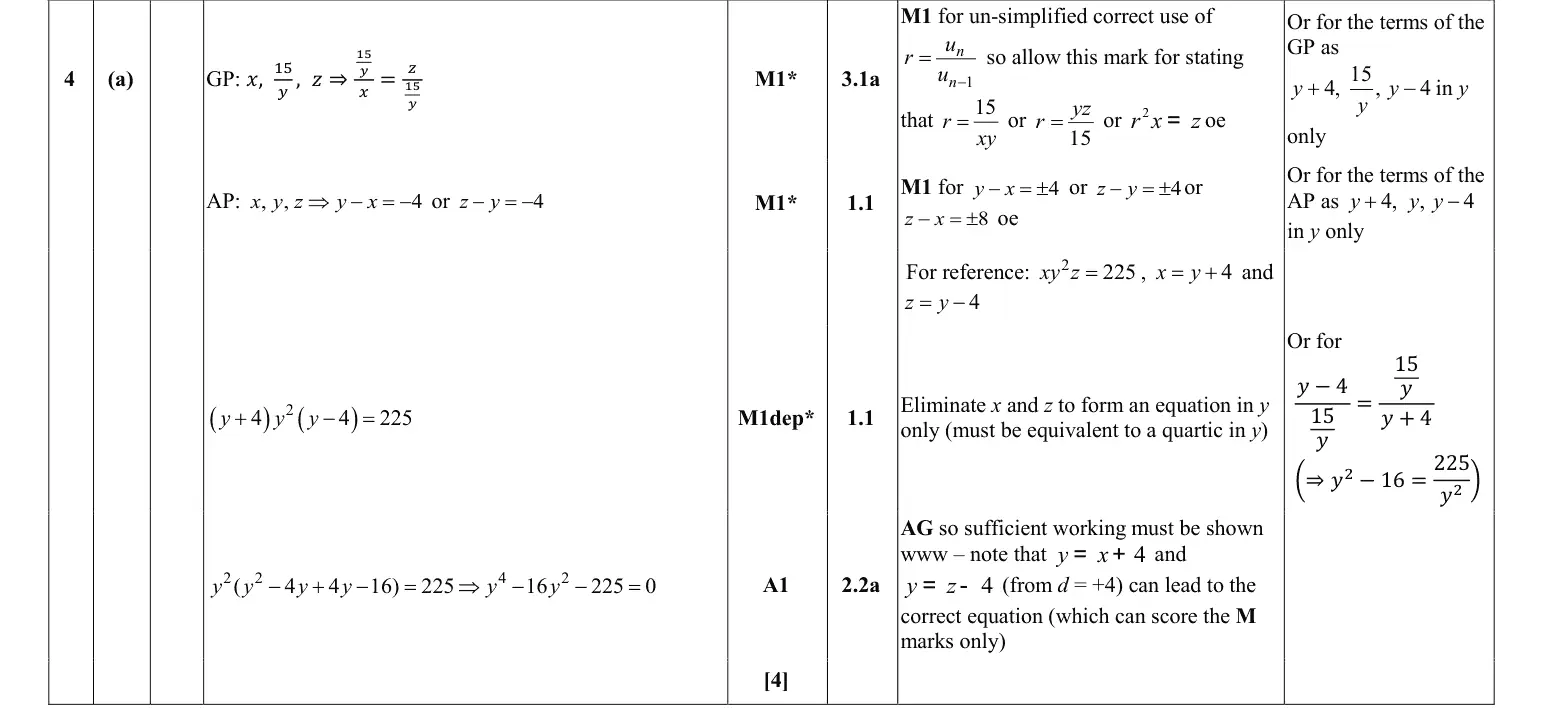
Candidates found this first part very demanding with many struggling to make any meaningful progress. The most successful responses were those that recognised that the information regarding the GP 15 zy = therefore xy z = 225, implied that and that the information regarding the AP implied that yx 15 Those that did usually went on to derive the required quartic equation in .y = + = − x y 4 and z y 4.
Key points and common errors
GP: 15/(xy) = yz/15 so xy²z = 225
AP: x = y + 4, z = y − 4
(y + 4)y²(y − 4) = 225 gives y⁴ − 16y² − 225 = 0
Autumn 2021 · Paper 2 · Q36 marksMedium
Mark scheme for this part
Examiner's comment
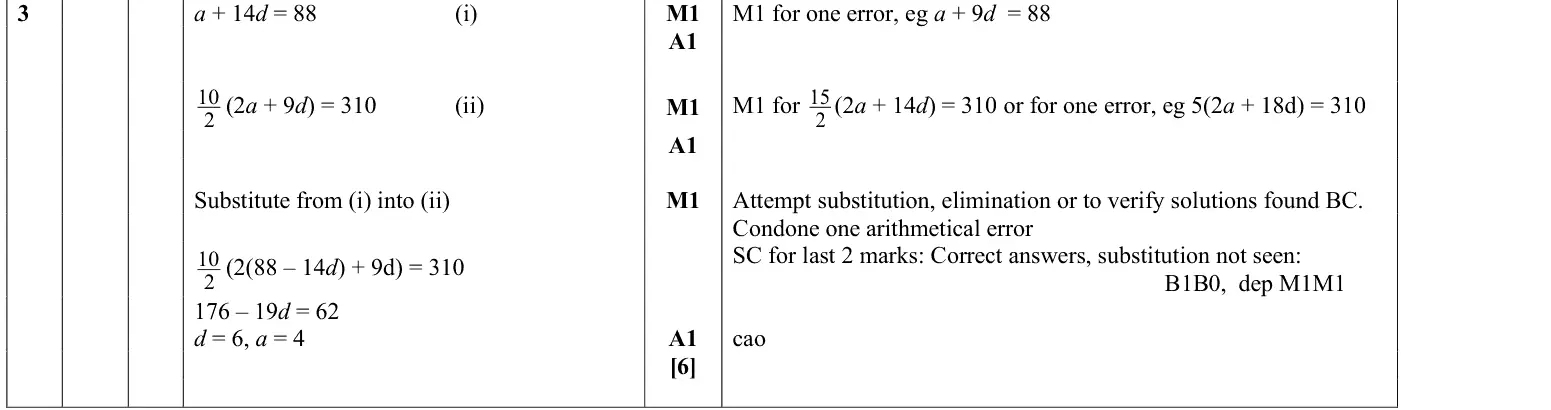
(From the general report) Comments on responses by question type Question 3: Some candidates treated 88 as the last term of the 10 terms whose sum is 310. For example, in Question 3, some candidates obtained the correct two linear equations, and then used the relevant calculator function to write down the answers, without showing a substitution or elimination method.
Key points and common errors
a + 14d = 88 and 5(2a + 9d) = 310
solve by substitution or elimination: d = 6, a = 4
error: treating 88 as the last of the 10 terms
calculator answers without method lose marks
Autumn 2021 · Paper 3 · Q35 marksMedium
Mark scheme for this part
Examiner's comment
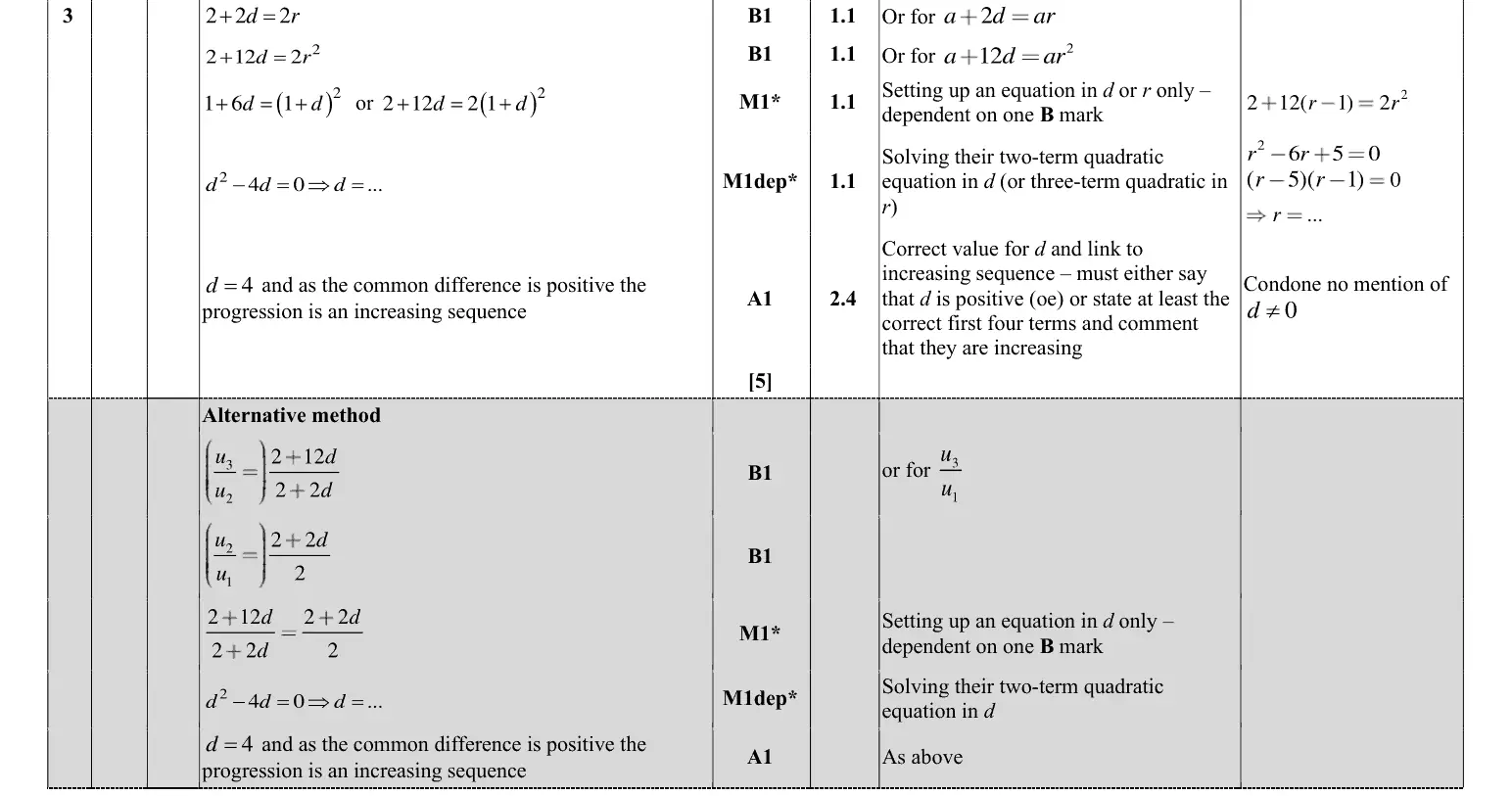
While most candidates could successfully set up and solve the required equations to find the value of d a number did not explain correctly why the value obtained implied that the sequence was increasing.
Key points and common errors
2 + 2d = 2r and 2 + 12d = 2r² give d² − 4d = 0
d ≠ 0 so d = 4
must explain that positive common difference means increasing
Autumn 2020 · Paper 1 · Q7(a)3 marksMedium
Mark scheme for this part
Examiner's comment
(Comment on Question 07 as a whole) The final part of Question 7 was another example of where candidates were expected to give clearly explained and sensible answers. Many could identify that there will eventually not be enough hours in the day, but finding a reason on a different theme for their second answer proved more problematical.
Key points and common errors
Anna AP: 30 + 9 × 15 = 165
Ben GP: 30 × 1.1⁹ = 71
difference 94
both terms evaluated
June 2019 · Paper 1 · Q4(a)2 marksEasy
Mark scheme for this part
Examiner's comment
The majority of candidates could identify that this was an arithmetic progression, find the common difference and attempt the tenth term. As this was a question posed in a real-life context it was expected that solution should reflect this; a number of candidates did not include units in their answer thus not gaining full credit.
Key points and common errors
AP with a = 16000, d = 1200
u₁₀ = £26,800
units required
June 2019 · Paper 1 · Q4(b)4 marksEasy
Show the start of this question
Mark scheme for this part
Examiner's comment
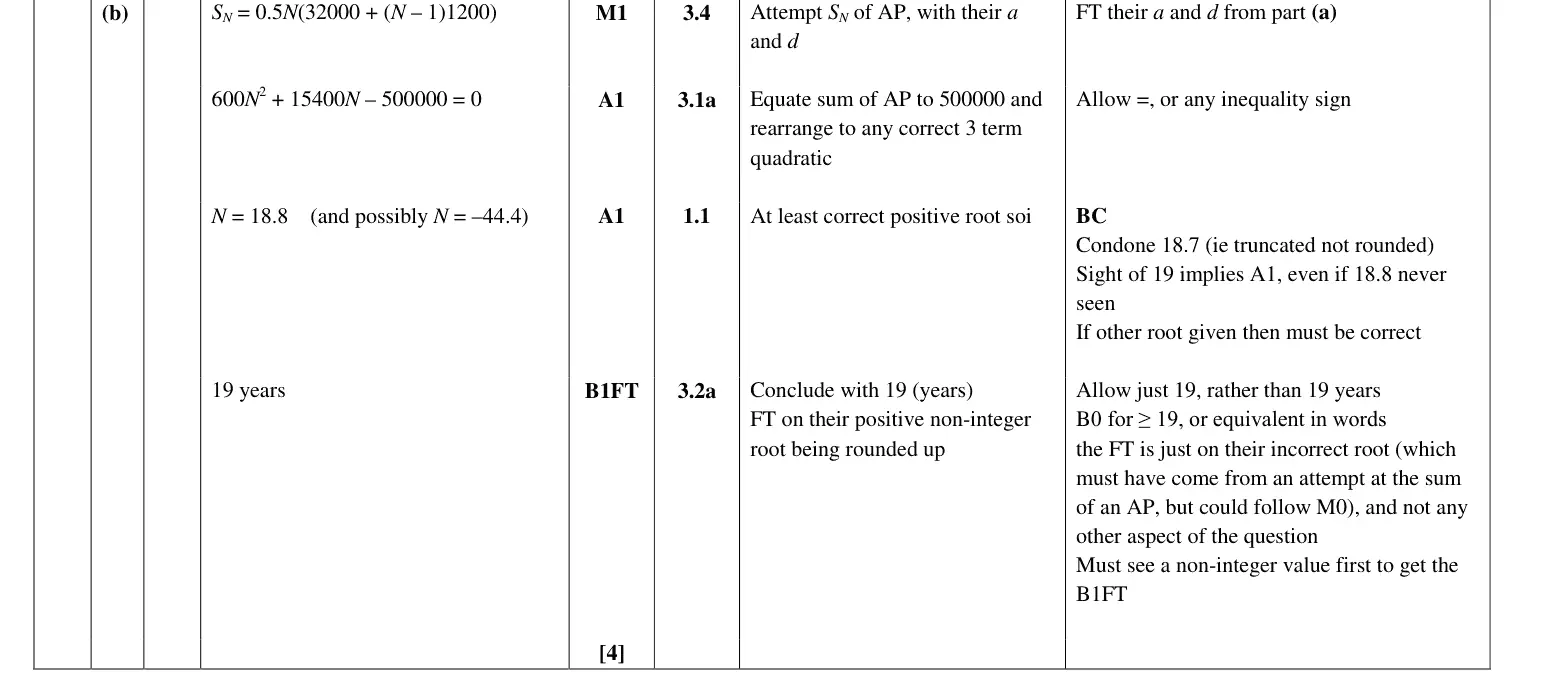
Most candidates could attempt the sum of the arithmetic progression, equate it to 500,000 and attempt to solve. There was an expectation that candidates would use their calculators to solve the resulting quadratic. While some did so, they were in the minority and errors in handling the ‘unfriendly’ numbers were seen. Candidates then had to appreciate that an integer solution was required, and most gained full marks by doing so. Rather than attempting the sum, the most common error was to instead use the nth term formula and the answer that Sam would have to work for 405 years did not seem to result in candidates reconsidering their solution.
Key points and common errors
S_N = ½N(32000 + 1200(N − 1)) > 500000
N = 18.8 so 19 years
use the calculator for the quadratic
using the nth term instead of the sum
Find an A-level maths tutor
Stuck on this? Book a trial session with an A-level maths tutor.