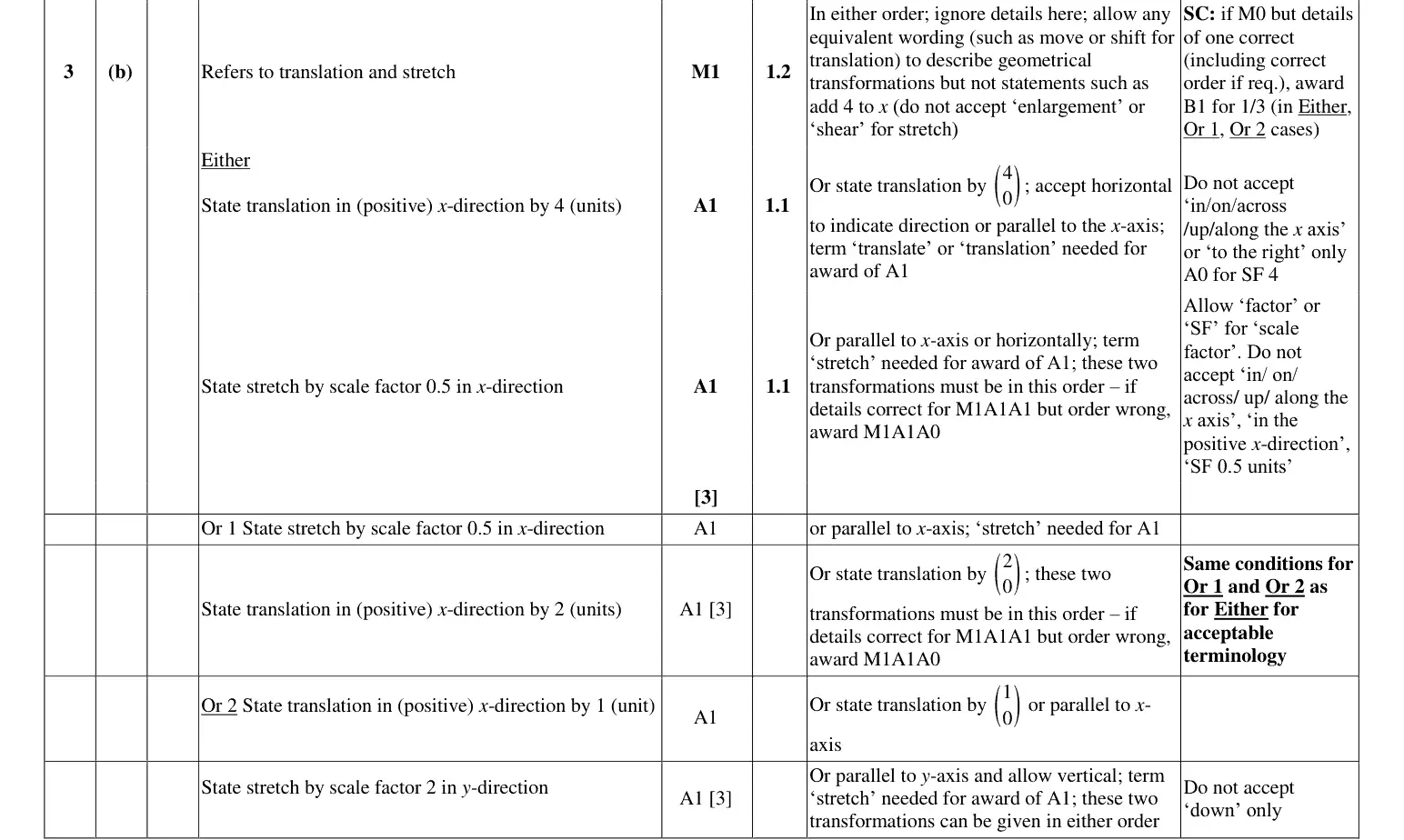
Mark scheme for this part

Examiner's comment
Most candidates were able to gain this mark by stating the correct scale factor.
Key points and common errors
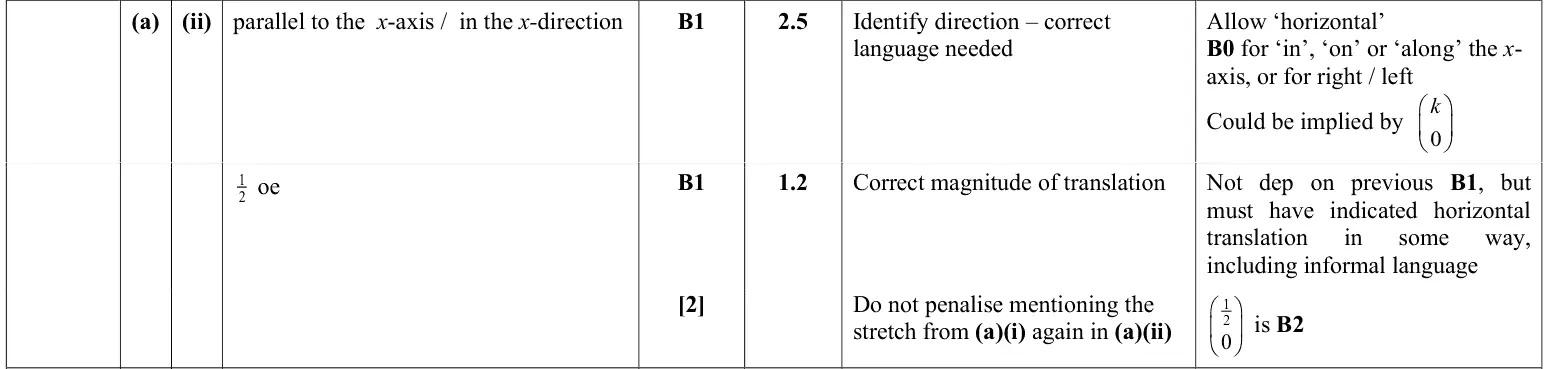
- stretch parallel to x-axis scale factor ½
Most candidates were able to gain this mark by stating the correct scale factor.

One mark was available for identifying the correct direction of the translation, using the expected mathematical terminology; this could also be implied by stating a vector for the translation with a y component of 0. Most candidates were able to gain this mark, usually through their vector statement, as long as this was not contradicted by their worded statement (e.g. stating that the translation was ‘vertical’ but giving a vector with a y component of 0 is ambiguous and thus B0). Identifying the magnitude of 0.5 proved to be more challenging, and only the most able candidates gained both of the marks available.

This part of the question proved to be more challenging, with just less than half of the candidates gaining the mark available. Those who were successful appreciated the need to rewrite the given equation in the form y = aebx, so as to address the information given in the question, and could then identify the magnitude of the stretch in the y-direction, giving the answer in an exact form.

It was less usual for partial credit to be given in this question; solutions tended to be either fully correct or very limited progress was made. The most successful method was to use a sketch diagram and consider the vertical translation to obtain c = 1. The gradient and intercept of the straight line graph could then be considered to obtain values for a and b. In the less successful responses, candidates tended to try to employ routine methods such as substituting values and then squaring to deal with the modulus, rather than trying to develop a more flexible approach. This candidate has made effective use of a sketch graph, and has considered the graph of y = ax – b to find values for a and b.



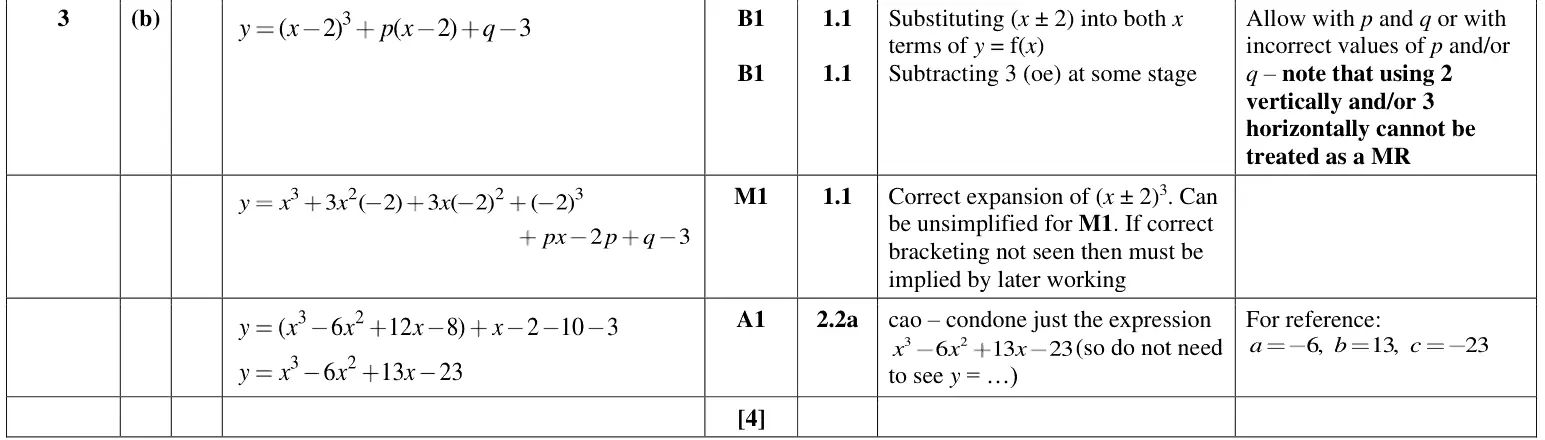
equation 𝑦𝑦= (𝑥𝑥−2)3 + 𝑝𝑝(𝑥𝑥−2) + 𝑞𝑞−3 some candidates incorrectly added the 3, or considered the Although most candidates realised that the given translation meant that the new curve would have the horizontal translation as (𝑥𝑥+ 2). Some then struggled to expand (𝑥𝑥−2)3 correctly or did not give their final answer as an equation of ‘𝑦𝑦= ⋯’ (and simply left their answer as 𝑥𝑥3 −6𝑥𝑥2 + 13𝑥𝑥−23).



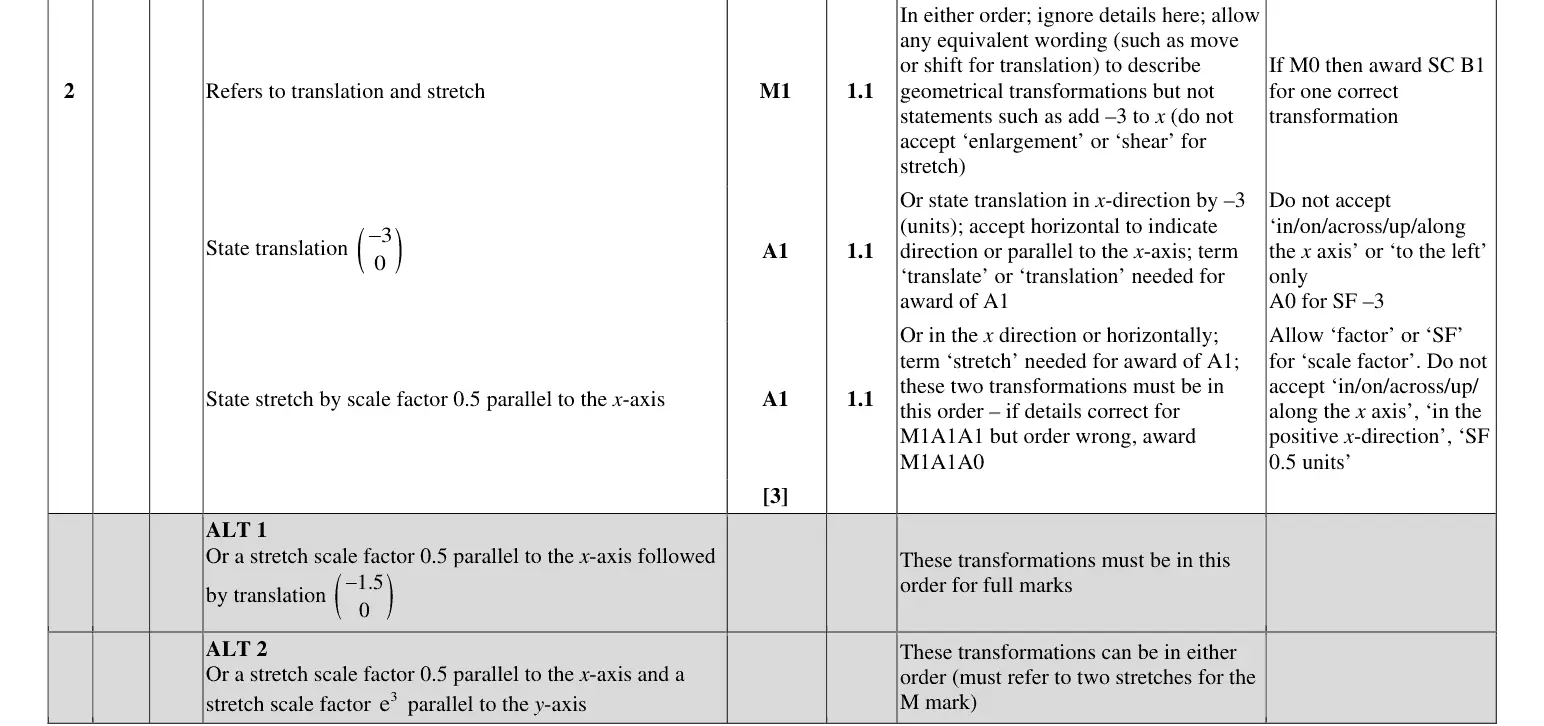
Although the majority of candidates demonstrated a clear understanding of the process of transformation there were very few who scored full marks, with most scoring 2 out of the 3 marks available. Some lost a mark for imprecise language, while others had the order of the transformations in the wrong order.


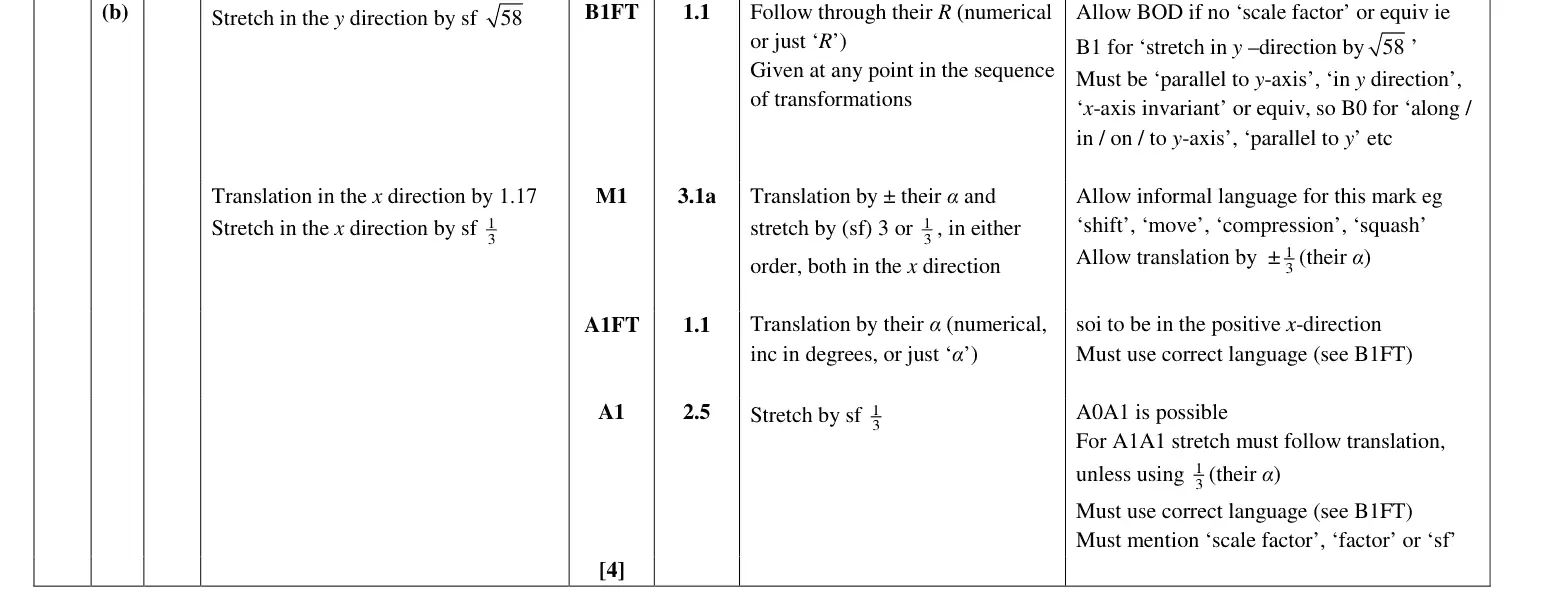
This part of the question proved to be much more challenging, and fully correct solutions were in the minority. Barely a third of the candidates could identify the three transformations and describe them using the correct terminology and only the most able could also give them in the correct order. There were some candidates who could use informal language to convey their intention (such as ‘shift’ and ‘compression’) and other explanations were ambiguous (for example ‘a stretch in the x-axis’). There was however a number of candidates who did not appreciate the link with part (a) and gave descriptions that involved a translation of 7sin3x. Candidates should always consider whether earlier parts of a question have been posed to give them assistance with later parts.


While it was clear that most candidates appreciated that the most common way of transforming the first graph to the other was by the application of a translation and a stretch the mathematical precision of language and understanding of the required order of transformations was not done well.
Stuck on this? Book a trial session with an A-level maths tutor.