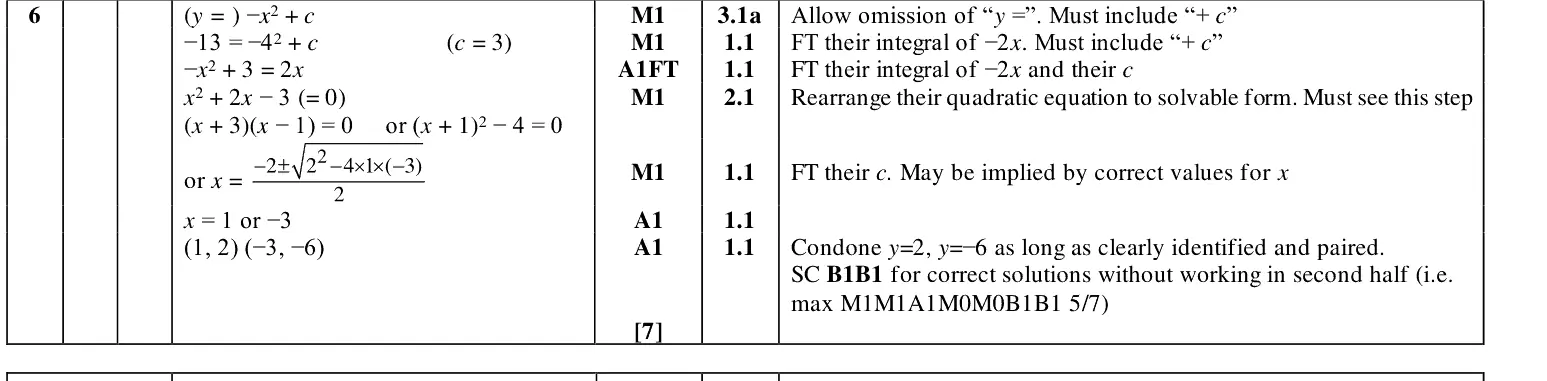
Most candidates made a good attempt at this question, although relatively few received all 7 marks. The majority of candidates were able to score 2 or 3 of the first 3 marks from integrating (although a few omitted the constant and therefore received 0 as they could not progress). As this question was ‘Determine’ candidates were required to show working for forming and solving their quadratic. A Special Case was included here for candidates who provided answers unsupported by working in the second part, but this should not be assumed for future exam series. Errors in deducing c were common, but candidates who obtained the correct equation were mostly able to correctly deduce that they needed to set this = 2x and solve the resulting quadratic for x. Some candidates obtained y = 12 or y = −12 instead of y = −6 where x = −3.
Key points and common errors
y = −x² + c
c = 3 from (4, −13)
−x² + 3 = 2x so (x + 3)(x − 1) = 0
(1, 2) and (−3, −6)
omitting + c blocks progress
show working for the quadratic
June 2024 · Paper 1 · Q7(c)6 marksEasy
Show the start of this question
Mark scheme for this part
Examiner's comment
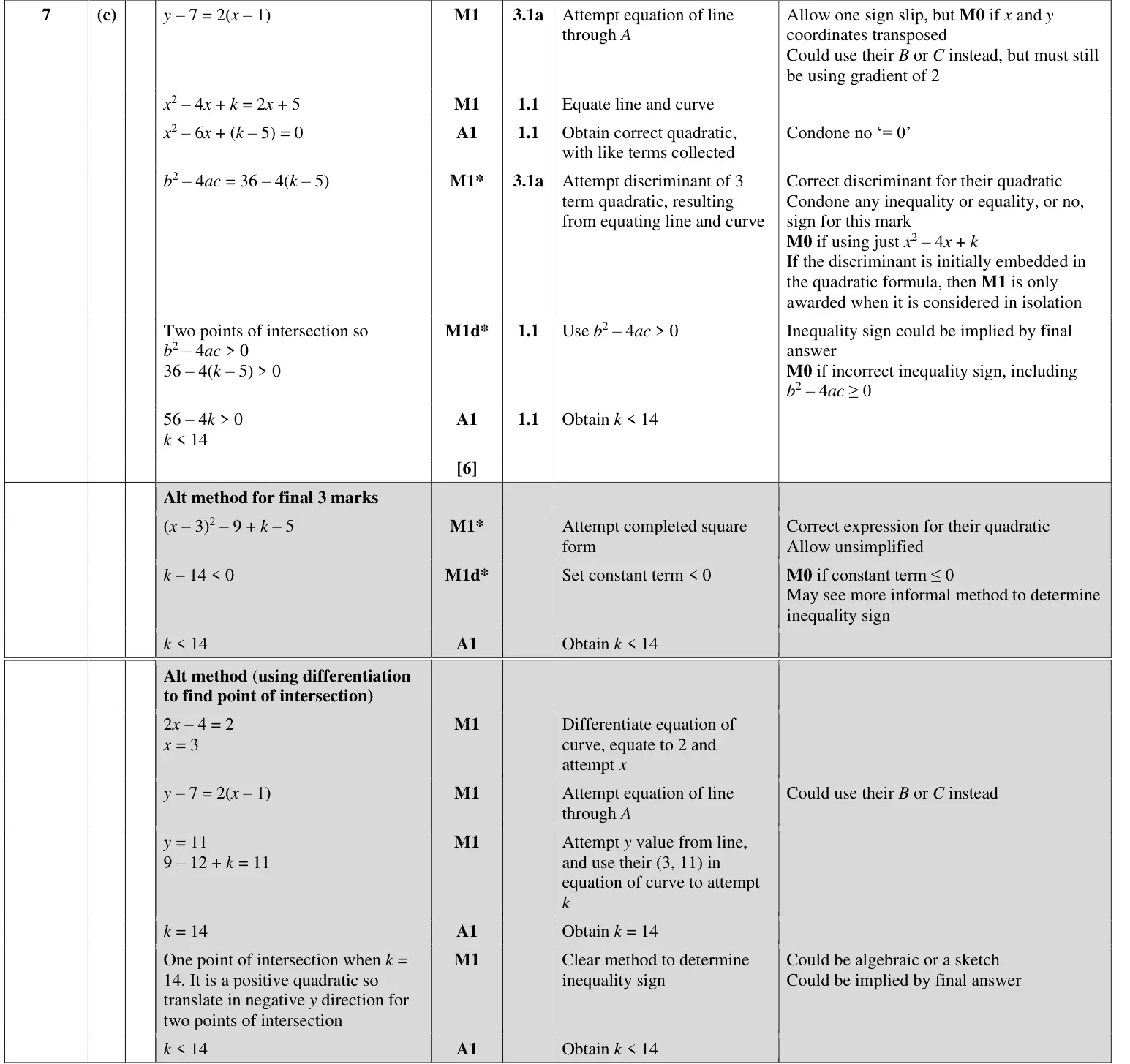
Most candidates found the equation of the line and equated it to the curve to get a quadratic equation in x for the points of intersection. The majority then used the discriminant property to get an inequality for k, although some lost a minus sign in calculating the discriminant or in dealing with the inequality while others made slips in expanding brackets. A few candidates used ‘completing the square’ to find the values of k for which the quadratic had two roots.
Key points and common errors
line y = 2x + 5
x² − 6x + (k − 5) = 0
b² − 4ac = 36 − 4(k − 5) > 0
k < 14
sign errors in discriminant
June 2022 · AS Paper 1 · Q3(a)2 marksHard
Mark scheme for this part
Examiner's comment
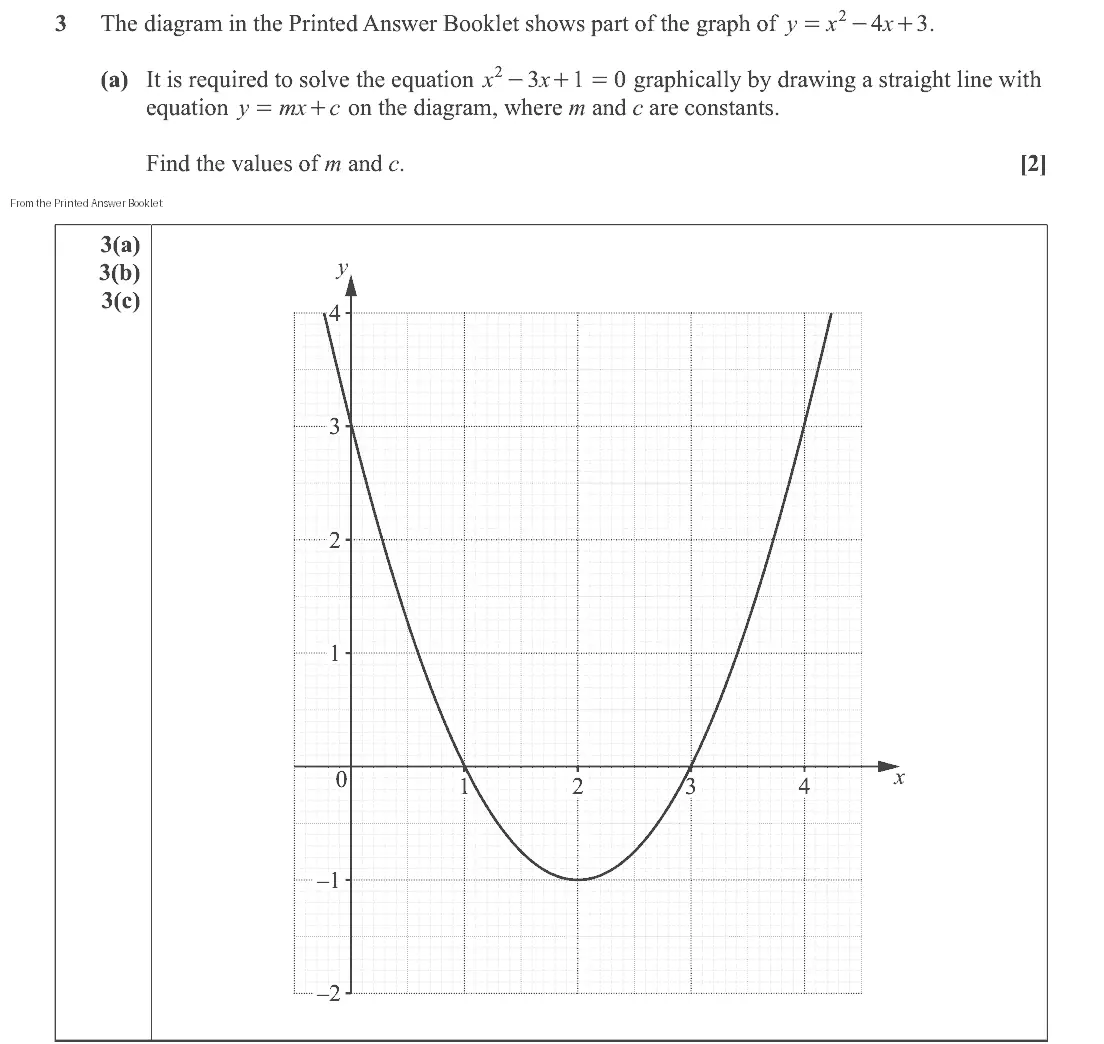
− + = − + Most candidates showed unfamiliarity with this style of question. Some wrote x 4 x 3 x 3 x 1 x − 2 = 0, but most did not know how to proceed to obtain the required straight-line equation. Some differentiated and concluded that the required straight-line equation was y = 2x− 3.
Key points and common errors
rearrange x² − 3x + 1 = 0 as x² − 4x + 3 = −x + 2, so m = −1, c = 2
many unfamiliar with the method
some differentiated
June 2022 · AS Paper 1 · Q3(b)2 marksMedium
Show the start of this question
Mark scheme for this part
Examiner's comment
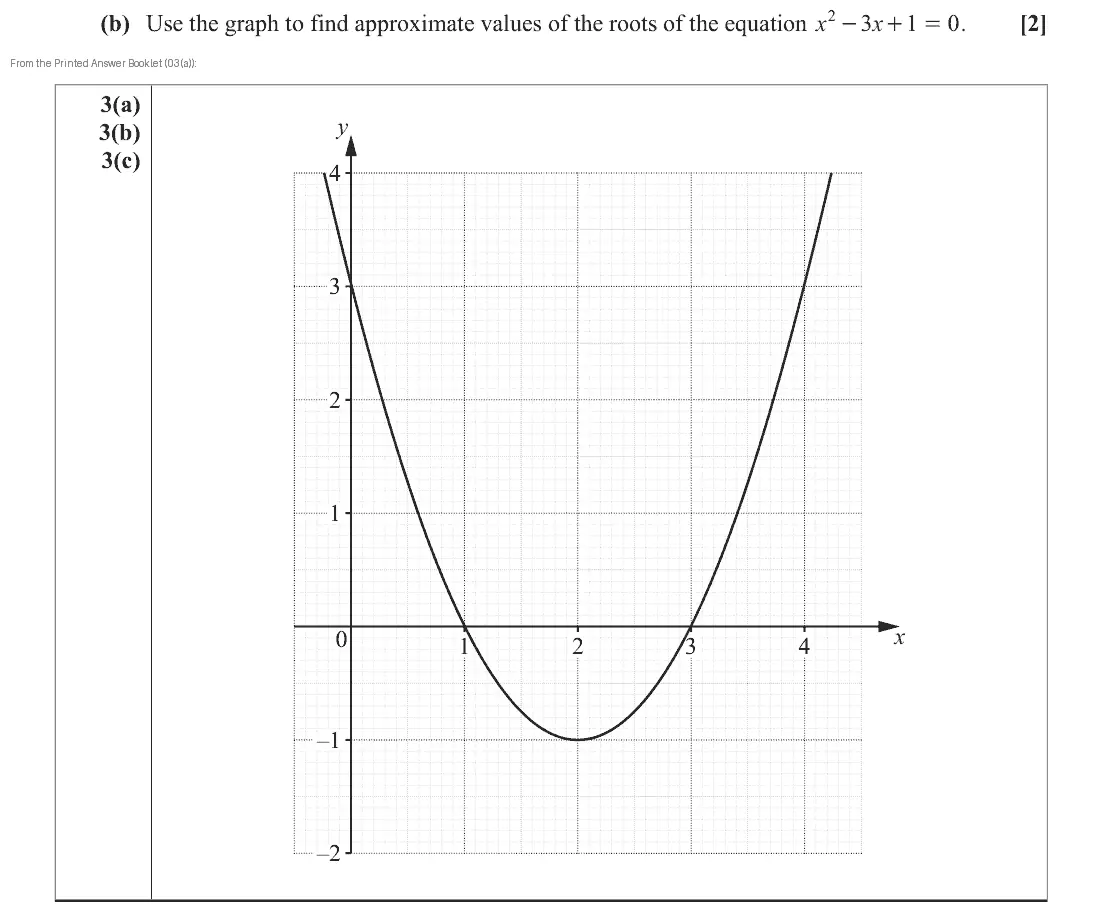
Most of the candidates who had obtained a straight line equation (either correct or incorrect) in part (a), knew how to use it to find solutions. Even an incorrect line could lead to one mark on follow-through. A minority of candidates misunderstood the instruction “Use the graph” and drew the graph of = − + y x 3 x 1 . These candidates were (perhaps rather generously) given one mark out of two for the correct solutions. A large number of candidates gave the correct solutions but had drawn either no line or an incorrect line. It was assumed that these candidates had used the calculator function to obtain these solutions and so they scored no marks. A common incorrect answer was x = 1 or 3, which comes from the intersection points of the given curve with the x-axis.
Key points and common errors
draw y = −x + 2 on the given graph
roots x ≈ 0.4 and 2.6 read from intersections
calculator answers without the line score 0
June 2022 · Paper 1 · Q3(b)2 marksMedium
Show the start of this question
Mark scheme for this part
Examiner's comment
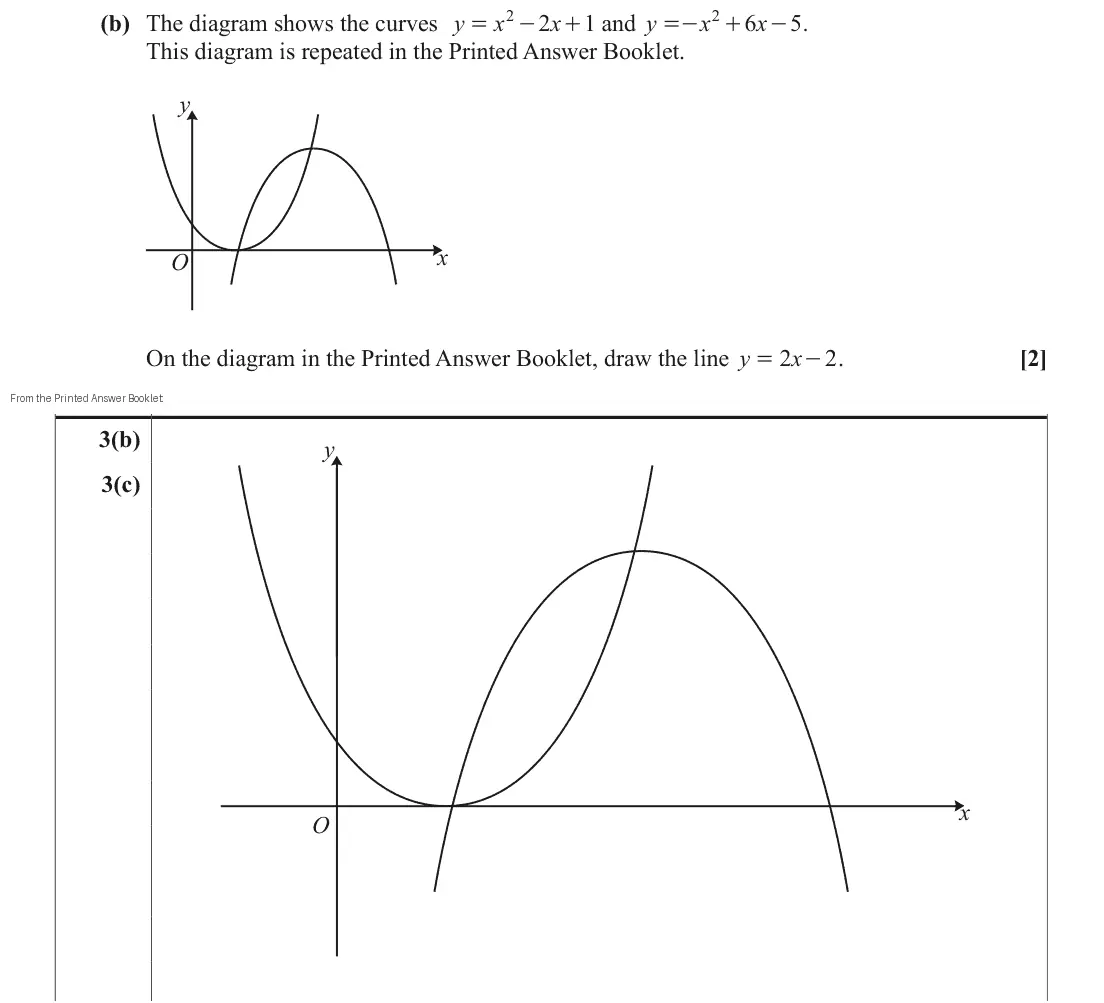
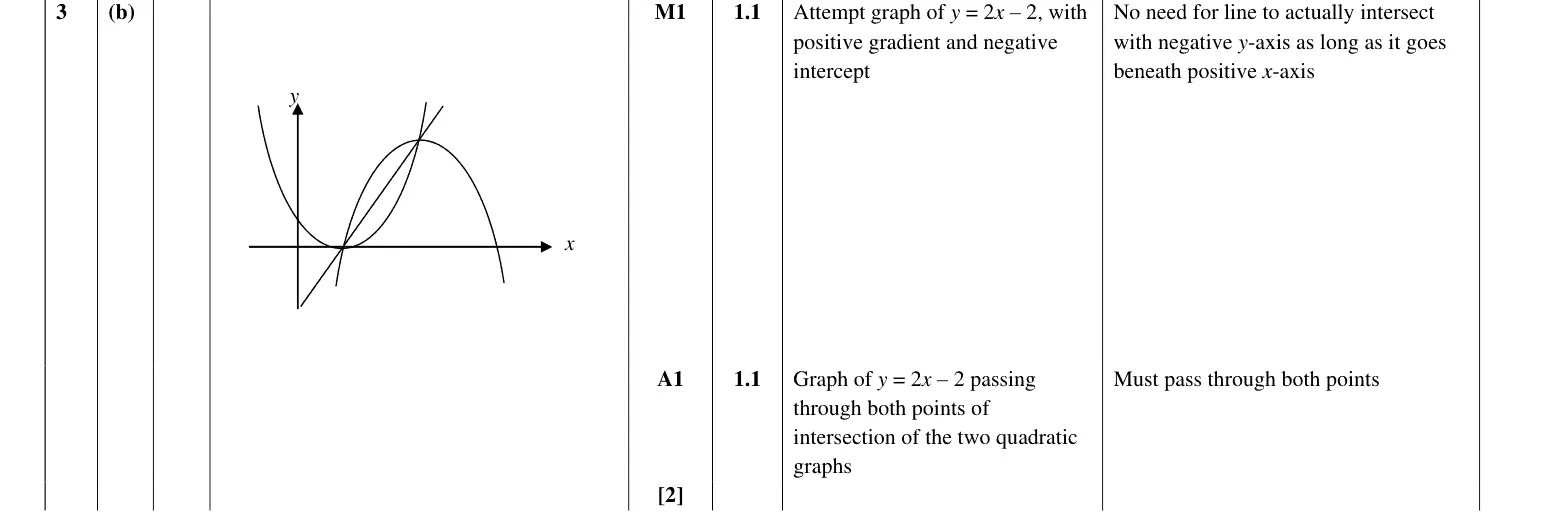
Nearly all of the candidates gained 1 mark for sketching a straight line with positive gradient and negative intercept. Many also appreciated the significance of the points of intersection already found, but a surprising number did not see the relevance of the work already done.
Key points and common errors
line with positive gradient and negative intercept passing through both intersection points (1, 0) and (3, 4)
Autumn 2021 · Paper 3 · Q4(b)1 markMedium
Show the start of this question
Mark scheme for this part
Examiner's comment
k y x 1 For the one mark available here it was not sufficient to simply say that because and y x x x 1 k had only one point of intersection that therefore the equation had only one real root. Candidates had to make a link between the two graphs and the corresponding equation.
Key points and common errors
the graphs meet once and x·abs(x − 1) = k is equivalent to abs(x − 1) = k/x
must link the intersection to the equation, not just state one intersection
Autumn 2020 · AS Paper 1 · Q75 marksMedium
Mark scheme for this part
Examiner's comment
Many candidates answered this question well. However, others attempted to substitute from one equation into the other by simply setting the two left-hand-sides equal to each other. This did not achieve the desired result of obtaining an equation in one letter only.
Key points and common errors
substitute x = 4 − 2y into the curve: y² + 2y − 15 = 0
y = 3 or −5
points (−2, 3) and (14, −5) paired
equating the two left-hand sides is invalid
Autumn 2020 · AS Paper 2 · Q2(b)2 marksHard
Show the start of this question
Mark scheme for this part
Examiner's comment
(Comment on Question 02 as a whole) Part (a) - Candidates should draw their curves to ‘fill’ the axes and sketch asymptotes carefully. There should not be too big a ‘gap’ between the curve and the asymptote and there should not be significant movement away from the asymptote. y = ln x attempts were disappointing. Part (b) - The connection between the given equation and ln x = k/x was not well appreciated or explained. Some were looking for an axis crossing point to justify one root.
Key points and common errors
x ln x − k = 0 rearranges to ln x = k/x
curves intersect exactly once
looking for an axis crossing gains nothing
Autumn 2020 · Paper 1 · Q9(b)(i)4 marksMedium
Show the start of this question
Mark scheme for this part
Examiner's comment
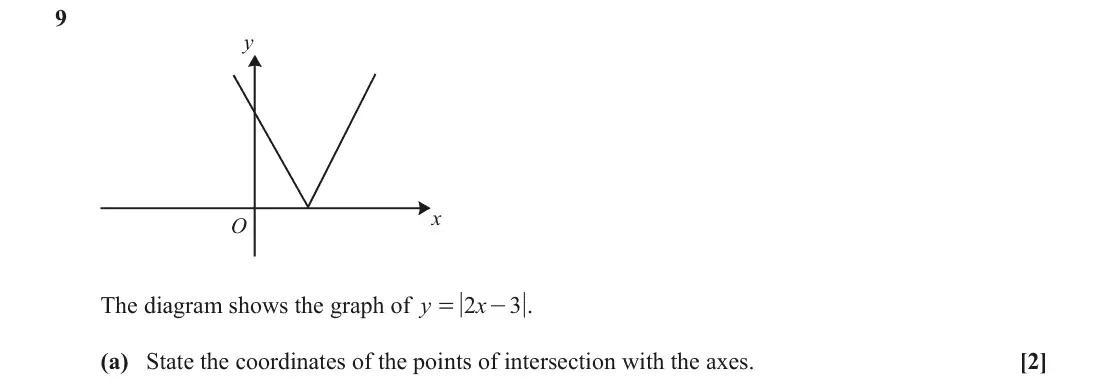
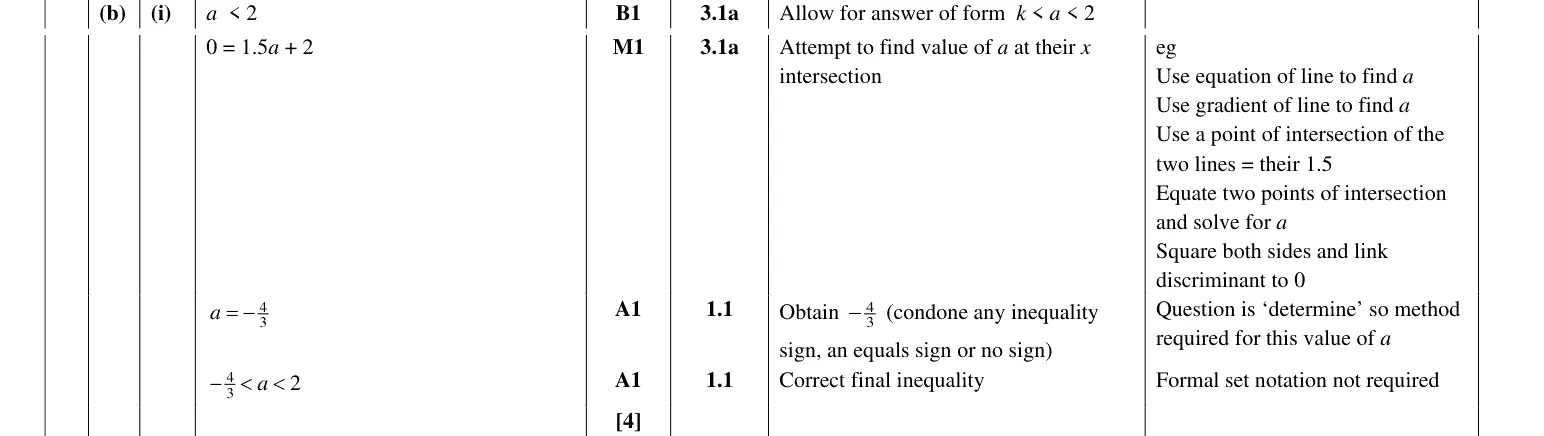
(Comment on Question 09 as a whole) The most successful candidates in Question 9(b)(i) were those who considered a graphical approach (which the diagram was included to help with) as opposed to those who embarked on the more standard techniques for a question involving moduli.
Key points and common errors
graphical approach best: line through (0, 2)
a < 2 (parallel to right arm)
through vertex (1.5, 0) gives a = −4/3
−4/3 < a < 2
June 2019 · AS Paper 1 · Q4(b)2 marksHard
Show the start of this question
Mark scheme for this part
Examiner's comment
Most candidates did not recognise that this question is actually about translating a curve in the y- direction. Some recognised that the key point is the position of the curve, but only gave the response k > 0. Others took the hint from the instruction "Using you answers from part (a)...." and substituted x = 1 and x = 3 into either x3 – 6x2 + 9x or x3 – 6x2 + 9x + k. This can lead to a correct method, but very few candidates used the results correctly. Some just gave k = 0 and k = –4. Others gave –4 < k < 0. A few gave the correct response but attempted to combine the two inequalities into one, giving –4 > k > 0. Some candidates tried to use a "discriminant" obtained somehow from the cubic equation.
Key points and common errors
translating the cubic by k
exactly one root when k > 0 or k < −4
−4 < k < 0 or k = 0, −4 are wrong
June 2018 · Paper 2 · Q77 marksMedium
Mark scheme for this part
Examiner's comment
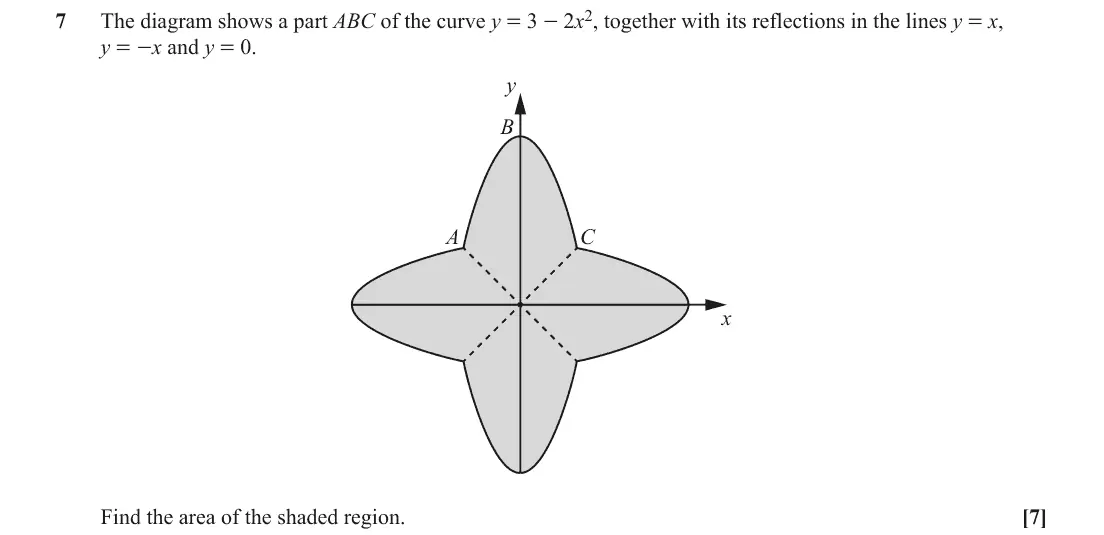
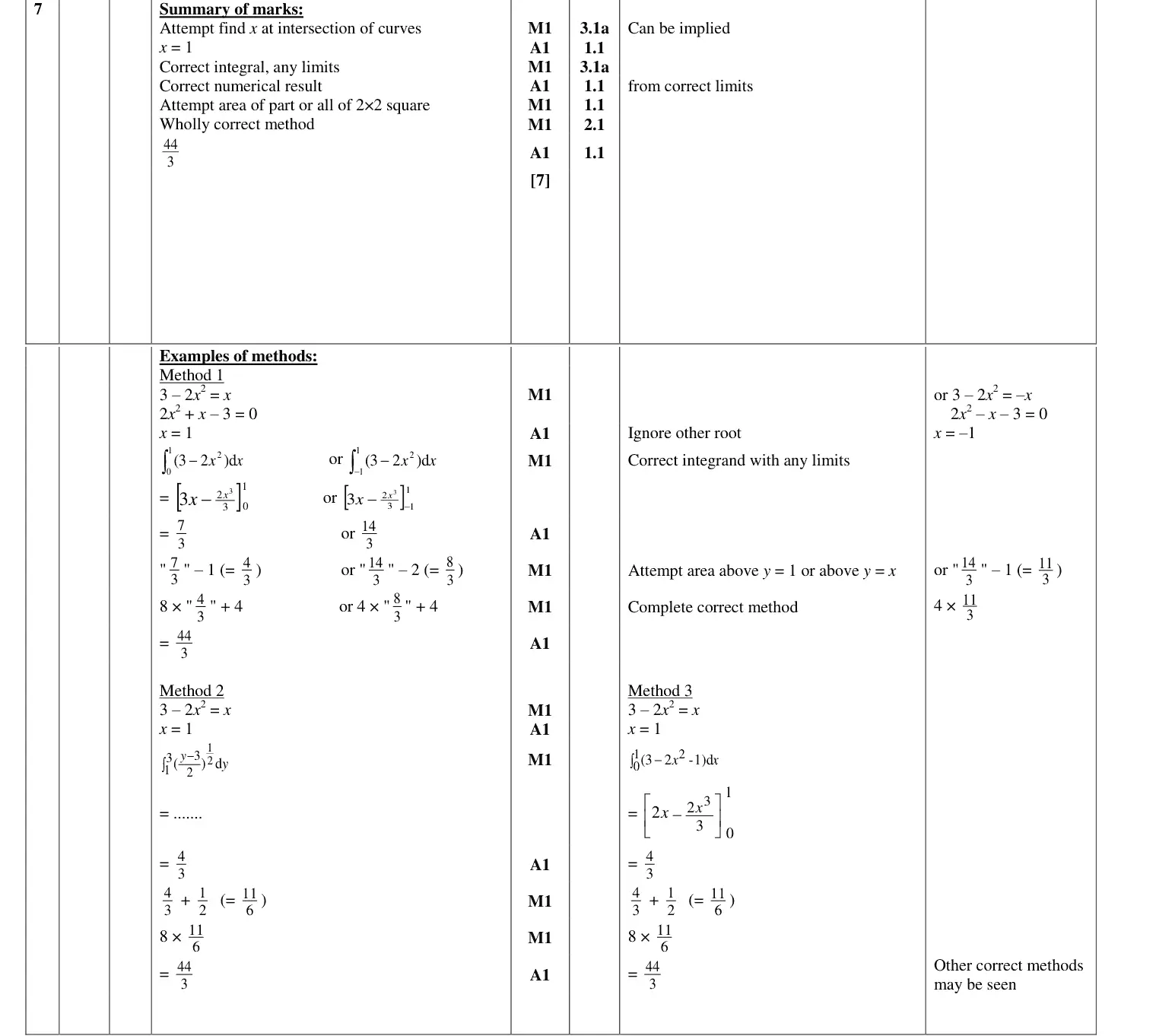
A large variety of correct methods were seen. Some were unnecessarily long. Examples of correct, although long, methods were these: 1. Find the inverse function in order to find the equation of the reflection of the given curve in y = x. Then solve this with the given function in order to find the point of intersection, C. xd . y 2. Rearrange the given function to make x the subject and then find ∫ Some candidates found the points where the given curve cuts the x-axis and hence integrated with incorrect limits. Many made mistakes in trying either to add or subtract all or part of the area of the middle square. 1 2 4 × ( 3 − 2 x − )1 d x + 4 ∫ Perhaps the neatest method was − 1 .
Key points and common errors
intersection 3 − 2x² = x gives x = 1
∫₀¹(3 − 2x² − 1)dx = 4/3
use symmetry: 8 × 11/6 = 44/3
wrong limits from the x-axis roots
errors adding or subtracting the central square
Find an A-level maths tutor
Stuck on this? Book a trial session with an A-level maths tutor.