1.02l The modulus function, including the notation |x|, and use relations…
Section
1.02 Algebra and Functions
Level
A level only
Statement
Understand and be able to use the modulus function, including the notation |x|, and use relations such as |a| = |b| ⇔ a² = b² and |x − a| < b ⇔ a − b < x < a + b in the course of solving equations and inequalities.
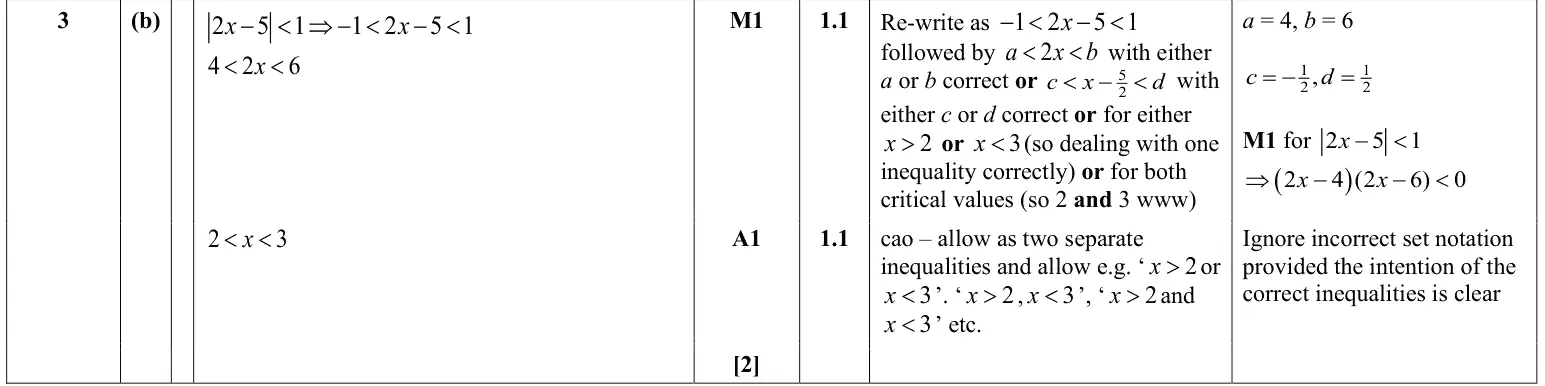
The part was answered extremely well although there were a significant minority of candidates that struggled with manipulating negative terms in an inequality with their solution of 5 −2𝑥< 1 incorrectly stated as x < 2 or obtaining an inequality with a negative numerical value.
Key points and common errors
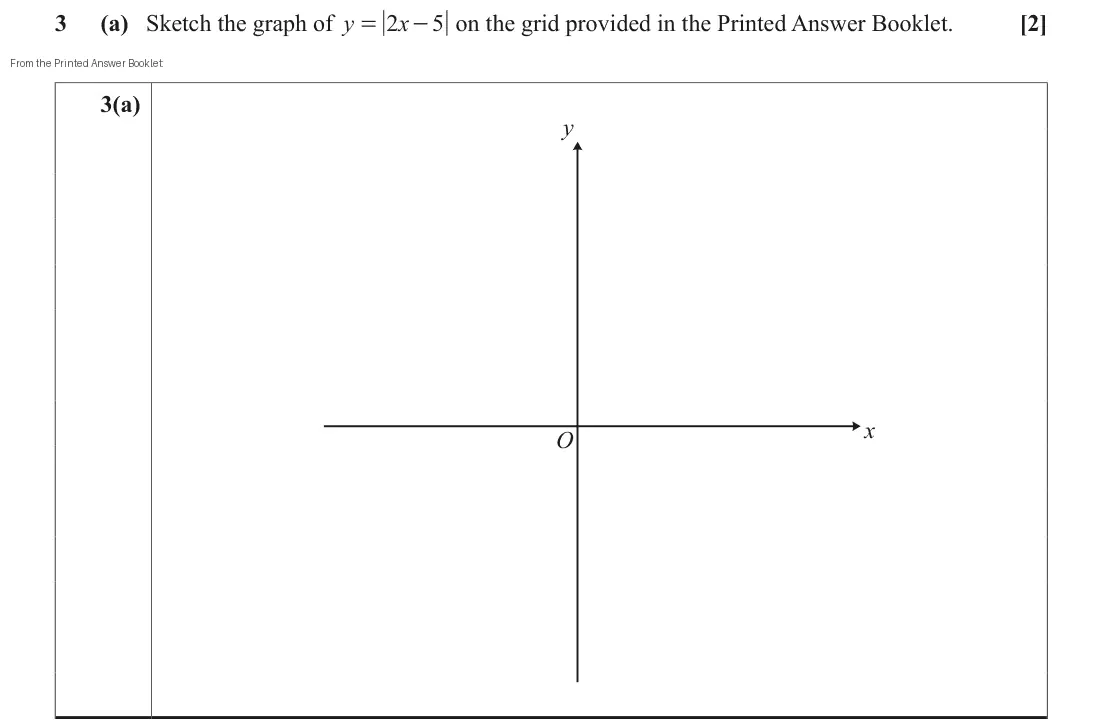
−1 < 2x − 5 < 1 so 2 < x < 3
errors with negative terms in inequalities
June 2025 · Paper 3 · Q3(c)3 marksMedium
Show the start of this question
Mark scheme for this part
Examiner's comment
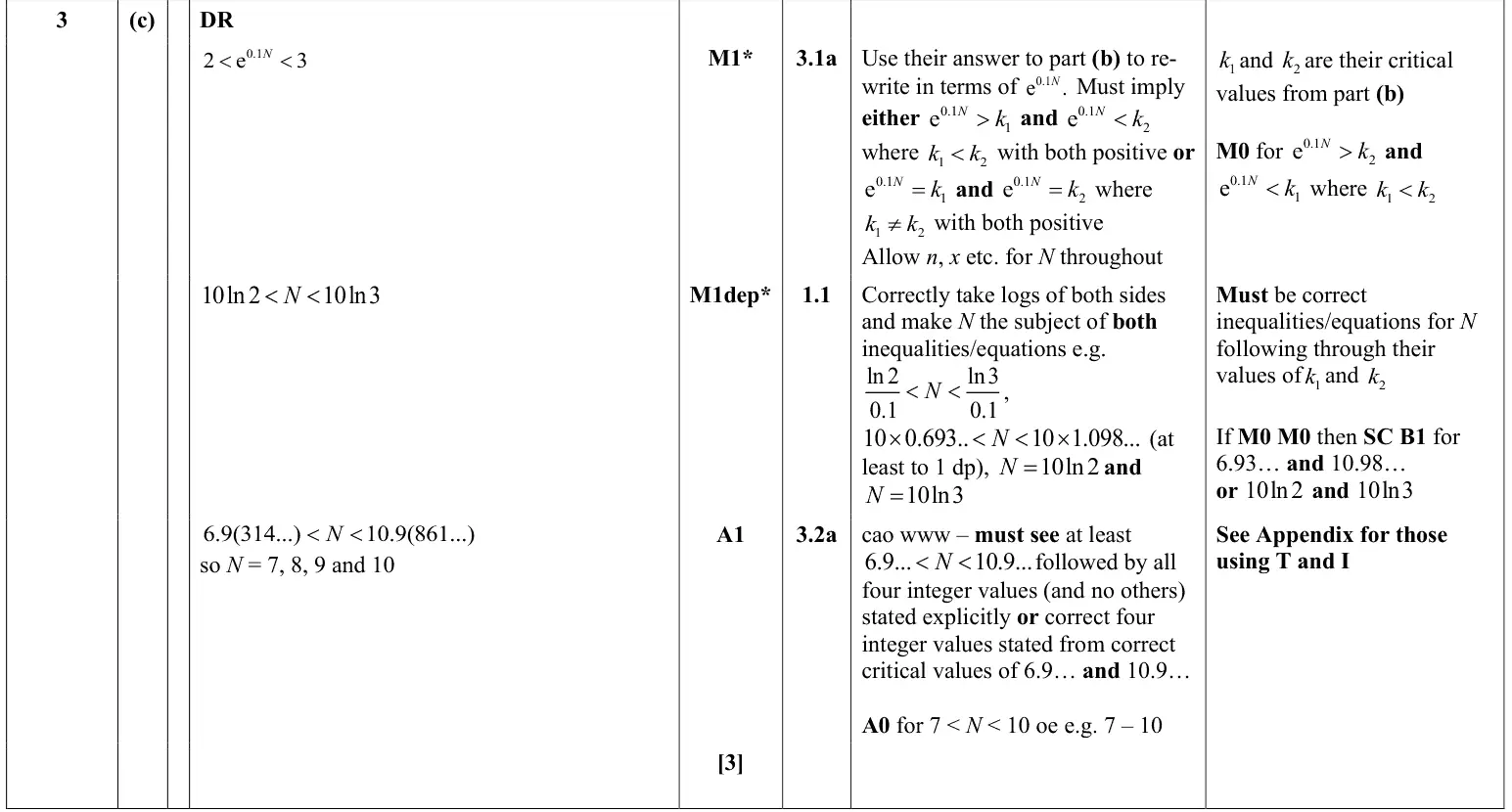
Although most candidates realised that importance of their answer to part (b) and started by stating that 2 < e01.𝑁< 3, many re-started in this part or did not see the significance of the previous part. While many candidates correctly stated that 10ln2 < 𝑁< 10ln3 many did not read the question carefully and either left this as their final answer or gave an answer in a form that did not make it explicitly clear what positive integers satisfied the given inequality (e.g. an answer of 7 ≤𝑁≤10 was far too common). Finally, as this question required detailed reasoning (DR) many went straight from 10ln2 < 𝑁< 10ln3 to N = 7, 8, 9 and 10 without first showing the critical values of 6.93… and 10.98….
Key points and common errors
replace x by e^(0.1N): 2 < e^(0.1N) < 3
10 ln 2 < N < 10 ln 3 i.e. 6.93 < N < 10.99
integers N = 7, 8, 9, 10
many stopped at the log inequality
June 2024 · Paper 1 · Q8(a)1 markEasy
Mark scheme for this part
Examiner's comment
This question was generally well answered.
Key points and common errors
x < 0 (not x ≤ 0)
interval notation (−∞, 0) allowed
June 2024 · Paper 1 · Q8(b)(i)1 markMedium
Mark scheme for this part
Examiner's comment
There were many different answers given to this question; 17 was the most frequently seen incorrect response.
Key points and common errors
n = −9 gives 19
17 a common wrong answer
June 2024 · Paper 1 · Q8(b)(ii)1 markMedium
Show the start of this question
Mark scheme for this part
Examiner's comment
Some candidates seemed to forget by this stage that only integer values for n were allowed, so used 0.5 to get an answer of 0. Values of –17 and –19 were also commonly seen.
Key points and common errors
n is an integer: n = 0 or 1 gives 1
0 from n = ½ is not allowed
June 2024 · Paper 1 · Q8(c)(i)3 marksEasy
Mark scheme for this part
Examiner's comment
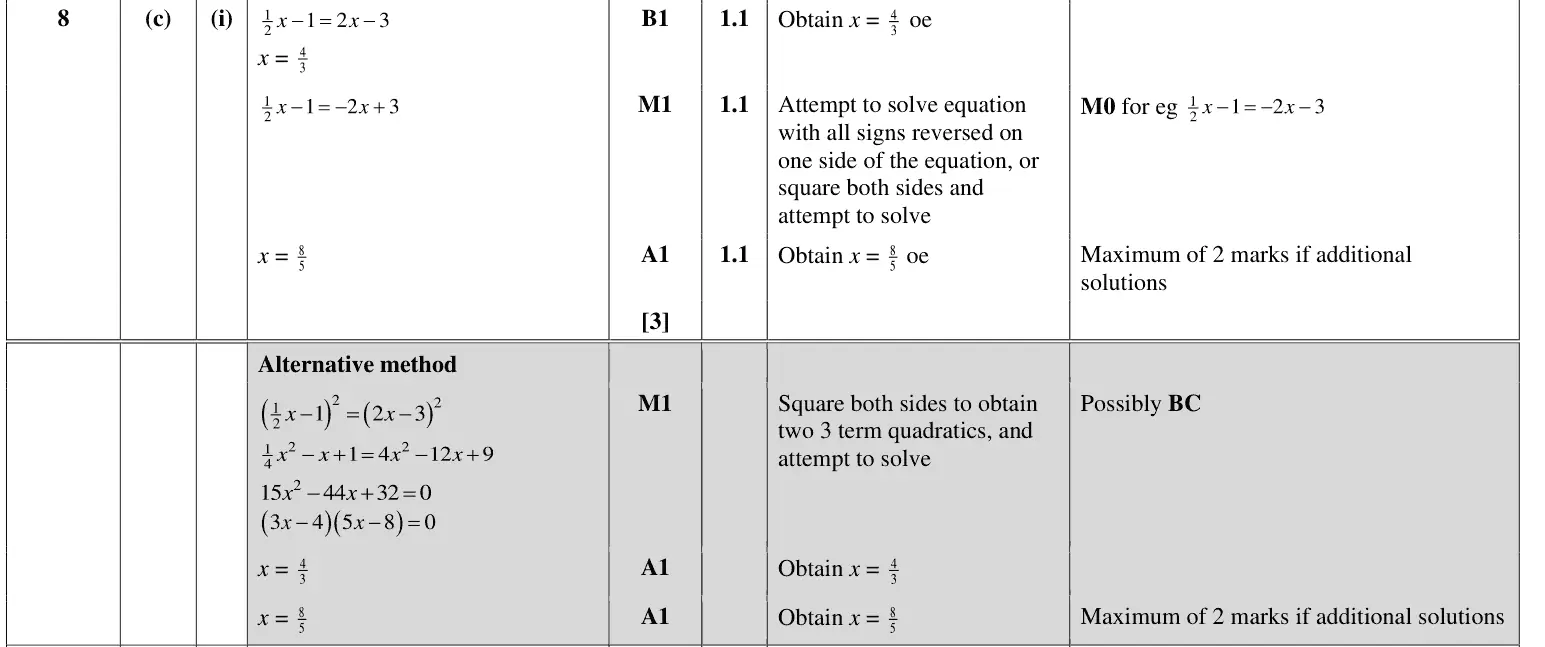
Candidates who squared both sides and solved the quadratic usually obtained full marks unless they had made a slip in their algebra. Those solving the two linear equations were also successful in general, although a minority got into difficulty changing the signs to find the second solution, with some changing one sign on each side and others changing all signs on both sides, rather than all signs on one side only.
Key points and common errors
½x − 1 = ±(2x − 3) or square both sides
x = 4/3, 8/5
reverse all signs on one side only
June 2024 · Paper 1 · Q8(c)(ii)1 markHard
Show the start of this question
Mark scheme for this part
Examiner's comment
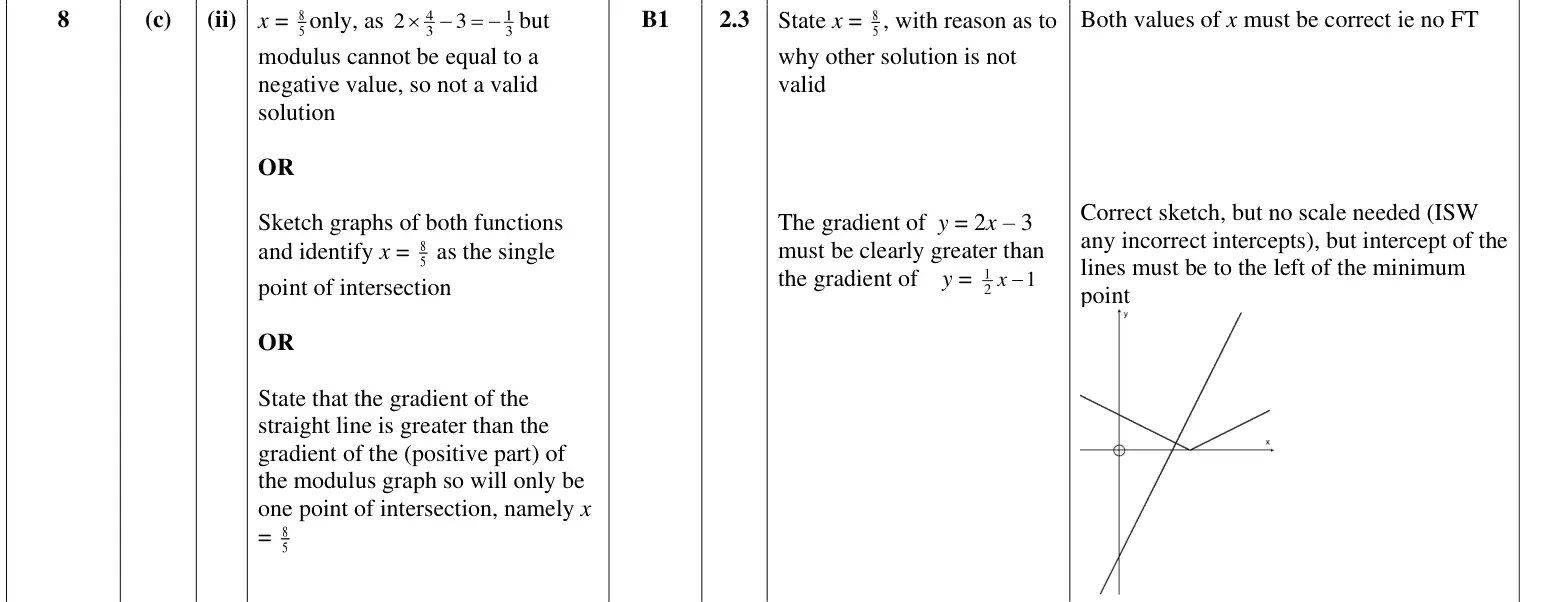
Few candidates successfully answered this question. Those who correctly identified x = 8/5 as the only valid solution were often not able to explain in enough detail why. A common response was to say that the graphs only intersect at one point, without going into detail to justify the statement. Some had sketched graphs in the previous part which would have completed their argument but did not think to use these here. Some referred to the modulus being positive but did not do the simple calculations to show why x = 4/3 did not work. Successful candidates often compared their solutions with the range of values for which y = 2x – 3 was positive.
Key points and common errors
x = 8/5 only: at x = 4/3, 2x − 3 = −⅓ but a modulus cannot be negative
or sketch/gradient argument
'the graphs meet once' without justification gains nothing
June 2023 · Paper 1 · Q5(a)(i)3 marksMedium
Mark scheme for this part
Examiner's comment
It was less usual for partial credit to be given in this question; solutions tended to be either fully correct or very limited progress was made. The most successful method was to use a sketch diagram and consider the vertical translation to obtain c = 1. The gradient and intercept of the straight line graph could then be considered to obtain values for a and b. In the less successful responses, candidates tended to try to employ routine methods such as substituting values and then squaring to deal with the modulus, rather than trying to develop a more flexible approach. This candidate has made effective use of a sketch graph, and has considered the graph of y = ax – b to find values for a and b.
Key points and common errors
sketch: vertical translation gives c = 1
vertex x = b/a = 3 and intercept give a = 2, b = 6
squaring both sides is unhelpful
June 2023 · Paper 1 · Q5(b)(i)3 marksMedium
Show the start of this question
Mark scheme for this part
Examiner's comment
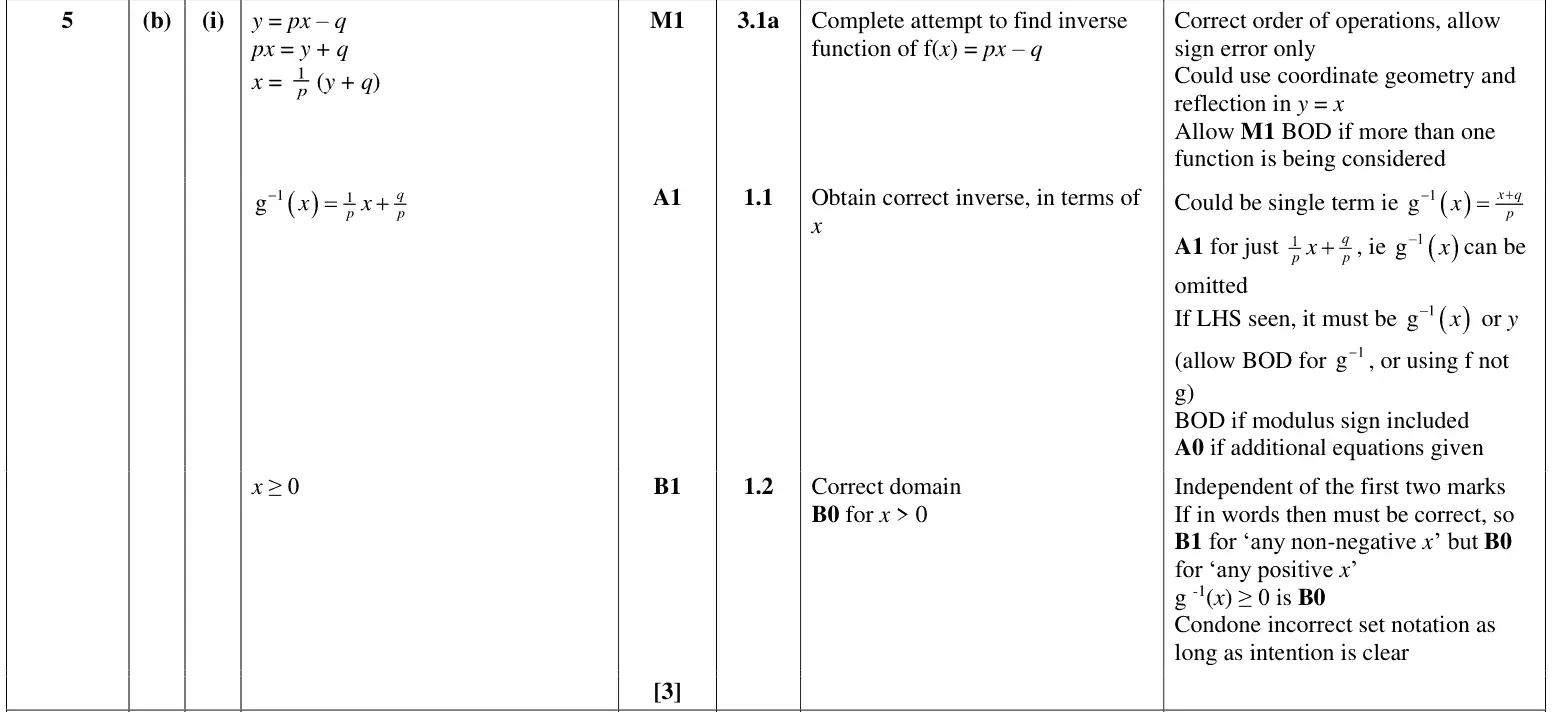
In the more successful responses, candidates identified that the relevant part of the graph was y = px – q, and it was then a routine process to find the inverse function that matched this. Some candidates ignored the domain and considered both parts of the given function, despite the previous part of the question having identified that the inverse of an entire modulus function would not be def ined. Once again some candidates went straight into attempting to square both sides, or even just one side, of the equation as this seemed to be their standard method when working with a modulus function. Candidates also found identifying the domain to be a challenge; most seemed familiar with the range of a function being the domain of the inverse function but were then unsure how to proceed. A few candidates did identify the condition of ≥ 0, but were unsure as to what, if anything, should go on the left hand side of the inequality.
Key points and common errors
for x ≥ q/p, g(x) = px − q
g⁻¹(x) = (x + q)/p with domain x ≥ 0
domain x > 0 is wrong
June 2022 · Paper 3 · Q13 marksEasy
Mark scheme for this part
Examiner's comment
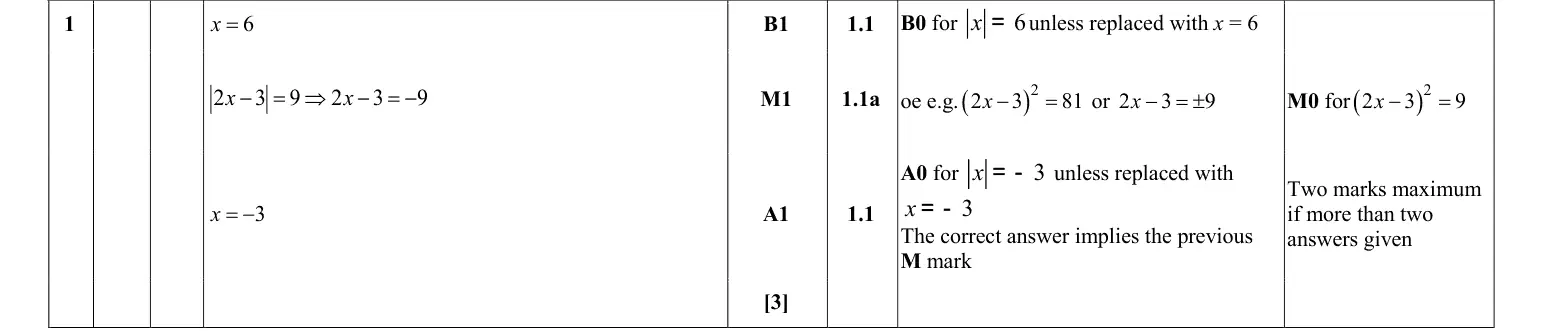
This question was answered extremely well with nearly all candidates correctly solving 2 x − 3 = ±9 , although some candidates only solved for one of these two possible cases. The two most common errors seen by examiners were those candidates who re-wrote the equation as either 2 x + 3 = 9 or ( ) 2 x − 3 = 9.
Key points and common errors
2x − 3 = ±9
x = 6 or x = −3
errors: squaring only one side, rewriting as 2x + 3 = 9
Autumn 2021 · Paper 3 · Q4(b)1 markMedium
Show the start of this question
Mark scheme for this part
Examiner's comment
k y x 1 For the one mark available here it was not sufficient to simply say that because and y x x x 1 k had only one point of intersection that therefore the equation had only one real root. Candidates had to make a link between the two graphs and the corresponding equation.
Key points and common errors
the graphs meet once and x·abs(x − 1) = k is equivalent to abs(x − 1) = k/x
must link the intersection to the equation, not just state one intersection
Autumn 2021 · Paper 3 · Q4(c)2 marksMedium
Show the start of this question
Mark scheme for this part
Key points and common errors
root is negative so x(1 − x) = −6
x² − x − 6 = 0
x = −2 only
Autumn 2020 · Paper 1 · Q9(a)2 marksMedium
Mark scheme for this part
Examiner's comment
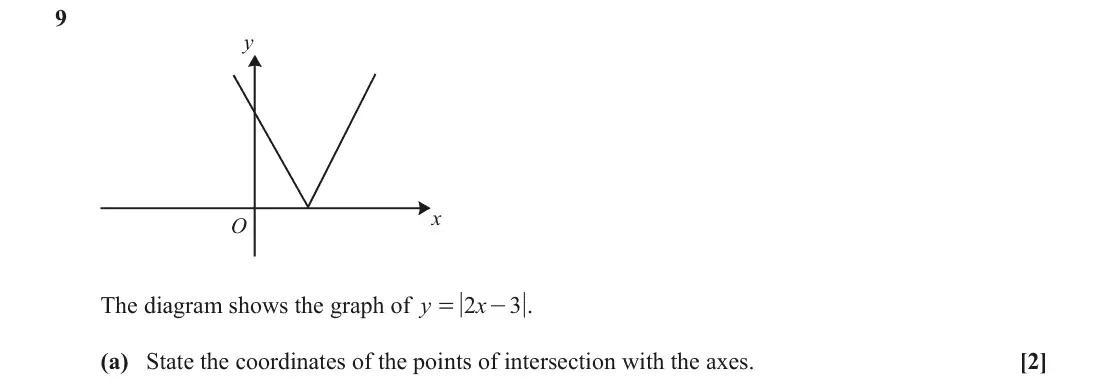
(Comment on Question 09 as a whole) The most successful candidates in Question 9(b)(i) were those who considered a graphical approach (which the diagram was included to help with) as opposed to those who embarked on the more standard techniques for a question involving moduli.
Key points and common errors
(1.5, 0) and (0, 3)
Autumn 2020 · Paper 1 · Q9(b)(ii)3 marksMedium
Show the start of this question
Mark scheme for this part
Examiner's comment
(Comment on Question 09 as a whole) The most successful candidates in Question 9(b)(i) were those who considered a graphical approach (which the diagram was included to help with) as opposed to those who embarked on the more standard techniques for a question involving moduli.
Key points and common errors
2x − 3 = ax + 2 gives x = 5/(2 − a)
3 − 2x = ax + 2 gives x = 1/(2 + a)
Autumn 2020 · Paper 2 · Q8(a)7 marksHard
Mark scheme for this part
Examiner's comment
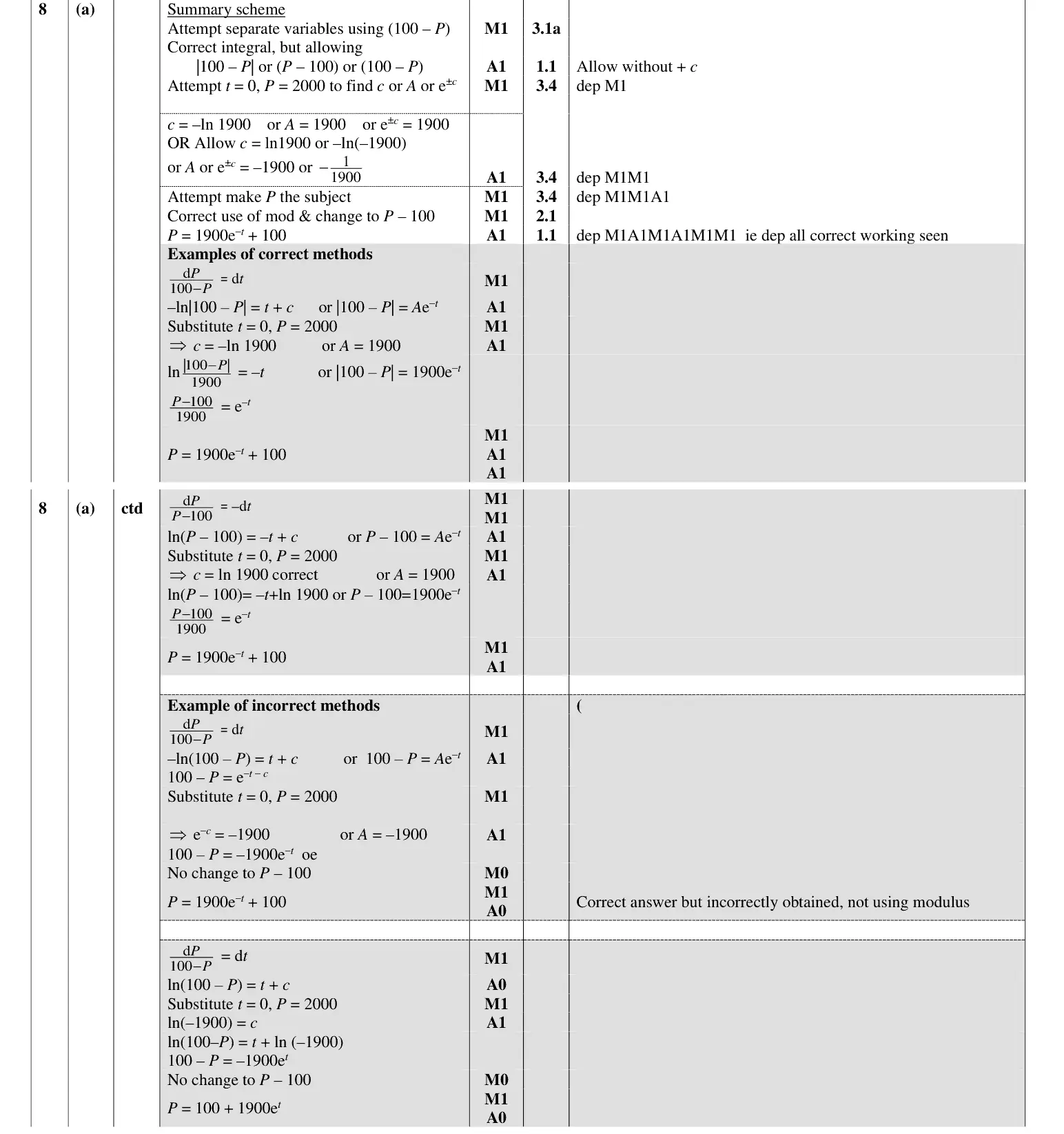
(Comment on Question 08 as a whole) This differential equation was difficult in that a correct solution depended on the correct use of the modulus sign when integrating . The majority of candidates either did not include the modulus sign or included it but then just ignored it. These candidates then obtained an impossible value for the ec = − constant of integration, such as ln ( 1900 ) or . Some noticed this and just dropped the c = − 1900 negative sign, while others ploughed on, seemly unaware of that this was a problem. Candidates who made errors such as these could, nevertheless, score 5 marks out of 7 if they made no other errors. A few candidates made no attempt to separate the variables and "integrated" to obtain equations such as . P = 100 t − Pt Section B: Statistics
Key points and common errors
separate variables: −ln(mod(100 − P)) = t + c
the modulus matters since P > 100: P = 1900e⁻ᵗ + 100
majority omitted or ignored the modulus giving impossible c = −ln 1900
June 2019 · Paper 3 · Q3(a)4 marksEasy
Mark scheme for this part
Examiner's comment
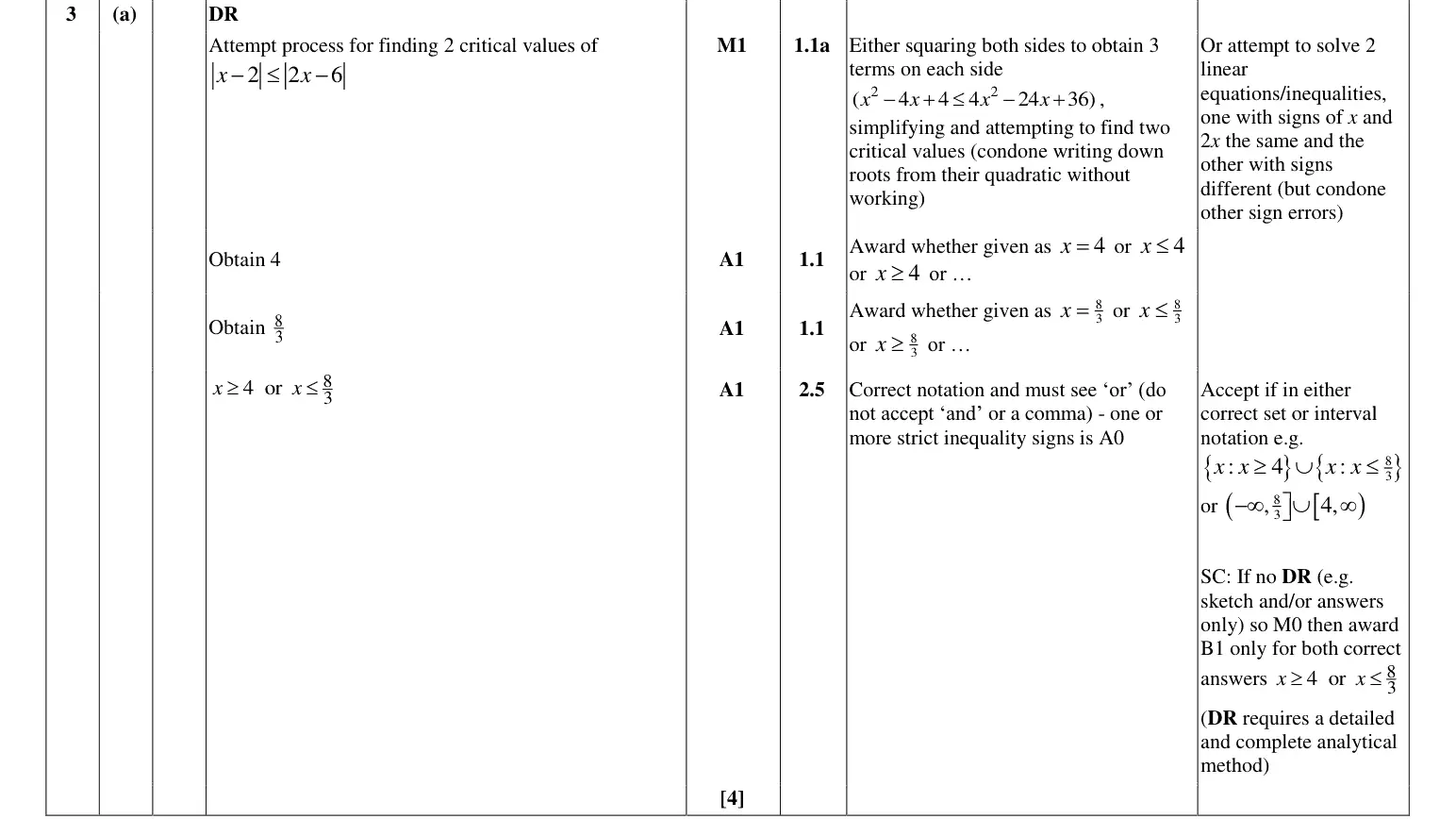
This question was answered extremely well with nearly all candidates correctly solving this inequality involving the modulus function. Of the two main methods for solving this type of inequality the first, which involved re-writing as ( ) ( ) x − 2 ≤ 2 x − 6 was far more successful than those candidates who decided to re-write as two linear equations/inequalities (one of which should have had signs of x and 2x the same and the other with signs different) as many made sign errors even though most started from the correct two equations/inequalities. Although most candidates obtain the correct two critical values, and so therefore obtained the first three values, the only answers accepted by examiners for consistency were: x ≥ 4 or x ≤ { } { } x : x ≥ 4 ∪ x : x ≤ ( [ ) −∞ , ∪ 4 , ∞
Key points and common errors
square both sides: critical values 8/3 and 4
x ≤ 8/3 or x ≥ 4 with 'or', not 'and'
sign errors with the two linear cases
June 2018 · Paper 3 · Q23 marksEasy
Mark scheme for this part
Examiner's comment
This question was answered extremely well with nearly all candidates correctly solving this equation involving the modulus function. Of the two main methods for solving this type of equation the first, which involved re-writing as ( ) ( ) 2 x − 1 = x + 3 was far more successful than those candidates who decided to re-write as two linear equation as many made sign errors even though most started from the correct two equations ( ) ( ) 2 x − 1 = ± x + 3 .
Key points and common errors
square both sides: 3x² − 10x − 8 = 0 so x = 4 or −2/3
squaring is more reliable than two linear equations (2x − 1) = ±(x + 3)
Find an A-level maths tutor
Stuck on this? Book a trial session with an A-level maths tutor.