Examiner's comment
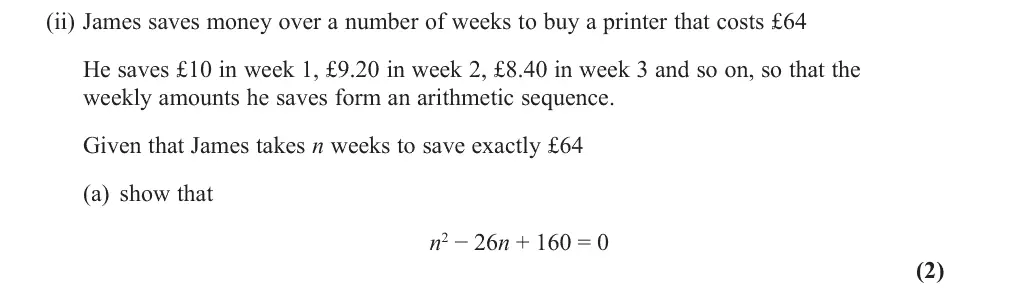
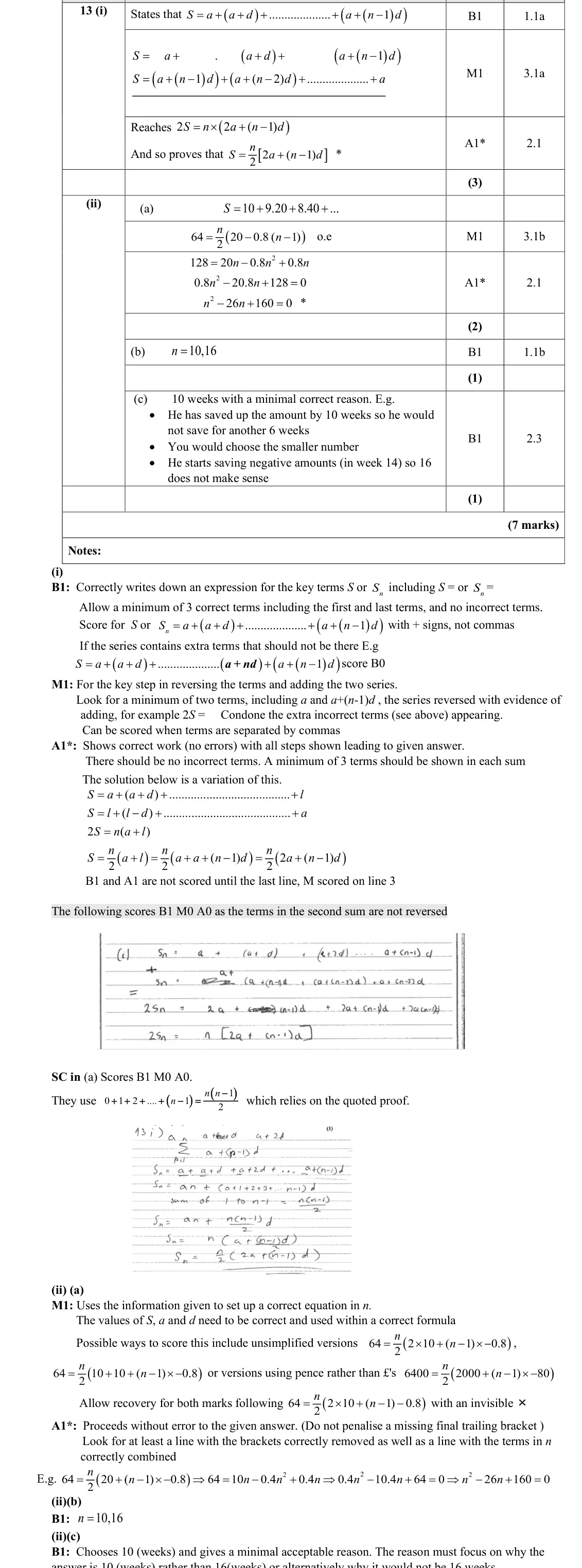
This question on arithmetic sequences and series proved to be very discriminating. The proof of the sum of an arithmetic sequence is standard, but was not answered well by many candidates. Most candidates however were able to then made progress with the rest of the question, having been given the required formula. Good candidates often did well in this question however, with 17% of the cohort achieving full marks. In part(i) those who had learned the standard proof for the sum of the first n terms of an arithmetic series often gained full marks. It was however, unusual to see a well set out, fully correct proof. Candidates often failed to write a correct expression for Sn at the start of their proof, or sometimes having an incorrect first or last term or extra terms (most often a+nd) within their sum. Other errors included not displaying a sufficient number of terms, not writing S= or Sn =, and using commas instead of + sign between the terms. In part(ii) most realised that they could make headway even if they hadn’t attempted part (i). In (ii) (a) many of the candidates used a=20, d = -0.8 and Sn = 64 in the sum formula to score the M mark. Poor notation such as (n-1)-0.8 was frequently seen, but candidates usually recovered from this. Following a correct equation most were able to proceed correctly to the given quadratic for the accuracy mark. A common error was where candidates used +0.8 as the common difference rather than -0.8 Part (ii) (b) was generally answered without issues. Almost all candidates managed to get B1 for getting the two values of n, either by factorising or by using a calculator. Part (ii)(c) was not answered very well with most candidates identifying 10 as the valid solution but not adequately justifying this choice. The reasons provided were often too vague or not related to why 10 was better than 16. More tended to score the mark by explaining that at 16 weeks he would be saving a negative amount rather than using the fact that 10 was the smaller number or that he would have had enough by 10 weeks so would not continue saving until 16 weeks.