Examiner's comment
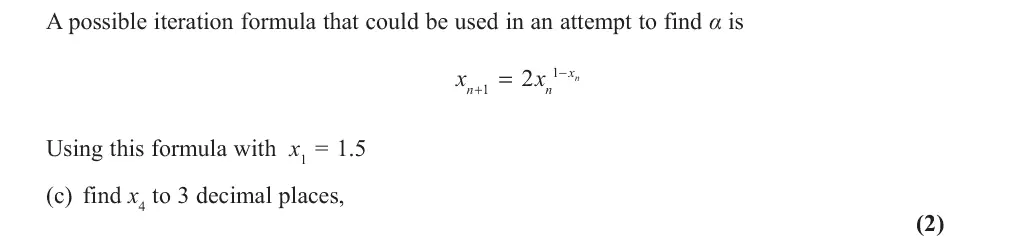
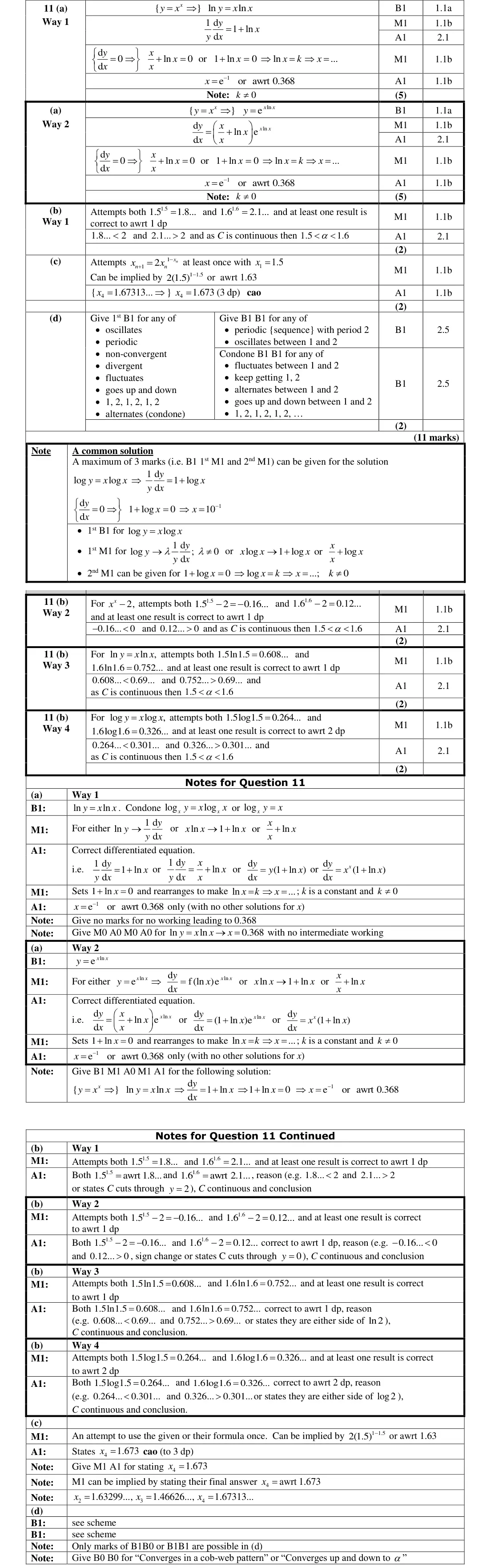
In general, Q11 discriminated well between candidates of all abilities. Q11(a) was demanding with most candidates scoring no more than one mark. Q11(b), Q11(c) and Q11(d) proved accessible to candidates of all abilities. In Q11(a), most candidates took logs, as advised by the question, and many obtained either ln ln y x x or log log . y x x At this point a significant number of candidates made no further creditable progress. Some candidates used a complete method of applying the product rule on x and implicit differentiation to obtain a correct ln x Most of these candidates then applied d y 1 d y x 1 y x e . x 0 to obtain Some 1 ln . x d d x log ’ method to obtain candidates, who received partial credit, used a ‘ after 0.1, 10 1 d y x finding A few candidates used logarithms without reference to a 1 log . x 10 d y x base. Those who proceeded to obtain received partial credit and those who 0.1 1 e x obtained were allowed full marks. There were some alternative methods employed by a few candidates in Q11(a). A few d y y x ln e x x x ln x x y x candidates rewrote as and applied to give a (1 ln )e 0 x d 1 e . x Others differentiated both sides of the equation ln ln y x x correct with 1 e . x respect to y and usually proceeded to find A very few candidates applied the ln y , x quotient rule to the equation but were rarely successful with this method. ln x xx x x xx or 2 1.6. In Q11(b), most candidates evaluated either at both and 1.5 Many candidates compared their values with either 2 or 0 (depending on whether they xx xx or 2 ). Although many of these concluded that 1.5 1.6, evaluated only a few made any reference to the curve being continuous in this interval. A few candidates, x who made no creditable progress, used values of x outside the given range, e.g. 1.4 x x 1.6. and Very few candidates used values within the range e.g. and 1.51 x 1.59, which meant that they were able to earn both marks. x 1.673, 4x In Q11(c), most candidates found a correct although a few did not state 4 , x x and 3x as part of their correct to 3 decimal places. Some wrote down the iterates 1 2 4x with no intermediate work. solution, while others stated In Q11(d), some candidates gave correct descriptions such as ‘sequence oscillates between 1 and 2’ or ‘the sequence is periodic with period 2’. Other descriptions such as ‘alternates between 1 and 2’, ‘keep getting 1 and 2’ or ‘fluctuates between 1 and 2’ were condoned. Some credit was given for partial explanations such as ‘sequence is non-convergent’, ‘sequence oscillates’ or ‘sequence is divergent’.