Use vectors in two dimensions and in three dimensions
Guidance
Students should be familiar with column vectors and with the use of i and j unit vectors in two dimensions and i, j and k unit vectors in three dimensions.
Mark scheme (whole question; this part is marked with the orange bar)
Examiner's comment
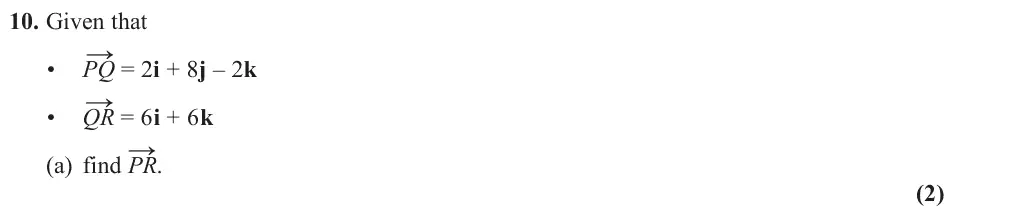
This question tested learners’ knowledge of vectors and proof of the properties of a triangle. In part (a), many gained both marks by successfully adding the vectors, correctly identifying and combining the i, j, and k components. Common errors included misreading the vector QR as 6 6 + i j, or subtracting the two given vectors. It should be noted that subtracting vectors was seen in a significant minority of responses. This was likely due to confusion arising from a misinterpretation of the vectors as position vectors, where PR OR OP = - . Learners should be encouraged to sketch a diagram as a guide.
Common mistakes
PR = PQ + QR = 8i + 8j + 4k (add, do not subtract: they are not position vectors)
misreading QR as 6i + 6j
June 2025 · Paper 1 · Q10(b)4 marks
Mark scheme (whole question; this part is marked with the orange bar)
Examiner's comment
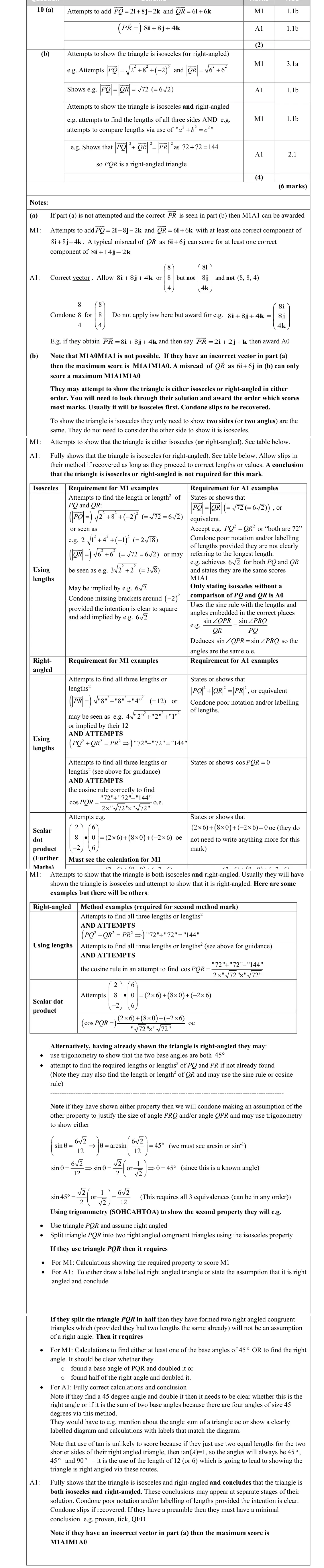
This question tested learners’ knowledge of vectors and proof of the properties of a triangle. It should be noted that in part (b) that, despite it being possible to gain full credit by finding the length of vectors and Pythagoras’ Theorem in a few lines, many learners chose to use more involved methods. This often led to them not gaining full marks due to errors in their working. Part (b) was well answered by most learners. Many responses lacked clarity when attempting to prove that the triangle was both isosceles and right-angled. In demonstrating that the triangle is isosceles, some calculated the magnitudes of the sides correctly but did not gain the accuracy mark as they just stated it was isosceles without reference two sides being equal. It seemed that learners found it harder to prove the triangle was right-angled. Most successful responses used Pythagoras’ Theorem to show that the triangle was right-angled and most of these responses gained full marks. When learners used the scalar dot product method, many of them did not show the calculation and therefore did not gain credit, whilst others were not very successful in showing the triangle was right-angled, with some learners incorrectly using it to show a perpendicular gradient of 1 - instead of 0. The least successful responses tended to involve SOHCAHTOA, mainly because this approach was more involved and thus required a fuller explanation, which was not always in evidence. As this was a ‘show’ question, a conclusion (either overall or separate for each property) and an assumption that the triangle was-right angled was required to score full marks. There were lots of incorrect attempts at the cosine rule, which learners either could not remember correctly, or did not rearrange correctly. A significant minority of responses attempted to show the right-angled property by splitting the triangle in half to create two right angled triangles and then used trigonometry. 15
Common mistakes
magnitudes PQ = QR = √72 = 6√2 (state that two sides are equal) and PR = 12 with 72 + 72 = 144 (Pythagoras) or scalar product = 0 shown
conclusion for both properties needed
longer cosine-rule or trigonometry methods led to errors
June 2024 · Paper 2 · Q7(a)1 mark
Mark scheme (whole question; this part is marked with the orange bar)
Examiner's comment
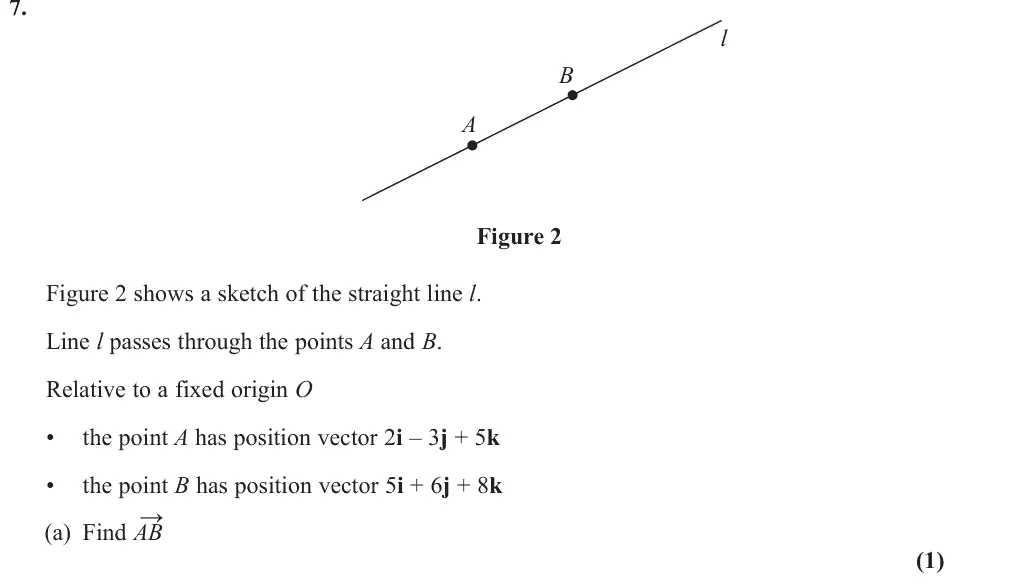
This question proved to be a differentiator between candidates. Some were unable to make any meaningful progress while others demonstrated a very intuitive grasp of the topic and were able to produce answers with very little working. Most candidates were successful in part (a) although there were a small number of incorrect responses which had arithmetic errors, used addition of vectors rather than subtraction or had poor notation.
Common mistakes
AB = b − a = 3i + 9j + 3k (subtract, not add)
a vector, not coordinates (3, 9, 3)
June 2024 · Paper 2 · Q7(b)4 marks
Mark scheme (whole question; this part is marked with the orange bar)
Examiner's comment
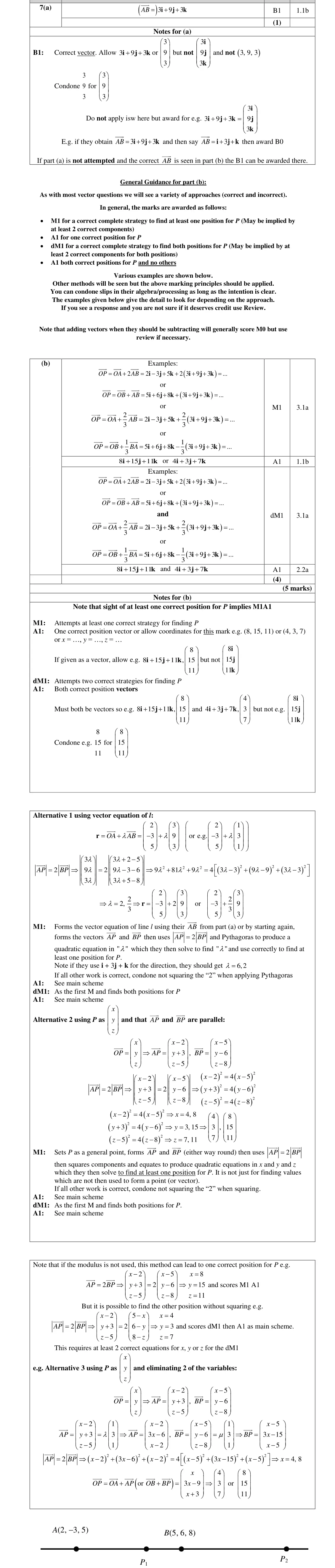
This question proved to be a differentiator between candidates. Some were unable to make any meaningful progress while others demonstrated a very intuitive grasp of the topic and were able to produce answers with very little working. In part (b), many candidates did not appreciate the scaffolding in the question and did not use their answer to part (a) to help them with a strategy for part (b). Relatively few candidates used the most straightforward method to find both two possible positions of P, e.g., 2 OP OA AB = + and 2 3 OP OA AB = + . Some candidates were able to find one of the positions (usually 8i+15j+11k) but not the other, with a common misconception being that the second point was on the opposite side of A, attempting 2 OP OA AB = - . There was also some confusion with the ratio with some candidates using 1 3 OP OA AB = + . Many candidates failed to appreciate that there were two points satisfying 2 AP BP = . Relatively few candidates drew a diagram or used the given diagram on the question paper to give them some idea of where P could be. It was much more common for candidates to take an unnecessarily complicated algebraic approach. Many responses calculated |𝐴𝐵⃗⃗⃗⃗⃗ |(= 3 sqrt 11) and progressed no further. Many responses attempted to express 2 AP BP = in terms of variables representing components of an unknown vector, showing a good understanding of how to calculate the magnitude, but struggled to formulate suitable equations. Some candidates used a fully correct method of considering the point P as the general point on the line OP OA AB = + and then setting up the equation 2 AP BP = . These candidates tended to arrive at two final answers for P, having found two log( ) log( ) log( ) ab a b = values for λ, but many had made processing errors and could only gain the method marks as a result. Other candidates set up a general point P in the form xi + yj + zk, then used 2 AP BP = , extracted and solved ( ) ( ) 2 2 2 4 5 , x x - = - ( ) ( ) 2 2 3 4 6 y y + = - and ( ) ( ) 2 2 5 4 8 z z - = - to generate 3 pairs of possible values for the x, y and z components. These candidates then tended to struggle to determine the possible positions of P from their 6 values. Vector notation was very variable with a wide variety of non-standard notations being encountered. It would be helpful for candidates to bear in mind that a four-mark question should not involve pages of work and that there are more efficient strategies. Whatever method was adopted, work was sometimes difficult to follow as there was little explanation and unclear notation used. In part (b), because of the volume of work they were producing, candidates often needed more space to complete their solution. Candidates are strongly advised that if they run out of space, they should use supplementary paper rather than complete their answer within the space of another question.
Common mistakes
two positions: OA + 2AB = 8i + 15j + 11k and OA + (2/3)AB = 4i + 3j + 7k
the second point is between A and B, not OA − 2AB
a diagram helps
finding the modulus of AB (3√11) alone gets nowhere
long algebraic methods error-prone
June 2024 · Paper 3 (Mechanics) · Q4(a)3 marks
Mark scheme (whole question; this part is marked with the orange bar)
Examiner's comment
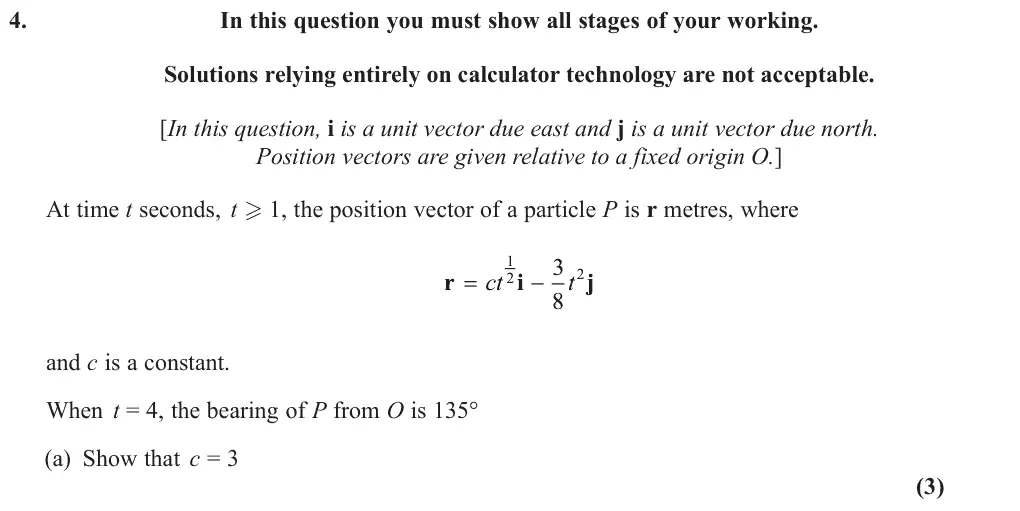
(a) This part of the question was worth three marks and required candidates to produce a rigorous proof to show that c = 3, either by using trigonometry or an isosceles triangle or both. It seemed that many candidates were telling themselves that the answer was obvious but were uncertain as to how to go about justifying the fact. Most candidates struggled to produce a rigorous proof, instead just stating, without justification, that for a bearing of 135o, the distance travelled in the x-direction would have the same magnitude as the distance travelled in the negative y-direction or equivalent. They were able to score two of the three marks available if they then went on the show that c = 3. Those candidates who drew a diagram and labelled it with all the information from the question were generally more successful in scoring all three marks than those who either did not draw a diagram or whose diagram did not include some of the information given. Some - 6 = o tan135 candidates correctly used or the equivalent, without a diagram. Common 2c errors included not being able to correctly sketch a bearing of 135o, or omissions of angles or sides in the diagram. The negative sign caused issues in several instances and was sometimes glossed over. There was also some poor algebra. A few candidates incorrectly wrote 2c + 6 = 0 to obtain c = 3.
Common mistakes
at t = 4, r = 2ci − 6j
bearing 135° means a 45° angle below east so 2c = 6, justified by tan 45° or an isosceles right-angled triangle on a correct diagram
stating equal components without justification loses a mark
2c + 6 = 0 is wrong
June 2023 · Paper 1 · Q3(a)1 mark
Mark scheme (whole question; this part is marked with the orange bar)
Examiner's comment
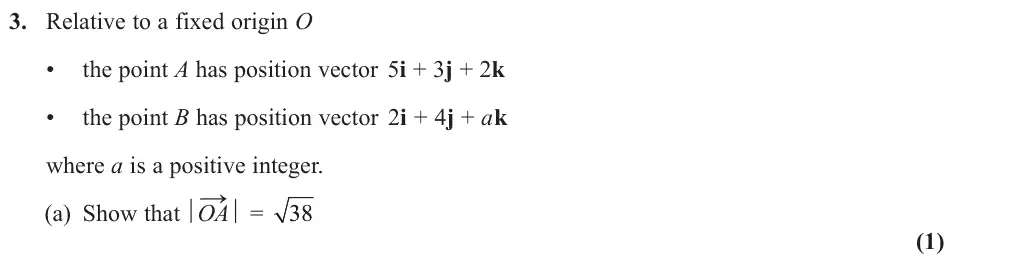
This was another short question on two-dimensional vectors with many candidates able to score 2 out of the 3 marks. Part (a) was generally answered accurately by all candidates. Sometimes the mark was lost because the candidate omitted the square root and wrote 25 9 4 OA = + + . Sometimes the notation was not made clear or i, j and k appeared.
Common mistakes
must show how 38 is formed from the three components
June 2023 · Paper 1 · Q3(b)2 marks
Mark scheme (whole question; this part is marked with the orange bar)
Examiner's comment
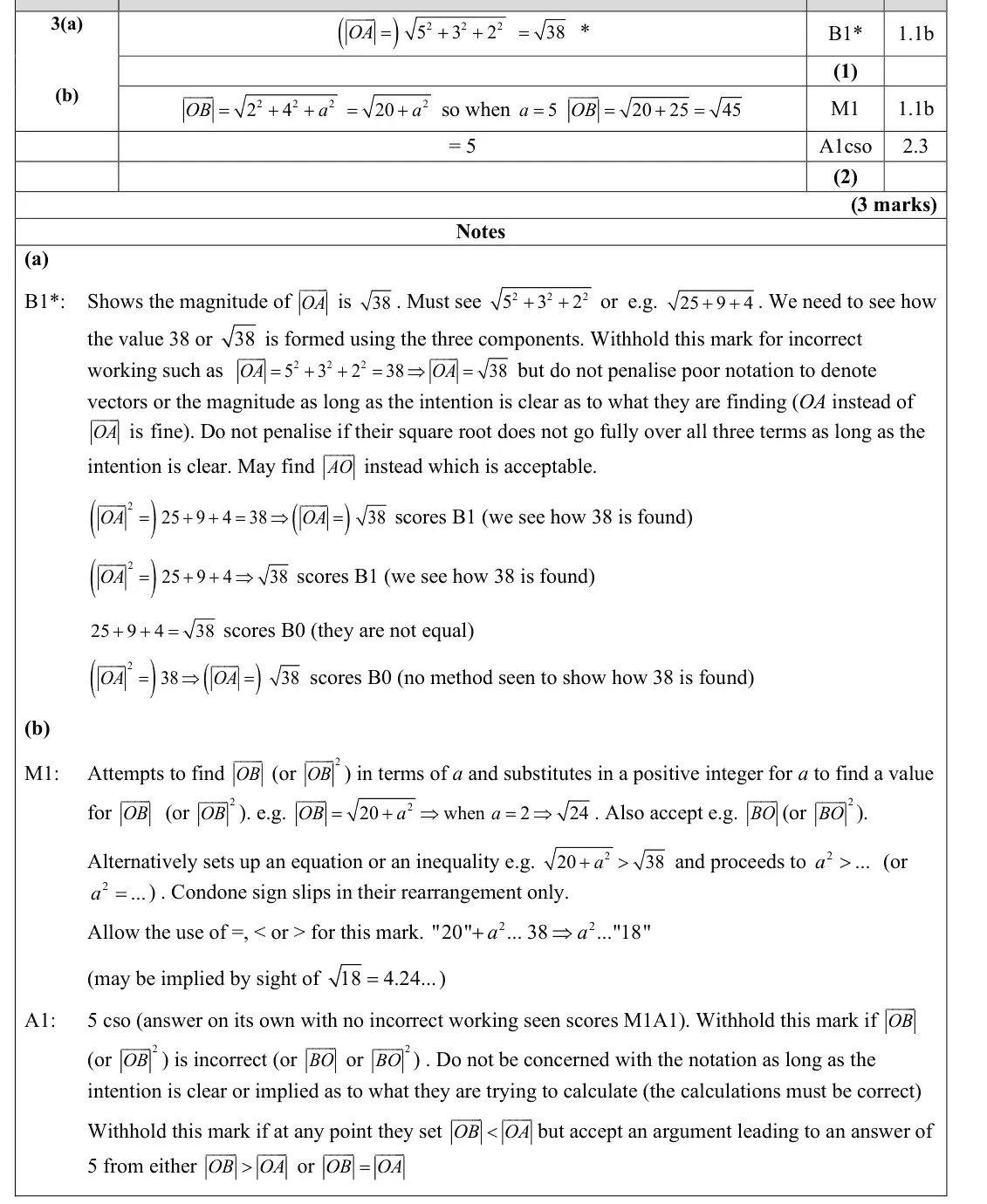
This was another short question on two-dimensional vectors with many candidates able to score 2 out of the 3 marks. In part (b), the most common approach was to proceed to 2 18 a or 2 18 a = , and the majority of candidates were able to achieve this. However, a significant number of candidates did not conclude that 5 a = , with some claiming that e.g. 18 is an integer or missing the requirement that “a” had to be an integer. Some other incorrect answers included 19 a = following 18 a and the answer 5 a was not condoned, which lots the final mark for a number of candidates. A common processing error was the simplification of 2 20 a + to 20 a + . Very few candidates used the substitution method and some of those did not reach any conclusion in the end.
Common mistakes
a must be a positive integer: a² > 18 gives a = 5, not a ≥ 5 or √19
√(20 + a²) wrongly split into √20 + a
June 2022 · Paper 1 · Q9(a)2 marksHard
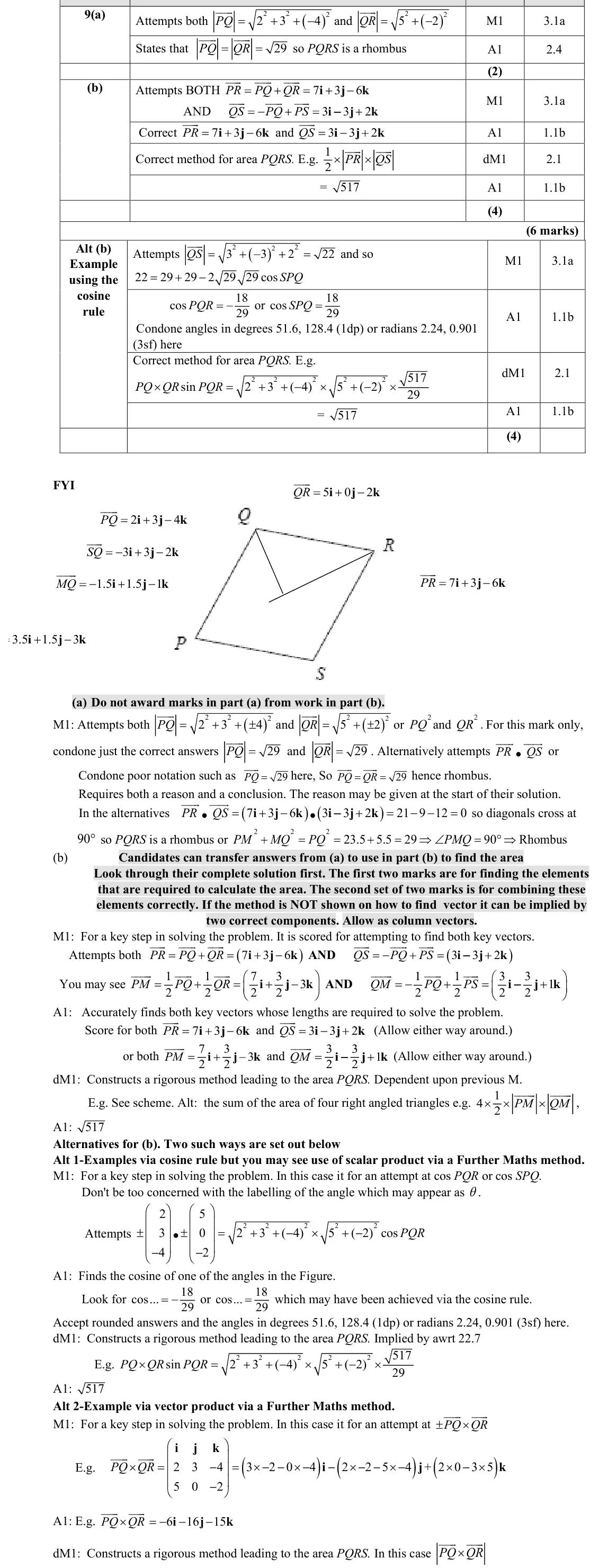
Mark scheme (whole question; this part is marked with the orange bar)
Examiner's comment
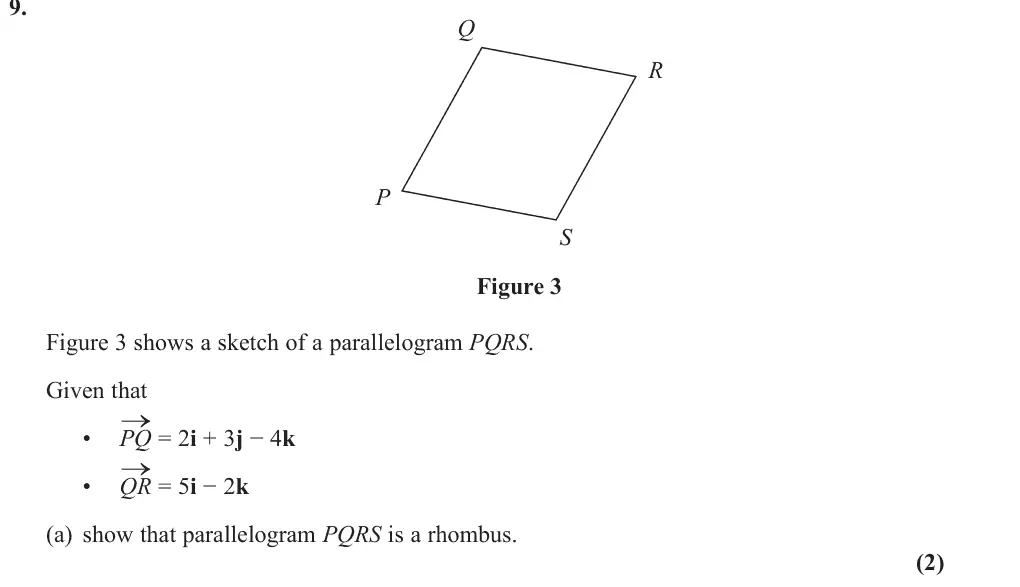
This vector question was set within the context of a rhombus. Surprisingly, many candidates were unable to use (or remember) the basic geometric of a rhombus and over 30% did not manage to make any progress. Part (a) required candidates to show that parallelogram PQRS was a rhombus. Although the requirement to 'show' is becoming more familiar to candidates, a significant number in this case didn't recognise the level of detail expected. So a lack of conclusion, or stating the sides were of length Ö29 without evidence of calculation, led to loss of credit. It was also necessary to conclude that the sides were equal, and not simply find the lengths and leave it to the reader to decide.
Common mistakes
modulus of PQ = modulus of QR = √29 with calculations shown and conclusion "so rhombus"
adjacent sides equal
June 2022 · Paper 1 · Q9(b)4 marksHard
Mark scheme (whole question; this part is marked with the orange bar)
Examiner's comment
This vector question was set within the context of a rhombus. Surprisingly, many candidates were unable to use (or remember) the basic geometric of a rhombus and over 30% did not manage to make any progress. A vast array of approaches were in evidence in part (b) to find the area of the rhombus. The easiest and most direct approach was to find 1 2 PR QS x . A more common method used involved finding the length of one diagonal, followed by the cosine rule to find an internal angle and then use of the formula 'ab sin C '. Unfortunately most attempts using this method only scored 3 marks as it was usual for answers to be given as 22.7 rather than the one required, Ö517. Other methods seen involved use of Heron’s formula, the “shoelace” determinant method, scalar product and vector product….. with many successfully used. Students who added a “narrative” – so explaining what they attempted to do – were in a better position to gain credit if they suffered a processing error early in their solution. This has to be considered good practice. The most common incorrect solution, seen many times over was in stating area = 29 29 29 PQ PS x = x =
the cosine-rule/½ab sin C route often gave 22.7 not √517
over 30% made no progress
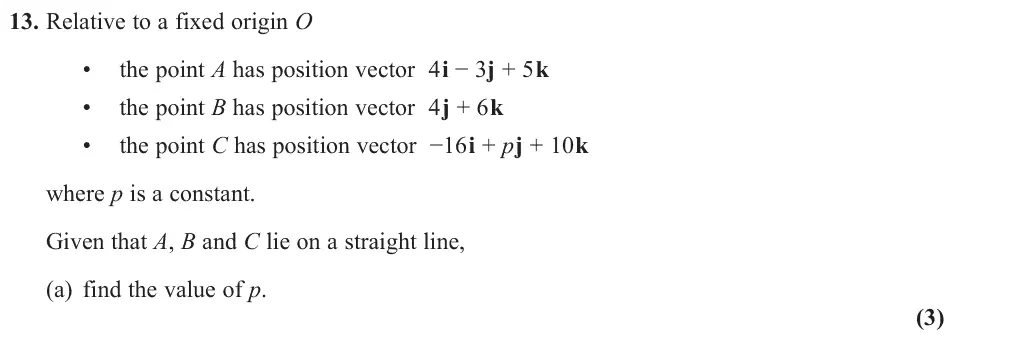
June 2022 · Paper 2 · Q13(a)3 marks
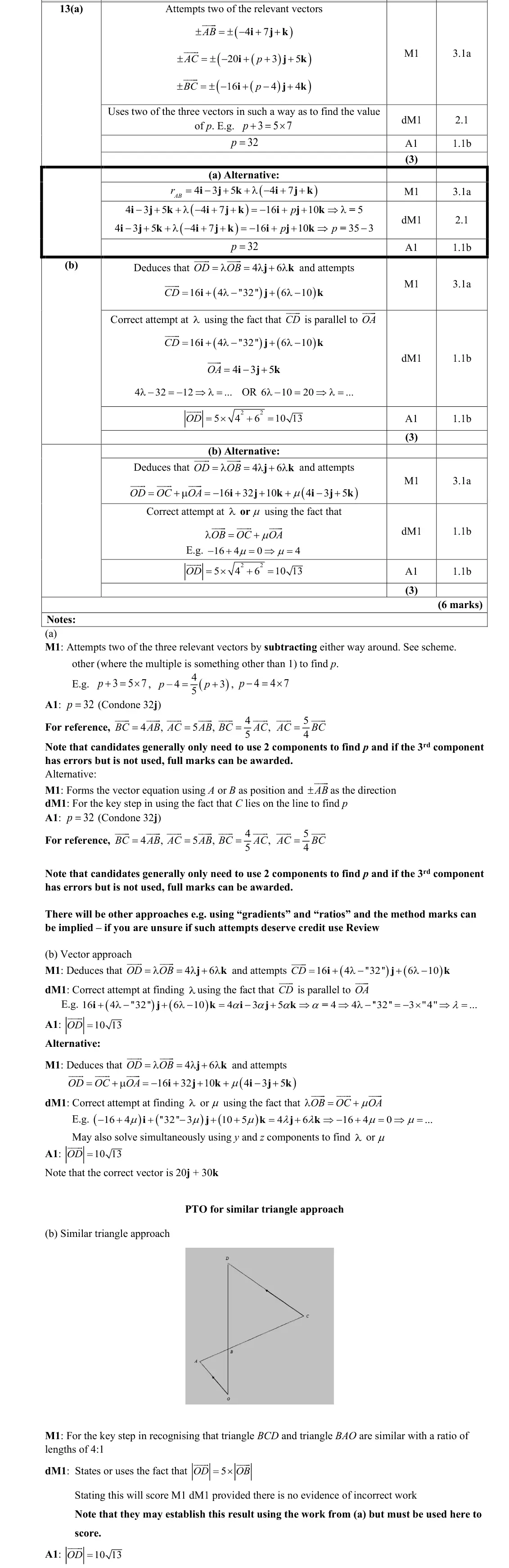
Mark scheme (whole question; this part is marked with the orange bar)
Examiner's comment
This question was a good differentiator, with the majority of candidates gaining some credit, but only the strongest achieving full marks. Overall, candidates often demonstrated good reasoning skills and were rewarded with good marks on this question but a significant number of candidates struggled with this topic. Throughout, methods of solution were many and varied, and often involved non vector approaches that were sometimes difficult to follow. In part (a) candidates using a vector method often attempted to subtract the given position vectors to form at least two of the vectors ±𝐴𝐴𝐴𝐴 ሬሬሬሬሬ⃗, ±𝐴𝐴𝐴𝐴 ሬሬሬሬሬ⃗ or ± 𝐵𝐵𝐵𝐵 ሬሬሬሬሬ⃗ although errors in their components were common. Candidates unfortunately often misread 𝑂𝑂𝑂𝑂 ሬሬሬሬሬ⃗ as ൭ 4 0 6 ൱ or ൭ 4 6 0 ൱. This was as far as many candidates reached, but some were able to successfully complete this approach by establishing 𝐵𝐵𝐵𝐵 ሬሬሬሬሬ⃗= 4𝐴𝐴𝐴𝐴 ሬሬሬሬሬ⃗, 𝐴𝐴𝐴𝐴 ሬሬሬሬሬ⃗= 5𝐴𝐴𝐴𝐴 ሬሬሬሬሬ⃗ or 5𝐵𝐵𝐶𝐶 ሬሬሬሬሬሬሬሬ⃗= 4𝐴𝐴𝐴𝐴 ሬሬሬሬሬ⃗ and reached p = 32. Some candidates incorrectly used methods like 𝐴𝐴𝐴𝐴 ሬሬሬሬሬ⃗= 𝐴𝐴𝐴𝐴 ሬሬሬሬሬ⃗ or assumed that the original position vectors were parallel. Candidates attempting to work out the magnitudes of vectors usually gained no marks. Others who made progress with vector methods, established the vector equation of the straight line through A, B and C and used this to find p. Candidates often used non vector methods as well. A common approach was to ignore one component and compare ‘gradients’ using the other two e.g. 4-(-3) 0-4 = 𝑝𝑝-4 -16-0 . This was judged to be an acceptable approach, although errors with the substitution of values were common. Some even established an ‘equation’ such as 𝑦𝑦= - 7 4 𝑥𝑥+ 4 and then substituted in 𝑥𝑥= -16 to find p, which, again, was acceptable, but it was a shame that so many candidates resorted to such methods and seemed to lack confidence in their ability to construct a solution using vectors. In some cases where the first method mark was awarded, candidates went on to an incorrect equation such as 𝑝𝑝= 4 x 7 and were much less likely to be awarded the second method mark, as it was often unclear which vector they were working with for this step. Many fully correct answers for (a) were seen, sometimes with minimal working. It should be noted here that candidates should try to make their intention clear, as there were many occasions where examiners struggled to follow the structure of candidates’ work and were unable to award marks as a result.
Common mistakes
form two of AB, AC, BC by subtraction (OB = 4j + 6k, no i component)
parallel vectors are multiples: AC = 5AB gives p + 3 = 35, p = 32
magnitudes are no help
June 2022 · Paper 2 · Q13(b)3 marks
Mark scheme (whole question; this part is marked with the orange bar)
Examiner's comment
This question was a good differentiator, with the majority of candidates gaining some credit, but only the strongest achieving full marks. Overall, candidates often demonstrated good reasoning skills and were rewarded with good marks on this question but a significant number of candidates struggled with this topic. Throughout, methods of solution were many and varied, and often involved non vector approaches that were sometimes difficult to follow. Part (b) was found to be challenging by most candidates, with few gaining any marks and with many not attempting it. Many candidates again worked with magnitudes of vectors and made no progress. Those candidates who did gain credit usually used the fact that 𝑘𝑘𝑂𝑂𝑂𝑂 ሬሬሬሬሬ⃗-𝑂𝑂𝑂𝑂 ሬሬሬሬሬ⃗= ൭ 16 4𝑘𝑘-𝑝𝑝 6𝑘𝑘-10 ൱ was parallel to 𝑂𝑂𝑂𝑂 ሬሬሬሬሬ⃗ to find 𝑘𝑘= 5 giving 𝑂𝑂𝑂𝑂 ሬሬሬሬሬሬ⃗= ൭ 0 20 30 ൱. Many candidates failed to realise that 𝑂𝑂𝑂𝑂 ሬሬሬሬሬሬ⃗= 𝑘𝑘൭ 0 4 6 ൱, and made no progress, whilst others incorrectly assumed that ൭ 16 4𝑘𝑘-𝑝𝑝 6𝑘𝑘-10 ൱= 𝑂𝑂𝑂𝑂 ሬሬሬሬሬ⃗. Candidates often drew diagrams to visualise the problem but full marks in this part were rarely awarded. A significant number of candidates who had found the correct vector, failed to find its magnitude.
Common mistakes
OD = λOB and CD = OD − OC parallel to OA gives λ = 5, OD = 20j + 30k
modulus 10√13 (fully simplified)
CD is not equal to OA
many stopped at the vector
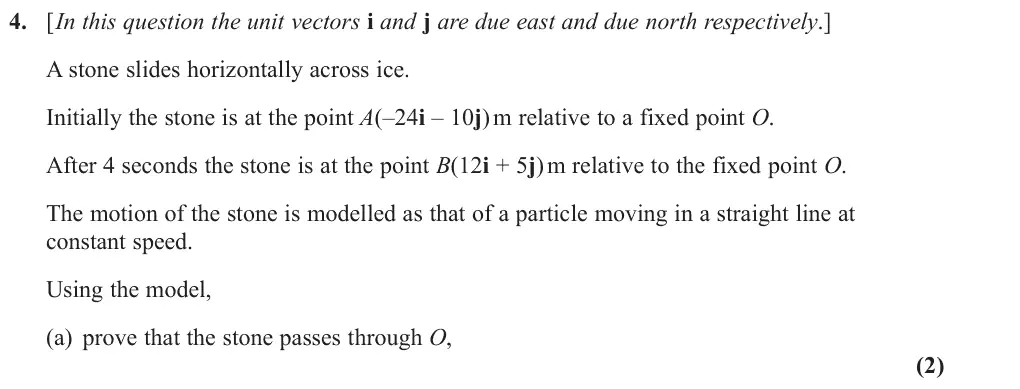
Oct 2021 · AS Paper 1 · Q4(a)2 marks
Mark scheme (whole question; this part is marked with the orange bar)
Examiner's comment
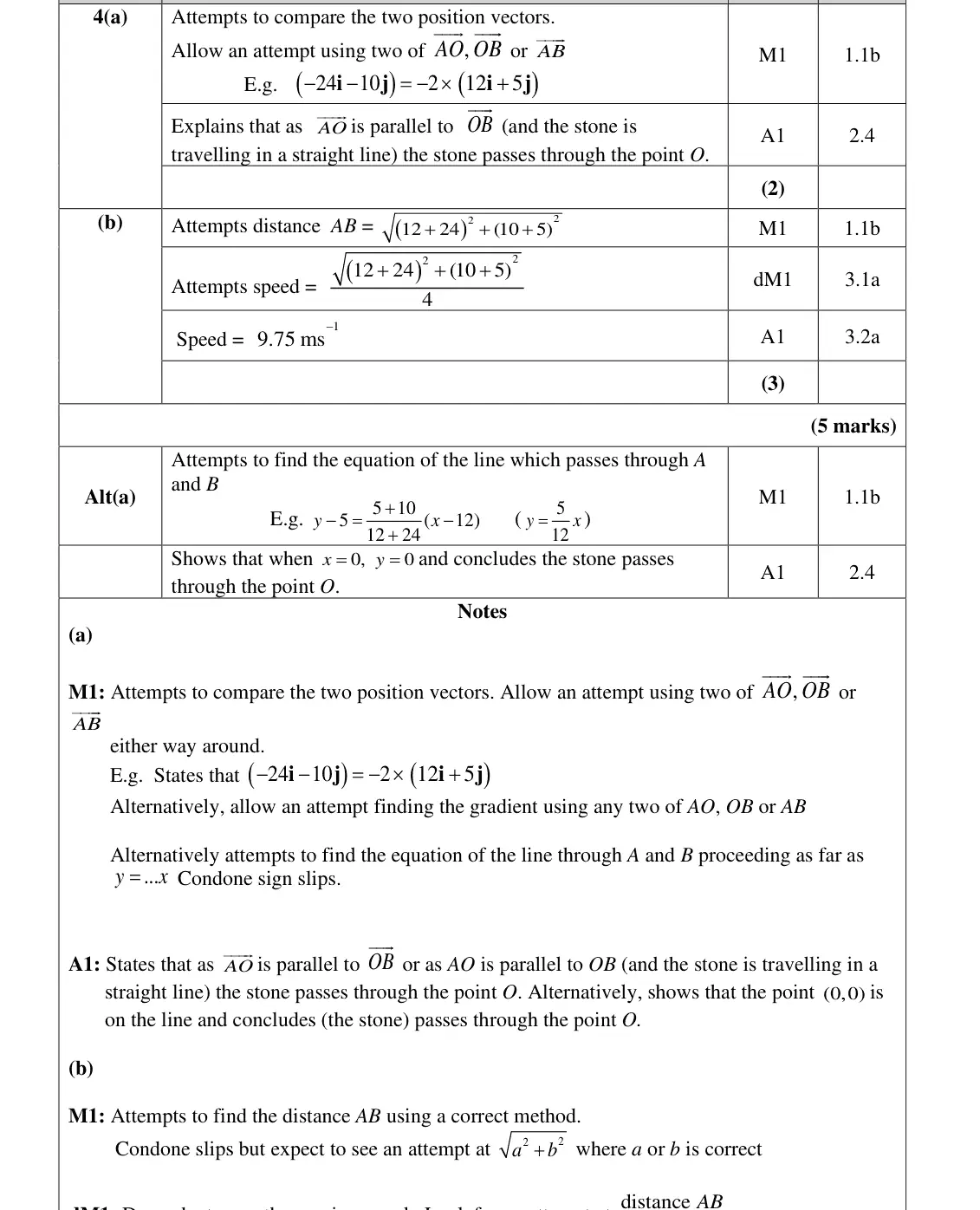
This question using vectors was generally well answered with most candidates scoring more than half of the marks available. In part (a) candidates seemed unsure how to go about proving that the stone passed through the origin. The most successful attempts typically involved finding the equation of the line for the stone which was 5 12 y x = and showed that the origin was on this line or stated that this linear equation would pass through the origin. Other attempts which candidates proceeded with involved either comparing the position vectors and showing that one was a multiple of the other or showing that the gradients of the position vectors were the same. Plotting the points on a graph was not an acceptable method to prove.
Common mistakes
show AO and OB are parallel, e.g. −24i − 10j = −2(12i + 5j), and conclude that as the stone moves in a straight line it passes through O
or show the line y = (5/12)x passes through the origin
plotting points is not a proof
Oct 2021 · Paper 1 · Q6(a)2 marks
Mark scheme (whole question; this part is marked with the orange bar)
Examiner's comment
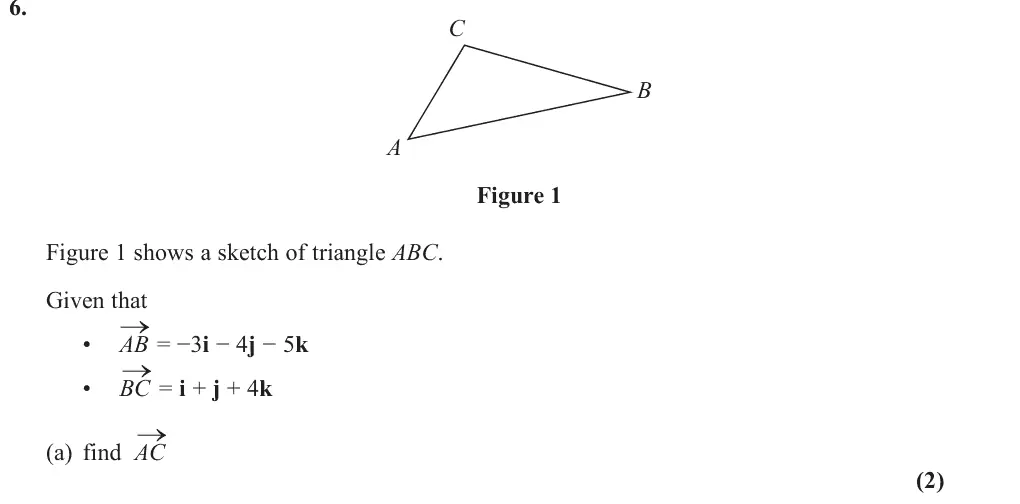
This was another question where the modal mark was full marks, this time achieved by over 40% of the candidates Part(a) A very significant majority of candidates obtained vector AC correctly. Only a few subtracted rather than adding the given vectors AB and BC.
Common mistakes
AC = AB + BC = −2i − 3j − k
add, not subtract
Oct 2021 · Paper 1 · Q6(b)3 marks
Mark scheme (whole question; this part is marked with the orange bar)
Examiner's comment
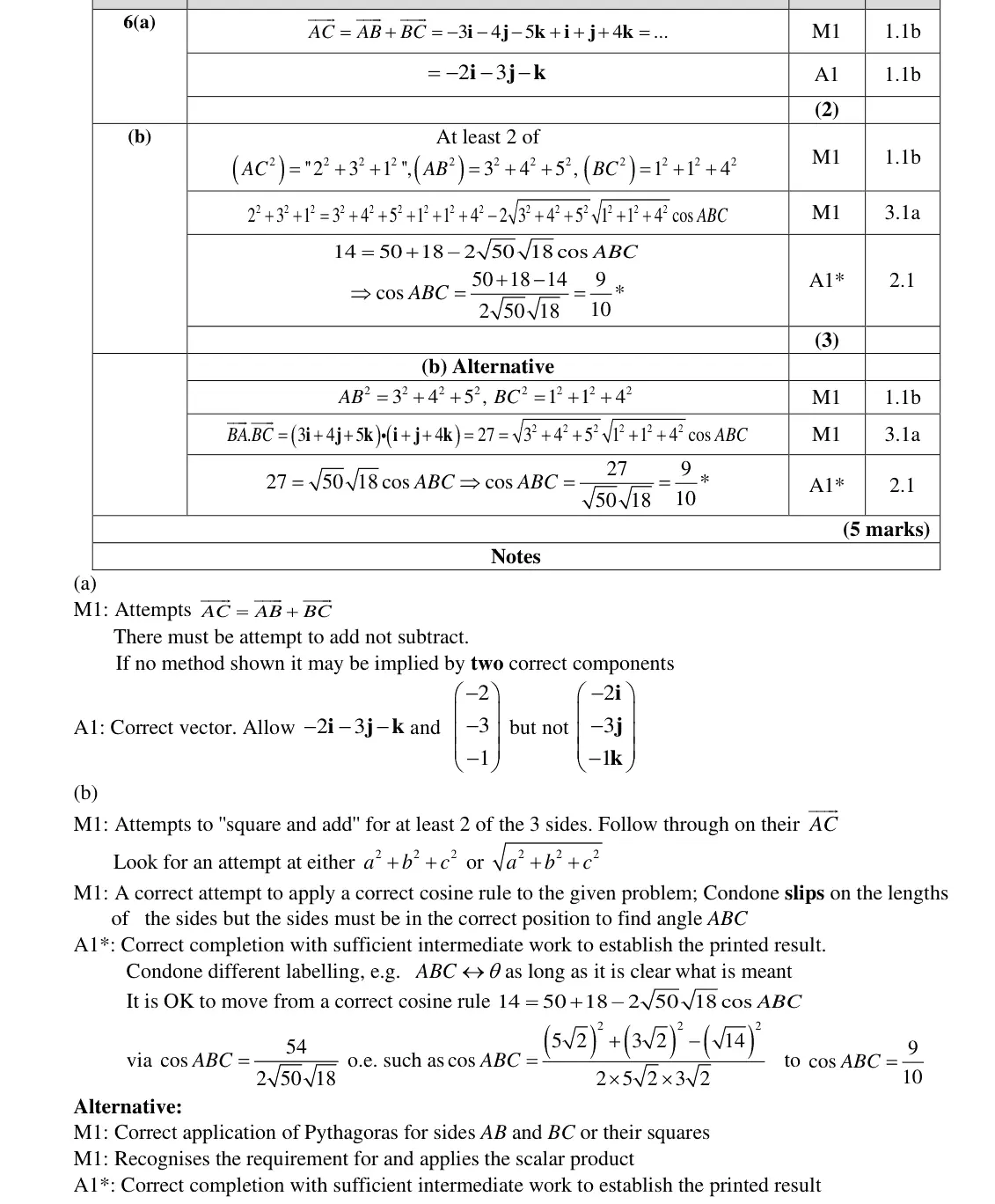
This was another question where the modal mark was full marks, this time achieved by over 40% of the candidates Part (b) The vast majority of candidates made some progress in this part, realising that the lengths of the vectors would be required to solve this problem. A small minority then simply stopped, having done no more than finding the lengths of the sides of the triangle ABC, with some assuming that the triangle was right angled. However most then went on to use the cosine rule to try to show the required result. In almost all cases a correct cosine rule was stated and used, so that following on from a previous accuracy error, the method marks could be awarded. Fully correct calculations were necessary in order to gain the final accuracy mark and very many candidates managed to do this and so gained full marks for this question. A few candidates, presumably those who had studied further maths, used the scalar correct way around. Many using this method showed that cos ABC = - 9 product. This method would be perfectly acceptable, as long as the vectors are used the 10 but failed to explain why the answer should be positive.
Common mistakes
find magnitudes √50, √18, √14 and use the cosine rule with the sides in the right positions
scalar product (BA.BC, not AB.BC) gives −9/10 if the direction is wrong
Oct 2021 · Paper 3 (Mechanics) · Q1(a)2 marks
Mark scheme (whole question; this part is marked with the orange bar)
Examiner's comment
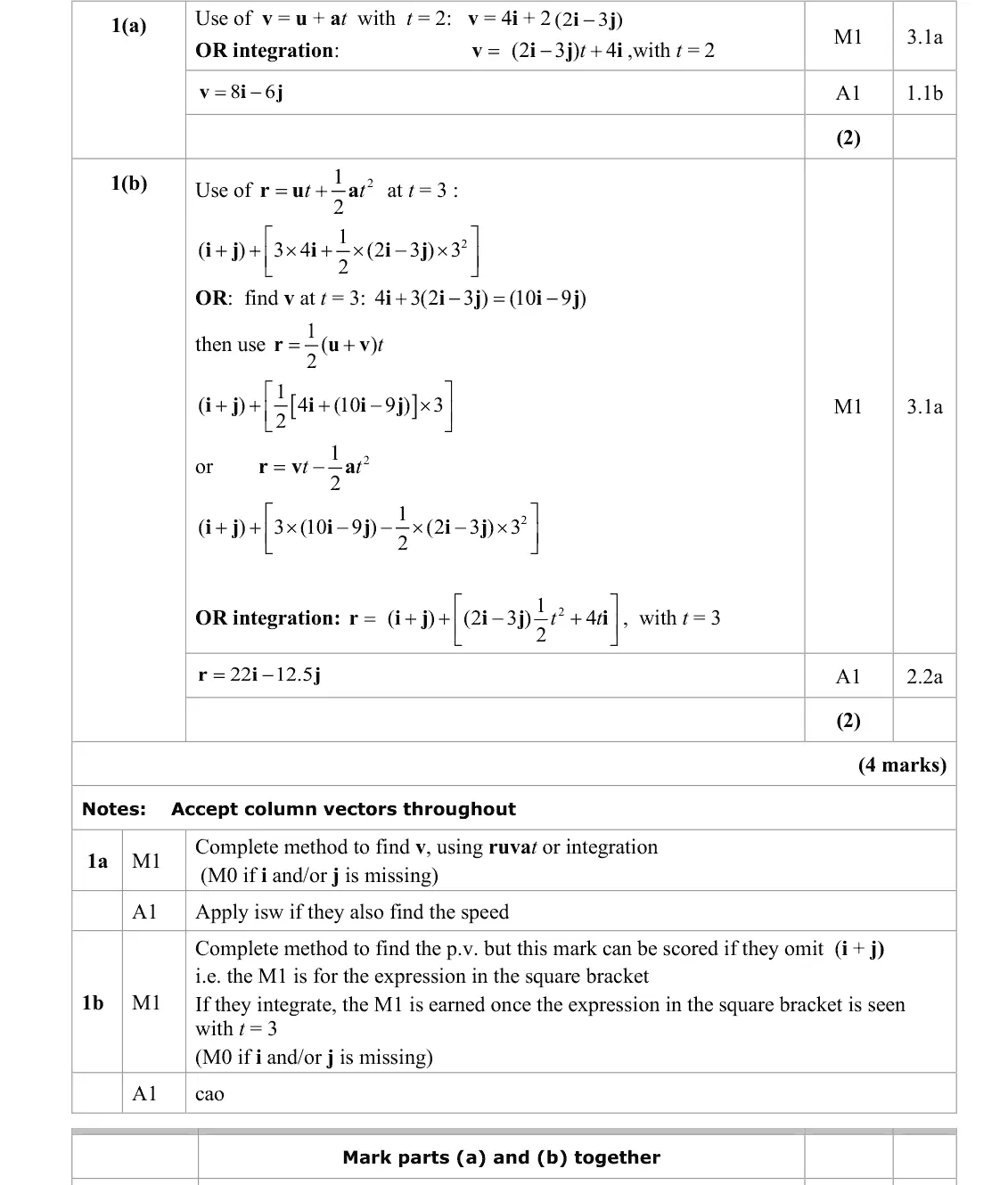
Part (a) was well answered with most students making use of v = u + at to arrive at the correct answer 8 6 = - v i j. It is important to note that this uses the initial velocity of 4i. The alternative method was to use integration, so the equivalent of the first stage was to integrate and use the 4i when calculating the constant of integration. A few made careless arithmetic errors and others forgot to use the 4i in the integration. A small number either differentiated or made no progress.
Common mistakes
v = u + at with u = 4i (if integrating, the 4i is the constant of integration and is often forgotten)
keep i and j (M0 if lost)
answer 8i − 6j
Oct 2021 · Paper 3 (Mechanics) · Q5(a)2 marks
Mark scheme (whole question; this part is marked with the orange bar)
Examiner's comment
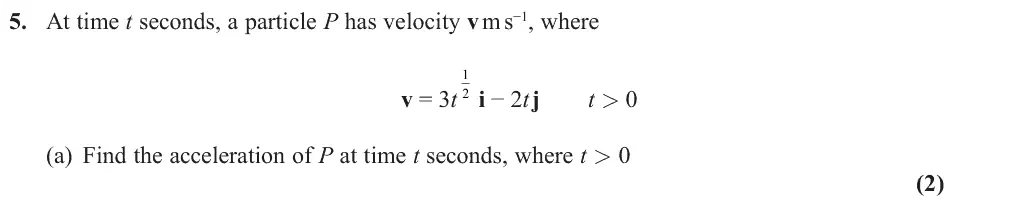
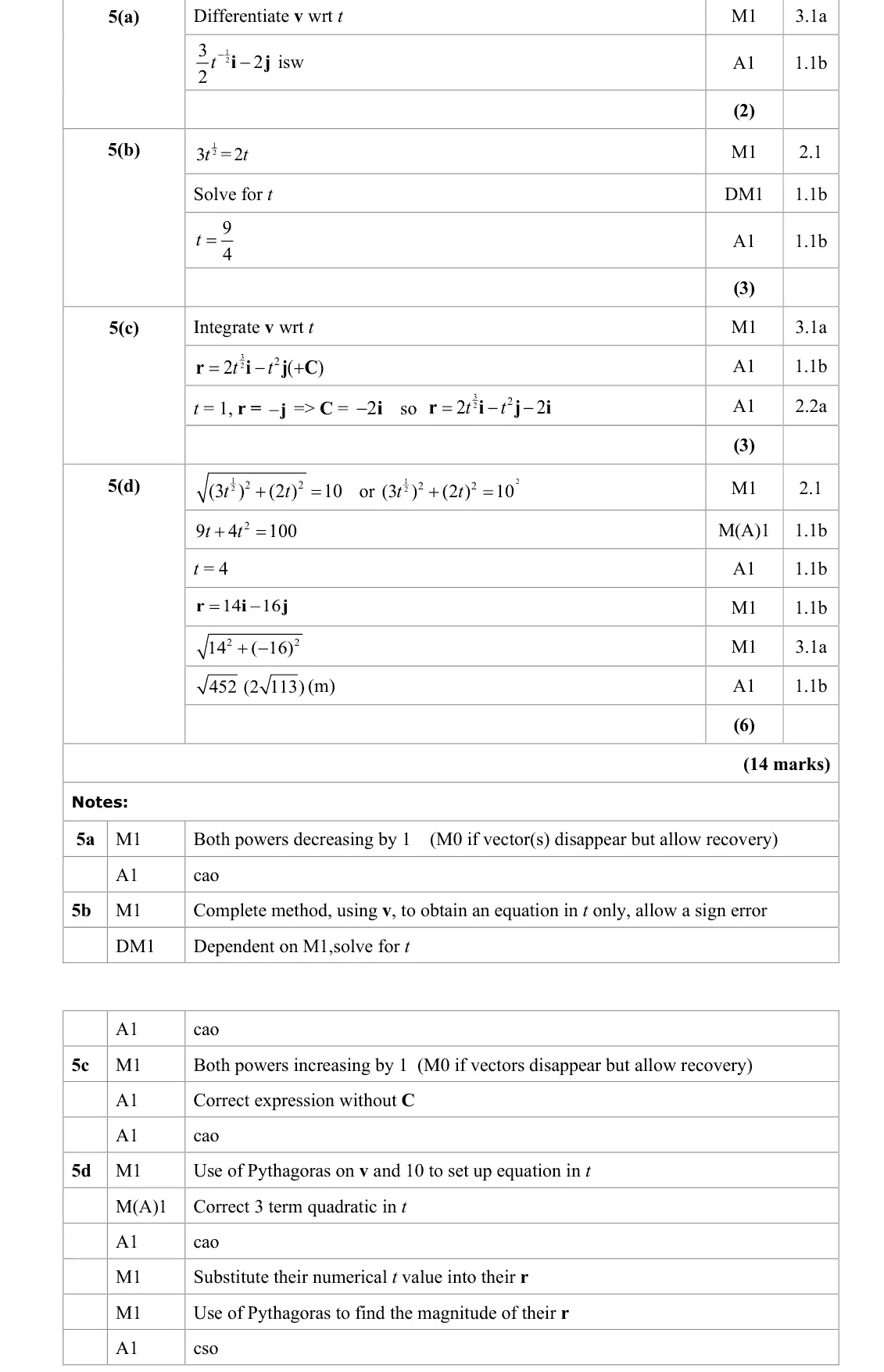
Part (a) was well answered by most candidates who realised that they needed to differentiate although a few candidates did omit the vector notation and therefore achieved zero marks. Part (b) proved to be the least popular part of this question.
Common mistakes
a = dv/dt: differentiate both components (powers decrease by 1)
keep the vector notation (M0 if i, j disappear)
answer (3/2)t^(−½) i − 2j
Oct 2021 · Paper 3 (Mechanics) · Q5(c)3 marks
Mark scheme (whole question; this part is marked with the orange bar)
Examiner's comment
direction of travel. Part (c) tended to be well answered with a good number of candidates integrating and gaining 2 or 3 marks here. It was disappointing to see a few using constant acceleration formulae. Part (d) allowed those who had made little progress on the first 3
Common mistakes
r = ∫v dt, both powers increase by 1
use r = −j at t = 1 to get C = −2i
suvat is invalid (acceleration not constant)
Oct 2020 · Paper 1 · Q3(a)2 marks
Mark scheme (whole question; this part is marked with the orange bar)
Examiner's comment
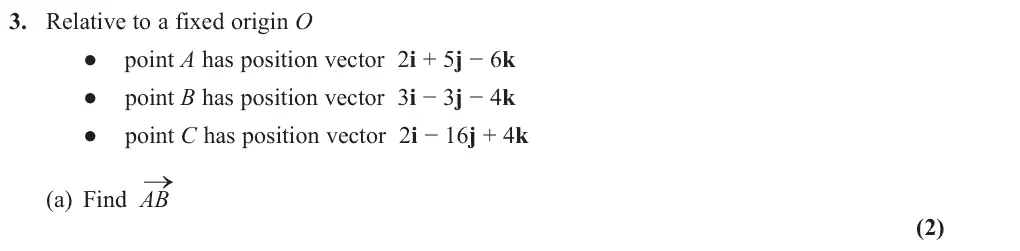
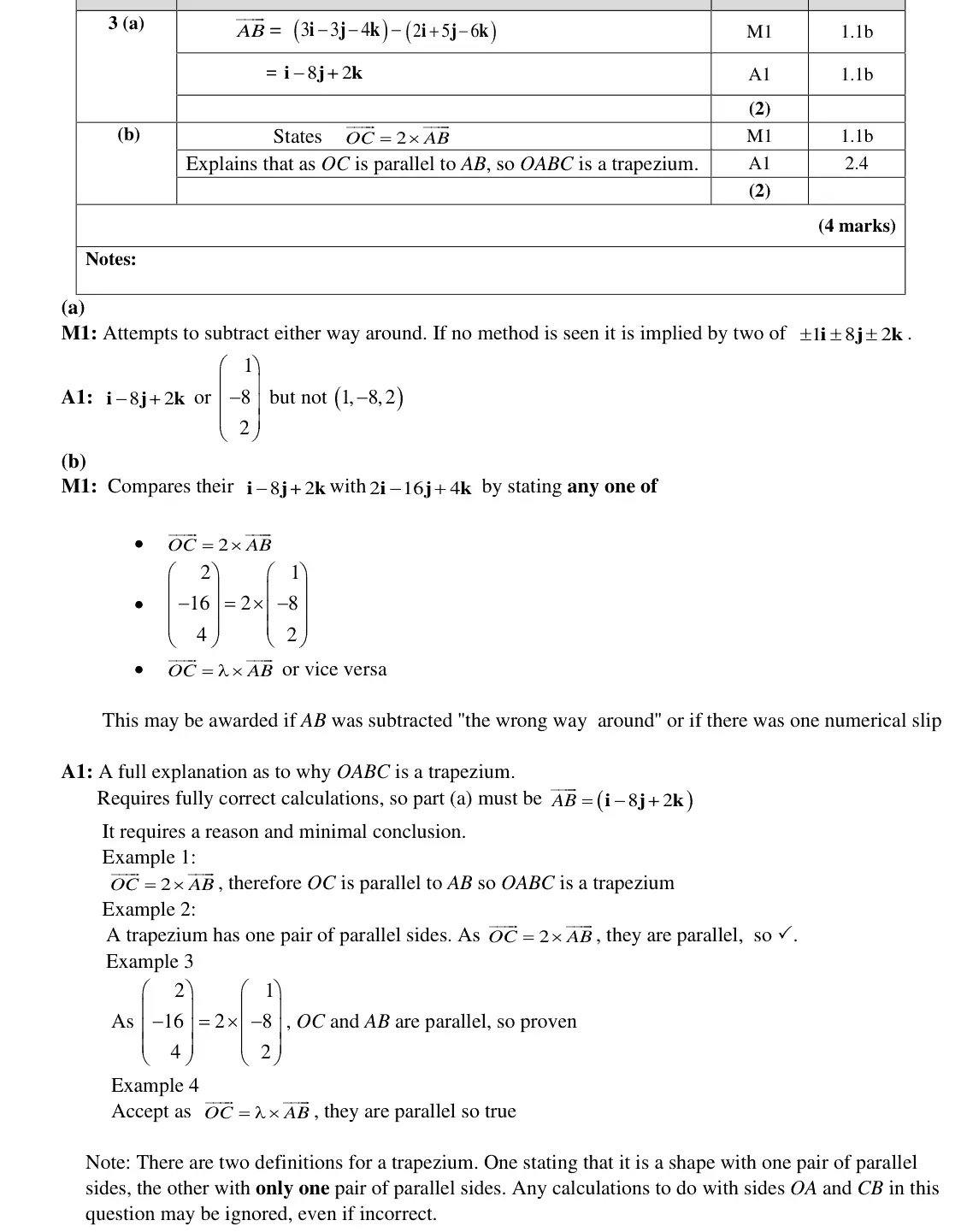
In part (a) most candidates were able to successfully subtract vectors the correct way round gaining both marks. Very few candidates added the two vectors together.
Common mistakes
AB = b − a (subtract the right way round) = i − 8j + 2k
coordinates (1, −8, 2) not accepted
Oct 2020 · Paper 1 · Q3(b)2 marks
Mark scheme (whole question; this part is marked with the orange bar)
Examiner's comment
In (b) those who gained both marks were able to compare the two vectors AB and OC to show that they were parallel and conclude that OABC is a trapezium. Usually candidates made a sketch of a trapezium so they could visualize which vectors or sides they would compare. This is a very good idea and should be encouraged by centres. Marks were lost when • candidates did not give a minimal conclusion after finding OC and AB were parallel. • candidates incorrectly stating that 2 AB OC = x • candidates finding the length of each side OABC rather than their directions
Common mistakes
OC = 2AB so OC is parallel to AB, hence a trapezium
a reason and minimal conclusion needed
finding side lengths instead of directions scores nothing
Oct 2020 · Paper 3 (Mechanics) · Q2(a)2 marks
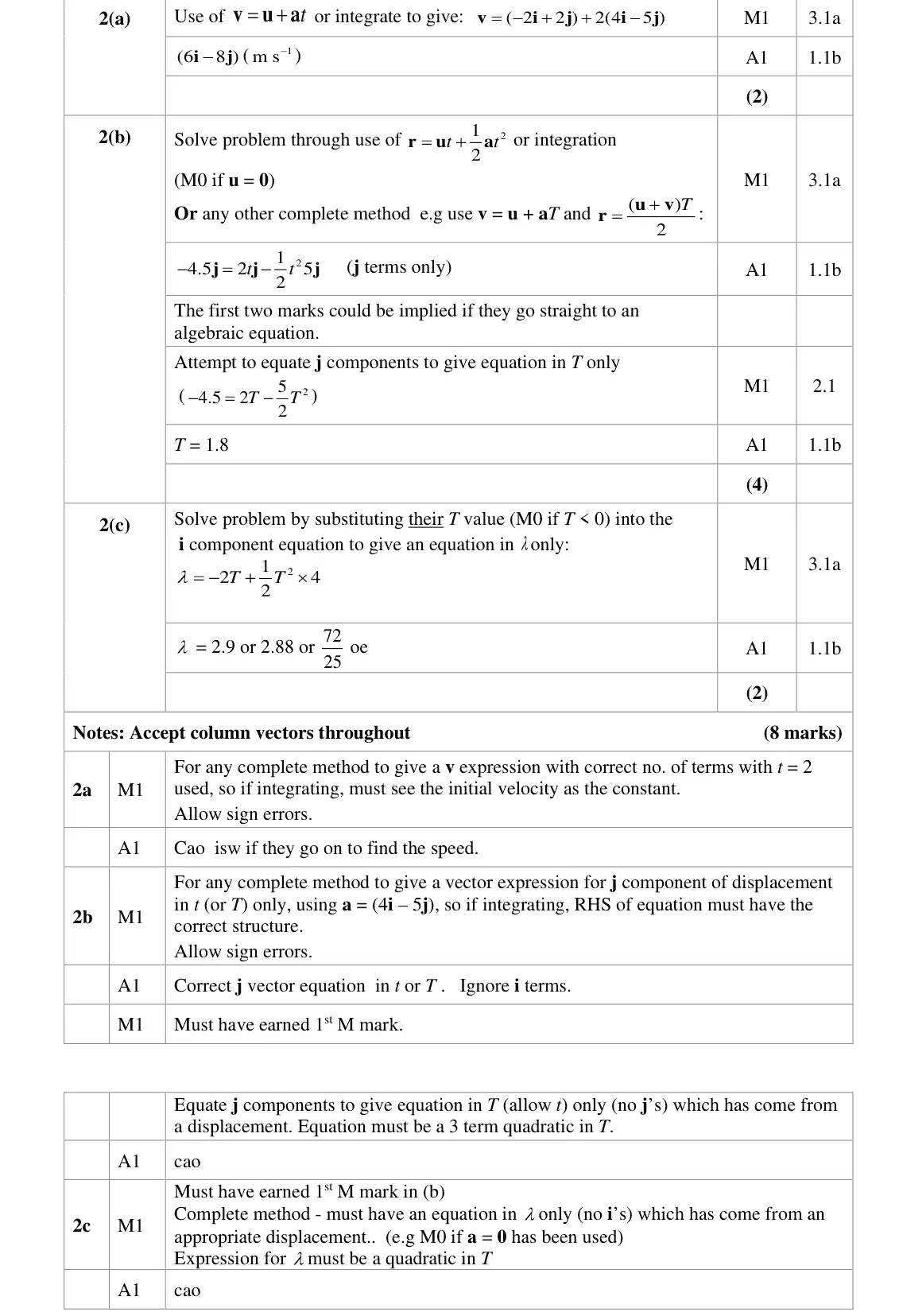
Mark scheme (whole question; this part is marked with the orange bar)
Examiner's comment
In the first part, the majority of candidates used v = u + at with t = 2 to obtain a correct constant, in this case, the initial velocity. In part (b), most used r = ut + 1 velocity. Some chose to integrate, often successfully, although some failed to include a 2 at2 to find a displacement vector. Again, some chose to integrate, mostly correctly. Having equated their displacement expression to λi – 4.5j, some did not know how to proceed. A few tried to use magnitudes and reduce the problem to scalars and some had mixed up velocity and displacement. Those who realised that equating j components gave an equation in T generally solved the resulting quadratic and found the correct answer. Part (c) required
Common mistakes
v = u + at with vectors: (−2i + 2j) + 2(4i − 5j) = 6i − 8j
if integrating, the initial velocity is the constant
velocity is a vector, the speed is not needed
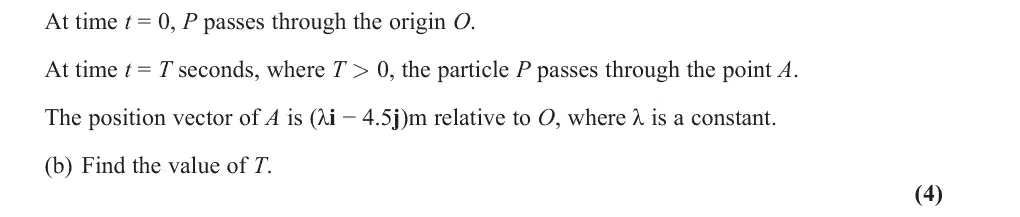
Oct 2020 · Paper 3 (Mechanics) · Q2(b)4 marks
Mark scheme (whole question; this part is marked with the orange bar)
Examiner's comment
In the first part, the majority of candidates used v = u + at with t = 2 to obtain a correct constant, in this case, the initial velocity. In part (b), most used r = ut + 1 velocity. Some chose to integrate, often successfully, although some failed to include a 2 at2 to find a displacement vector. Again, some chose to integrate, mostly correctly. Having equated their displacement expression to λi – 4.5j, some did not know how to proceed. A few tried to use magnitudes and reduce the problem to scalars and some had mixed up velocity and displacement. Those who realised that equating j components gave an equation in T generally solved the resulting quadratic and found the correct answer. Part (c) required the marks in part (b) went on to gain the two marks here. A method mark was available for those carrying through a wrong value for T provided that it had been found from a valid method in part (b).
Common mistakes
r = ut + ½at² (not with u = 0)
equate the j components only: −4.5 = 2T − (5/2)T² gives T = 1.8
do not take magnitudes or mix up velocity and displacement
Oct 2020 · Paper 3 (Mechanics) · Q2(c)2 marks
Mark scheme (whole question; this part is marked with the orange bar)
Examiner's comment
generally solved the resulting quadratic and found the correct answer. Part (c) required the value for T to be substituted into the i component and virtually all those who achieved the marks in part (b) went on to gain the two marks here. A method mark was available
Common mistakes
substitute T = 1.8 into the i component: λ = −2T + 2T² = 2.88 (72/25)
reject a negative T
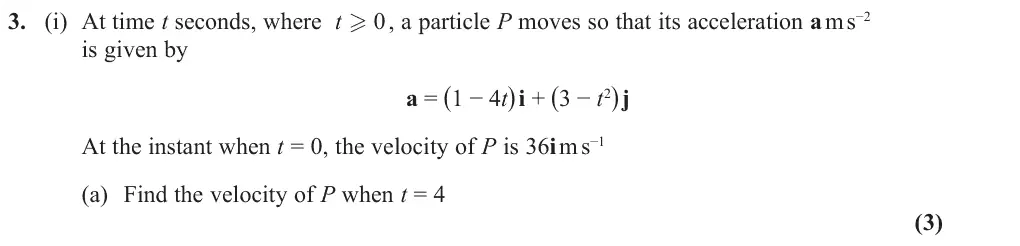
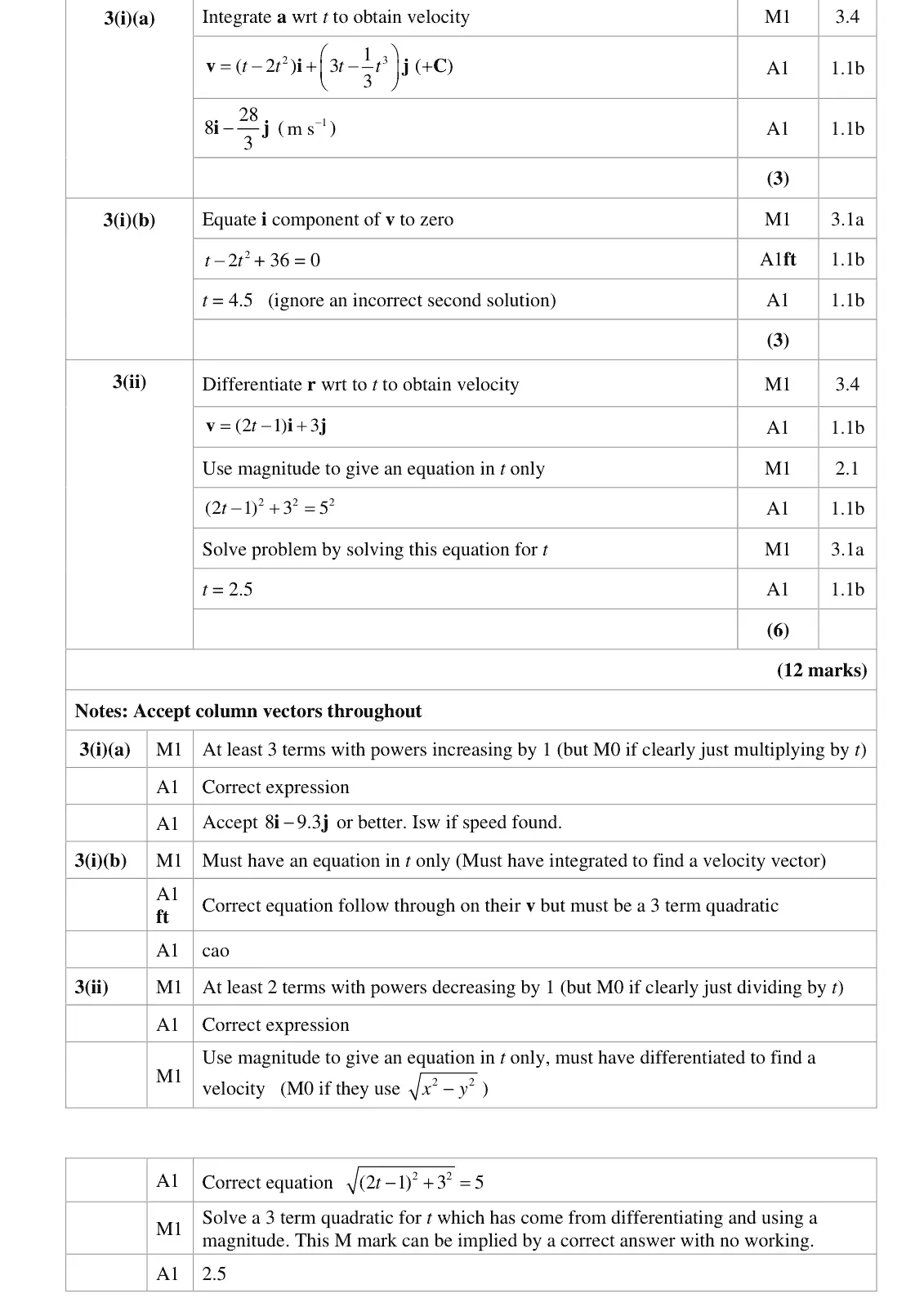
Oct 2020 · Paper 3 (Mechanics) · Q3(i)(a)3 marks
Mark scheme (whole question; this part is marked with the orange bar)
Examiner's comment
Part (i) involved variable acceleration but a significant minority of candidates tried to apply suvat equations and so achieved no credit. In part (i)(a), many did complete the required integration to find an expression for v and substitute t = 4; a fair number of correct answers were seen with the main errors either being numerical slips or neglecting to include the constant, 36i. In part (i)(b), candidates needed to realise that moving perpendicular to i implies the i component of v is zero; those who equated the j components to zero achieved no marks. Occasionally the i and j components were equated and some candidates did not know how to proceed at all. Some focussed on the displacement vector. Those who knew what to do generally obtained the correct answer. Part (ii) was generally found more accessible and many of the candidates who had used suvat in (i) now realised that they had to differentiate here to find the velocity. Most knew how to use the given speed to create an equation in t, although a few just tried to equate their vector to 5 and then either gave up or just dropped the i and j. A fair number achieved full marks for this part of the question.
Common mistakes
variable acceleration so suvat scores nothing
integrate each component and include the constant 36i
v = 8i − (28/3)j
Oct 2020 · Paper 3 (Mechanics) · Q3(i)(b)3 marks
Mark scheme (whole question; this part is marked with the orange bar)
Examiner's comment
Part (i) involved variable acceleration but a significant minority of candidates tried to apply suvat equations and so achieved no credit. In part (i)(a), many did complete the required integration to find an expression for v and substitute t = 4; a fair number of correct answers were seen with the main errors either being numerical slips or neglecting to include the constant, 36i. In part (i)(b), candidates needed to realise that moving perpendicular to i implies the i component of v is zero; those who equated the j components to zero achieved no marks. Occasionally the i and j components were equated and some candidates did not know how to proceed at all. Some focussed on the displacement vector. Those who knew what to do generally obtained the correct answer. Part (ii) was generally found more accessible and many of the candidates who had used suvat in (i) now realised that they had to differentiate here to find the velocity. Most knew how to use the given speed to create an equation in t, although a few just tried to equate their vector to 5 and then either gave up or just dropped the i and j. A fair number achieved full marks for this part of the question.
Common mistakes
perpendicular to i means the i component of v is zero: t − 2t² + 36 = 0 gives t = 4.5
equating the j component to zero (or i to j) scores nothing
use velocity, not displacement
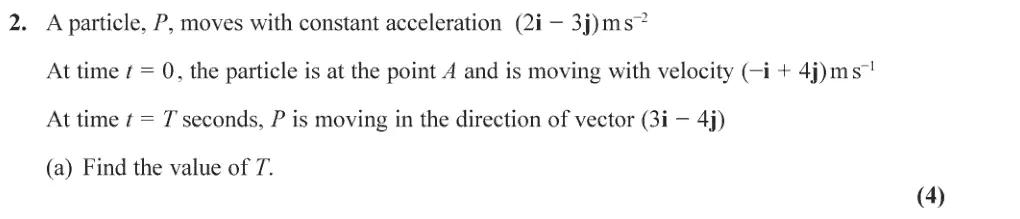
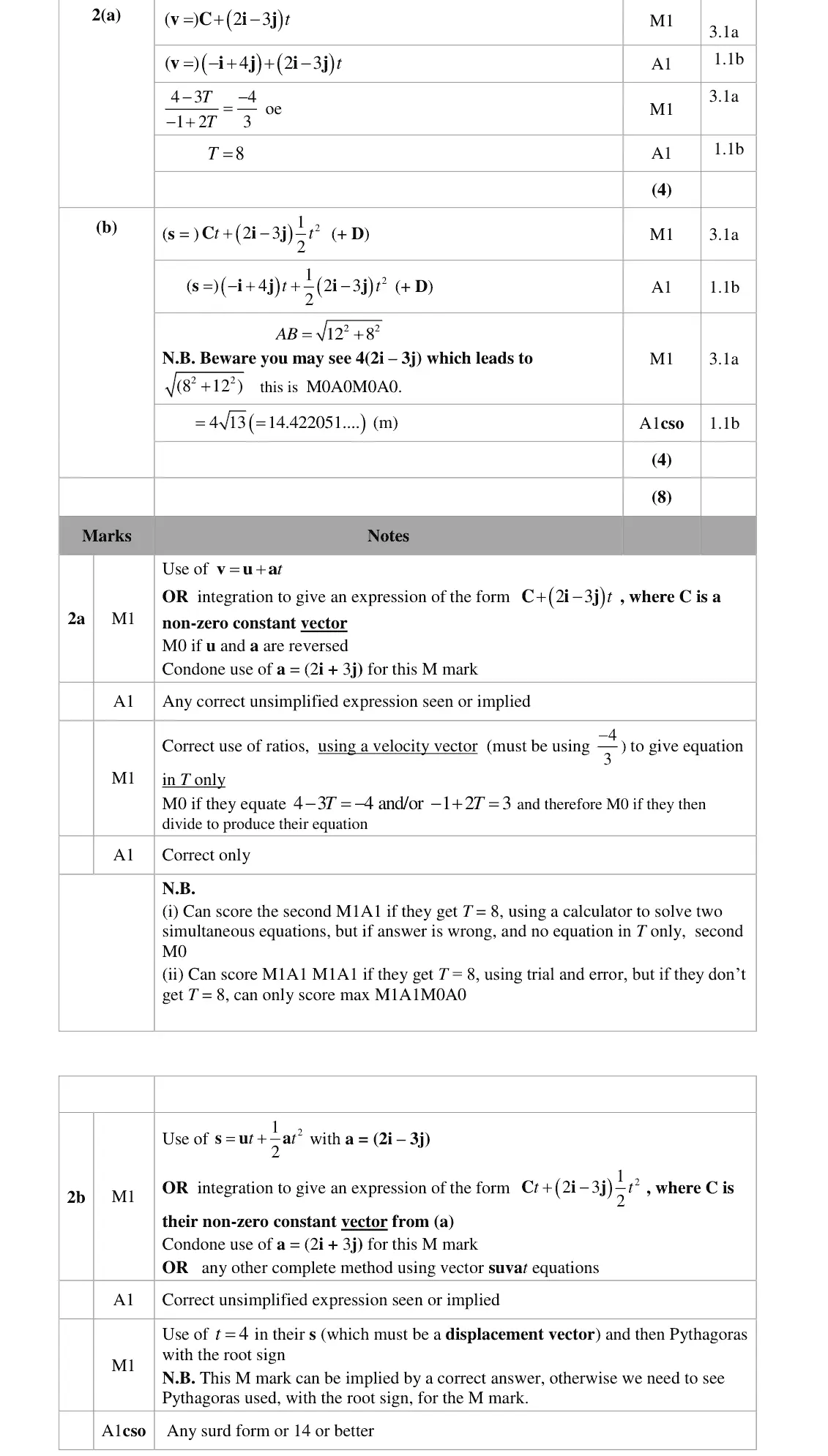
June 2019 · Paper 3 (Mechanics) · Q2(a)4 marks
Mark scheme (whole question; this part is marked with the orange bar)
Examiner's comment
In part (a), although many candidates realised that finding an expression for the velocity was relevant to determining the direction of motion, only a minority could use the fact that it was specified as being in the direction of 3i – 4j. The most common error was in equating the actual vectors rather than either equating the ratios of components or equating to a multiple of 3i – 4j. A fair number attempted to use a displacement vector showing a lack of understanding of the situation. The second part was generally
Common mistakes
v = (−1 + 2T)i + (4 − 3T)j
parallel to 3i − 4j means ratio of components (4 − 3T)/(−1 + 2T) = −4/3, not equating the vectors themselves
using displacement is wrong
T = 8
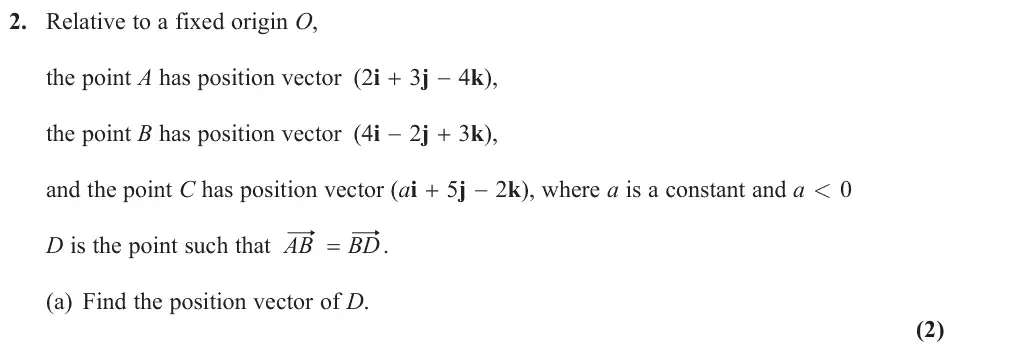
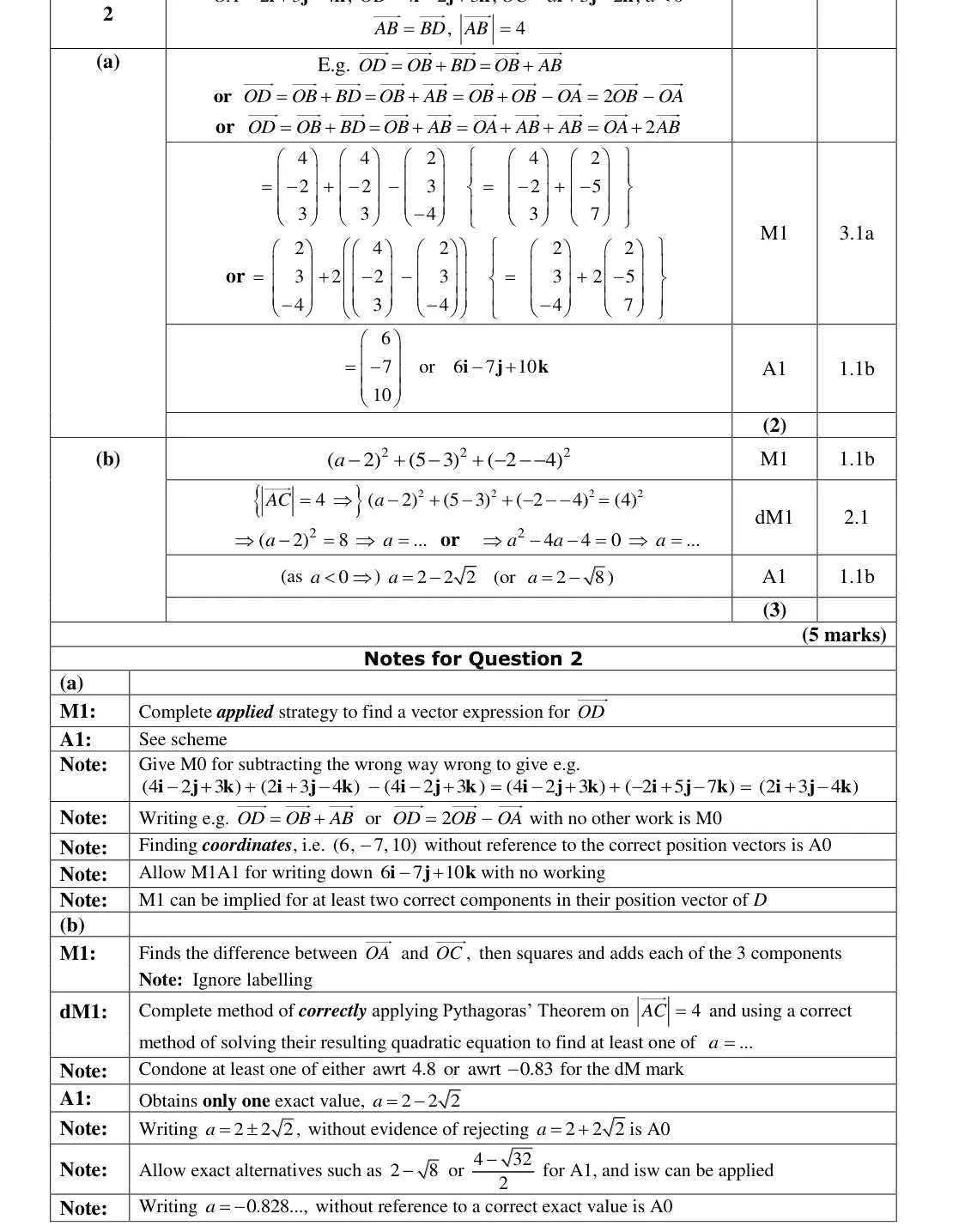
June 2018 · Paper 2 · Q2(a)2 marks
Mark scheme (whole question; this part is marked with the orange bar)
Examiner's comment
This was a well-answered question with most students scoring at least 4 of the 5 marks available. Part (a) was often completed successfully. Most students found AB and used the given result AB BD to deduce and apply . OD OB AB A few students applied 2 . OD OA AB There were some sign, manipulation and bracketing errors seen in this part and students who used column vectors were generally more successful than those who used the , , i j k notation.
Common mistakes
OD = OB + BD = OB + AB = 2OB − OA = 6i − 7j + 10k
sign, bracketing errors with i j k notation (column vectors safer)
June 2018 · Paper 2 · Q2(b)3 marks
Mark scheme (whole question; this part is marked with the orange bar)
Examiner's comment
This was a well-answered question with most students scoring at least 4 of the 5 marks available. In part (b), most students found the difference between OC and , OA and applied Pythagoras’ Theorem to 4 AC to give the correct 2 2 2 2 ( 2) (2) (2) (4) . a The resulting quadratic equation was generally solved correctly but not always efficiently. Too often, students expanded to form a 3-term quadratic rather than spotting that their quadratic was already in a ‘completed square’ form. Despite the question stating that 0, a some students gave both solutions 2 2 2 a as their final answer, while others mistakenly rejected 2 2 2 a to leave 2 2 2. a
Common mistakes
AC = OC − OA
(a − 2)² + 2² + 2² = 16 is already completed-square form, (a − 2)² = 8
reject 2 + 2√2 because a < 0, answer a = 2 − 2√2
Find an Edexcel maths tutor
Stuck on this? Book a trial session with an Edexcel specialist.