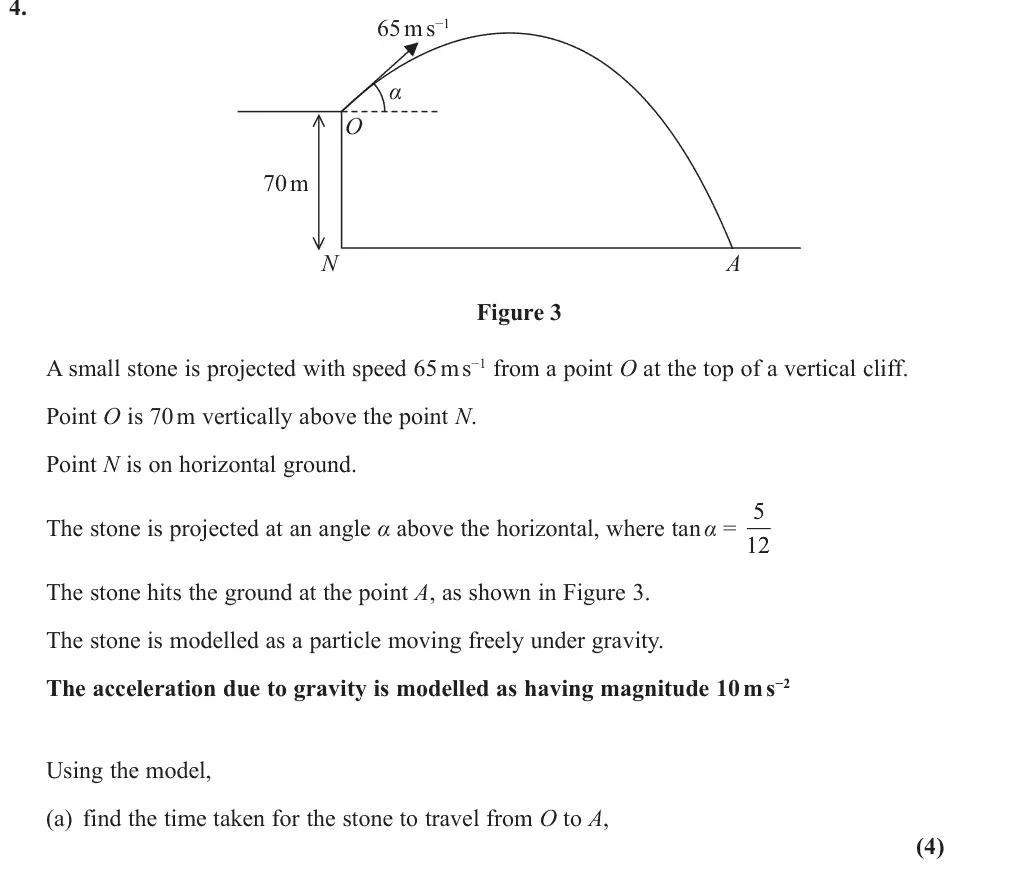
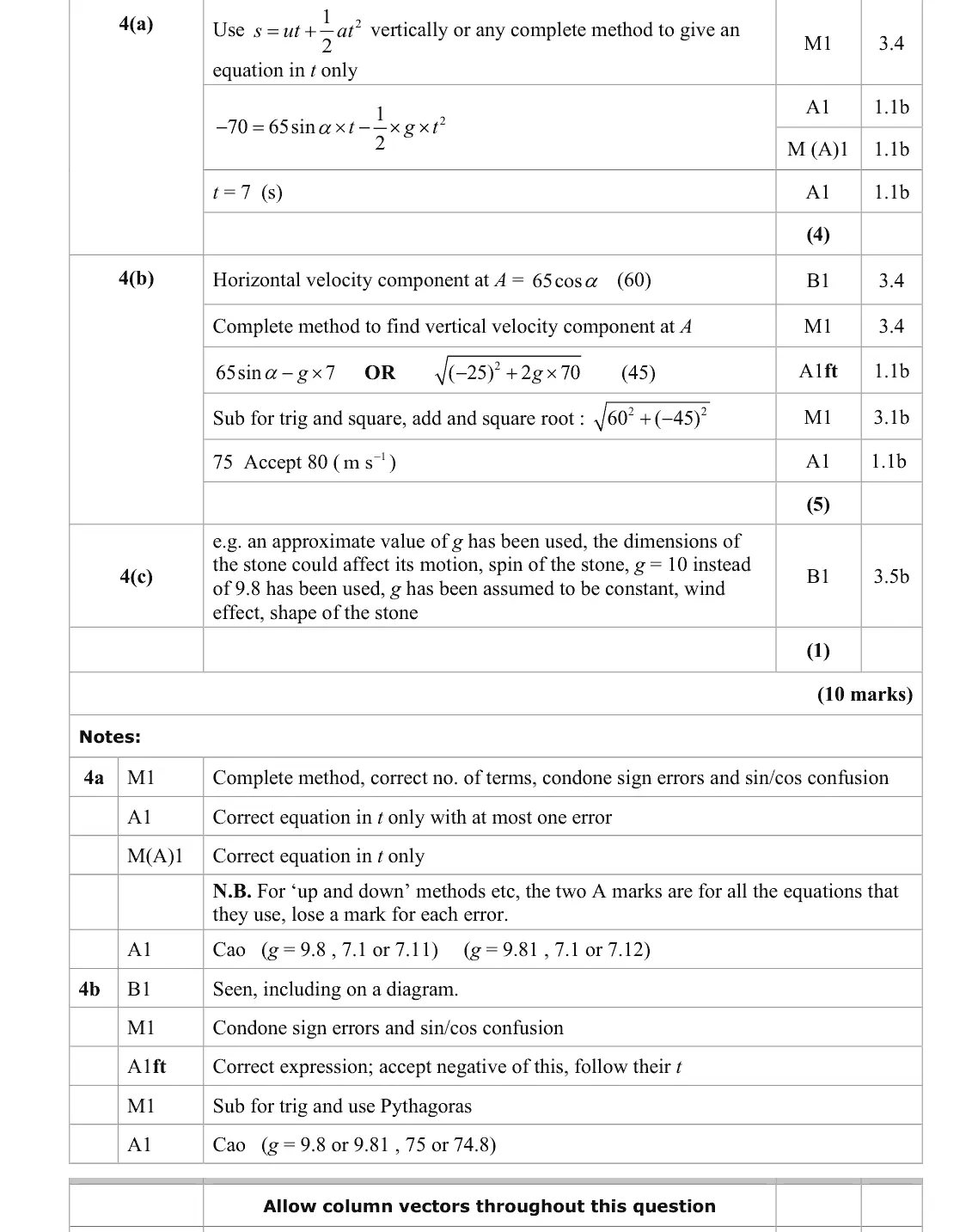
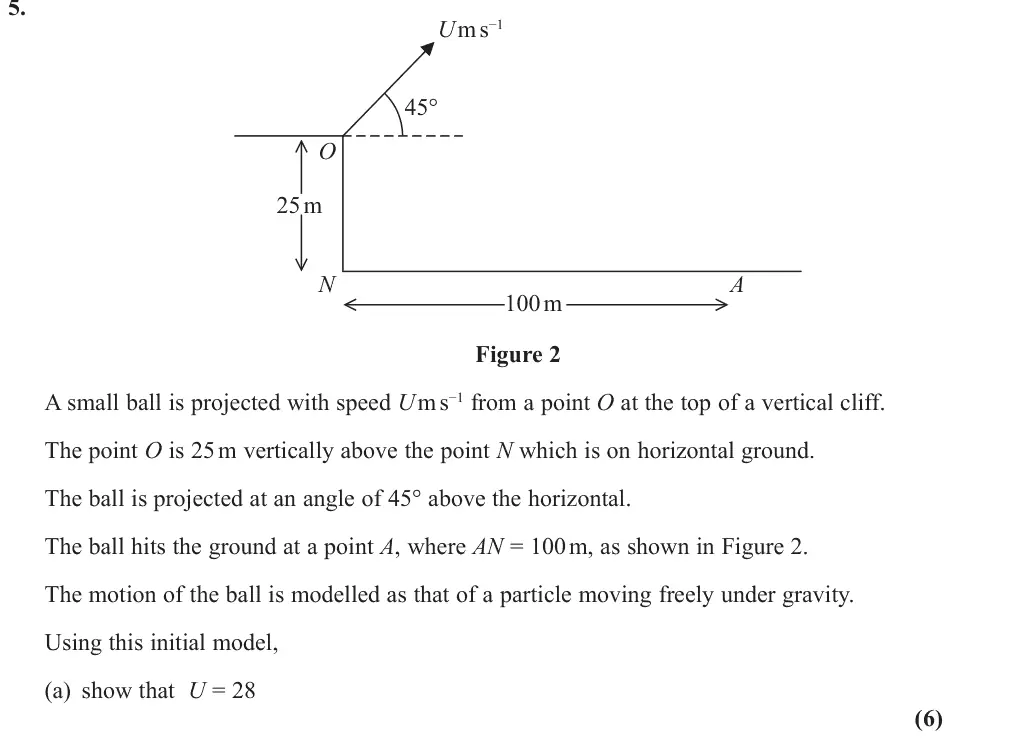
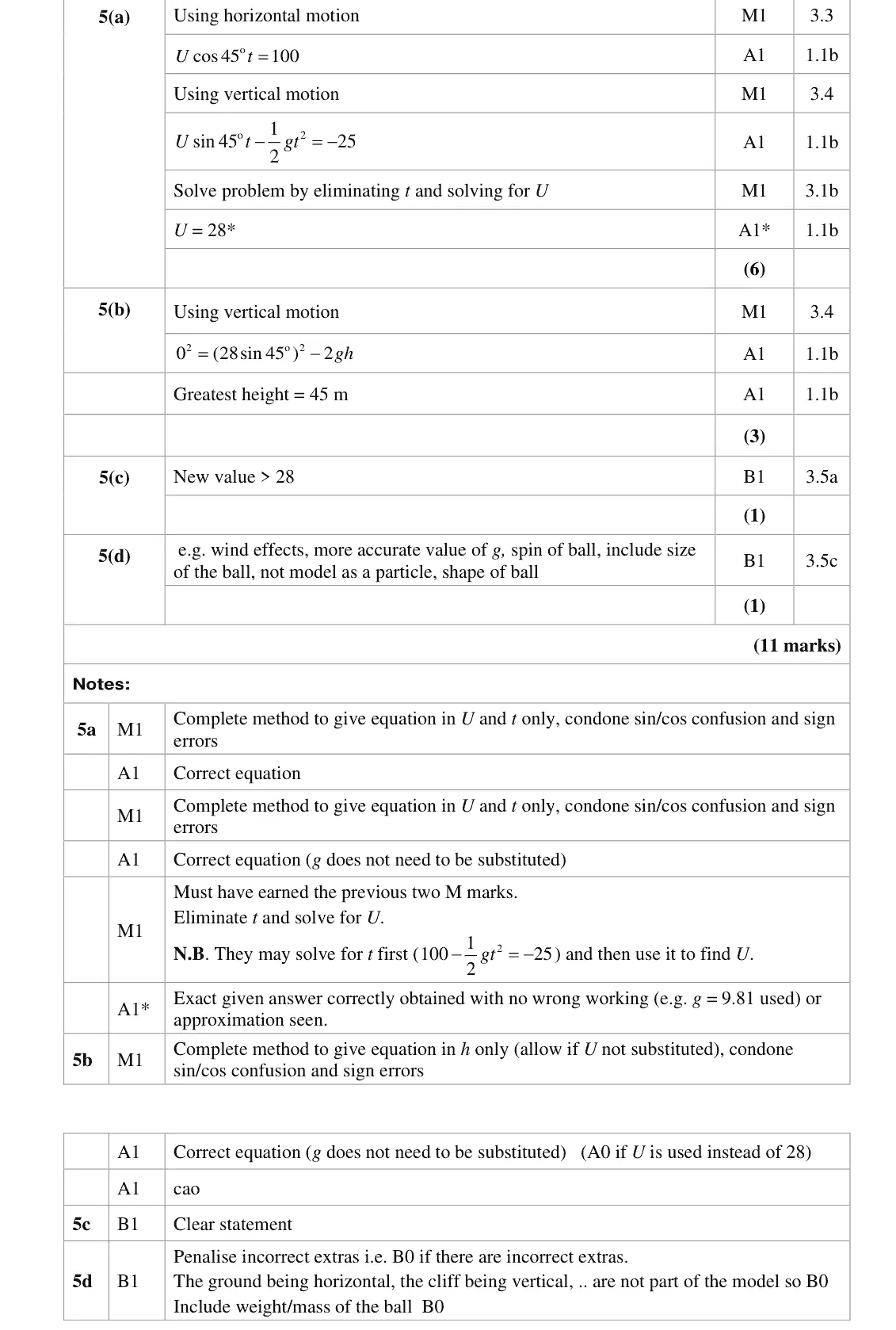
Mark scheme (whole question; this part is marked with the orange bar)
Examiner's comment
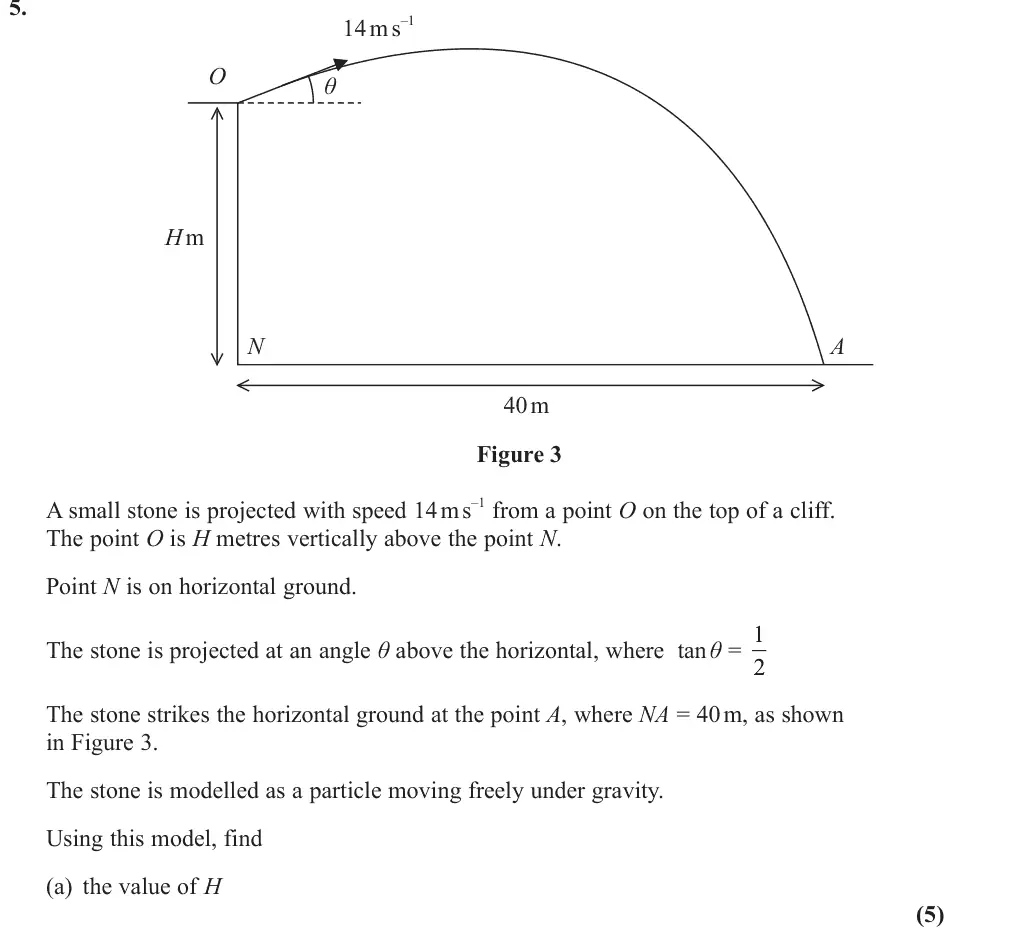
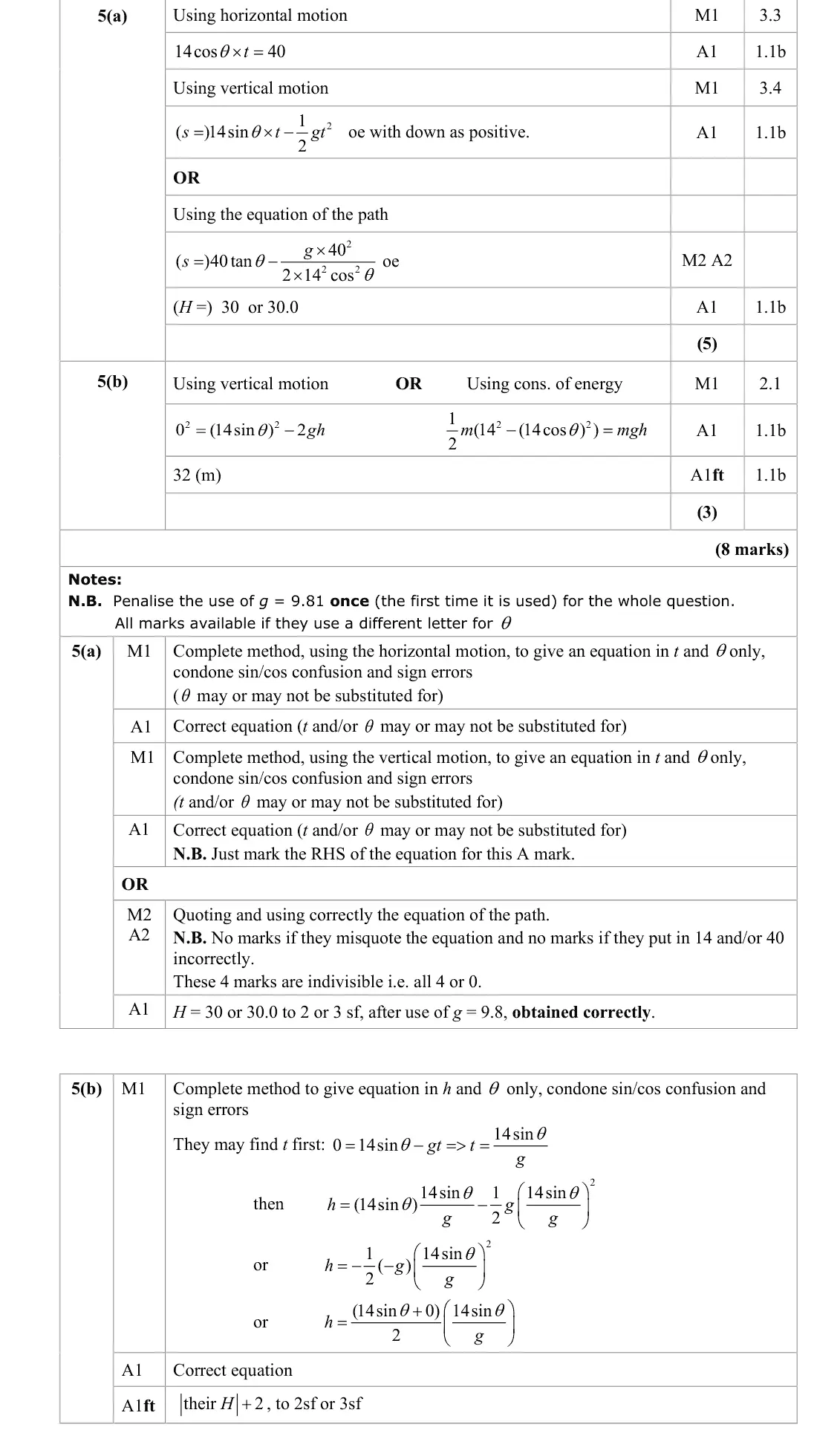
In part (a) there were many excellent responses seen. Most responses gave an expression or an actual value for t by considering the horizontal motion and then substituted it into their equation for vertical motion. Many gained full marks, but some used a heavily rounded value for t and lost accuracy. Others were not clear whether they were taking upwards or downwards as positive in the vertical direction and this led to two common errors. The first was that both terms in their expression for vertical displacement had the same sign. The second was, if they were taking upwards as positive as most did, they replaced ‘s’ with H in their equation and erroneously reached the result H = 30 - and then just wrote H = 30 which resulted in not gained the final accuracy mark. Other errors included poor substitution into formulae, forgetting to resolve the velocity into its components and sin/cos confusion. Quoting and using the equation of the path was rarely seen. Some responses erroneously used half of their time from part (a), treating the motion as if it were symmetrical and gained no marks. The energy solution was rarely seen.
Common mistakes
sin θ = 1/√5, cos θ = 2/√5
t from horizontal motion 14cos θ × t = 40, then vertical motion
keep a consistent positive direction (H = −30 must become 30 correctly)
do not halve the time (not symmetrical)
premature rounding of t
June 2025 · Paper 3 (Mechanics) · Q5(b)3 marks
Mark scheme (whole question; this part is marked with the orange bar)
Examiner's comment
In part (b), finding the maximum height above the ground was done well by nearly all learners, with most using 2 2 2 v u as = + . Common errors seen were to round values prematurely or drop a square from a term after stating a correct initial equation. Those who used two equations were generally less successful. A few others did not gain the final follow through accuracy mark as they did not give their final answer to 2 or 3 significant figures.
Common mistakes
0 = (14 sin θ)² − 2gh gives 2 m above O
answer is H + 2 = 32 m above the ground
do not drop the square or round early
2 or 3 s.f.
June 2024 · Paper 3 (Mechanics) · Q5(a)6 marks
Mark scheme (whole question; this part is marked with the orange bar)
Examiner's comment
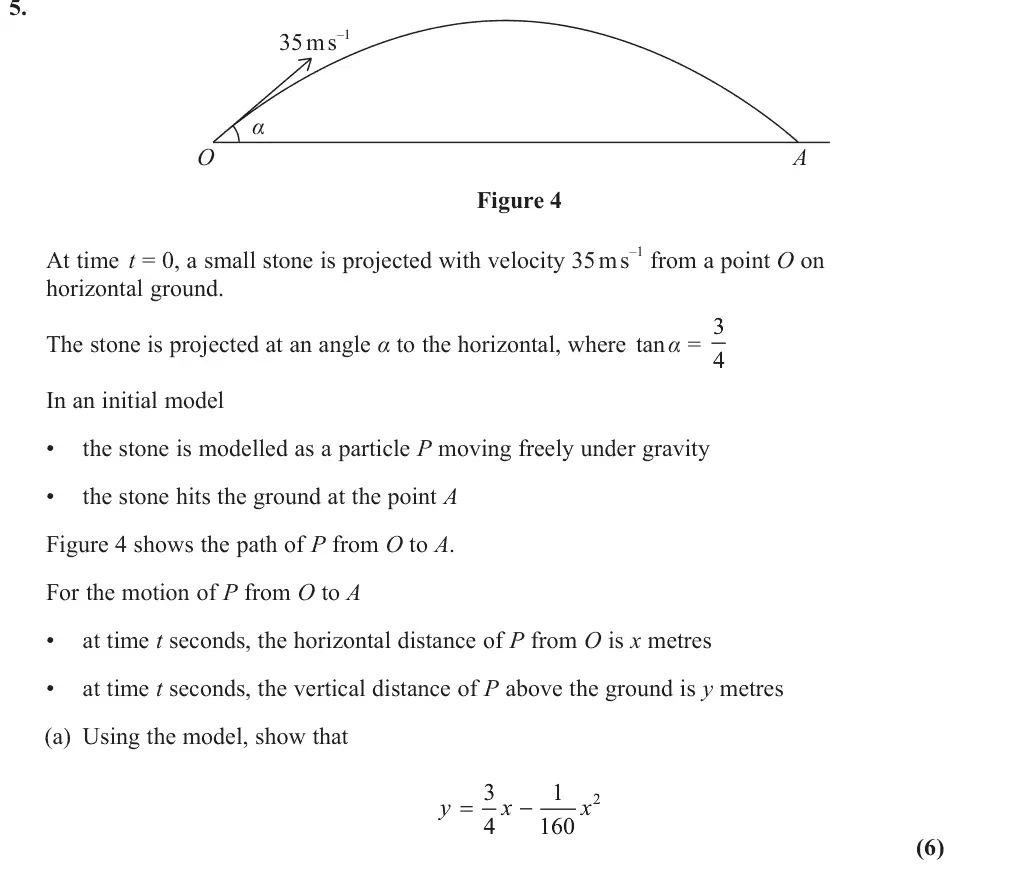
(a)This part required the derivation of an equation for the flight path of a stone moving freely under gravity given the initial speed and angle of projection. There were many excellent responses seen where candidates used horizontal and vertical components of the = + 2 s ut at initial velocity in to find expressions for x and y in terms of t, with the 1 2 majority realising that the acceleration was zero in the horizontal direction. Occasionally the velocities were not resolved or the acceleration in both directions was taken as g, but such instances were rare. Most proceeded to eliminate t correctly and obtain the printed equation. Since it was a given answer any slips in working tended to be rectified including any previous cos/sin confusion. The final mark did require 9.8 for the value of g to be seen being used explicitly in the working. Although full marks were often achieved in this part of the question, there were candidates who failed to make any valid progress, often because they equated their vertical distance to zero, possibly proceeding to calculate t and then realising they had no strategy for finding a general equation. Those who quoted the general equation for a trajectory and substituted in the given angle achieved no credit, but this was only very rarely seen. Some omitted this part of the question entirely, but it did not preclude them from accessing all marks in the subsequent parts. An alternative but significantly less common approach was to quote the general equation of a parabola as y = ax2 + bx + c and use the coordinates of three specific points to find the constants. Most realised that c = 0 and achieved the first two marks. Generally, the points corresponding to the range and the greatest height were found using suvat equations, although other points were possible. Some attempted to use completing the square with the maximum point at (60, 22.5) but failed to deal properly with the coefficients. Occasionally the derivative at x = 0 was used successfully to find the value of b. There were a fair number of entirely correct solutions seen using this method but also some which lacked organisation and a clear strategy. made no progress in part (a) often achieved the marks here.
Common mistakes
x = 35cos α × t (no horizontal acceleration) and y = 35sin α × t − ½gt², eliminate t
g = 9.8 must be seen explicitly
setting y = 0 gives no general equation
quoting the trajectory formula scores nothing
June 2024 · Paper 3 (Mechanics) · Q5(b)2 marks
Mark scheme (whole question; this part is marked with the orange bar)
Examiner's comment
(b) Most candidates scored the two available marks in this part for finding the range OA. The most common method was to set y = 0 in the given equation and solve to find x. Sometimes a two-step suvat approach was adopted, generally successfully. Those who made no progress in part (a) often achieved the marks here.
Common mistakes
set y = 0 in the path equation and solve: OA = 120 m (or double the x of the maximum, or a two-stage suvat method)
June 2024 · Paper 3 (Mechanics) · Q5(c)2 marks
Mark scheme (whole question; this part is marked with the orange bar)
Examiner's comment
(c) This part was generally done well with many correct answers seen. Often a suvat approach was used to find H, the greatest height. Alternatively, many used the symmetry of the parabola and substituted x = 60 (half the range) into the given equation to find y. Some differentiated to find the maximum (or used a calculator) but occasionally gave 60 (the x value) rather than 22.5 (the y value) as their final answer. Completing the square was also employed successfully on occasion.
Common mistakes
substitute x = 60 (half the range) or complete the square or use dy/dx = 0: H = 22.5
giving 60 (the x value) as the answer
45/2 not accepted
June 2024 · Paper 3 (Mechanics) · Q5(d)1 mark
Mark scheme (whole question; this part is marked with the orange bar)
Examiner's comment
(d) In this part the majority of candidates recognised that H would be greater than K i.e the particle would reach a greater height in a model without air resistance than it would in a model including air resistance. Not all, however, gave a satisfactory reason with some just claiming ‘because of air resistance’ or ‘air resistance limits the maximum height reached’ rather than explaining that air resistance opposes the motion of the particle or causes it to reduce its velocity more quickly. A few referred to the initial velocity being less which was incorrect since the speed of projection was given and was not part of the model.
Common mistakes
H is greater because air resistance opposes the motion or reduces the speed
"because of air resistance" or "it limits the height" alone is not a reason
not "reduces the initial velocity"
June 2024 · Paper 3 (Mechanics) · Q5(e)1 mark
Mark scheme (whole question; this part is marked with the orange bar)
Examiner's comment
(e) There were many correct answers for possible limitations of the refined model in this part. The most popular included not accounting for spin, wind effects, dimensions of the stone and the inaccuracy of using g = 9.8 m s-2. Continuing to model the stone as a particle was an acceptable limitation, but those who thought that this meant mass was ignored did not gain the mark. Also, the ground not being entirely flat and horizontal was not credited since it was not part of the model. Only one limitation was required, and extra incorrect answers were penalised to avoid rewarding those who made a list of possible answers hoping that at least one might be correct. However, the instances of this happening appeared to be fewer than in previous years.
Common mistakes
e.g. inaccuracy of g = 9.8, wind, spin, size or shape of the stone (still a particle)
mass or weight, air resistance, uneven ground are B0
incorrect extras are penalised
June 2023 · Paper 3 (Mechanics) · Q5(a)2 marks
Mark scheme (whole question; this part is marked with the orange bar)
Examiner's comment
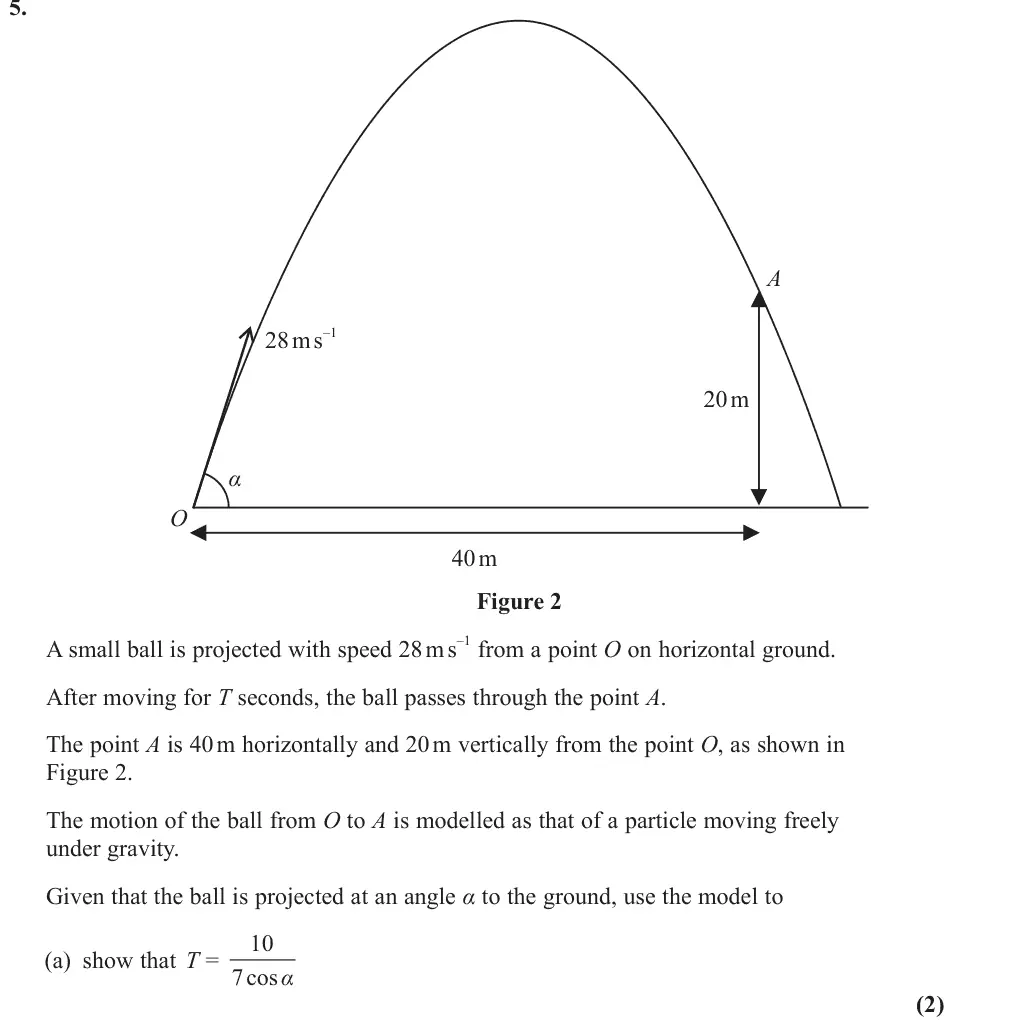
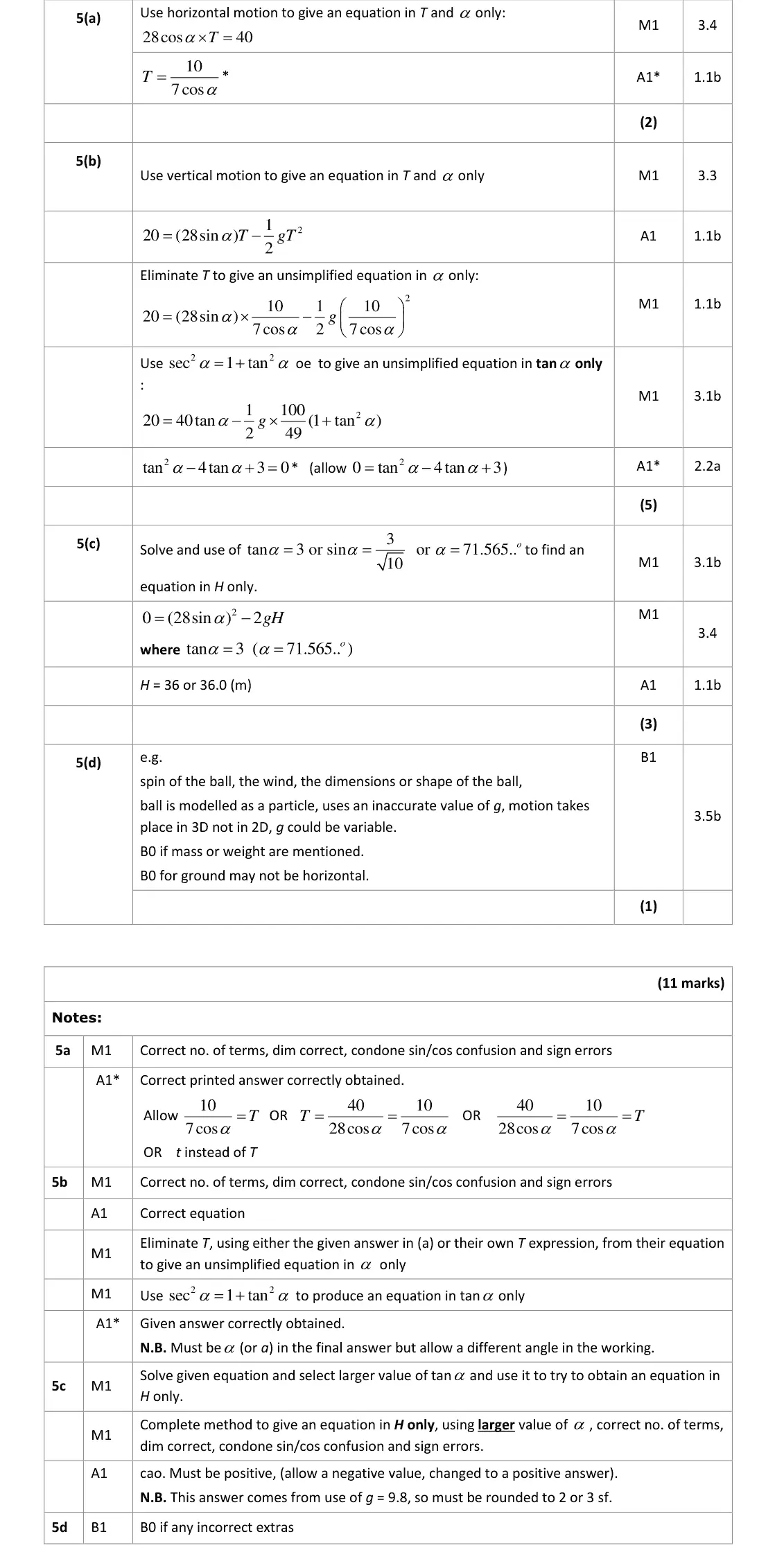
In part (a), the vast majority of candidates recognised that the horizontal component of velocity of the particle remained constant throughout the motion; this was then used, together with the horizontal distance, to form an equation in T and alpha and to derive the given result. The second part, however, provided a greater challenge and, although many occasional sign errors. They mostly then substituted the expression for T from part (a) to obtain an equation in alpha although slips were not uncommon at this stage. Those starting with different suvat equations tended to make little significant progress. To achieve the given result it was necessary to use the trig identity sec2 alpha = 1 + tan2 alpha (or equivalent work) to obtain an unsimplified quadratic equation in tan alpha before reaching the given equation. This was the main stumbling block for many and it was not unusual to see candidates make more than one attempt. Since the final equation was given and the demand of the question was “show that”, it was essential that all steps in the working were correct and the final answer was stated exactly as printed in order to achieve all the marks. In part (c) height as half the answer in part (a) or choosing sin alpha = 1 to give the maximum height in an otherwise correct suvat equation. Rounding errors were not uncommon leaving the final answer incorrect to 3 significant figures. In the final part, most candidates were able
Common mistakes
horizontal velocity 28 cos α is constant: 28 cos α × T = 40
June 2023 · Paper 3 (Mechanics) · Q5(b)5 marks
Mark scheme (whole question; this part is marked with the orange bar)
Examiner's comment
given result. The second part, however, provided a greater challenge and, although many realised that they needed to consider the vertical motion, a few did not know how to proceed, with some solving the given quadratic in tan alpha rather deriving it. However, many 1 = + 2 s ut at did make progress, using with a vertical distance of 20 although there were 2 occasional sign errors. They mostly then substituted the expression for T from part (a) to
Common mistakes
vertical motion 20 = 28 sin α T − ½gT²
eliminate T using (a)
use sec²α = 1 + tan²α to reach a quadratic in tan α
derive (not solve) the given equation and state it exactly
June 2023 · Paper 3 (Mechanics) · Q5(c)3 marks
Mark scheme (whole question; this part is marked with the orange bar)
Examiner's comment
the final answer was stated exactly as printed in order to achieve all the marks. In part (c) most candidates realised they should solve the given quadratic in tan alpha to give two possible angles of projection. Consideration of the situation should have indicated that the larger of the two angles would lead to the greatest possible height. Although many recognised that the greatest height is reached when the vertical component of velocity is zero, some chose to use the smaller 45o angle. Some found the greatest heights for both angles but then failed to select the relevant one. Other errors included using the time to greatest height as half the answer in part (a) or choosing sin alpha = 1 to give the maximum height in
Common mistakes
tan α = 1 or 3: the larger angle gives the greatest height
vertical velocity zero: 0 = (28 sin α)² − 2gH, H = 36 m
not using half the time from (a) or sin α = 1
June 2023 · Paper 3 (Mechanics) · Q5(d)1 mark
Mark scheme (whole question; this part is marked with the orange bar)
Examiner's comment
final answer incorrect to 3 significant figures. In the final part, most candidates were able to suggest an acceptable limitation of the model such as it not including spin, dimensions of the ball, effect of wind or a more accurate value for g. The most common incorrect answers were that the model did not include weight/mass of the ball and the ground was not perfectly flat which was not specified as a modelling assumption in the question.
Common mistakes
e.g. spin, wind, size/shape of the ball, inaccurate g
mass/weight or ground not horizontal score B0
June 2022 · Paper 3 (Mechanics) · Q5(a)6 marks
Mark scheme (whole question; this part is marked with the orange bar)
Examiner's comment
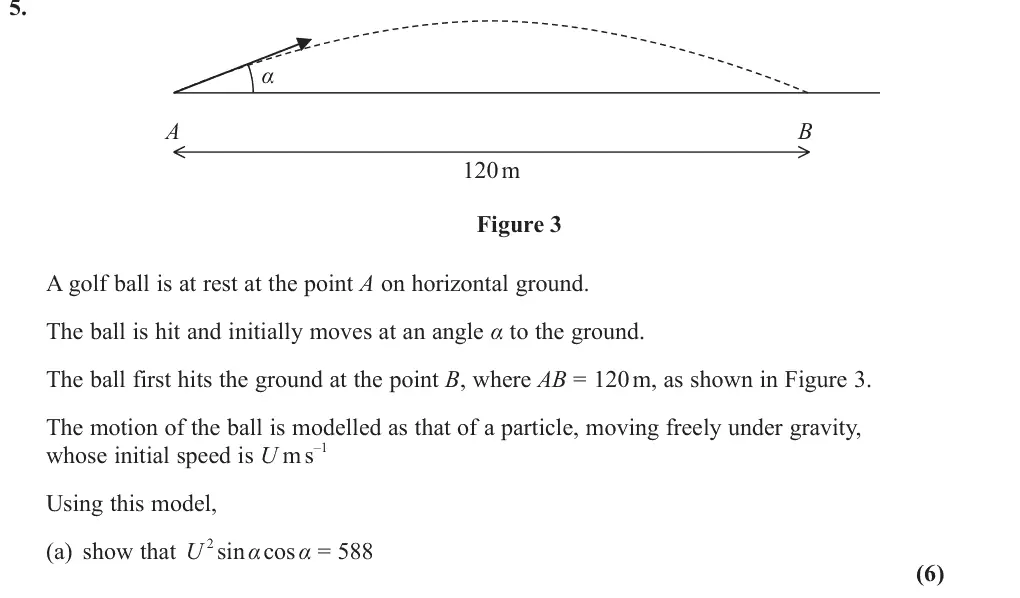
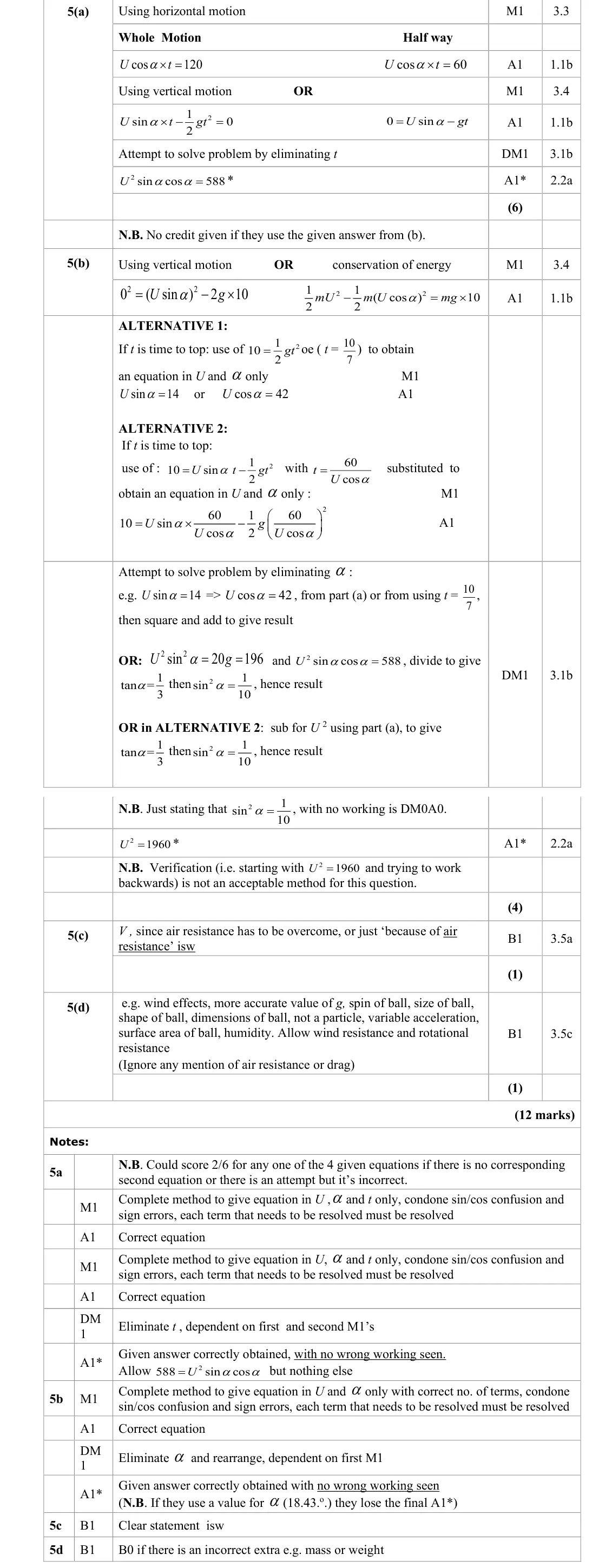
In part (a), the majority of candidates found an equation for the horizontal motion in terms of t. Most then used this to substitute t =120/Ucos alpha into 0 = Usin alpha t – ½ gt2, the vertical motion equation for the whole trajectory. This was generally rearranged to give the required answer although cancelling the common factor of t from the quadratic before substitution led to a neater solution. A minority chose to consider just half the motion with v = u + at and v = 0 at the greatest height which also led to a neat solution. Some candidates failed to identify that the vertical displacement would be zero over the whole motion, and some were inconsistent in considering the time for the whole or half trajectory. A small but surprising number of answers were seen where 120 m was used as the vertical distance. It should again be emphasised that candidates, when required to derive a given result, should write the final answer in exactly the same form as that stated in the question. In the second part, many candidates correctly arrived at an equation in from part (a) and, of those who did, some struggled with the required algebra. Many who correctly identified the value of alpha as tan-1 (1/3) used the decimal value for the angle in degrees rather than calculating an exact value for sin alpha with which to substitute, and lost the final mark. A few candidates set up an equation by using s = ut + ½at2 with s = 10 and substituting in the time to travel 60 m horizontally, but again had trouble finishing off for the last 2 marks having more difficulty with the slightly more complicated algebra required. Part (c) required a comparison of the initial velocity in the model without air
Common mistakes
horizontal U cos α × t = 120 and vertical U sin α × t − ½gt² = 0 (or half-way with 0 = U sin α − gt and 60 m)
eliminate t
inconsistent whole/half times
120 m used as a vertical distance
final line must match the given answer
June 2022 · Paper 3 (Mechanics) · Q5(b)4 marks
Mark scheme (whole question; this part is marked with the orange bar)
Examiner's comment
in the question. In the second part, many candidates correctly arrived at an equation in Usin alpha using v2 = u2 + 2as although a failure to resolve the vertical velocity giving U2 = 196 was not uncommon. Most were unable to progress further and so only gained 2 out of a possible 4 marks. For example, they just left it there or found the “correct” answer without any justification for the value of alpha . Some did not realise they could use the answer from part (a) and, of those who did, some struggled with the required algebra. Many who
Common mistakes
0 = (U sin α)² − 2g × 10 (not U² = 196 unresolved)
divide by the result of (a) to get tan α = 1/3 then exact sin²α = 1/10
using α = 18.43° loses the final mark
verification from U² = 1960 not accepted
June 2022 · Paper 3 (Mechanics) · Q5(c)1 mark
Mark scheme (whole question; this part is marked with the orange bar)
Examiner's comment
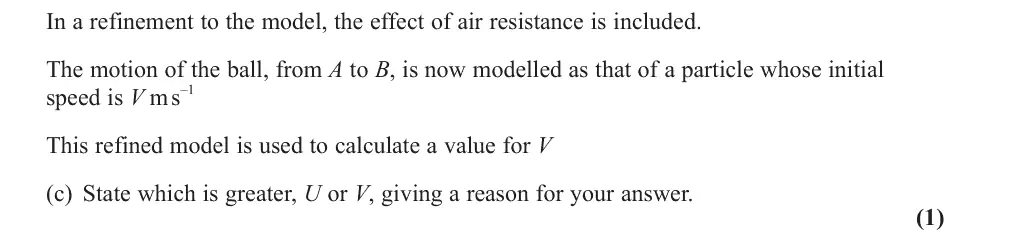
required. Part (c) required a comparison of the initial velocity in the model without air resistance (U) and the initial velocity in a model which took account of air resistance (V). Since the horizontal range and greatest height were fixed, the expected answer was that V > U as air resistance would have to be overcome. However, it was very common to see ‘U is greater because air resistance will decrease the velocity’ or something similar. A few perhaps confused V with the final speed and so said that U would be greater as air resistance would slow the final speed down. A correct possible refinement was often given in part (d). The most common correct suggestions were to take spin into account,
Common mistakes
V is greater because air resistance must be overcome to reach the same range and height
common wrong answer: U greater because air resistance slows the ball
June 2022 · Paper 3 (Mechanics) · Q5(d)1 mark
Mark scheme (whole question; this part is marked with the orange bar)
Examiner's comment
given in part (d). The most common correct suggestions were to take spin into account, consider the effect of wind or to model the particle as having dimensions. A fair number of candidates incorrectly believed that considering mass or weight was an acceptable answer and that a particle has no mass. Others made suggestions regarding the ground not being level but this, however, was not part of the model as defined in the question.
Common mistakes
e.g. spin, wind, size or shape of the ball (not a particle), more accurate g
an incorrect extra such as mass or weight gets B0
air resistance already included
uneven ground is not part of the model
Oct 2021 · Paper 3 (Mechanics) · Q4(a)4 marks
Mark scheme (whole question; this part is marked with the orange bar)
Examiner's comment
Candidates were instructed to use g = 10 in this question but were only penalised once if another value was used. In part (a), the majority of successful candidates employed the 1 most efficient method using a single application of to find the time to the 2 s ut at = + 2 ground. Other successful methods found the time to the top of the flight and then the time to go from the top to the ground and added. However, sign errors were common resulting candidates who used 𝑣𝑣2 = 𝑢𝑢2 + 2𝑎𝑎𝑎𝑎 to find the vertical component of velocity of the in 2/4 marks being scored for this part. A few candidates did not resolve the speed of 65 m s-. This lost the M mark and consequently they scored zero for part (a). In part (b), 1 particle at A were generally more successful than those who used the time found in part (a). Many solutions finished here and did not consider the need to look at the horizontal component as well. Those who had both components usually went on to apply Pythagoras theorem and calculate the actual speed of 75 m s-. For part (c), there were several 1
Common mistakes
resolve the 65: vertical component 65 sin α = 25 (tan α = 5/12)
s = ut + ½at² vertically with s = −70 and g = 10 (sign errors common)
up-and-down methods possible
t = 7 s
Oct 2021 · Paper 3 (Mechanics) · Q4(b)5 marks
Mark scheme (whole question; this part is marked with the orange bar)
Examiner's comment
Candidates were instructed to use g = 10 in this question but were only penalised once if candidates who used 𝑣𝑣2 = 𝑢𝑢2 + 2𝑎𝑎𝑎𝑎 to find the vertical component of velocity of the in 2/4 marks being scored for this part. A few candidates did not resolve the speed of 65 m s-. This lost the M mark and consequently they scored zero for part (a). In part (b), 1 particle at A were generally more successful than those who used the time found in part (a). Many solutions finished here and did not consider the need to look at the horizontal component as well. Those who had both components usually went on to apply Pythagoras theorem and calculate the actual speed of 75 m s-. For part (c), there were several 1
Common mistakes
need both components: horizontal 65 cos α = 60 (often omitted) and vertical 45 (v² = u² + 2as is more reliable than using t)
Pythagoras gives 75 m/s
Oct 2021 · Paper 3 (Mechanics) · Q4(c)1 mark
Mark scheme (whole question; this part is marked with the orange bar)
Examiner's comment
Candidates were instructed to use g = 10 in this question but were only penalised once if theorem and calculate the actual speed of 75 m s-. For part (c), there were several 1 possible answers, and candidates should always focus their attention on refining the model that has been used, in this case g = 10 and the stone being modelled as a particle i.e. the dimensions of the particle ignored (not the mass of the particle, which was a common wrong answer). Candidates should note that they should concentrate on giving a single correct answer to this type of question as extra incorrect answer(s) will lose the mark. The most common correct answer was ‘to use a more accurate value for g’.
Common mistakes
e.g. g = 10 is approximate (use a more accurate g), dimensions/shape/spin of the stone, wind
mass of the stone is a common wrong answer
incorrect extras score B0
Oct 2020 · Paper 3 (Mechanics) · Q5(a)6 marks
Mark scheme (whole question; this part is marked with the orange bar)
Examiner's comment
In part (a), many candidates made some valid progress in creating horizontal and vertical distance equations in terms of t and U. Most tried to eliminate or find t to solve for U but sometimes lacked systematic working and gave up before reaching an answer or simply stated the given answer following incorrect or incomplete work. Those who did not complete a solution for U could go on to gain full marks for part (b) which was generally
Common mistakes
horizontal U cos 45° t = 100 and vertical U sin 45° t − ½gt² = −25 (sign of the 25)
eliminate t systematically to reach U = 28
no approximations or g = 9.81
Oct 2020 · Paper 3 (Mechanics) · Q5(b)3 marks
Mark scheme (whole question; this part is marked with the orange bar)
Examiner's comment
complete a solution for U could go on to gain full marks for part (b) which was generally well attempted. Nearly all recognised that the vertical velocity was zero at the highest point. A few failed to use the vertical component of U and so did not achieve the method mark. Others assumed the highest point occurred when the horizontal distance was 50 m, half the range, which was not the case here since the start and end points were not on the same level. The most common error was in giving the answer as a height above the level of projection rather than above ground level. For part (c) there were certain statements
Common mistakes
vertical velocity zero at the top: 0 = (28 sin 45°)² − 2gh gives 20 m
add the 25 m cliff, answer 45 m above the ground
use the vertical component of U
the top is not at half the range (50 m)
Oct 2020 · Paper 3 (Mechanics) · Q5(c)1 mark
Mark scheme (whole question; this part is marked with the orange bar)
Examiner's comment
of projection rather than above ground level. For part (c) there were certain statements in the question that were not part of the model. These included that AN =100 m. Therefore, if air resistance were included in the model, the ball would have to be thrown with a speed greater than 28 if it were to still reach the same point, A. The vast majority of candidates failed to realise this with most stating that it would be less. Although a reason was not required for the mark, many stated that it would be less because air resistance slows the ball down; however, this should have led to the conclusion that U should be greater and not less than 28. In part (d) one refinement, apart from air resistance, was required for this
Common mistakes
AN = 100 m is fixed, so with air resistance U must be greater than 28
most wrongly said less
incorrect extras are penalised
Oct 2020 · Paper 3 (Mechanics) · Q5(d)1 mark
Mark scheme (whole question; this part is marked with the orange bar)
Examiner's comment
not less than 28. In part (d) one refinement, apart from air resistance, was required for this final mark. The most popular acceptable answers were to include spin, wind effects, use a more accurate value for g, take account of the size of the ball. The most common wrong answer was to take account of the mass/weight of the ball. Also, comments about the ground not being exactly horizontal or the angle of projection not exactly 45o did not relate to this specific model. It should be remembered that, when only one refinement is required, any extra answers would all have to be correct for the mark to be awarded.
Common mistakes
e.g. spin, wind, more accurate g, size or shape of the ball (not a particle)
not air resistance (already included)
mass or weight of the ball, ground not horizontal, cliff not vertical score B0
extra wrong answers lose the mark
June 2019 · Paper 3 (Mechanics) · Q5(a)6 marks
Mark scheme (whole question; this part is marked with the orange bar)
Examiner's comment
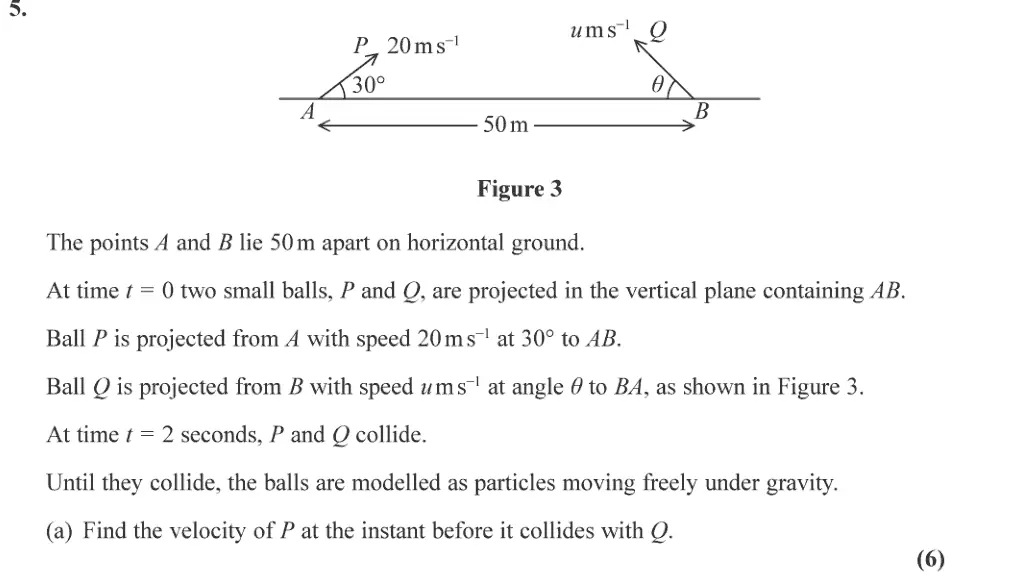
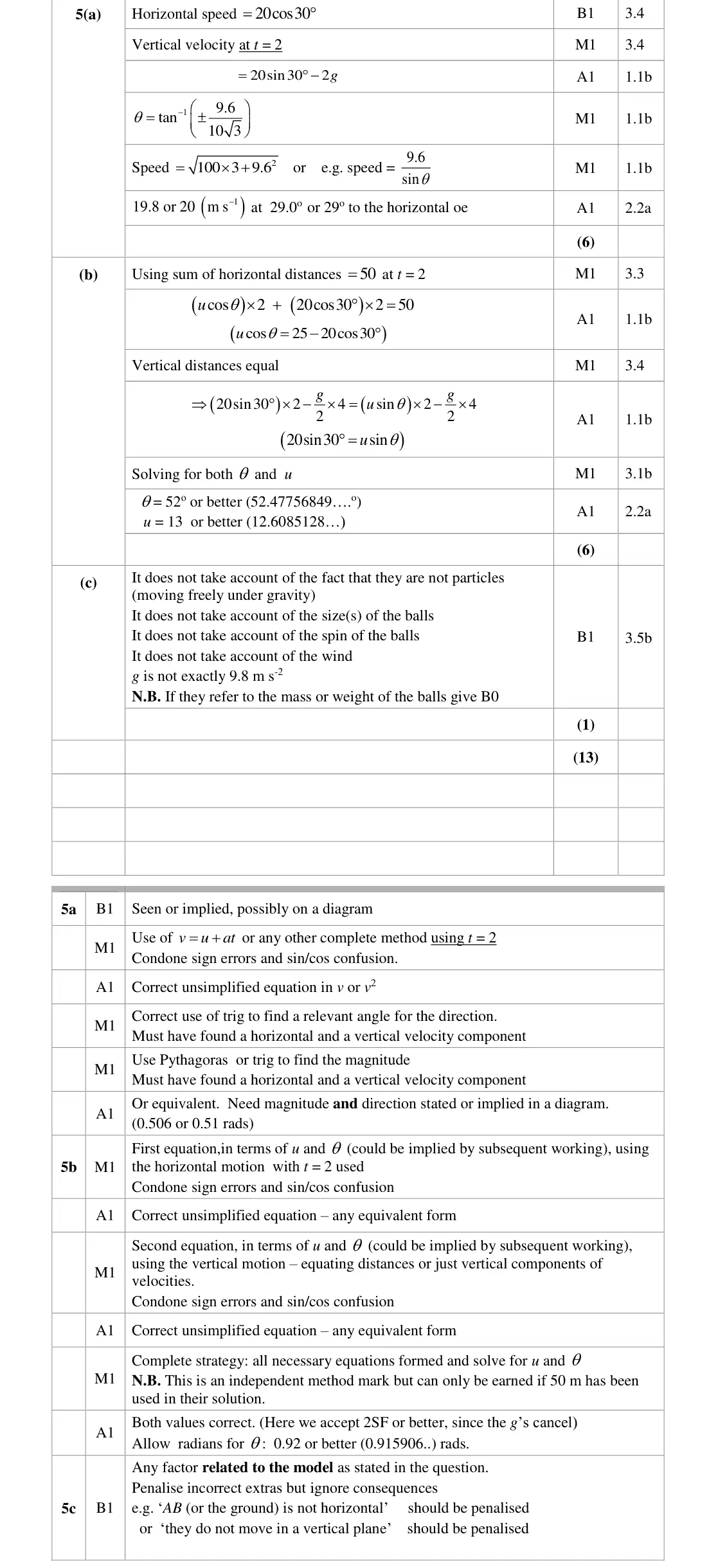
In part (a), the majority of candidates obtained the first mark for the horizontal component and most candidates also made a good attempt to find the vertical component, although sometimes it was seen as part of their working for part (b). Of those who found the horizontal and vertical components of the
need both speed (19.8 m/s) and direction (29° below horizontal)
do not give the answer in i and j (not defined)
June 2019 · Paper 3 (Mechanics) · Q5(b)6 marks
Mark scheme (whole question; this part is marked with the orange bar)
Examiner's comment
part of their working for part (b). Of those who found the horizontal and vertical components of the velocity, only a proportion proceeded to calculate the speed and of those, very few found the direction. This was despite the clear lead from the question which had given each velocity as a speed with a direction. A sizeable minority broke the universal rule that answers must be given in terms of quantities which are given in the question, giving their velocity in terms of i and j, which had not been defined in this question. The second part proved to be quite discriminating although a significant number of candidates did successfully find the correct values of both and u. The most common error was for candidates to simply equate both the horizontal and vertical displacements at the time of collision and ignore the 50 m horizontal distance altogether. Others assumed that the particles met halfway between A and B. However, only a minority of candidates made errors when resolving their velocities. In the final part, a substantial number of candidates correctly identified a limitation of the model with the size
Common mistakes
horizontal distances sum to 50 m at t = 2 (not equal, not meeting halfway)
vertical displacements equal gives u sin θ = 20 sin 30°
θ = 52°, u = 12.6
June 2019 · Paper 3 (Mechanics) · Q5(c)1 mark
Mark scheme (whole question; this part is marked with the orange bar)
Examiner's comment
final part, a substantial number of candidates correctly identified a limitation of the model with the size of the balls being the most common response. Wind, spin and an inaccurate value for g were also relatively common. A significant number lost the mark by referring to mass or weight and some referred to air resistance even though the question specified “other than air resistance’’.
Common mistakes
e.g. size of the balls, spin, wind, g not exactly 9.8
not air resistance (excluded)
mass or weight of the balls scores B0
June 2018 · Paper 3 · Q10(a)2 marks
Mark scheme (whole question; this part is marked with the orange bar)
Examiner's comment
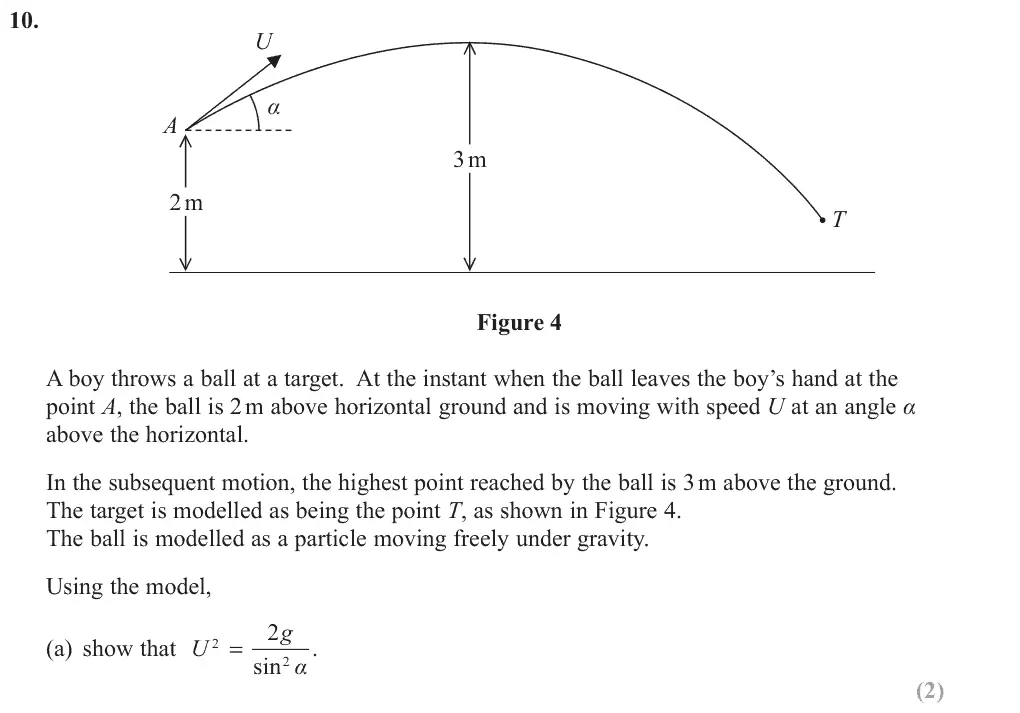
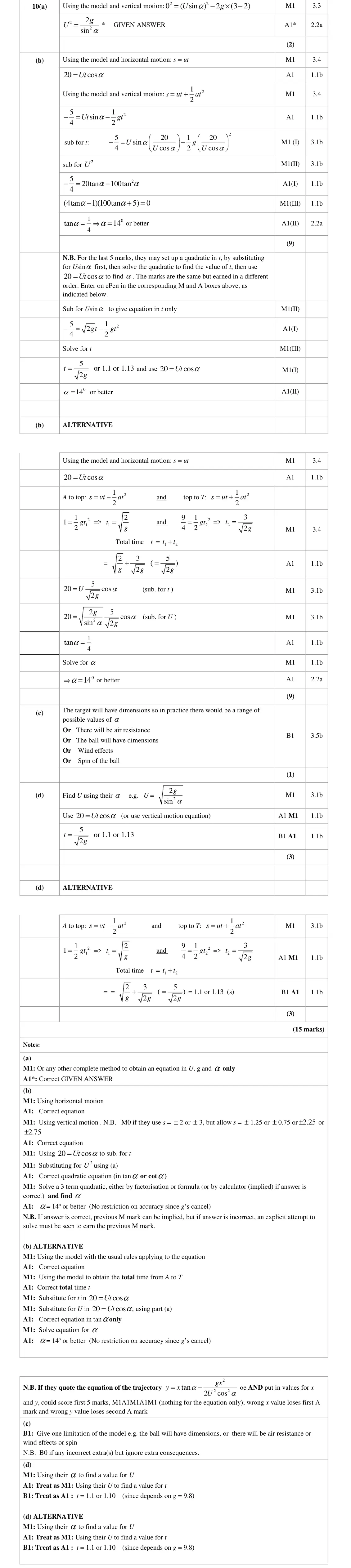
In the first part, the majority of candidates used ‘v2 = u2 + 2as’ with a correct distance to derive the given expression for U2. A few attempted equations involving t but not always successfully. In part
Common mistakes
vertical motion to the top: 0 = (U sin α)² − 2g(3 − 2)
distance 1 m, not 3
June 2018 · Paper 3 · Q10(b)9 marks
Mark scheme (whole question; this part is marked with the orange bar)
Examiner's comment
(b), most started with the valid strategy of using horizontal and vertical equations (s = ut + 1/2at2). Not all included the appropriate correct distance (-1.25) and there were occasional sign errors. By substituting for t and then for U (using the expression from (a)) it was possible to obtain a quadratic equation in tan alpha . Not all attempts were successful, with errors in simplification leading to equations with a variety of trig functions or else not quadratics. Alternatively, rather than substituting for t and U in the original equation, a quadratic in t could be found by an initial substitution for Usin alpha . The resulting value of t could then be used in ’20 = Utcos alpha ’ to find alpha . This method was seen successfully employed on occasion. Similarly, the motion could be split into two stages and the times to and from the highest points found. This approach was only very rarely seen. Some candidates made several attempts at this part of the question; it is worth remembering that if none are crossed out only the last most complete solution will be credited. Reference to air resistance was by far the most common correct response about the limitations of the model in part (c). Other valid comments relating to spin, dimensions of the ball and wind effects were
Common mistakes
20 = Ut cos α and −1.25 = Ut sin α − ½gt² (vertical displacement −1.25, not ±2 or ±3)
substitute for t and U² to get quadratic 400tan²α − 80tan α − 5 = 0 (or in t), tan α = 1/4, α = 14°
sign errors and simplification errors common
June 2018 · Paper 3 · Q10(c)1 mark
Mark scheme (whole question; this part is marked with the orange bar)
Examiner's comment
model in part (c). Other valid comments relating to spin, dimensions of the ball and wind effects were all seen on occasion. Most candidates who offered an answer managed to score the mark with comments such as ‘the ball might hit something’ or ‘it is difficult to throw at exactly that angle’ being only very rarely seen. Those who attempted part (d) generally used a correct method to find the time, most commonly using
Common mistakes
air resistance, wind, spin, dimensions of ball or target
any incorrect extra limitation is B0
June 2018 · Paper 3 · Q10(d)3 marks
Mark scheme (whole question; this part is marked with the orange bar)
Examiner's comment
Those who attempted part (d) generally used a correct method to find the time, most commonly using their value of alpha to find U and then to find t (from 20 = Utcos alpha ). An incorrect value of alpha carried forward meant 2 out of a possible 3 marks could be achieved. Some reverted to the vertical motion equation and calculated t from the quadratic. Others made no attempt at this part having presumably run out of time or having not found a value for alpha previously.
Common mistakes
find U from their α then t from 20 = Ut cos α (or two vertical stages)
t = 5/√(2g) = 1.1 s (2 s.f. since g = 9.8)
Find an Edexcel maths tutor
Stuck on this? Book a trial session with an Edexcel specialist.