Oct 2020: AS AS Paper 2 Section B: Mechanics

30 marks · 10 question parts · Question paper, mark scheme and examiner's report on Pearson's site

Question by question

QTopicMarksDifficulty
1(a) Constant acceleration (SUVAT), Forces, Newton's laws and connected particles 2 —
1(b) Constant acceleration (SUVAT) 2 —
1(c) Constant acceleration (SUVAT), Quadratics and the discriminant 4 —
1(d) Kinematics: language and graphs 2 —
1(e) Forces, Newton's laws and connected particles, Constant acceleration (SUVAT) 1 —
1(f) Forces, Newton's laws and connected particles 1 —
2(a) Forces, Newton's laws and connected particles 8 —
2(b) Forces, Newton's laws and connected particles 1 —
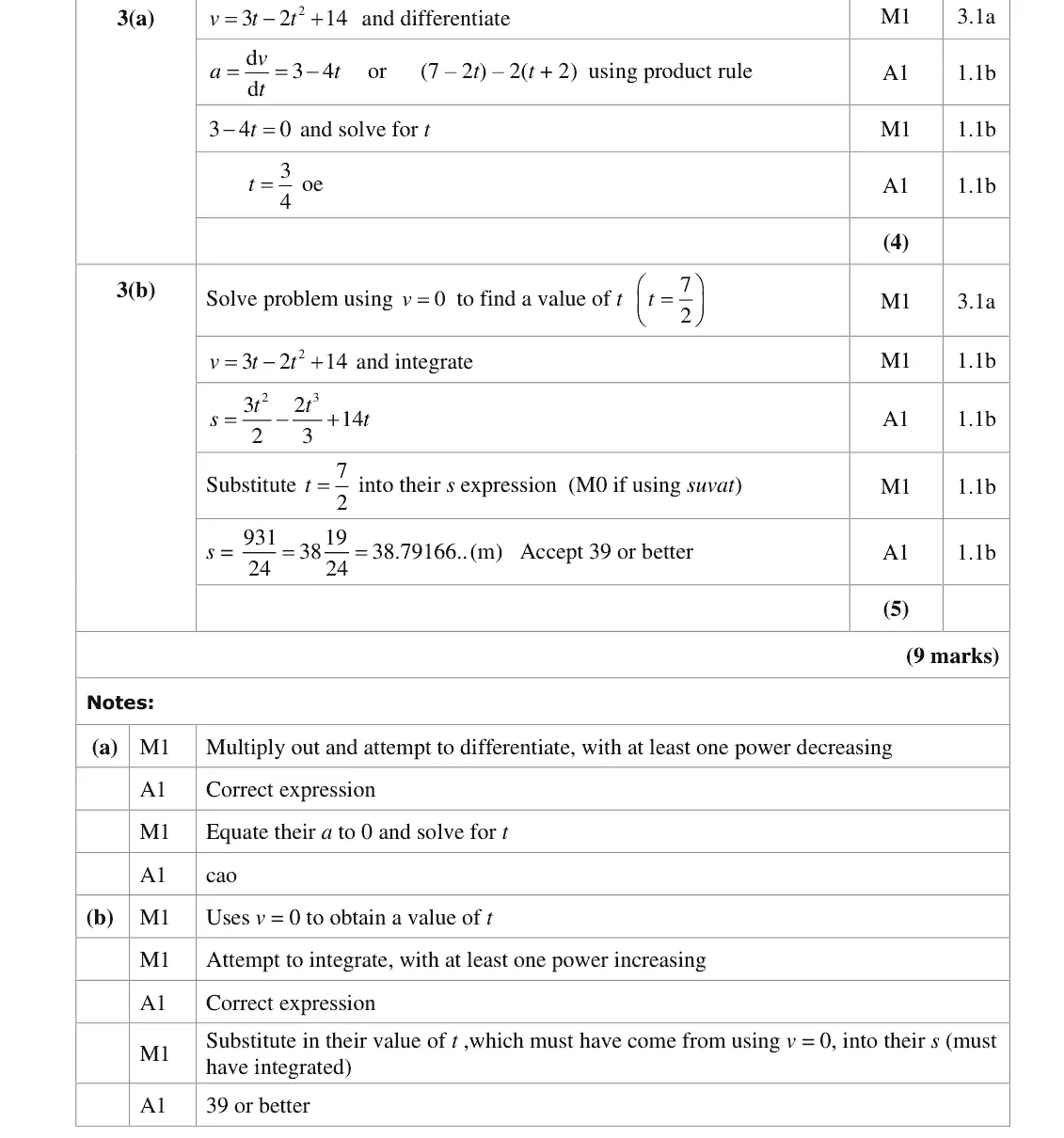
3(a) Variable acceleration, Algebraic methods: polynomials, factor theorem and division, Differentiation: first principles, gradients, stationary points 4 —
3(b) Variable acceleration, Quadratics and the discriminant, Integration: standard integrals, definite integrals and areas 5 —

The questions

1(a)1(b)1(c)1(d)1(e)1(f)2(a)2(b)3(a)3(b)
Oct 2020 · AS Paper 2 (Mechanics) · Q1(a) 2 marks constant accelerationforces and newtons laws
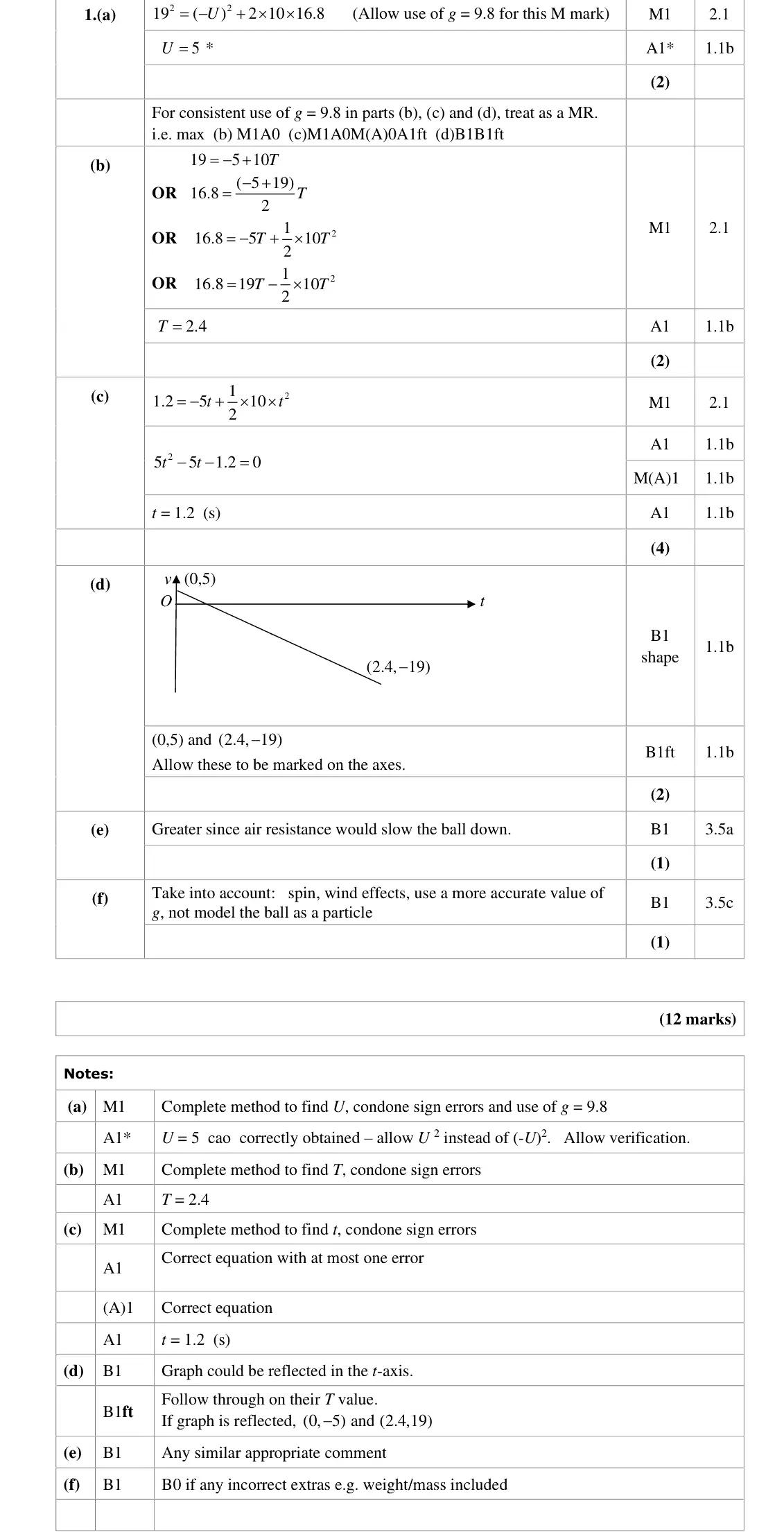
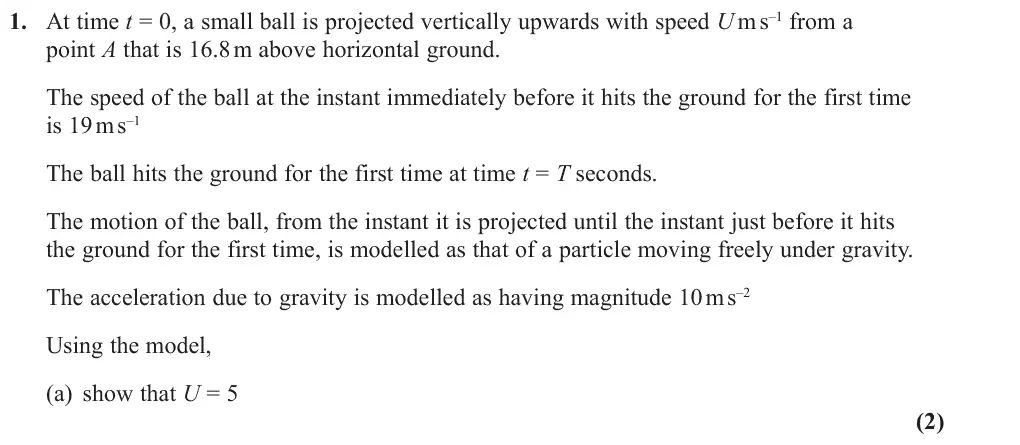
1. At time t = 0, a small ball is projected vertically upwards with speed U m s–1 from a point A that is 16.8 m above horizontal ground. The speed of the ball at the instant immediately before it hits the ground for the first time is 19 m s–1 The ball hits the ground for the first time at time t = T seconds. The motion of the ball, from the instant it is projected until the instant just before it hits the ground for the first time, is modelled as that of a particle moving freely under gravity. The acceleration due to gravity is modelled as having magnitude 10 m s–2 Using the model, (a) show that U = 5 (2)
Oct 2020 · AS Paper 2 (Mechanics) · Q1(b) 2 marks constant acceleration
(b) find the value of T, (2)
Oct 2020 · AS Paper 2 (Mechanics) · Q1(c) 4 marks constant accelerationquadratics
(c) find the time from the instant the ball is projected until the instant when the ball is 1.2 m below A. (4)
Oct 2020 · AS Paper 2 (Mechanics) · Q1(d) 2 marks kinematics
(d) Sketch a velocity‑time graph for the motion of the ball for 0 t T, stating the coordinates of the start point and the end point of your graph. (2)
Oct 2020 · AS Paper 2 (Mechanics) · Q1(e) 1 mark forces and newtons lawsconstant acceleration
In a refinement of the model of the motion of the ball, the effect of air resistance on the ball is included and this refined model is now used to find the value of U. (e) State, with a reason, how this new value of U would compare with the value found in part (a), using the initial unrefined model. (1)
Oct 2020 · AS Paper 2 (Mechanics) · Q1(f) 1 mark forces and newtons laws
(f) Suggest one further refinement that could be made to the model, apart from including air resistance, that would make the model more realistic. (1)
Oct 2020 · AS Paper 2 (Mechanics) · Q2(a) 8 marks forces and newtons laws
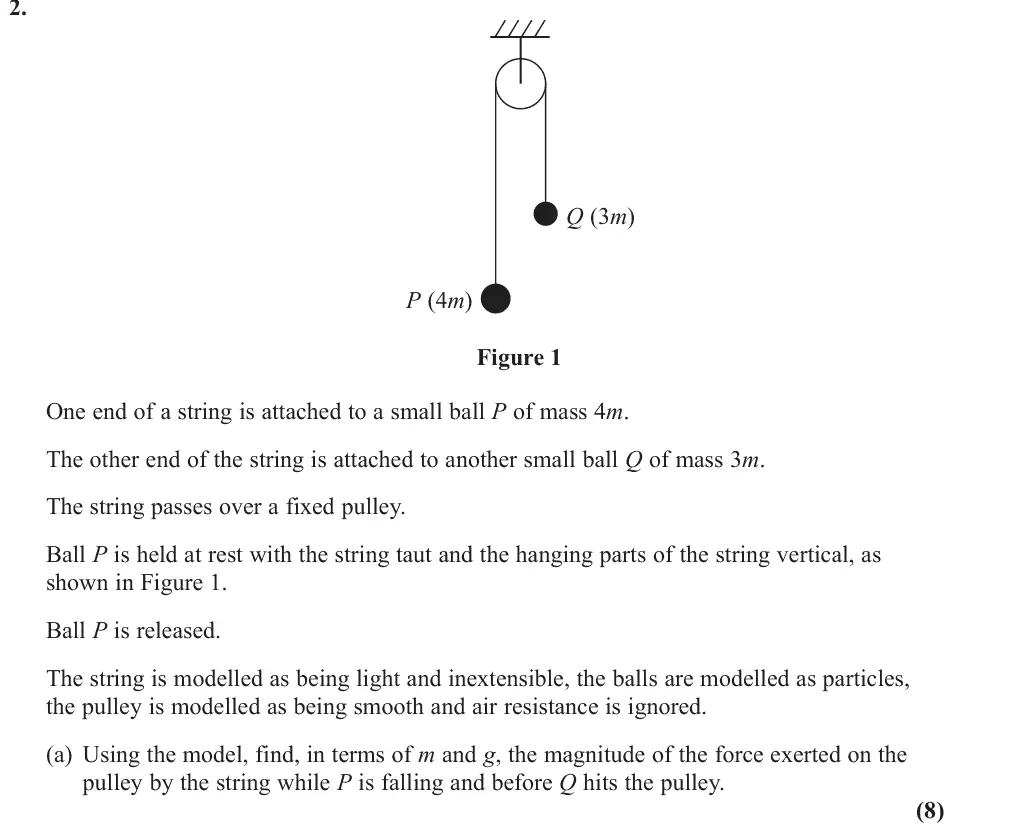
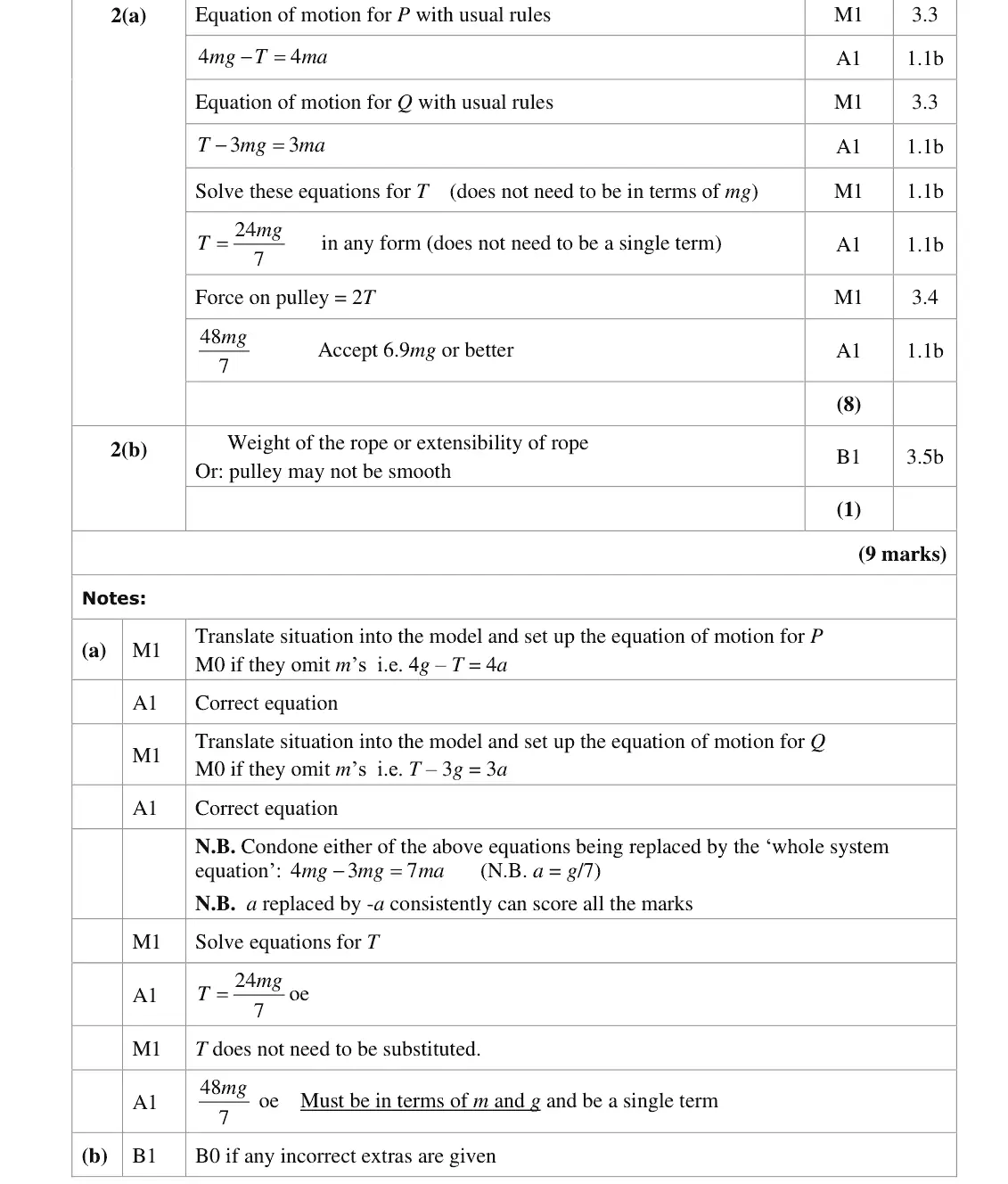
2. Q (3m) P (4m) Figure 1 One end of a string is attached to a small ball P of mass 4m. The other end of the string is attached to another small ball Q of mass 3m. The string passes over a fixed pulley. Ball P is held at rest with the string taut and the hanging parts of the string vertical, as shown in Figure 1. Ball P is released. The string is modelled as being light and inextensible, the balls are modelled as particles, the pulley is modelled as being smooth and air resistance is ignored. (a) Using the model, find, in terms of m and g, the magnitude of the force exerted on the pulley by the string while P is falling and before Q hits the pulley. (8)
Oct 2020 · AS Paper 2 (Mechanics) · Q2(b) 1 mark forces and newtons laws
(b) State one limitation of the model, apart from ignoring air resistance, that will affect the accuracy of your answer to part (a). (1)
Oct 2020 · AS Paper 2 (Mechanics) · Q3(a) 4 marks variable accelerationalgebraic methodsdifferentiation
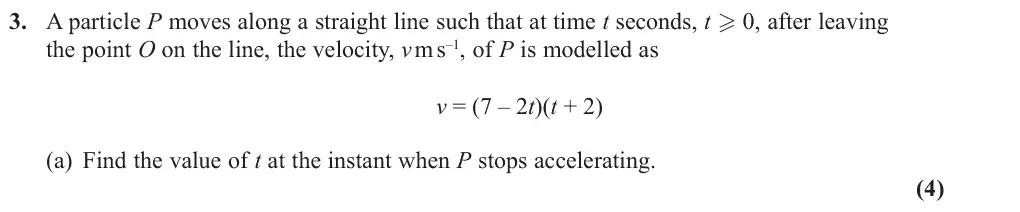
3. A particle P moves along a straight line such that at time t seconds, t 0, after leaving the point O on the line, the velocity, v m s–1, of P is modelled as v = (7 – 2t)(t + 2) (a) Find the value of t at the instant when P stops accelerating. (4)
Oct 2020 · AS Paper 2 (Mechanics) · Q3(b) 5 marks variable accelerationquadraticsintegration
(b) Find the distance of P from O at the instant when P changes its direction of motion. (5)

Find an Edexcel maths tutor

Want this paper marked and gone through with you? Message us.

Prefer email? Send an enquiry

If you are under 18, please include a parent's contact details. Enquiries go to enquiries@mathsaleveltutor.com and are deleted once handled.