Mark scheme (whole question; this part is marked with the orange bar)
Examiner's comment
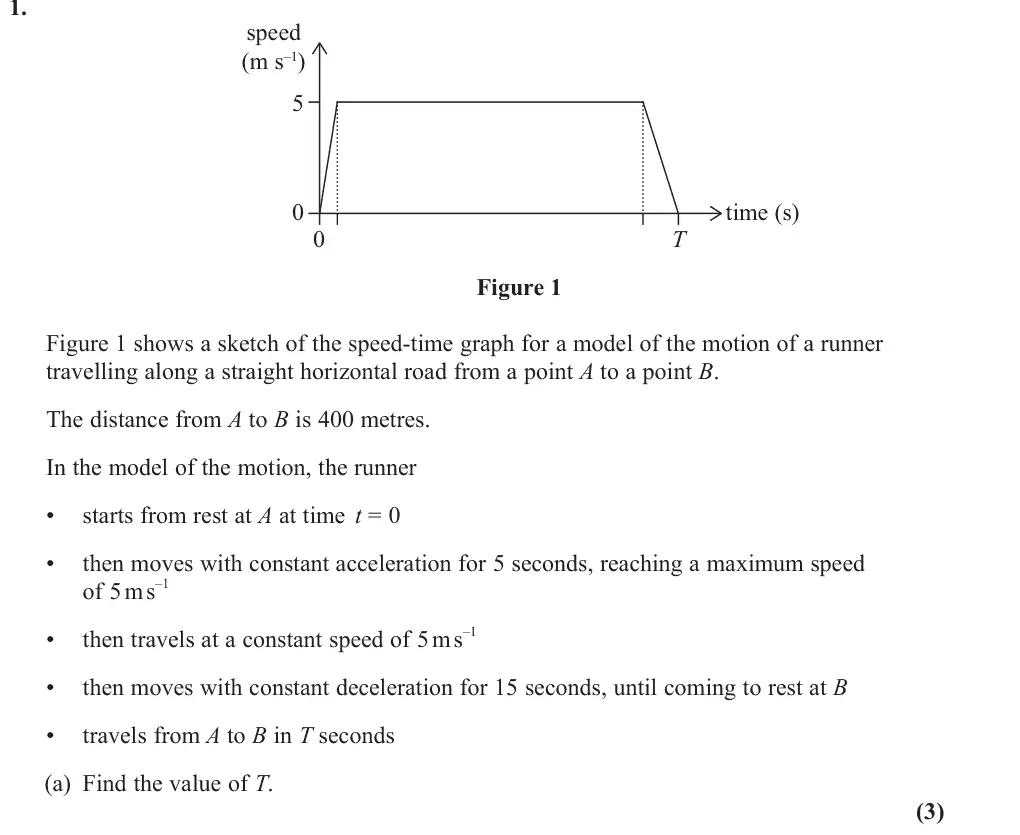
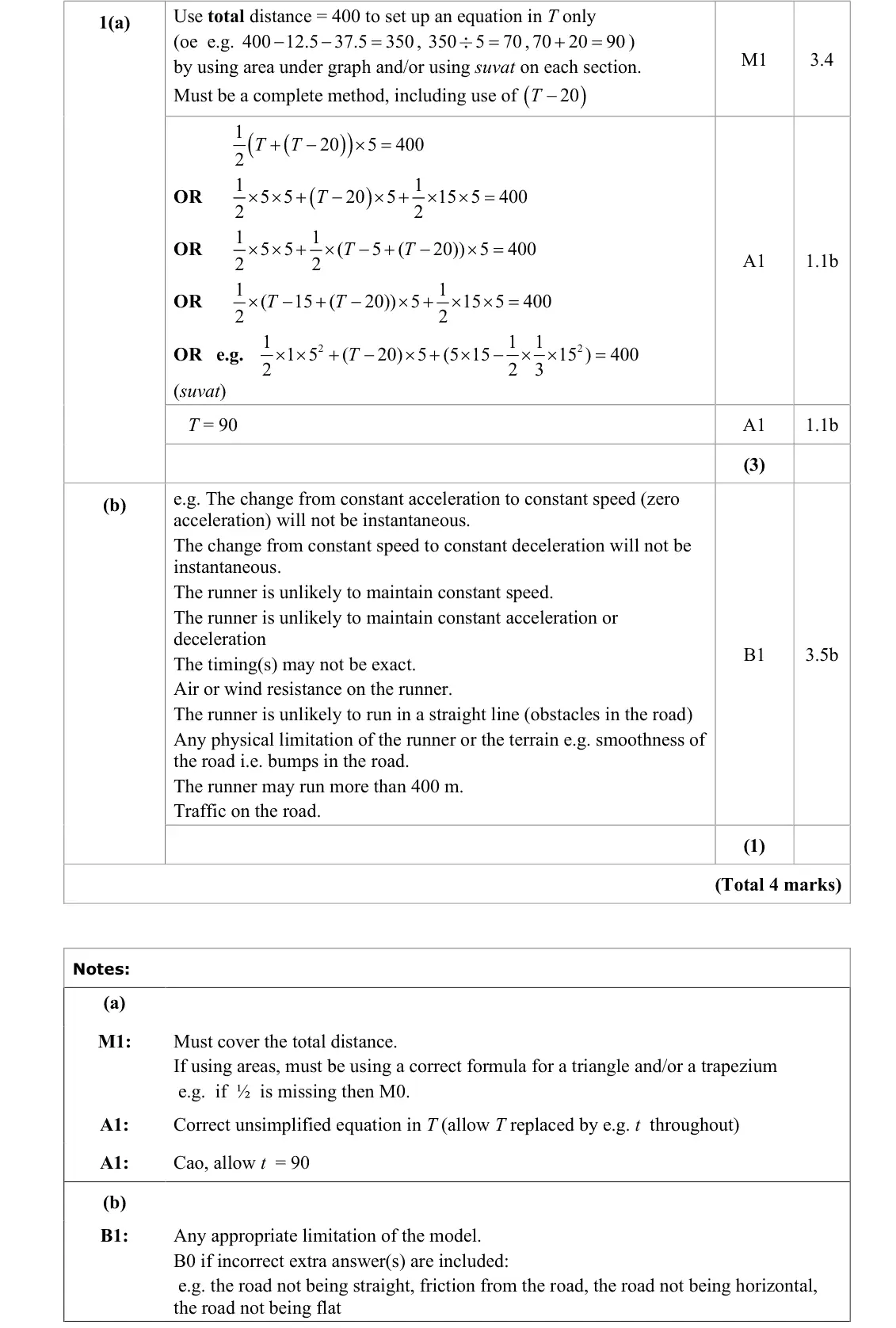
In part (a), the majority of candidates made an attempt to equate the area under the graph to the distance covered. Some used the formula for the area of a trapezium to form an equation in T but the parallel sides were not always identified correctly as T and (T -20). However, the most common approach was to use the area of a triangle, rectangle and triangle respectively for each of the three stages of the motion. Many who used this approach found the time for the constant speed was 70 seconds and then added 5 and 15 to find T= 90 as required. Those who just left their final answer as 70 gained no credit as there was no complete method to find T. A few added the distances rather than the times to 70 showing confusion in their understanding. A small number of candidates used suvat equations for each of the three stages but those using this approach seemed more likely to make an error with one or more of the values. Occasionally attempts were seen using a single suvat equation with s = 400.
Common mistakes
- total area under the speed-time graph = 400: ½(T + (T − 20)) × 5 = 400 or triangle + rectangle + triangle gives T = 90
- the parallel sides of the trapezium are T and T − 20
- leaving 70 (the constant-speed time) scores 0
- adding distances to 70 instead of the times 5 and 15
- the ½ is needed for the M mark