June 2019: AS AS Paper 2 Section B: Mechanics

30 marks · 10 question parts · Question paper, mark scheme and examiner's report on Pearson's site

Question by question

QTopicMarksDifficulty
1(a) Forces, Newton's laws and connected particles, Constant acceleration (SUVAT) 1 —
1(b) Kinematics: language and graphs 2 —
1(c) Kinematics: language and graphs, Constant acceleration (SUVAT) 5 —
1(d) Kinematics: language and graphs, Forces, Newton's laws and connected particles 1 —
1(e) Forces, Newton's laws and connected particles 1 —
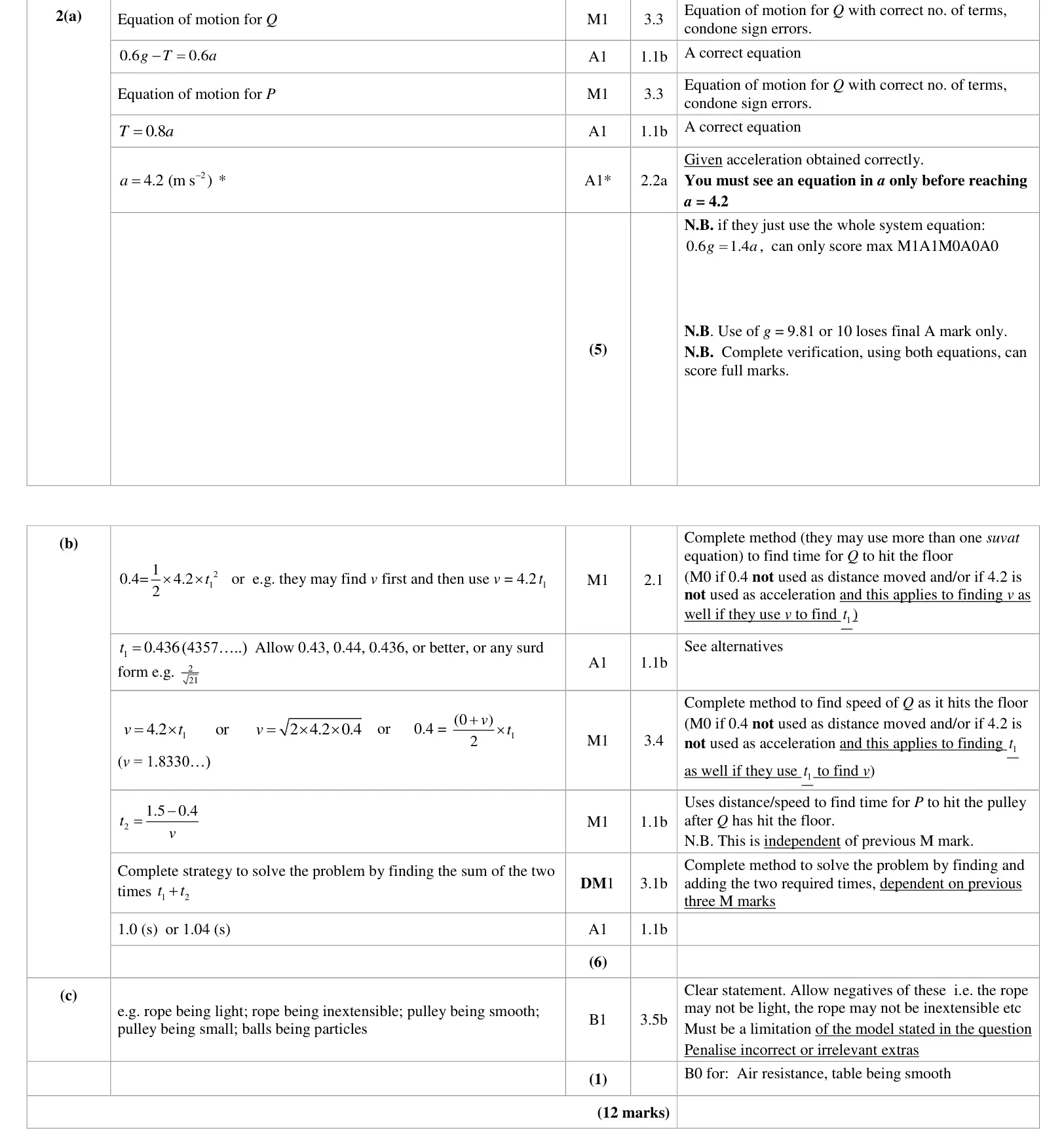
2(a) Forces, Newton's laws and connected particles 5 —
2(b) Constant acceleration (SUVAT), Forces, Newton's laws and connected particles 6 —
2(c) Forces, Newton's laws and connected particles 1 —
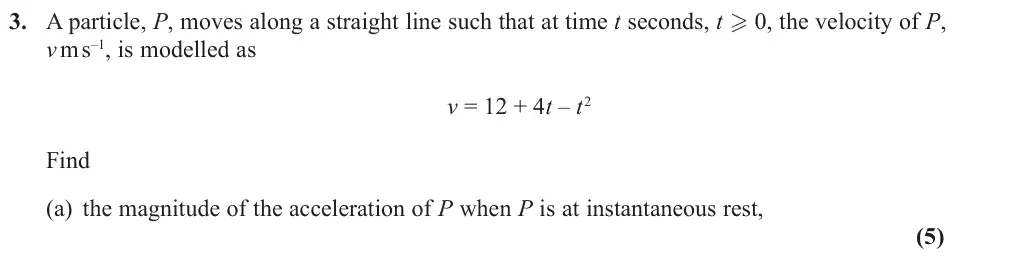
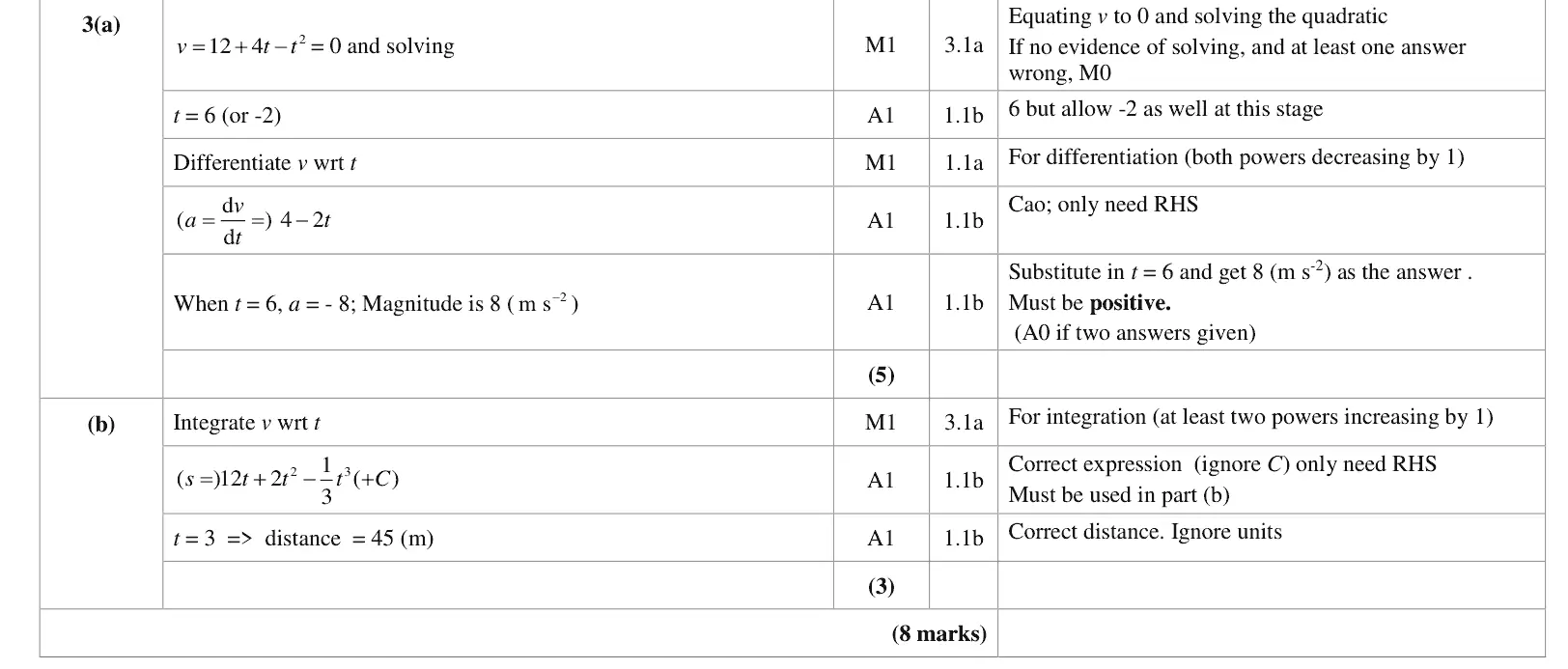
3(a) Variable acceleration, Kinematics: language and graphs, Quadratics and the discriminant, Differentiation: first principles, gradients, stationary points 5 —
3(b) Variable acceleration, Kinematics: language and graphs, Integration: standard integrals, definite integrals and areas 3 —

The questions

1(a)1(b)1(c)1(d)1(e)2(a)2(b)2(c)3(a)3(b)
June 2019 · AS Paper 2 (Mechanics) · Q1(a) 1 mark forces and newtons lawsconstant acceleration
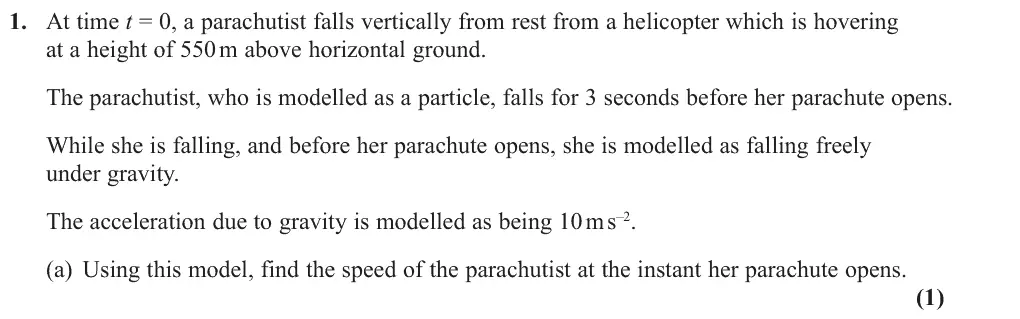
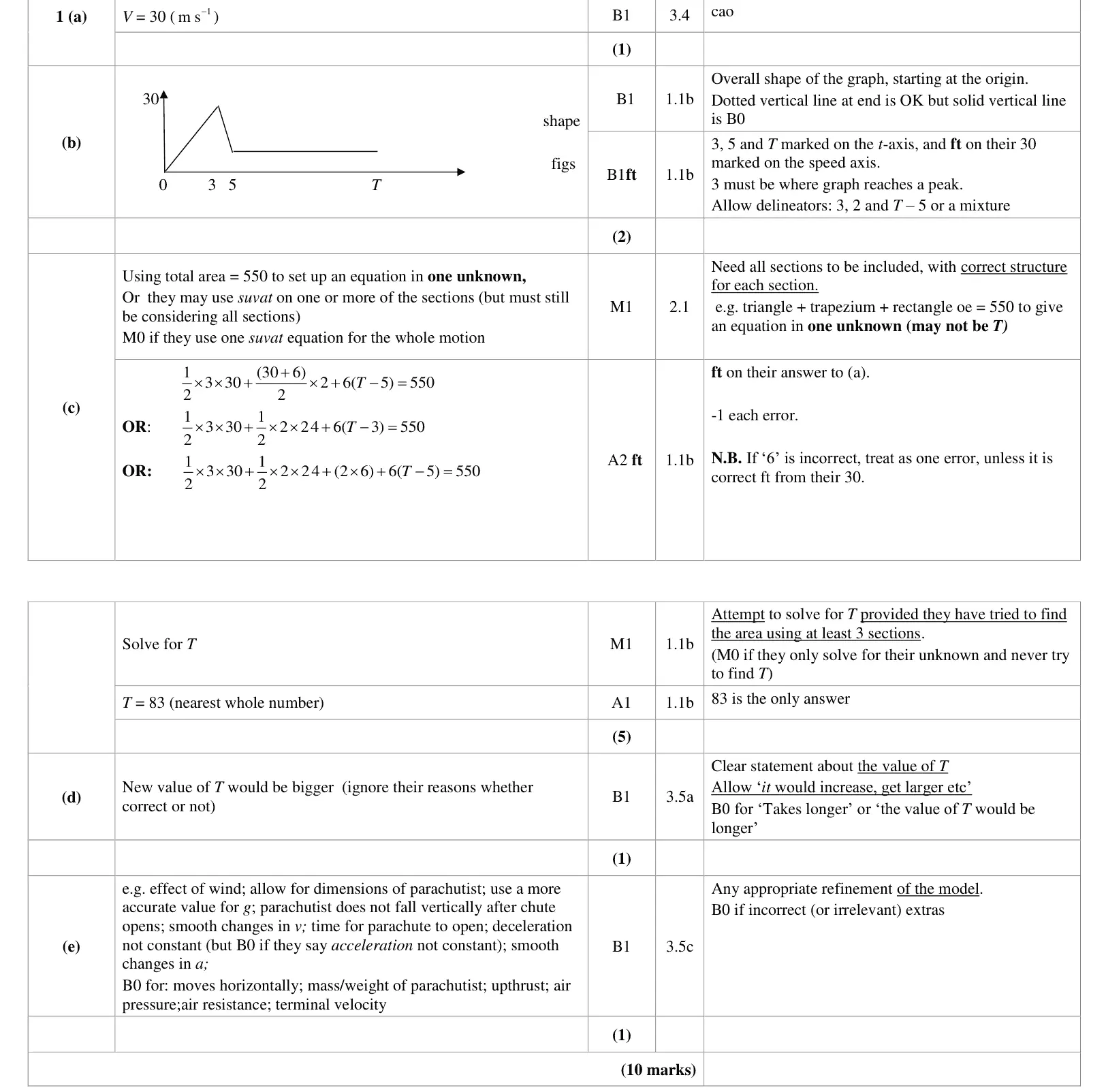
1. At time t = 0, a parachutist falls vertically from rest from a helicopter which is hovering at a height of 550 m above horizontal ground. The parachutist, who is modelled as a particle, falls for 3 seconds before her parachute opens. While she is falling, and before her parachute opens, she is modelled as falling freely under gravity. The acceleration due to gravity is modelled as being 10 m s–2. (a) Using this model, find the speed of the parachutist at the instant her parachute opens. (1)
June 2019 · AS Paper 2 (Mechanics) · Q1(b) 2 marks kinematics
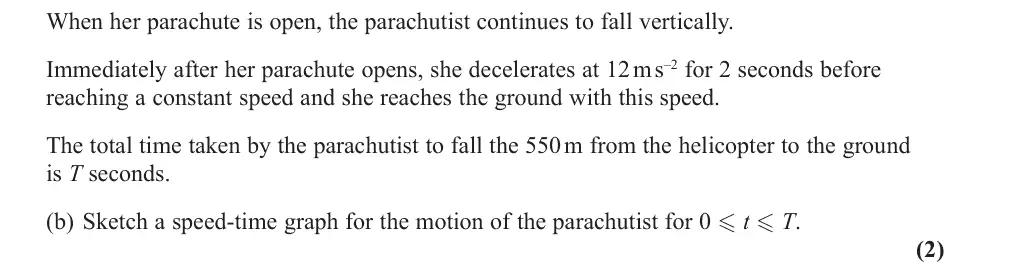
When her parachute is open, the parachutist continues to fall vertically. Immediately after her parachute opens, she decelerates at 12 m s–2 for 2 seconds before reaching a constant speed and she reaches the ground with this speed. The total time taken by the parachutist to fall the 550 m from the helicopter to the ground is T seconds. (b) Sketch a speed-time graph for the motion of the parachutist for 0 - t - T. (2)
June 2019 · AS Paper 2 (Mechanics) · Q1(c) 5 marks kinematicsconstant acceleration
(c) Find, to the nearest whole number, the value of T. (5)
June 2019 · AS Paper 2 (Mechanics) · Q1(d) 1 mark kinematicsforces and newtons laws
In a refinement of the model of the motion of the parachutist, the effect of air resistance is included before her parachute opens and this refined model is now used to find a new value of T. (d) How would this new value of T compare with the value found, using the initial model, in part (c)? (1)
June 2019 · AS Paper 2 (Mechanics) · Q1(e) 1 mark forces and newtons laws
(e) Suggest one further refinement to the model, apart from air resistance, to make the model more realistic. (1)
June 2019 · AS Paper 2 (Mechanics) · Q2(a) 5 marks forces and newtons laws
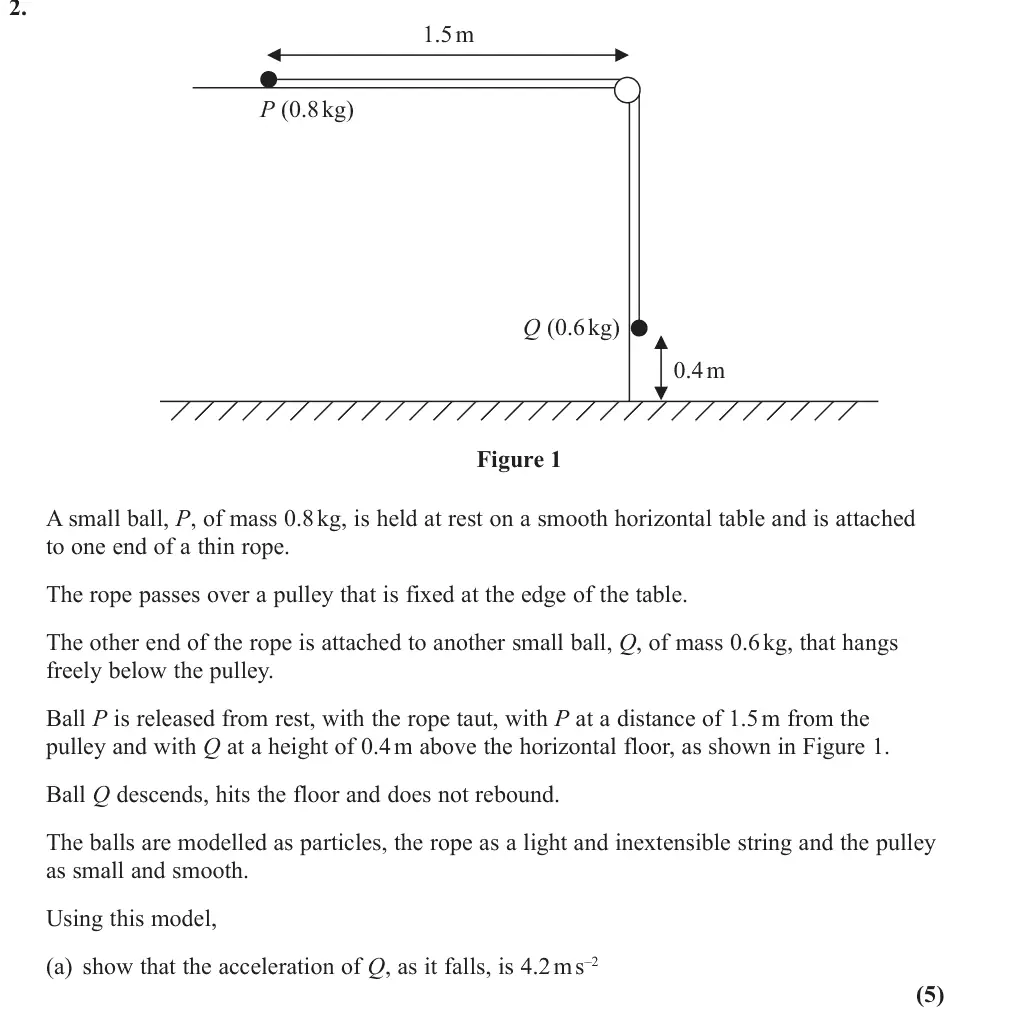
2. 1.5 m P (0.8 kg) Q (0.6 kg) 0.4 m Figure 1 A small ball, P, of mass 0.8 kg, is held at rest on a smooth horizontal table and is attached to one end of a thin rope. The rope passes over a pulley that is fixed at the edge of the table. The other end of the rope is attached to another small ball, Q, of mass 0.6 kg, that hangs freely below the pulley. Ball P is released from rest, with the rope taut, with P at a distance of 1.5 m from the pulley and with Q at a height of 0.4 m above the horizontal floor, as shown in Figure 1. Ball Q descends, hits the floor and does not rebound. The balls are modelled as particles, the rope as a light and inextensible string and the pulley as small and smooth. Using this model, (a) show that the acceleration of Q, as it falls, is 4.2 m s–2 (5)
June 2019 · AS Paper 2 (Mechanics) · Q2(b) 6 marks constant accelerationforces and newtons laws
(b) find the time taken by P to hit the pulley from the instant when P is released. (6)
June 2019 · AS Paper 2 (Mechanics) · Q2(c) 1 mark forces and newtons laws
(c) State one limitation of the model that will affect the accuracy of your answer to part (a). (1)
June 2019 · AS Paper 2 (Mechanics) · Q3(a) 5 marks variable accelerationkinematicsquadraticsdifferentiation
3. A particle, P, moves along a straight line such that at time t seconds, t . 0, the velocity of P, v m s–1, is modelled as v = 12 + 4t – t2 Find (a) the magnitude of the acceleration of P when P is at instantaneous rest, (5)
June 2019 · AS Paper 2 (Mechanics) · Q3(b) 3 marks variable accelerationkinematicsintegration
(b) the distance travelled by P in the interval 0 - t - 3 (3)

Find an Edexcel maths tutor

Want this paper marked and gone through with you? Message us.

Prefer email? Send an enquiry

If you are under 18, please include a parent's contact details. Enquiries go to enquiries@mathsaleveltutor.com and are deleted once handled.