3.03v Solve problems regarding the motion of a body on a rough surface

Section
3.03 Forces and Newton's Laws
Level
A level only
Statement
Understand and be able to solve problems regarding the motion of a body on a rough surface.
Guidance
e.g. The motion of a body projected down a line of greatest slope on a rough inclined plane. [Problems set on inclined planes will only consider motion along the line of greatest slope and therefore a vector consideration of the motion will not be required.]
Since 2018
10 parts, 51 marks · topic pages: Friction, resultant forces and motion in a plane, Constant acceleration (SUVAT), Trigonometric ratios, graphs, radians and the sine and cosine rules, Forces, Newton's laws and connected particles

Back to the checklist

June 2025 · Paper 3 · Q12(b) 4 marks Medium
Show the start of this questionEarlier part of this question
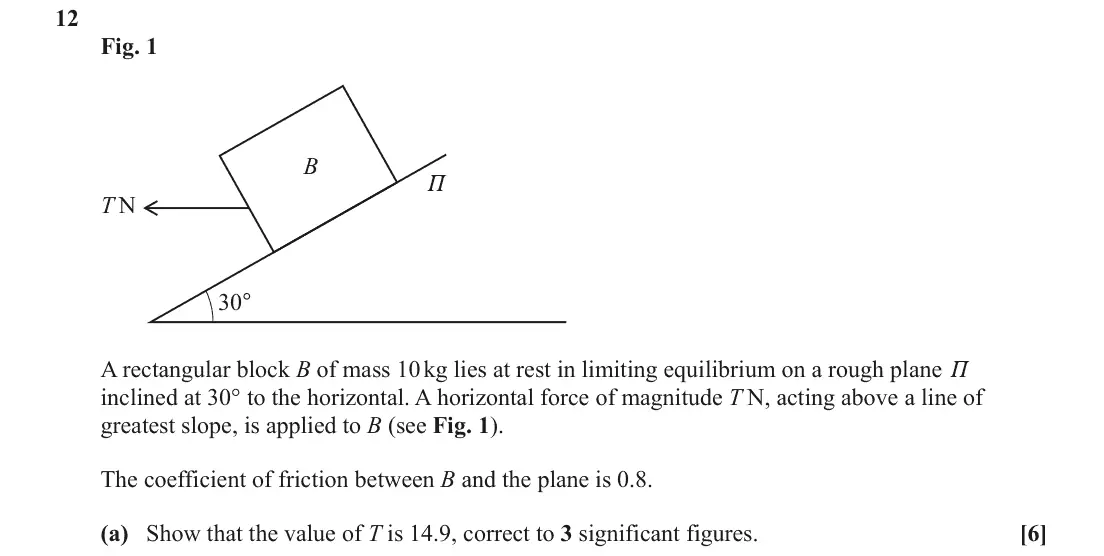
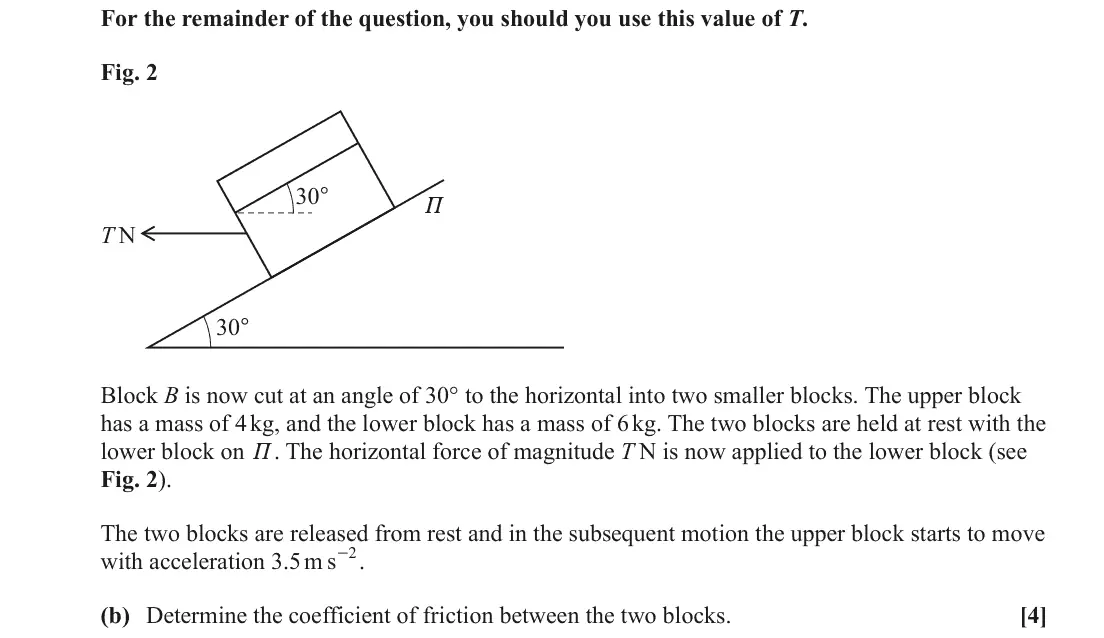
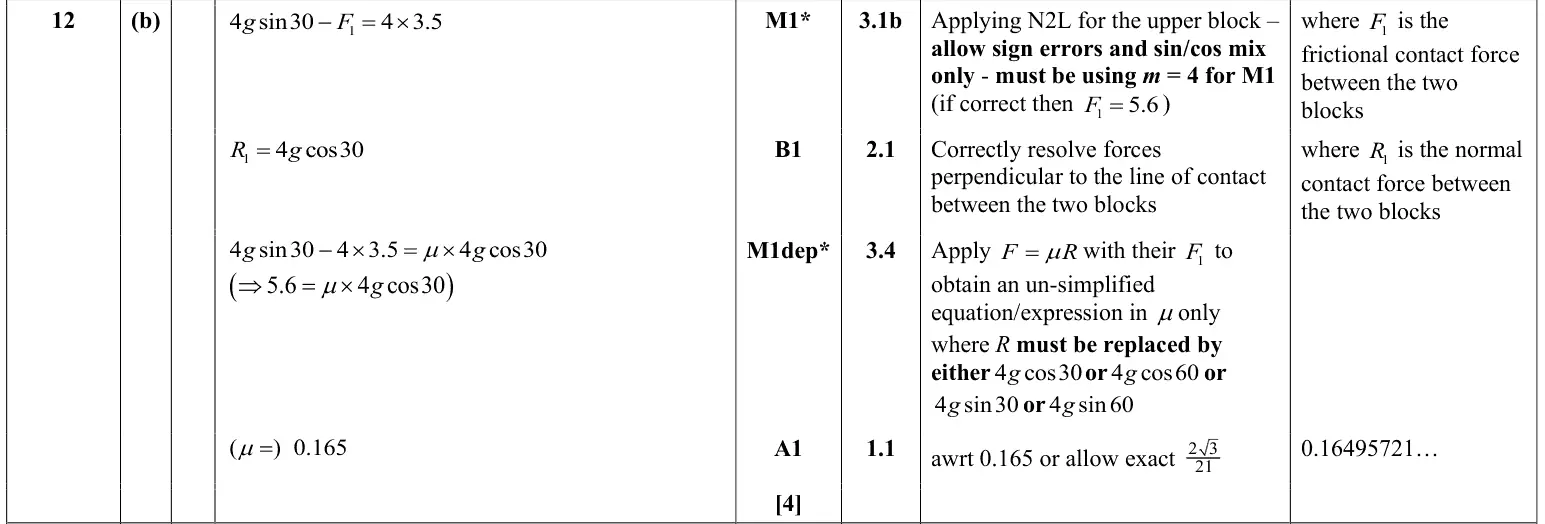
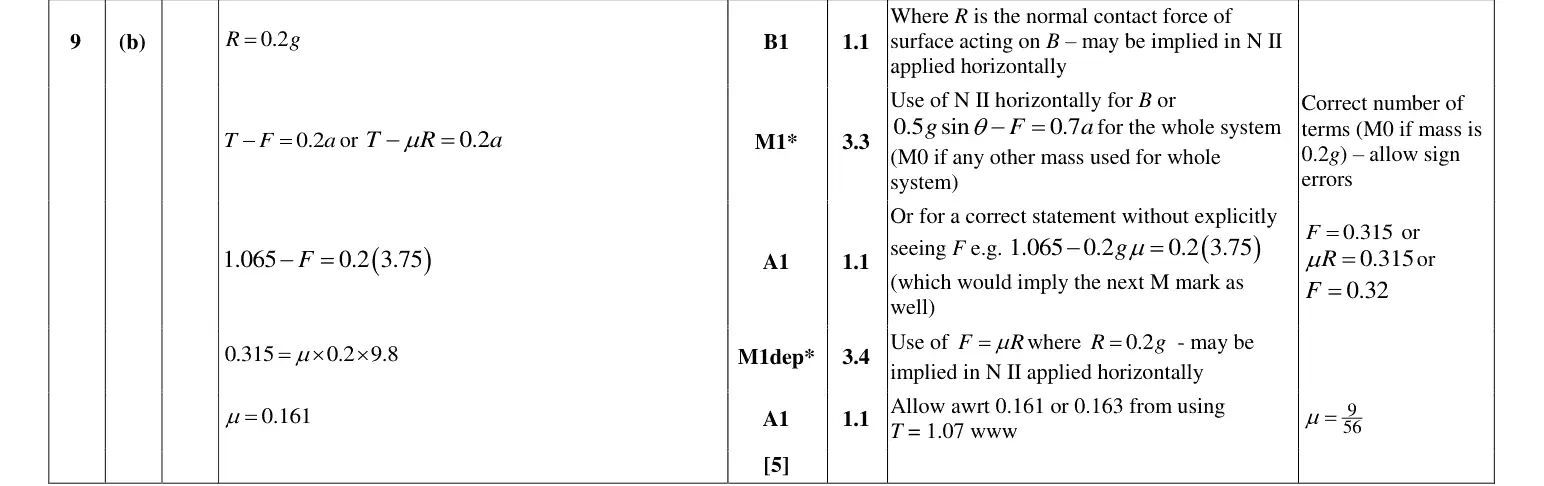
For the remainder of the question, you should you use this value of T. Fig. 2 30° P T N 30° Block B is now cut at an angle of 30° to the horizontal into two smaller blocks. The upper block has a mass of 4 kg, and the lower block has a mass of 6 kg. The two blocks are held at rest with the lower block on P. The horizontal force of magnitude T N is now applied to the lower block (see Fig. 2). The two blocks are released from rest and in the subsequent motion the upper block starts to move - . with acceleration 3.5 m s 2 (b) Determine the coefficient of friction between the two blocks. [4]
June 2024 · Paper 3 · Q13(a) 6 marks Hard
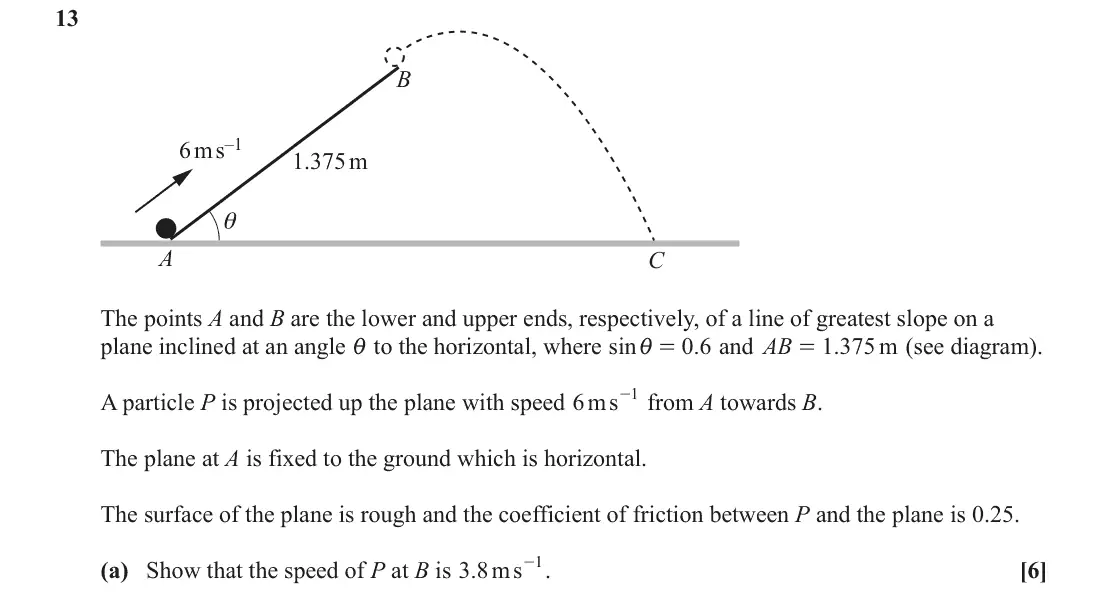
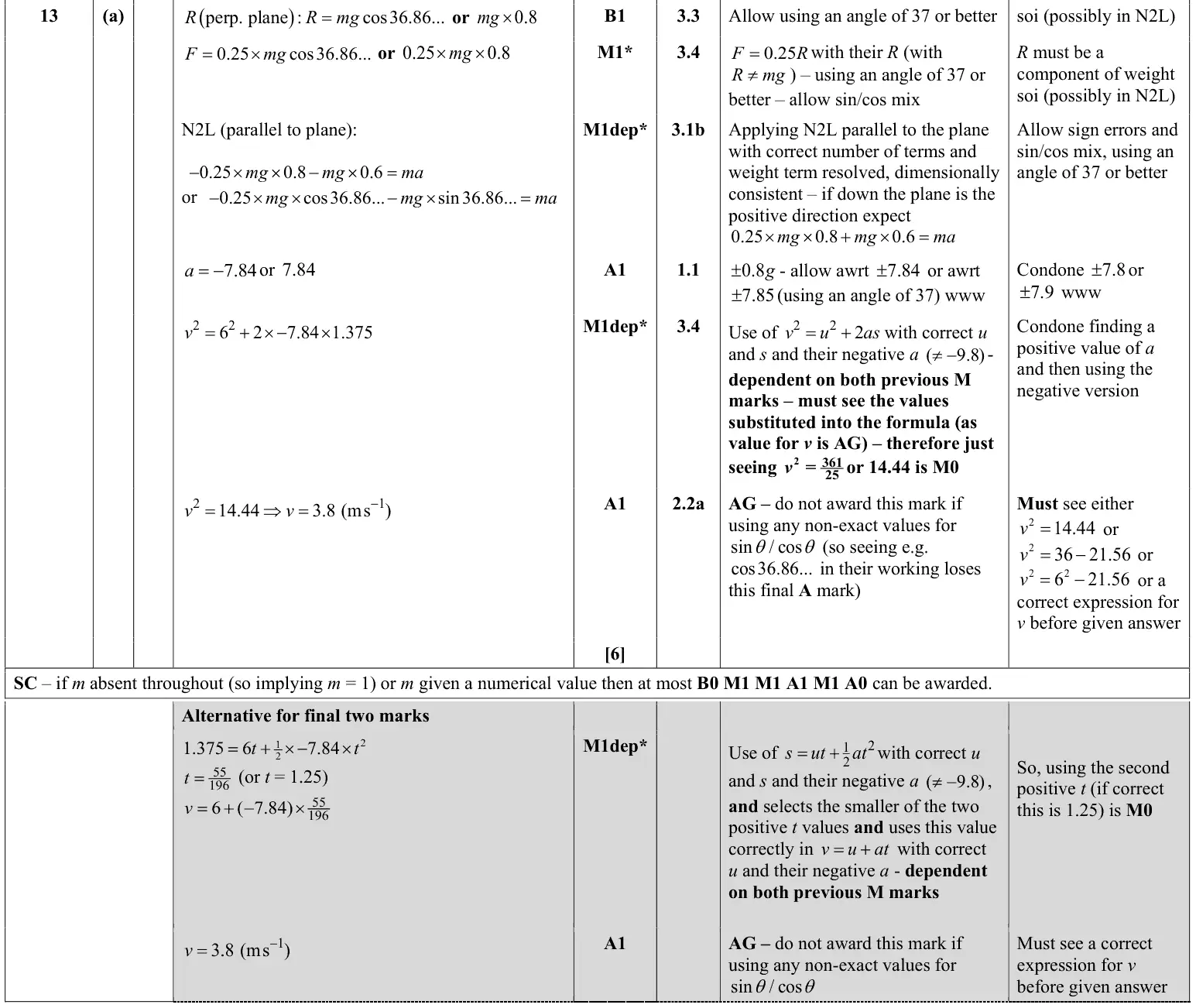
13 B 6 m s–1 1.375 m θ A C The points A and B are the lower and upper ends, respectively, of a line of greatest slope on a plane inclined at an angle i to the horizontal, where sin 0 6 . and AB 1 375 . m (see diagram). i = = A particle P is projected up the plane with speed ms - from A towards B. The plane at A is fixed to the ground which is horizontal. The surface of the plane is rough and the coefficient of friction between P and the plane is 0.25. - . (a) Show that the speed of P at B is . ms 3 8 [6]
June 2023 · Paper 3 · Q13(a) 7 marks Medium
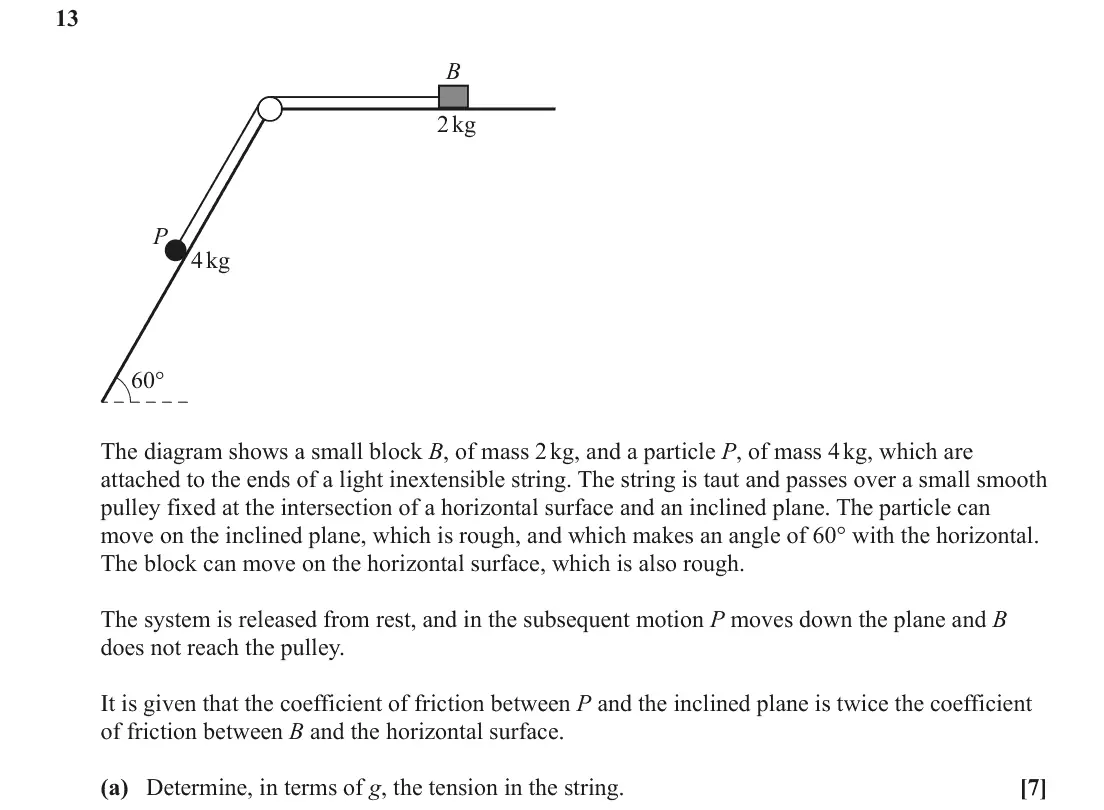
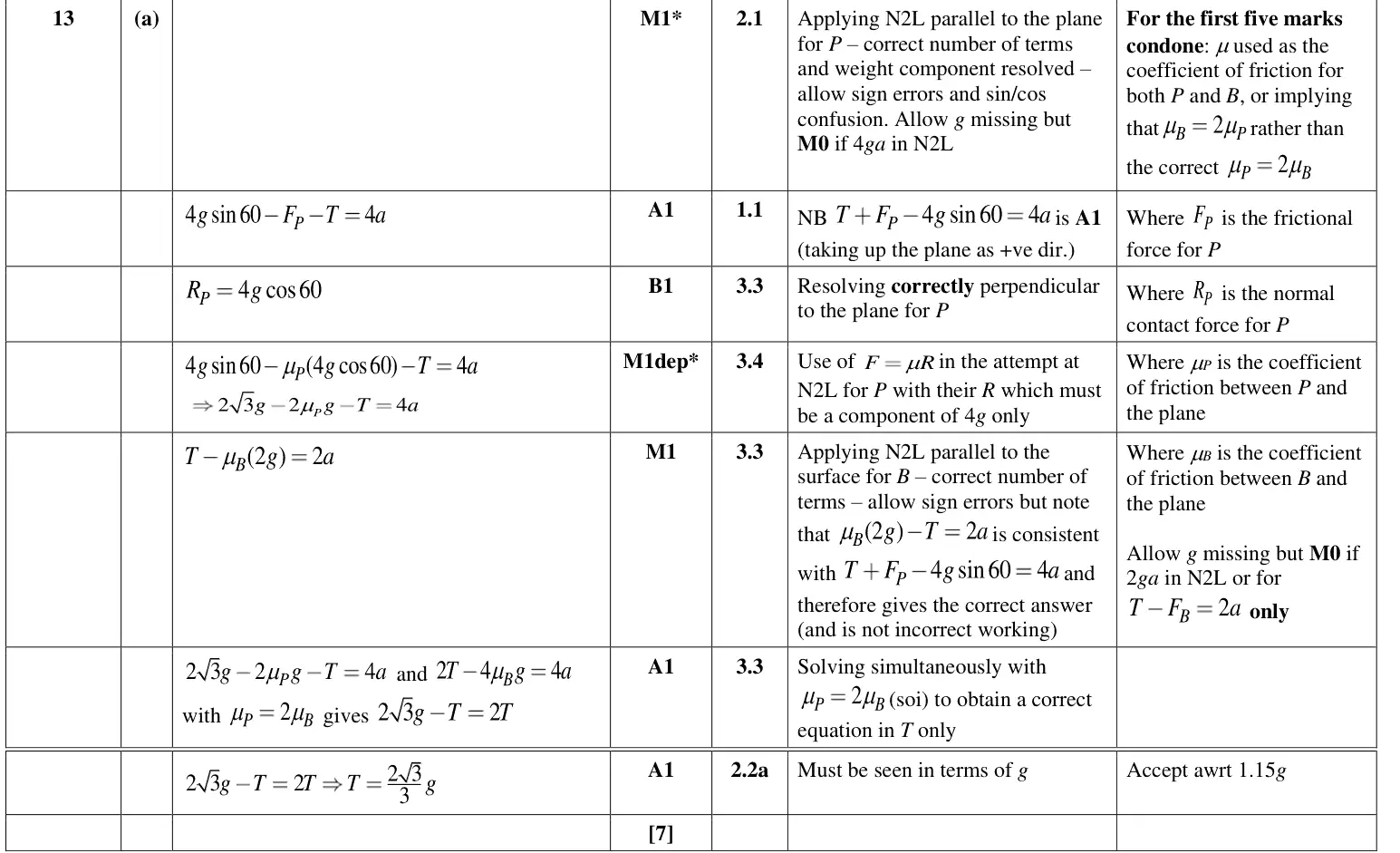
13 B 2 kg P 4 kg 60° The diagram shows a small block B, of mass 2 kg, and a particle P, of mass 4 kg, which are attached to the ends of a light inextensible string. The string is taut and passes over a small smooth pulley fixed at the intersection of a horizontal surface and an inclined plane. The particle can move on the inclined plane, which is rough, and which makes an angle of 60° with the horizontal. The block can move on the horizontal surface, which is also rough. The system is released from rest, and in the subsequent motion P moves down the plane and B does not reach the pulley. It is given that the coefficient of friction between P and the inclined plane is twice the coefficient of friction between B and the horizontal surface. (a) Determine, in terms of g, the tension in the string. [7]
June 2023 · Paper 3 · Q13(b) 5 marks Hard
Show the start of this questionEarlier part of this question
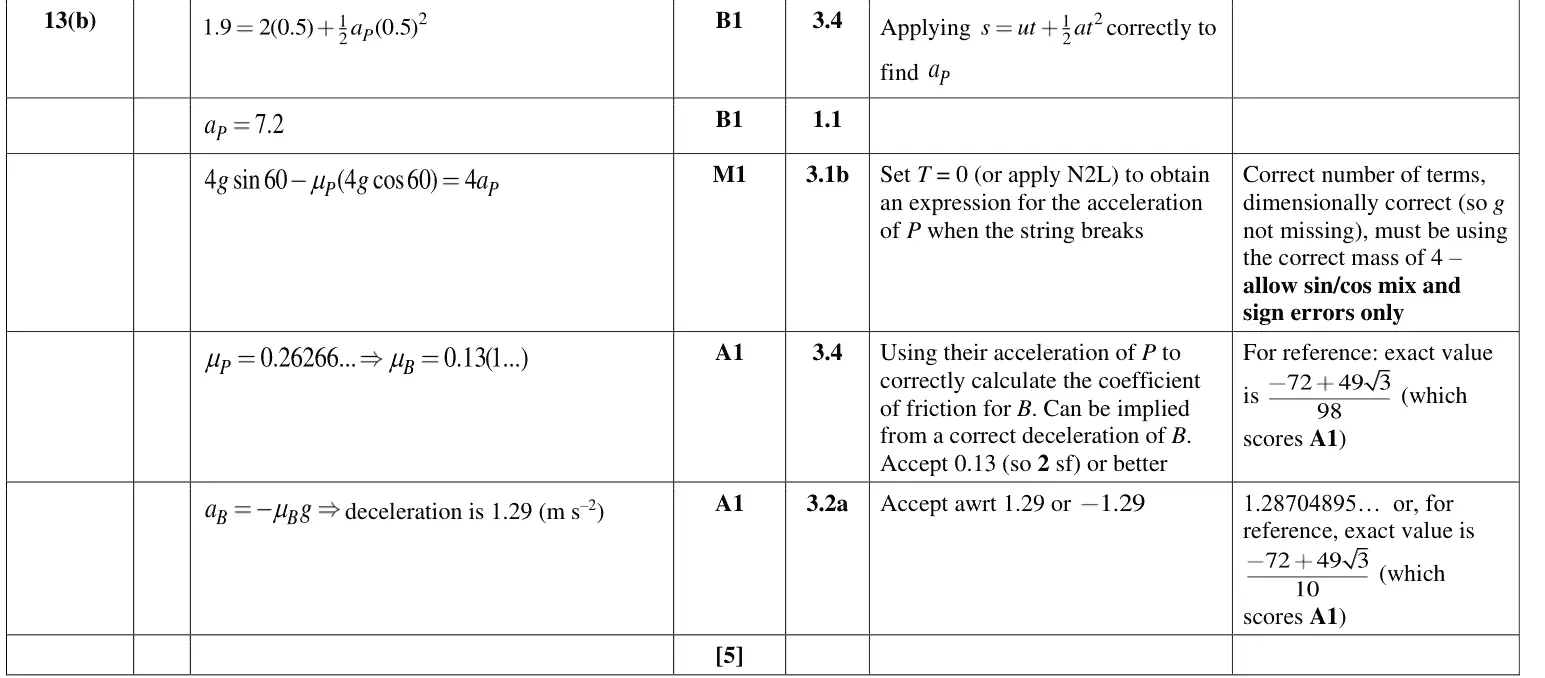
When P is moving at ms - the string breaks. In the 0.5 seconds after the string breaks P moves 1.9 m down the plane. (b) Determine the deceleration of B after the string breaks. Give your answer correct to 3 significant figures. [5]
June 2022 · Paper 3 · Q10(b) 3 marks Easy
Show the start of this questionEarlier part of this question
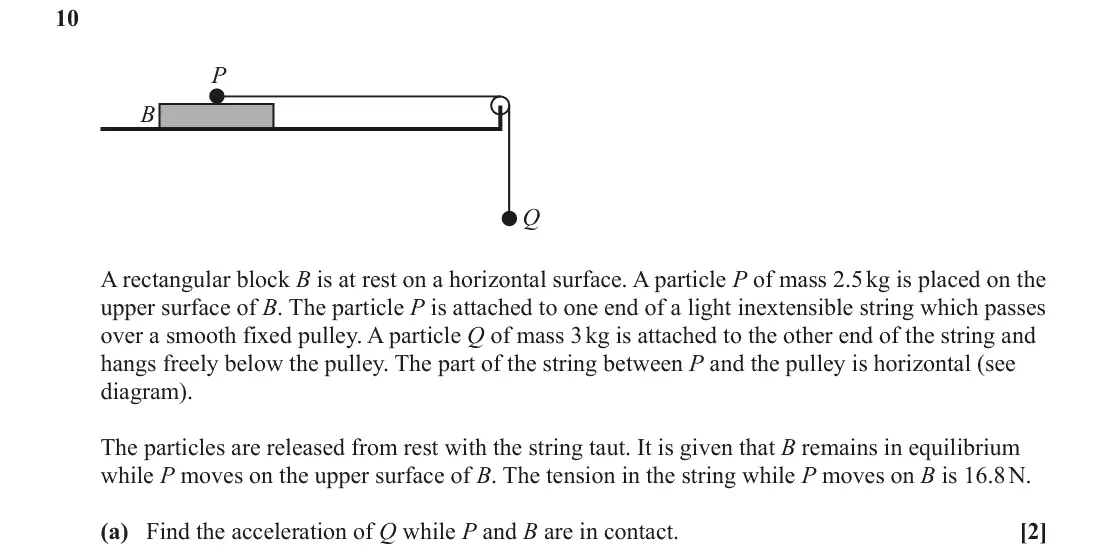
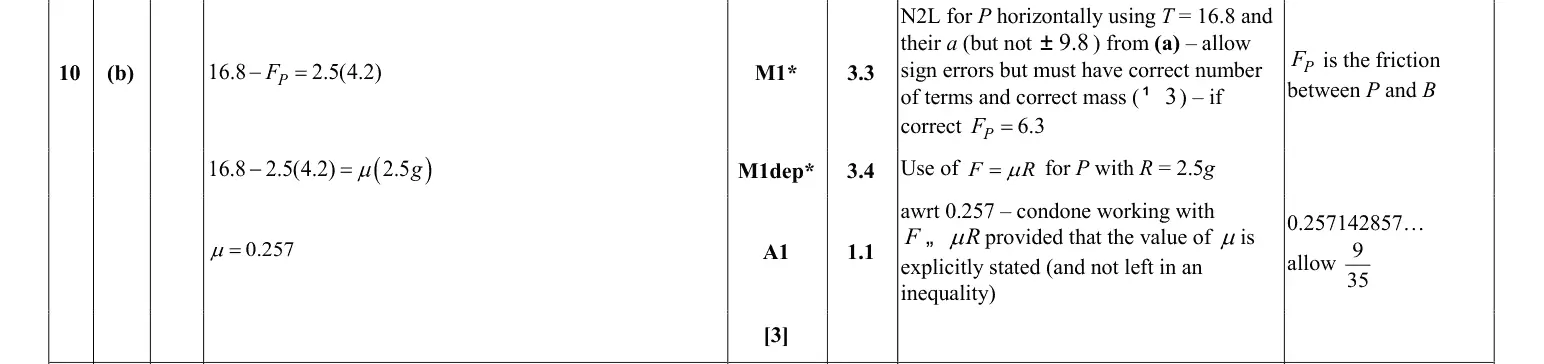
(b) Determine the coefficient of friction between P and B. [3]
Autumn 2021 · Paper 3 · Q14(a) 7 marks Medium
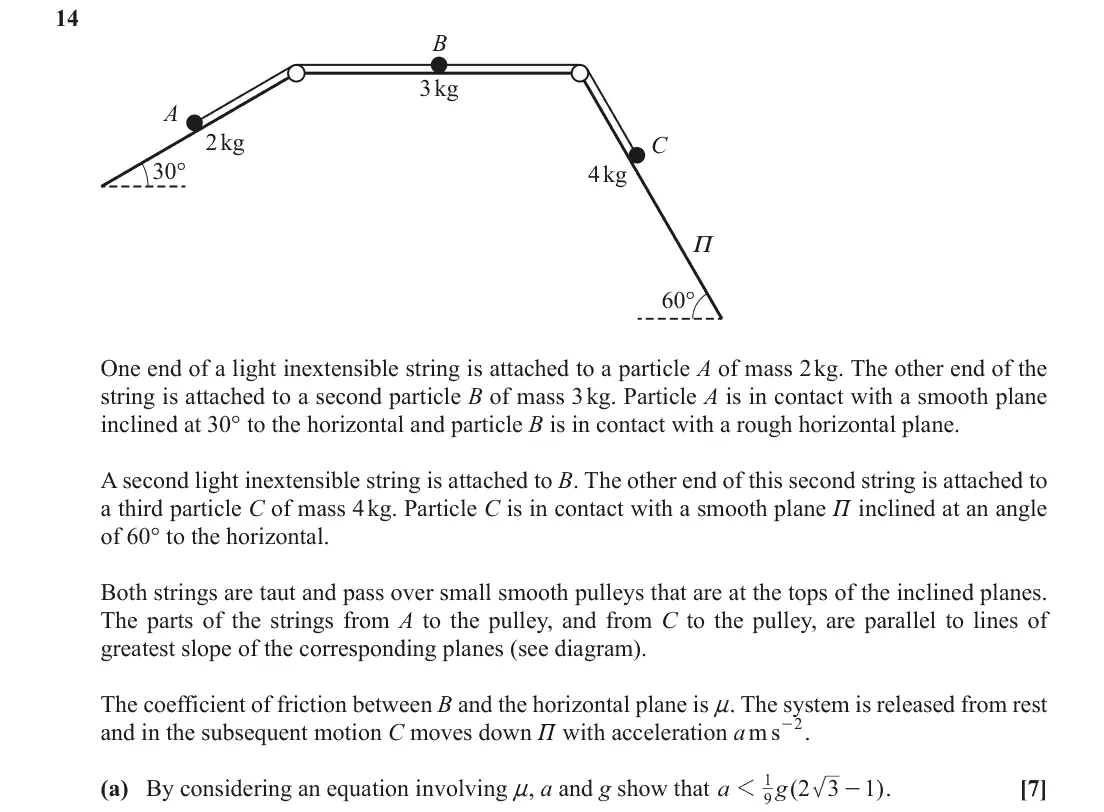
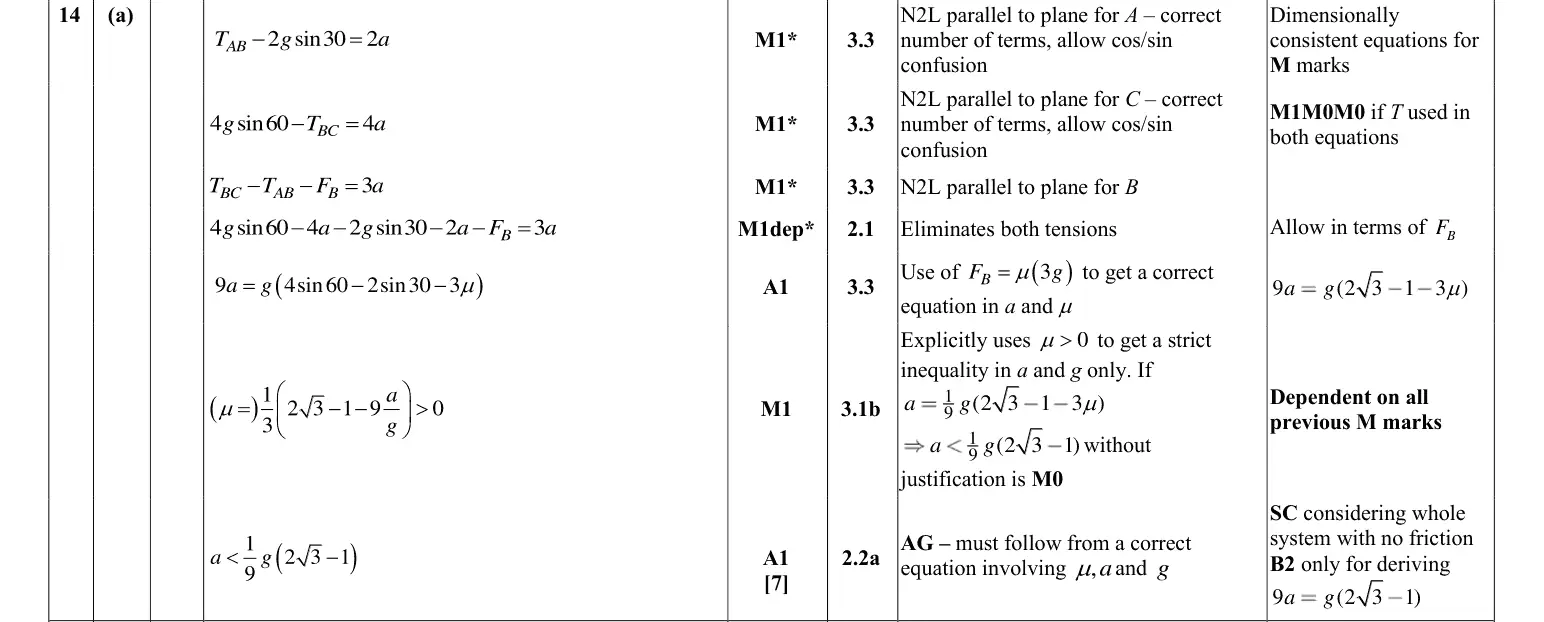
14 B 3 kg A 2 kg C 30° 4 kg Π 60° One end of a light inextensible string is attached to a particle A of mass 2 kg. The other end of the string is attached to a second particle B of mass 3 kg. Particle A is in contact with a smooth plane inclined at 30° to the horizontal and particle B is in contact with a rough horizontal plane. A second light inextensible string is attached to B. The other end of this second string is attached to a third particle C of mass 4 kg. Particle C is in contact with a smooth plane P inclined at an angle of 60° to the horizontal. Both strings are taut and pass over small smooth pulleys that are at the tops of the inclined planes. The parts of the strings from A to the pulley, and from C to the pulley, are parallel to lines of greatest slope of the corresponding planes (see diagram). The coefficient of friction between B and the horizontal plane is n. The system is released from rest - . and in the subsequent motion C moves down P with acceleration a m s (a) By considering an equation involving n, a and g show that a g 2 3 ( ) . [7] -
Autumn 2020 · Paper 3 · Q9(c) 5 marks Medium
Show the start of this questionEarlier part of this questionEarlier part of this question
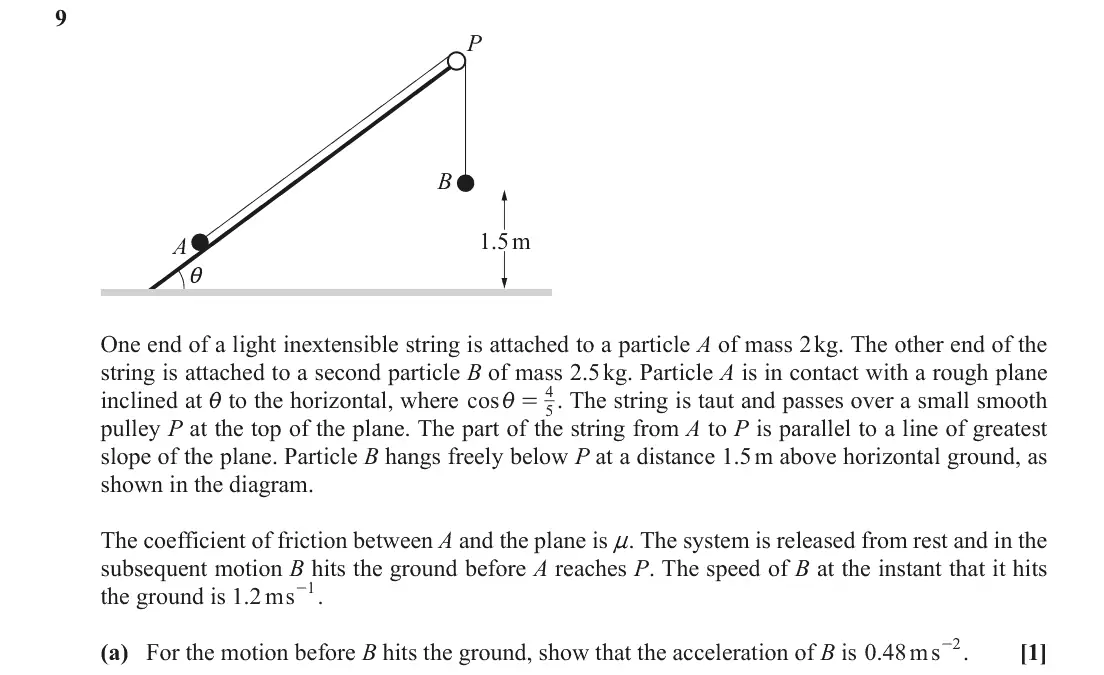
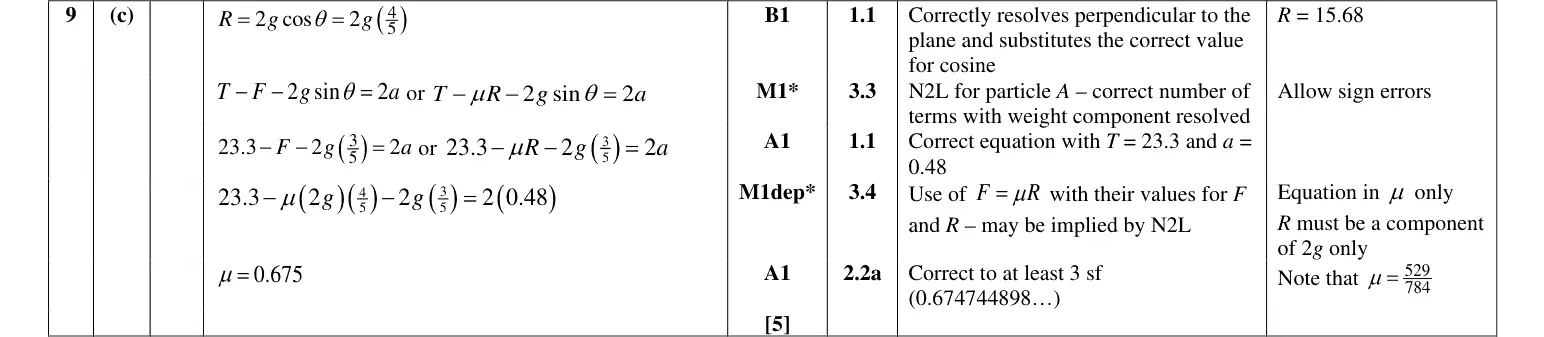
(c) Determine the value of n. [5]
Autumn 2020 · Paper 3 · Q9(d) 4 marks Medium
Show the start of this questionEarlier part of this questionEarlier part of this questionEarlier part of this question
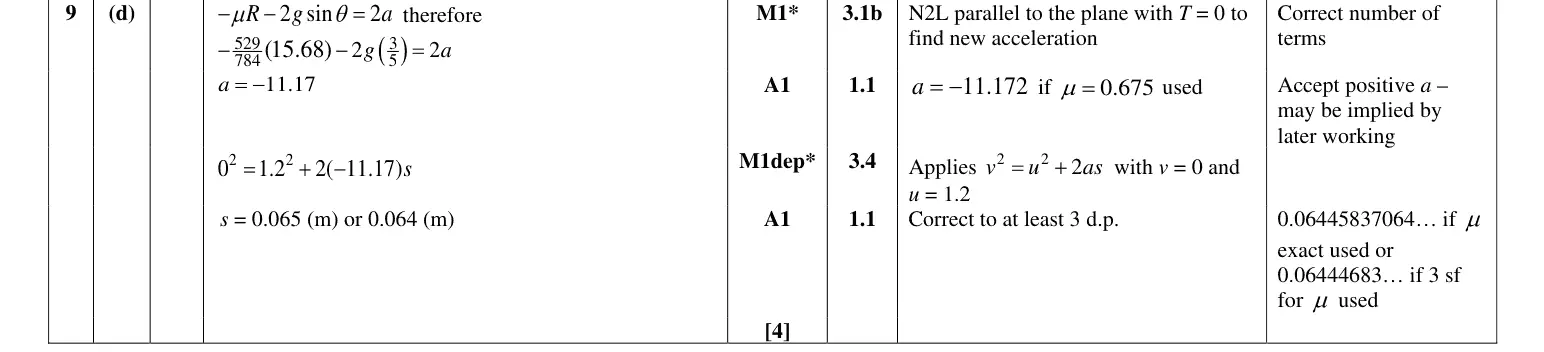
After B hits the ground, A continues to travel up the plane before coming to instantaneous rest before it reaches P. (d) Determine the distance that A travels from the instant that B hits the ground until A comes to instantaneous rest. [4]
June 2019 · Paper 3 · Q9(b) 5 marks Hard
Show the start of this questionEarlier part of this question
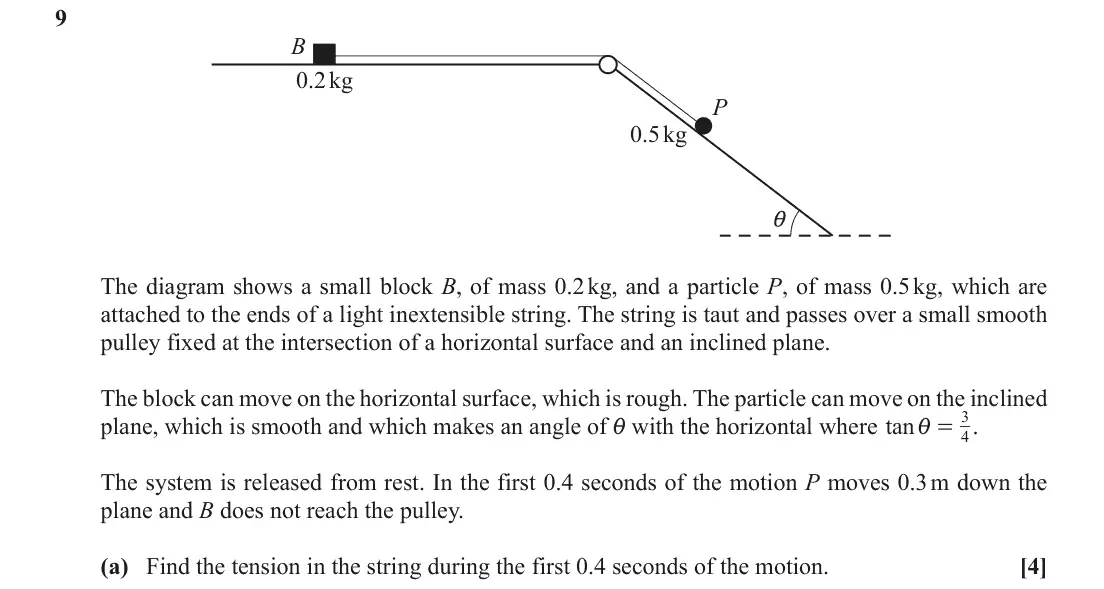
(b) Calculate the coefficient of friction between B and the horizontal surface. [5]
June 2018 · Paper 3 · Q12(ii) 5 marks Hard
Show the start of this questionEarlier part of this question
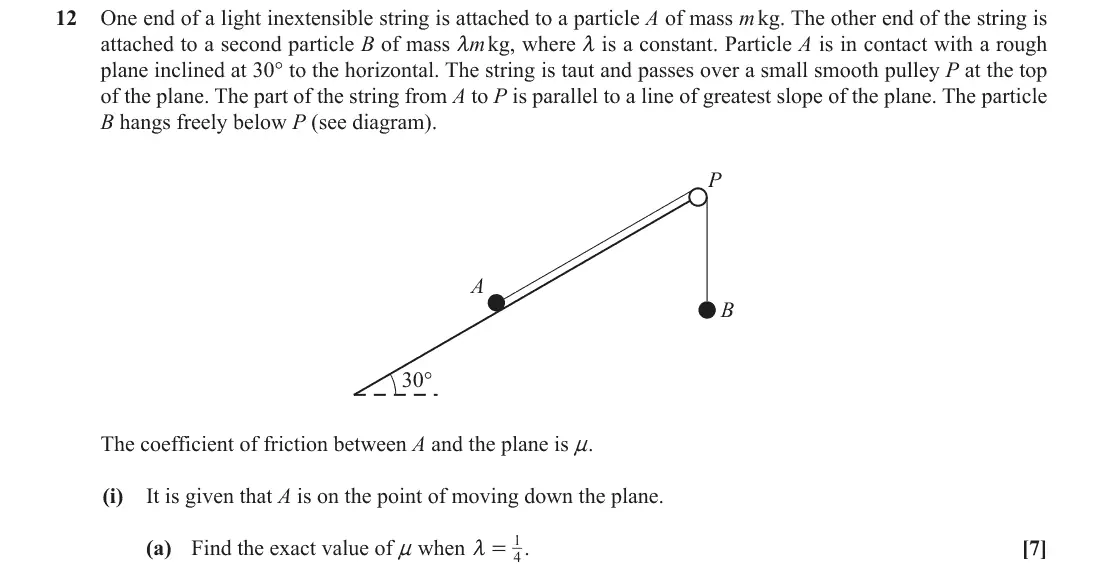
1 g m s-2, find the exact value of n. (ii) Given instead that m = 2 and that the acceleration of A is 4 [5]

Find an A-level maths tutor

Stuck on this? Book a trial session with an A-level maths tutor.

Prefer email? Send an enquiry

If you are under 18, please include a parent's contact details. Enquiries go to enquiries@mathsaleveltutor.com and are deleted once handled.