3.03r The concept of a frictional force and be able to apply it in…

Section
3.03 Forces and Newton's Laws
Level
AS & A level
Statement
Understand the concept of a frictional force and be able to apply it in contexts where the force is given in vector or component form, or the magnitude and direction of the force are given.
Since 2018
8 parts, 19 marks · topic pages: Forces, Newton's laws and connected particles, Friction, resultant forces and motion in a plane, Constant acceleration (SUVAT), Trigonometric ratios, graphs, radians and the sine and cosine rules

Back to the checklist

June 2025 · AS Paper 2 · Q11(d) 1 mark Medium
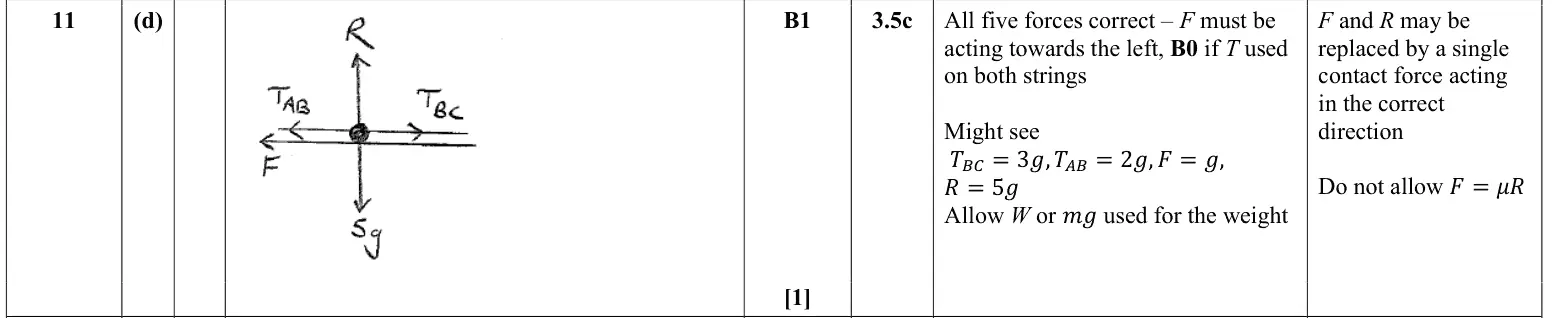
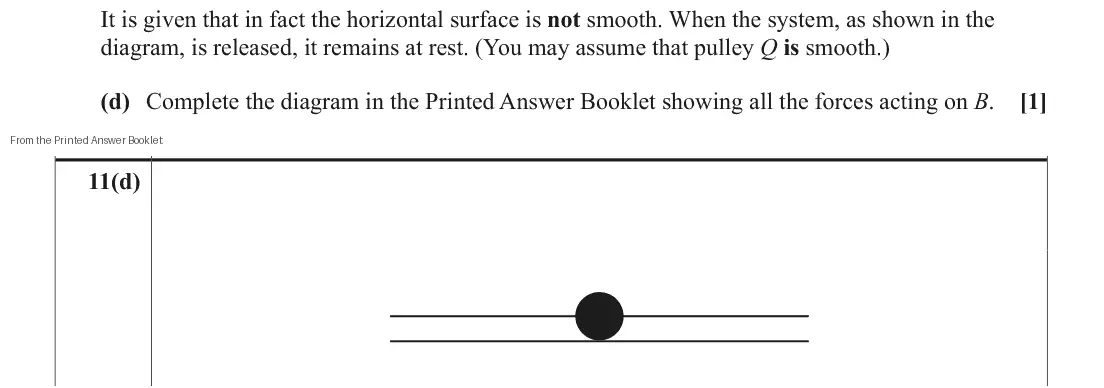
It is given that in fact the horizontal surface is not smooth. When the system, as shown in the diagram, is released, it remains at rest. (You may assume that pulley Q is smooth.) (d) Complete the diagram in the Printed Answer Booklet showing all the forces acting on B. [1]
June 2025 · AS Paper 2 · Q11(e) 1 mark Hard
Show the start of this questionEarlier part of this question
(e) State the magnitude of the frictional force acting on B. Give a brief justification for your [1] answer.
June 2023 · AS Paper 2 · Q11(a) 2 marks Medium
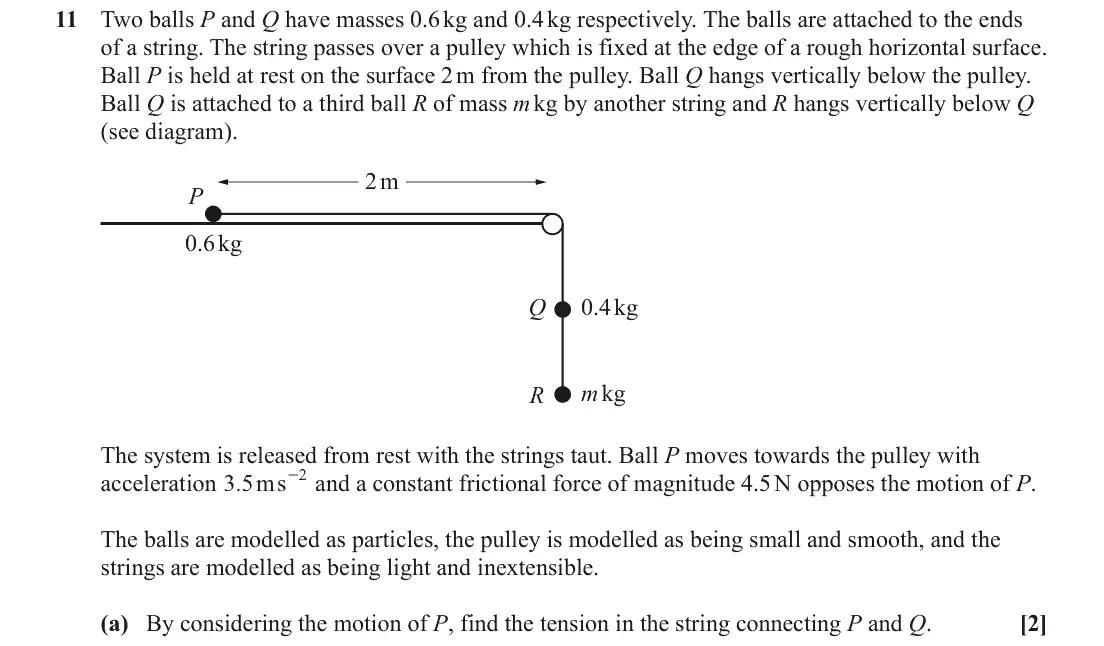
11 Two balls P and Q have masses 0.6 kg and 0.4 kg respectively. The balls are attached to the ends of a string. The string passes over a pulley which is fixed at the edge of a rough horizontal surface. Ball P is held at rest on the surface 2 m from the pulley. Ball Q hangs vertically below the pulley. Ball Q is attached to a third ball R of mass m kg by another string and R hangs vertically below Q (see diagram). 2 m P 0.6 kg Q 0.4 kg m kg R The system is released from rest with the strings taut. Ball P moves towards the pulley with acceleration .3 5ms 2 - and a constant frictional force of magnitude 4.5 N opposes the motion of P. The balls are modelled as particles, the pulley is modelled as being small and smooth, and the strings are modelled as being light and inextensible. (a) By considering the motion of P, find the tension in the string connecting P and Q. [2]
June 2023 · AS Paper 2 · Q11(c) 6 marks Hard
Show the start of this questionEarlier part of this questionEarlier part of this question
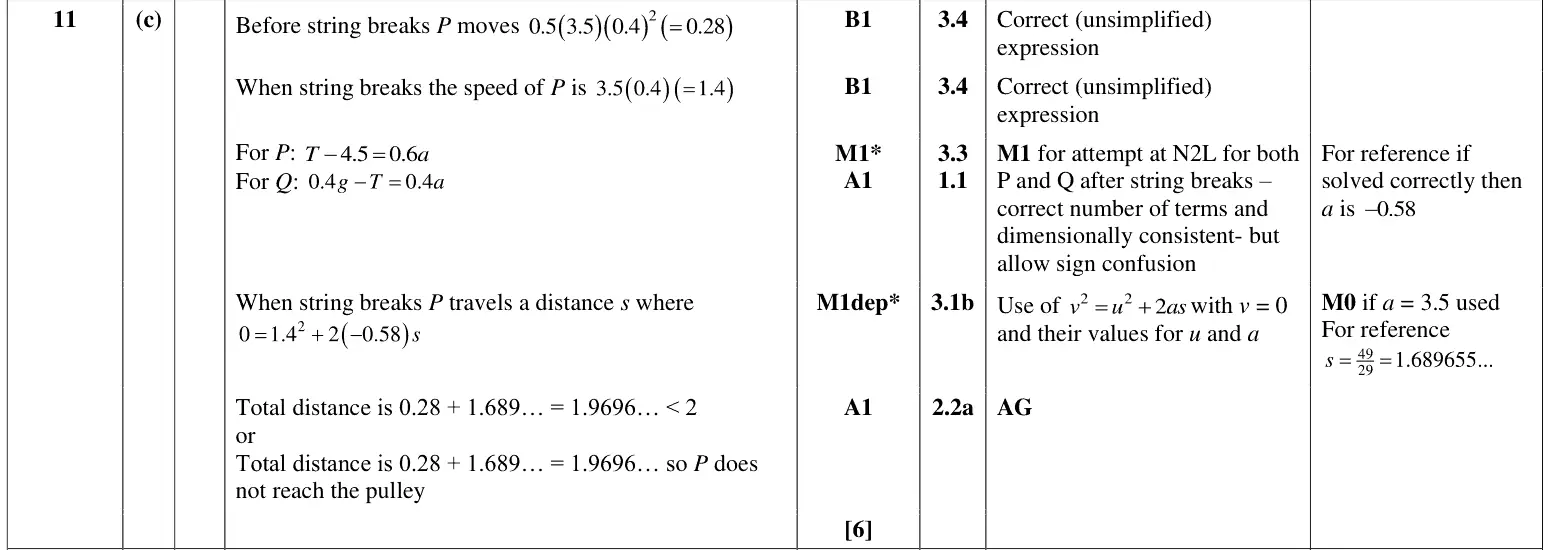
When the balls have been in motion for 0.4 seconds the string connecting Q and R breaks. (c) Show that, according to the model, P does not reach the pulley. [6]
June 2022 · Paper 3 · Q8 2 marks Easy
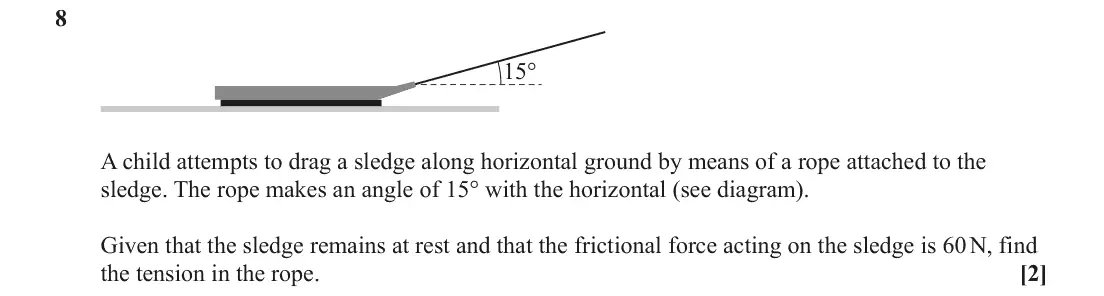
8 15° A child attempts to drag a sledge along horizontal ground by means of a rope attached to the sledge. The rope makes an angle of 15° with the horizontal (see diagram). Given that the sledge remains at rest and that the frictional force acting on the sledge is 60 N, find the tension in the rope. [2]
Autumn 2021 · Paper 3 · Q10(a) 1 mark Medium
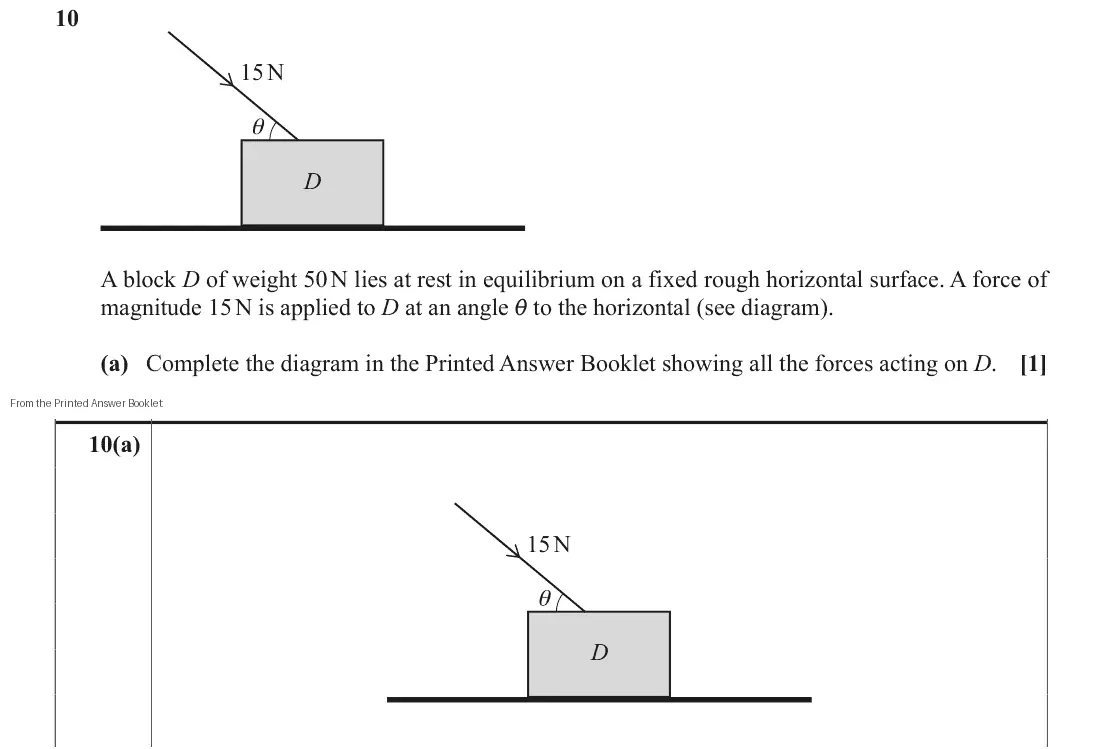
10 15 N θ D A block D of weight 50 N lies at rest in equilibrium on a fixed rough horizontal surface. A force of magnitude 15 N is applied to D at an angle i to the horizontal (see diagram). (a) Complete the diagram in the Printed Answer Booklet showing all the forces acting on D. [1]
June 2019 · AS Paper 2 · Q11(a) 5 marks Medium
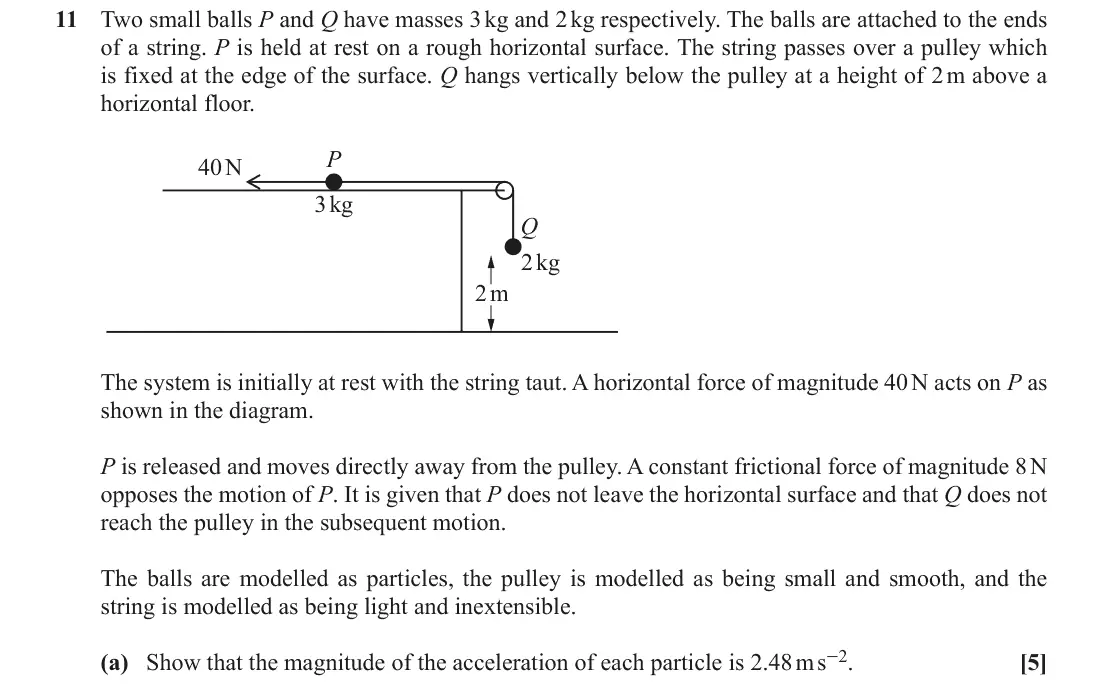
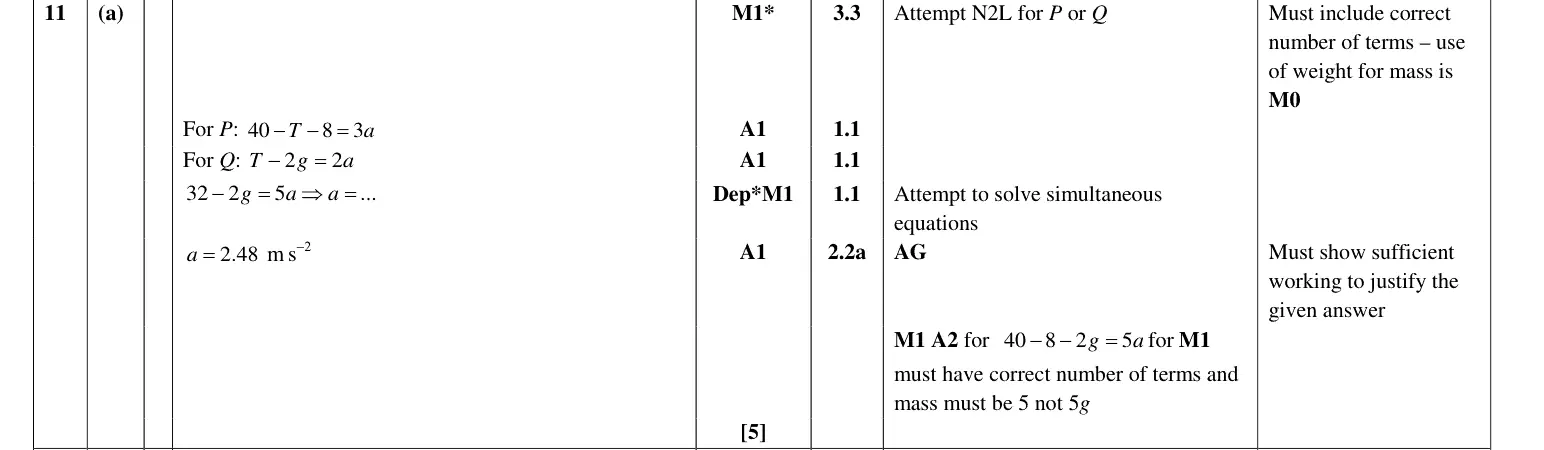
11 Two small balls P and Q have masses 3 kg and 2 kg respectively. The balls are attached to the ends of a string. P is held at rest on a rough horizontal surface. The string passes over a pulley which is fixed at the edge of the surface. Q hangs vertically below the pulley at a height of 2 m above a horizontal floor. P 40 N 3 kg Q 2 kg 2 m The system is initially at rest with the string taut. A horizontal force of magnitude 40 N acts on P as shown in the diagram. P is released and moves directly away from the pulley. A constant frictional force of magnitude 8 N opposes the motion of P. It is given that P does not leave the horizontal surface and that Q does not reach the pulley in the subsequent motion. The balls are modelled as particles, the pulley is modelled as being small and smooth, and the string is modelled as being light and inextensible. (a) Show that the magnitude of the acceleration of each particle is 2.48 m s-2. [5]
June 2019 · AS Paper 2 · Q11(f) 1 mark Medium
Show the start of this questionEarlier part of this question
(f) State one improvement that could be made to the model. [1]

Find an A-level maths tutor

Stuck on this? Book a trial session with an A-level maths tutor.

Prefer email? Send an enquiry

If you are under 18, please include a parent's contact details. Enquiries go to enquiries@mathsaleveltutor.com and are deleted once handled.