3.03k The concept of equilibrium together with one dimensional motion in…
Section
3.03 Forces and Newton's Laws
Level
AS & A level
Statement
Be able to use the concept of equilibrium together with one dimensional motion in a straight line to solve problems that involve connected particles and smooth pulleys.
Guidance
e.g. A train engine pulling a train carriage(s) along a straight horizontal track or the vertical motion of two particles, connected by a light inextensible string passing over a fixed smooth peg or light pulley.
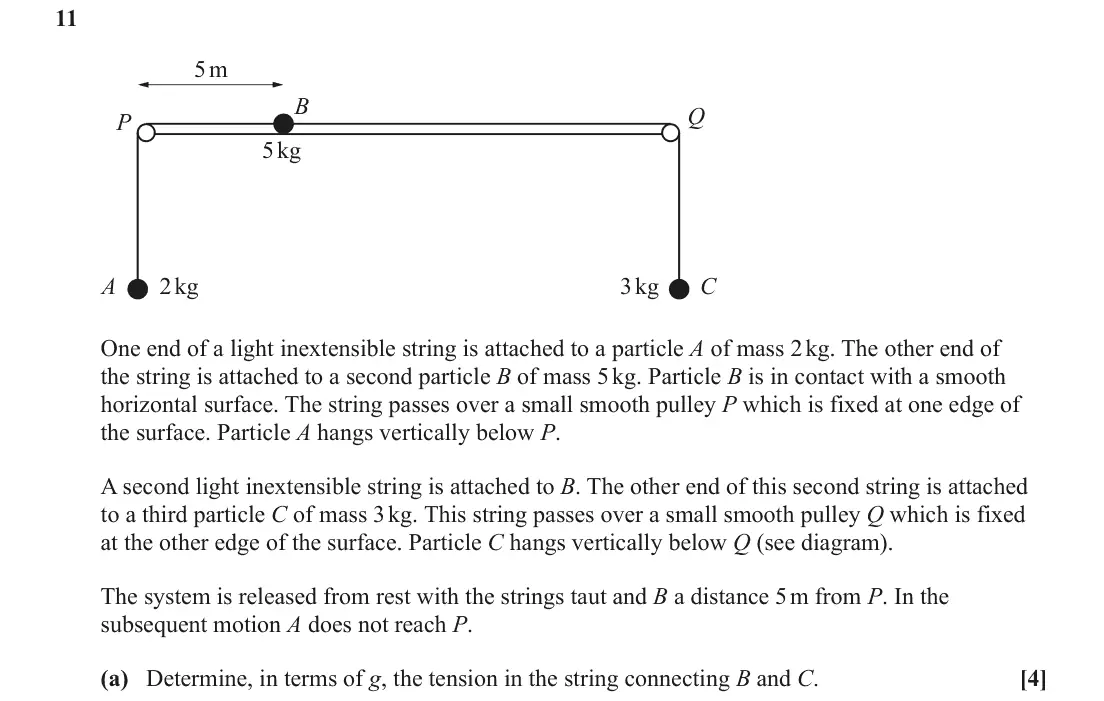
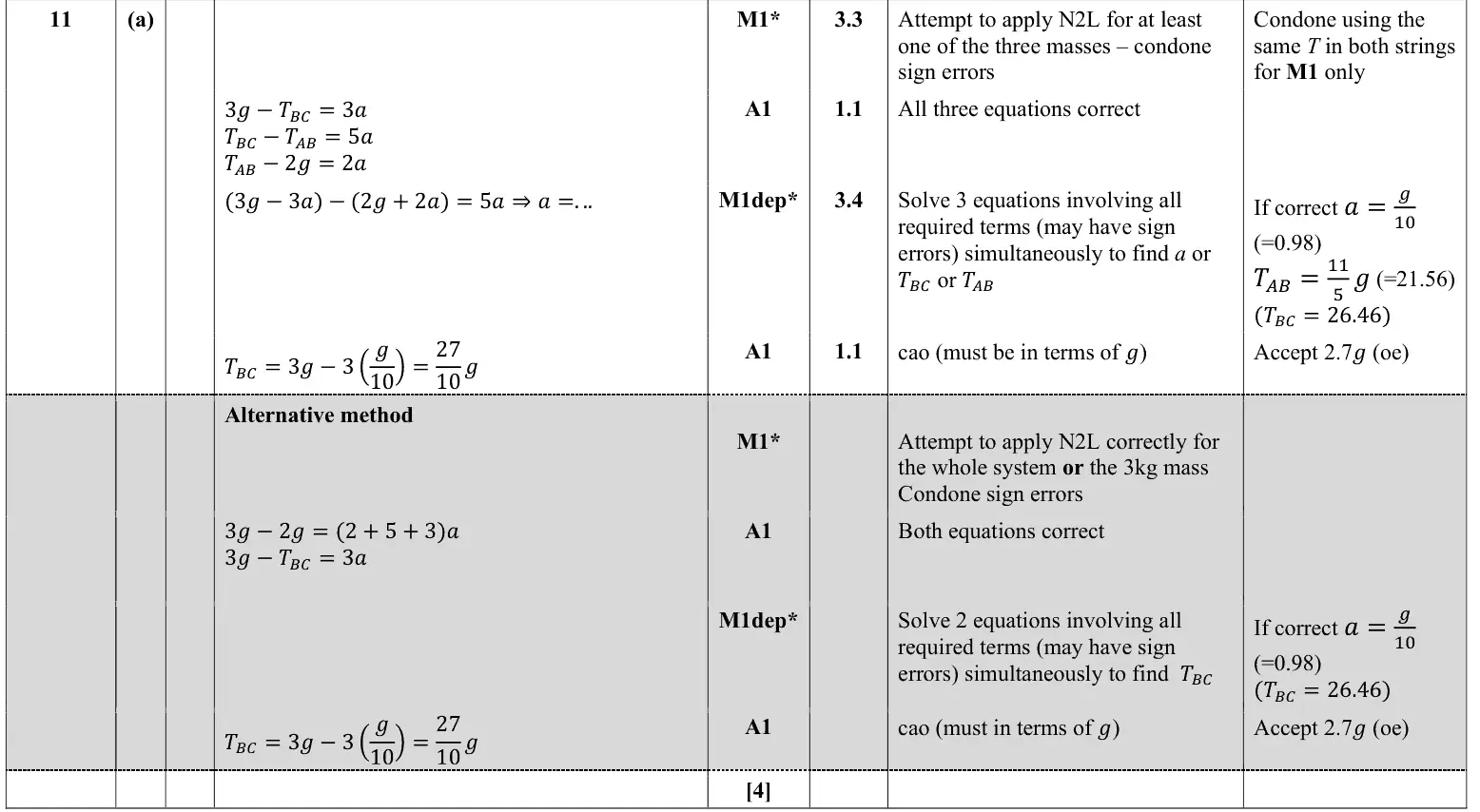
Those candidates who realised that the tension in AB was not the same as the tension in BC were generally very successful in this part, usually providing accurate working. Occasionally the answer was not given in terms of g as requested. Many assumed there was only one tension to find, which gained at most the first M mark.
Key points and common errors
two different tensions: 3g − T_BC = 3a, T_BC − T_AB = 5a, T_AB − 2g = 2a
a = g/10
T_BC = 27g/10
answer in terms of g
June 2025 · AS Paper 2 · Q11(b)6 marksHard
Show the start of this question
Mark scheme for this part
Examiner's comment
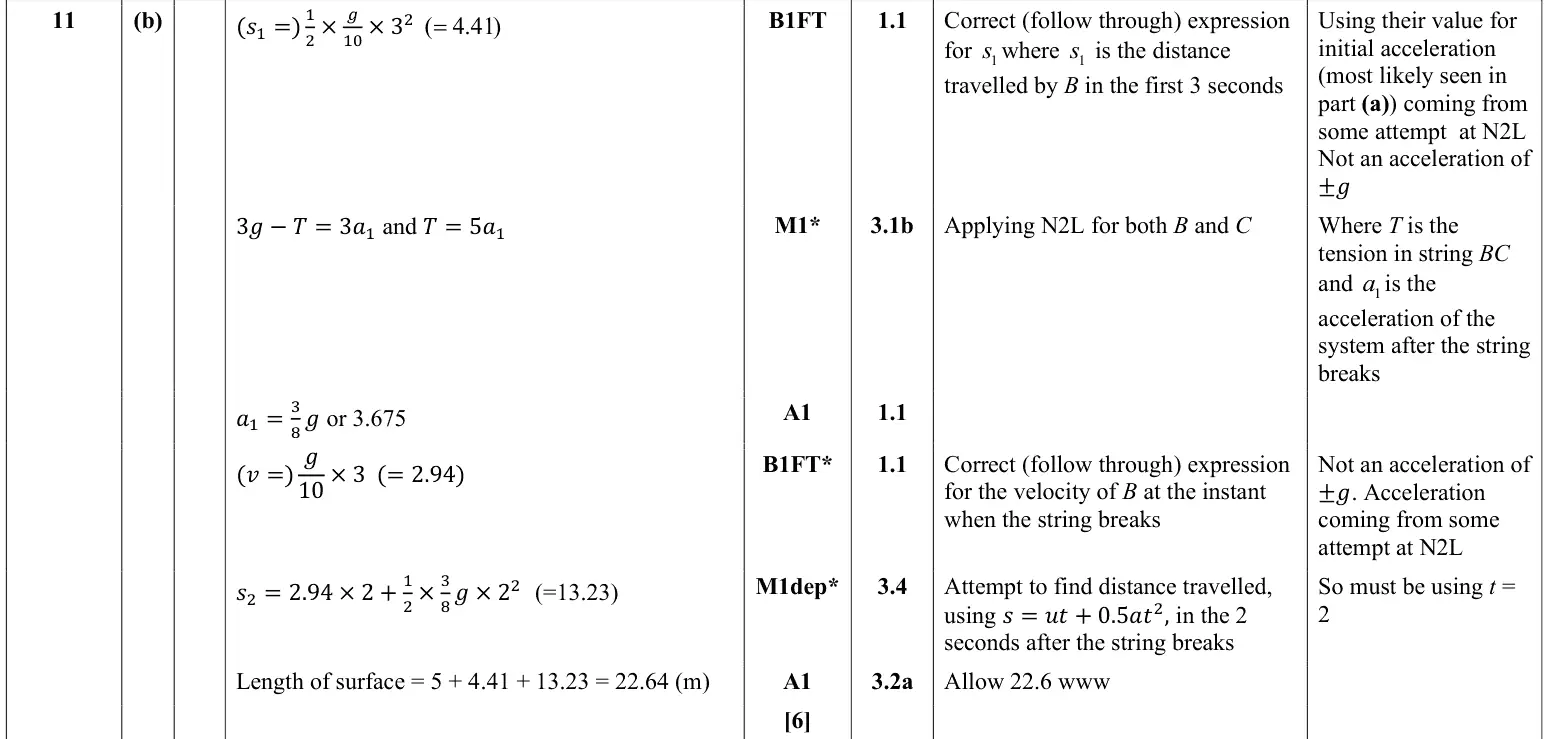
This question proved difficult for many candidates. There were some good solutions to this part seen, but full marks depended on a correctly obtained acceleration in (a). A few ignored the 5m when giving their final answer. Many candidates did not apply Newton’s Second Law to the situation after the string broke, using their previous acceleration, or g, or 0, so gaining at most the 2 B marks. In this solution, which follows from a fully correct part (a), the acceleration g/10 is correctly found although this had already been done in (a) actually so there was no need to repeat the calculation. It is used correctly for the 2 B marks to be given. Then T = 5a, one of the correct equations needed, is used with the tension found in part (a) and the equation 3g – T = 3a never appears. So M0 and no further marks were awarded.
Key points and common errors
first 3 s: s₁ = 4.41 m, v = 2.94
after break N2L for B and C: a₁ = 3g/8
s₂ = 2.94 × 2 + ½(3g/8)(4) = 13.23
PQ = 5 + 4.41 + 13.23 = 22.6 m
June 2025 · AS Paper 2 · Q11(c)1 markHard
Show the start of this question
Mark scheme for this part
Examiner's comment
The mark scheme lays out that to earn this mark ‘Any statement which suggests the tension is not constant…’ was required and this was rare. Most responses just said either the tension had increased or it had decreased.
Key points and common errors
a rough pulley means the tension is not the same throughout the string BC
'increases' or 'decreases' alone gains nothing
June 2025 · Paper 3 · Q8(a)2 marksEasy
Mark scheme for this part
Examiner's comment
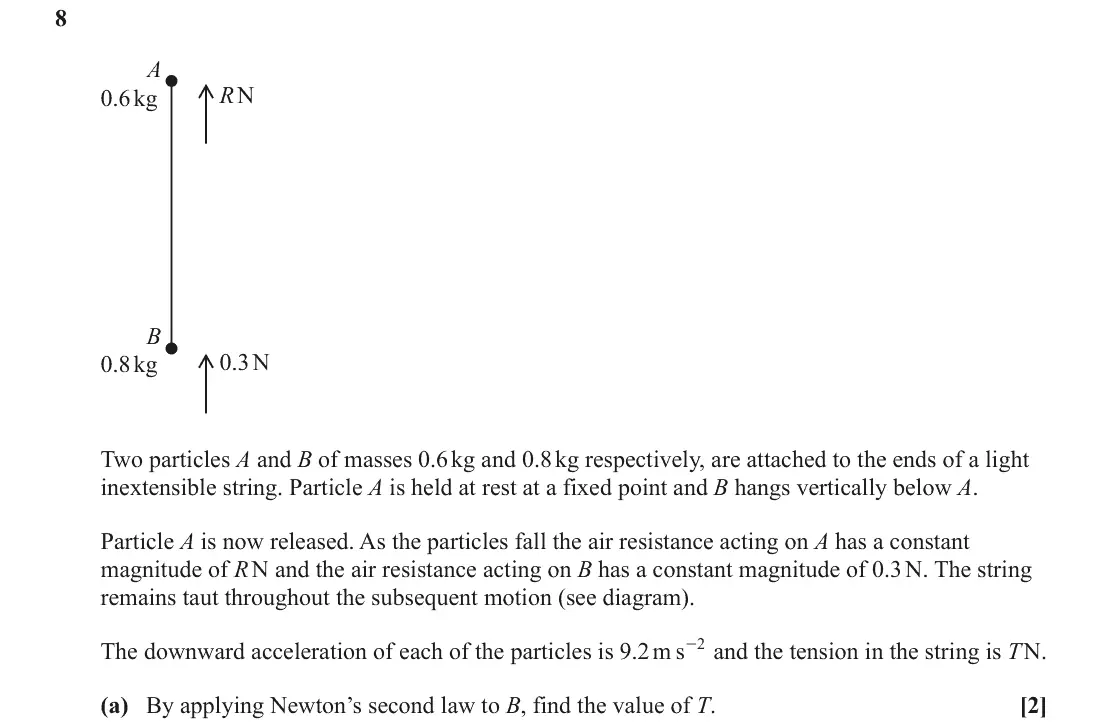
Although answered well by most candidates some struggled to include all the forces acting on B with many forgetting to include the weight of B. Of those that did include all three forces acting on B many made sign error with the acceleration term which led to a common incorrect answer of 14.9 for the tension in the string.
Key points and common errors
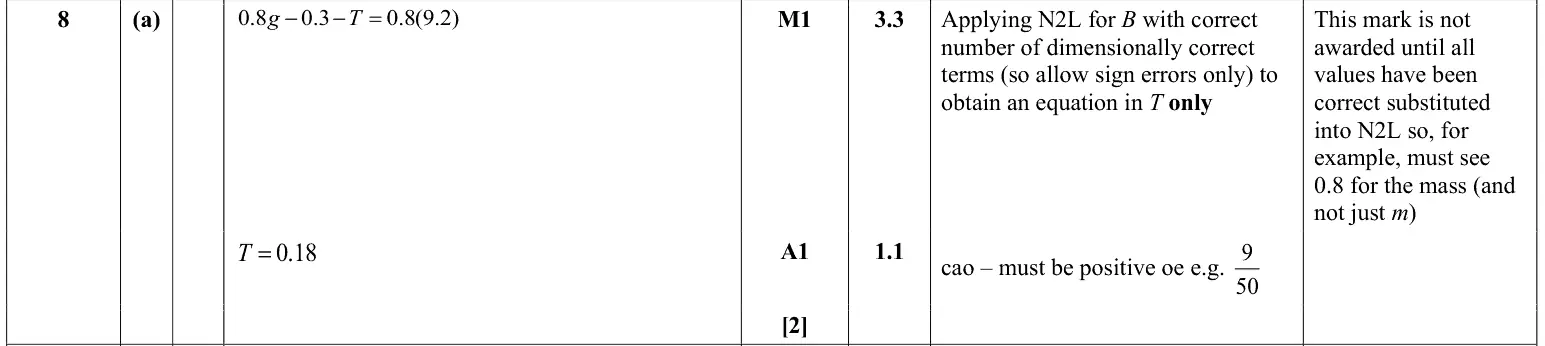
N2L for B: 0.8g − 0.3 − T = 0.8 × 9.2 so T = 0.18
weight of B often omitted
sign error gives 14.9
June 2025 · Paper 3 · Q8(b)2 marksMedium
Show the start of this question
Mark scheme for this part
Examiner's comment
Candidates were evenly split between applying Newton’s second law to A or the system to answer this part. Those who attempted the former were usually more successful as many who attempted a ‘system’ equation included, in error, the tension in the string (or missed off one of the forces).
Key points and common errors
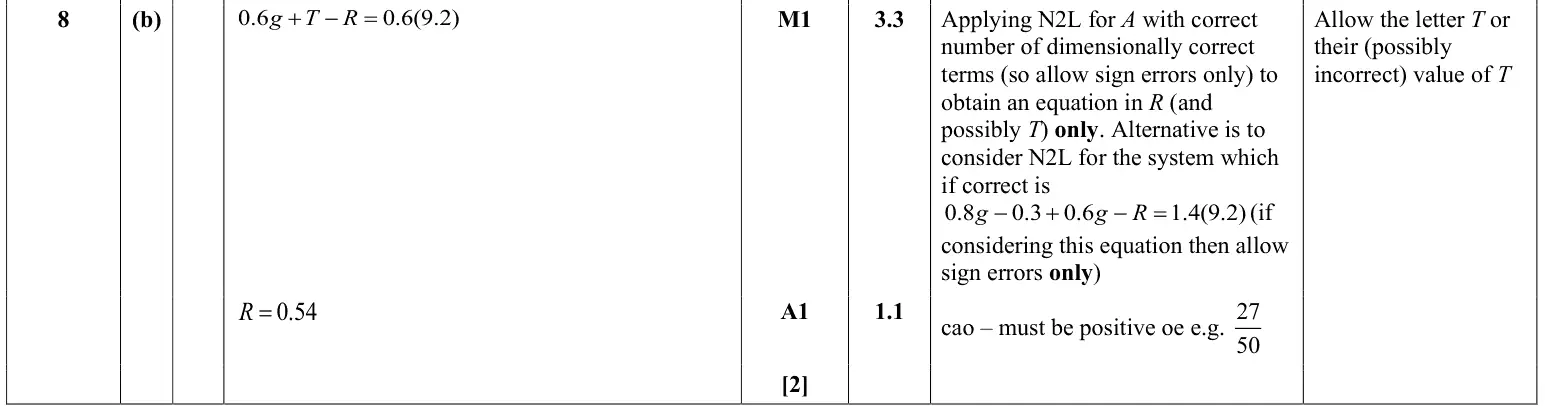
N2L for A: 0.6g + T − R = 0.6 × 9.2 so R = 0.54
system equations wrongly include T
June 2024 · AS Paper 2 · Q10(a)4 marksEasy
Mark scheme for this part
Examiner's comment
This part was successfully done by many. The need to use Newton’s Second law was well recognised and the correct answer was often seen. Most found a first and then T. We still saw equations like 3g – T = T – 2g with no mention of a, but these seemed less common than in the past.
Key points and common errors
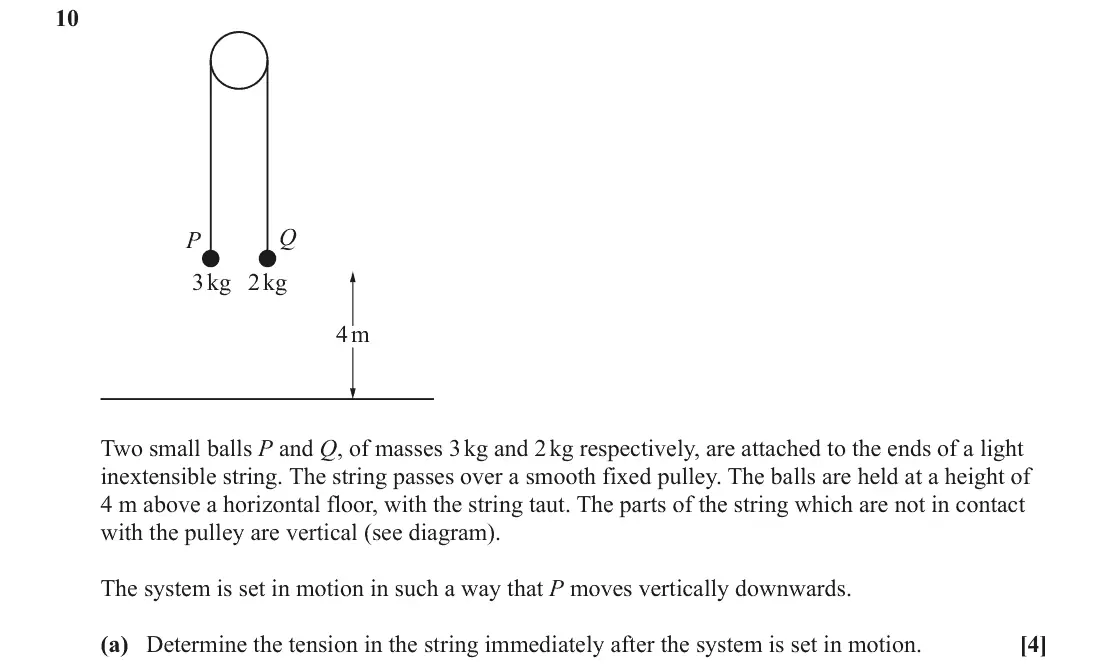
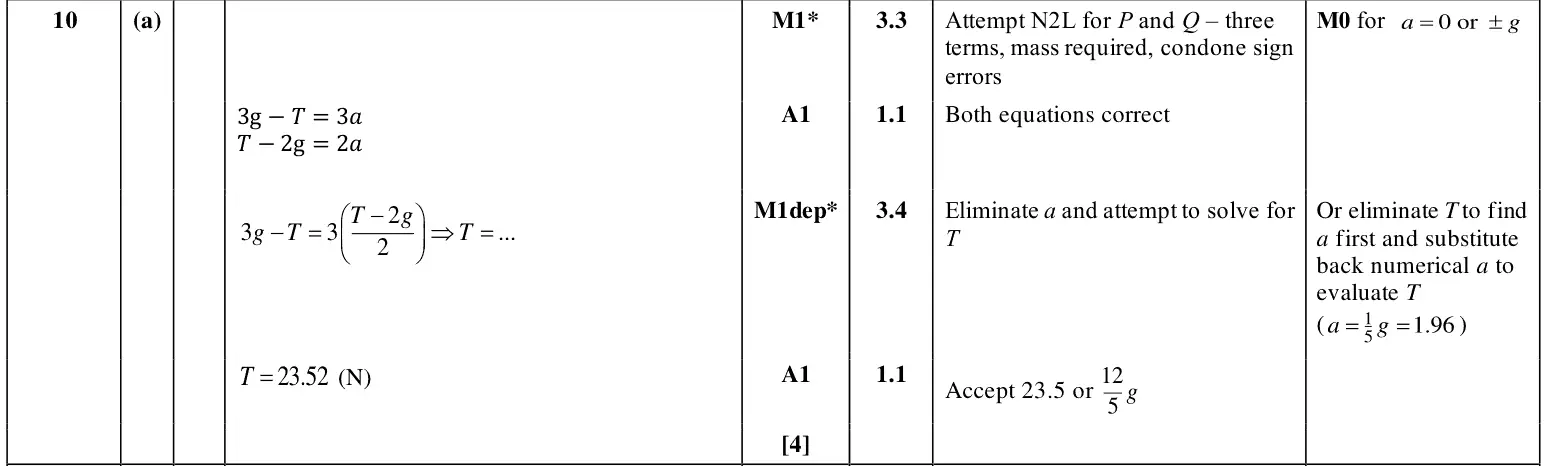
N2L: 3g − T = 3a and T − 2g = 2a
a = g/5 = 1.96
T = 23.52 N
June 2024 · AS Paper 2 · Q10(d)1 markHard
Show the start of this question
Mark scheme for this part
Examiner's comment
Hardly any candidates referred to the magnitude of the acceleration. Please refer to the mark scheme’s appendix for what we were expecting and examples of what was and was not accepted.
Key points and common errors
accelerations of P and Q would not have equal magnitude
June 2023 · AS Paper 2 · Q11(b)4 marksMedium
Show the start of this question
Mark scheme for this part
Examiner's comment
We saw some good solutions to this part, but quite a lot of equations had extra or missing terms. In the equation for R the value found for T1 was sometimes placed where T2 should have been, resulting in this equation alone being used to find m. Those considering Q and R together here needed to be careful (see the comment in (a)). 04m was used in some equations. The request for 3 significant figures was well followed here.
Key points and common errors
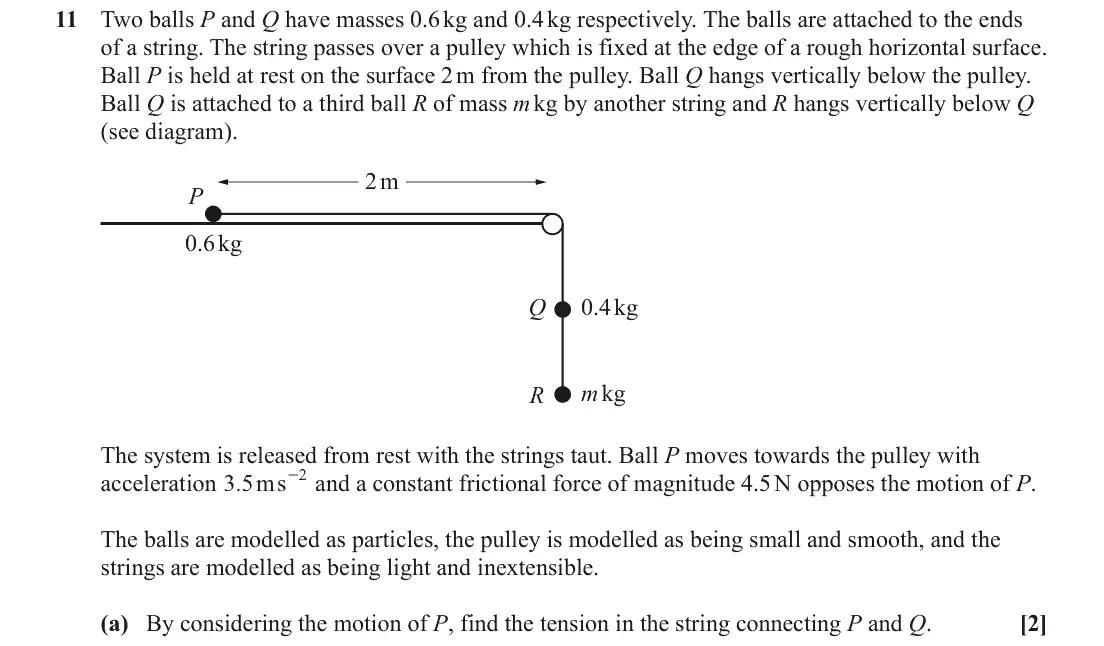
for Q: T₂ + 0.4g − 6.6 = 0.4 × 3.5
for R: mg − T₂ = 3.5m
m = 0.648 (3 s.f.)
missing or extra terms
tensions mixed up
June 2023 · AS Paper 2 · Q11(c)6 marksHard
Show the start of this question
Mark scheme for this part
Examiner's comment
Many candidates earned the first 2 B marks for the motion until the string breaks, but what happened after this was often confused. Some just thought P only moved 0.28 m and compared this with 2 or used a = g in the subsequent motion. Others who attempted one or two Newton II equations used T = 0 or maybe 6.6. Use of the correct deceleration was uncommon. This shows a candidate who realises that there is a change of acceleration but uses Newton II with T = 0.
Key points and common errors
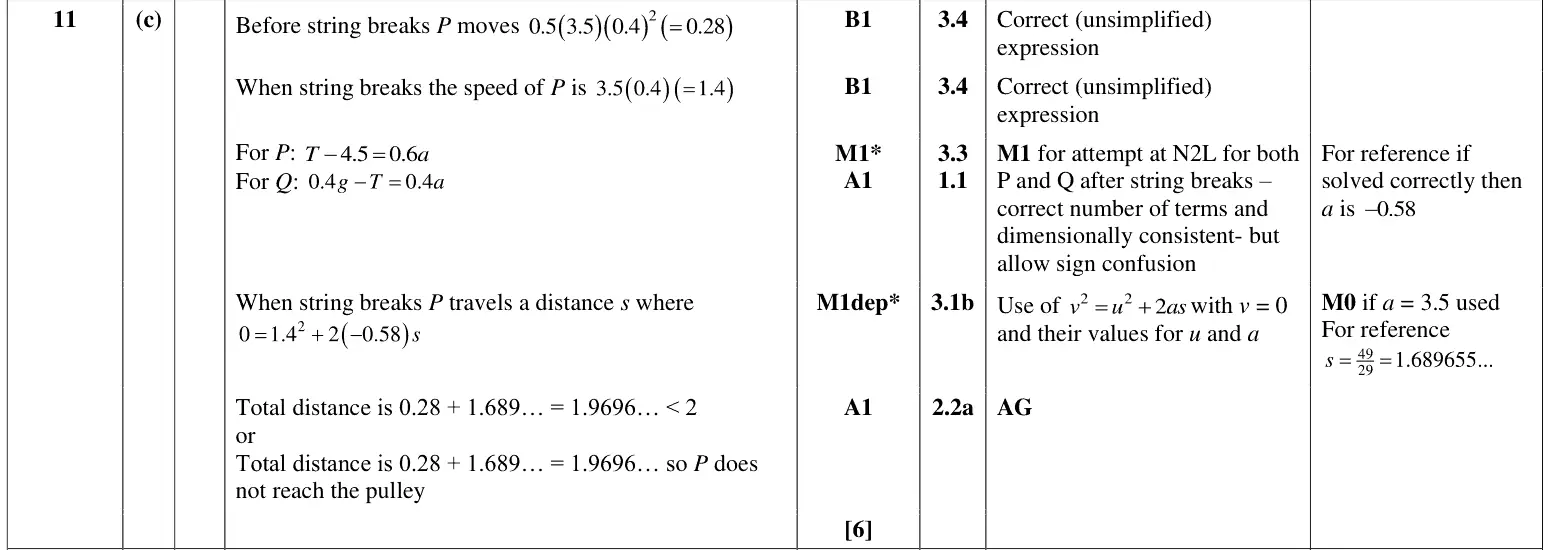
before break: 0.28 m and speed 1.4
after: P and Q decelerate with a = −0.58 (T ≠ 0 and ≠ 6.6)
0 = 1.4² + 2(−0.58)s gives s = 1.69
total 1.97 < 2
June 2023 · AS Paper 2 · Q11(d)1 markMedium
Show the start of this question
Mark scheme for this part
Examiner's comment
The mark scheme provides examples of the sort of things we accepted here and it would be recommended for centres to review this with future students. Candidates should be encouraged to write their response in a full sentence, as it was not always clear what a candidate meant. For example, some candidates just wrote ‘Friction’, which could mean the frictional force opposing the motion of P is not constant (which means the ball could reach the pulley), or there is a frictional force on the pulley (which would make the ball less likely to reach the pulley). Some comments were difficult to read; we encourage candidates to always write their responses clearly. It is also worth noting that one factor was requested; if more than one factor was given then all had to be acceptable to gain the mark.
Key points and common errors
P and the pulley modelled as having no size
or friction not constant, string not light/inextensible
must be clearly stated
June 2022 · AS Paper 2 · Q12(b)5 marksHard
Show the start of this question
Mark scheme for this part
Examiner's comment
In this part many just gained the first 3 marks, applying Newton’s Second Law to both particles and calculating a and T. Few realised that the magnitude of the force exerted on the pulley by the string was 2T. One examiner mentioned that when teaching this topic, they got students to draw the tensions acting downwards from the pulley as well as the tensions acting upwards just in case this sort of question came up! In this type of question, a good diagram of the forces involved is to be encouraged. Those who considered the system as a whole, which is to be discouraged, often did not score full marks . If they succeeded in finding a sensibly, they did not then show clarity when trying to find T.
Key points and common errors
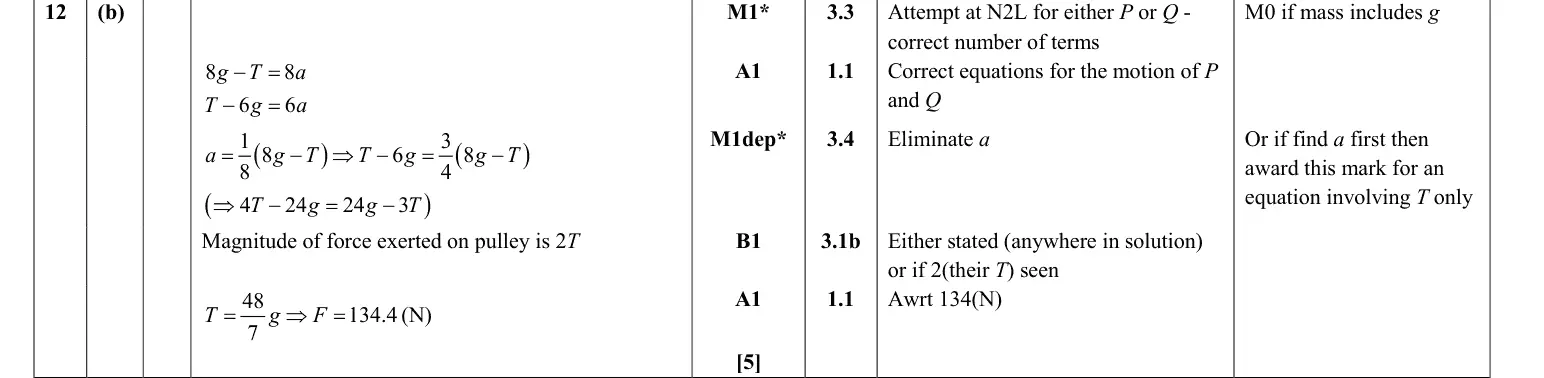
8g − T = 8a, T − 6g = 6a
T = 48g/7
force on pulley 2T = 134 N
few realised 2T
June 2022 · AS Paper 2 · Q12(c)4 marksHard
Show the start of this question
Mark scheme for this part
Examiner's comment
Many struggled with this question. The most common error was not understanding that the acceleration of Q changed when P hit the floor. 9.8 or their answer to part (b) was used in both stages of the motion. Finding the velocity of Q at the instant when P hits the floor was critical to solving this problem. A few good efforts lost the final mark by giving the answer as 2 x (0.25) + 1.75. This exemplar illustrates the above comment about acceleration. This candidate uses the acceleration found in part (b) of 1.4ms-2 in both stages of the motion.
Key points and common errors
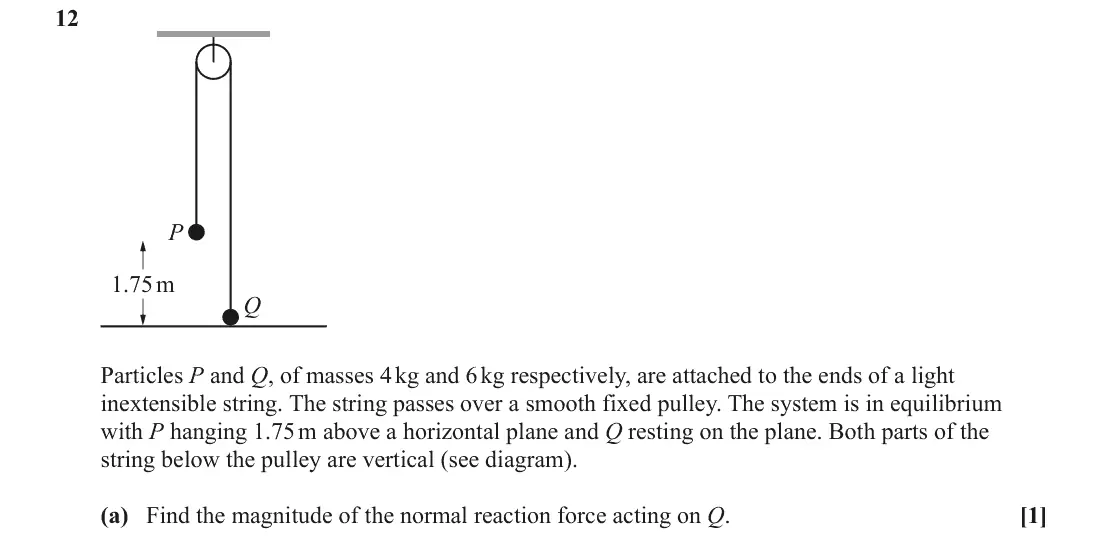
a = 1.4: v² = 2(1.4)(1.75) = 4.9 when P lands
then Q moves freely under gravity: s = 0.25
total 2 m
common error using the same acceleration in both stages
June 2022 · AS Paper 2 · Q12(d)1 markEasy
Show the start of this question
Mark scheme for this part
Examiner's comment
Many correctly cited ‘air resistance’ or ‘friction at the pulley’.
Key points and common errors
e.g. air resistance, friction at the pulley, string not light or inextensible
'more accurate g' not accepted
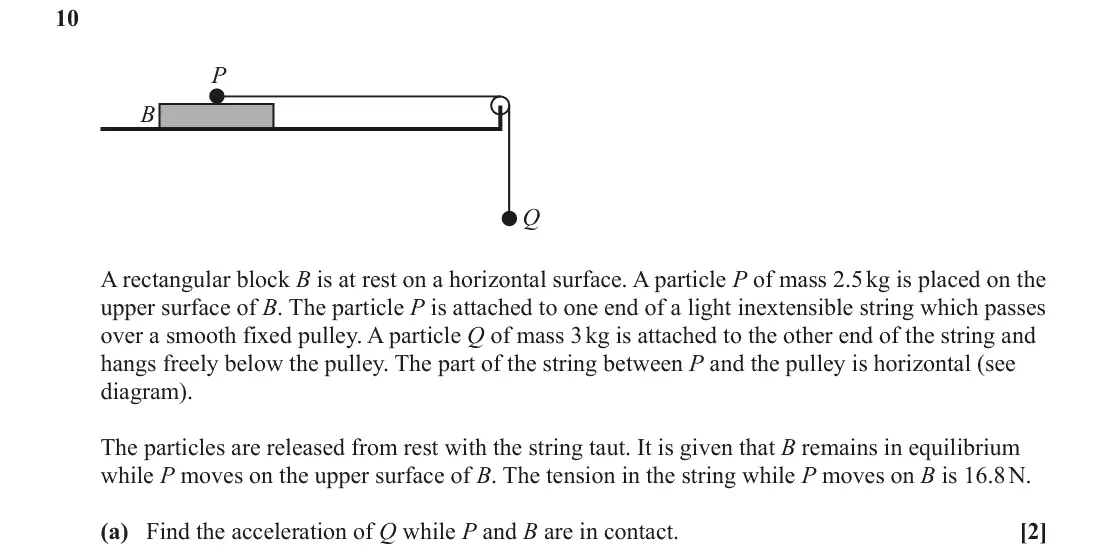
June 2022 · Paper 3 · Q10(a)2 marksEasy
Mark scheme for this part
Examiner's comment
This question was answered very well with most candidates correctly applying Newton’s second law vertically for particle Q. Occasionally, candidates attempted to apply Newton’s second law to either the entire system or to P (but without any success).
Key points and common errors
N2L for Q: 3g − 16.8 = 3a
a = 4.2 m s⁻²
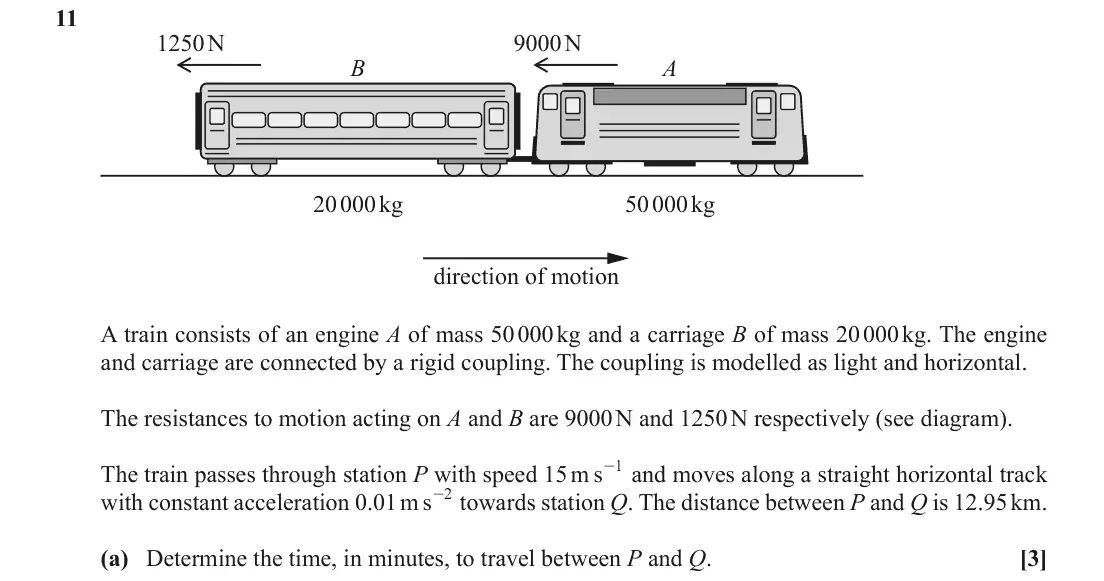
Autumn 2021 · AS Paper 2 · Q11(b)2 marksMedium
Show the start of this question
Mark scheme for this part
Key points and common errors
N2L for the whole train: D − 1250 − 9000 = 70 000 × 0.01
D = 10 950 N
Autumn 2021 · AS Paper 2 · Q11(c)2 marksMedium
Show the start of this question
Mark scheme for this part
Key points and common errors
N2L for carriage B: T − 1250 = 20 000 × 0.01
T = 1450 N
Autumn 2020 · AS Paper 2 · Q9(a)2 marksMedium
Mark scheme for this part
Examiner's comment
(Comment on Question 09 as a whole) Part (a) - 9500 = 885a prevalent. Examiners really want to see the correct number of terms in Newton’s second law, else it is regarded as a fundamental misunderstanding. Also, of course, weight and mass must not be confused. Part (b) - This did not appear to be understood at all well by most candidates. Many candidates could not isolate the forces on the crate and display just those on a diagram. R often missing. Part (c) - Much confusion with the use of Newton’s second law ; 885 appearing in equations with R.
Key points and common errors
9500 − 885g = 885a: a = 0.934 m/s²
9500 = 885a common
weight and mass confused
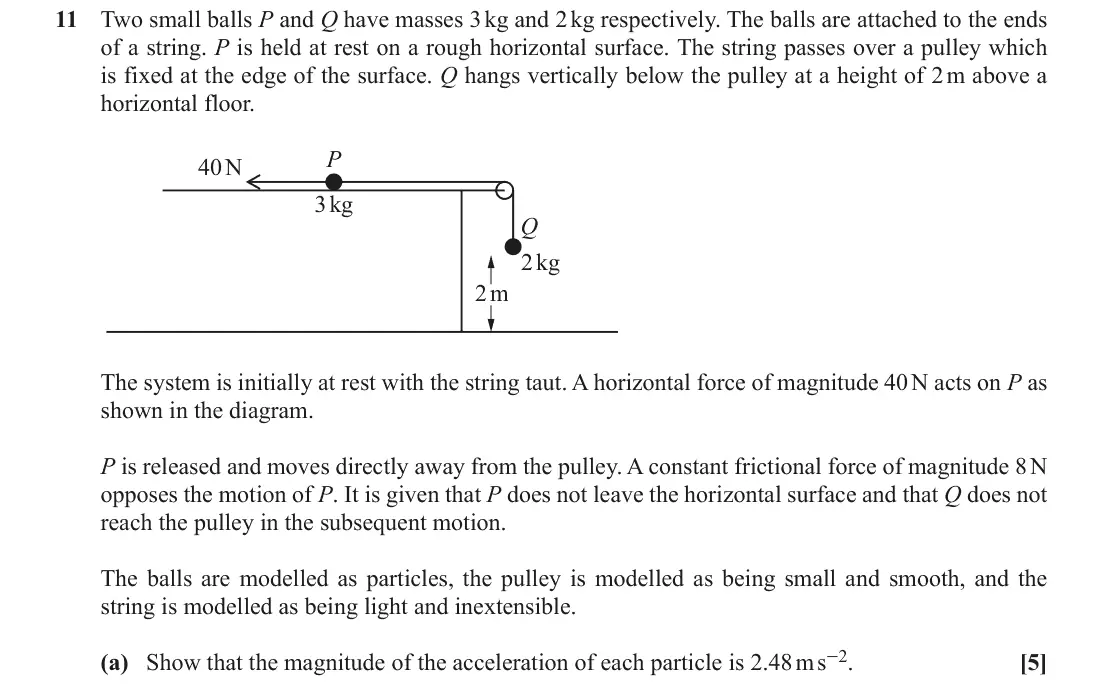
June 2019 · AS Paper 2 · Q11(a)5 marksMedium
Mark scheme for this part
Examiner's comment
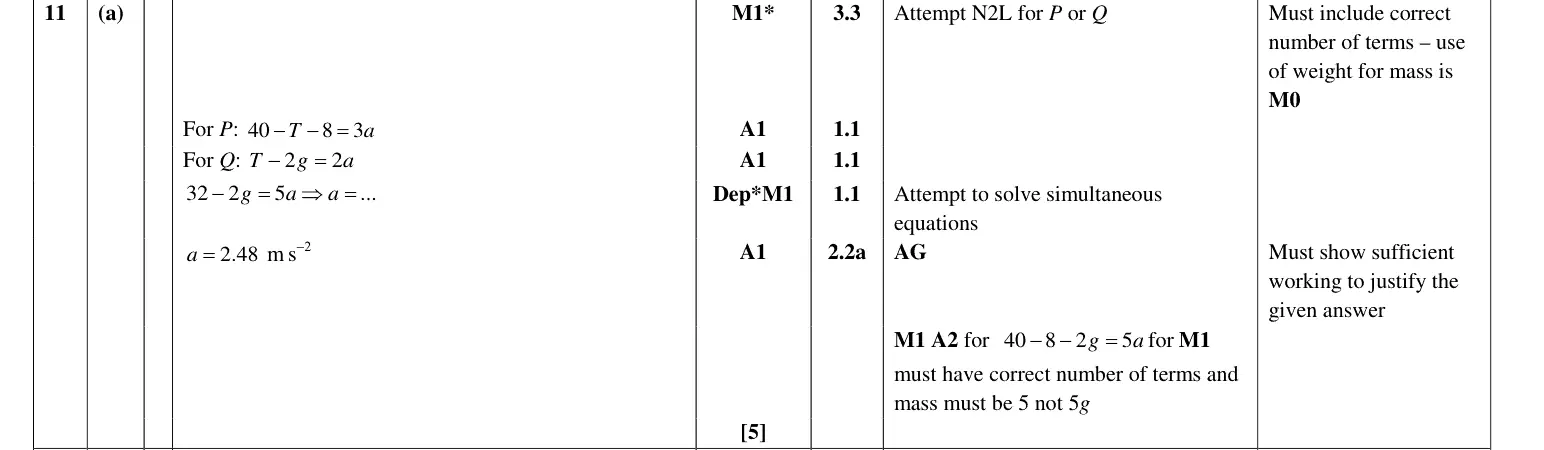
Candidates should be completely discouraged from treating the system as a whole (this is a high risk strategy because when thing go wrong it nearly always scores 0) and keep things simple by applying F = ma to each particle. It is good practice to draw a diagram of the forces involved for each particle and show the direction of positive acceleration. This helps to avoid missing forces in the two equations, examiners considered this quite a serious error, and also encourages sensible consistent use of signs. Use of mga also lost the method marks. If - 2.48 appeared we expected the negative to be explained.
Key points and common errors
N2L for each particle: 40 − T − 8 = 3a and T − 2g = 2a gives a = 2.48
whole-system equations risky
missing forces
mass not weight on the right
June 2019 · AS Paper 2 · Q11(b)2 marksMedium
Show the start of this question
Mark scheme for this part
Examiner's comment
We expected 2.48 to be used here. 2g – T = 2a with this value gained the method mark.
Key points and common errors
T − 2g = 2 × 2.48 so T = 24.56 N
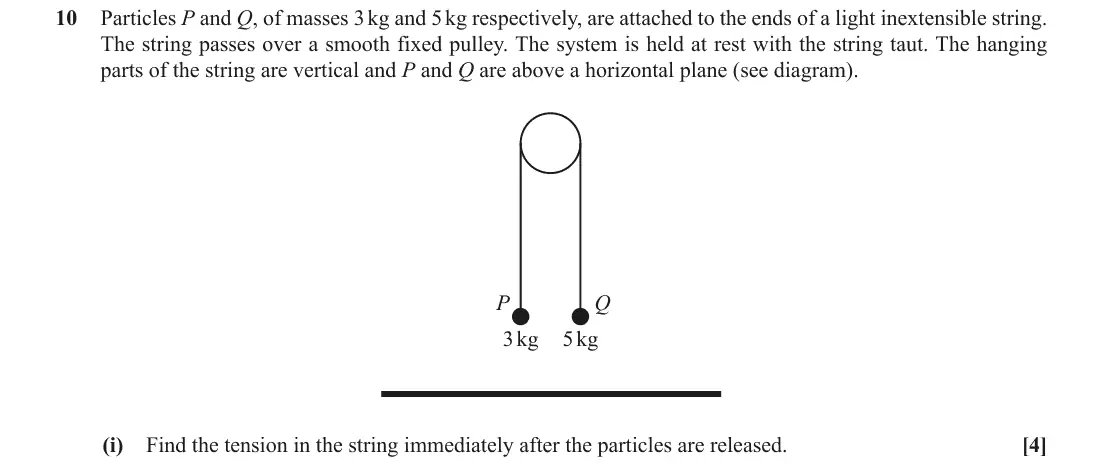
June 2018 · AS Paper 2 · Q10(i)4 marksEasy
Mark scheme for this part
Examiner's comment
Whilst this standard situation was generally well understood, it was not uncommon to see attempts which assumed the acceleration after release was g or 0. Those who produced initial appropriate equations generally produced fully accurate solutions, although sign errors were sometimes seen.
Key points and common errors
T − 3g = 3a and 5g − T = 5a
T = 36.75 N (15g/4)
assuming acceleration g or 0
June 2018 · AS Paper 2 · Q10(ii)4 marksMedium
Show the start of this question
Mark scheme for this part
Examiner's comment
We expected to see an acceleration other than g or 0 used for the descent of Q. Some candidates used v = 0 for this phase rather than u = 0, presumably because ‘Q strikes the plane and is immediately brought to rest’. Those who now looked at the next phase of the motion sometimes did not realise that it was motion under gravity. Some good attempts omitted to double 0.625.
Key points and common errors
a = 0.25g
v² = 2 × 2.45 × 2.5 = 12.25 when Q lands
P then moves freely under gravity: h = 0.625 up, so distance up and down 1.25 m
forgetting to double 0.625
Find an A-level maths tutor
Stuck on this? Book a trial session with an A-level maths tutor.