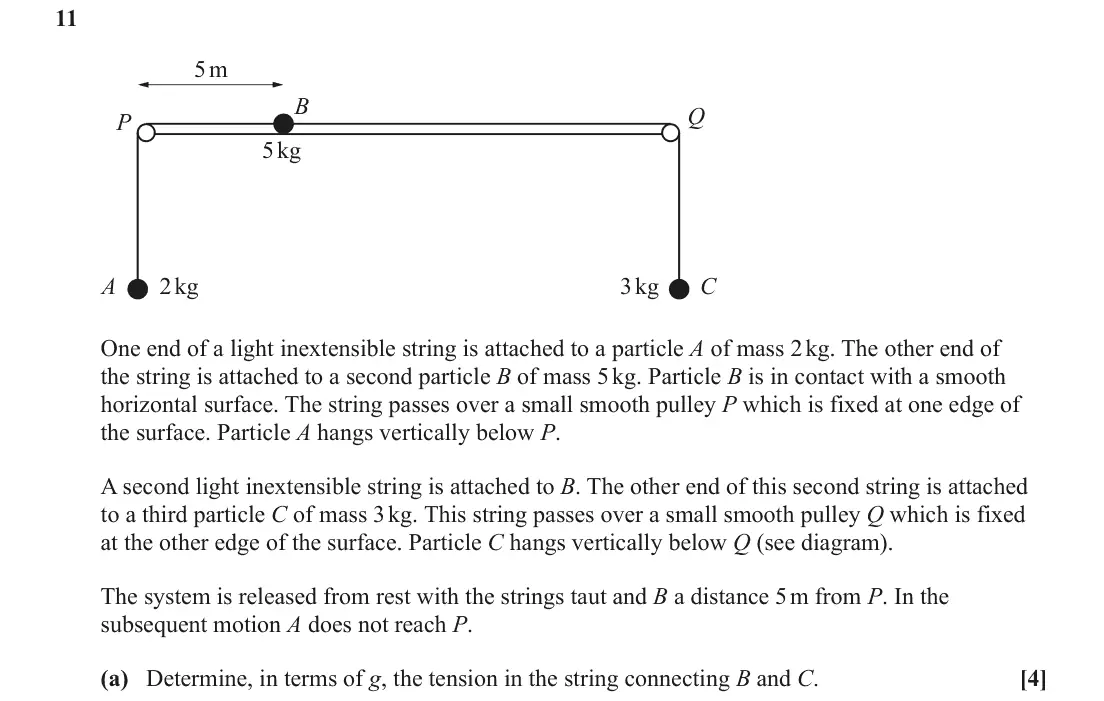
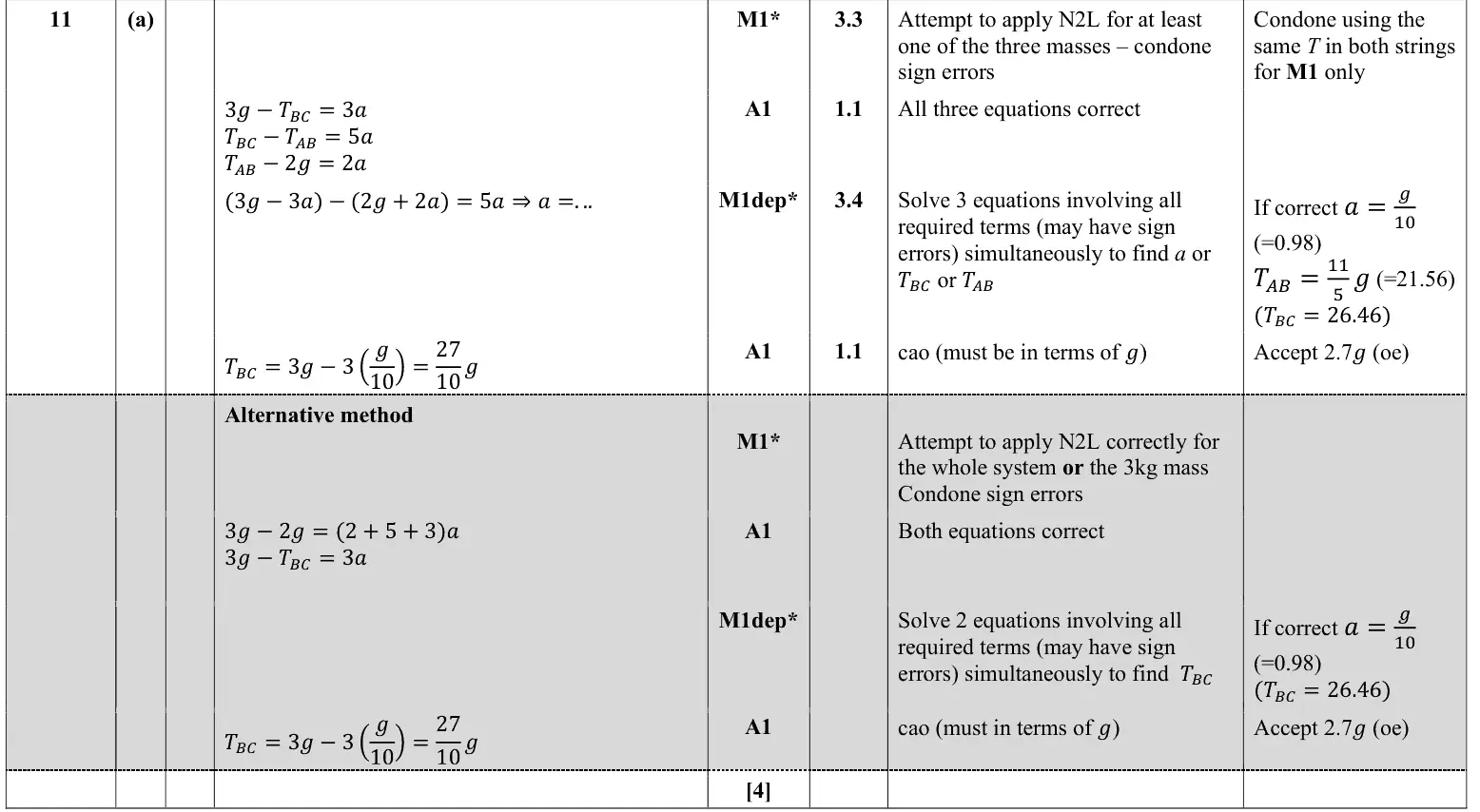
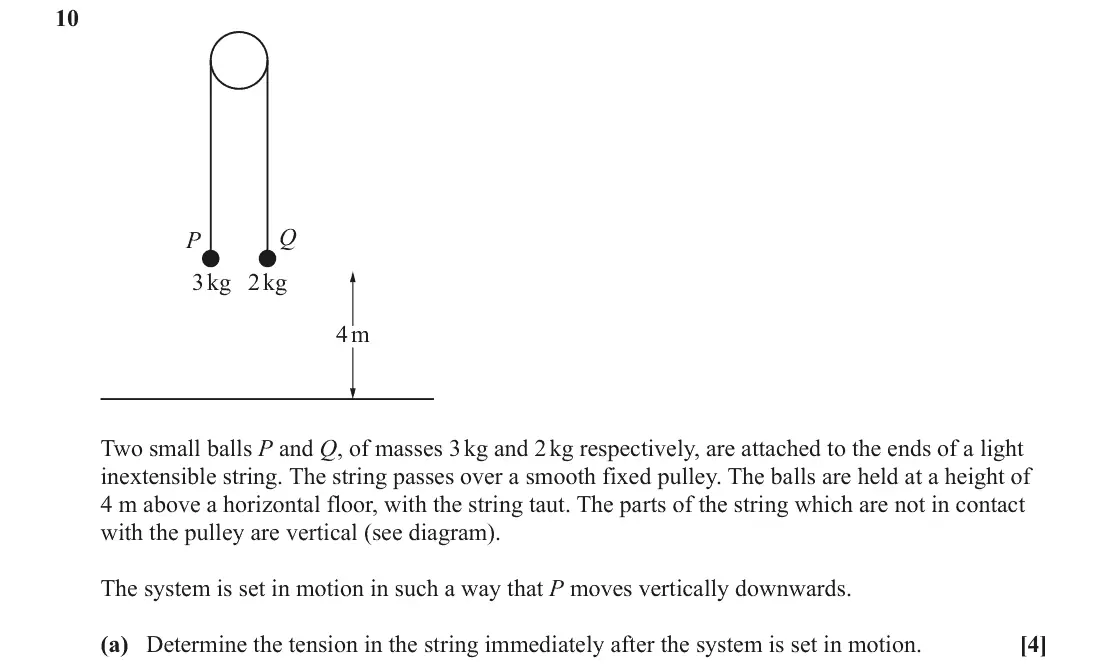
Those candidates who realised that the tension in AB was not the same as the tension in BC were generally very successful in this part, usually providing accurate working. Occasionally the answer was not given in terms of g as requested. Many assumed there was only one tension to find, which gained at most the first M mark.
Key points and common errors
two different tensions: 3g − T_BC = 3a, T_BC − T_AB = 5a, T_AB − 2g = 2a
a = g/10
T_BC = 27g/10
answer in terms of g
June 2025 · Paper 3 · Q8(a)2 marksEasy
Mark scheme for this part
Examiner's comment
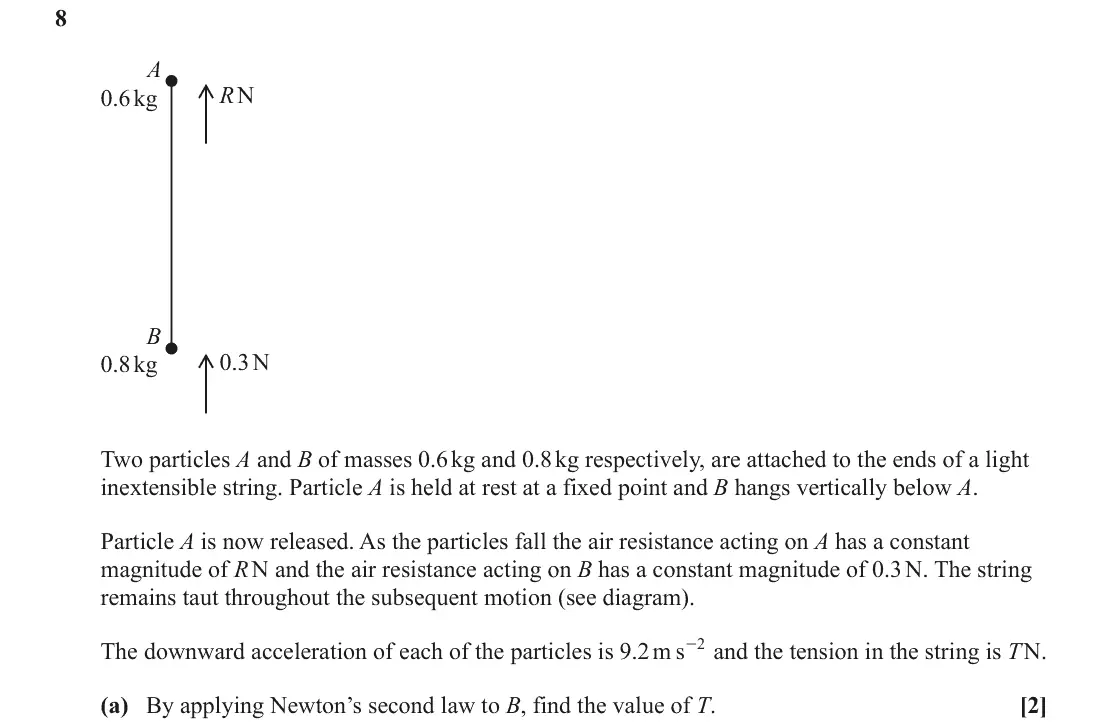
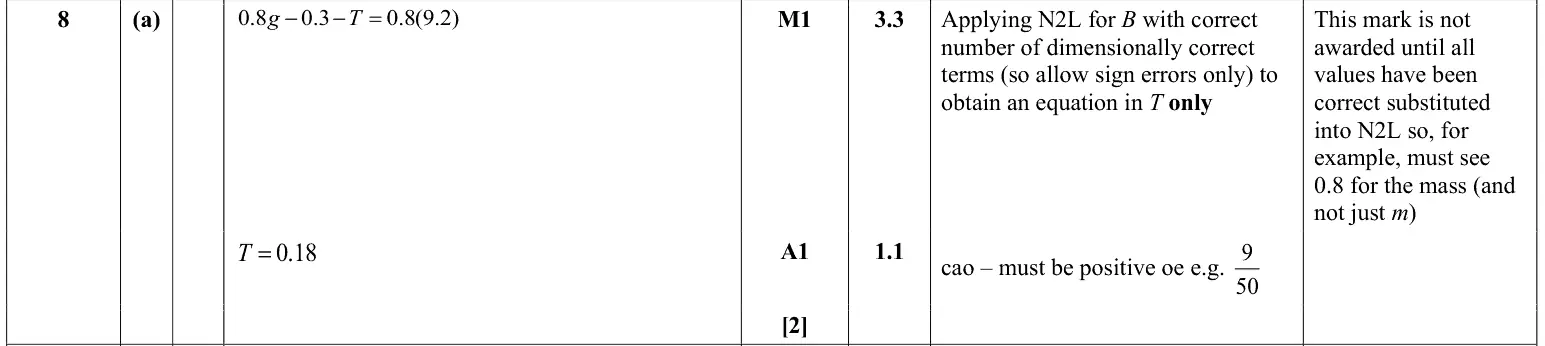
Although answered well by most candidates some struggled to include all the forces acting on B with many forgetting to include the weight of B. Of those that did include all three forces acting on B many made sign error with the acceleration term which led to a common incorrect answer of 14.9 for the tension in the string.
Key points and common errors
N2L for B: 0.8g − 0.3 − T = 0.8 × 9.2 so T = 0.18
weight of B often omitted
sign error gives 14.9
June 2024 · AS Paper 2 · Q10(a)4 marksEasy
Mark scheme for this part
Examiner's comment
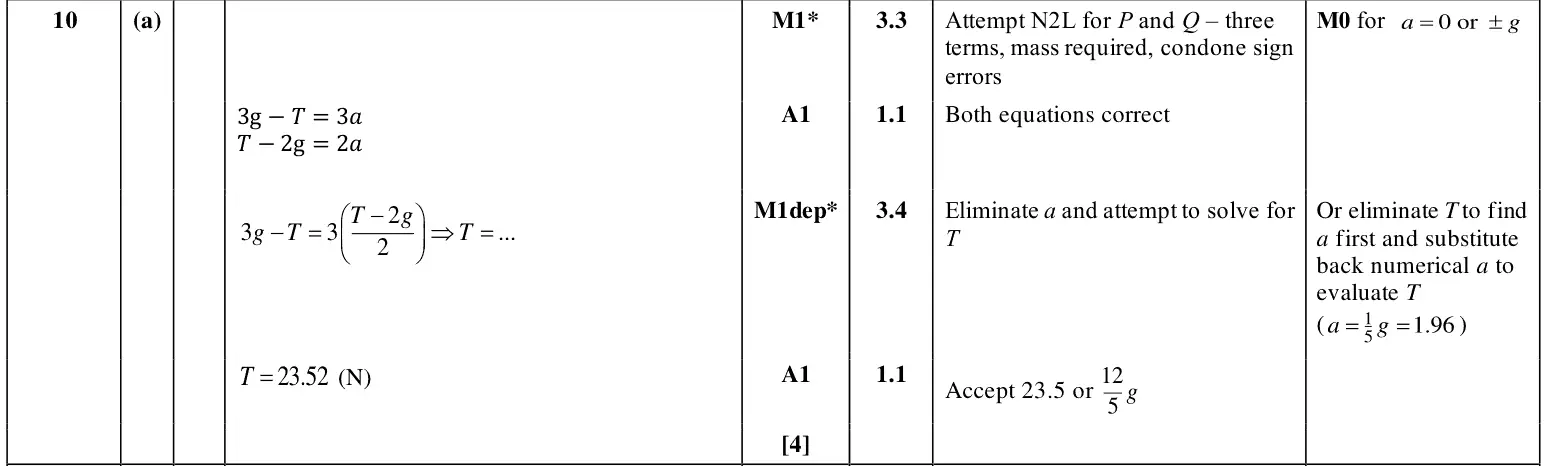
This part was successfully done by many. The need to use Newton’s Second law was well recognised and the correct answer was often seen. Most found a first and then T. We still saw equations like 3g – T = T – 2g with no mention of a, but these seemed less common than in the past.
Key points and common errors
N2L: 3g − T = 3a and T − 2g = 2a
a = g/5 = 1.96
T = 23.52 N
June 2024 · AS Paper 2 · Q10(c)4 marksMedium
Show the start of this question
Mark scheme for this part
Examiner's comment
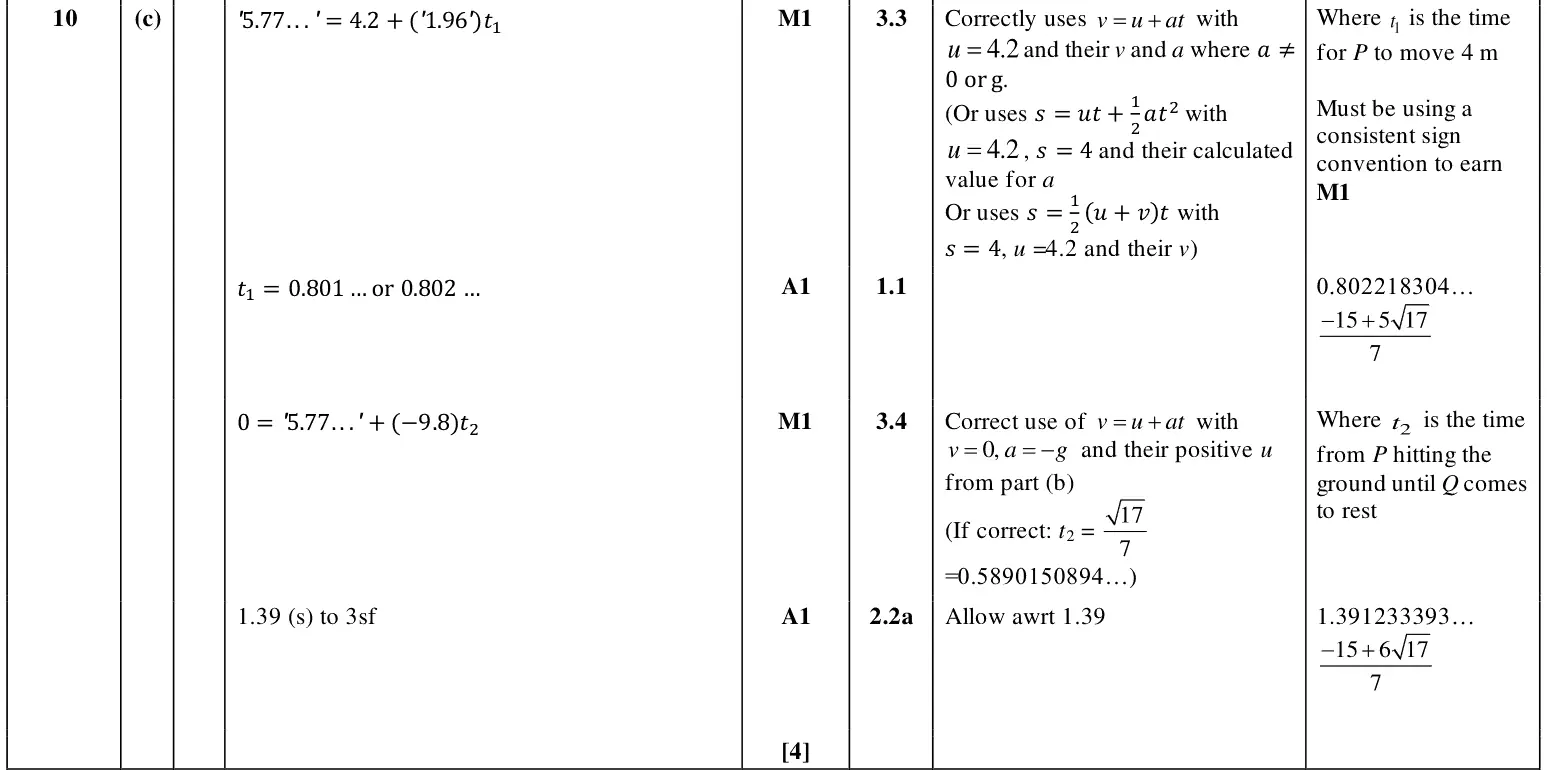
Attempts at this part were less successful. To calculate t1, using s = ut + ½at 2 was prevalent, but a = 9.8 again appeared. Giving t1 = 0.8 or 0.80 resulted in A0, unless anything more accurate was seen. Some found t1 and gave it as their final answer. Some candidates recalculated v using u = 0 and used this new value in their working for t1 and t2, rather than the value found in (b). Occasionally s = ut + ½at 2 was attempted with s = 8.
Key points and common errors
t₁ = 0.802 s for P to fall 4 m
then Q moves freely under gravity: 0 = 5.77 − 9.8t₂, t₂ = 0.589
total 1.39 s
June 2023 · AS Paper 2 · Q11(b)4 marksMedium
Show the start of this question
Mark scheme for this part
Examiner's comment
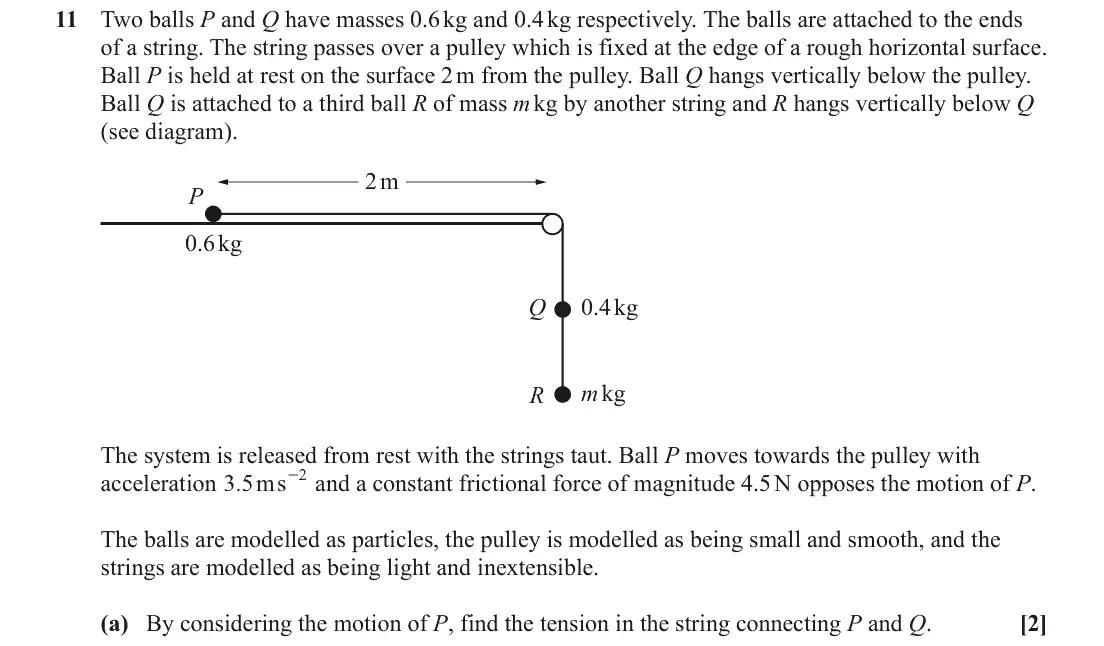
We saw some good solutions to this part, but quite a lot of equations had extra or missing terms. In the equation for R the value found for T1 was sometimes placed where T2 should have been, resulting in this equation alone being used to find m. Those considering Q and R together here needed to be careful (see the comment in (a)). 04m was used in some equations. The request for 3 significant figures was well followed here.
Key points and common errors
for Q: T₂ + 0.4g − 6.6 = 0.4 × 3.5
for R: mg − T₂ = 3.5m
m = 0.648 (3 s.f.)
missing or extra terms
tensions mixed up
June 2022 · AS Paper 2 · Q103 marksMedium
Mark scheme for this part
Examiner's comment
The ‘direct’ method written out on the scheme was obviously quicker than considering the motion in various parts but seemed to be less popular. Those who tried to apply it often did not appreciate that the initial velocity was not in the same direction as the displacement and acceleration. Note the quadratic here could be done by calculator (BC). Those who did it by considering the motion up and the motion down, for example, often got full marks but a complete method for what we requested was needed to gain any credit. If a relevant time was omitted, no marks were given.
Key points and common errors
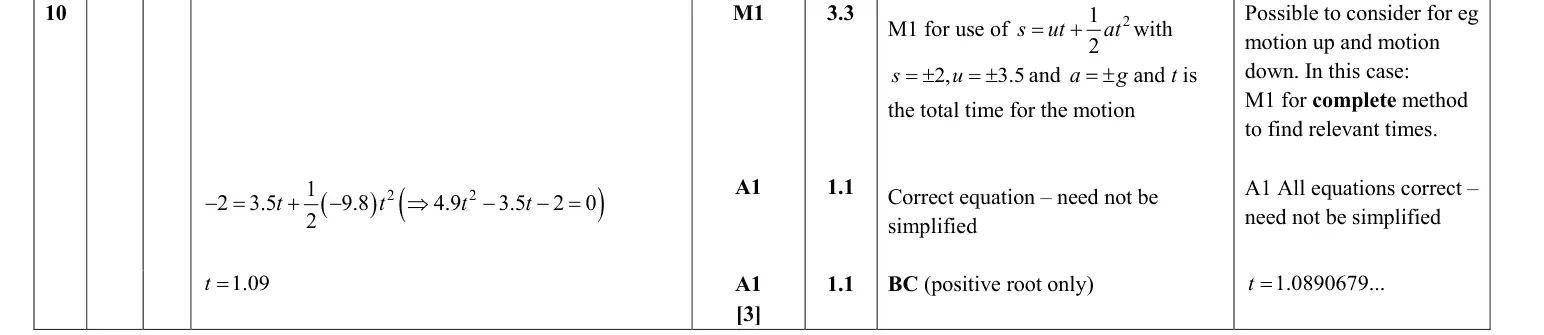
s = ut + ½at² with s = −2, u = 3.5, a = −9.8: 4.9t² − 3.5t − 2 = 0, t = 1.09
directions of u, s, a must be consistent
split-motion methods need all times
June 2022 · AS Paper 2 · Q12(a)1 markHard
Mark scheme for this part
Examiner's comment
Correct answers were rare here, with 6g the value generally given.
Key points and common errors
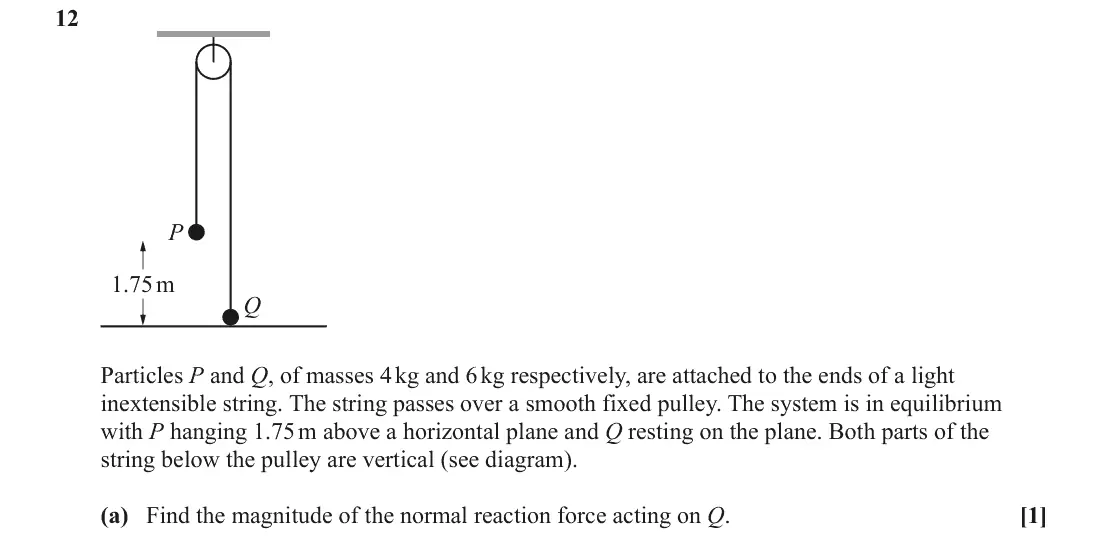
R = 6g − 4g = 2g = 19.6 N
6g commonly given
June 2022 · Paper 3 · Q10(a)2 marksEasy
Mark scheme for this part
Examiner's comment
This question was answered very well with most candidates correctly applying Newton’s second law vertically for particle Q. Occasionally, candidates attempted to apply Newton’s second law to either the entire system or to P (but without any success).
Key points and common errors
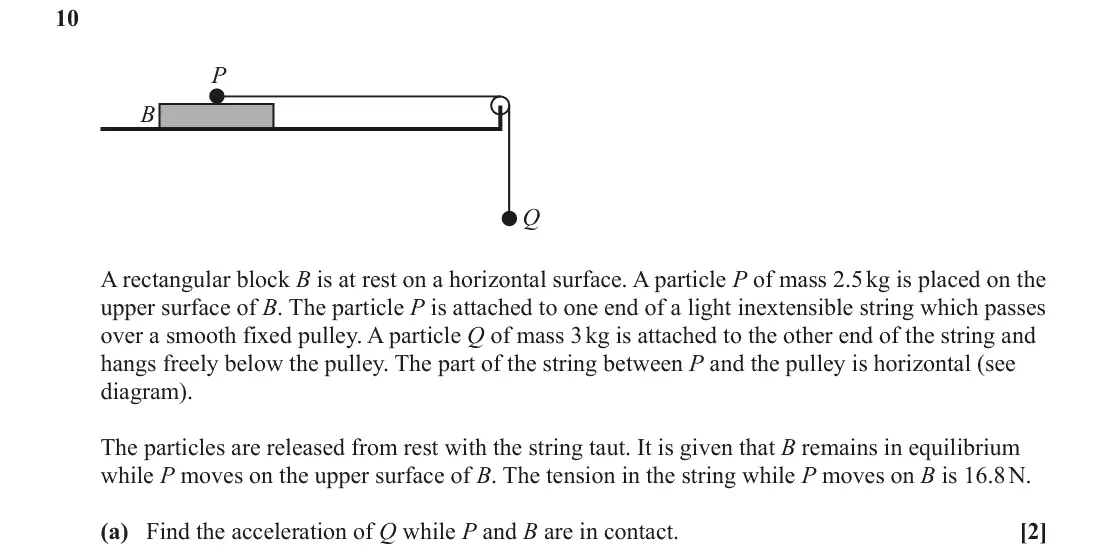
N2L for Q: 3g − 16.8 = 3a
a = 4.2 m s⁻²
Autumn 2020 · AS Paper 2 · Q9(a)2 marksMedium
Mark scheme for this part
Examiner's comment
(Comment on Question 09 as a whole) Part (a) - 9500 = 885a prevalent. Examiners really want to see the correct number of terms in Newton’s second law, else it is regarded as a fundamental misunderstanding. Also, of course, weight and mass must not be confused. Part (b) - This did not appear to be understood at all well by most candidates. Many candidates could not isolate the forces on the crate and display just those on a diagram. R often missing. Part (c) - Much confusion with the use of Newton’s second law ; 885 appearing in equations with R.
Key points and common errors
9500 − 885g = 885a: a = 0.934 m/s²
9500 = 885a common
weight and mass confused
Autumn 2020 · Paper 3 · Q9(b)3 marksMedium
Show the start of this question
Mark scheme for this part
Examiner's comment
(Comment on Question 09 as a whole) 4 In this question the angle θ was defined as cosθ = . Candidates should resist the temptation to 5 calculate the decimal approximation for θ and instead use their knowledge of Pythagoras Triples to state the exact values for sinθ (and tanθ if required). The exact values have been chosen to make the arithmetic easier. Similarly, some questions will use the values of θ that candidates are expected to know the exact values for, and these should be used rather than the decimal approximation. If the examiner wants the decimal approximations to be used, then the angle θ will simply be defined as a numerical value. Most candidates showed sufficient working using for part (a). There was evidence that most candidates understood how to obtain the given answer in part (b), but some responses did not fully justify their working. A few students used mass rather than weight and did not include g in their equations. Part (c) was attempted by all candidates but one or more of the following mistakes were made: ● Assumed a = 0 . ● Used rather than using components. R = 2g ● Sine/Cosine confusion when stating the components of any force. 4 3 ● Rounding errors with calculated values of θ rather than using cosθ = and sinθ = . 5 5 ● Incorrect directions used leading to sign errors. ● Under-specifying the final answer given to less than 3 sf. Although a fairly standard question, part (d) is traditionally expected to be a challenge for most candidates. For this reason, it was pleasing to see the number of fully correct answers. Common mistakes included: ● Tension was still applied. ● Incorrect acceleration; either the same a = 0 48 . , or a > 0 , or even a = 9 8. . ● Distance = speed × time used rather than ‘suvat’.
Key points and common errors
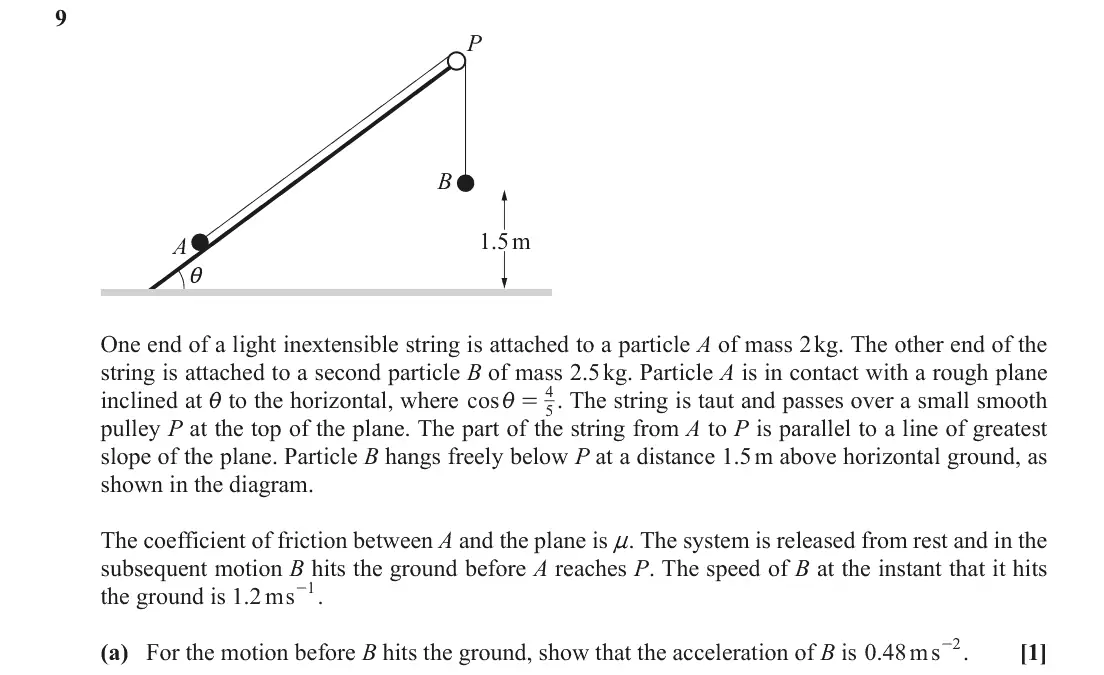
N2L for B: 2.5g − T = 2.5a
T = 23.3 N
use weight not mass
June 2019 · AS Paper 2 · Q11(c)5 marksHard
Show the start of this question
Mark scheme for this part
Examiner's comment
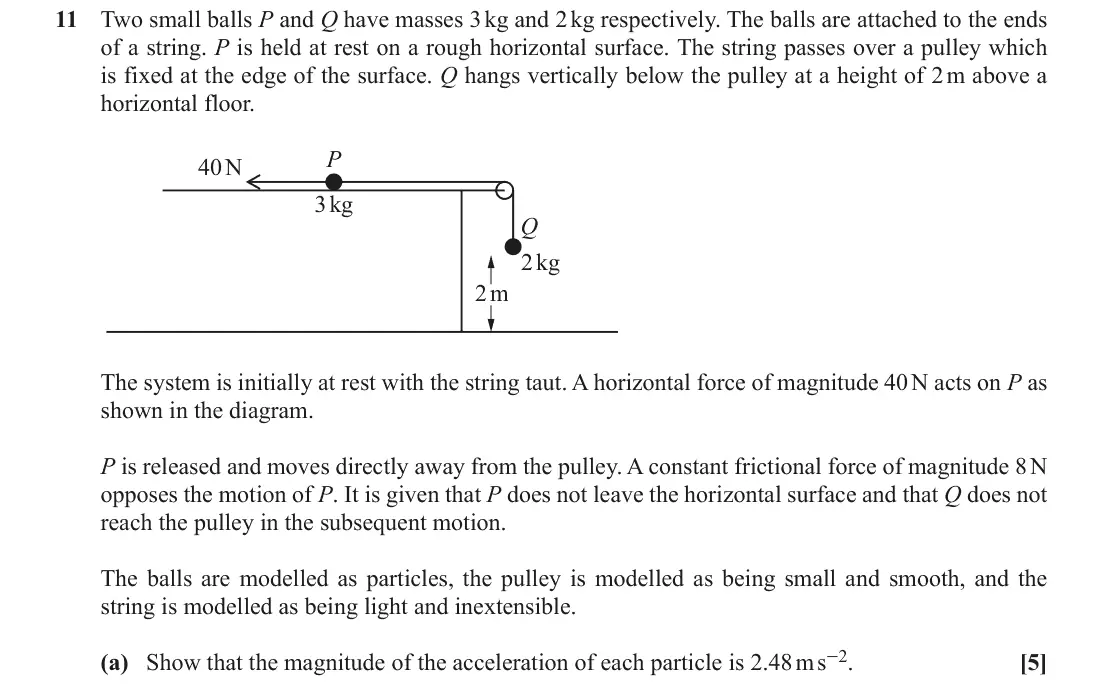
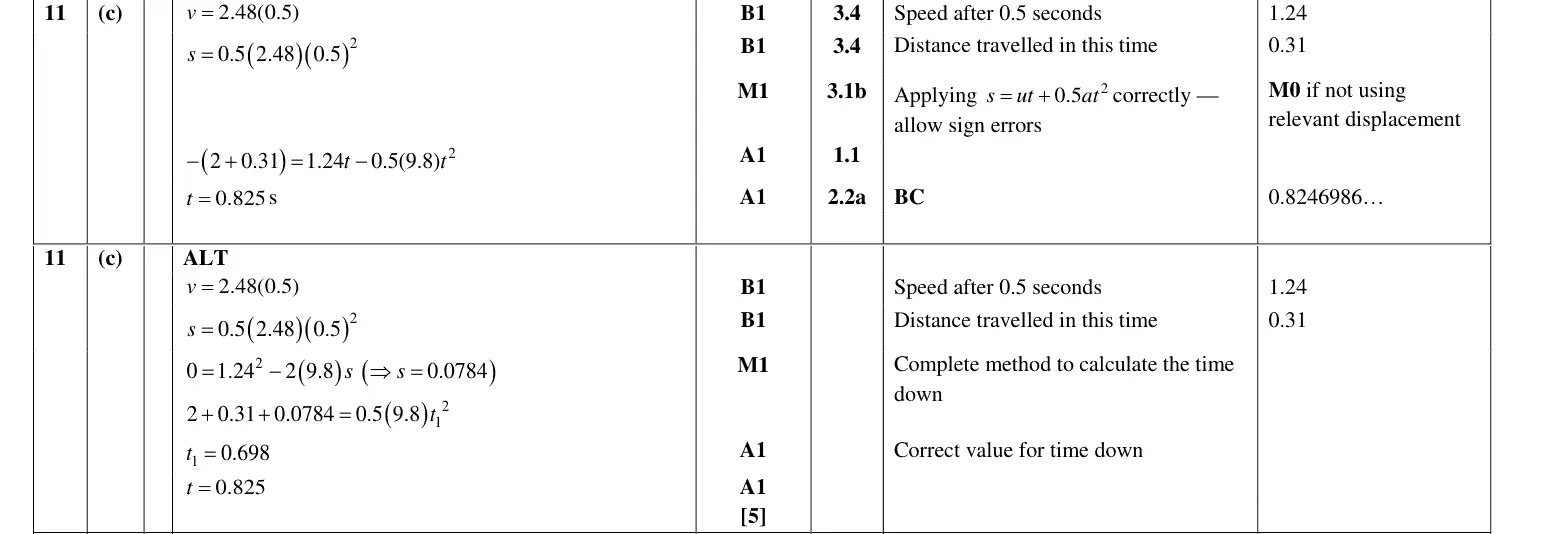
This part proved challenging. Those trying to follow the main approach on the Mark Scheme who realised they had to find the extra distance travelled until the string broke, and the velocity at this instant, then often did not take account of the signs needed for a correct equation from s = ut + ½at2.Some used s = 1.69 and/or u = 0, both of which scored M0. Those who tried to break the motion into ‘up’ and ‘down’ often used 2.31as the distance down, failing to calculate the extra distance needed to reach the highest point. This approach was generally not very successful.
Key points and common errors
after 0.5 s Q is moving up at 1.24 m/s, 0.31 m higher
then free fall: −2.31 = 1.24t − 4.9t² gives t = 0.825 s
using u = 0 or s = 1.69 scores nothing
June 2019 · AS Paper 2 · Q11(e)1 markEasy
Show the start of this question
Mark scheme for this part
Examiner's comment
Well answered.
Key points and common errors
R = 2g = 19.6 N
June 2018 · AS Paper 2 · Q10(i)4 marksEasy
Mark scheme for this part
Examiner's comment
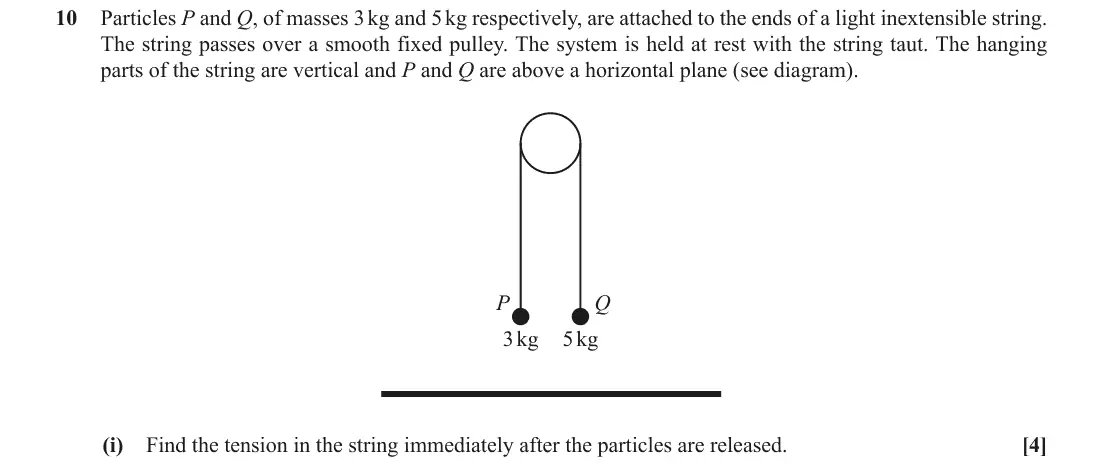
Whilst this standard situation was generally well understood, it was not uncommon to see attempts which assumed the acceleration after release was g or 0. Those who produced initial appropriate equations generally produced fully accurate solutions, although sign errors were sometimes seen.
Key points and common errors
T − 3g = 3a and 5g − T = 5a
T = 36.75 N (15g/4)
assuming acceleration g or 0
June 2018 · Paper 3 · Q8(i)3 marksMedium
Mark scheme for this part
Examiner's comment
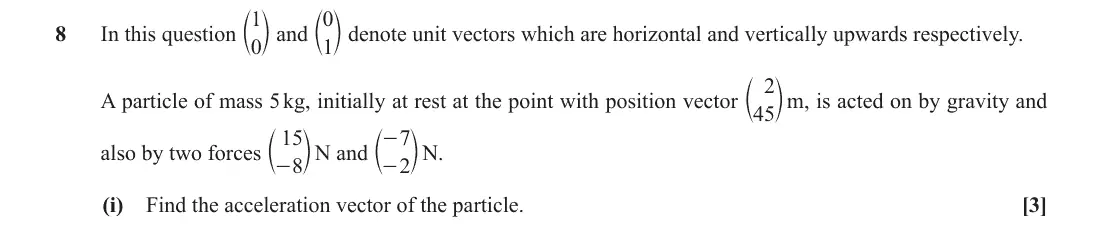
A significant number of candidates either forgot to include a gravity term or wrote that 15 − 7 0 + + = 5 a therefore forgetting to multiply the gravity term by the mass of the particle. − 8 − 2 − 9 8 .
Key points and common errors
resultant (15, −8) + (−7, −2) + 5(0, −9.8) = 5a
a = (1.6, −11.8)
weight must be included and multiplied by the mass
Find an A-level maths tutor
Stuck on this? Book a trial session with an A-level maths tutor.