3.03e Extend use of Newton's second law to situations where forces need…

Section
3.03 Forces and Newton's Laws
Level
A level only
Statement
Be able to extend use of Newton's second law to situations where forces need to be resolved (restricted to two dimensions).
Guidance
e.g. A force acting downwards on a body at a given angle to the horizontal or the motion of a body projected down a line of greatest slope of an inclined plane.
Since 2018
6 parts, 30 marks · topic pages: Friction, resultant forces and motion in a plane, Trigonometric ratios, graphs, radians and the sine and cosine rules, Constant acceleration (SUVAT), Forces, Newton's laws and connected particles

Back to the checklist

June 2025 · Paper 3 · Q12(a) 6 marks Medium
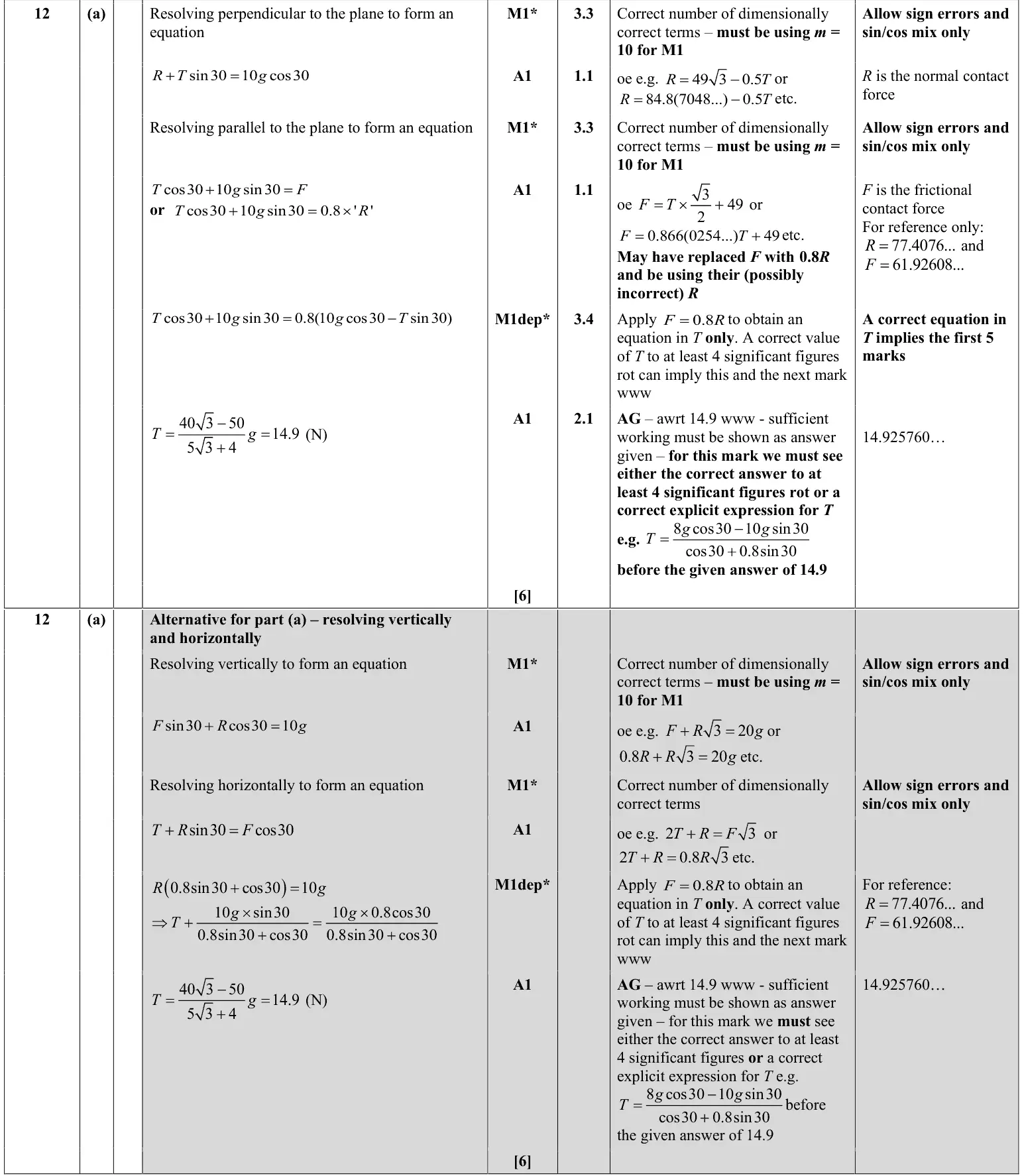
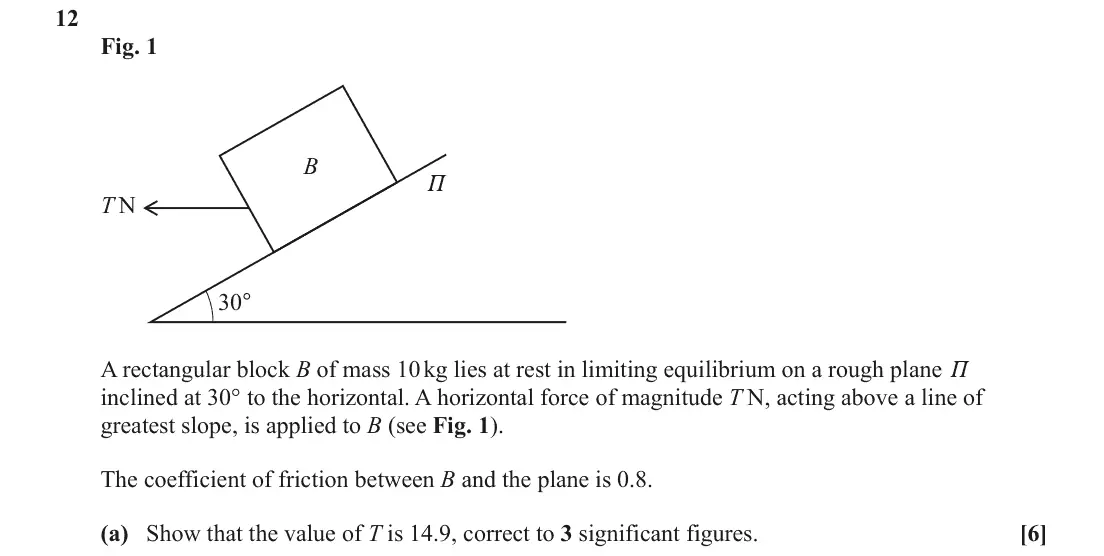
12 Fig. 1 B P T N 30° A rectangular block B of mass 10 kg lies at rest in limiting equilibrium on a rough plane P inclined at 30° to the horizontal. A horizontal force of magnitude T N, acting above a line of greatest slope, is applied to B (see Fig. 1). The coefficient of friction between B and the plane is 0.8. (a) Show that the value of T is 14.9, correct to 3 significant figures. [6]
June 2025 · Paper 3 · Q12(b) 4 marks Medium
Show the start of this questionEarlier part of this question
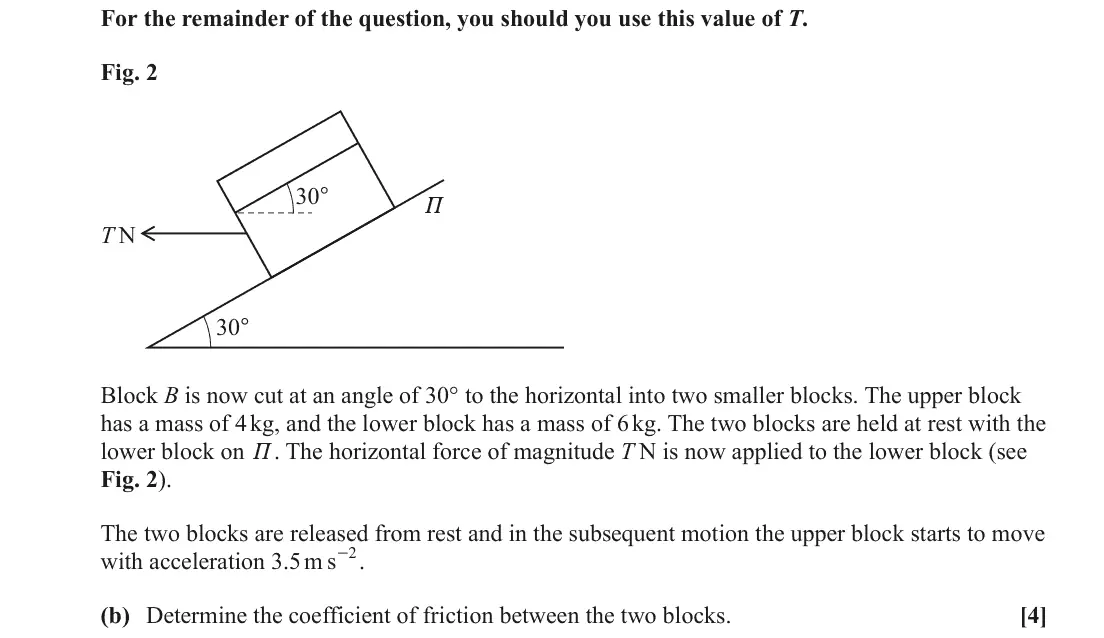
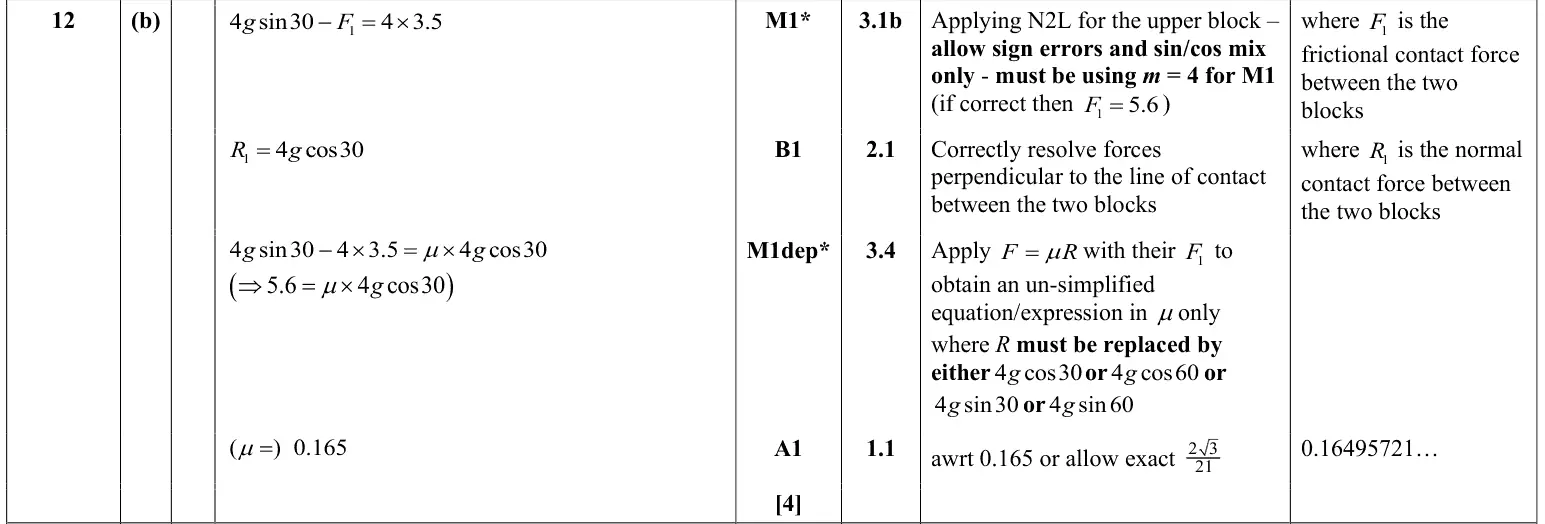
For the remainder of the question, you should you use this value of T. Fig. 2 30° P T N 30° Block B is now cut at an angle of 30° to the horizontal into two smaller blocks. The upper block has a mass of 4 kg, and the lower block has a mass of 6 kg. The two blocks are held at rest with the lower block on P. The horizontal force of magnitude T N is now applied to the lower block (see Fig. 2). The two blocks are released from rest and in the subsequent motion the upper block starts to move - . with acceleration 3.5 m s 2 (b) Determine the coefficient of friction between the two blocks. [4]
June 2025 · Paper 3 · Q12(c) 3 marks Hard
Show the start of this questionEarlier part of this questionEarlier part of this question
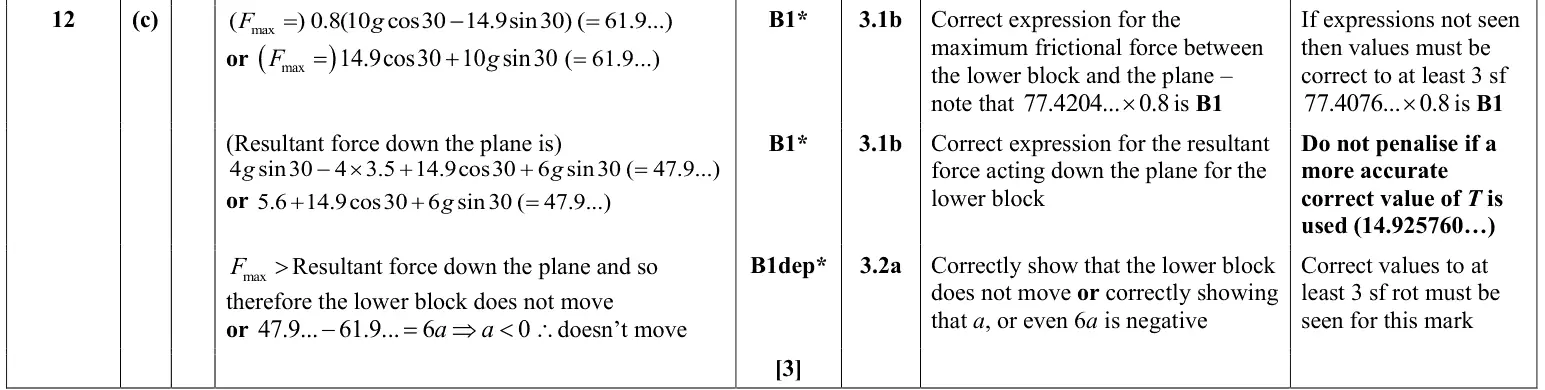
(c) Show that the lower block does not move. [3]
June 2024 · Paper 3 · Q13(a) 6 marks Hard
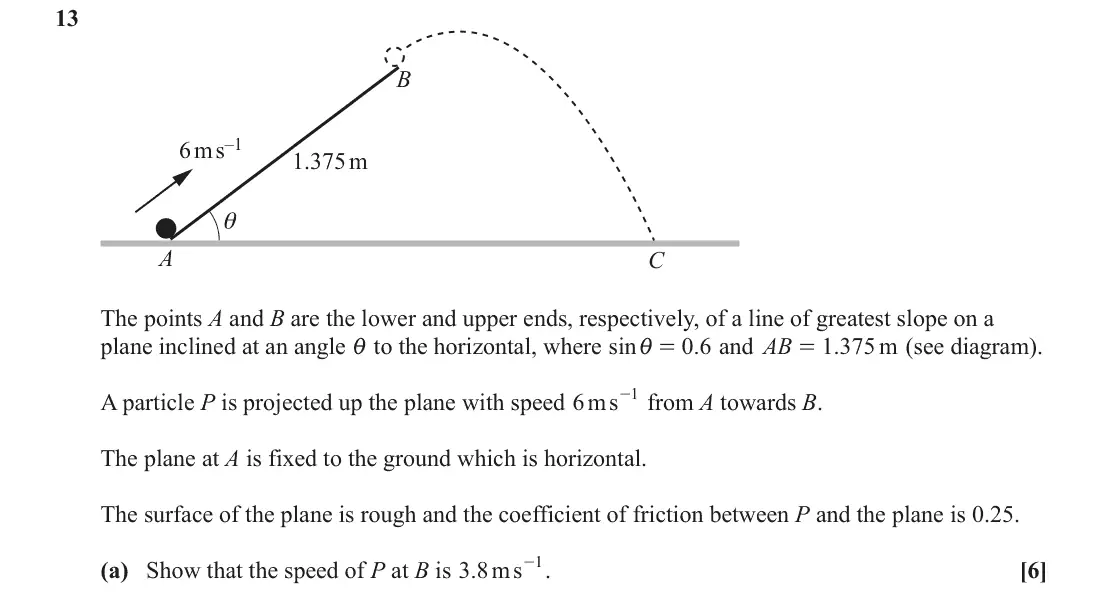
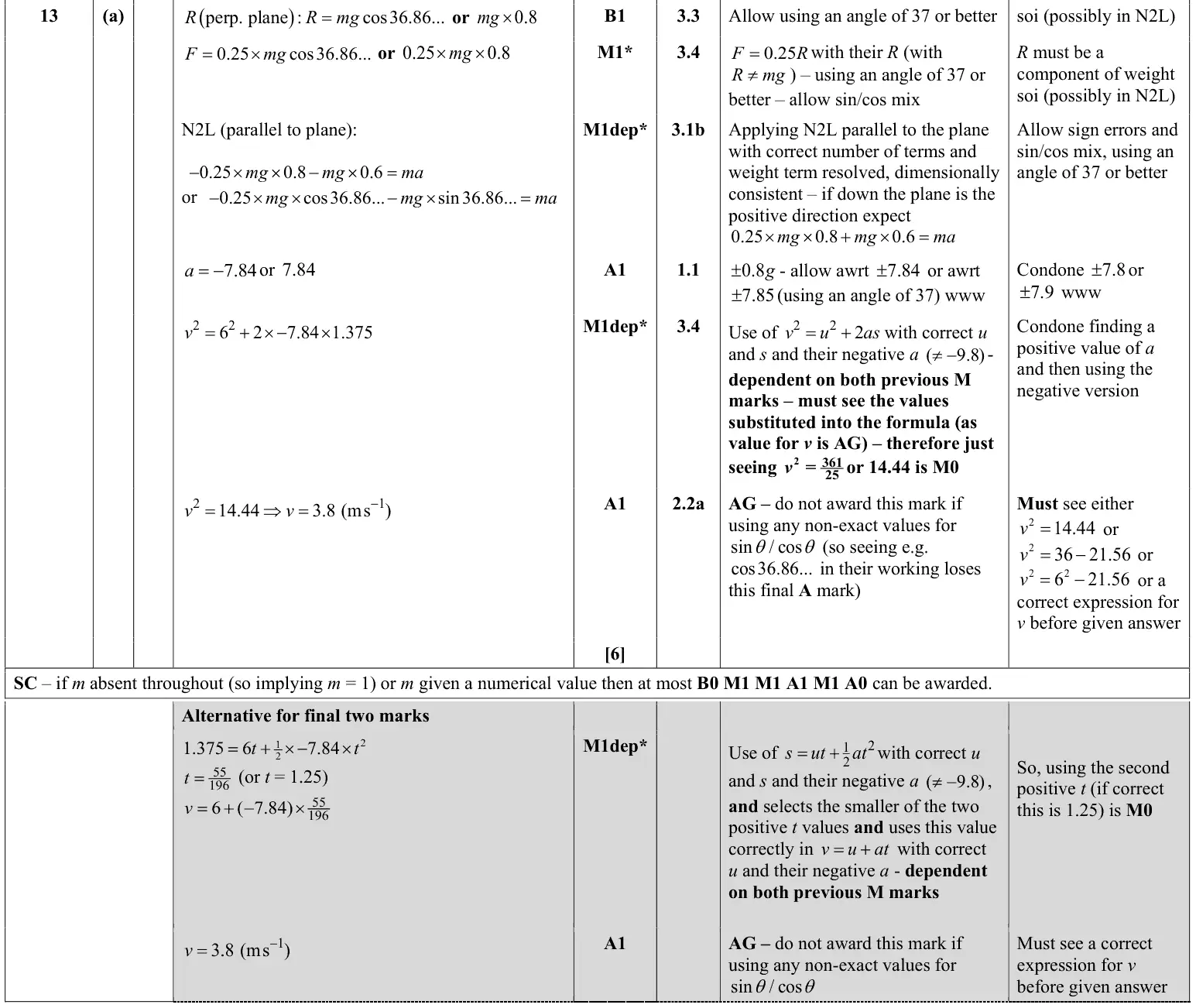
13 B 6 m s–1 1.375 m θ A C The points A and B are the lower and upper ends, respectively, of a line of greatest slope on a plane inclined at an angle i to the horizontal, where sin 0 6 . and AB 1 375 . m (see diagram). i = = A particle P is projected up the plane with speed ms - from A towards B. The plane at A is fixed to the ground which is horizontal. The surface of the plane is rough and the coefficient of friction between P and the plane is 0.25. - . (a) Show that the speed of P at B is . ms 3 8 [6]
Autumn 2021 · Paper 3 · Q14(a) 7 marks Medium
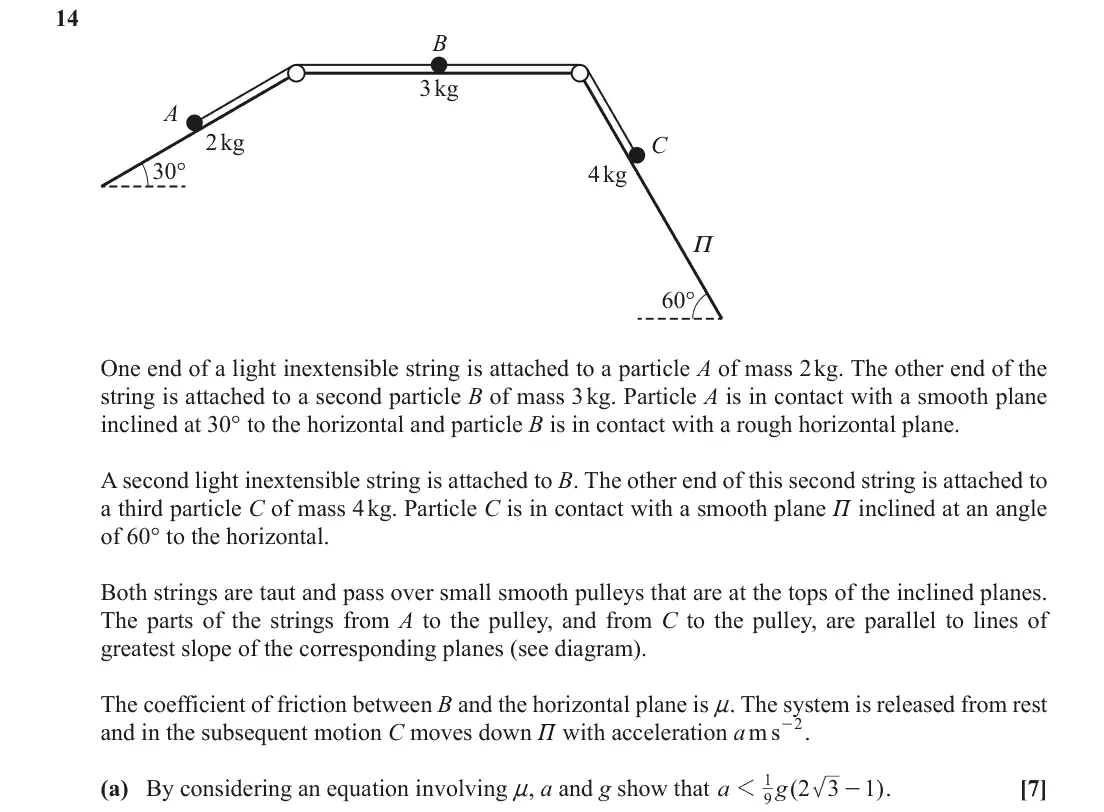
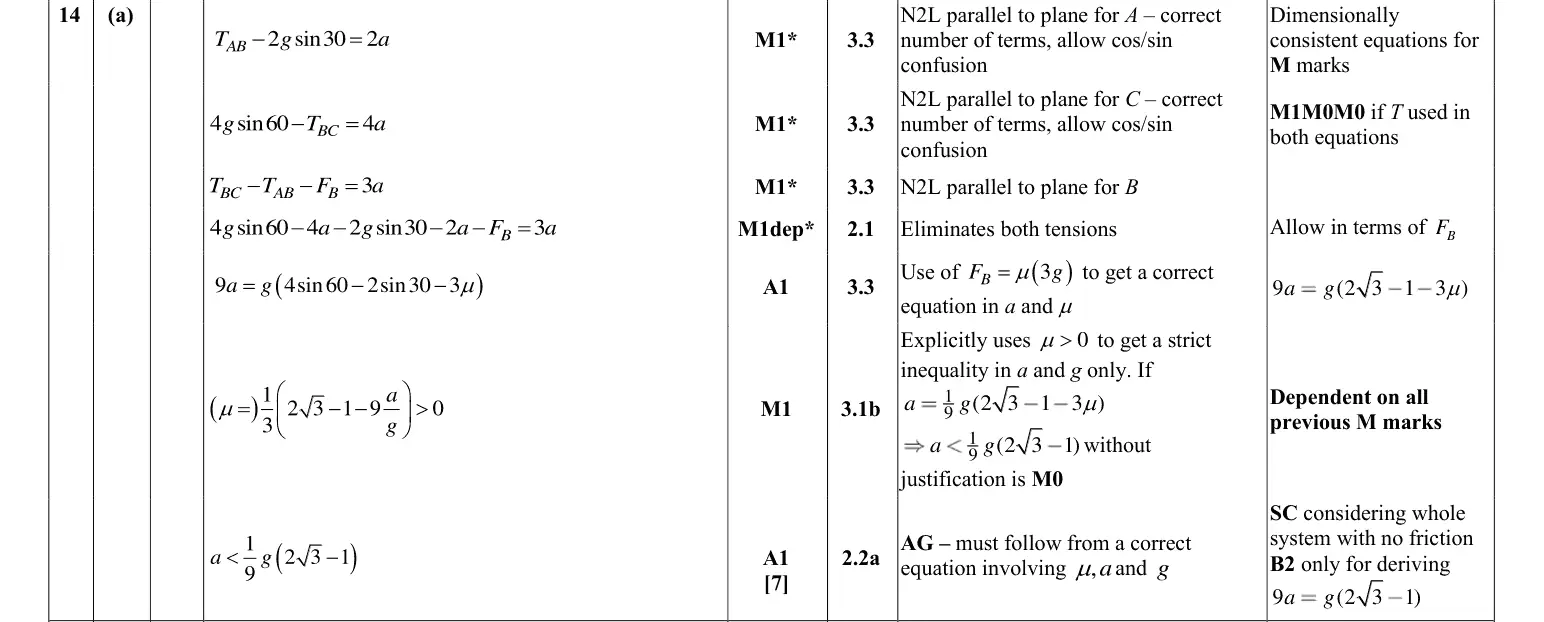
14 B 3 kg A 2 kg C 30° 4 kg Π 60° One end of a light inextensible string is attached to a particle A of mass 2 kg. The other end of the string is attached to a second particle B of mass 3 kg. Particle A is in contact with a smooth plane inclined at 30° to the horizontal and particle B is in contact with a rough horizontal plane. A second light inextensible string is attached to B. The other end of this second string is attached to a third particle C of mass 4 kg. Particle C is in contact with a smooth plane P inclined at an angle of 60° to the horizontal. Both strings are taut and pass over small smooth pulleys that are at the tops of the inclined planes. The parts of the strings from A to the pulley, and from C to the pulley, are parallel to lines of greatest slope of the corresponding planes (see diagram). The coefficient of friction between B and the horizontal plane is n. The system is released from rest - . and in the subsequent motion C moves down P with acceleration a m s (a) By considering an equation involving n, a and g show that a g 2 3 ( ) . [7] -
June 2019 · Paper 3 · Q9(a) 4 marks Medium
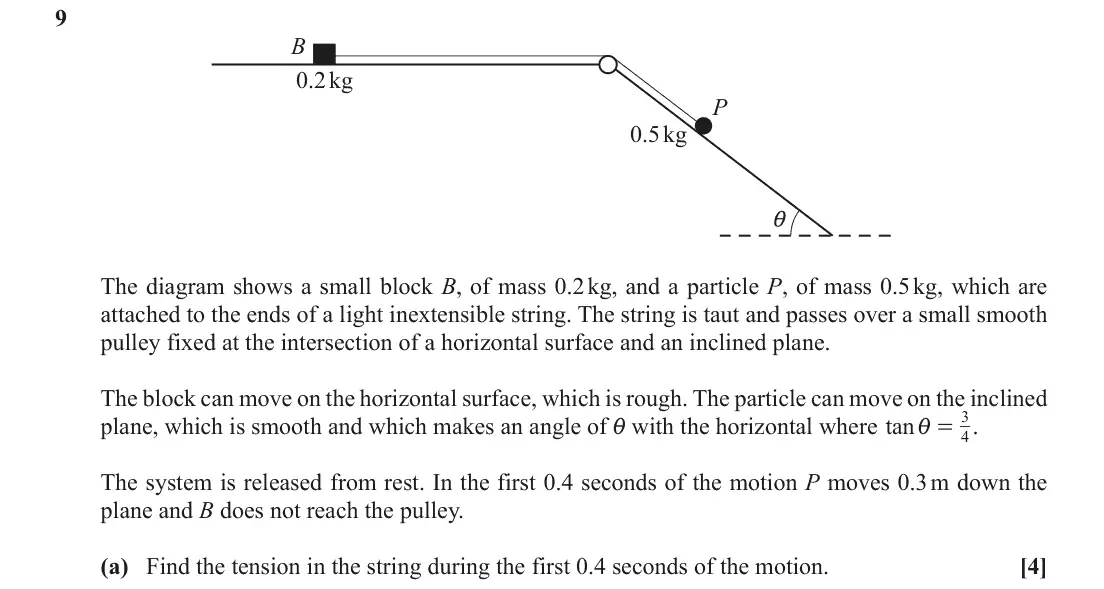
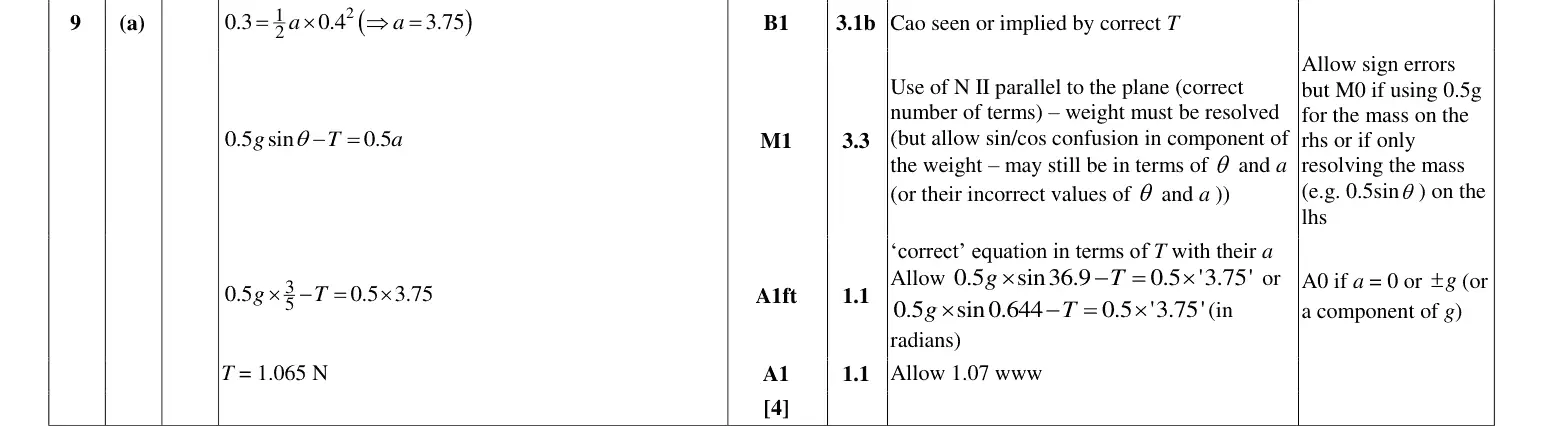
9 B 0.2 kg P 0.5 kg i The diagram shows a small block B, of mass 0.2 kg, and a particle P, of mass 0.5 kg, which are attached to the ends of a light inextensible string. The string is taut and passes over a small smooth pulley fixed at the intersection of a horizontal surface and an inclined plane. The block can move on the horizontal surface, which is rough. The particle can move on the inclined plane, which is smooth and which makes an angle of i with the horizontal where tan . i = The system is released from rest. In the first 0.4 seconds of the motion P moves 0.3 m down the plane and B does not reach the pulley. (a) Find the tension in the string during the first 0.4 seconds of the motion. [4]

Find an A-level maths tutor

Stuck on this? Book a trial session with an A-level maths tutor.

Prefer email? Send an enquiry

If you are under 18, please include a parent's contact details. Enquiries go to enquiries@mathsaleveltutor.com and are deleted once handled.