Examiner's comment
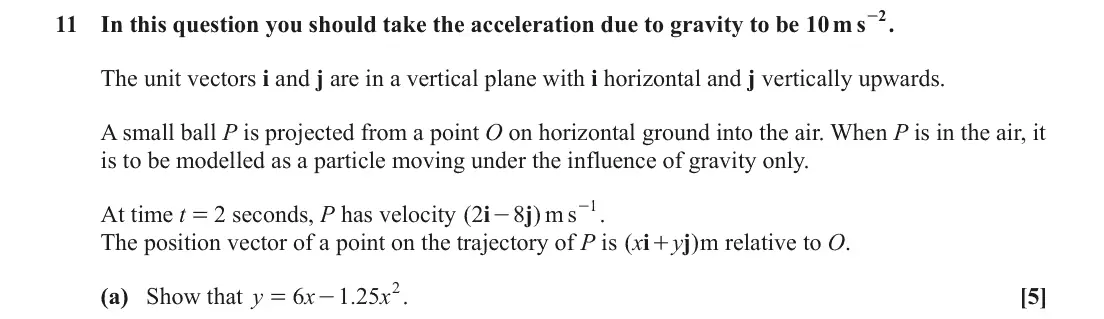
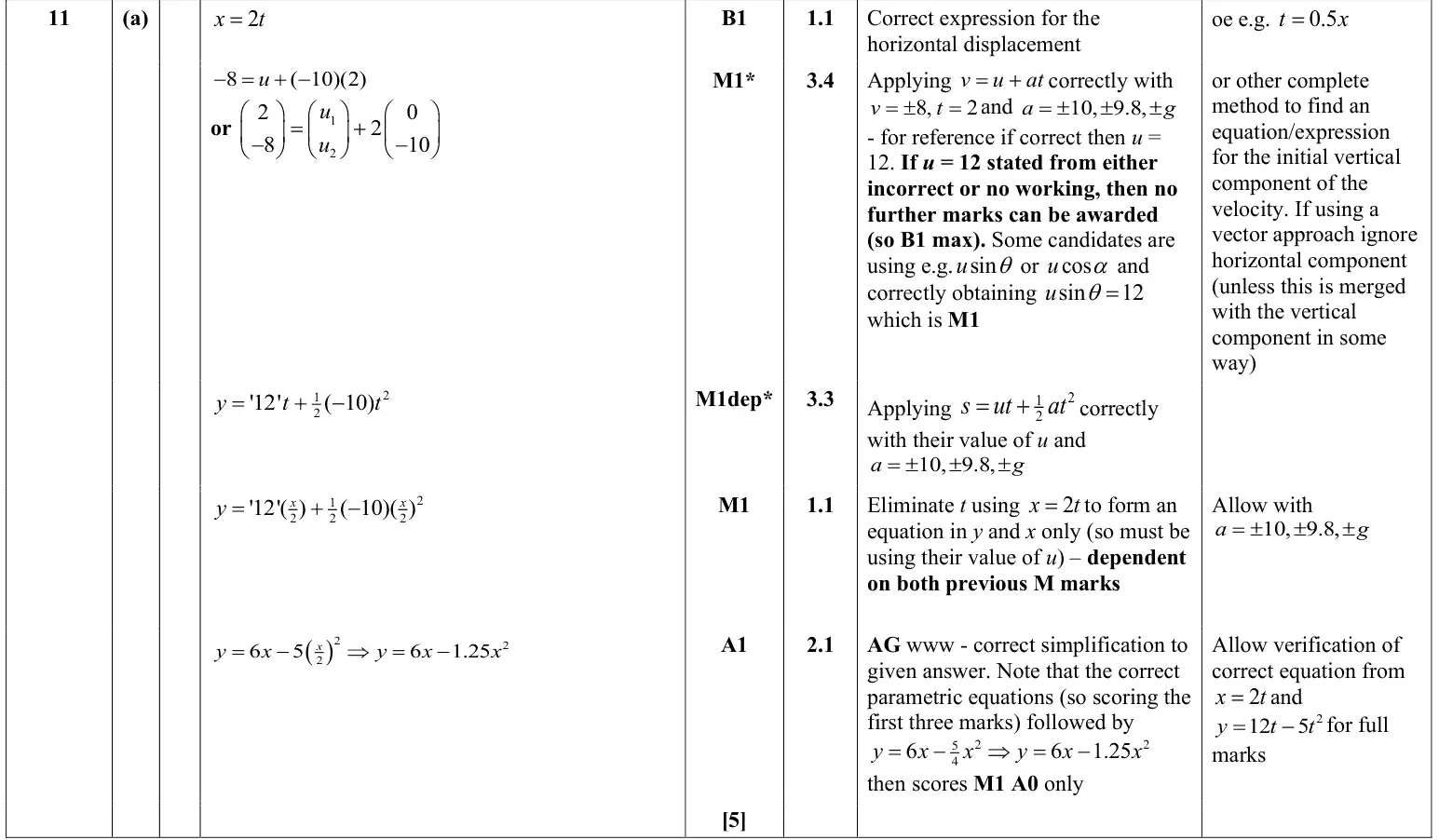
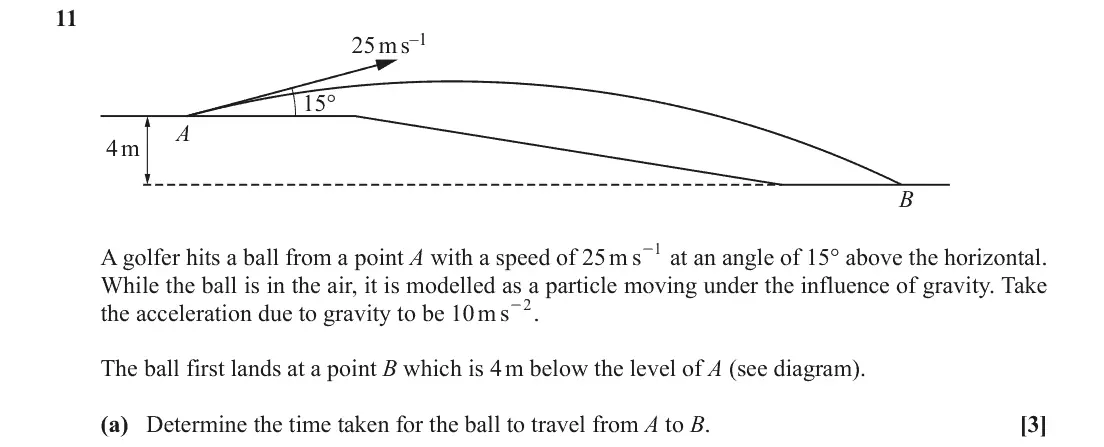
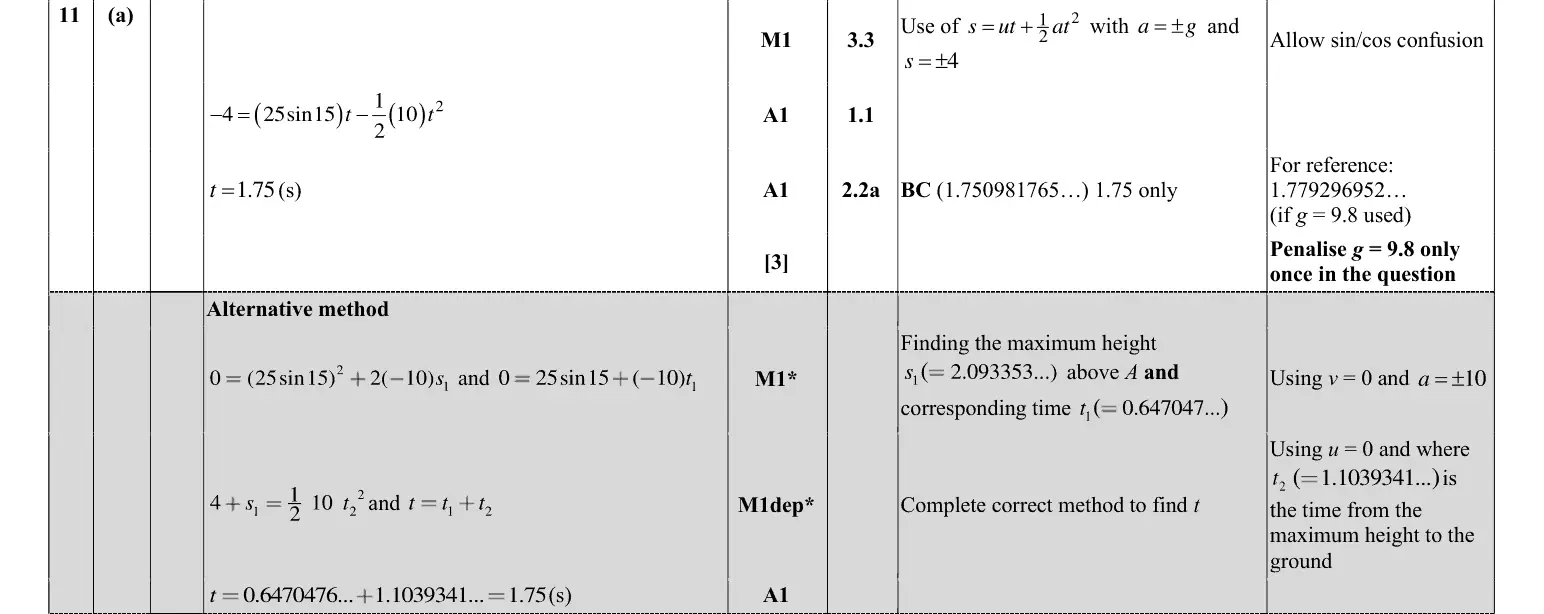
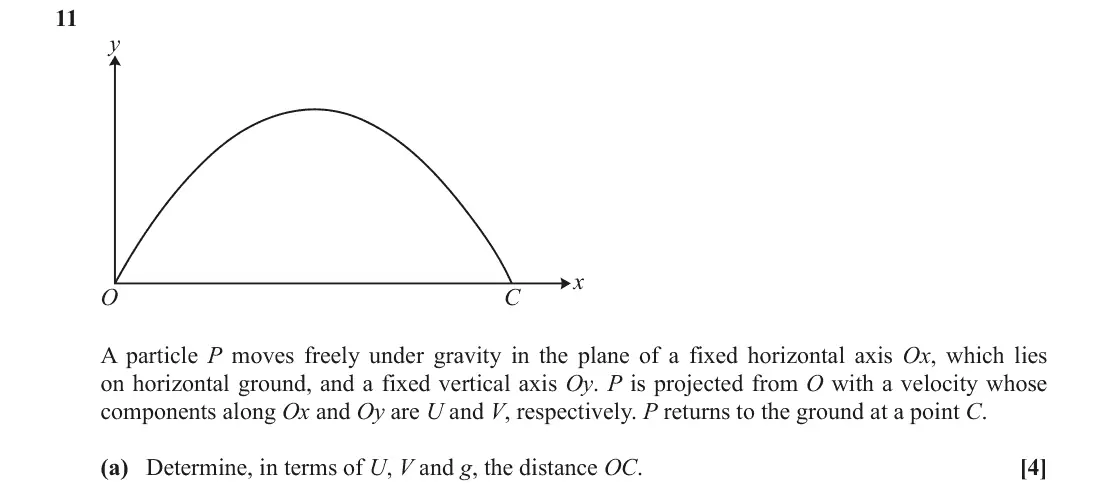
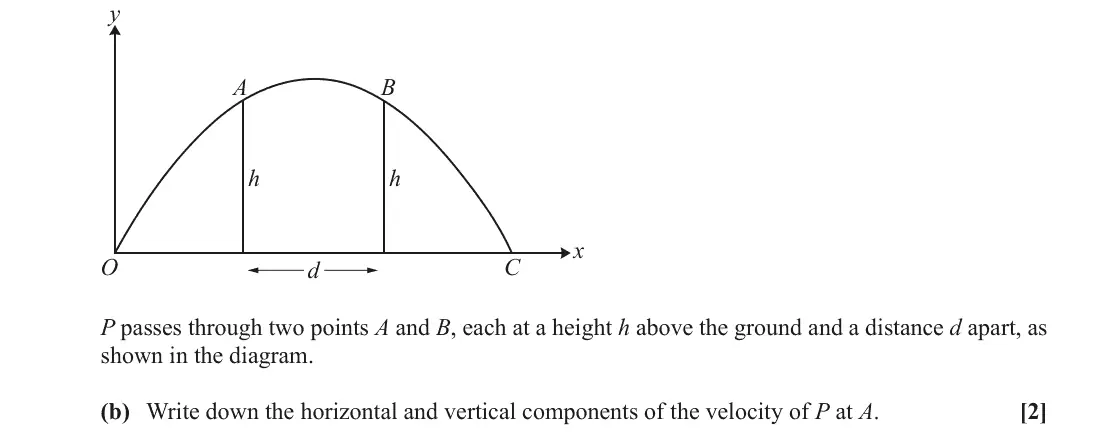
(Comment on Question 11 as a whole) Some candidates struggled with the algebraic format of this question. Those that set out their ‘suvat’ equations clearly distinguishing horizontal and vertical components were more success. Of those candidates that made a good attempt at part (a), a few dropped marks by only calculating the horizontal distance travelled to get to the maximum height – a valid method but which was only 1 2OC . Some otherwise excellent attempts to part (b) had answers in terms of an introduced variable T (or similar); this could only be given full marks if T was explicitly defined as part of the solution. Part (c) and part (d) proved the most challenging, with only the most able candidates making any meaningful progress. Both parts required careful notation to avoid confusing terms. For example, in Vertical component of velocity part (d) some candidates recognised tan θ = but the working Horizontal component of velocity suggested they used values at O rather than A. Guidance on using this paper as a mock This paper has a good range of questions on Pure and Mechanics and while overall there was a nice gradient on demand, it should be noted that Question 2 proved more challenging for this cohort than was expected with respect to its position on the paper. Section A Pure Section B Mechanics Mensuration in non-right angle triangles. Constant acceleration problem using vectors. Curve transformations. Investigate linear motion of particle with variable acceleration. Inverse and compound functions. Particles connected by pulley system involving rough slope. Investigating ln curves using calculus and Moments problem involving rod held in numerical methods. equilibrium. Investigating gradients and enclosed areas of Investigating flight of a projectile over level curves defined parametrically. ground. Investigating curves using implicit differentiation.