Examiner's comment
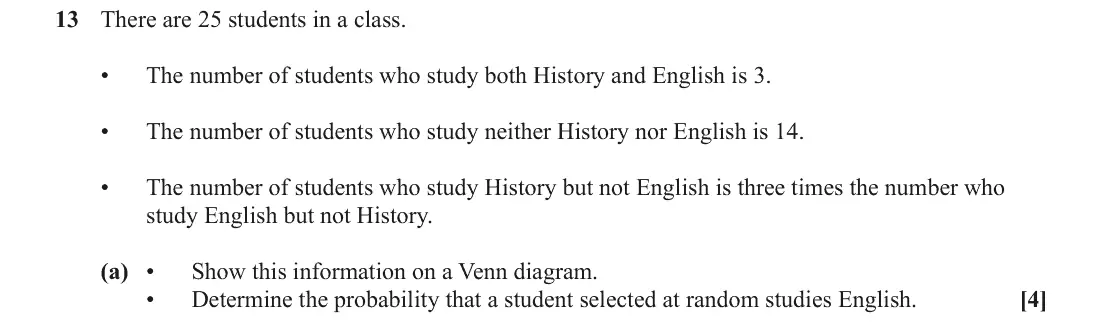
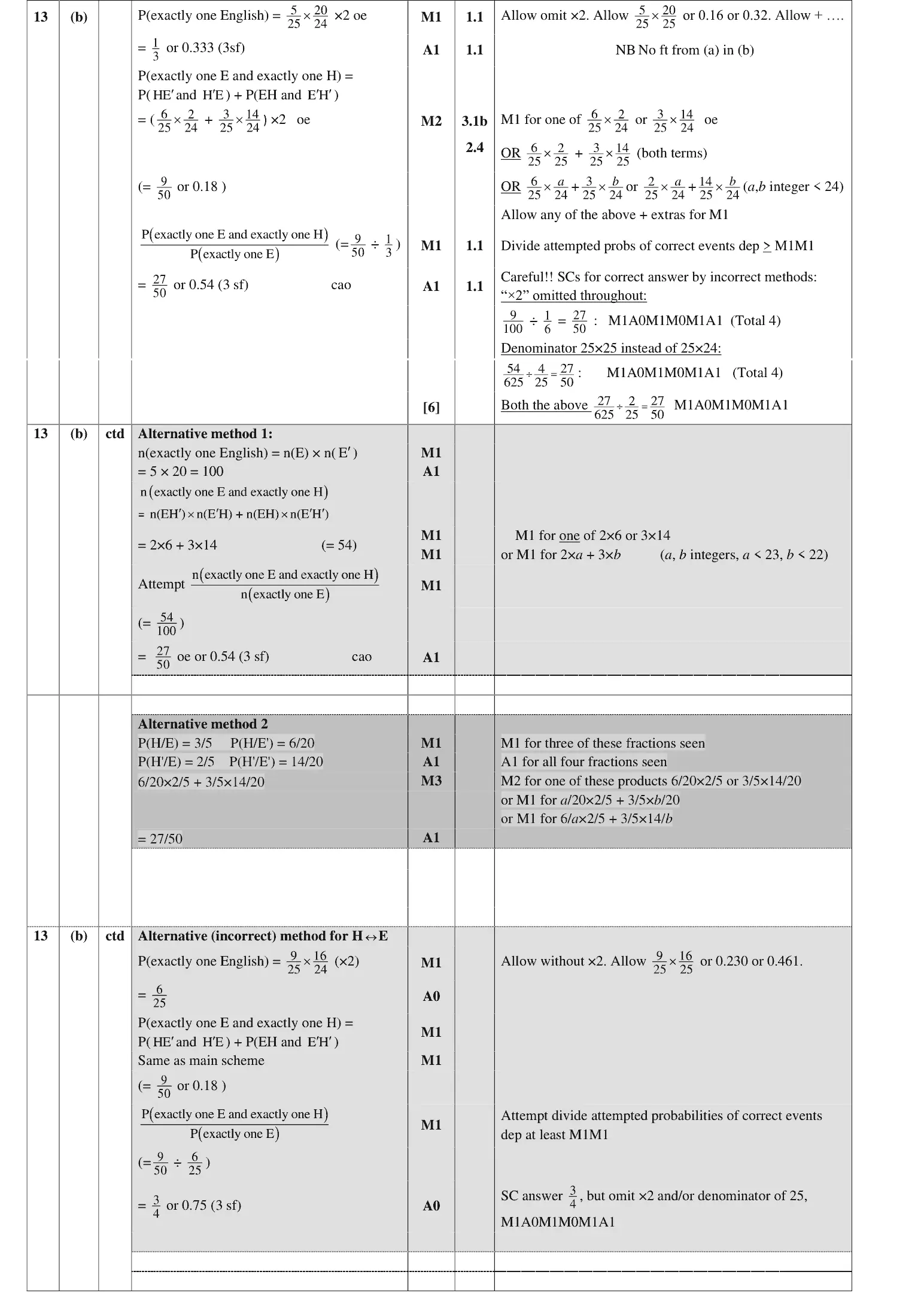
A number of different correct approaches to this problem were seen, some of them quite ingenious. The most common method that was reasonably successful was to use the conditional probability formula: ( ) P exactly one E and exactly one H . ( ) P exactly one E The correct working for the denominator is P(Exactly one English) = P( EH′) = 5 20 × ×2, 25 24 and for the numerator is P(exactly one E and exactly one H) = P( HE′and H E ′ ) + P(EH and E H ′ ′ ) = ( 6 2 + 3 14 × × ) ×2. 25 24 25 24 Many candidates used this method correctly, except for one or both of the following errors. They used 25 instead of 24 (i.e. “with replacement”). They omitted the “× 2” (i.e. ignoring the order in which the two students are chosen). If the method was otherwise correct, these candidates scored 4 marks out of 6. Some candidates attempted the above method for the numerator, but only included one of the products, either 6 2 or 3 14 × × . 25 24 25 24 Many candidates made errors involving which regions in the Venn diagram to include. As examples of this, here are some incorrect attempts to calculate P( HE′and H E ′ ) + P(EH and E H ′ ′ ). ( 6 2 + 9 14 ) ×2 (Here the 9 25 is P(H) where it should be 3 × × 25 which is P(EH)) 25 24 25 24 5 9 + 5 2 2 9 + 3 8 + 6 5 + 3 4 × × , × × × × , 25 24 25 24 25 24 25 24 25 24 25 24 9 16 × × 2 25 25 Some candidates attempted to use probabilities that applied to only one student. For example P(E and H) = 3/25 3 . = P(E) 5/25 5 This result can, of course, be written down immediately, and some candidates did this as the first step towards another, rather elegant, method that uses conditional probability but not the conditional probability formula: 2 6 + 3 14 = 27 P(E only / E) × P(H only / not E) + P(E&H / E) × P(Neither / not E) = × × 50 . 5 20 5 20 Some candidates appeared to be attempting something like this method, but muddled it with the above 2 6 + 3 14 × × correct method, showing working such as . 5 24 5 24