2.01d Select or critique sampling techniques in the context of solving a…

Section
2.01 Statistical Sampling
Level
AS & A level
Statement
Be able to select or critique sampling techniques in the context of solving a statistical problem, including understanding that different samples can lead to different conclusions about the population.
Guidance
Learners should be familiar with (and be able to critique in context) the following sampling methods, but will not be required to carry them out: systematic, stratified, cluster and quota sampling.
Since 2018
13 parts, 15 marks · topic pages: Data presentation: histograms, box plots, measures and outliers, Sampling, The large data set, Probability, including conditional probability, Discrete distributions and the binomial distribution

Back to the checklist

June 2025 · AS Paper 1 · Q10(d) 1 mark Medium
Show the start of this questionEarlier part of this question
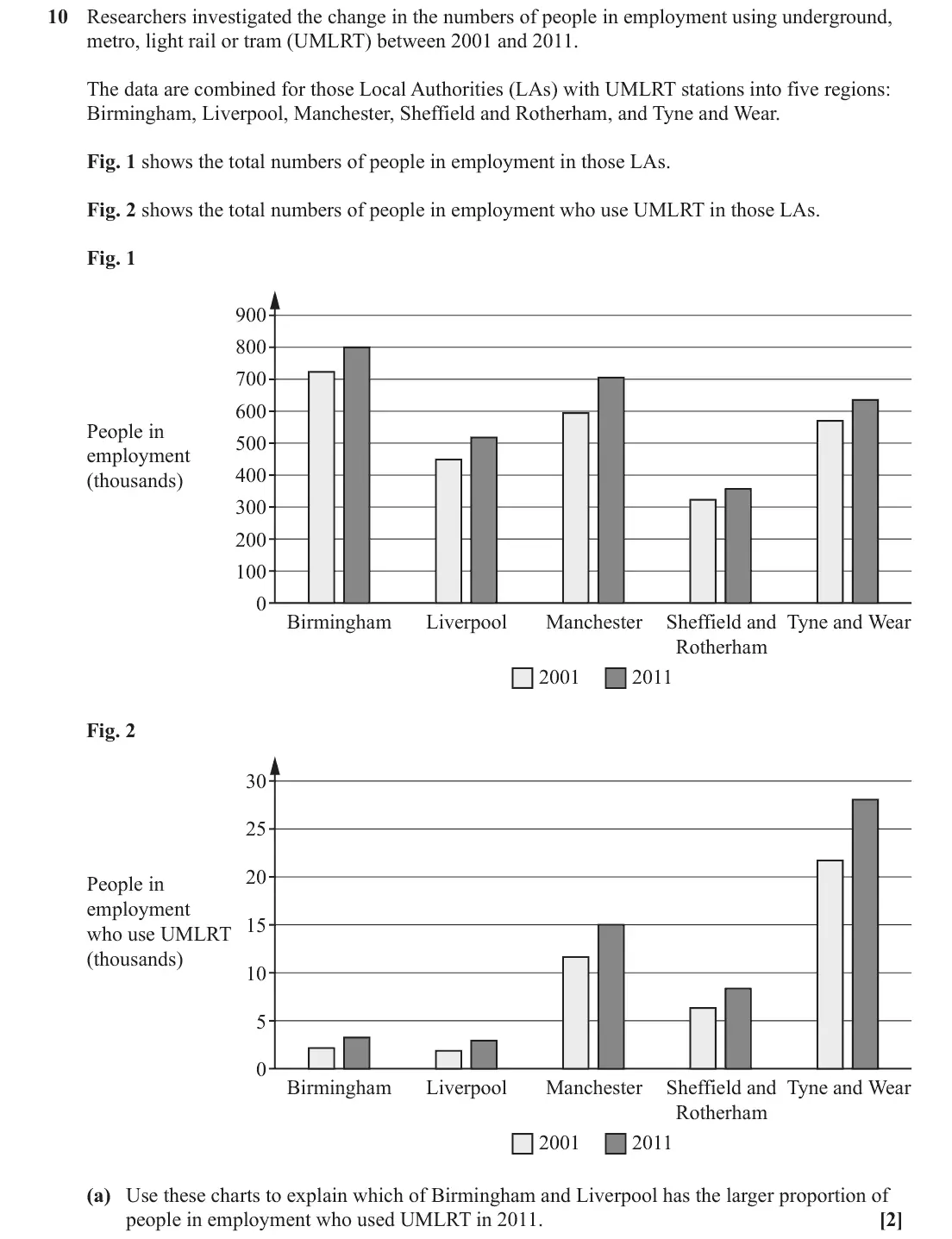
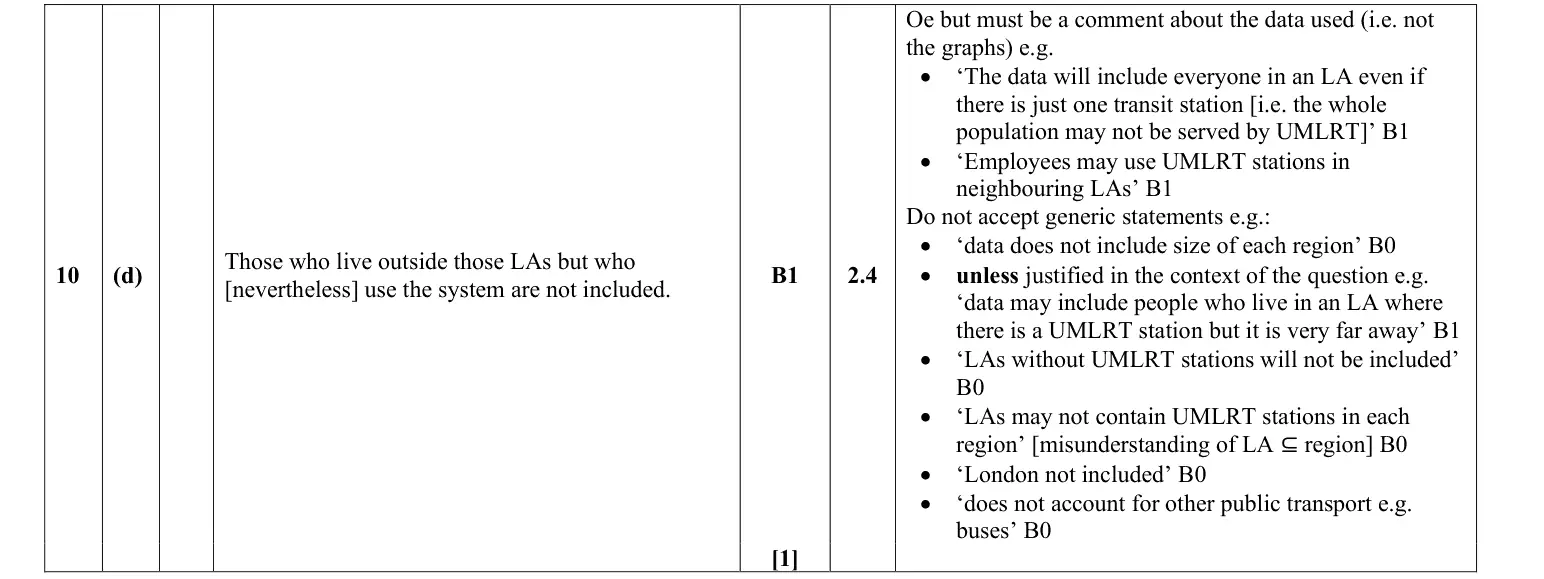
(d) The charts are compiled from data in the Large Data Set by using those LAs which contain UMLRT stations in each region. Explain a disadvantage of using these data. [1]
June 2025 · AS Paper 1 · Q12(c) 1 mark Easy
Show the start of this questionEarlier part of this question
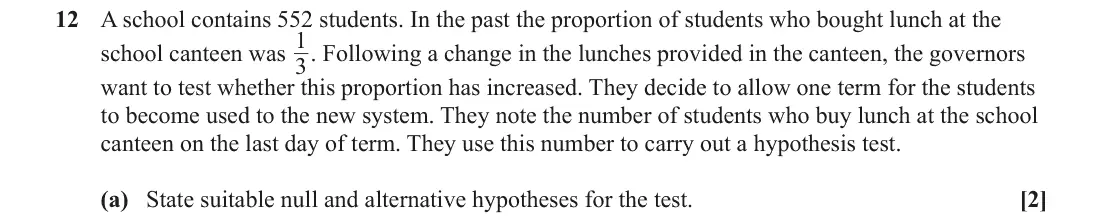
(c) Suggest one reason why the conclusion of the test may not be reliable. [1]
June 2024 · AS Paper 1 · Q13(a) 2 marks Easy
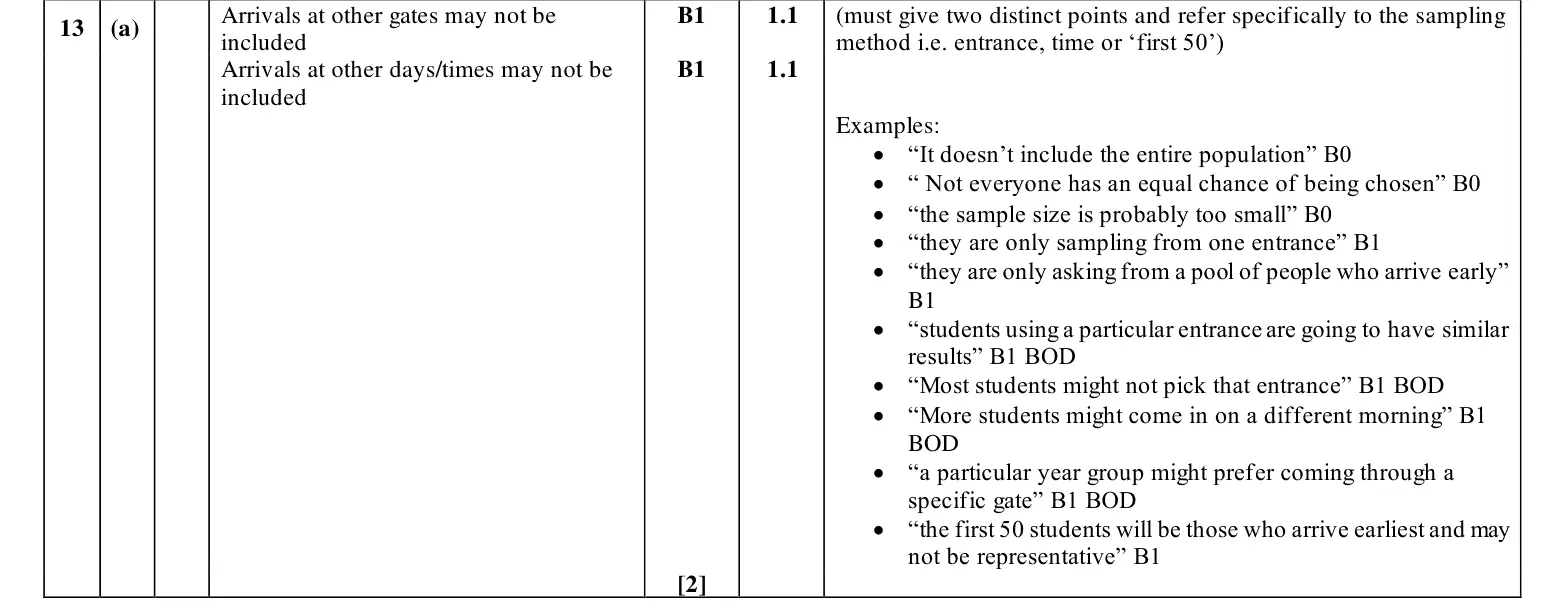
13 Some students at a large school are doing a survey about attitudes to school uniform. They want to give a questionnaire to a random sample of 50 students at their school. The school has three entrances. Gabi suggests giving the questionnaire to the first 50 students who arrive at a particular entrance on a randomly chosen morning. (a) Give two reasons why this method of sampling will not produce a random sample. [2]
June 2024 · Paper 2 · Q12(a) 2 marks Hard
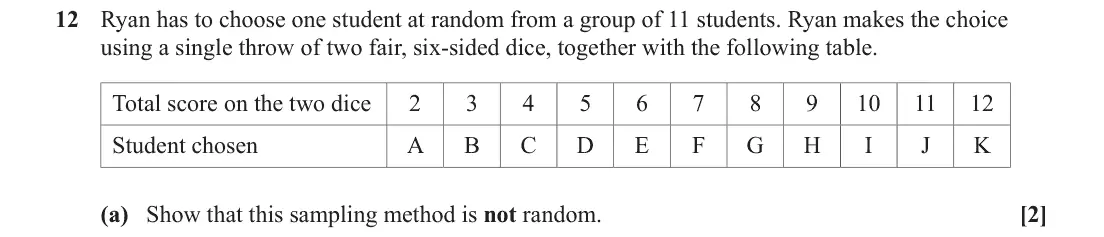
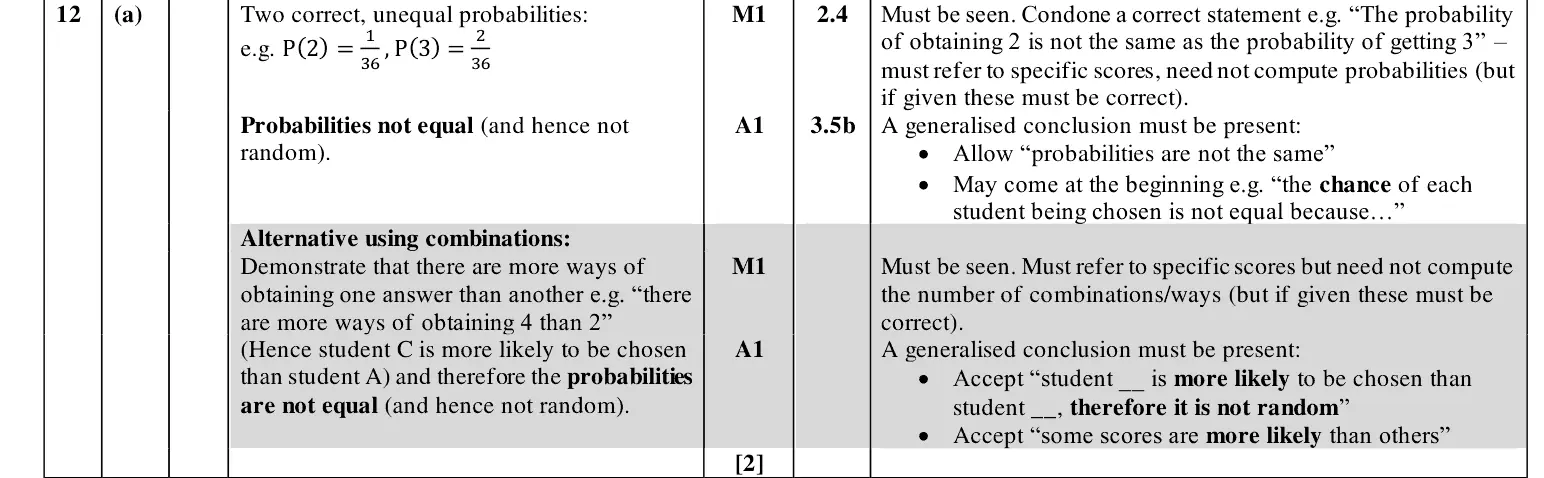
12 Ryan has to choose one student at random from a group of 11 students. Ryan makes the choice using a single throw of two fair, six-sided dice, together with the following table. Total score on the two dice Student chosen A B C D E F G H I J K (a) Show that this sampling method is not random. [2]
June 2024 · Paper 2 · Q12(b)(i) 1 mark Easy
Show the start of this questionEarlier part of this question
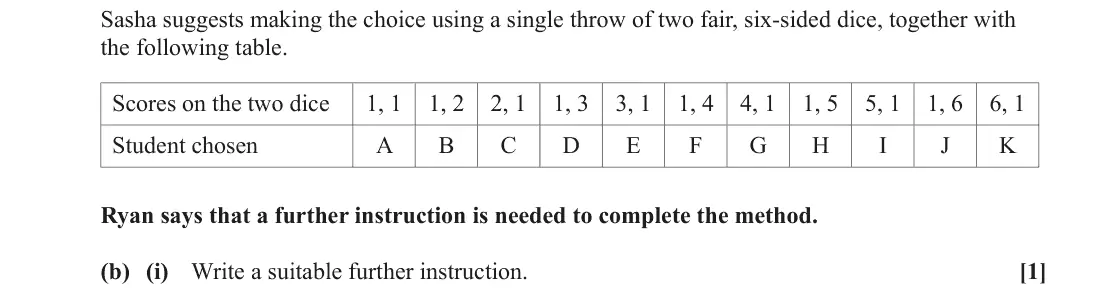
Sasha suggests making the choice using a single throw of two fair, six-sided dice, together with the following table. Scores on the two dice 1, 1 1, 2 2, 1 1, 3 3, 1 1, 4 4, 1 1, 5 5, 1 1, 6 6, 1 Student chosen A B C D E F G H I J K Ryan says that a further instruction is needed to complete the method. (b) (i) Write a suitable further instruction. [1]
June 2023 · Paper 2 · Q9(d) 1 mark Medium
Show the start of this questionEarlier part of this question
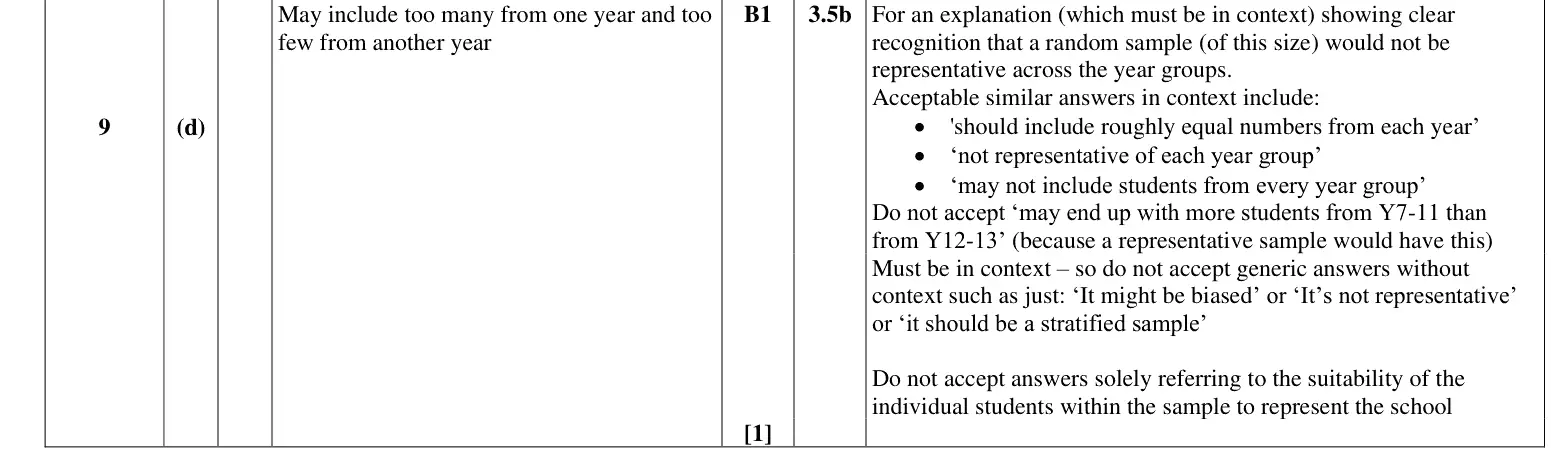
(d) State one disadvantage of using a random sample in this context. [1]
June 2022 · AS Paper 1 · Q9(c) 1 mark Medium
Show the start of this questionEarlier part of this question
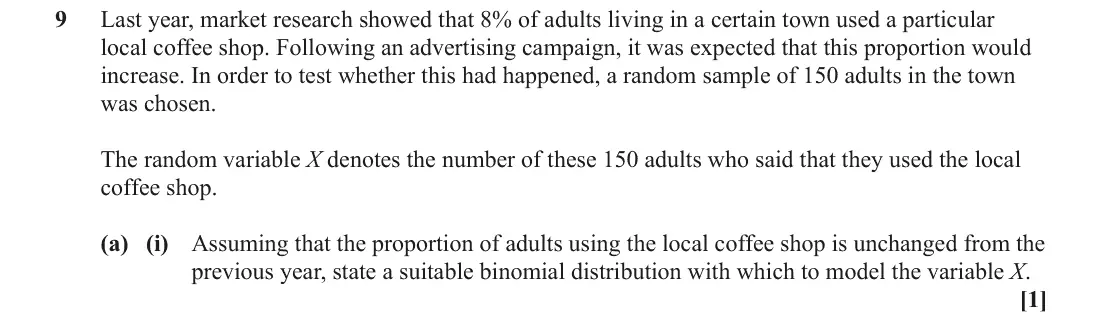
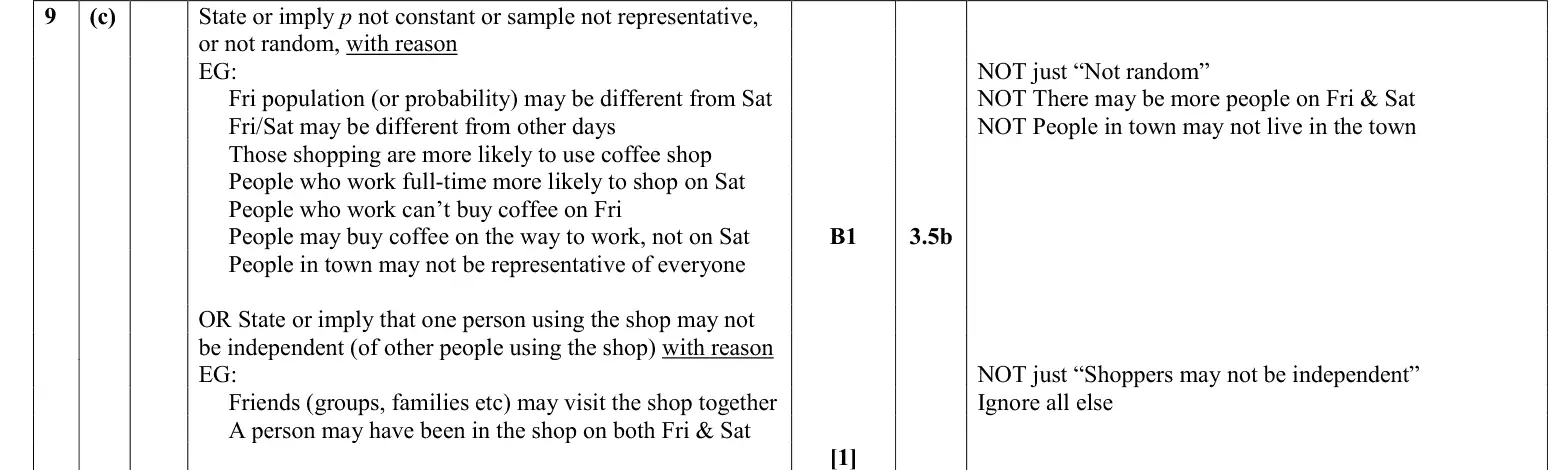
It was later discovered by a statistician that the random sample of 150 adults had been chosen from shoppers in the town on a Friday and a Saturday. (c) Explain why this suggests that the assumptions made when using a binomial model for X may not be valid in this context. [1]
Autumn 2021 · AS Paper 1 · Q10(c)(i) 1 mark Medium
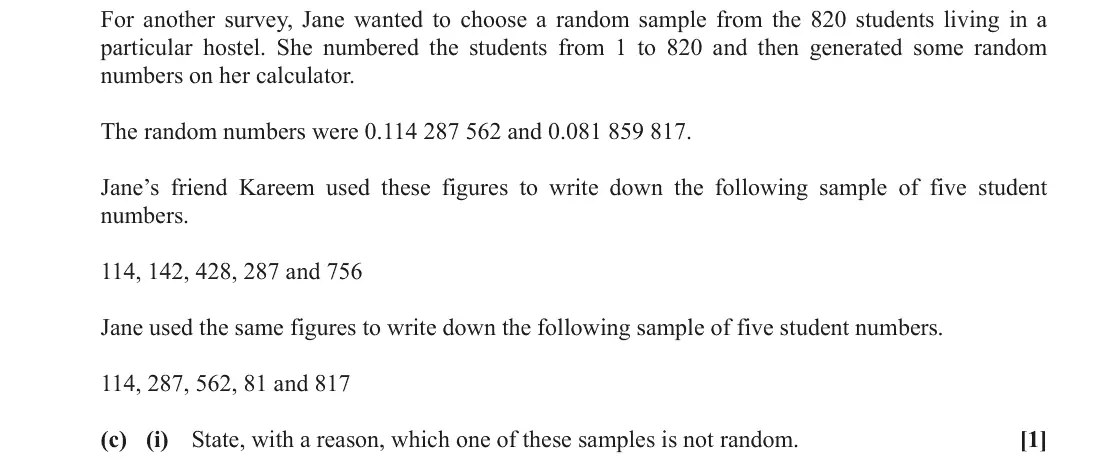
For another survey, Jane wanted to choose a random sample from the 820 students living in a particular hostel. She numbered the students from 1 to 820 and then generated some random numbers on her calculator. The random numbers were 0.114 287 562 and 0.081 859 817. Jane’s friend Kareem used these figures to write down the following sample of five student numbers. 114, 142, 428, 287 and 756 Jane used the same figures to write down the following sample of five student numbers. 114, 287, 562, 81 and 817 (c) (i) State, with a reason, which one of these samples is not random. [1]
Autumn 2021 · Paper 2 · Q11(b) 1 mark Medium
Show the start of this questionEarlier part of this question
(b) Amaya suggests that Zac should use a sample that is stratified by school year. Give one advantage of this method as compared with random sampling, in this context. [1]
Autumn 2020 · AS Paper 1 · Q9(a) 1 mark Medium
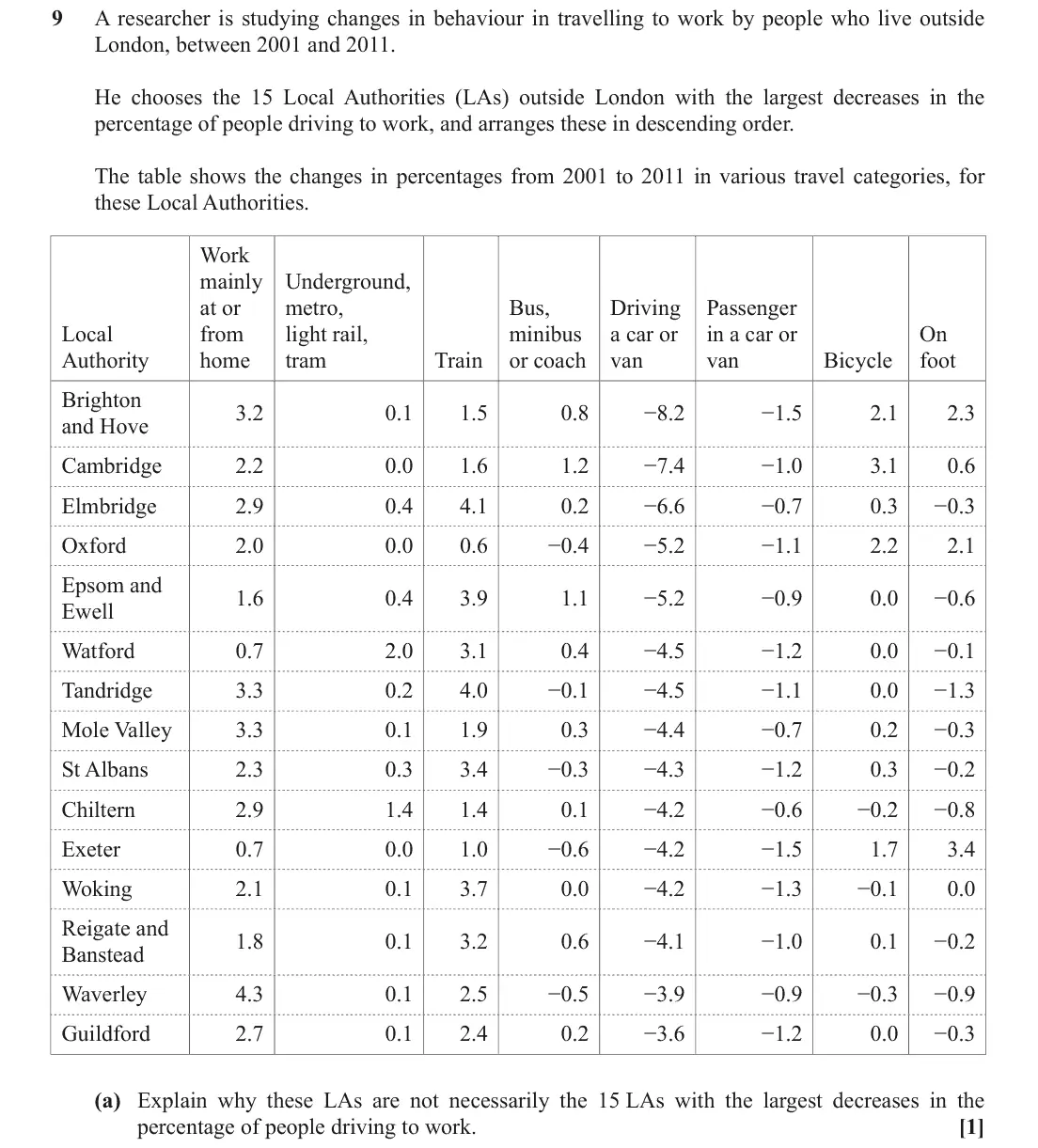
9 A researcher is studying changes in behaviour in travelling to work by people who live outside London, between 2001 and 2011. He chooses the 15 Local Authorities (LAs) outside London with the largest decreases in the percentage of people driving to work, and arranges these in descending order. The table shows the changes in percentages from 2001 to 2011 in various travel categories, for these Local Authorities. Work mainly Underground, at or metro, Bus, Driving Passenger Local from light rail, minibus a car or in a car or On Authority home tram Train or coach van van Bicycle foot Brighton 3.2 0.1 1.5 0.8 −8.2 −1.5 2.1 2.3 and Hove Cambridge 2.2 0.0 1.6 1.2 −7.4 −1.0 3.1 0.6 Elmbridge 2.9 0.4 4.1 0.2 −6.6 −0.7 0.3 −0.3 Oxford 2.0 0.0 0.6 −0.4 −5.2 −1.1 2.2 2.1 Epsom and 1.6 0.4 3.9 1.1 −5.2 −0.9 0.0 −0.6 Ewell Watford 0.7 2.0 3.1 0.4 −4.5 −1.2 0.0 −0.1 Tandridge 3.3 0.2 4.0 −0.1 −4.5 −1.1 0.0 −1.3 Mole Valley 3.3 0.1 1.9 0.3 −4.4 −0.7 0.2 −0.3 St Albans 2.3 0.3 3.4 −0.3 −4.3 −1.2 0.3 −0.2 Chiltern 2.9 1.4 1.4 0.1 −4.2 −0.6 −0.2 −0.8 Exeter 0.7 0.0 1.0 −0.6 −4.2 −1.5 1.7 3.4 Woking 2.1 0.1 3.7 0.0 −4.2 −1.3 −0.1 0.0 Reigate and 1.8 0.1 3.2 0.6 −4.1 −1.0 0.1 −0.2 Banstead Waverley 4.3 0.1 2.5 −0.5 −3.9 −0.9 −0.3 −0.9 Guildford 2.7 0.1 2.4 0.2 −3.6 −1.2 0.0 −0.3 (a) Explain why these LAs are not necessarily the 15 LAs with the largest decreases in the percentage of people driving to work. [1]
June 2018 · AS Paper 1 · Q9(i) 1 mark Hard
9 Jo is investigating the popularity of a certain band amongst students at her school. She decides to survey a sample of 100 students. (i) State an advantage of using a stratified sample rather than a simple random sample. [1]
June 2018 · AS Paper 1 · Q9(ii) 1 mark Hard
Show the start of this questionEarlier part of this question
(ii) Explain whether it would be reasonable for Jo to use her results to draw conclusions about all students in the UK. [1]
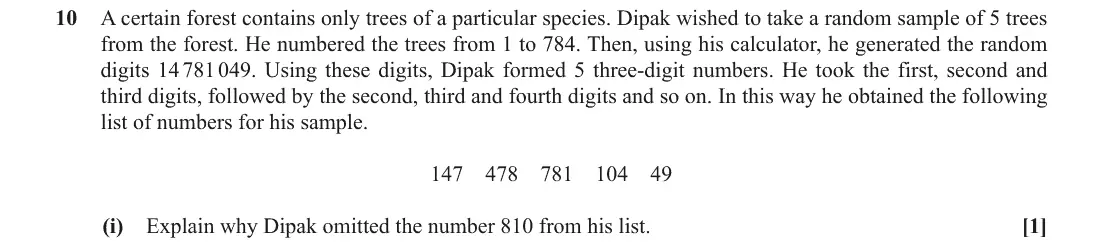
June 2018 · Paper 2 · Q10(ii) 1 mark Hard
Show the start of this questionEarlier part of this question
(ii) Explain why Dipak’s sample is not random. [1]

Find an A-level maths tutor

Stuck on this? Book a trial session with an A-level maths tutor.

Prefer email? Send an enquiry

If you are under 18, please include a parent's contact details. Enquiries go to enquiries@mathsaleveltutor.com and are deleted once handled.