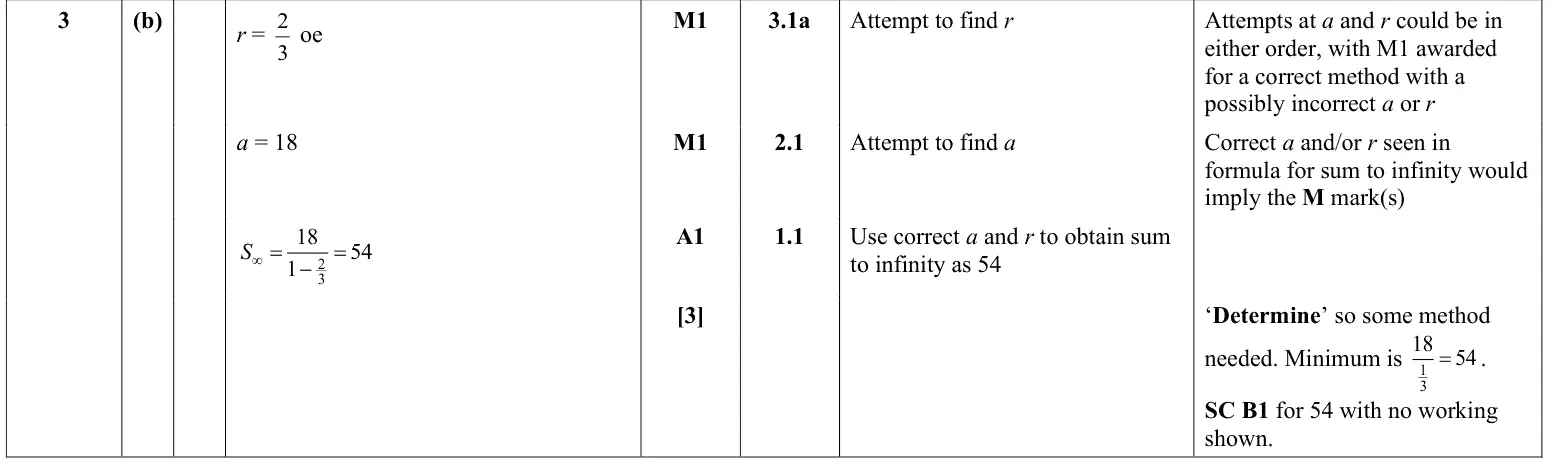
This question was also very well answered, with mostly fully correct solutions seen. The most common error was to correctly find the common ratio, but then use 12 as the first term when attempting the sum to infinity.
Key points and common errors
r = 2/3, first term a = 18 (not 12), S∞ = 54
method needed for Determine
June 2025 · Paper 2 · Q7(a)(i)1 markEasy
Mark scheme for this part
Examiner's comment
Most candidates answered this part well, demonstrating understanding of the two sequences described in the question to deduce the given fact. Some candidates did not score the mark because they did not approach this as a ‘proof’ – although the result is straightforward to deduce, candidates still needed to demonstrate their understanding of the setup before writing down the expression given in the question. When an answer is given, candidates should be reminded to make sure that they provide a logical argument that shows how that answer is reached.
Key points and common errors
third term of AP is a + 2d = ar
must show a + 2d before the given result
June 2025 · Paper 2 · Q7(a)(ii)2 marksHard
Show the start of this question
Mark scheme for this part
Examiner's comment
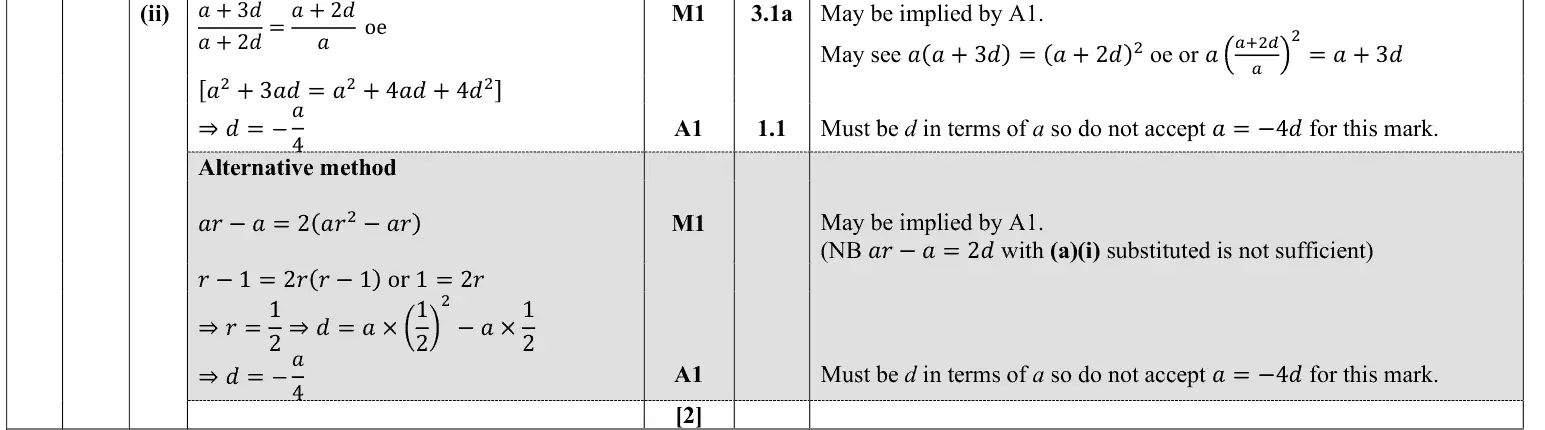
This part was much less well answered than (a) (i), with some candidates appearing unsure about how to translate the given information into a mathematical expression. As shown on the scheme, several different approaches were possible – with the key requirement being to write down an equation in a and d only. Most candidates identified that this meant using the expression for r from part (a) (i) to eliminate r but were often unable to make further progress. A common incorrect answer was 𝑑= −𝑎. The question specifically requested ‘d in terms of a’ which meant that 𝑎= −4𝑑 was not sufficient for the final mark.
Key points and common errors
(a + 3d)/(a + 2d) = (a + 2d)/a gives d = −a/4
a = −4d not accepted
common wrong answer d = −a
June 2025 · Paper 2 · Q7(b)2 marksHard
Show the start of this question
Mark scheme for this part
Examiner's comment
Relatively few candidates scored both marks in this part. Some candidates identified (as shown in the main method on the scheme) that they could find the value of r by combining their answers to (a) (i) and (a) (ii), but many others attempted more complex working – often resulting in a quadratic in r. It was possible to solve this and deduce the required answer, but candidates rarely did so successfully. Some candidates (following incorrect or incomplete working in (a) (ii)) started this part by improving on their answer to (a) (ii) but did not appear to recognise that they had done so. Here, and in part (a) (ii), some candidates kept returning to the trivial equation used in part (a) (i) i.e. 𝑎𝑟= 𝑎+ 2𝑑 without recognising that they needed to use further information from the question to deduce another equation.
Key points and common errors
substitute d = −a/4 into r = (a + 2d)/a to get r = 1/2
many formed a quadratic in r and did not solve it
June 2024 · Paper 1 · Q108 marksEasy
Mark scheme for this part
Examiner's comment
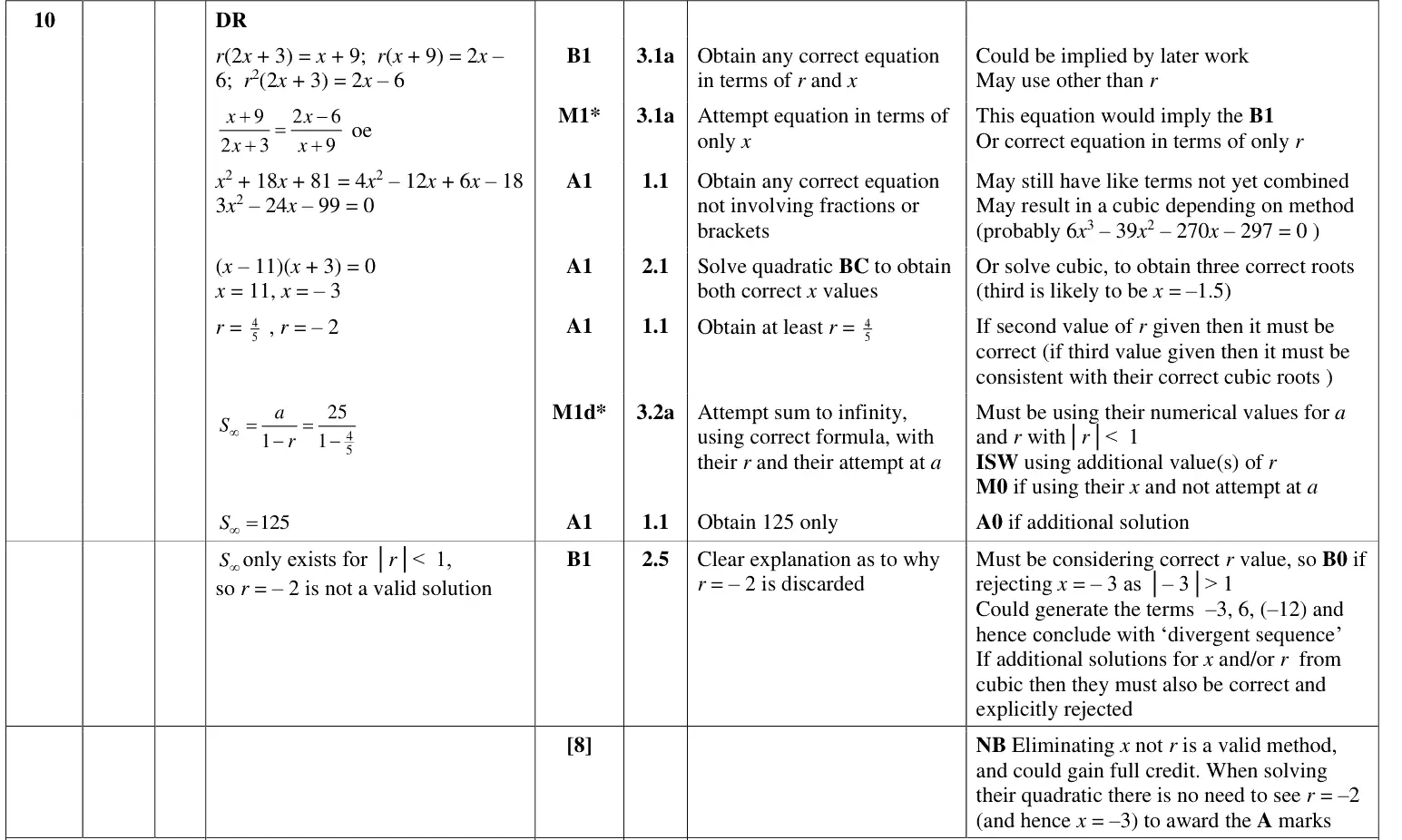
This question was well answered with many candidates scoring 7 or 8 marks. Almost all candidates obtained a correct expression for r, and most went on to form a correct equation in x. Most also solved their equation in x, either a quadratic or a cubic, to find the correct values of x. Despite this being a ‘detailed reasoning’ question, some candidates went straight from the quadratic equation to stating the roots. On this occasion this was condoned, but candidates would be well advised to make sure that sufficient detail is always provided in these types of questions. The majority then went on to find at least one value for r. However, many discarded the solution r = –2 without clear reasoning and in a few cases attempted to incorrectly calculate a second sum to infinity for this incorrect r value. Those candidates that didn’t score well, often tried to use their algebraic expression for r in the formula for the sum to infinity but were then unable to progress from this.
Key points and common errors
(x + 9)/(2x + 3) = (2x − 6)/(x + 9)
3x² − 24x − 99 = 0
x = 11 (r = 4/5) or x = −3 (r = −2)
reject r = −2 since the modulus of r must be < 1
S∞ = 25/(1 − 4/5) = 125
June 2023 · Paper 1 · Q11(d)(i)4 marksHard
Show the start of this question
Mark scheme for this part
Examiner's comment
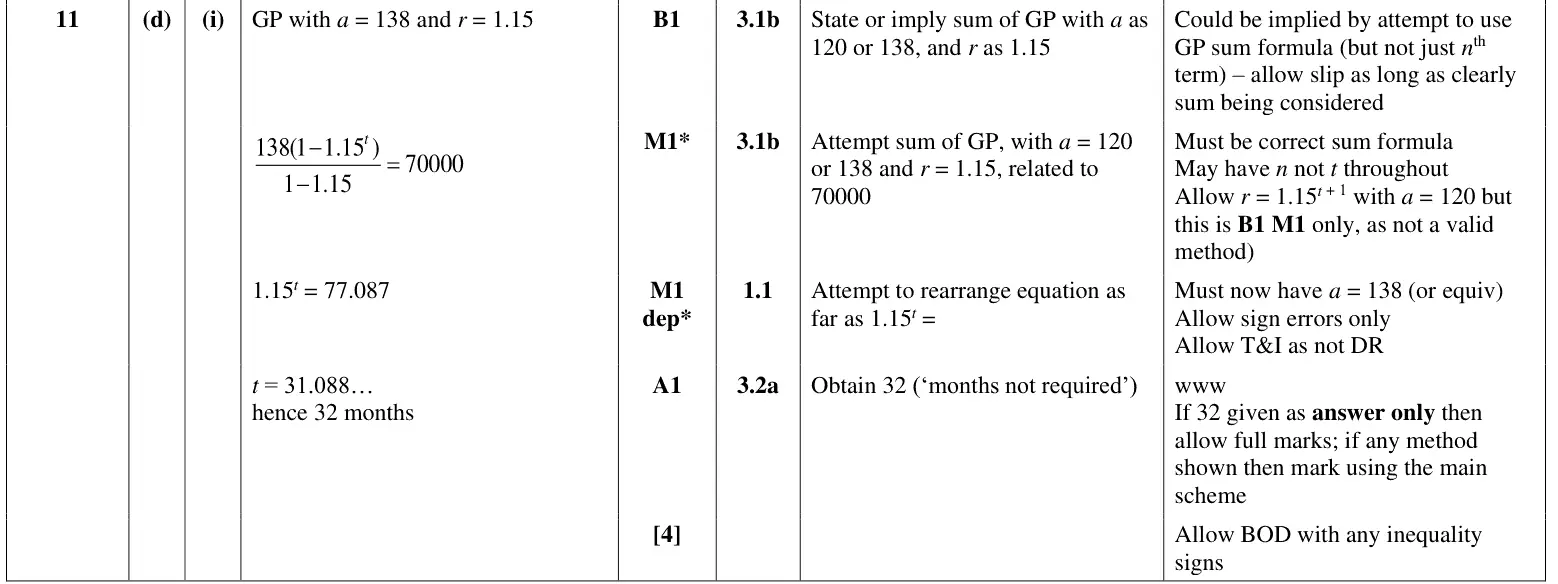
The two equally common approaches were to either equate the monthly sales to 70000 or to consider total sales, using the sum of a GP but with an initial value of 120. Only the higher scoring candidates realised that the first value in the GP should be 138, and these candidates invariably solved the equation correctly to gain full marks.
Key points and common errors
sum of GP with first term 138 (not 120) and r = 1.15
1.15ᵗ = 77.087
t = 31.09 so 32 months
June 2022 · Paper 2 · Q45 marksMedium
Mark scheme for this part
Examiner's comment
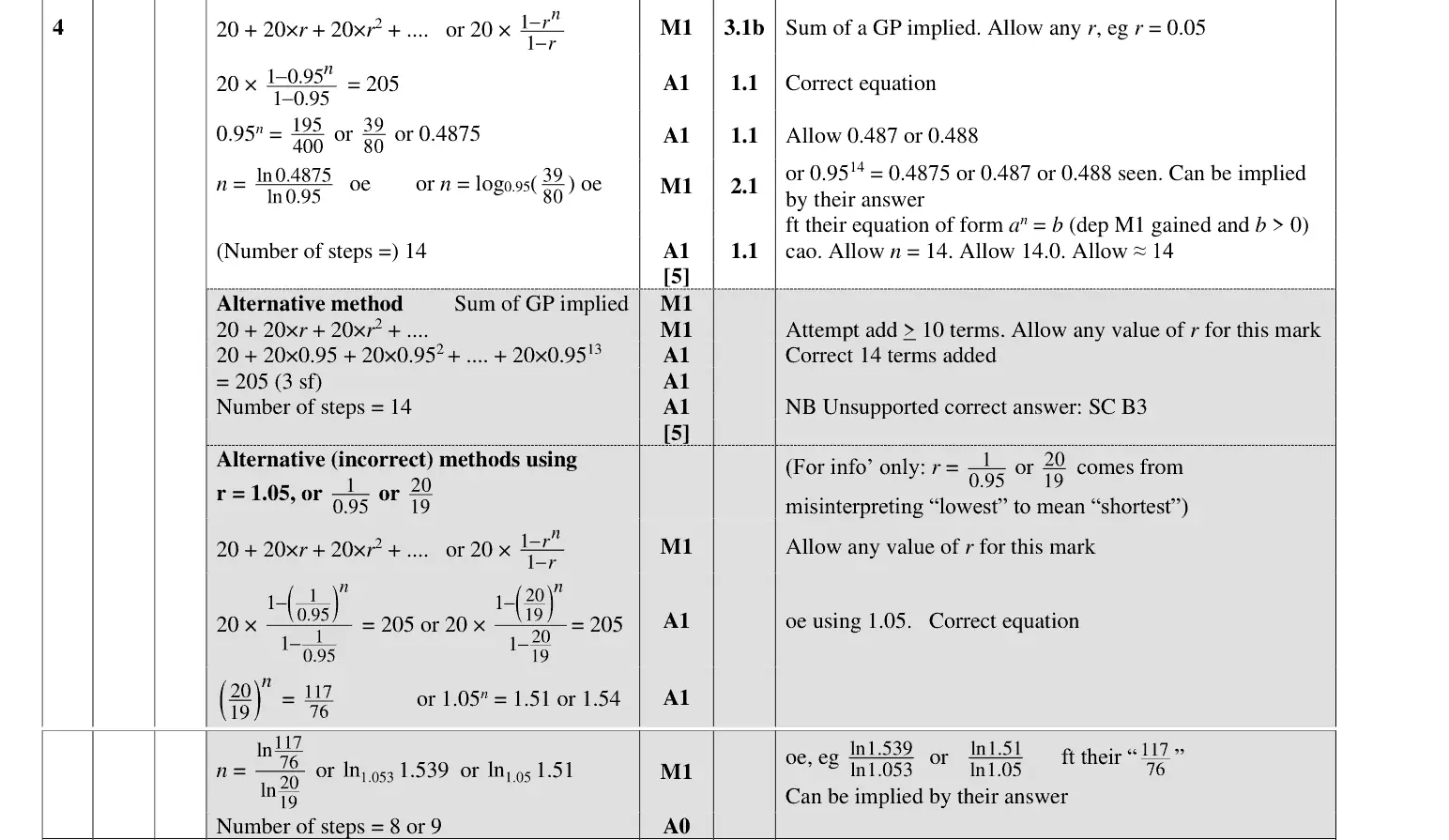
Almost all candidates recognised the need to consider the sum of a geometric progression. (Although a few used either the formula for the nth term of a GP or the formula for the sum of n terms of an AP.) In most cases, there was some good algebraic manipulation, including the use of logs to solve an equation such as 0.95n = 39 80 . There were two common errors. Firstly some candidates used r = 1.05 (representing 1 increasing, rather than decreasing, heights). Others used r = 0.95 (resulting from a misreading of the word “lowest” in the question to mean “shortest”). Candidates who made either of these errors, but whose working was otherwise correct, scored 4 marks out of 5. A more serious error was to use r = 0.05. Candidates who made this error could only score one mark for recognising a geometric progression.
Key points and common errors
sum of GP with a = 20, r = 0.95: 20(1 − 0.95ⁿ)/0.05 = 205
0.95ⁿ = 0.4875
n = 14
errors r = 1.05 or 1/0.95
June 2022 · Paper 3 · Q4(a)4 marksHard
Mark scheme for this part
Examiner's comment
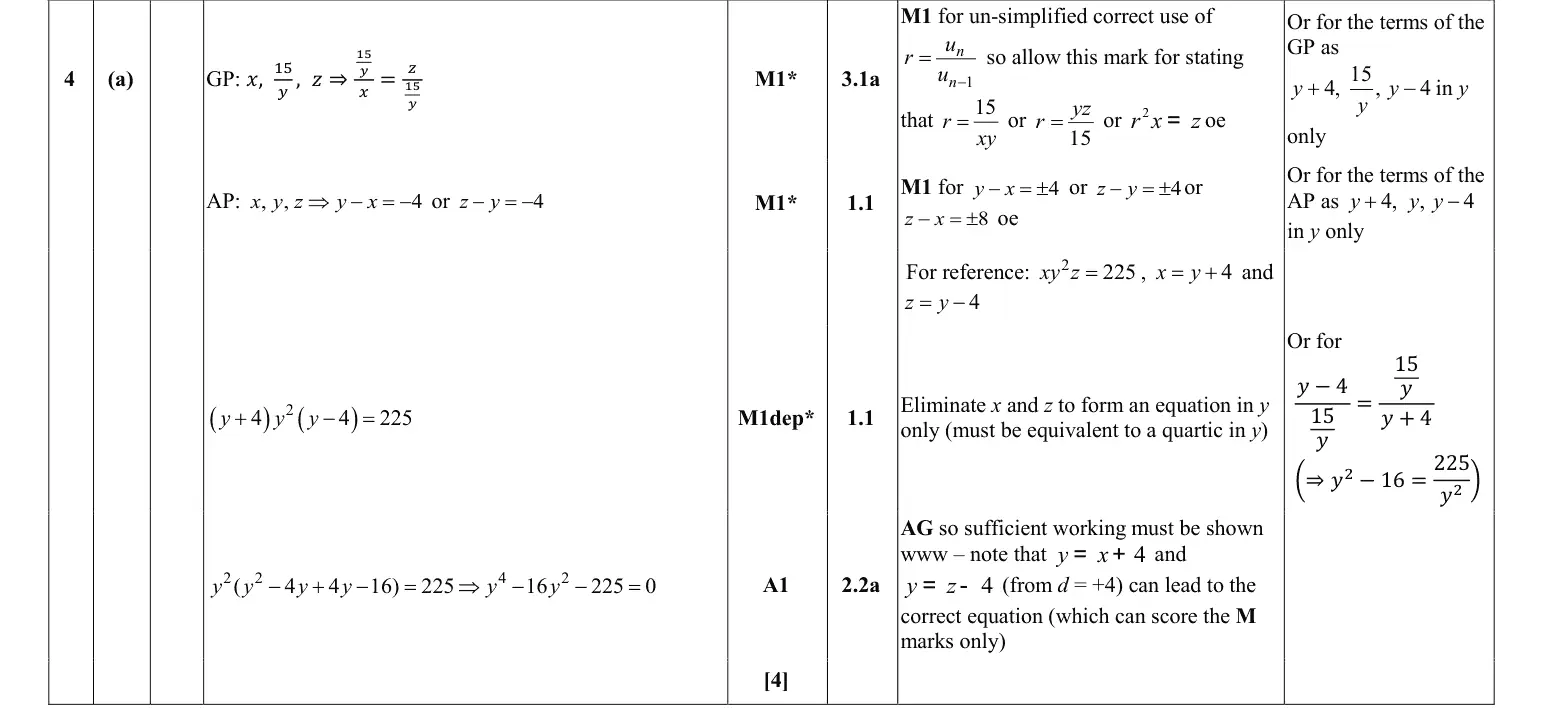
Candidates found this first part very demanding with many struggling to make any meaningful progress. The most successful responses were those that recognised that the information regarding the GP 15 zy = therefore xy z = 225, implied that and that the information regarding the AP implied that yx 15 Those that did usually went on to derive the required quartic equation in .y = + = − x y 4 and z y 4.
Key points and common errors
GP: 15/(xy) = yz/15 so xy²z = 225
AP: x = y + 4, z = y − 4
(y + 4)y²(y − 4) = 225 gives y⁴ − 16y² − 225 = 0
June 2022 · Paper 3 · Q4(b)4 marksMedium
Show the start of this question
Mark scheme for this part
Examiner's comment
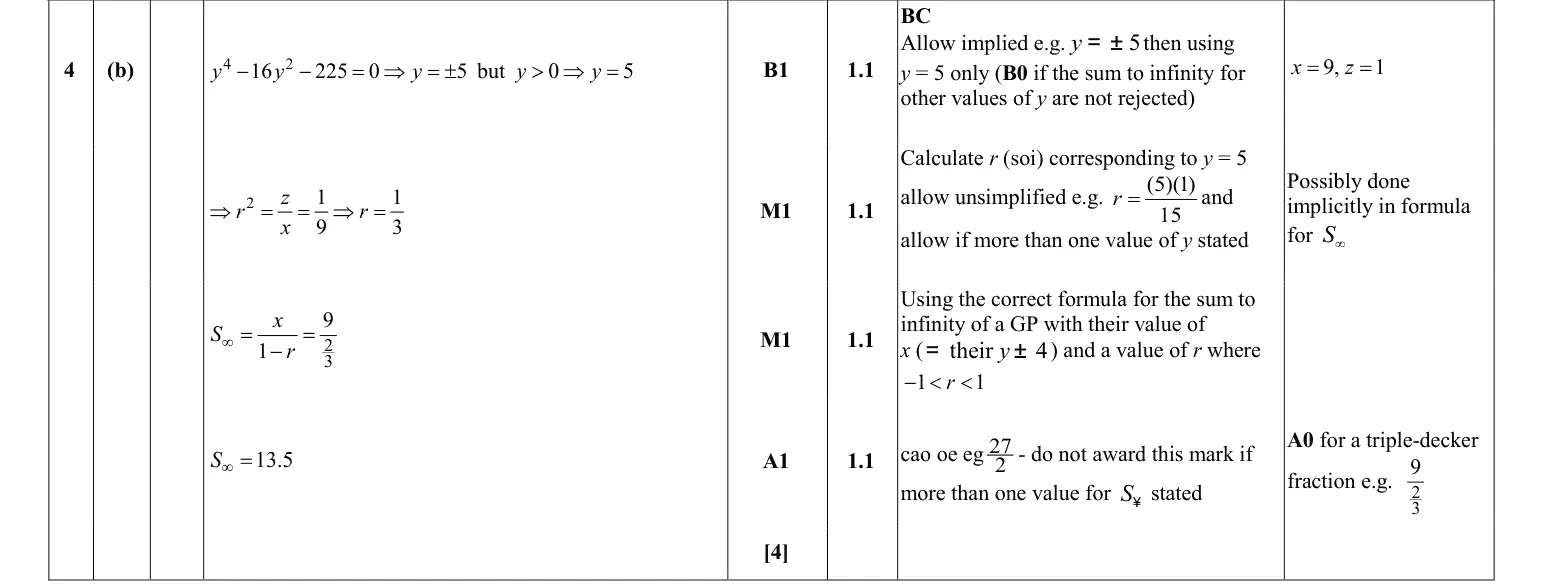
Even though this question said ‘hence’ many candidates did not use their calculators to solve the given quartic equation from part (a). Of those that did many simply stated that y = even though the 5 question explicitly stated that y was a positive integer (with many candidates only realising that y − 5 much later in the question when this led to a value for the common ratio that was greater than 1). Of those candidates who successfully found a common ratio for the infinite geometric progression most correctly applied the correct formula for the corresponding sum to infinity.
Key points and common errors
y² = 25, y = 5 (positive integer)
x = 9, z = 1, r = 1/3
S∞ = 9/(1 − 1/3) = 27/2
Autumn 2021 · Paper 3 · Q35 marksMedium
Mark scheme for this part
Examiner's comment
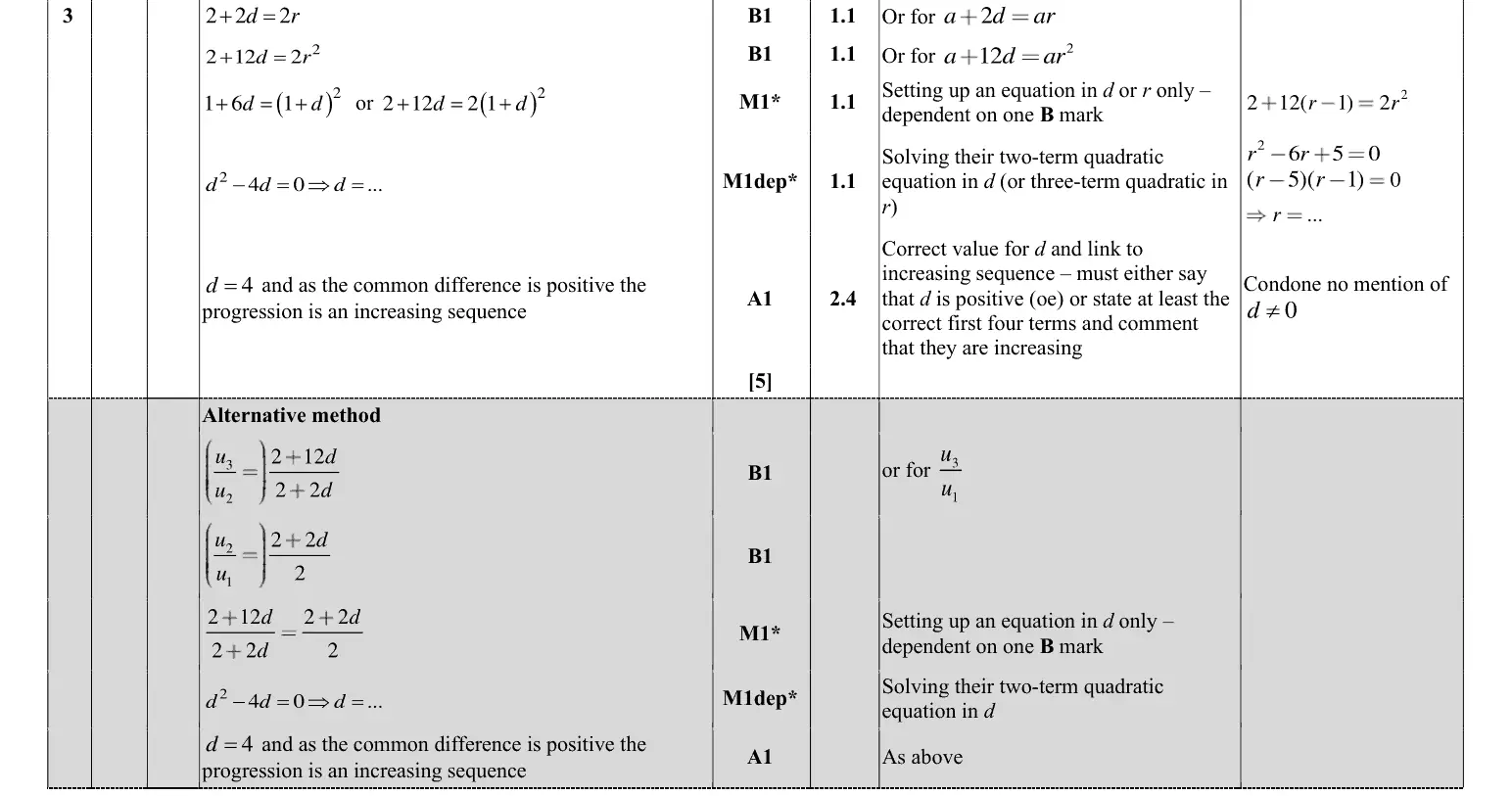
While most candidates could successfully set up and solve the required equations to find the value of d a number did not explain correctly why the value obtained implied that the sequence was increasing.
Key points and common errors
2 + 2d = 2r and 2 + 12d = 2r² give d² − 4d = 0
d ≠ 0 so d = 4
must explain that positive common difference means increasing
Autumn 2020 · Paper 1 · Q7(a)3 marksMedium
Mark scheme for this part
Examiner's comment
(Comment on Question 07 as a whole) The final part of Question 7 was another example of where candidates were expected to give clearly explained and sensible answers. Many could identify that there will eventually not be enough hours in the day, but finding a reason on a different theme for their second answer proved more problematical.
Key points and common errors
Anna AP: 30 + 9 × 15 = 165
Ben GP: 30 × 1.1⁹ = 71
difference 94
both terms evaluated
June 2019 · Paper 1 · Q78 marksHard
Mark scheme for this part
Examiner's comment
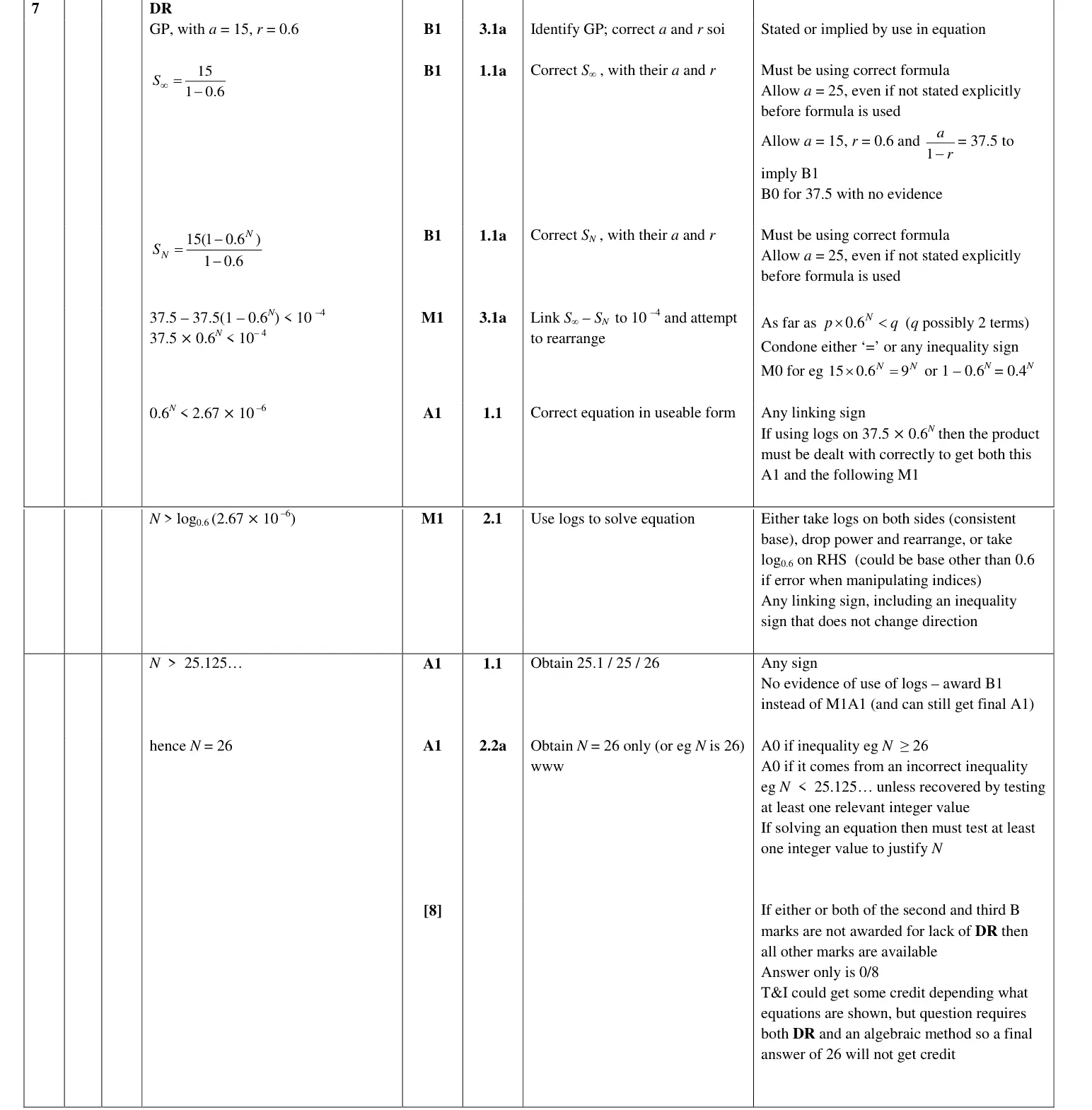
Most candidates were able to gain some credit on this question, but fully correct solutions were in a minority. The most effective method was to start by writing out the first few terms of the sequence, to allow the first term and common ratio to be identified. These values could then be substituted into the relevant formulae, and the inequality rearranged to useable form. Candidates were generally able to make a good attempt at this, but sign errors were relatively common. In this ‘detailed reasoning’ question, there was an expectation that the use of logarithms to solve the inequality would be explicit and this was nearly always the case. Candidates then had to conclude by stating the correct integer value of N, a step that some omitted and concluded with a decimal answer. The final answer had to be fully justified by correct use of inequalities throughout (which was often not the case with log0.6 involved), or by testing at least one relevant integer value. The most common misconception was to assume that the first term of the sequence was 25, with no check of n = 1.
Key points and common errors
GP with a = 15, r = 0.6
S∞ − S_N = 37.5 × 0.6^N < 10⁻⁴
logs give N > 25.1 so N = 26
inequality reverses on dividing by log 0.6
trial and improvement scores nothing
June 2018 · Paper 1 · Q7(i)4 marksMedium
Mark scheme for this part
Examiner's comment
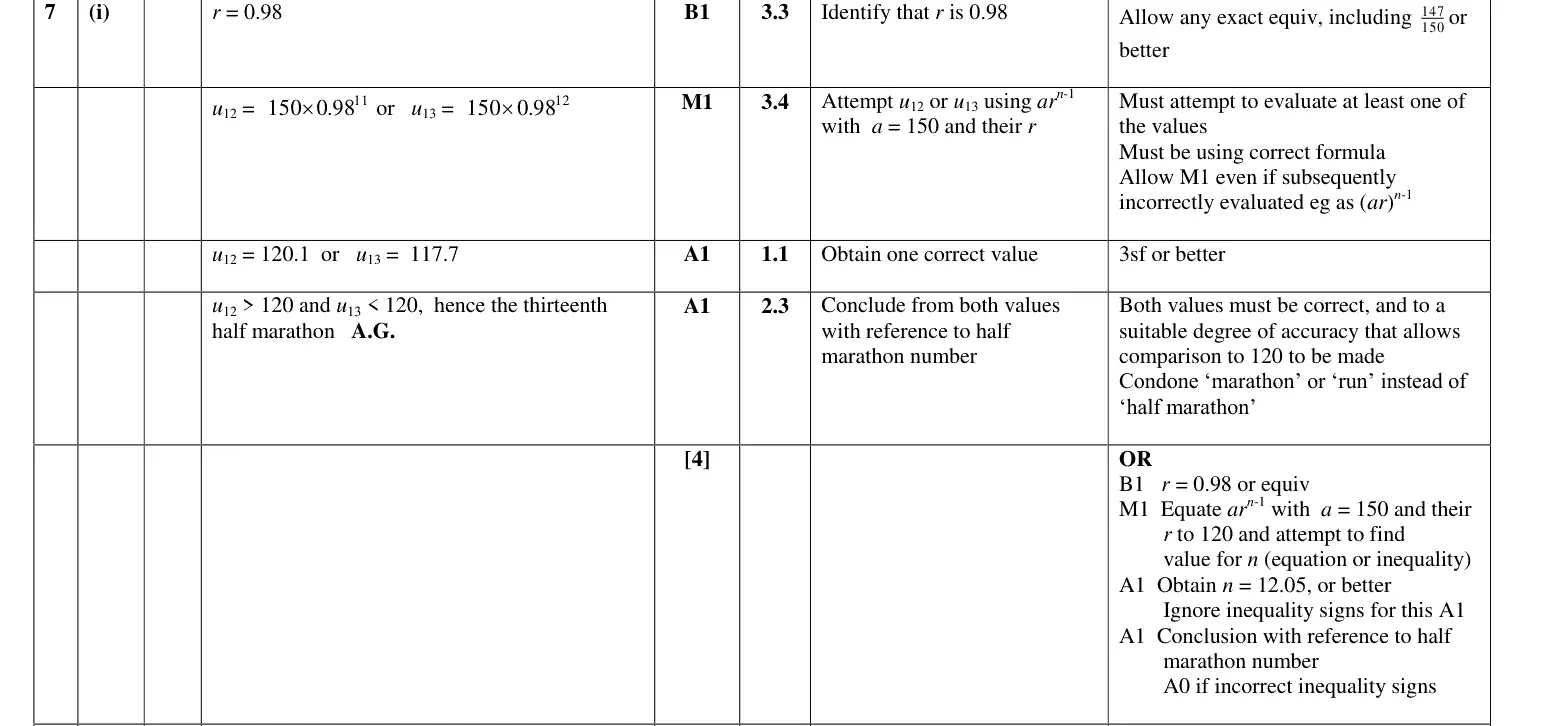
Having been told that the training programme was being modelled by a geometric progression, candidates were able to identify the first term and common ratio and use these in the nth term formula. Some candidates demonstrated that the time on the thirteenth half marathon was indeed less than 120 minutes, but to answer the question fully they also had to show that the time on the twelfth half marathon was more than 120 minutes. Other candidates set up an inequality and solved this for n, but the signs were not always correct throughout. As this is a modelling question the answer was expected to be in context namely referring to the thirteenth half marathon, although just ‘marathon’ or ‘run’ were also condoned.
Key points and common errors
r = 0.98
u₁₂ = 120.1 > 120 and u₁₃ = 117.7 < 120
both terms needed for the conclusion
June 2018 · Paper 1 · Q7(ii)3 marksEasy
Show the start of this question
Mark scheme for this part
Examiner's comment
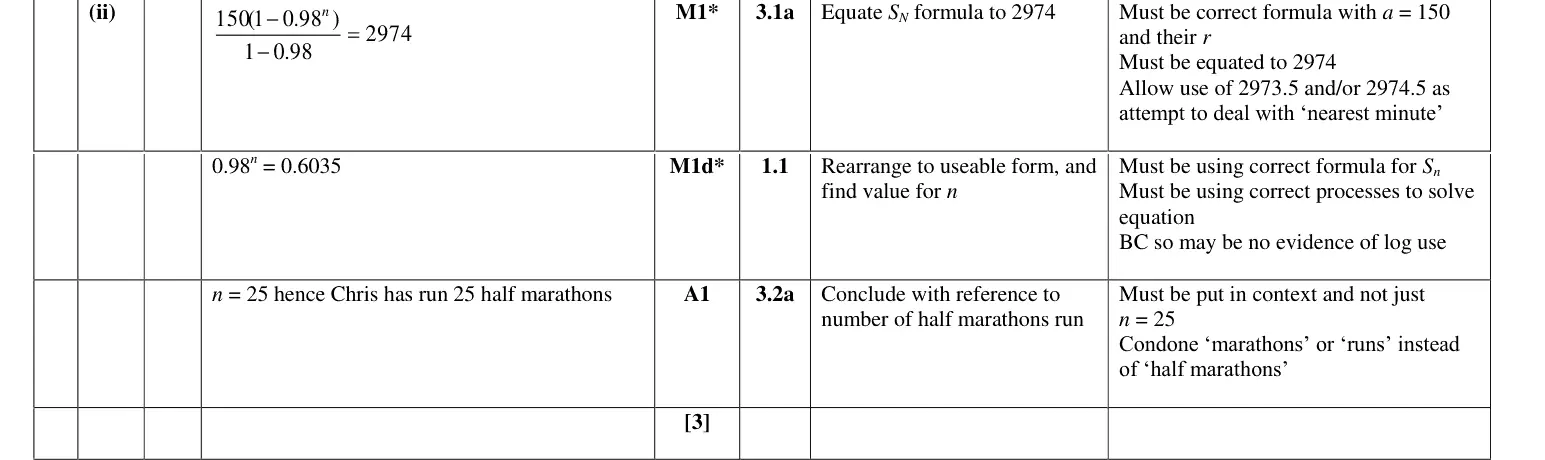
Candidates could correctly equate the expression for the sum of n terms to 2974, and most were able to solve this equation. Most candidates showed a clear mathematical justification even though there was no specific command in the question requiring this level of detail for full credit. Once again, the final answer was expected to be given in context.
Key points and common errors
150(1 − 0.98ⁿ)/(1 − 0.98) = 2974
0.98ⁿ = 0.6035
n = 25 half marathons, answer in context
Find an A-level maths tutor
Stuck on this? Book a trial session with an A-level maths tutor.