1.04c Extend the binomial expansion of (a + bx)ⁿ to any rational n…
Section
1.04 Sequences and Series
Level
A level only
Statement
Be able to extend the binomial expansion of (a + bx)ⁿ to any rational n, including its use for approximation.
Guidance
Learners may be asked to find a particular term, but the general term will not be required. Learners should be able to write (a + bx)ⁿ in the form aⁿ(1 + bx/a)ⁿ prior to expansion.
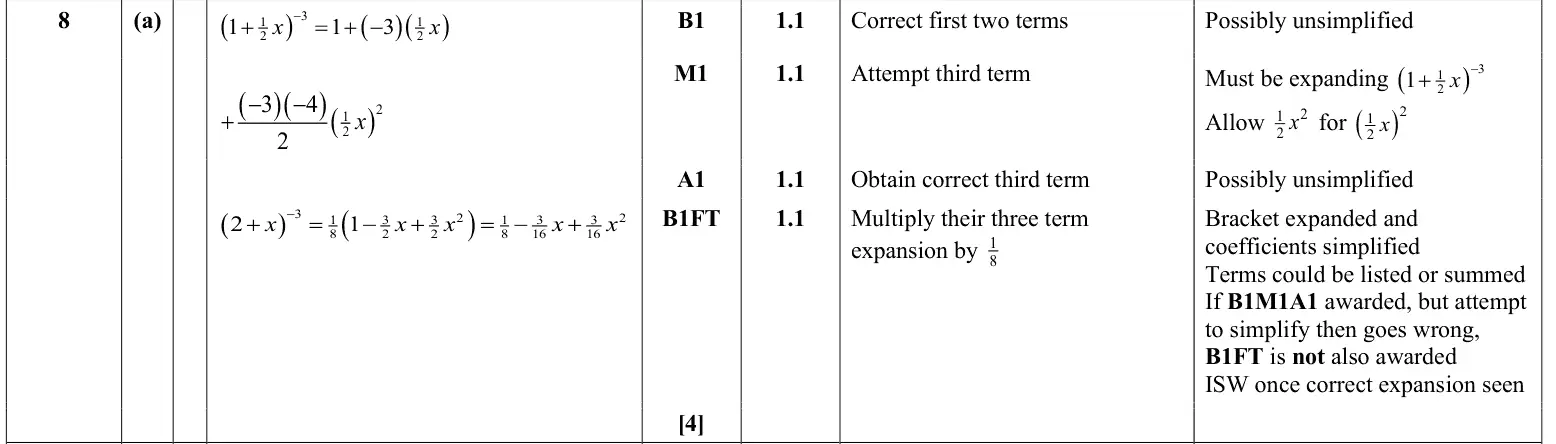
Most candidates were able to make a good attempt at this routine question, with many gaining full credit. The most successful solutions made effective use of brackets so as to avoid sign errors and make sure that the index was applied to the 0.5 when attempting the third term. The most common error was not correctly dealing with the required multiplier of 2-3, some candidates did have the correct value but then forgot to then apply it when attempting the final answer whereas others omitted the index and simply multiplied by 2 instead. Some candidates attempted to use Maclaurin’s expansion from first principles. This approach could gain full credit, but attempts rarely did so as the relevant formula is not given at the start of this paper. Candidates who are also studying Further Mathematics should always attempt to use the method most fitting to the paper being taken.
Key points and common errors
take out 2⁻³ = 1/8: 1/8 − (3/16)x + (3/16)x²
forgetting or mishandling the 2⁻³ factor
sign errors
June 2025 · Paper 1 · Q8(b)4 marksMedium
Show the start of this question
Mark scheme for this part
Examiner's comment
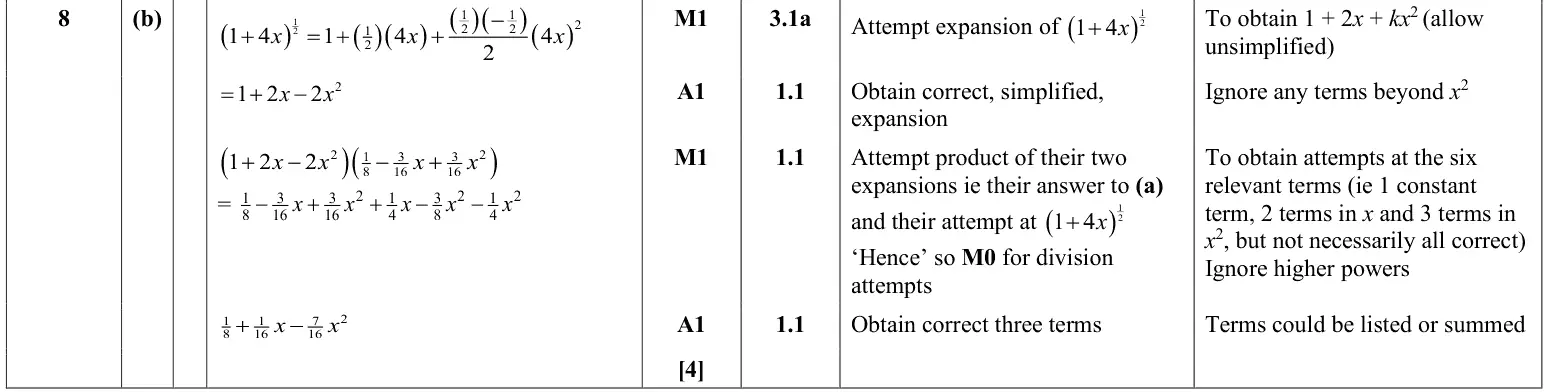
Most candidates appreciated the need to first find the expansion of (1 + 4x)0.5 and obtained a correct expression. The command word ‘hence’ should indicate to candidates that they needed to use their result from the previous part of the question and most attempted to do so thus gaining at least 3 of the 4 marks available. Candidates generally showed sufficient detail when finding the product of their two expressions, which allowed the method mark to be given even if an error had previously occurred. The candidate gains the method mark for attempting to expand (1 + 4x)0.5 but not using brackets results in the coefficient of the quadratic term being incorrect. The expansion from part (a) is also incorrect but, when attempting the product of their two expansions, the candidate shows sufficient detail to allow the second method mark to also be awarded. Had the penultimate line not been shown the method mark would not have been awarded, as an incorrect final answer cannot imply a correct method.
Key points and common errors
(1 + 4x)^½ = 1 + 2x − 2x²
multiply by part (a): 1/8 + x/16 − 7x²/16
June 2024 · Paper 3 · Q3(a)4 marksEasy
Mark scheme for this part
Examiner's comment
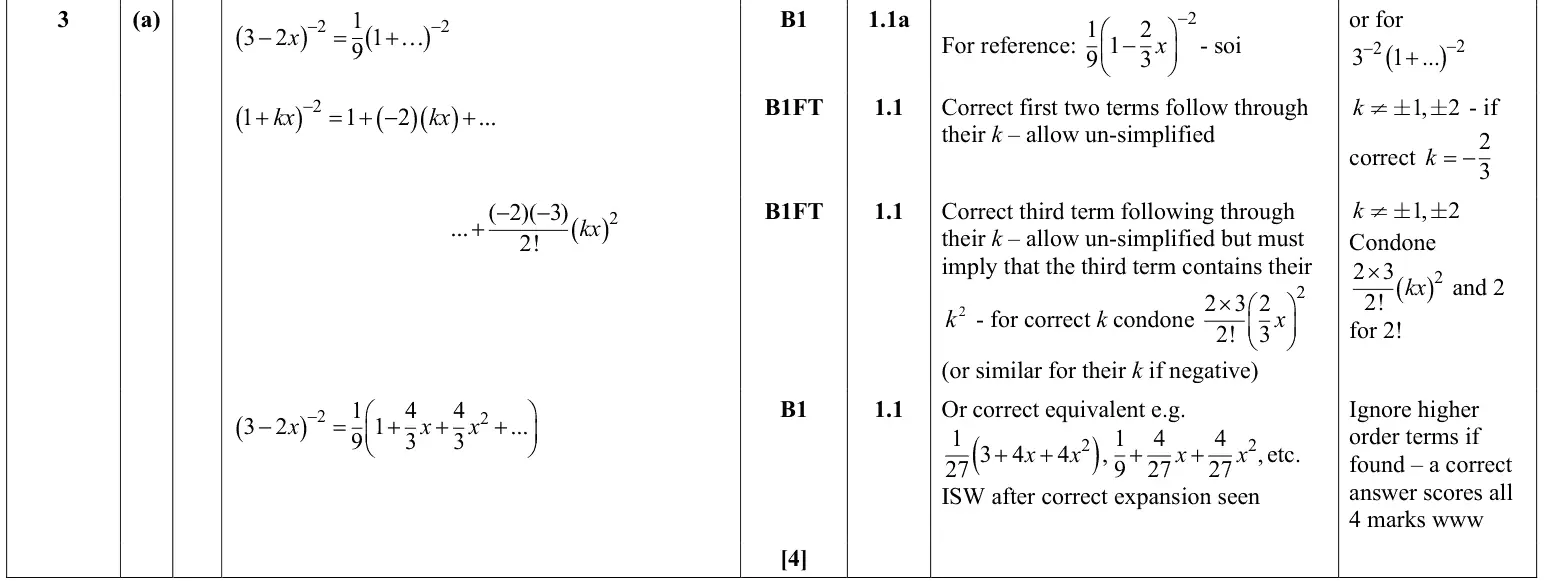
This part was answered well with almost all candidates knowing the correct method for binomially expanding expressions of the form (1 + 𝑥)𝑛 where 𝑛∉𝕫+. The most common errors were not taking out the correct factor of 9 or sign errors when evaluating either (−2) (− 3 𝑥) or . (− 3 𝑥)
Key points and common errors
(3 − 2x)⁻² = (1/9)(1 − ⅔x)⁻²
1/9 + 4x/27 + 4x²/27
errors: factor of 9, signs in (−⅔x) terms
June 2024 · Paper 3 · Q3(c)2 marksEasy
Show the start of this question
Mark scheme for this part
Examiner's comment
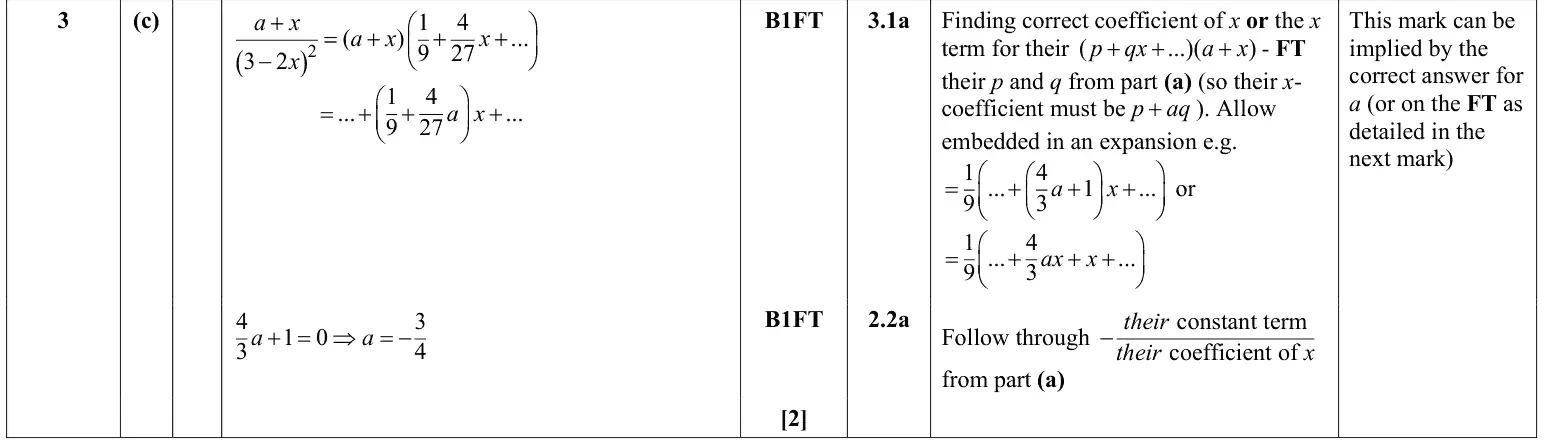
This part was generally answered well with many candidates recognising the need to use the expansion from part (a), multiplying this by (𝑎+ 𝑥) and then setting the coefficient of 𝑥 equal to zero.
Key points and common errors
(a + x)(1/9 + 4x/27 + …): coefficient of x is 4a/27 + 1/9 = 0 so a = −3/4
June 2023 · Paper 1 · Q8(a)4 marksEasy
Mark scheme for this part
Examiner's comment
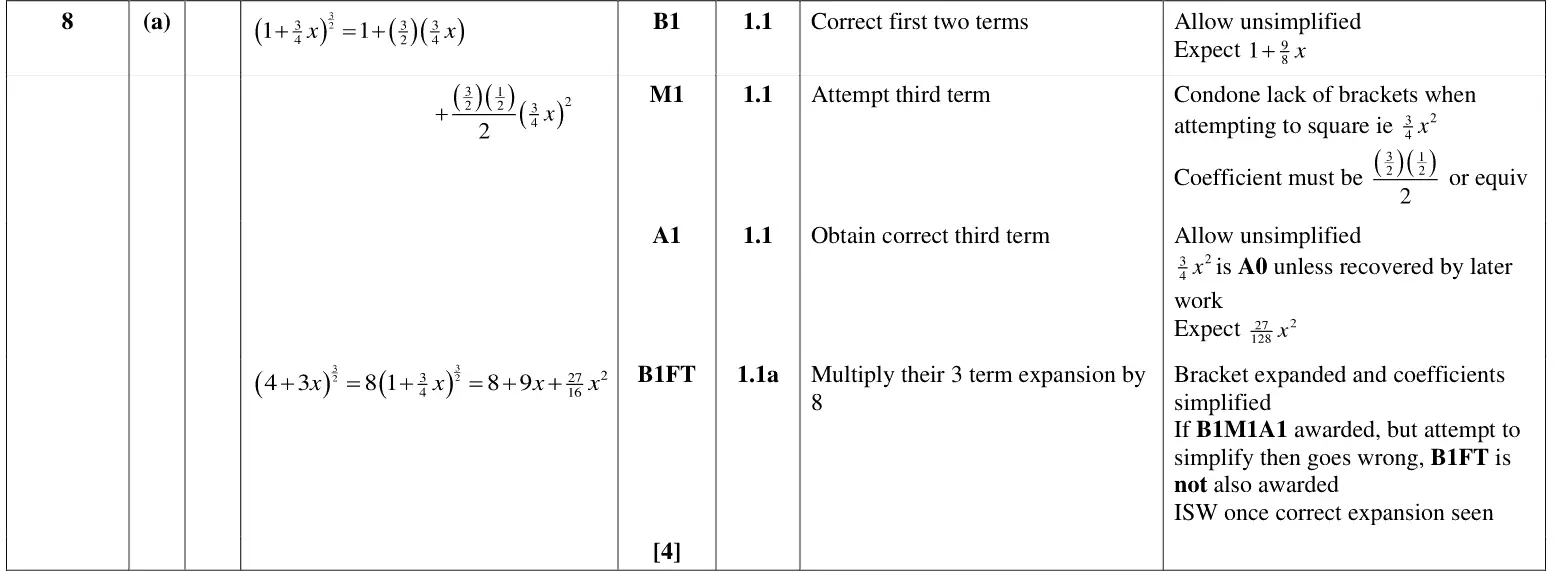
This question was very well answered, with the majority of candidates gaining full credit. The most successful responses saw candidates make effective use of brackets in the third term. The most common error was multiplying through by 4 rather than 8. Some candidates did attempt to use Newton’s method; it was unclear whether they had been taught this method or whether they were selecting the incorrect formula, but it was rarely done correctly.
Key points and common errors
take out 4^(3/2) = 8: 8(1 + 3x/4)^(3/2)
8 + 9x + 27x²/16
common error multiplying by 4 not 8
June 2023 · Paper 1 · Q8(c)4 marksEasy
Show the start of this question
Mark scheme for this part
Examiner's comment
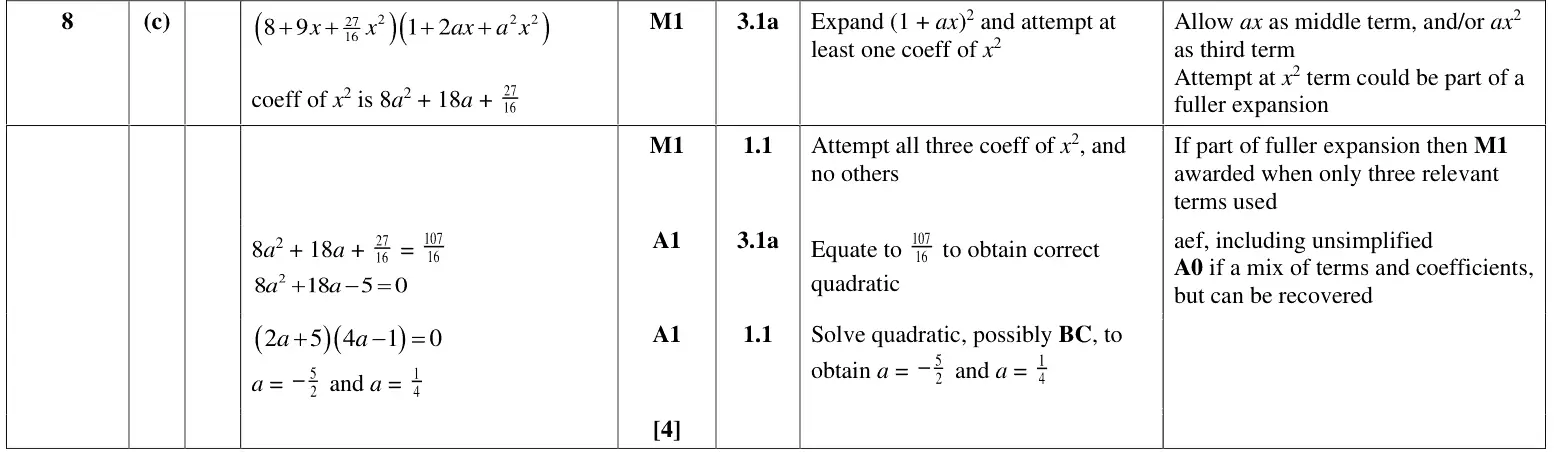
This part of the question was also very well answered. Most candidates were able to gain at least 2 marks for attempting three relevant terms from the product of their expansion with their attempt at (1 + ax)2. While detailed methods were more common, the wording of the question did allow candidates to solve the resulting equation on their calculator, but it was only a minority that did so.
Key points and common errors
coefficient of x² is 8a² + 18a + 27/16 = 107/16
a = −5/2 or 1/4
Autumn 2021 · Paper 1 · Q6(a)4 marksEasy
Mark scheme for this part
Examiner's comment
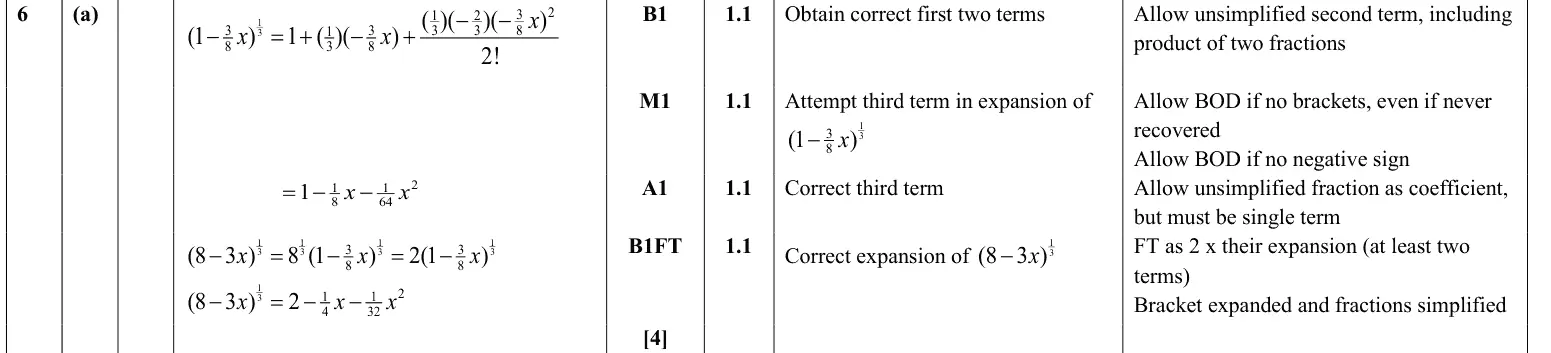
(From the general report) Question 6(a) was a routine question, and many candidates were able to provide clear and correct solutions.
Key points and common errors
take out 8^(1/3) = 2: 2(1 − 3x/8)^(1/3)
2 − x/4 − x²/32
bracket the −3x/8 term
Autumn 2021 · Paper 1 · Q6(c)4 marksMedium
Show the start of this question
Mark scheme for this part
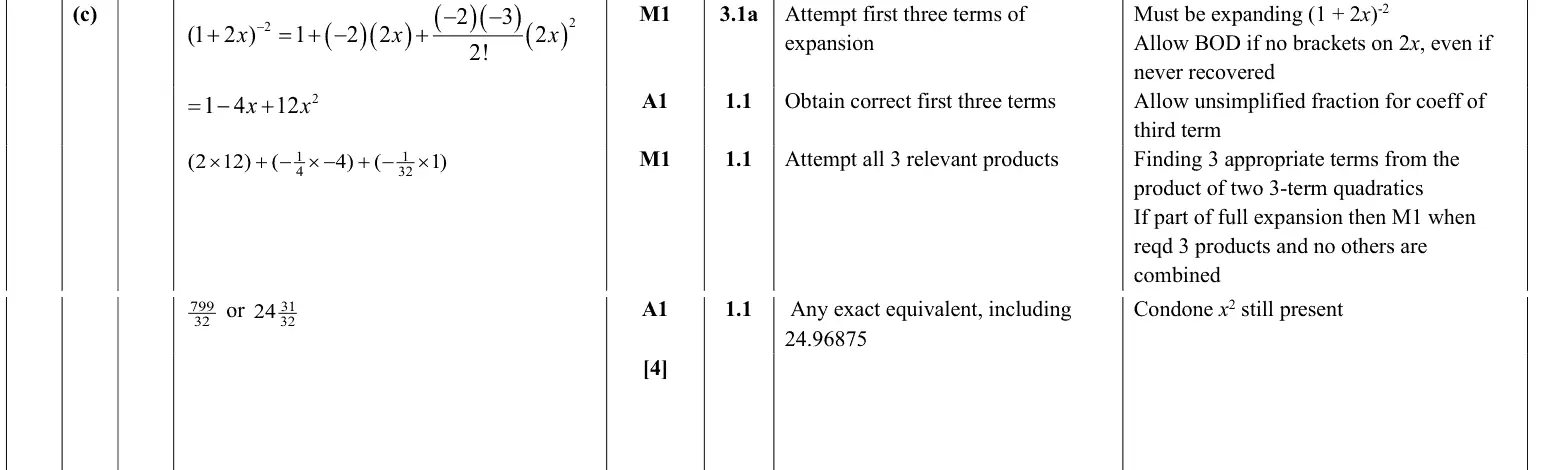
Key points and common errors
(1 + 2x)⁻² = 1 − 4x + 12x²
combine the three relevant products
799/32
Autumn 2021 · Paper 3 · Q2(b)4 marksHard
Show the start of this question
Mark scheme for this part
Examiner's comment
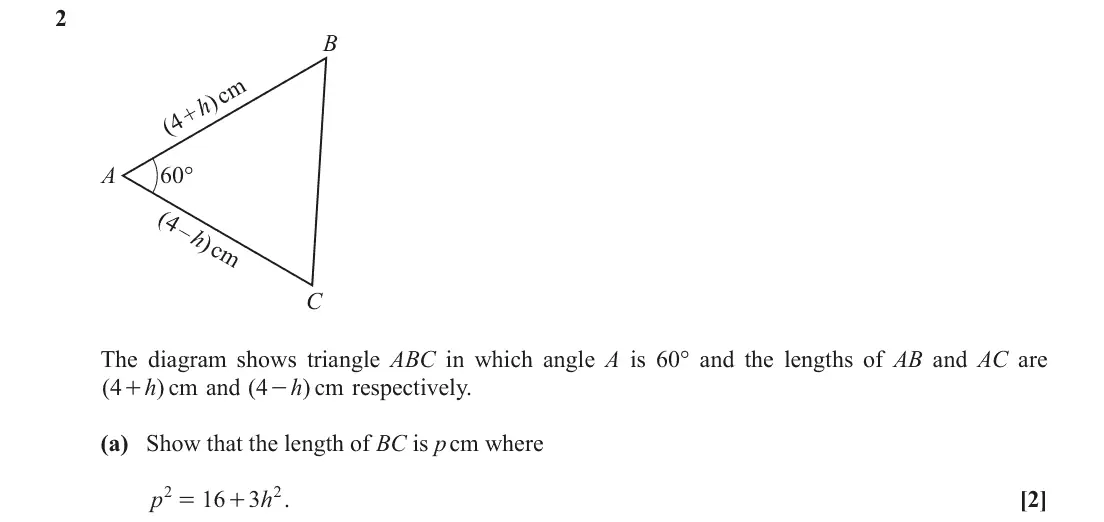
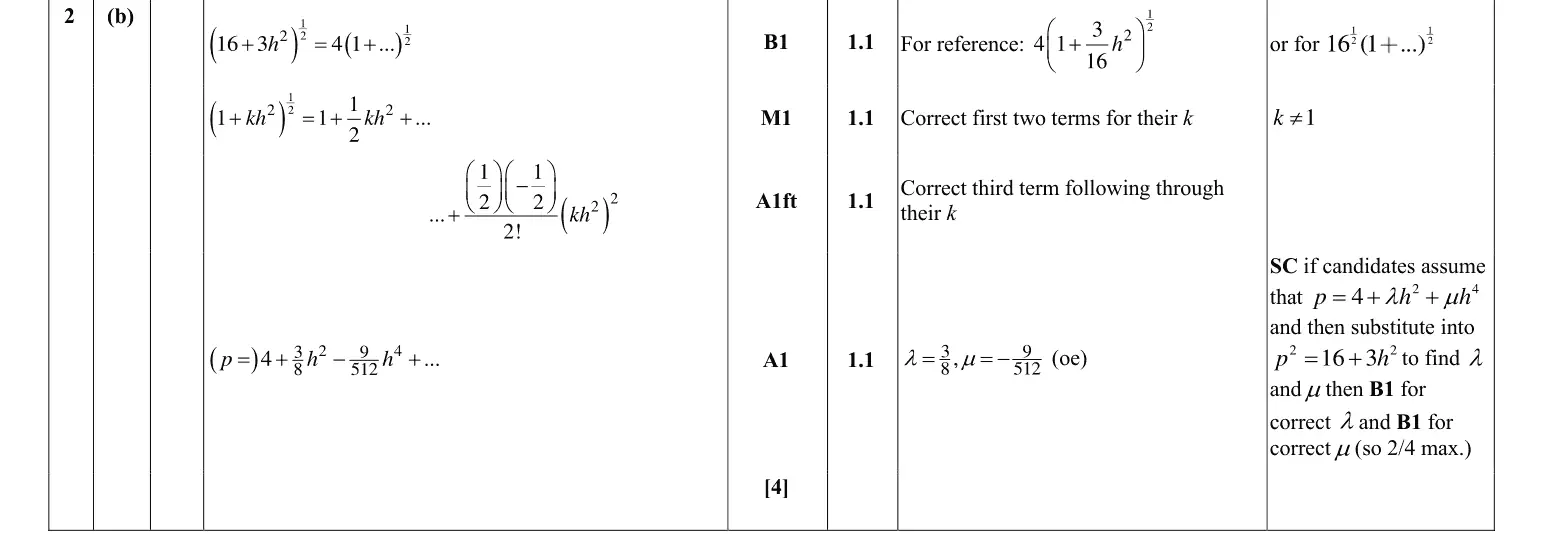
Candidates struggled to see the link between part (a), in which most candidates were successful in applying the cosine rule to derive the given result of p 16 3 h , and the demand in (b) to find a three- term approximation for p in powers of .h Most candidates did not realise that a binomial expansion was required and instead tried to use, quite surprisingly, small-angle approximations (even though the expression for p did not contain any trigonometric terms).
Key points and common errors
p = (16 + 3h²)^½ = 4(1 + 3h²/16)^½
binomial expansion gives λ = 3/8, μ = −9/512
many wrongly tried small-angle approximations
Autumn 2020 · Paper 2 · Q3(a)(i)2 marksMedium
Mark scheme for this part
Key points and common errors
(1 − x)⁻² = 1 + 2x + 3x² + 4x³
sign errors with (−x)
Autumn 2020 · Paper 2 · Q3(a)(ii)1 markMedium
Show the start of this question
Mark scheme for this part
Key points and common errors
spot the pattern: (n + 1)xⁿ
Autumn 2020 · Paper 2 · Q3(c)3 marksHard
Show the start of this question
Mark scheme for this part
Examiner's comment
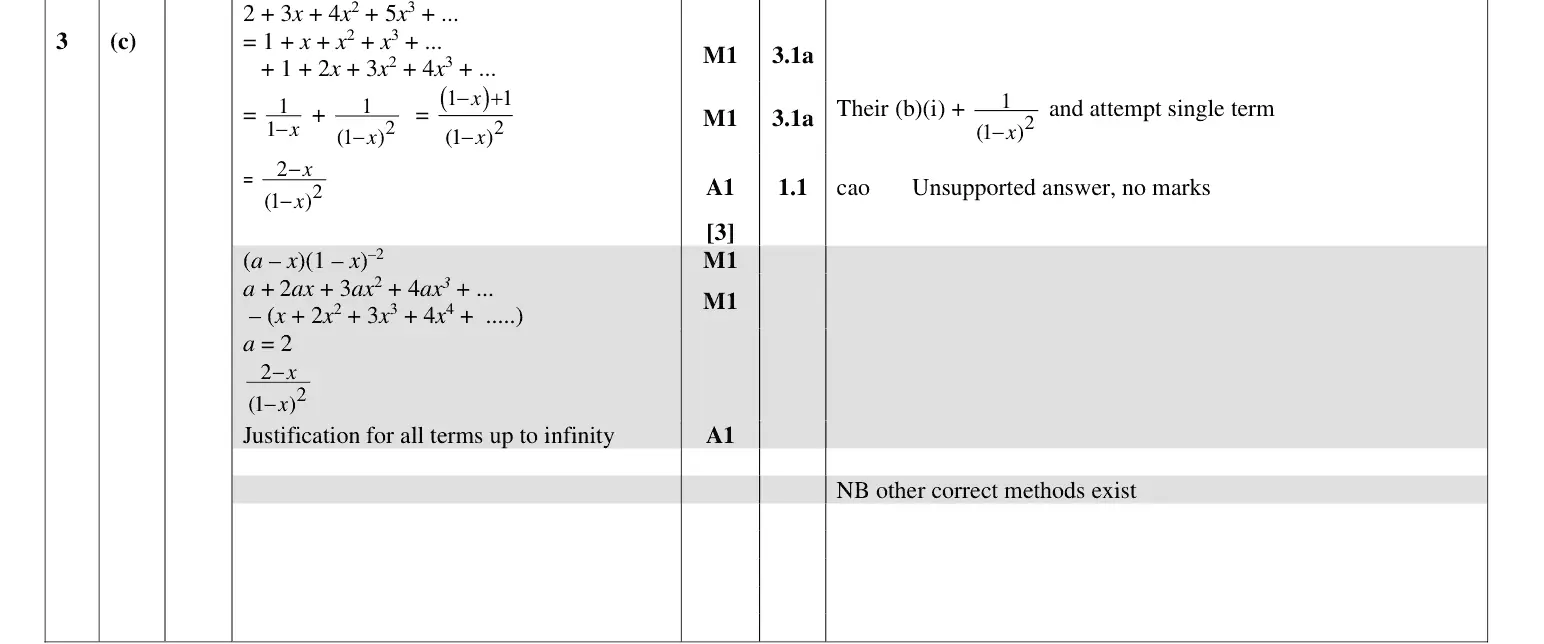
This is a good example of the use of "Hence or otherwise". Those candidates who took the hint and used their answers to parts (a) and (b), obtained the required result quickly. Unfortunately, the majority of candidates opted for the "otherwise" route and, in almost all cases, did not obtain any marks. 4 sin θ = − Many candidates correctly obtained sin θ = or 1 , but then deduced that sinθ = , omitting 1 3 4 the case where sinθ = −. Some also gave no comment about rejecting 1 sin θ = − , but merely crossed 3 it out.
Key points and common errors
split the series as (1 + x + x² + …) + (1 + 2x + 3x² + …) = 1/(1 − x) + 1/(1 − x)²
answer (2 − x)/(1 − x)²
the majority tried 'otherwise' and scored nothing
unsupported answer no marks
June 2019 · Paper 2 · Q2(b)(i)3 marksMedium
Mark scheme for this part
Examiner's comment
3 3 3 Many answered correctly. Some made an error with the "3" and gave 1 + x − x + x . Others 2 8 16 omitted the "3" altogether.
Key points and common errors
1 + (3/2)x − (9/8)x² + (27/16)x³
errors with or omission of the 3
June 2019 · Paper 2 · Q2(b)(iii)3 marksHard
Show the start of this question
Mark scheme for this part
Examiner's comment
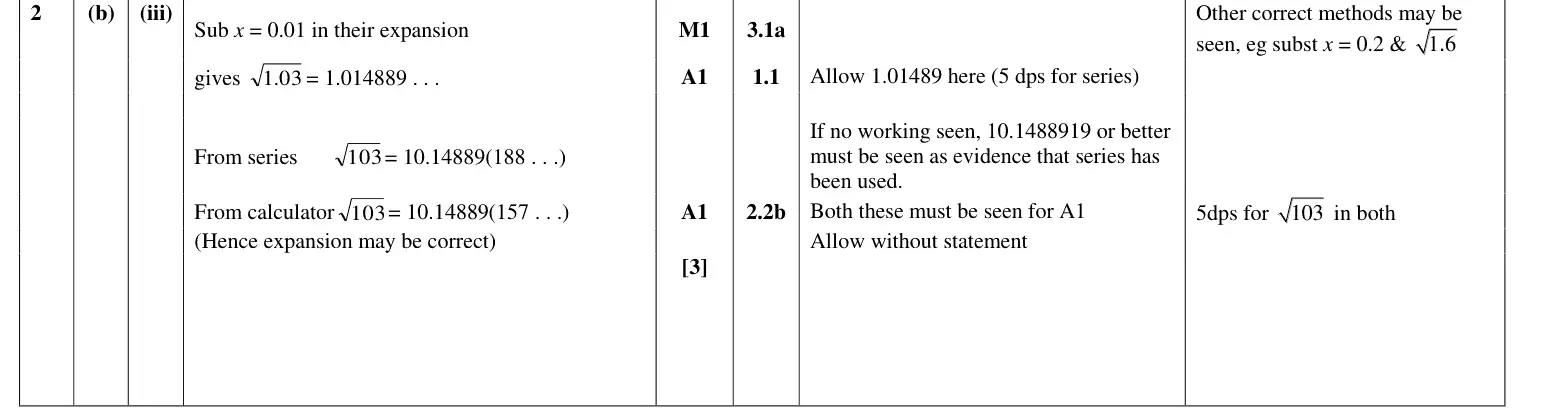
This part was challenging for most candidates, with candidates not spotting the link to the previous work. Some used their series successfully, but lost a mark by not showing explicitly their substitution of x = 0 01 . into the series. The majority attempted 1 + 3 x = 103 , giving x = 34 and then substituted x = 34 into their expansion, apparently not recognising that this is invalid. A few candidates managed to answer correctly with other substitutions.
Key points and common errors
√103 = 10√1.03 so x = 0.01
compare 10.14889 from series with calculator
substituting x = 34 is outside the valid range
substitution must be shown
June 2018 · Paper 1 · Q8(i)4 marksEasy
Mark scheme for this part
Examiner's comment
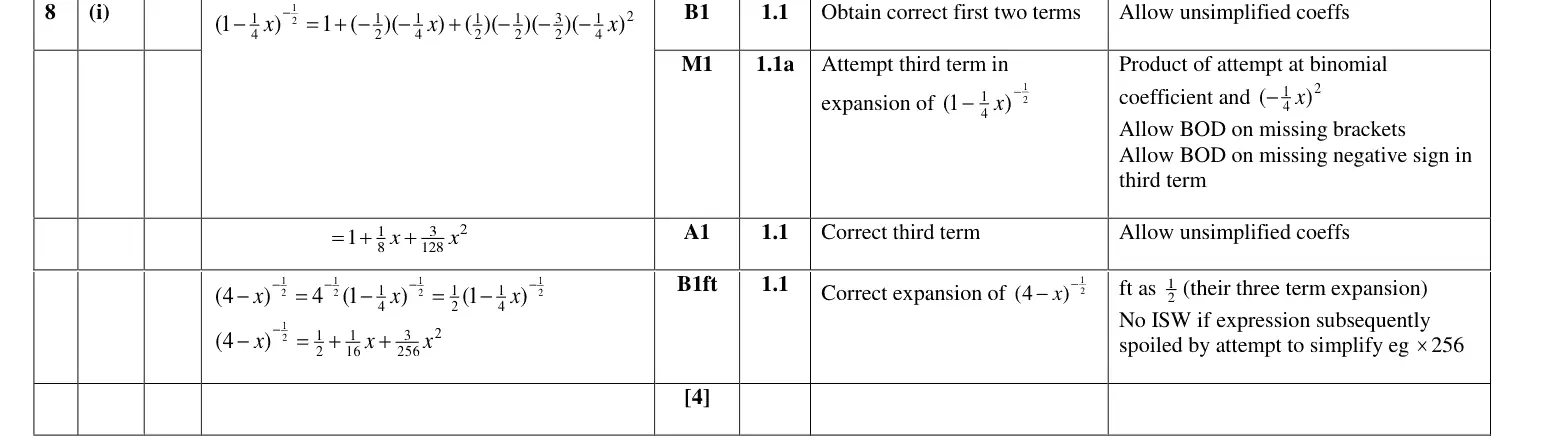
This question was well answered with many fully correct solutions seen. The most successful solutions made effective use of brackets to ensure that the relevant indices were applied to the entire term including the coefficient of x. Showing clear working allowed partial credit to be credited for attempting a valid method should the final answer not be correct.
Key points and common errors
(4 − x)^(−½) = ½(1 − ¼x)^(−½)
½ + x/16 + 3x²/256
brackets round −¼x
June 2018 · Paper 1 · Q8(ii)3 marksEasy
Show the start of this question
Mark scheme for this part
Examiner's comment
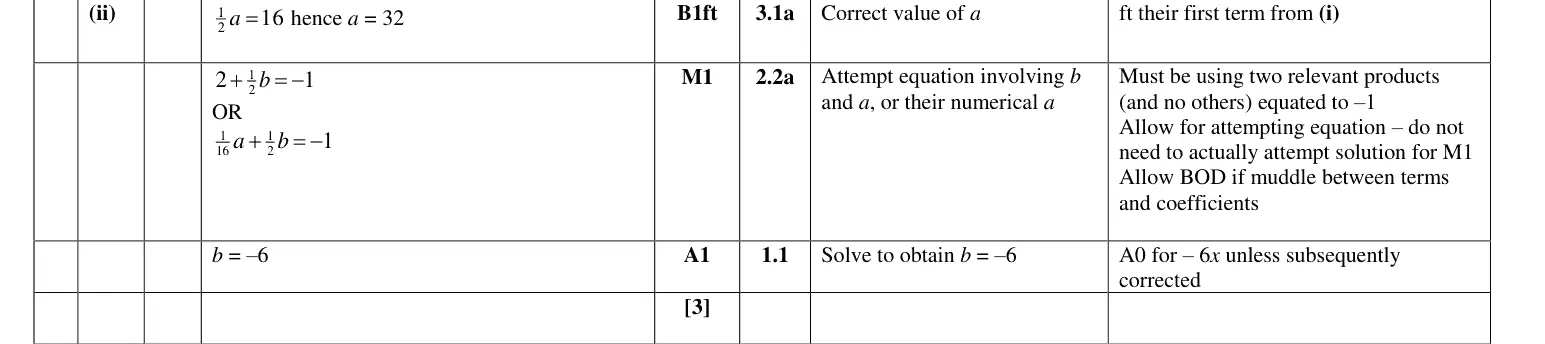
This part of the question was also very well answered. Most candidates appreciated the connection with the previous part of the question, and equated coefficients to find the values of a and b. An alternative method was to cross-multiply and then square both sides before equating coefficients, and this was usually equally successful.
Key points and common errors
multiply (a + bx) by the expansion
½a = 16 so a = 32
2 + ½b = −1 so b = −6
Find an A-level maths tutor
Stuck on this? Book a trial session with an A-level maths tutor.