Examiner's comment
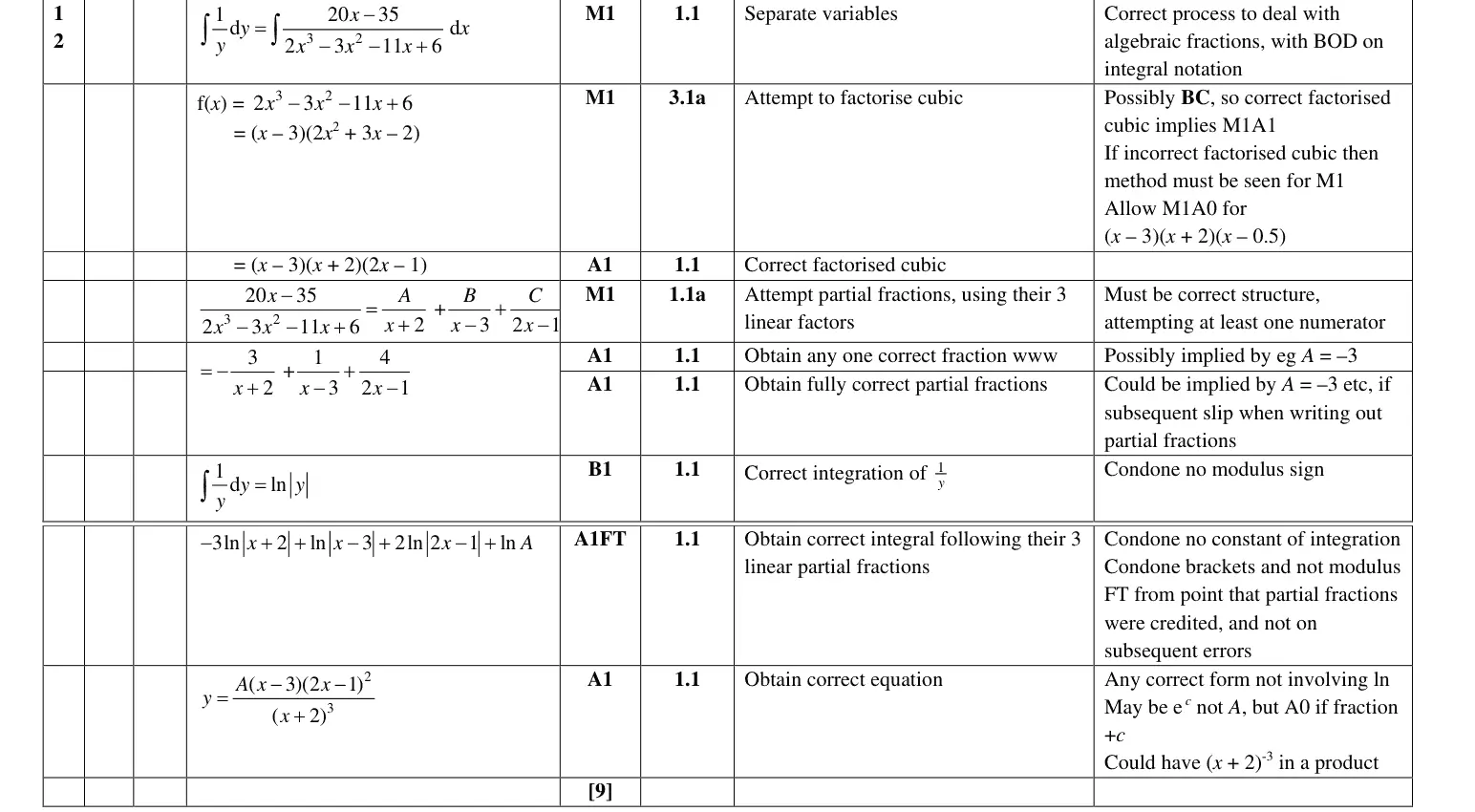
Question 12 was the final question on the paper and was generally well answered, with a number of candidates able to make good progress in this unstructured, multi-step question. As the question did not require ‘detailed reasoning’, calculator use to find the roots of the cubic denominator was acceptable. However, when then working backwards from the roots to the factors, it was fairly common to lose the lead coefficient of 2 with the expected factor of ( ) being given as ( ) 2 x − 1 x − 0 5. but with no compensation in the other factors. Candidates who took the longer method of identifying a factor, carrying out algebraic long division and then finding the other two linear factors were usually more successful. This demonstrates the need for candidates to know how to use the calculator functions effectively and accurately. The remainder of the question was generally well attempted, although only the most able candidates gained the final mark for correctly dealing with both the indices and the constant of integration when removing the logarithms to make y the subject. Common misconceptions One common misconception was commenting on the model in Question 7; a number of candidates commented on why the revision programme may be difficult for the student to implement (e.g. may get bored and not want to revise) as opposed to why it may not be realistic. Key teaching and learning points – comments on improving performance Candidates need to be aware of the command words that are used, and the implication for the detail in their solutions. ‘Determine’ was used in a number of questions and candidates should appreciate that this indicates that justification should be given; just stating the answer is unlikely to attract much, if any, credit. When commenting on the reliability of a model, or how realistic it may be, candidates are expected to give a sensible, specific reason; vague comments that refer just to ‘other factors’ are insufficient. It is essential that candidates are familiar with all areas of the specification; on this paper a number of candidates seemed less confident on topic areas that did not feature on the legacy 7890 specification, namely small angle approximations, proof by contradictions and upper and lower bounds. Guidance on using this paper as a mock When marking the mock examination, teachers should pay close attention to the additional guidance in the mark scheme to make sure that lack of sufficient detail in a solution is clearly identified and feedback given to the candidates as to what additional detail was required.