1.02v Inverse functions and their graphs, and composite functions
Section
1.02 Algebra and Functions
Level
A level only
Statement
Understand and be able to use inverse functions and their graphs, and composite functions. Know the condition for the inverse function to exist and be able to find the inverse of a function either graphically, by reflection in the line y = x, or algebraically.
Guidance
The vocabulary and associated notation is expected e.g. gf(x) = g(f(x)), f²(x), f⁻¹(x).
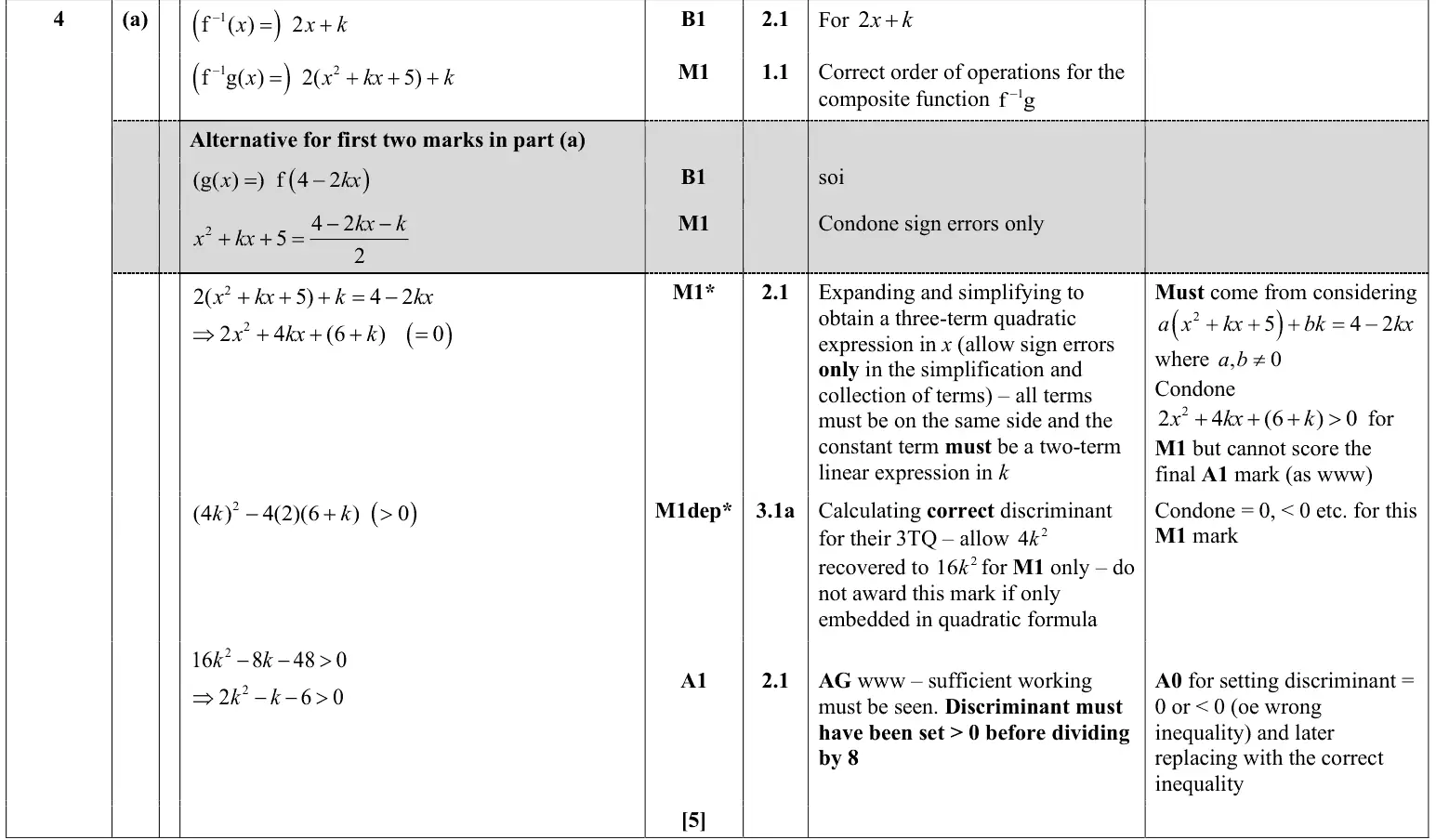
Most candidates correctly found the inverse of f and applied the correct order of operations to obtain f −1g(𝑥) = 2𝑥2 + 2𝑘𝑥+ 10 + 𝑘 although some candidates incorrectly found fg(𝑥) and then attempted to find the inverse of this, or simply equated fg(𝑥) to 4 −2𝑘𝑥. A significant number of candidates incorrectly considered the equation f −1g(𝑥) = 0. Of those that did consider f −1g(𝑥) = 4 −2𝑘𝑥 most obtained the correct three-term quadratic in 𝑥 and were successful in deriving the given inequality by considering the discriminant > 0. As this was a given answer any incorrect working seen (or setting the discriminant > 0 after dividing by 8) meant that the final accuracy mark could not be awarded.
Key points and common errors
f⁻¹(x) = 2x + k
f⁻¹g(x) = 2(x² + kx + 5) + k
set equal to 4 − 2kx and collect: 2x² + 4kx + 6 + k = 0
discriminant > 0 gives 2k² − k − 6 > 0
fg or f⁻¹g = 0 are common errors
June 2023 · Paper 1 · Q5(a)(ii)1 markMedium
Show the start of this question
Mark scheme for this part
Examiner's comment
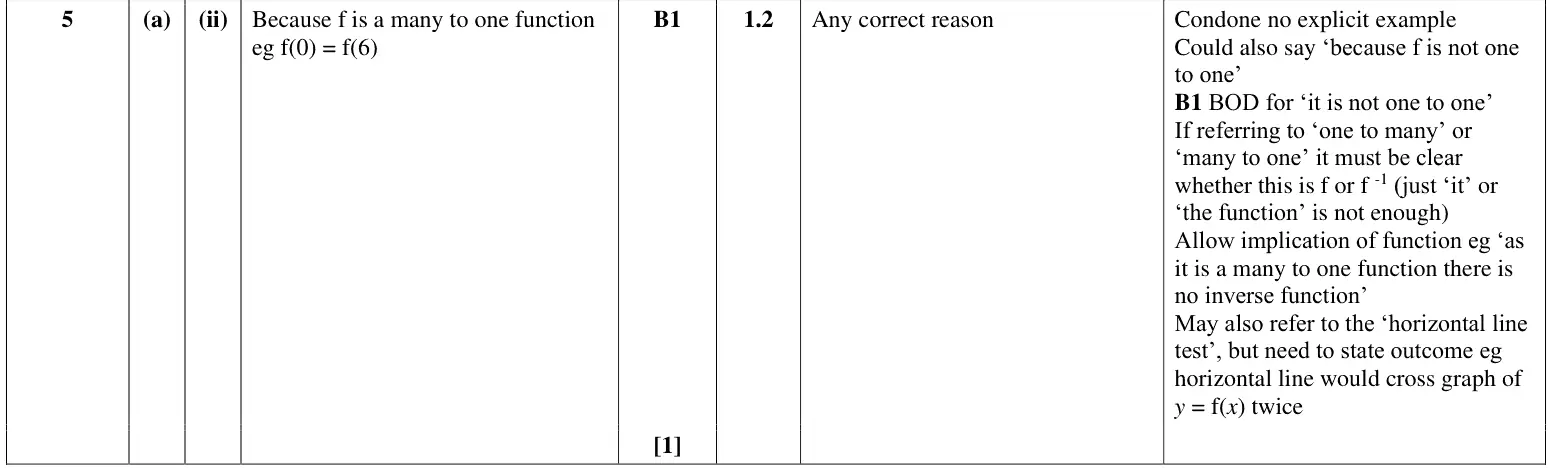
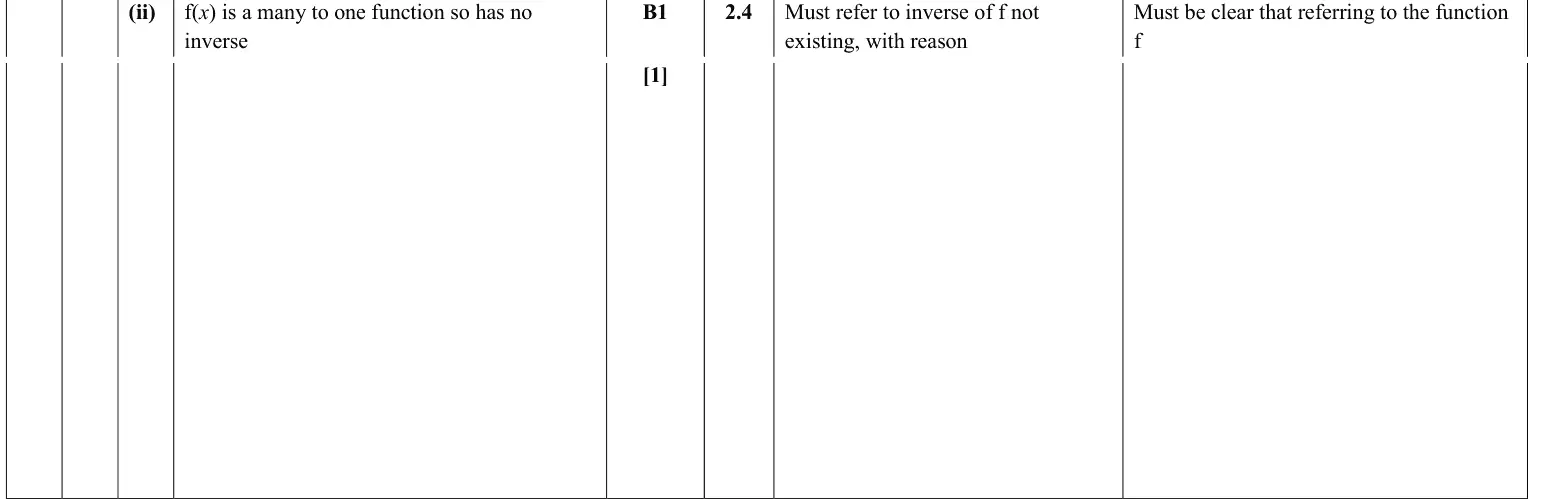
The most convincing explanations referred to f being a many to one solution, sometimes even giving specific coordinates to support this statement. The most common error was a lack of precision in the explanation, simply referring to ‘it’ without explicitly referencing whether this was the function or the inverse function.
Key points and common errors
f is many-to-one (e.g. f(0) = f(6))
must say f not just 'it'
June 2023 · Paper 1 · Q5(b)(i)3 marksMedium
Show the start of this question
Mark scheme for this part
Examiner's comment
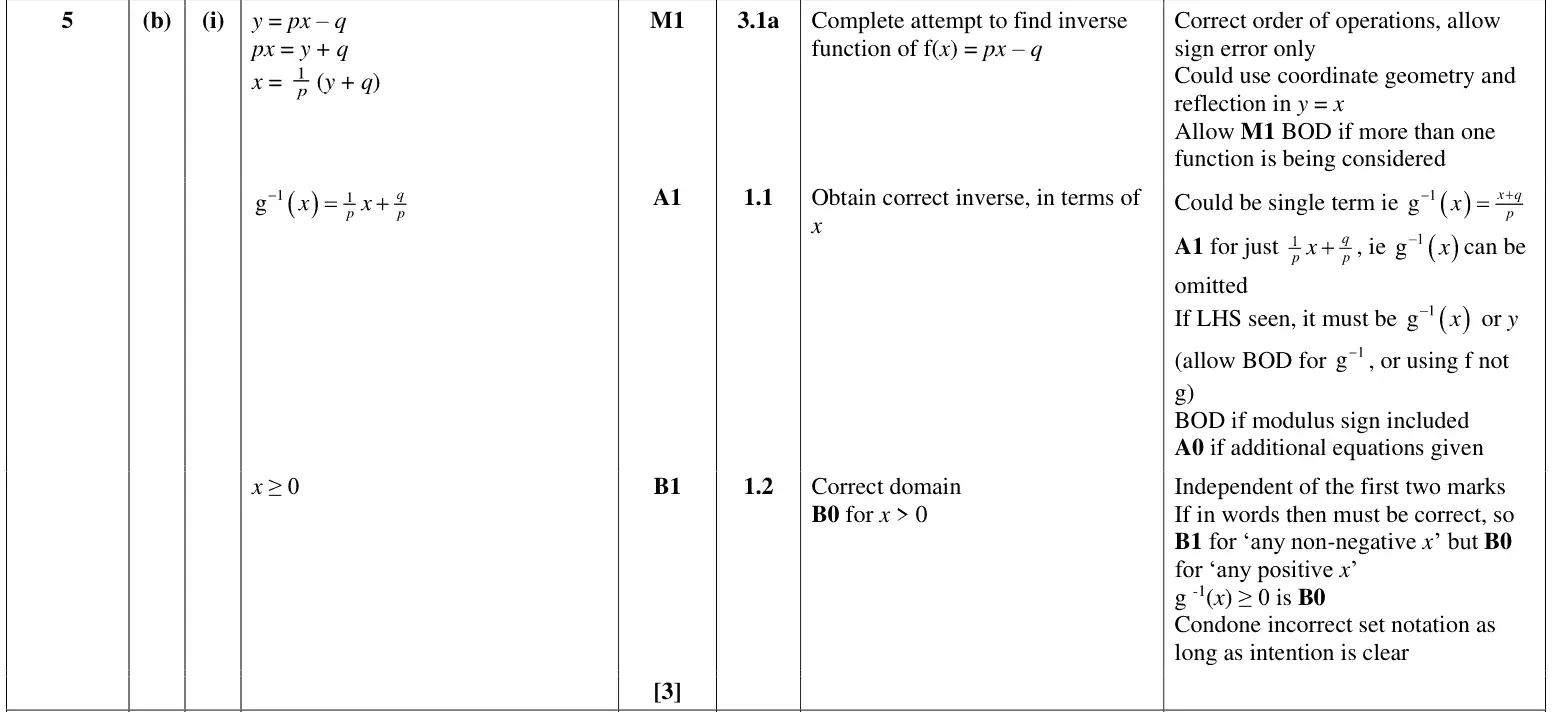
In the more successful responses, candidates identified that the relevant part of the graph was y = px – q, and it was then a routine process to find the inverse function that matched this. Some candidates ignored the domain and considered both parts of the given function, despite the previous part of the question having identified that the inverse of an entire modulus function would not be def ined. Once again some candidates went straight into attempting to square both sides, or even just one side, of the equation as this seemed to be their standard method when working with a modulus function. Candidates also found identifying the domain to be a challenge; most seemed familiar with the range of a function being the domain of the inverse function but were then unsure how to proceed. A few candidates did identify the condition of ≥ 0, but were unsure as to what, if anything, should go on the left hand side of the inequality.
Key points and common errors
for x ≥ q/p, g(x) = px − q
g⁻¹(x) = (x + q)/p with domain x ≥ 0
domain x > 0 is wrong
June 2023 · Paper 1 · Q5(b)(ii)1 markHard
Show the start of this question
Mark scheme for this part
Examiner's comment
There were very few correct solutions seen to this part of the question. These tended to come from considering the relationship between a function, its inverse and the line y = x. Candidates employing a more algebraic approach could sometimes identify the key value of p = 1, but then struggled to identify the required inequality.
Key points and common errors
g and g⁻¹ meet on y = x
no solutions when 0 < p ≤ 1
p < 1 alone is wrong
June 2022 · Paper 2 · Q6(a)4 marksMedium
Mark scheme for this part
Examiner's comment
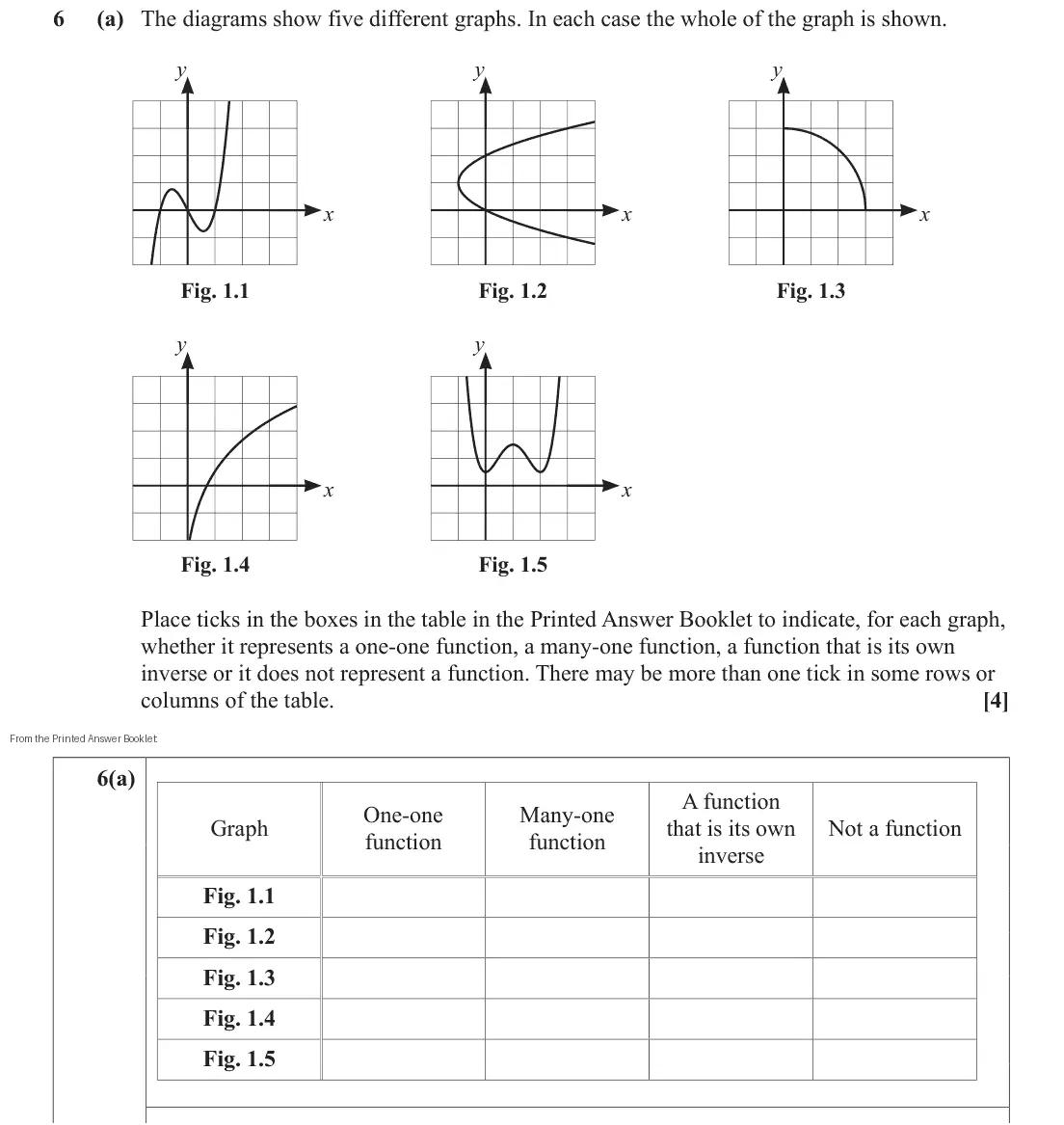
Responses to this question were mixed. The responses for diagrams 1.4 and 1.5 were usually correct. Perhaps the most difficult aspect of the question was identifying the curve that represented a self-inverse function.
Key points and common errors
Fig 1.1 many-one
1.2 not a function
1.3 one-one and self-inverse
1.4 one-one
1.5 many-one
the self-inverse curve was hardest
June 2022 · Paper 3 · Q2(b)2 marksEasy
Show the start of this question
Mark scheme for this part
Examiner's comment
x − 8, While a few candidates either differentiated or found the reciprocal of most knew the correct process of finding the inverse of the given function. The most common error was from those candidates who left their response in terms of y.
Key points and common errors
y + 8 = x³ so f⁻¹(x) = ∛(x + 8)
must be in terms of x
June 2022 · Paper 3 · Q2(c)1 markEasy
Show the start of this question
Mark scheme for this part
Examiner's comment
Most candidates scored the mark for stating that one graph was a reflection of the other graph in the line y = x. The most common errors were those who gave a non-geometrically reason (for example, simply stating that one was the inverse of the other) or did not state the line of reflection.
Key points and common errors
reflection in the line y = x
both 'reflection' and 'y = x' needed
Autumn 2021 · Paper 1 · Q5(a)(iii)1 markMedium
Show the start of this question
Mark scheme for this part
Key points and common errors
inverse reflects in y = x: (6, 2)
Autumn 2021 · Paper 1 · Q8(b)(i)2 marksMedium
Show the start of this question
Mark scheme for this part
Key points and common errors
sec 0.6 = 1.2116 then 2tan(1.2116) = 5.3269
at least one interim value needed
radians
Autumn 2021 · Paper 1 · Q8(b)(ii)1 markMedium
Show the start of this question
Mark scheme for this part
Key points and common errors
f is many-one on 0 ≤ x ≤ 2π so f⁻¹ does not exist
Autumn 2020 · Paper 3 · Q3(b)1 markMedium
Show the start of this question
Mark scheme for this part
Examiner's comment
(Comment on Question 03 as a whole) There were some excellent responses to this question, although some candidates dropped marks for errors in the notation used. Those candidates that used completing the square in part (a) were generally more successful than those that used calculus. A significant number did not gain the final accuracy mark due to incorrectly stating 9 9 rather than correctly stating the range of the function ( ) x ≥− f x ≥− . 2 2 Some candidates appeared to misunderstand the concept of range, finding the roots by factorising to ( ) 2 x x + 3 to then incorrectly conclude that 3 x ≥ In part (b) there were unfortunately a number of vague answers provided starting ‘It is …’. Examiners cannot be expected to know what the ‘it’ is that the candidate is talking about; answers need to be explicit, either in words or as part of an annotated diagram. ( ) Most candidates started part (c) successfully and found the expression for g a . Some candidates introduced errors, or just wasted some exam time, producing an initial algebraic form for the composite f g x rather than substituting their numerical answer to ( ( ) ) into ( ) function g − 2 f x . Part (d) included the request to give their final answer in set notation. The ‘Determine’ request meant that the method mark was for clear and accurate algebraic manipulation into the standard three term quadratic. There is an assumption that candidates would solve quadratic equations by inspection or by using the solve function on their calculator, the command word just signals that the mathematical argument must be evident. The majority of candidates scored these initial 2 marks, but a significant number struggled with giving their result in correct set notation format.
Key points and common errors
f is not one-one (many-one)
vague answers starting 'It is…' not credited
Autumn 2020 · Paper 3 · Q3(c)4 marksMedium
Show the start of this question
Mark scheme for this part
Examiner's comment
(Comment on Question 03 as a whole) There were some excellent responses to this question, although some candidates dropped marks for errors in the notation used. Those candidates that used completing the square in part (a) were generally more successful than those that used calculus. A significant number did not gain the final accuracy mark due to incorrectly stating 9 9 rather than correctly stating the range of the function ( ) x ≥− f x ≥− . 2 2 Some candidates appeared to misunderstand the concept of range, finding the roots by factorising to ( ) 2 x x + 3 to then incorrectly conclude that 3 x ≥ In part (b) there were unfortunately a number of vague answers provided starting ‘It is …’. Examiners cannot be expected to know what the ‘it’ is that the candidate is talking about; answers need to be explicit, either in words or as part of an annotated diagram. ( ) Most candidates started part (c) successfully and found the expression for g a . Some candidates introduced errors, or just wasted some exam time, producing an initial algebraic form for the composite f g x rather than substituting their numerical answer to ( ( ) ) into ( ) function g − 2 f x . Part (d) included the request to give their final answer in set notation. The ‘Determine’ request meant that the method mark was for clear and accurate algebraic manipulation into the standard three term quadratic. There is an assumption that candidates would solve quadratic equations by inspection or by using the solve function on their calculator, the command word just signals that the mathematical argument must be evident. The majority of candidates scored these initial 2 marks, but a significant number struggled with giving their result in correct set notation format.
Key points and common errors
g⁻¹(a) = (a − 2)/3
fg(−2) = f(−4) = 8
a = 26
substitute numbers rather than forming fg(x)
June 2019 · Paper 1 · Q3(a)1 markHard
Mark scheme for this part
Examiner's comment
The more able candidates appreciated that the domain had to be restricted as f(x) had to be a one to one function, and were able to write down the value of k with ease. However, many candidates seemed unsure as to how to proceed, with the most common error being to solve f(x) = 0.
Key points and common errors
f⁻¹ exists only if f is one-one: domain starts at the vertex, k = 3
common error solving f(x) = 0
June 2019 · Paper 1 · Q3(b)2 marksHard
Show the start of this question
Mark scheme for this part
Examiner's comment
The most efficient method was to first find f(5); those candidates who first attempted at algebraic expression for ff(x) were rarely successful. Having found that f(5) = –13, candidates were expected to observe that this was outside the domain and hence ff(5) was undefined, and more astute candidates did indeed give this solution. However the subtlety of the question, combined with a number of incorrect solutions to part (a), meant that this was missed by many who simply gave their final answer as 239. This approach was condoned as a special case when marking.
Key points and common errors
f(5) = −13 is outside the domain so ff(5) is not defined
239 given by many (special case)
June 2019 · Paper 1 · Q3(c)3 marksMedium
Show the start of this question
Mark scheme for this part
Examiner's comment
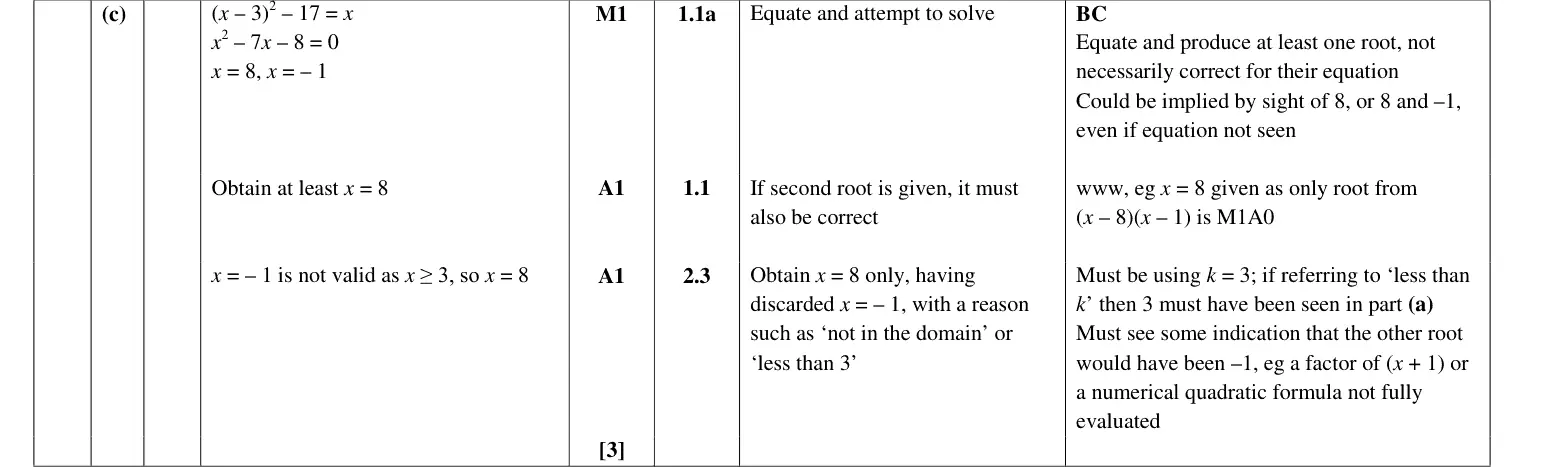
Most candidates were able to gain two marks for setting up and solving the relevant equation, but only a minority of the candidates gained the final mark for discarding x = –1, noting that it was outside the domain.
Key points and common errors
x² − 7x − 8 = 0 gives x = 8 or −1
reject −1 as outside the domain x ≥ 3
only a minority did
June 2019 · Paper 1 · Q3(d)1 markMedium
Show the start of this question
Mark scheme for this part
Examiner's comment
Some candidates were able to give clear and concise explanations about the two functions being reflections in y = x and thus intersecting on this line; but a number of explanations lacked precision.
Key points and common errors
f and f⁻¹ are reflections in y = x so they meet on y = x
explanations often lacked precision
June 2018 · Paper 1 · Q9(ii)4 marksEasy
Mark scheme for this part
Examiner's comment
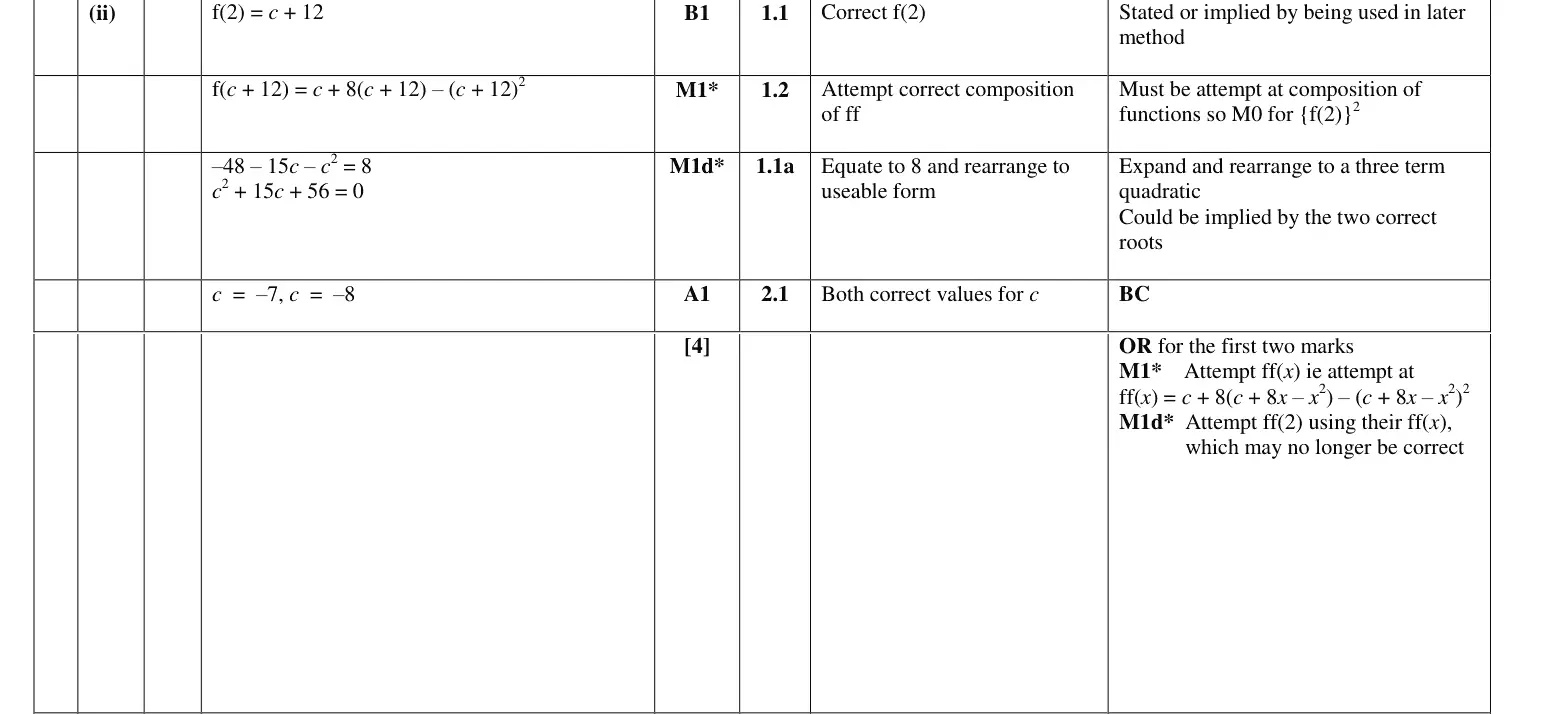
All candidates understood the meaning of ff(2) and were able to attempt the correct process for the composition of functions. The more successful method was to first find f(2), simplify this to c + 12 and then attempt f(c + 12). Candidates who attempted to find ff(x) before substituting x = 2 were more likely to make mistakes when simplifying their algebraic expression. It was expected that candidates would use their calculators to solve the quadratic equation, but the vast majority instead showed full detail of the method used.
Key points and common errors
f(2) = c + 12 then f(c + 12) = 8
c² + 15c + 56 = 0
c = −7, −8
June 2018 · Paper 3 · Q4(i)(a)1 markEasy
Mark scheme for this part
Examiner's comment
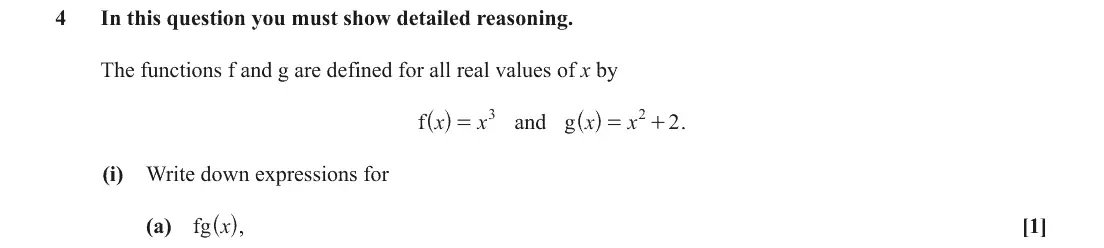
(Comment on Question 04(i) as a whole) Nearly all candidates correctly found the composite function fg(x) as ( ) x + 2 although a number did expand the bracket in this part. Candidates are reminded that the number of marks available for a question or part-question are the best indicators to the amount of working and detail that is required. Once again this was nearly always done correctly with the most common errors being those minority of candidates who stated that ( ) x was equal to either x or x .
Key points and common errors
fg(x) = (x² + 2)³
expansion not needed for 1 mark
June 2018 · Paper 3 · Q4(i)(b)1 markEasy
Mark scheme for this part
Examiner's comment
(Comment on Question 04(i) as a whole) Nearly all candidates correctly found the composite function fg(x) as ( ) x + 2 although a number did expand the bracket in this part. Candidates are reminded that the number of marks available for a question or part-question are the best indicators to the amount of working and detail that is required. Once again this was nearly always done correctly with the most common errors being those minority of candidates who stated that ( ) x was equal to either x or x .
Key points and common errors
gf(x) = (x³)² + 2 = x⁶ + 2
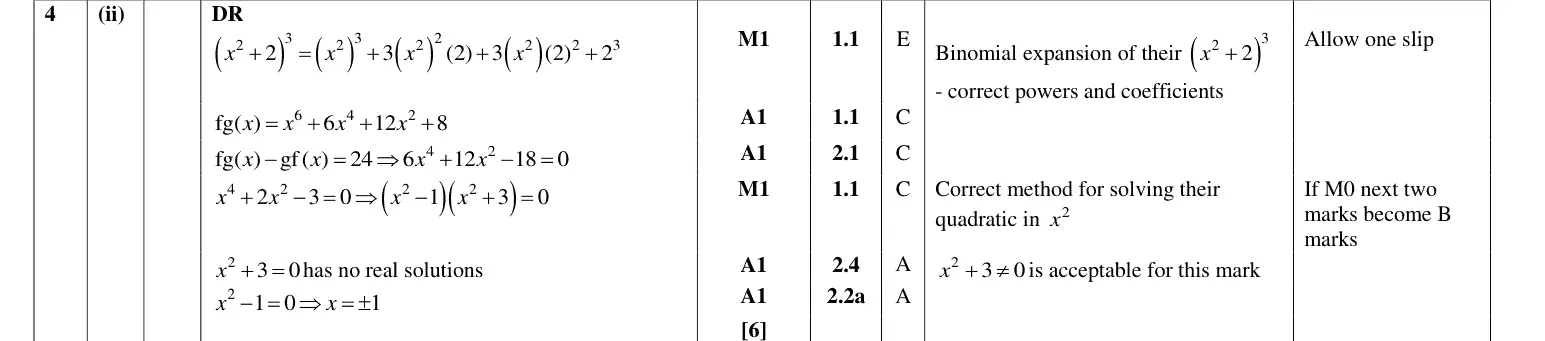
June 2018 · Paper 3 · Q4(ii)6 marksMedium
Show the start of this question
Mark scheme for this part
Examiner's comment
There were a significant number of candidates that did not employ correct bracketing and mistakenly wrote( ) rather than( ) ( ) ( ) x + 2 − x + 2 = 24 x + 2 − x + 2 = 24 ⇒ x + 2 − x − 2 = 24 . The majority of candidates went for expanding ( ) x + 2 by writing out the bracket three times rather than using the binomial expansion of ( a + b ) . While the majority rearranged their quartic into the form ( ) + 6 x 12 x − 18 = 0 there were a number of candidates did not show sufficient working in solving this quartic, even though the full question required detailed reasoning. Finally, it is expected at this level that as part of the detailed reasoning candidates should justify why x + 3 = 0 did not provide any solutions.
Key points and common errors
expand (x² + 2)³ = x⁶ + 6x⁴ + 12x² + 8
brackets needed when subtracting gf(x)
6x⁴ + 12x² − 18 = 0
(x² − 1)(x² + 3) = 0
reject x² = −3 explicitly
x = ±1
Find an A-level maths tutor
Stuck on this? Book a trial session with an A-level maths tutor.