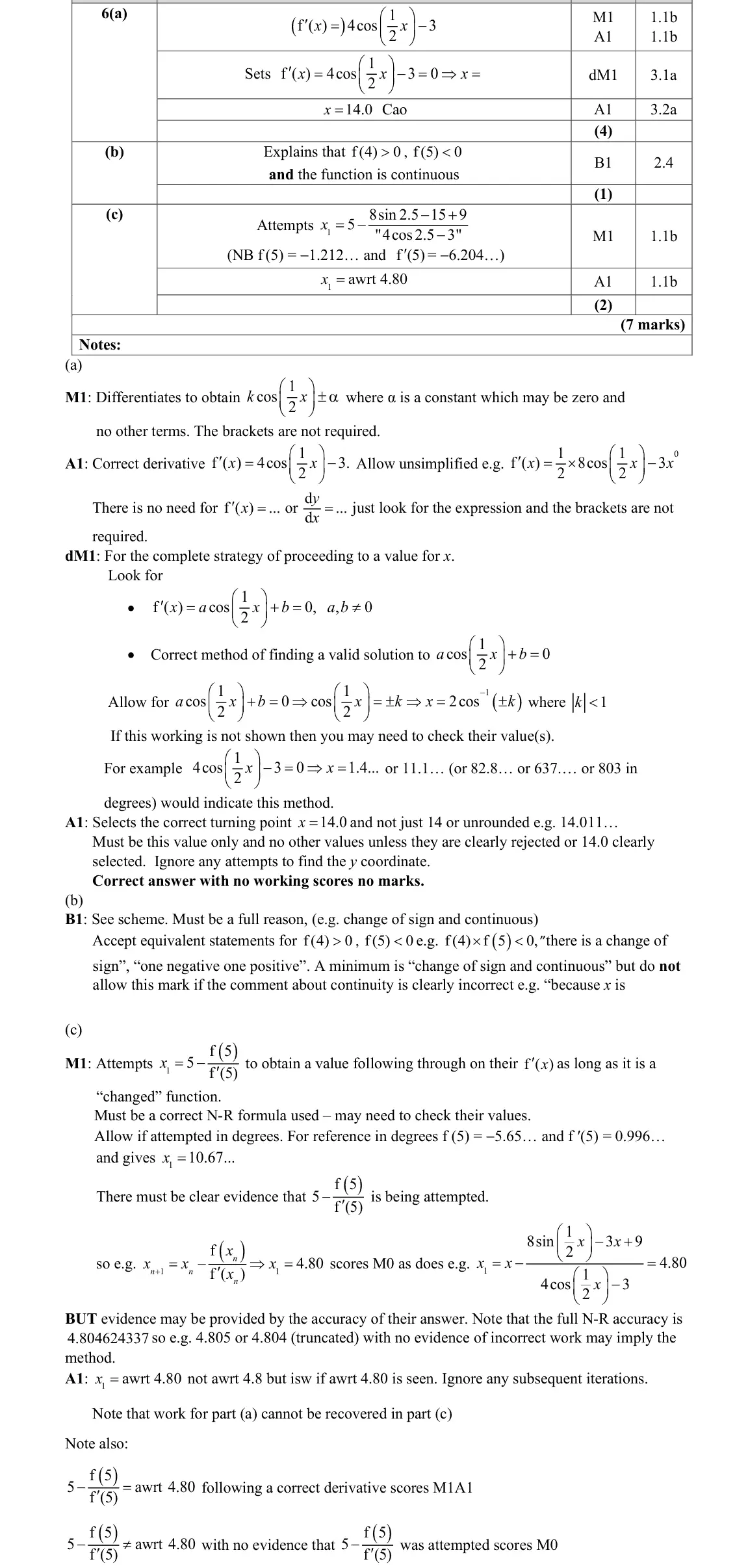
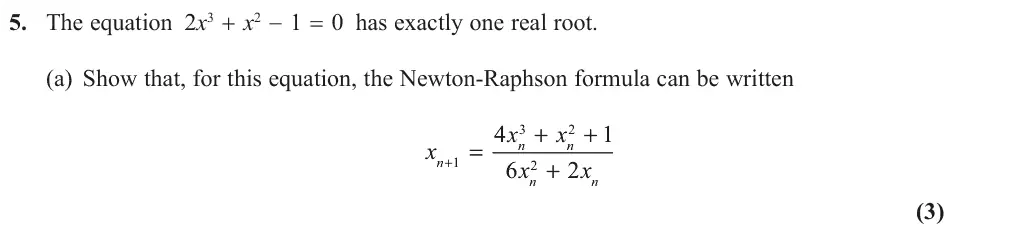
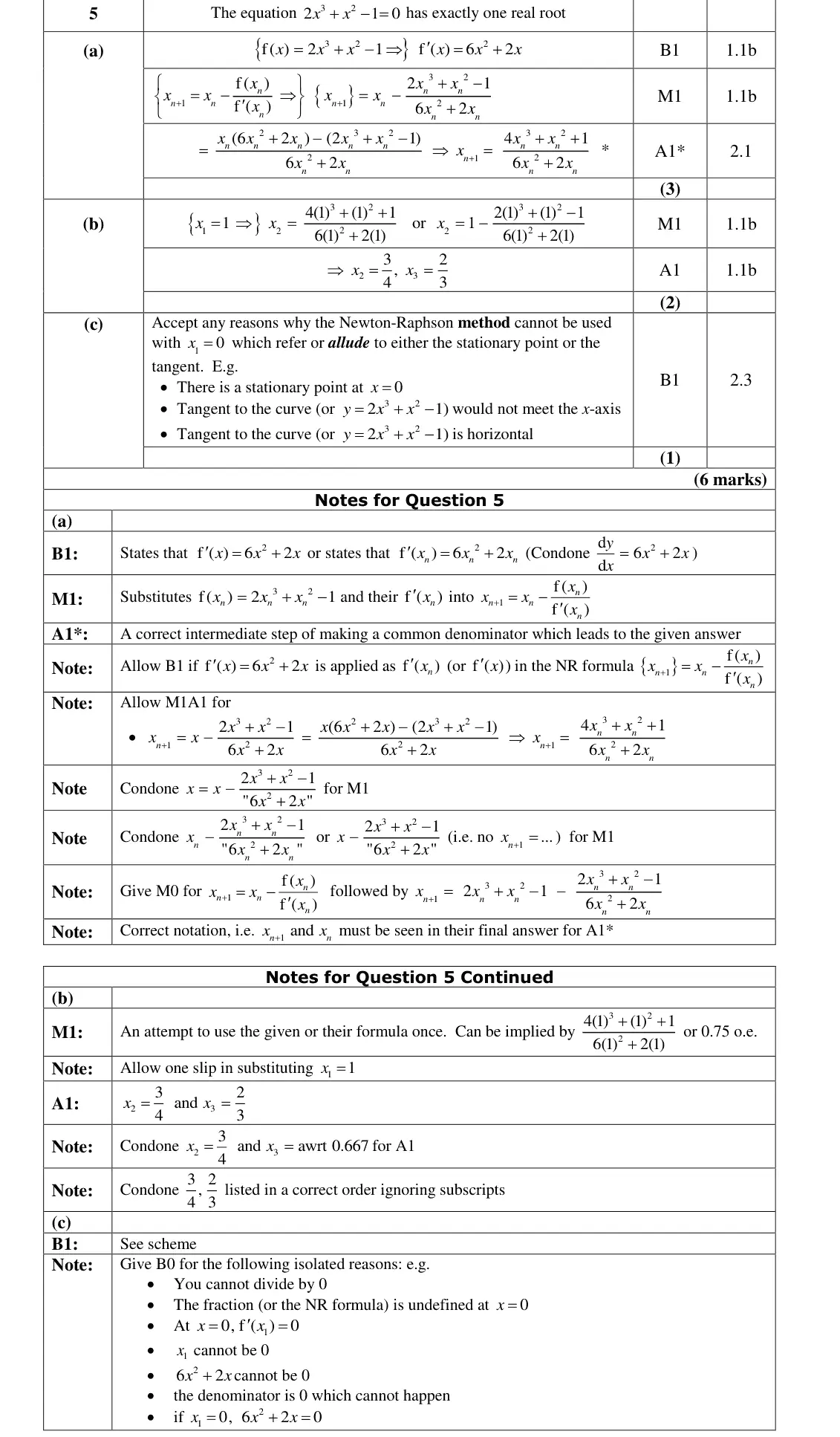
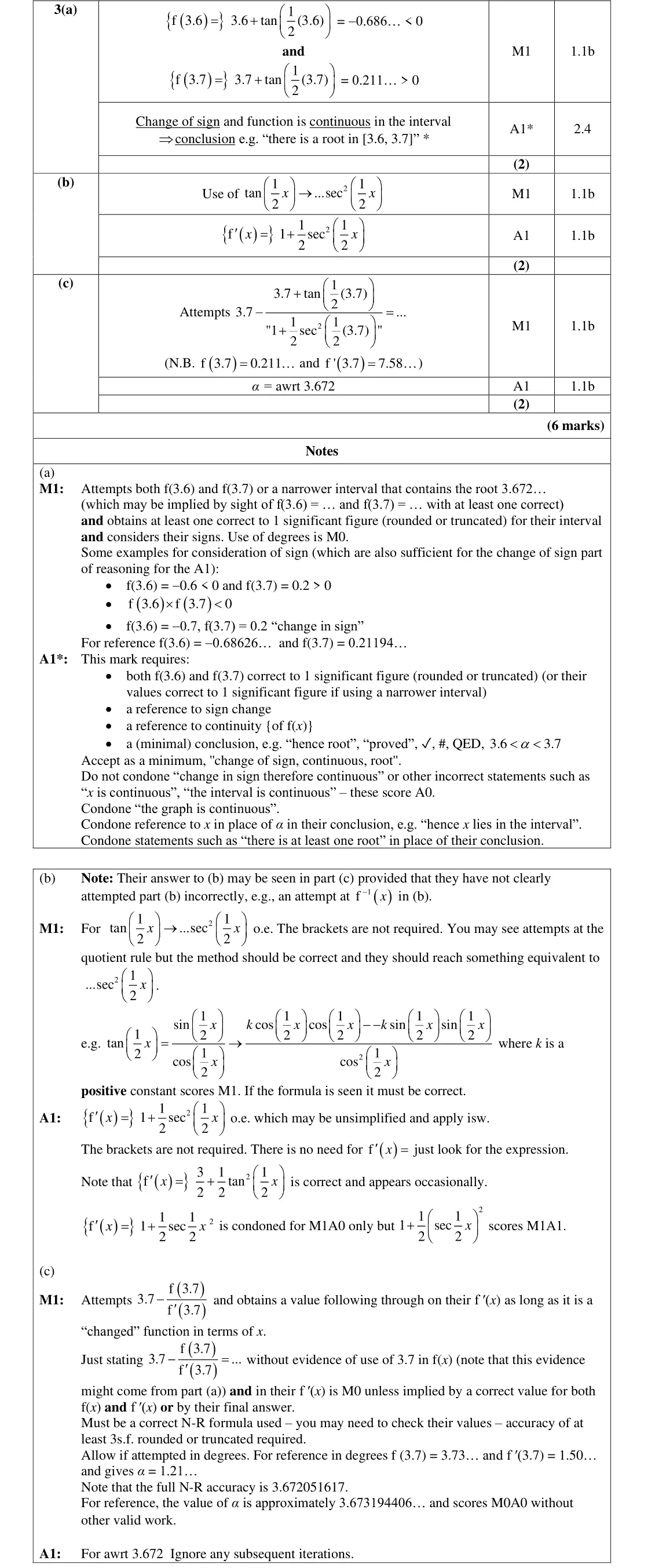
Mark scheme (whole question; this part is marked with the orange bar)
Examiner's comment
Many candidates were successful across all parts of this question demonstrating a good understanding of the Newton Raphson method, but this question did start to discriminate between the least confident and those who were more careful in their processing. Incorrect derivatives were occasionally seen, and candidates should be advised to refer to the derivative of tan(kx) provided in the formula booklet. A common error was forgetting to differentiate the x to 1 or losing it entirely. There were some attempts at integrating and unfortunately some misread (or misinterpreted) the notation and attempted to find the inverse of the function. These responses were unable to score any marks in part (b), even if they went on to differentiate in part (c). Candidates who converted 1 tan 2 x to 1 sin 2 1 cos 2 x x were generally not successful at applying the quotient rule correctly. Candidates had varying degrees of success in part (c). The Newton-Raphson formula was generally well quoted or used, however, difficulty evaluating 2 3.7 sec 2 led to the accuracy mark being lost. Evidence of substitution into the formula was inconsistent across the cohort, with some clearly showing the substitution and some leaving it to the examiner to try to establish what they had done. Those that did not explicitly show the substitution of 3.7 in f(x) and ( ) f ' x often made calculation errors and thus scored no marks in this part. Candidates are encouraged to show their substitution into the formula (not just stating ( ) ( ) f 3.7 3.7 f 3.7 - ) for this reason. Those candidates who did not obtain a correct derivative in part (b) were still able to achieve the method mark for using the Newton-Raphson formula correctly with their derivative. Those that did not differentiate in part (b) were able to go on and score both marks in part (c) if they restarted the differentiation at this stage.
Common mistakes
- x₂ = 3.7 − f(3.7)/f′(3.7) in radians
- evaluating sec²(1.85) is a common slip
- awrt 3.672