e.g. To determine the forces acting on a horizontal beam or to determine the forces acting on a ladder resting on horizontal ground against a vertical wall. Questions will be set in which the context of the problem can be modelled using rectangular laminas, uniform and non-uniform rods only. Learners may assume that: 1. for a uniform rod the weight acts at the midpoint of the rod, 2. for a non-uniform rod the weight acts at either a specified given point or is to be determined by moments, 3. for a rectangular lamina the weight acts at its point of symmetry.
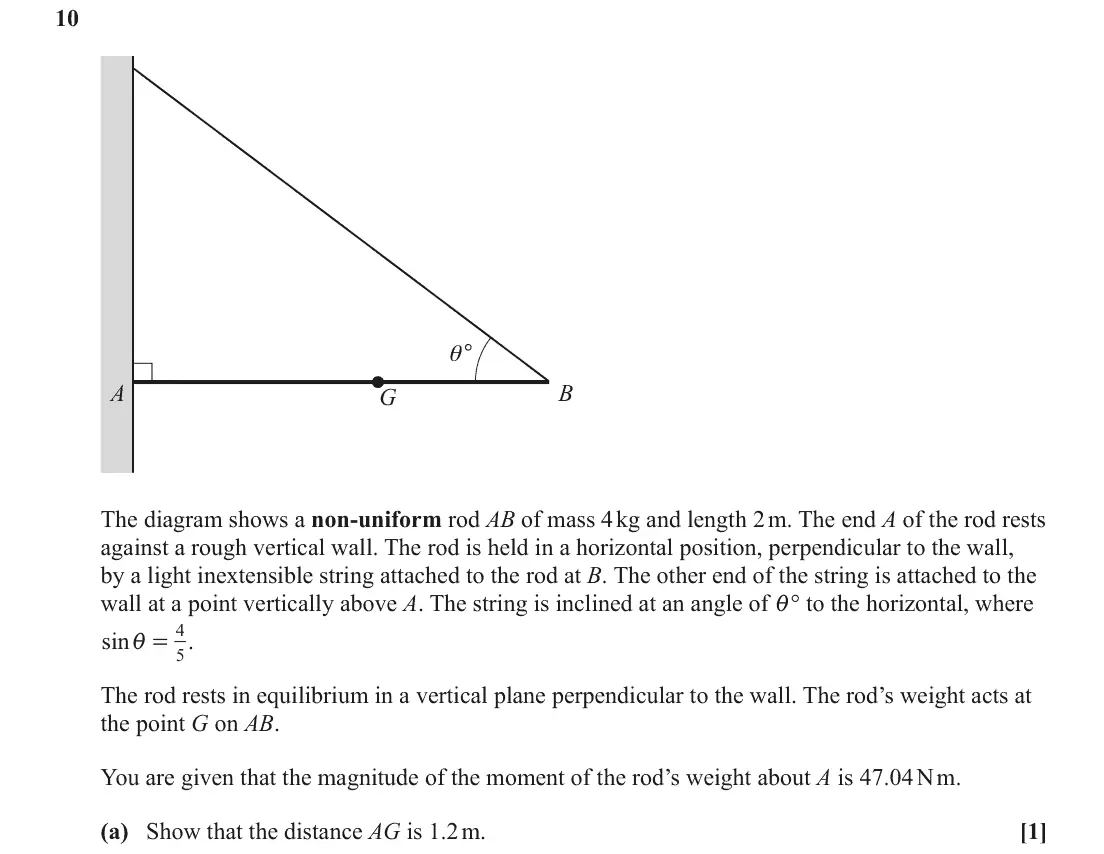
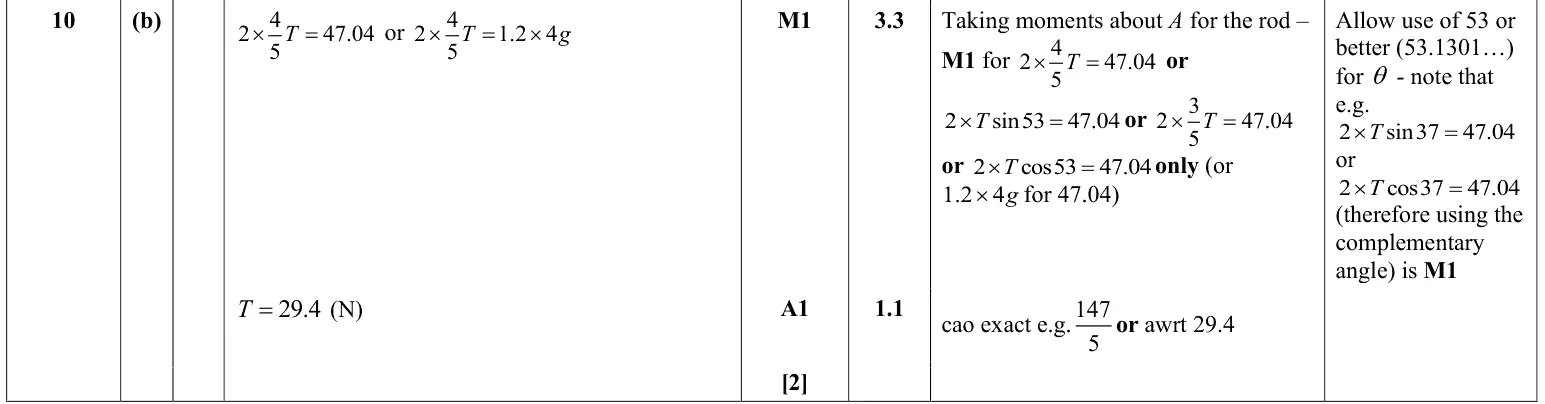
While most candidates seem to realise that the most effective way of finding the tension in the string was to take moments about A, many forgot to include a distance or used a wrong angle.
Key points and common errors
moments about A: 2 × T × 4/5 = 47.04 so T = 29.4 N
missing distance or wrong angle
June 2024 · Paper 3 · Q11(a)4 marksHard
Mark scheme for this part
Examiner's comment
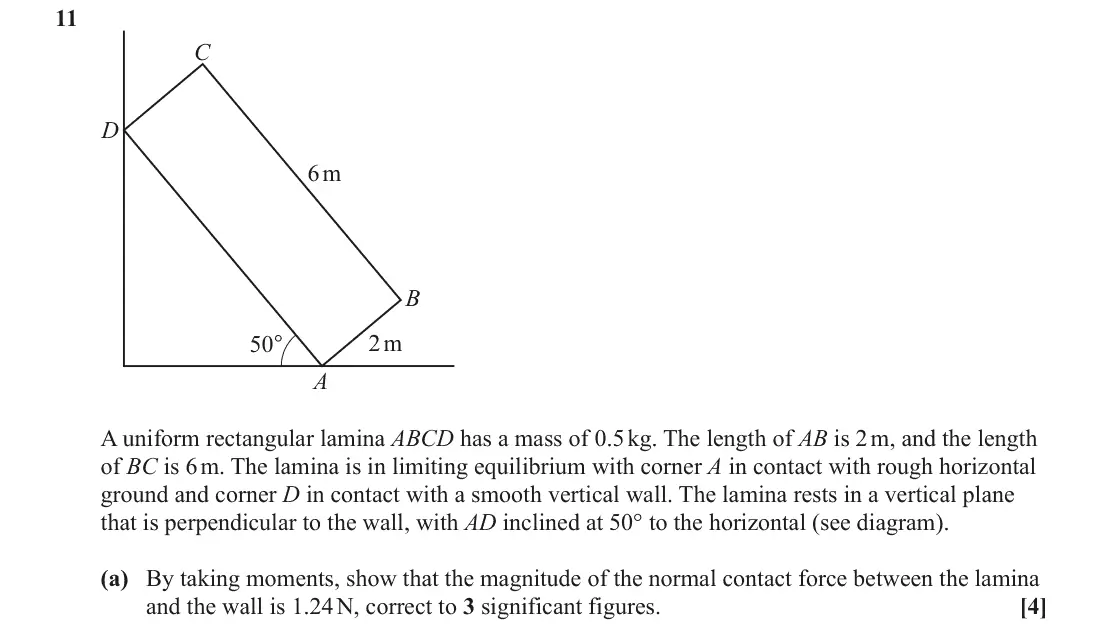
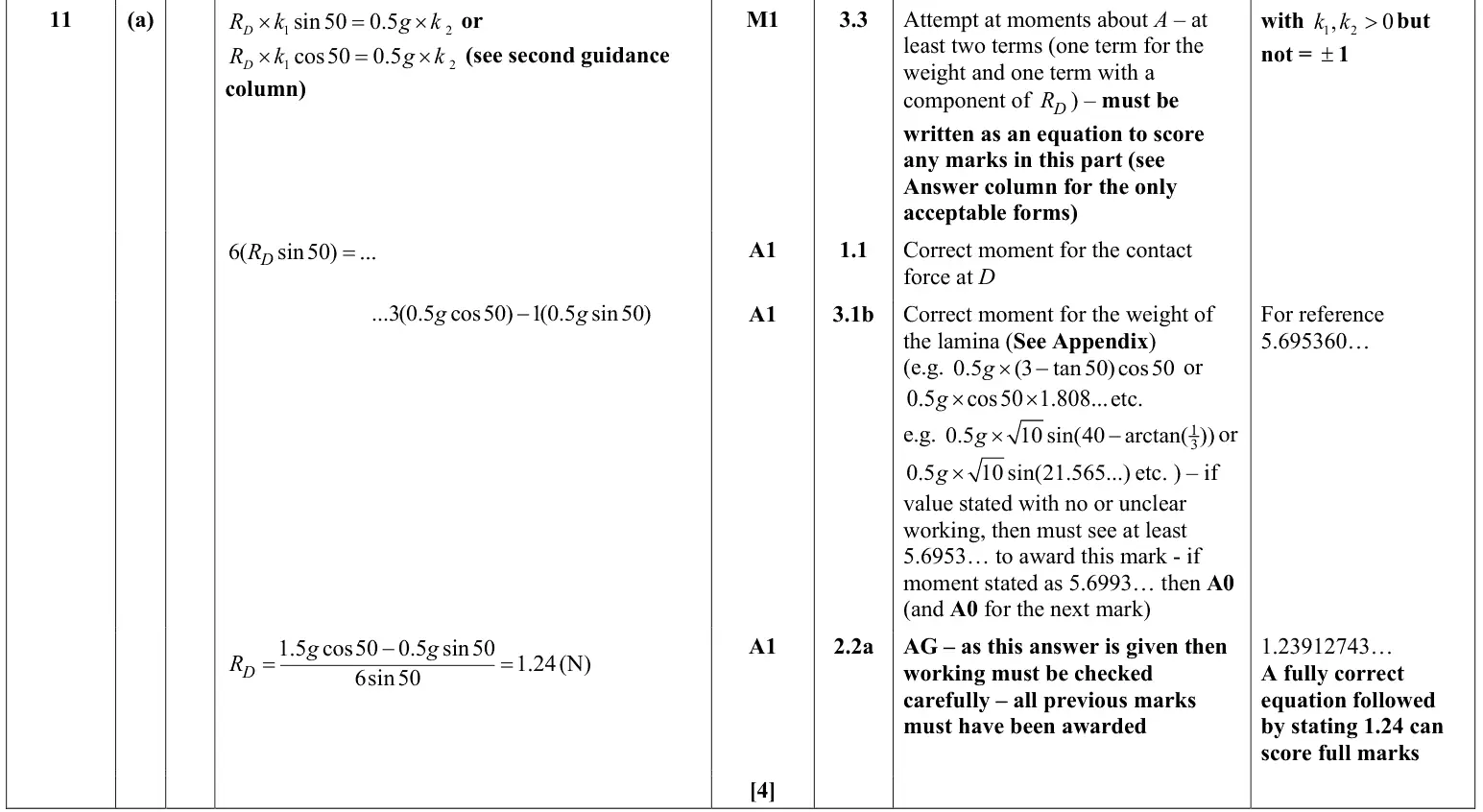
Although most candidates realised that the way to find the magnitude of the normal contact force acting on the lamina at 𝐵 was to take moments about point 𝐴, many struggled with the corresponding geometry of the situation. Although most correctly realised that the expression for the moment of the normal contact force was given by 𝑅𝐷× (6sin50), almost all could not deal correctly with the corresponding moment for the weight. The most efficient way of considering this moment was to resolve the weight in directions parallel and perpendicular to the sides of the lamina (and hence obtain the moment as 3 × (0.5𝑔cos 50) −1 × (0.5𝑔× sin50)).
Key points and common errors
moments about A: R_D × 6sin50 = 0.5g(3cos50 − sin50)
R_D = 1.24 N
the moment arm of the weight was the main difficulty
June 2023 · Paper 3 · Q11(a)3 marksHard
Mark scheme for this part
Examiner's comment
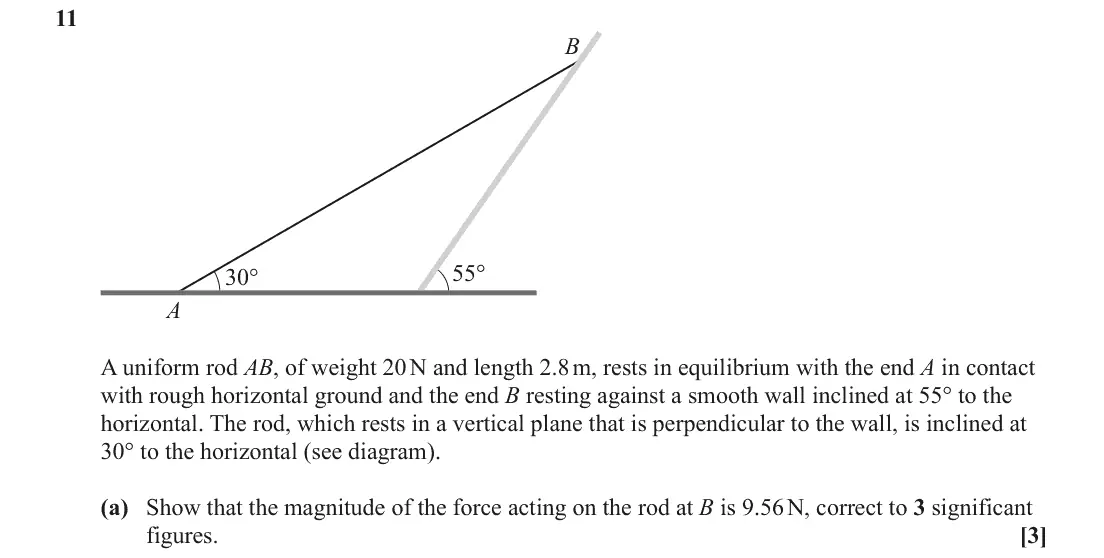
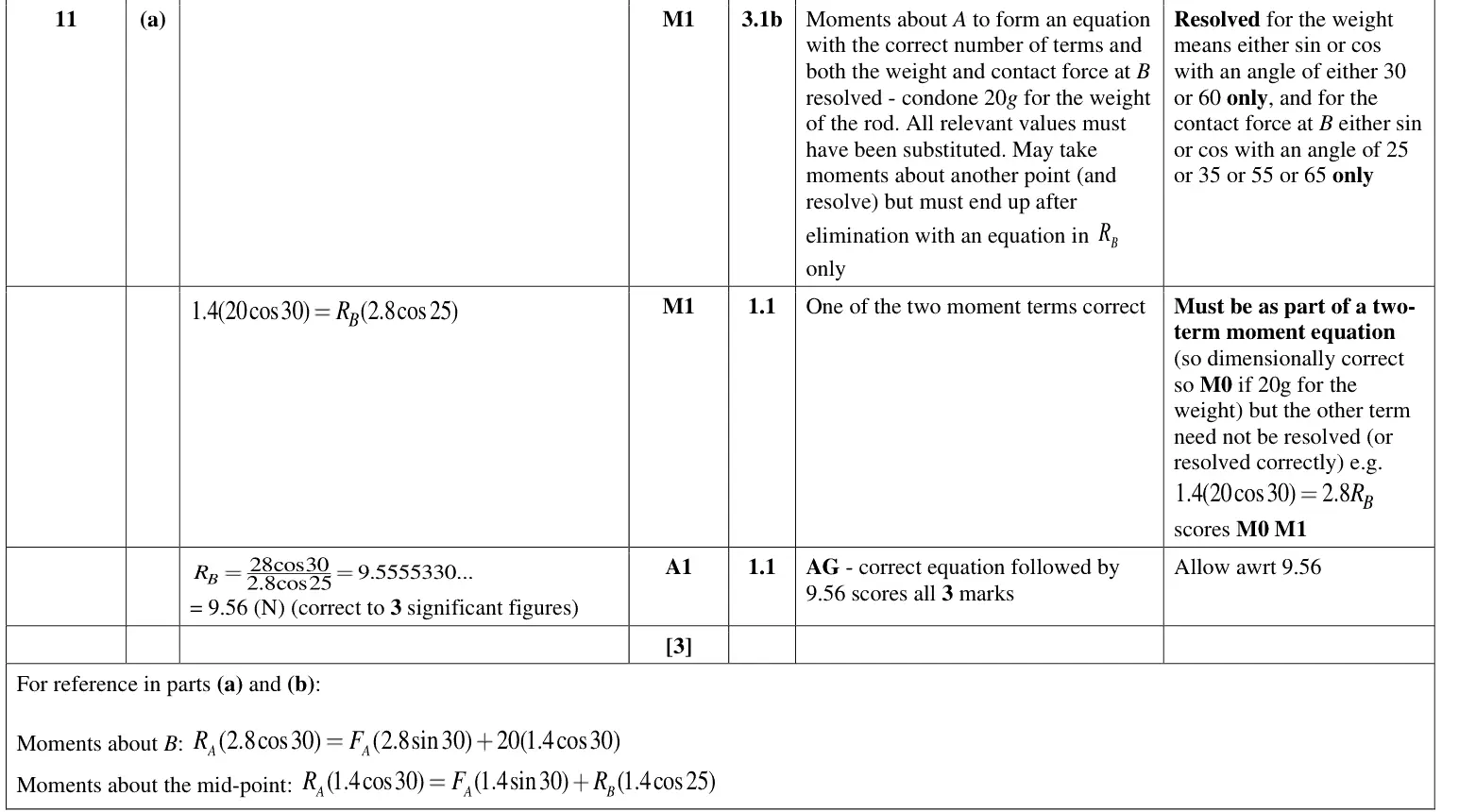
Although most candidates realised that the best way to find the magnitude of the force acting on the rod at B was to take moments about point A, many struggled with the corresponding geometry of the was given by 1.4(20cos30), most could not deal with the corresponding moment for the force acting at B situation. Although most candidates correctly realised that the expression for the moment of the weight with many having either an angle of 30, 60, 35 or 55.
Key points and common errors
moments about A: 1.4 × 20cos30° = R_B × 2.8cos25°
R_B = 9.56 N
reaction at B is perpendicular to the wall so the angle with AB is 65°/25°
wrong angles 30, 60, 35, 55
June 2022 · Paper 3 · Q11(a)3 marksMedium
Mark scheme for this part
Examiner's comment
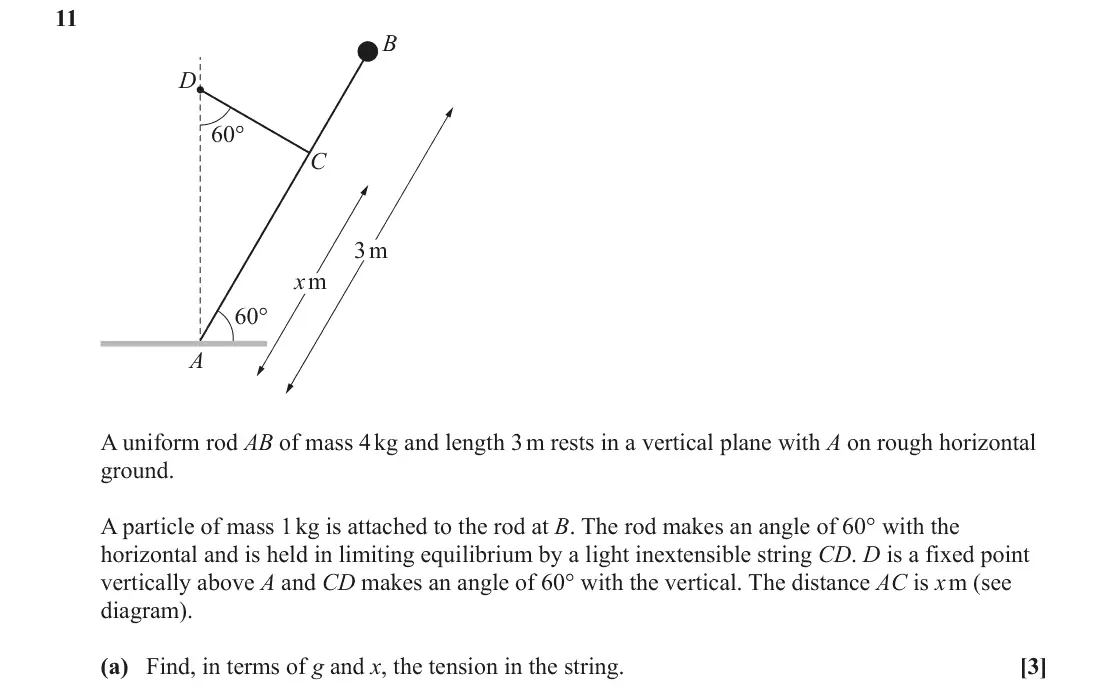
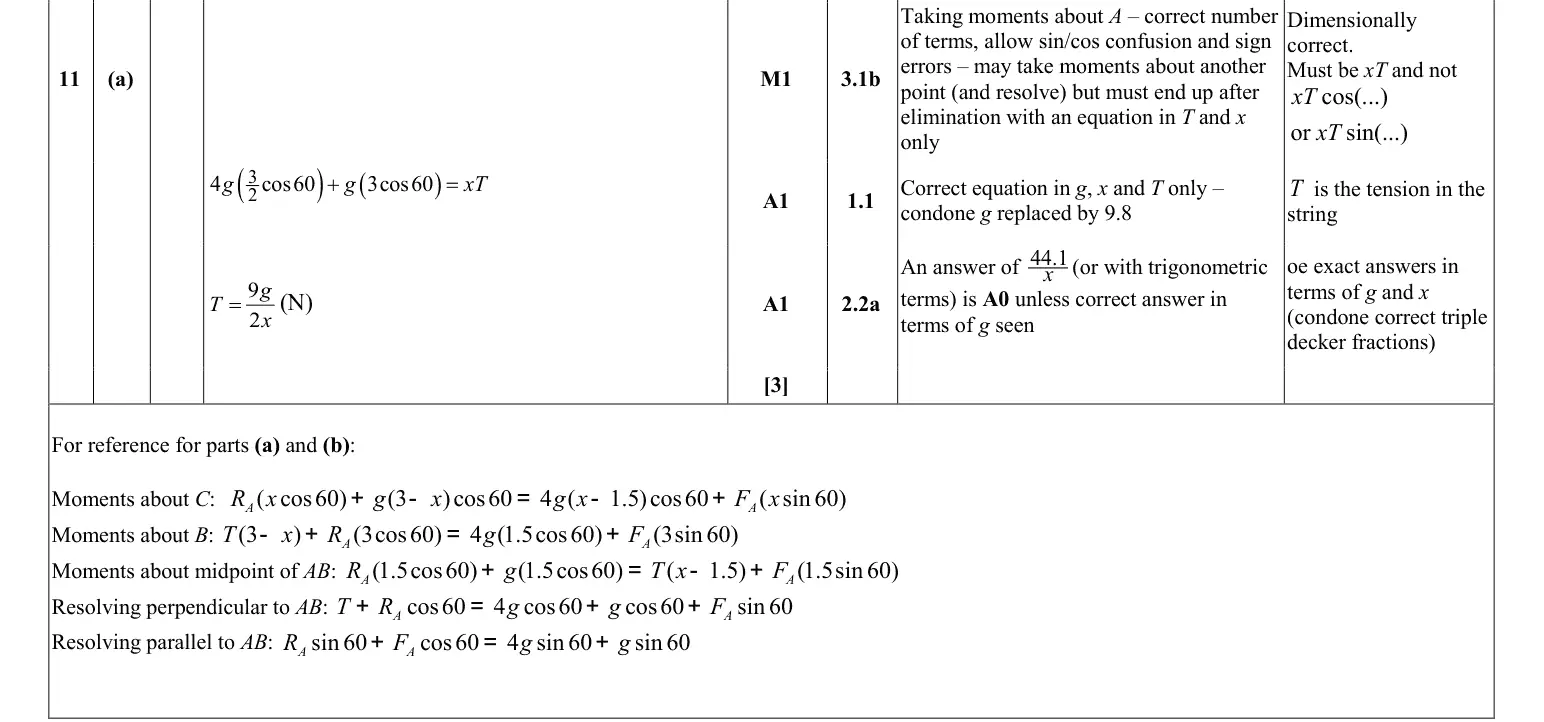
Although most candidates realised that the best way to find the tension in the string was to take moments about point A for the rod, many struggled with the corresponding geometry of the situation. ( ) ( ) xT = 4 g cos60 + g 3cos60 Although many did obtain the correct equation a number of candidates left their response either in terms of cos(60) or gave their response as 44.1 even though the question x specifically asked for a response in terms of g and x.
Key points and common errors
moments about A: 4g(1.5cos60°) + g(3cos60°) = xT
T = 9g/(2x)
answer in terms of g and x
Autumn 2021 · Paper 3 · Q12(a)5 marksMedium
Mark scheme for this part
Key points and common errors
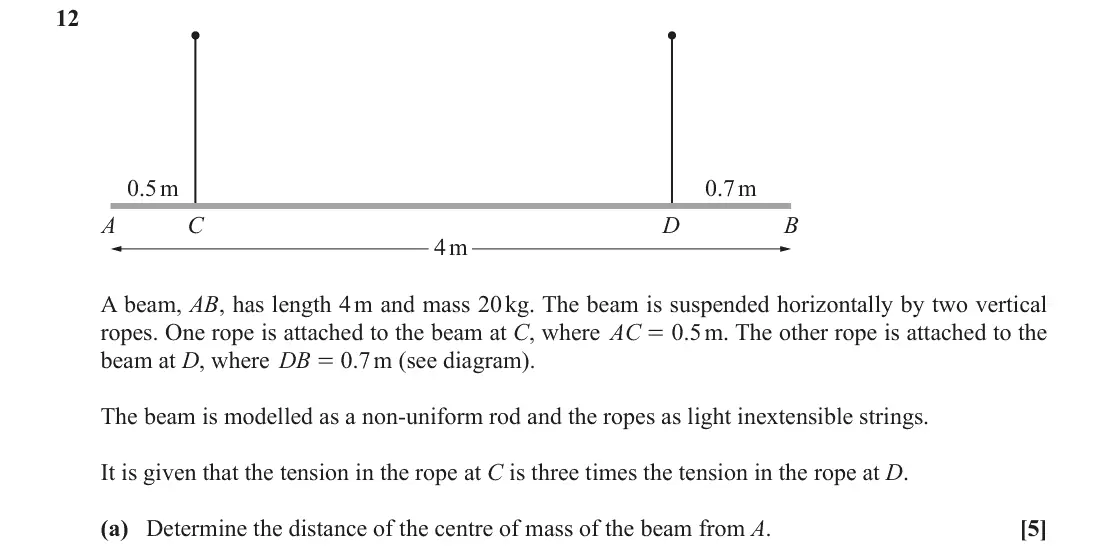
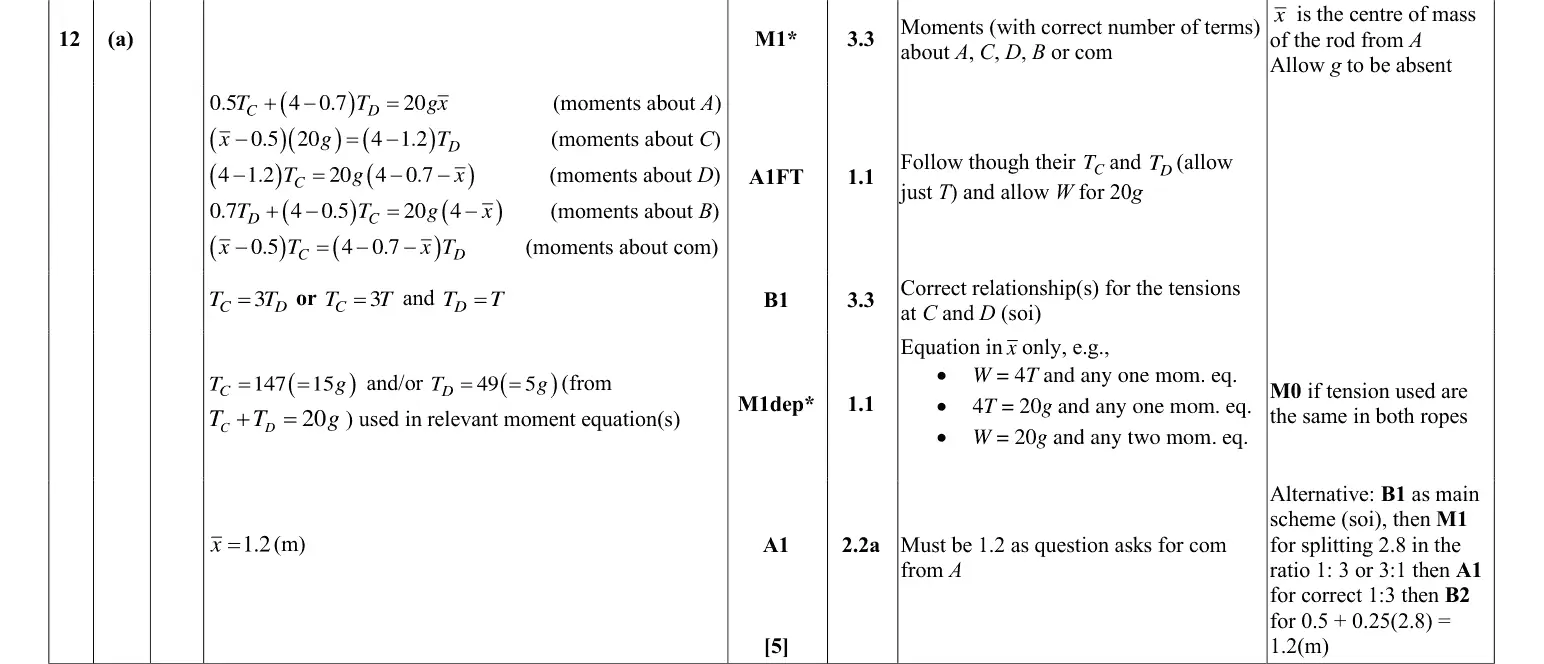
T_C = 3T_D and T_C + T_D = 20g
take moments
non-uniform rod so centre of mass x̄ = 1.2 m from A
equal tensions get M0
Autumn 2021 · Paper 3 · Q12(b)2 marksHard
Show the start of this question
Mark scheme for this part
Examiner's comment
This was found to be the most demanding part of the paper. Most candidates did not realise that as the question asked for the largest possible value of m the most efficient way of finding this was to take moments about D as the tension in the rope at C would be zero. Most candidates who took moments about C still assumed the information about the relationship between the tensions in the two ropes from the stem to (a) still applied instead of realising that the tension in D would now be of magnitude 20 g mg .
Key points and common errors
largest m when tension at C is zero
moments about D: 0.7mg = 20g(4 − 1.2 − 0.7)
m = 60
many wrongly kept T_C = 3T_D
Autumn 2020 · Paper 3 · Q10(a)4 marksMedium
Mark scheme for this part
Examiner's comment
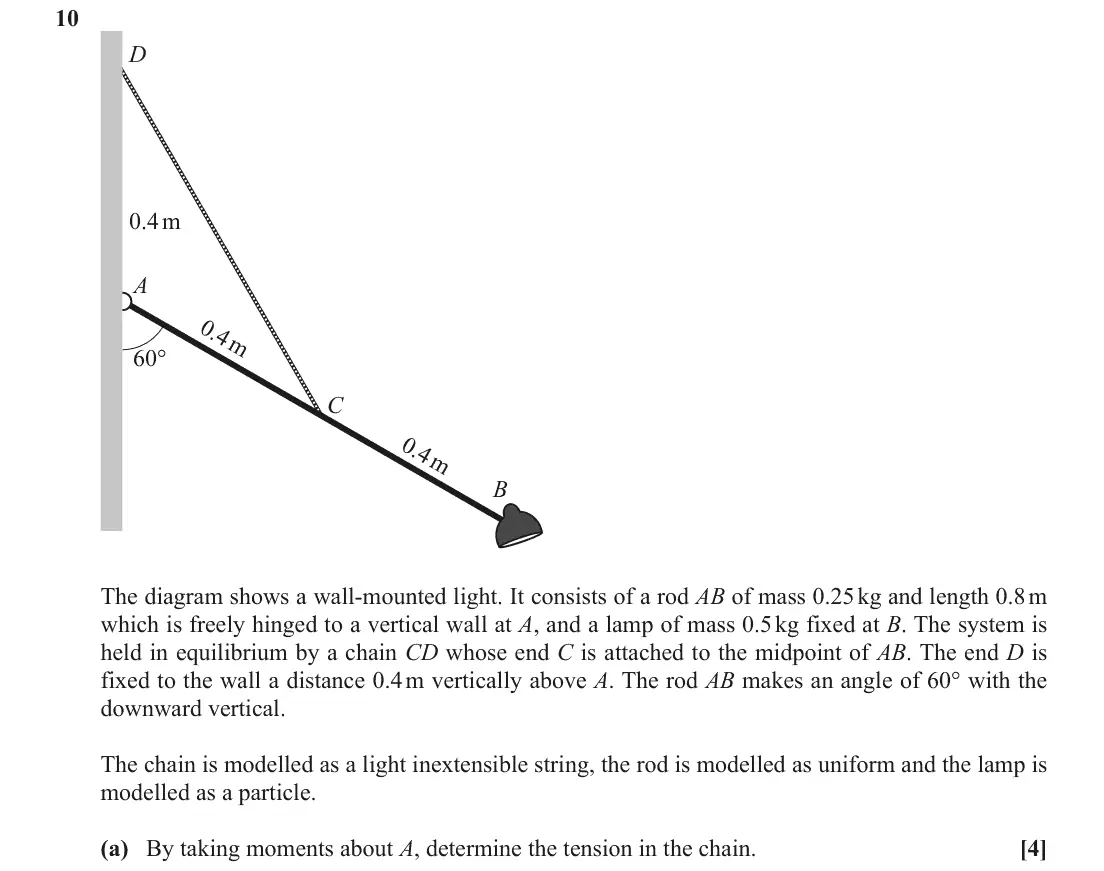
(Comment on Question 10 as a whole) A significant number of candidates did not follow the instruction to take moments about point A in part (a). It was also common to see candidates use mass rather than weight or miss some of the terms. Mixing sine and cosine was also common. In part (b) (i) it was mathematically easier to work with vertical and horizontal components of the force exerted on the rod at A rather than components parallel and perpendicular to the rod. Candidates that picked up marks on this question generally provided an annotated sketch with some degree of success. Part (b) (ii) was generally answered well by those that attempted it from their work on part (b) (i). However, of those, a few did not score both marks due to not clearly indicating what their angle was measured from (below the horizontal or measured from the downward vertical).
Key points and common errors
moments about A: 0.4(0.25g sin 60°) + 0.8(0.5g sin 60°) = T(0.4 sin 30°)
T = 21.2 N
must use weights
many did not take moments about A
Autumn 2020 · Paper 3 · Q10(c)1 markMedium
Show the start of this question
Mark scheme for this part
Examiner's comment
(Comment on Question 10 as a whole) A significant number of candidates did not follow the instruction to take moments about point A in part (a). It was also common to see candidates use mass rather than weight or miss some of the terms. Mixing sine and cosine was also common. In part (b) (i) it was mathematically easier to work with vertical and horizontal components of the force exerted on the rod at A rather than components parallel and perpendicular to the rod. Candidates that picked up marks on this question generally provided an annotated sketch with some degree of success. Part (b) (ii) was generally answered well by those that attempted it from their work on part (b) (i). However, of those, a few did not score both marks due to not clearly indicating what their angle was measured from (below the horizontal or measured from the downward vertical).
Key points and common errors
e.g. include the weight of the chain, lamp dimensions, non-uniform rod, friction at hinge
June 2019 · Paper 3 · Q11(a)4 marksHard
Mark scheme for this part
Examiner's comment
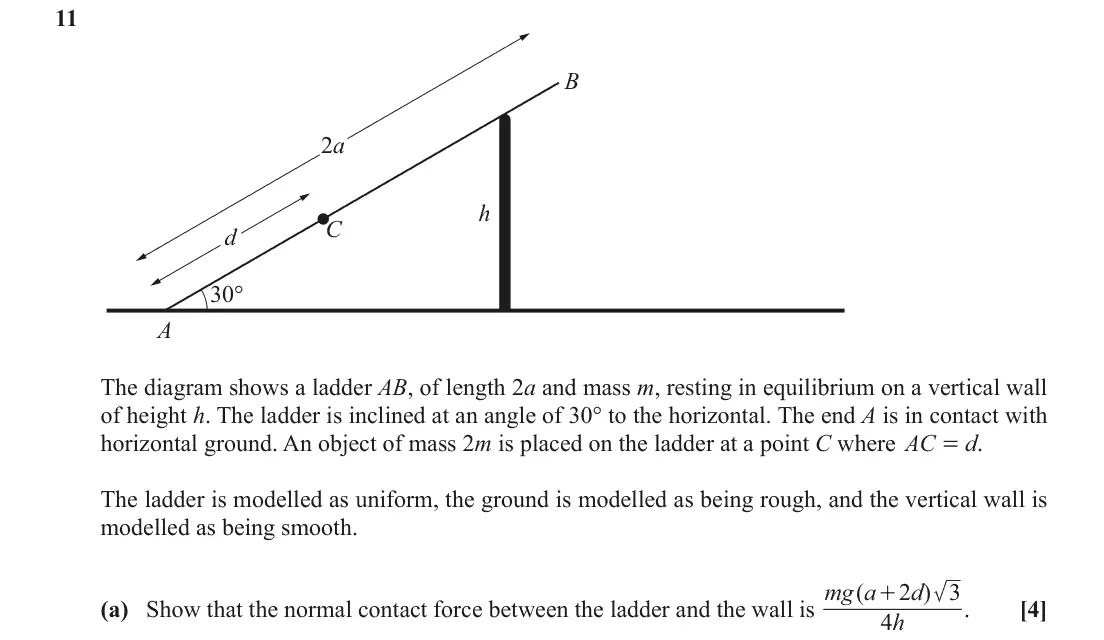
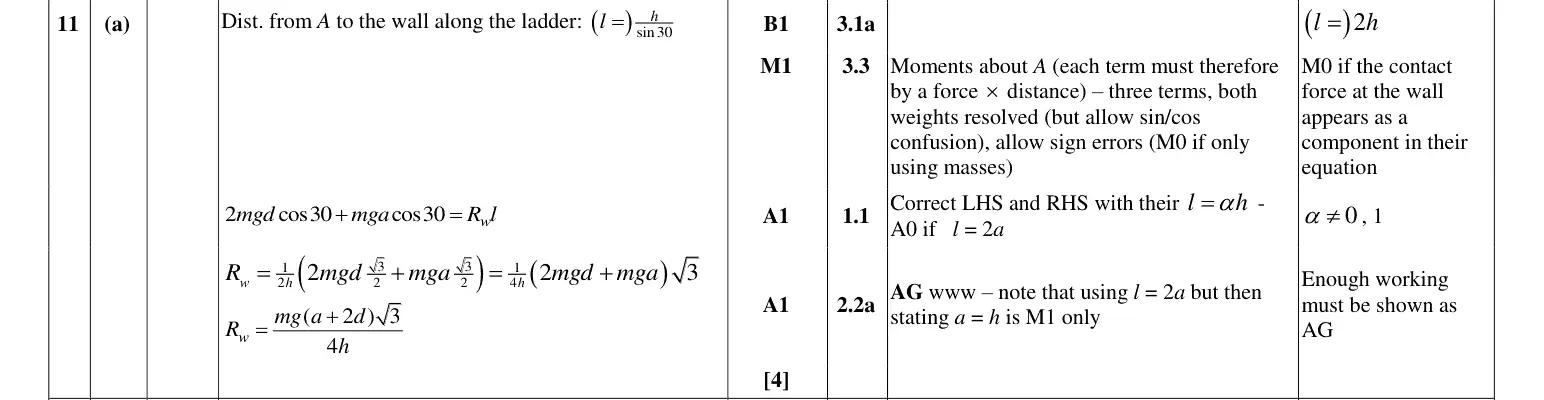
While many candidates correctly derived the given answer for the normal contact force between the ladder and the wall it was clear that many candidates were unclear how to proceed and many were hampered by assuming that this normal contact force was acting either horizontally or vertically at the wall instead of acting perpendicular to the ladder. It was evident to examiners that while many candidates did attempt to take moments about A and some correctly achieved the clockwise moment of 2 m d g cos30 + m a g cos30 (for the two weights) many fudged the anticlockwise moment with very few h convincingly realising that this anticlockwise moment was given by the expression R . sin30 This response scored no marks. The diagram, together with the fact that in their moments equation they have a component of the normal contact force at the wall, indicates that their normal contact force is not pointing in the correct direction for this problem. The fact that the candidates obtains the ‘correct’ answer does not change the fact this response scored no marks as in the penultimate line of working the denominator is clearly equivalent to 2a but conveniently appears as the correct 4h in the final line.
Key points and common errors
distance from A to wall contact = h/sin30° = 2h
moments about A: 2mgd cos30° + mga cos30° = R × 2h
wall reaction is perpendicular to the ladder, not horizontal
June 2019 · Paper 3 · Q11(c)2 marksHard
Show the start of this question
Mark scheme for this part
Examiner's comment
Only the most able candidates realised that h could not exceed 2 30 and therefore the greatest asin possible value of d was 13 22 a.
Key points and common errors
h cannot exceed 2a sin30° = a: (11/24)(a + 2d) ≤ a gives d ≤ 13a/22
June 2019 · Paper 3 · Q11(d)1 markMedium
Show the start of this question
Mark scheme for this part
Examiner's comment
Although many candidates gave a correct improvement (e.g. model the ladder as non-uniform, include a frictional component for the contact of the ladder with the wall) many either believed that the model could be improved by modelling the ground as smooth or using a more accurate value of g. Also, some candidates did not read this part carefully and instead gave a limitation of the model (e.g. the wall is unlikely to be smooth) and not an improvement.
Key points and common errors
non-uniform ladder, friction at the wall, size of the object, ladder thickness or bending
smooth ground or better g gains nothing
a limitation is not an improvement
June 2018 · Paper 3 · Q9(ii)3 marksEasy
Show the start of this question
Mark scheme for this part
Examiner's comment
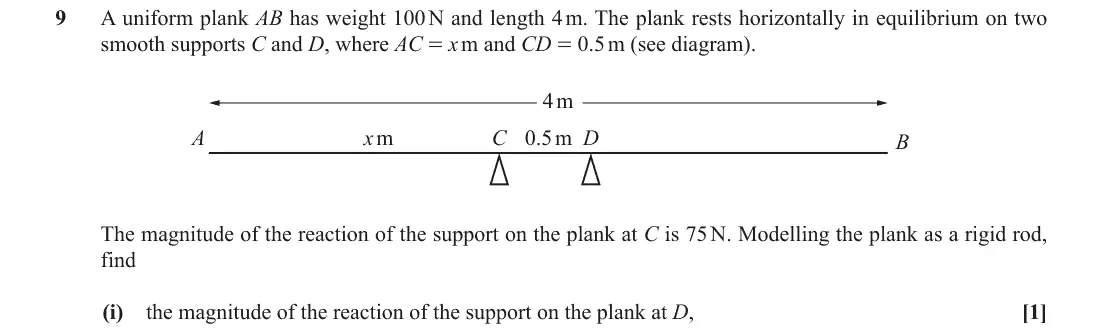
The most common point on the plank to take moment about in this part was A and most who did so were successful in finding x. Of those that considered moments about a different point, while some were successful, too often examiners noted that candidates did not include all the required terms.
Key points and common errors
moments about A: 2(100) = 75x + (x + 0.5)(25)
x = 1.875
all terms needed when taking moments about other points
June 2018 · Paper 3 · Q9(iii)3 marksHard
Show the start of this question
Mark scheme for this part
Examiner's comment
Many candidates struggled with this part and did not realise that if the plank was about to tilt about D then this was the point to take moments about as the reaction at C is therefore zero in this limiting case. Candidates are strongly advised when taking moments to make it clear to the examiners which point (in this case on the plank) they are taking moments about. A number of candidates attempted to take moments about another point together with resolve forces vertically; these attempts were usually unsuccessful. Key:
Key points and common errors
on the point of tilting about D the reaction at C is zero
(Comment on Question 09(iv) as a whole) It was pleasing that candidates were well prepared for this type of question with many correctly stating that the modelling the stone as a particle assumes that the weight of the block acts exactly at B and therefore the block’s dimensions (or the distribution of the mass of the block) has not been taken into account. A number of candidates incorrectly stated that modelling the block as a particle implied that the block had negligible mass. This part was also answered extremely well, with many correctly stating that modelling the block as a rigid rod assumes that the plank remains in a straight line and does not bend. A number of candidates, however, assumed that friction and/or air resistance had some relevance to this part.
Key points and common errors
the weight is assumed to act exactly at B
the block's dimensions and mass distribution are ignored
June 2018 · Paper 3 · Q9(iv)(b)1 markMedium
Show the start of this question
Mark scheme for this part
Examiner's comment
(Comment on Question 09(iv) as a whole) It was pleasing that candidates were well prepared for this type of question with many correctly stating that the modelling the stone as a particle assumes that the weight of the block acts exactly at B and therefore the block’s dimensions (or the distribution of the mass of the block) has not been taken into account. A number of candidates incorrectly stated that modelling the block as a particle implied that the block had negligible mass. This part was also answered extremely well, with many correctly stating that modelling the block as a rigid rod assumes that the plank remains in a straight line and does not bend. A number of candidates, however, assumed that friction and/or air resistance had some relevance to this part.
Key points and common errors
assumes the plank stays straight and does not bend
Find an A-level maths tutor
Stuck on this? Book a trial session with an A-level maths tutor.