2.01c Sampling techniques, including simple random sampling and…

Section
2.01 Statistical Sampling
Level
AS & A level
Statement
Understand and be able to use sampling techniques, including simple random sampling and opportunity sampling.
Guidance
When considering random samples, learners may assume that the population is large enough to sample without replacement unless told otherwise.
Since 2018
7 parts, 9 marks · topic pages: Sampling, Probability, including conditional probability

Back to the checklist

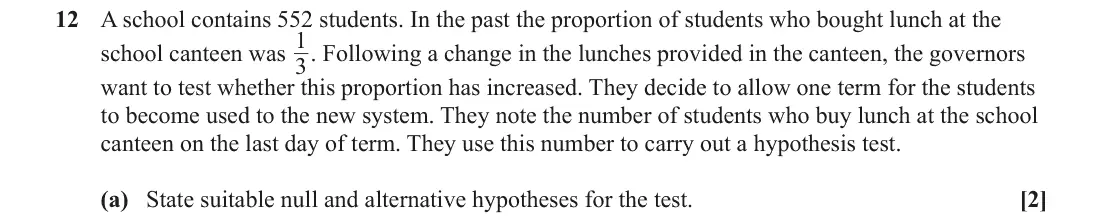
June 2025 · AS Paper 1 · Q12(c) 1 mark Easy
Show the start of this questionEarlier part of this question
(c) Suggest one reason why the conclusion of the test may not be reliable. [1]
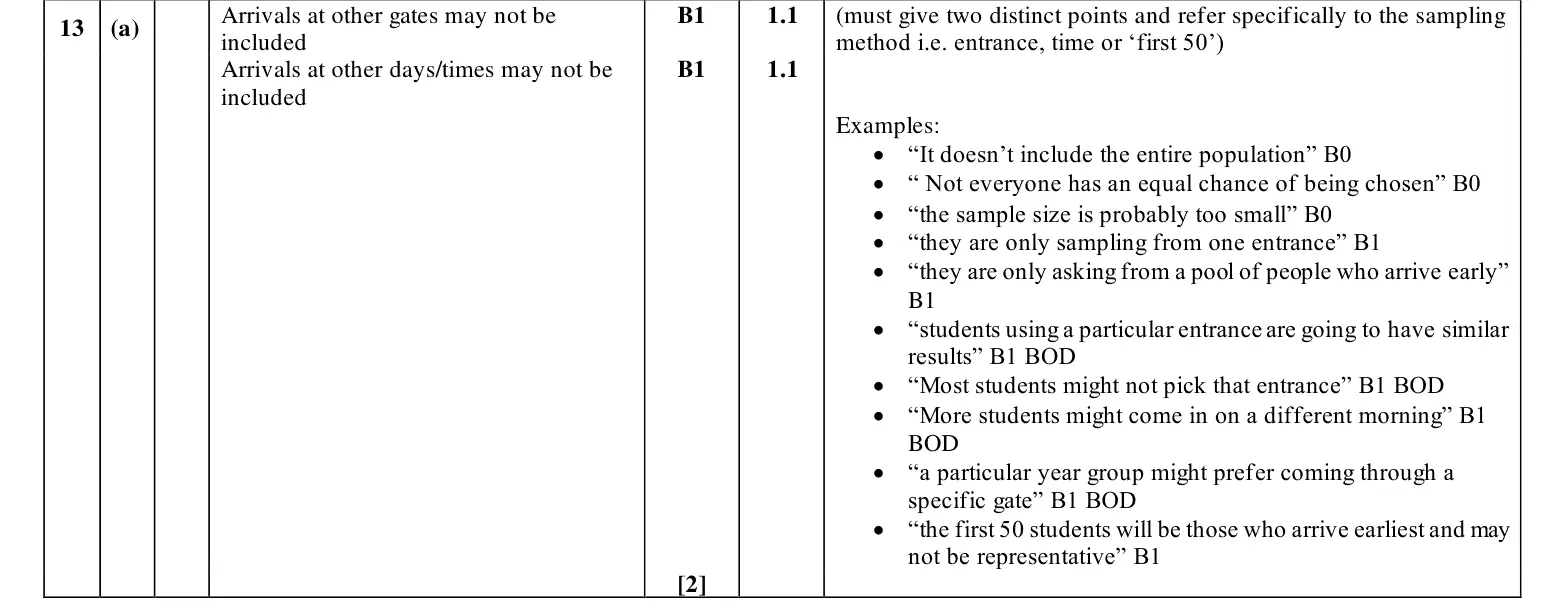
June 2024 · AS Paper 1 · Q13(a) 2 marks Easy
13 Some students at a large school are doing a survey about attitudes to school uniform. They want to give a questionnaire to a random sample of 50 students at their school. The school has three entrances. Gabi suggests giving the questionnaire to the first 50 students who arrive at a particular entrance on a randomly chosen morning. (a) Give two reasons why this method of sampling will not produce a random sample. [2]
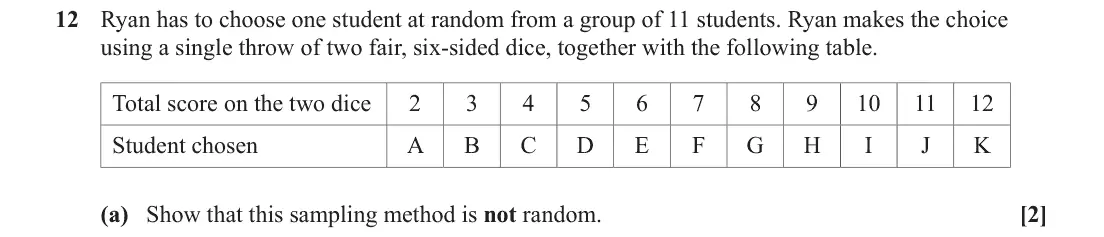
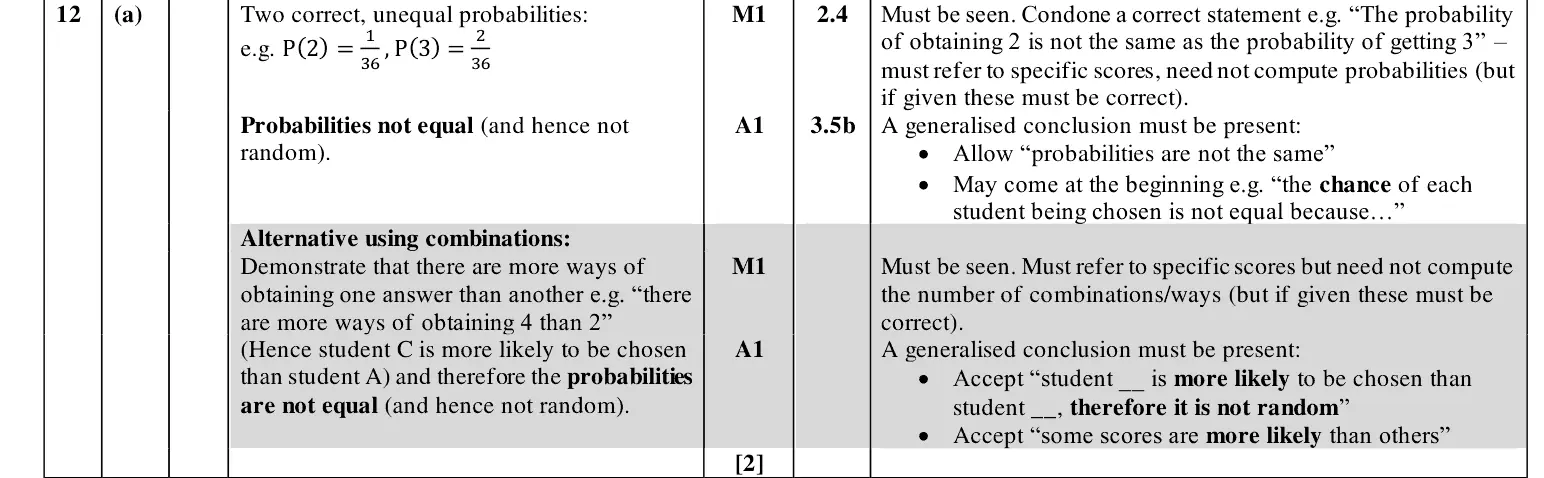
June 2024 · Paper 2 · Q12(a) 2 marks Hard
12 Ryan has to choose one student at random from a group of 11 students. Ryan makes the choice using a single throw of two fair, six-sided dice, together with the following table. Total score on the two dice Student chosen A B C D E F G H I J K (a) Show that this sampling method is not random. [2]
Autumn 2021 · AS Paper 1 · Q10(c)(i) 1 mark Medium
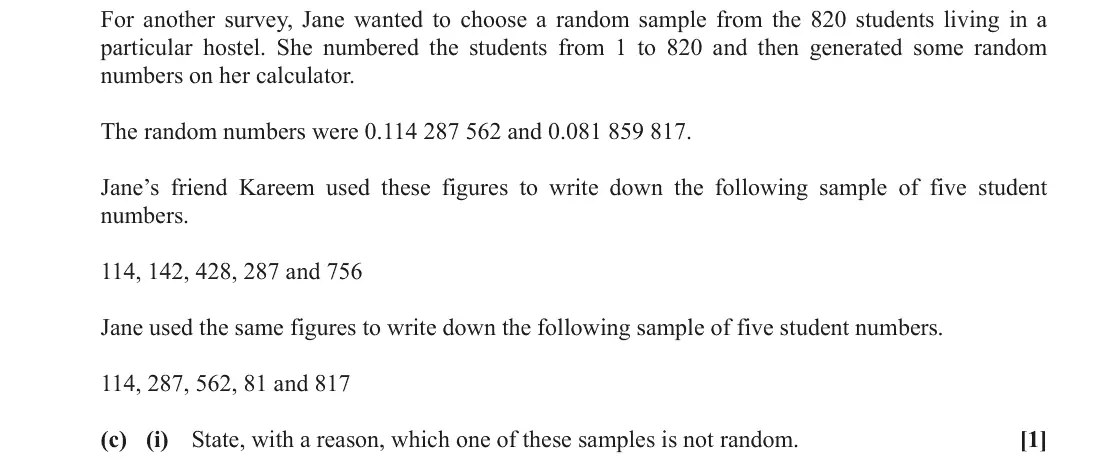
For another survey, Jane wanted to choose a random sample from the 820 students living in a particular hostel. She numbered the students from 1 to 820 and then generated some random numbers on her calculator. The random numbers were 0.114 287 562 and 0.081 859 817. Jane’s friend Kareem used these figures to write down the following sample of five student numbers. 114, 142, 428, 287 and 756 Jane used the same figures to write down the following sample of five student numbers. 114, 287, 562, 81 and 817 (c) (i) State, with a reason, which one of these samples is not random. [1]
Autumn 2021 · AS Paper 1 · Q10(c)(ii) 1 mark Medium
Show the start of this questionEarlier part of this question
(ii) Explain why Jane omitted the number 859 from her sample. [1]
June 2018 · Paper 2 · Q10(i) 1 mark Easy
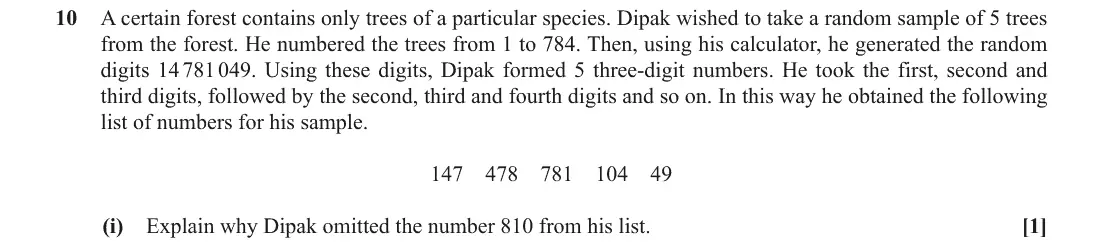
10 A certain forest contains only trees of a particular species. Dipak wished to take a random sample of 5 trees from the forest. He numbered the trees from 1 to 784. Then, using his calculator, he generated the random digits 14 781 049. Using these digits, Dipak formed 5 three-digit numbers. He took the first, second and third digits, followed by the second, third and fourth digits and so on. In this way he obtained the following list of numbers for his sample. 147 478 781 104 49 (i) Explain why Dipak omitted the number 810 from his list. [1]
June 2018 · Paper 2 · Q10(ii) 1 mark Hard
Show the start of this questionEarlier part of this question
(ii) Explain why Dipak’s sample is not random. [1]

Find an A-level maths tutor

Stuck on this? Book a trial session with an A-level maths tutor.

Prefer email? Send an enquiry

If you are under 18, please include a parent's contact details. Enquiries go to enquiries@mathsaleveltutor.com and are deleted once handled.