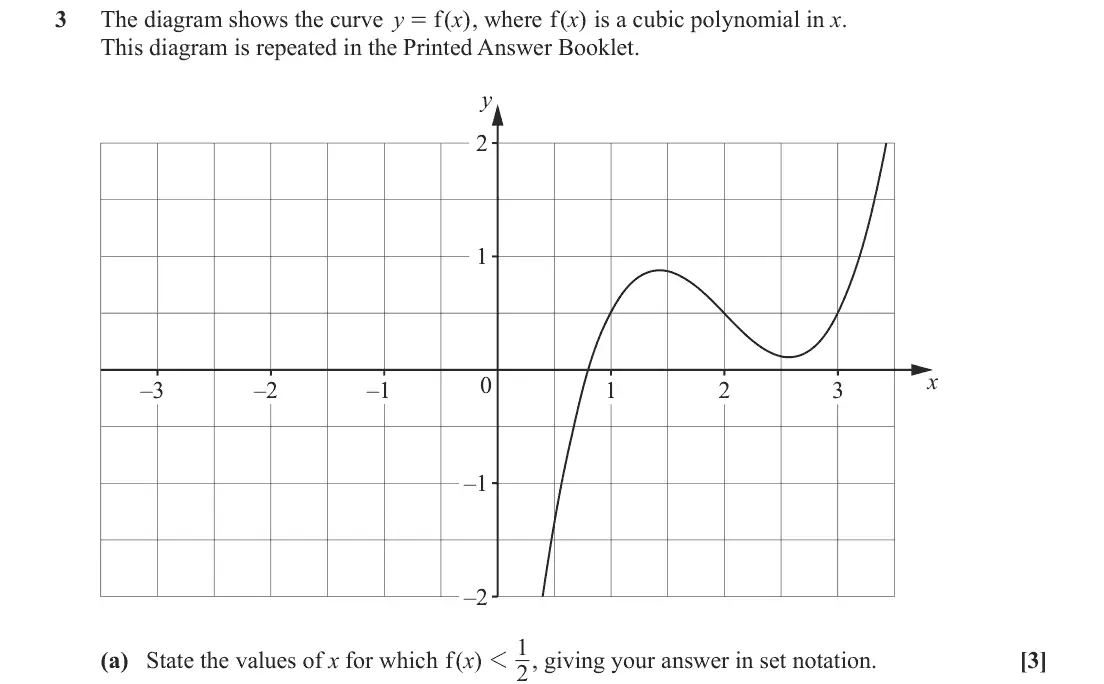
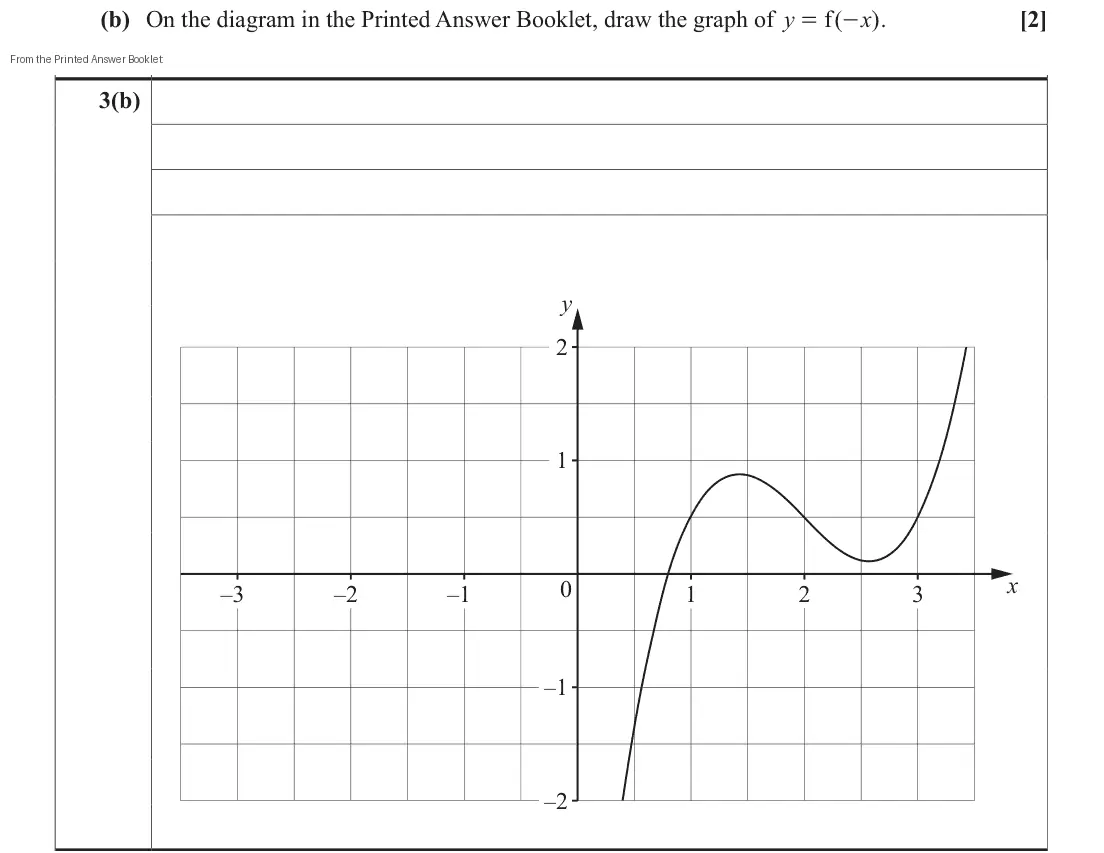
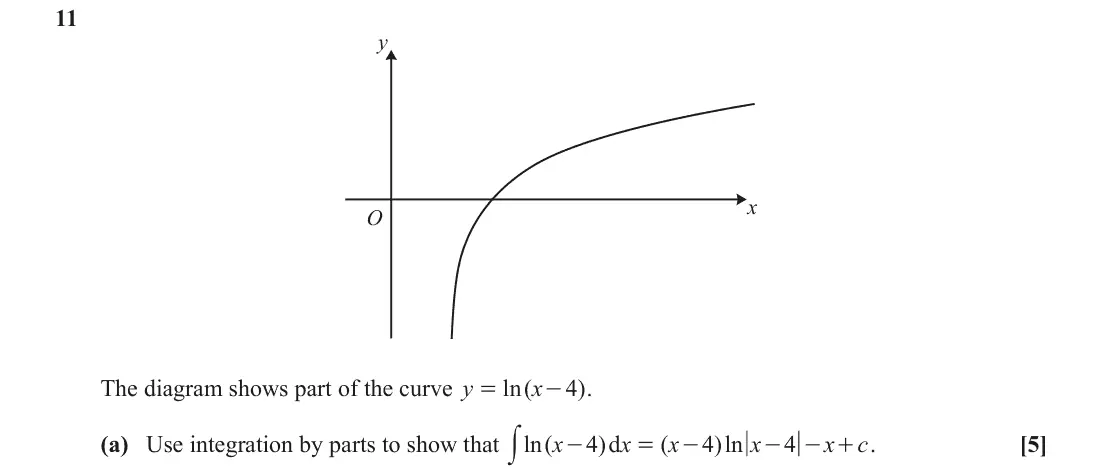
1.02w The effect of simple transformations on the graph of y = f(x)…
Section
1.02 Algebra and Functions
Level
AS & A level
Statement
Understand the effect of simple transformations on the graph of y = f(x) including sketching associated graphs, describing transformations and finding relevant equations: y = af(x), y = f(x) + a, y = f(x + a) and y = f(ax), for any real a.
Guidance
Only single transformations will be requested. Translations may be specified by a two-dimensional column vector.
The correct response appeared quite often and fewer candidates seemed to omit ‘y =’ this series. Note that in this instance, credit was not given for only ‘f(x) = ‘, as the question requested an equation of a curve. Some incorrect offerings : 3lnx , ln(x – 3), ⅓lnx, ln(-3x).
Key points and common errors
y = ln(x/3) (or ln x − ln 3)
must be an equation
ln 3x, ln(x − 3), 3 ln x are common errors
June 2025 · AS Paper 2 · Q6(b)4 marksMedium
Mark scheme for this part
Examiner's comment
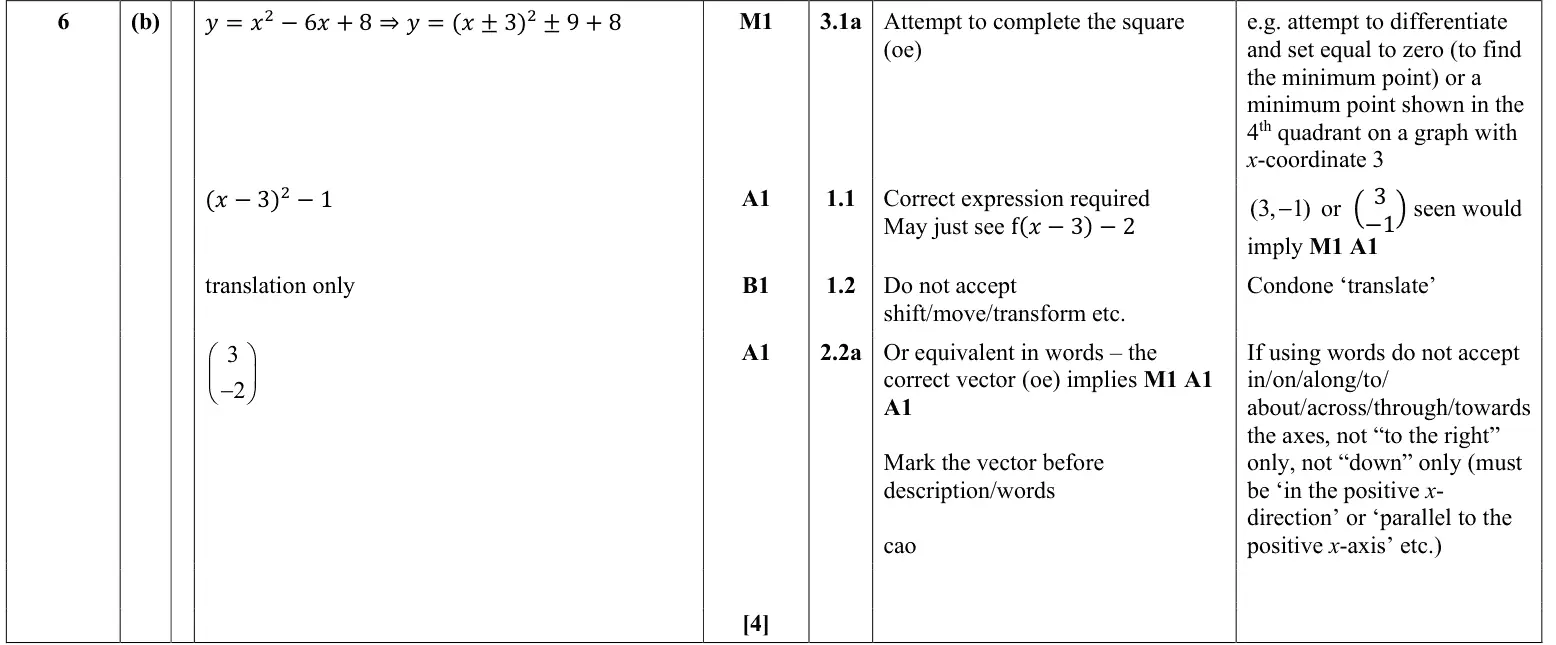
Perhaps completing the square was the most common route, but considering how the minima transformed was also prevalent. Move, shift and transform rather than translate still appear as explanations of the transformation but it was pleasing to see a vector being used regularly to describe the translation. Some gave a y component of – 1 rather than – 2 and occasionally the transformation of y = x2 - 6x + 8 to the curve y = x2 + 1 was given. Candidates should be encouraged to show how they reach their conclusions in transformation questions as some responses did not have much supporting evidence. In these instances, if the final answer is incorrect, it can difficult for examiners to follow the working in order to give credit. Many of those who struggled with this question used -6x + 7 somehow to explain the transformation.
Key points and common errors
x² − 6x + 8 = (x − 3)² − 1
translation by the vector (3, −2)
'translation' must be used, not shift or move
y-component −1 is wrong
June 2025 · Paper 3 · Q2(a)2 marksEasy
Mark scheme for this part
Examiner's comment
This part was answered extremely well with many correct answers seen. The most common errors included 𝑦= (𝑥+4)3, 𝑦= 𝑥3 ± 4 . The question has explicitly asked for ‘the equation’ so simply stating the expression (𝑥−4)3 only gained the method mark.
Key points and common errors
y = 1/(x − 4)³
must be an equation
(x + 4)³ and x³ ± 4 are common errors
June 2025 · Paper 3 · Q2(b)2 marksEasy
Mark scheme for this part
Examiner's comment
Like part (a) this was answered extremely well with many candidates giving the correct answer of (3, 180). While most candidates correctly realised that the x-coordinate was invariant, many struggled to correctly state the corresponding y-coordinate. The question asked for coordinates, but examiners could award the marks if candidates made it explicitly clear what values of x and y were being declaring in this part.
Key points and common errors
x-coordinate invariant
y = 4 × 5 × 3² = 180
P = (3, 180)
June 2024 · AS Paper 2 · Q4(a)2 marksMedium
Mark scheme for this part
Examiner's comment
Clear thinking was needed here. Examiners saw a fair number of correct answers, however responses 1 such as y = √1 4 √2x - 1, y = √8x - 4 and y = √1 4 x - 1, y = 4√2x - 1, y = 2 x - 4 were also offered. An equation was requested, so ‘y =’ was expected.
Key points and common errors
replace x with 4x: y = √(8x − 1)
'y =' required
June 2024 · AS Paper 2 · Q4(b)2 marksMedium
Mark scheme for this part
Examiner's comment
Rather than just dealing with the point where x = 5 and translating it, many candidates got into difficulty because they tried to find the equation of the curve after the translation and obtained an incorrect equation. It was common for y = √2(x + 4) - 1 to appear and lead to (5, √17) as the answer.
Key points and common errors
point at x = 5 is (5, 3)
translate by (−4, 0) to (1, 3)
finding the new equation first led to errors
June 2023 · AS Paper 2 · Q5(a)2 marksMedium
Mark scheme for this part
Examiner's comment
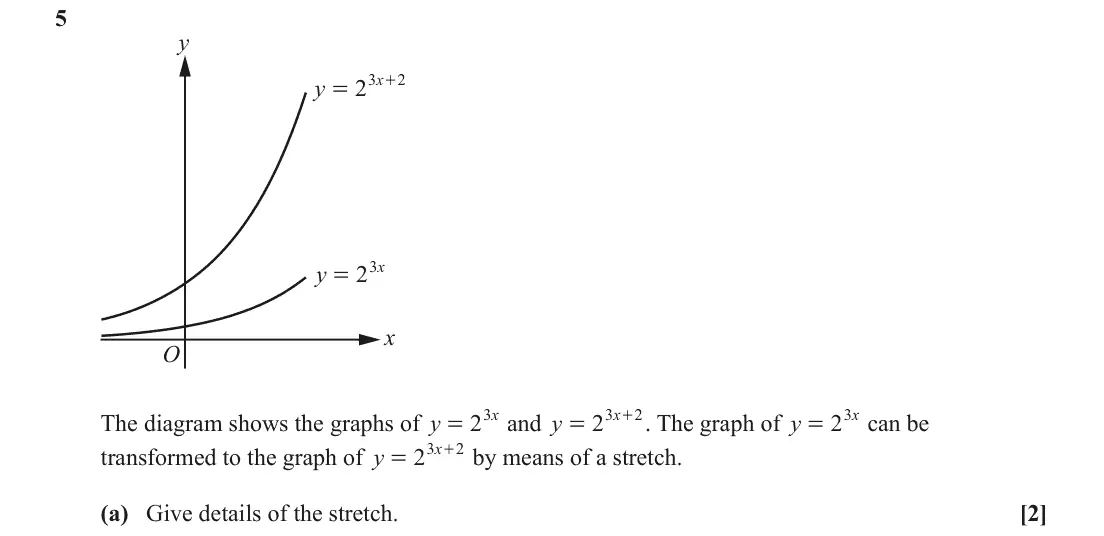
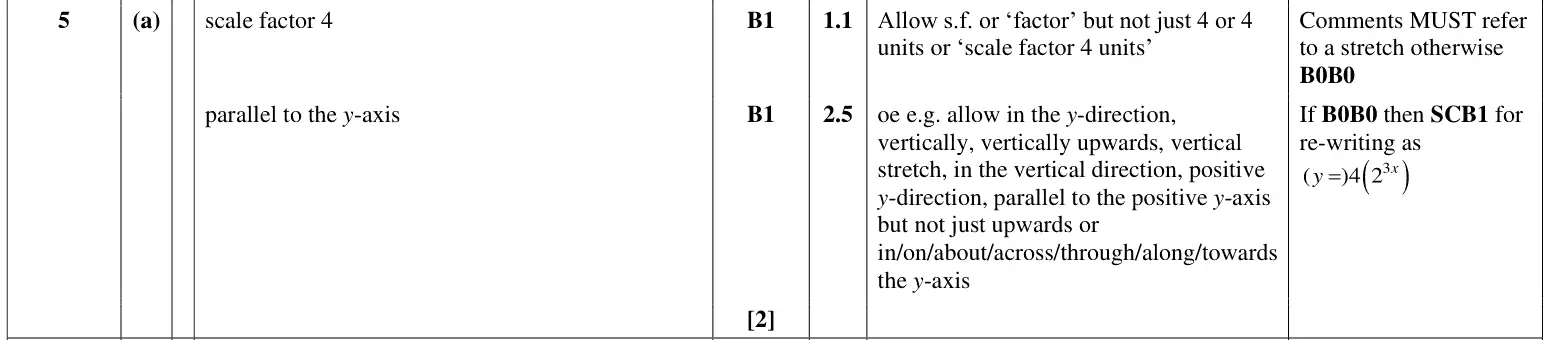
The mark scheme gives comprehensive detail about the wording that was accepted and this is well 1 worth studying carefully. Giving the scale factor as 2 or 2 was fairly common, as was ‘in the y-axis’.
Key points and common errors
2^(3x + 2) = 4 × 2^(3x): stretch scale factor 4 parallel to the y-axis
s.f. 2 or ½ and 'in the y-axis' are common errors
June 2023 · Paper 3 · Q3(b)4 marksMedium
Show the start of this question
Mark scheme for this part
Examiner's comment
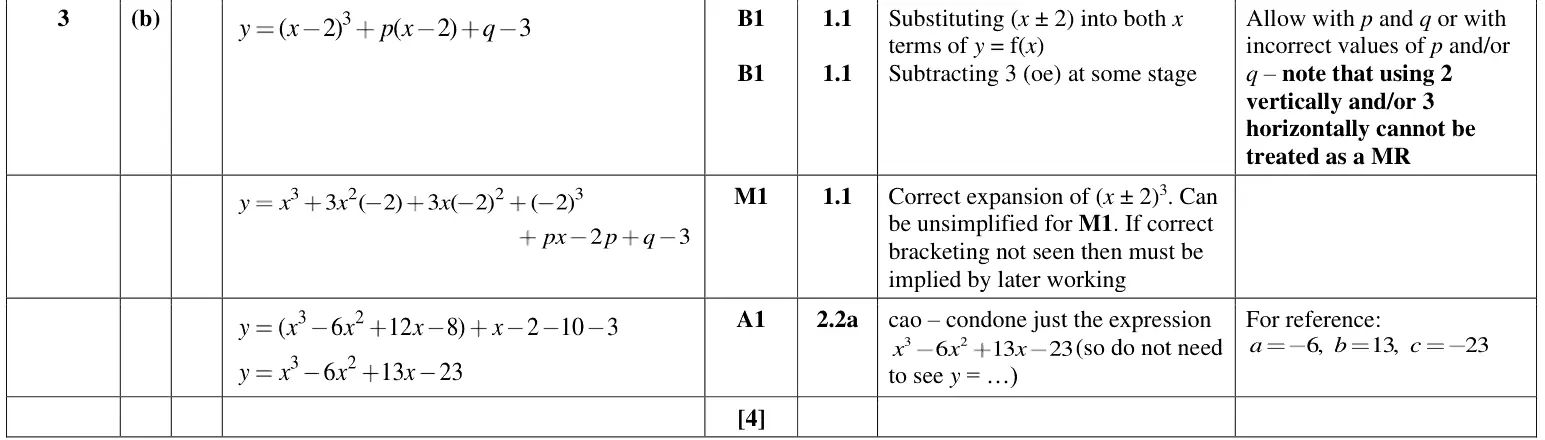
equation 𝑦𝑦= (𝑥𝑥−2)3 + 𝑝𝑝(𝑥𝑥−2) + 𝑞𝑞−3 some candidates incorrectly added the 3, or considered the Although most candidates realised that the given translation meant that the new curve would have the horizontal translation as (𝑥𝑥+ 2). Some then struggled to expand (𝑥𝑥−2)3 correctly or did not give their final answer as an equation of ‘𝑦𝑦= ⋯’ (and simply left their answer as 𝑥𝑥3 −6𝑥𝑥2 + 13𝑥𝑥−23).
1 y = − − 2 There were some good efforts at this part, but inevitably (x – 2) appeared in answers. was 2 x seen also. We expected to see ‘y =’ in the final answer. Candidates should be encouraged to give their 1 0.5 final answer in a more pleasing form y = − rather than as y = − . Some did not answer 2( x + 2) ( x + 2) the question here and worked with the gradient function rather than the curve C.
Key points and common errors
replace x by x + 2: y = −1/(2(x + 2))
error (x − 2)
some transformed the gradient function instead of C
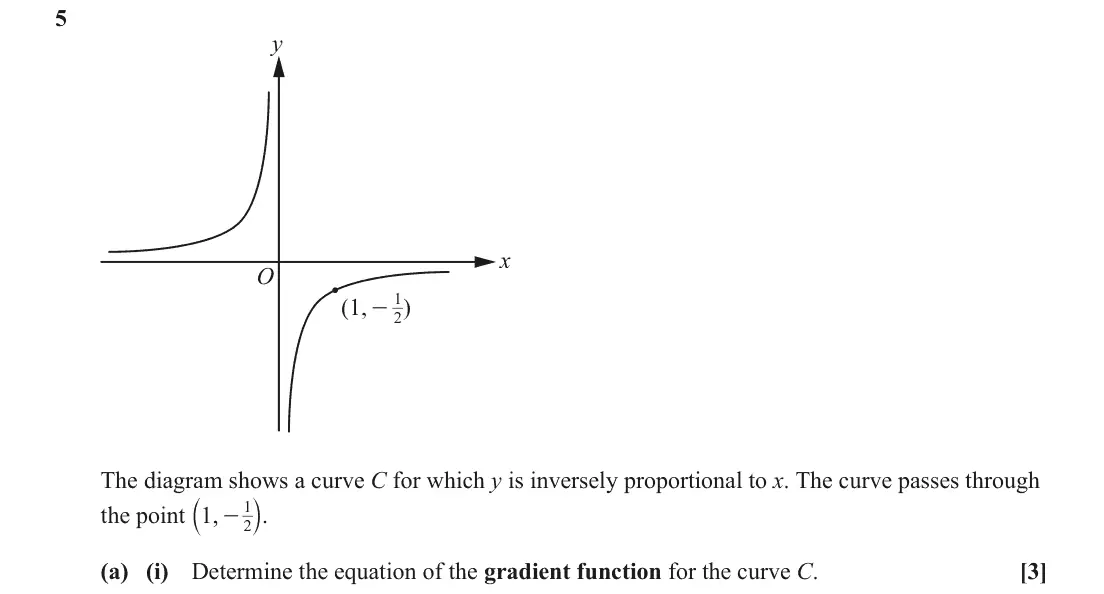
June 2022 · Paper 1 · Q5(a)(i)2 marksMedium
Mark scheme for this part
Examiner's comment
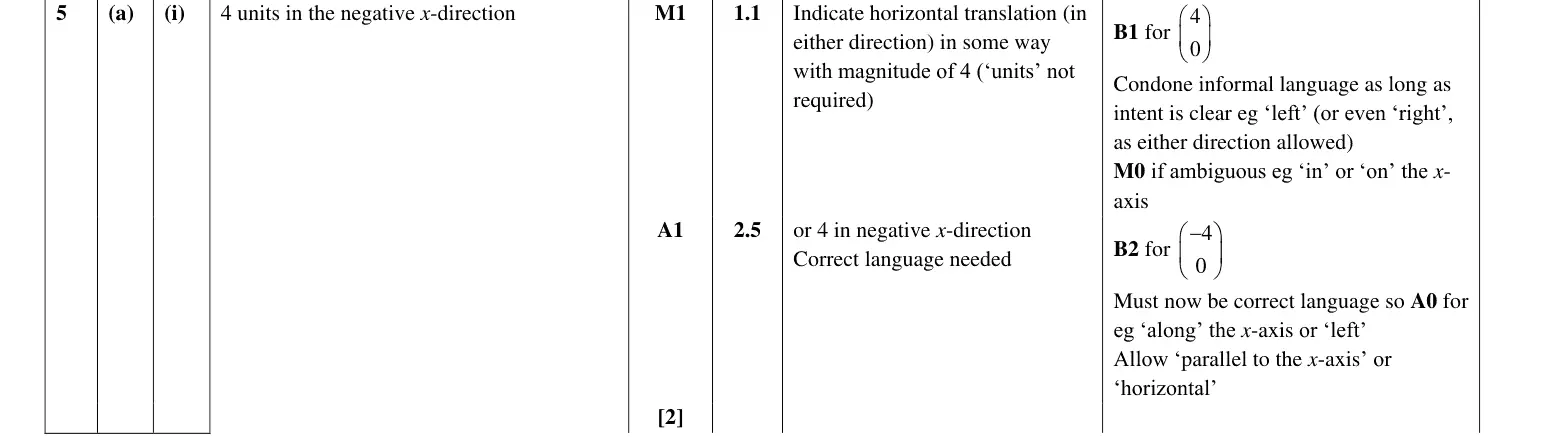
Most candidates could identify that a horizontal translation of 4 units was required, and also that it would be in the negative x-direction. To gain full credit, mathematically correct language was required but ambiguous statements such as ‘in’ the x-axis or informal ones such as ‘along’ the axis were all too common. The most successful approach was to state the correct column vector, thus avoiding the need for any additional description.
Key points and common errors
translation 4 units in the negative x-direction, or vector (−4, 0)
'along' or 'in' the x-axis is not acceptable
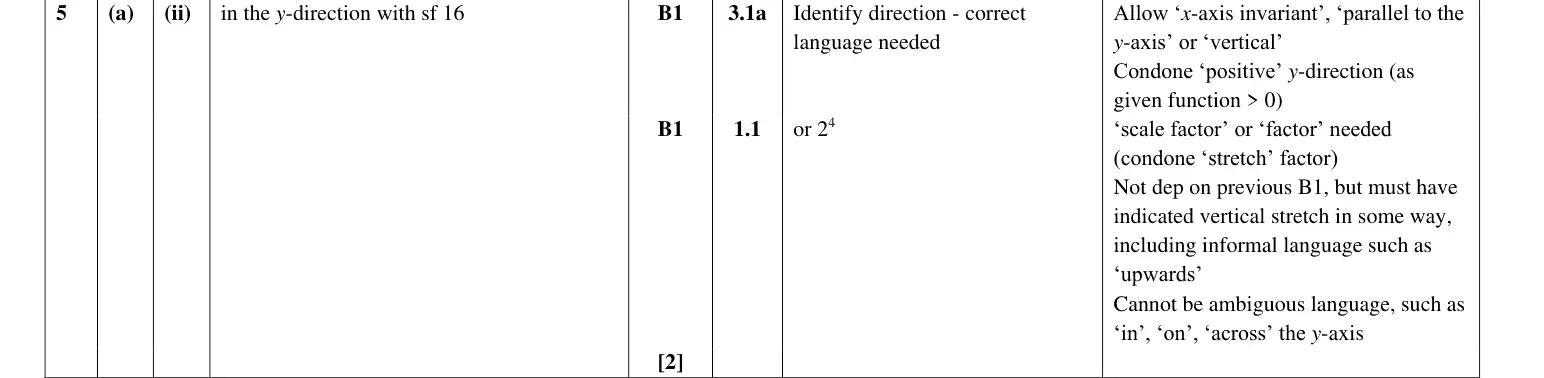
June 2022 · Paper 1 · Q5(a)(ii)2 marksHard
Mark scheme for this part
Examiner's comment
This part proved to be more challenging, with around half of the candidates being able to identify both the correct direction and the correct scale factor. Once again, incorrect language was all too common.
Key points and common errors
2^(x+4) = 16 × 2ˣ: stretch parallel to the y-axis, scale factor 16
correct language needed
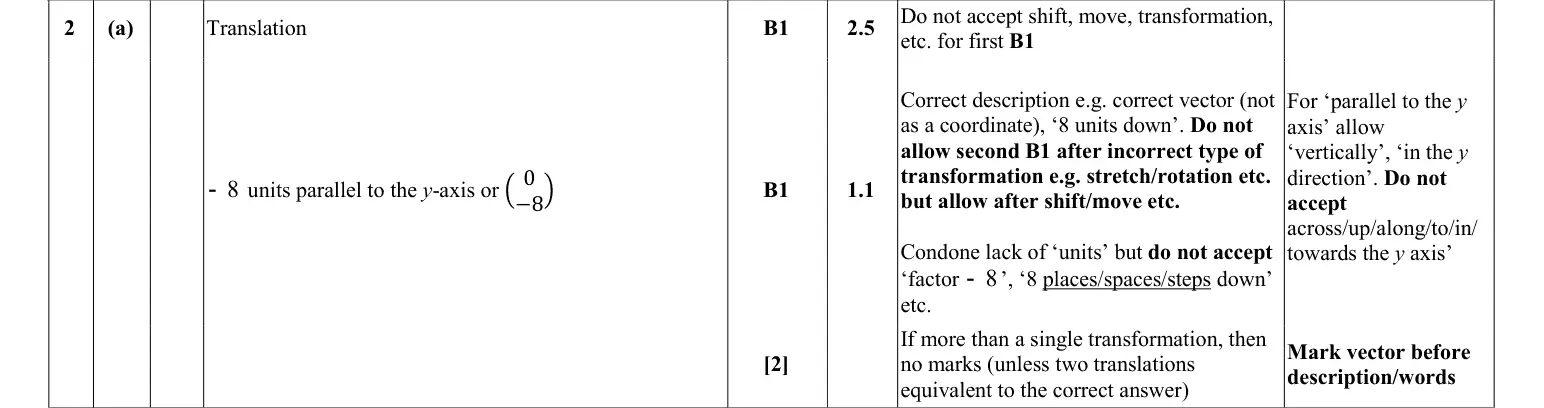
June 2022 · Paper 3 · Q2(a)2 marksMedium
Mark scheme for this part
Examiner's comment
While it was clear that most candidates appreciated that the transformation required was a translation, the mathematical precision of language could have been better.
v = 0 gives C = k ≠ 0 but a car at 0 mph covers no miles
Autumn 2021 · AS Paper 1 · Q5(d)2 marksMedium
Show the start of this question
Mark scheme for this part
Key points and common errors
multiply Jamal's formula by k with k > 1 (increase both constants by the same factor)
'increase both constants' alone scores 1
Autumn 2021 · Paper 1 · Q5(a)(i)1 markMedium
Mark scheme for this part
Key points and common errors
(2, 9)
Autumn 2021 · Paper 3 · Q7(c)2 marksMedium
Show the start of this question
Mark scheme for this part
Key points and common errors
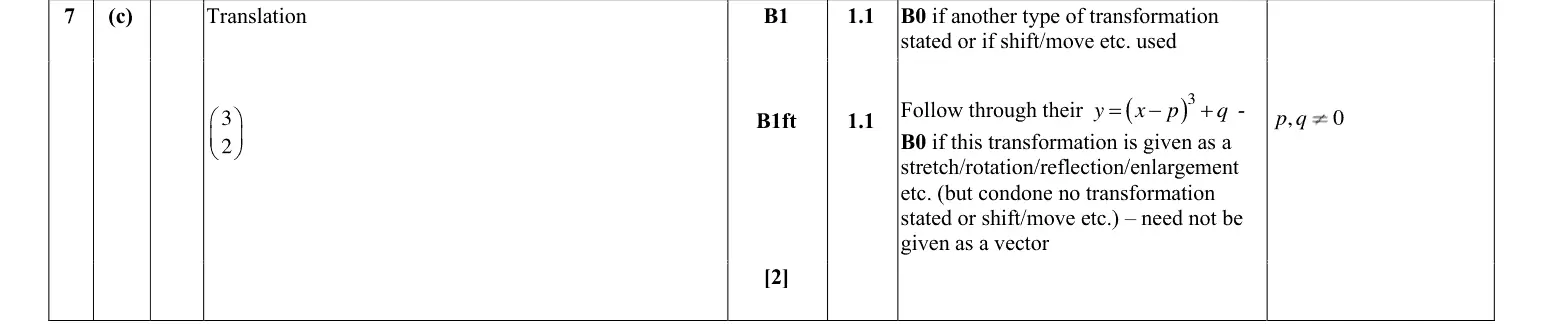
translation by vector (3, 2)
words such as shift or move get B0
Autumn 2020 · AS Paper 2 · Q5(a)2 marksMedium
Mark scheme for this part
Examiner's comment
(Comment on Question 05 as a whole) Part (b) - The translation was not well done or just ignored.
Key points and common errors
vertex of a(x + b)² + c is (−b, c): b = 3, c = 2
Autumn 2020 · AS Paper 2 · Q5(b)3 marksHard
Show the start of this question
Mark scheme for this part
Examiner's comment
(Comment on Question 05 as a whole) Part (b) - The translation was not well done or just ignored.
Key points and common errors
translated curve y = a(x + b − 4)² + c
substitute (3, −18): a = −5
translation often ignored or applied wrongly
June 2019 · AS Paper 1 · Q4(b)2 marksHard
Show the start of this question
Mark scheme for this part
Examiner's comment
Most candidates did not recognise that this question is actually about translating a curve in the y- direction. Some recognised that the key point is the position of the curve, but only gave the response k > 0. Others took the hint from the instruction "Using you answers from part (a)...." and substituted x = 1 and x = 3 into either x3 – 6x2 + 9x or x3 – 6x2 + 9x + k. This can lead to a correct method, but very few candidates used the results correctly. Some just gave k = 0 and k = –4. Others gave –4 < k < 0. A few gave the correct response but attempted to combine the two inequalities into one, giving –4 > k > 0. Some candidates tried to use a "discriminant" obtained somehow from the cubic equation.
Key points and common errors
translating the cubic by k
exactly one root when k > 0 or k < −4
−4 < k < 0 or k = 0, −4 are wrong
June 2019 · AS Paper 2 · Q3(b)2 marksHard
Show the start of this question
Mark scheme for this part
Examiner's comment
This part often went wrong. We expected to see the equation ‘ y = ’, not just ‘ ( ) f x − 2 = ’, and we expected the minus sign to be present for the method mark. 1 Many solutions involved . − ( ) x − 2
Key points and common errors
replace x by x − 2: y = −1/(x − 2)²
'y =' and the minus sign needed
1/(x − 2)² is wrong
June 2019 · AS Paper 2 · Q3(c)2 marksMedium
Show the start of this question
Mark scheme for this part
Examiner's comment
Reasonably well answered. The most common error was for candidates to state the coordinates 1 4 , − 2 .
Key points and common errors
stretch parallel to y-axis sf ½ halves the y-coordinate: P = (½, −2)
common error (½, −4) with x changed
June 2019 · Paper 1 · Q11(b)1 markEasy
Show the start of this question
Mark scheme for this part
Examiner's comment
This question was generally very well answered, with most candidates able to state the correct equation.
Key points and common errors
x = 4, must be an equation
June 2018 · AS Paper 2 · Q2(i)2 marksEasy
Mark scheme for this part
Examiner's comment
This was well done. 2/(3 + x +4) was seen, and the less satisfactory 2/(3 + x) + 4 also. We wanted the answer to be tidied up and ‘y =’ was expected.
Key points and common errors
replace x by x − 4: y = 2/(x − 1)
2/(3 + x) + 4 is wrong
'y =' required
June 2018 · AS Paper 2 · Q2(ii)2 marksMedium
Mark scheme for this part
Examiner's comment
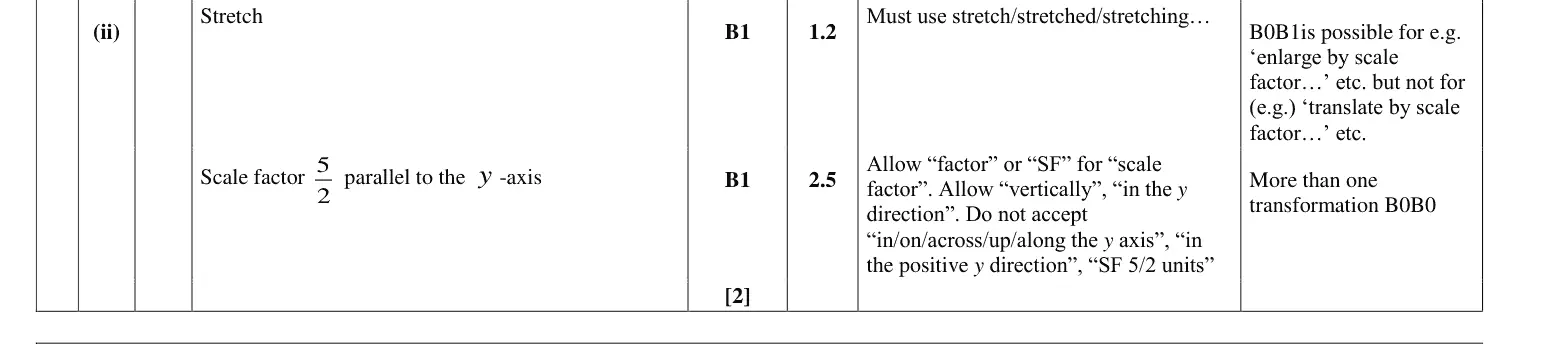
Many candidates realised this was a stretch, but did not necessarily describe it well. We wanted to see scale factor 5/2 and an accurate description of the direction. y- stretch was not considered acceptable. A small minority misunderstood the concept and gave a translation of 3 units as their response.
Key points and common errors
stretch, scale factor 5/2, parallel to the y-axis
'y-stretch' or 'along the y-axis' not accepted
a translation is wrong
June 2018 · Paper 1 · Q6(iv)2 marksEasy
Show the start of this question
Mark scheme for this part
Examiner's comment
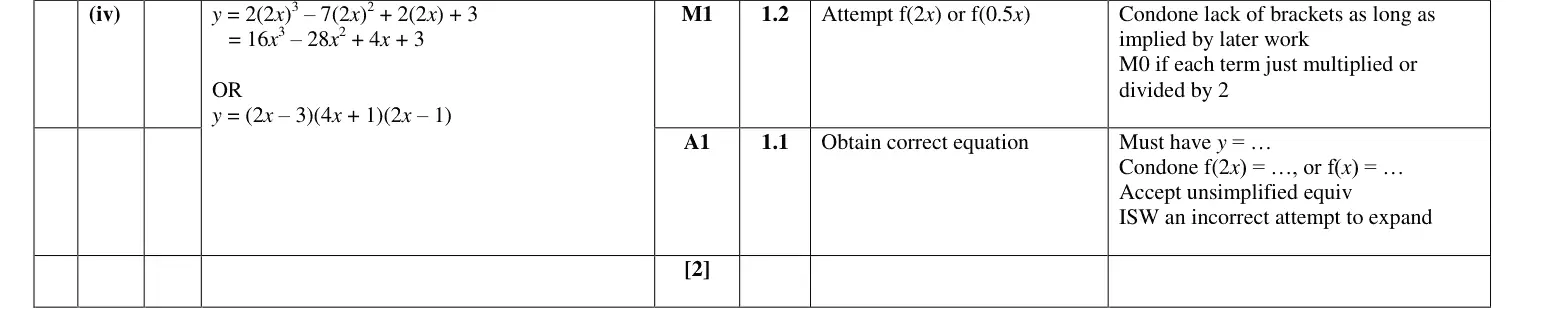
Most candidates were able to replace x with 2x to obtain a correct equation although a few gave it as an expression, omitting the ‘y =’ at the start. The best solutions made effective use of brackets to show x being replaced with 2x, and then expanded them. Other candidates simply wrote down an equation; if this was wrong then there was no evidence to justify that they had been attempting the correct method, but with an error on substitution, as opposed to attempting to double each term.
Key points and common errors
replace x by 2x: y = 16x³ − 28x² + 4x + 3
must include 'y ='
not halving each term
June 2018 · Paper 2 · Q77 marksMedium
Mark scheme for this part
Examiner's comment
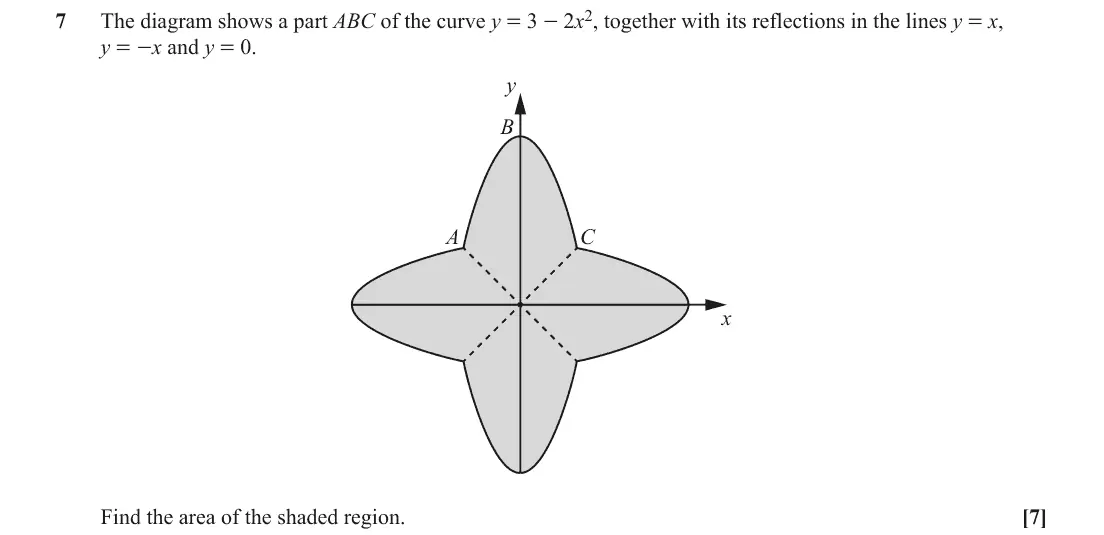
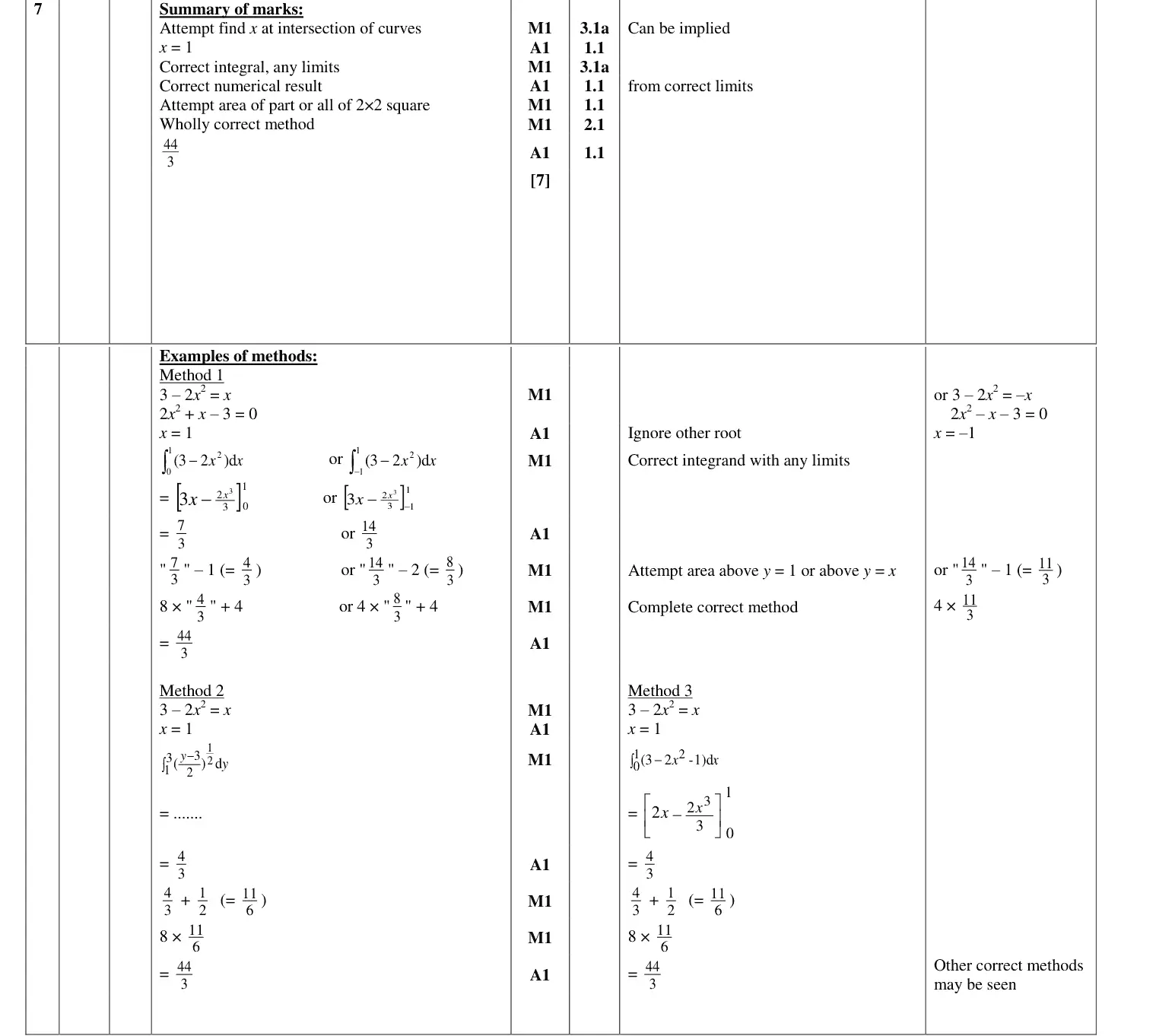
A large variety of correct methods were seen. Some were unnecessarily long. Examples of correct, although long, methods were these: 1. Find the inverse function in order to find the equation of the reflection of the given curve in y = x. Then solve this with the given function in order to find the point of intersection, C. xd . y 2. Rearrange the given function to make x the subject and then find ∫ Some candidates found the points where the given curve cuts the x-axis and hence integrated with incorrect limits. Many made mistakes in trying either to add or subtract all or part of the area of the middle square. 1 2 4 × ( 3 − 2 x − )1 d x + 4 ∫ Perhaps the neatest method was − 1 .
Key points and common errors
intersection 3 − 2x² = x gives x = 1
∫₀¹(3 − 2x² − 1)dx = 4/3
use symmetry: 8 × 11/6 = 44/3
wrong limits from the x-axis roots
errors adding or subtracting the central square
Find an A-level maths tutor
Stuck on this? Book a trial session with an A-level maths tutor.